

- Market Size (2026)
- USD 1.2 Bn
- Forecast (2036)
- USD 1.9 Bn
- CAGR (2026 to 2036)
- 4.6%
How big is Psychobiotic Supplements Market in 2026?
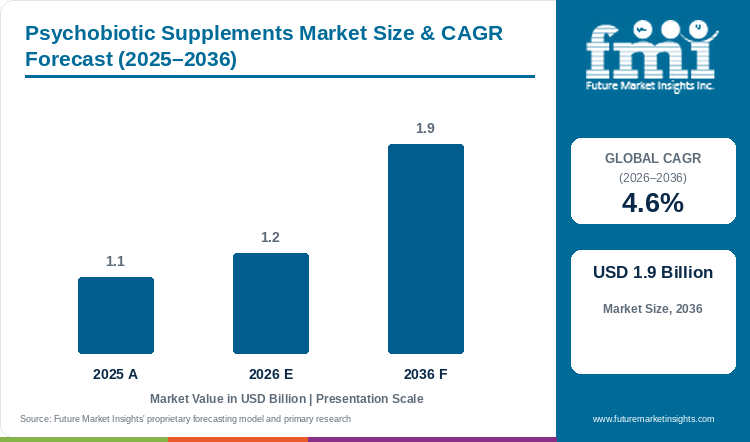
Demand for psychobiotic supplements is projected to expand at 4.6% CAGR between 2026 and 2036. Industry value grows from USD 1.1 billion in 2025 to USD 1.2 billion in 2026 and is projected to reach USD 1.9 billion by 2036.
FMI research indicates that the psychobiotic supplements market moves from USD 1.1 billion in 2025 to USD 1.2 billion in 2026, advancing to USD 1.9 billion by 2036 at a 4.6% CAGR over the assessment period. Consumer interest is transitioning rapidly beyond generalized digestive health toward targeted cognitive wellness through the bidirectional gut-brain axis. In November 2025, a meta-analysis evaluating 72 randomized controlled trials across 6,097 participants documented significant reductions in standardized anxiety and depression scales following targeted probiotic supplements interventions, while identifying substantial outcome variances dictated by strain selection[1]. Probiotic psychobiotics lead product type demand with a 46.8% share in 2026 because live, clinically verified strains provide direct empirical credibility for consumers navigating premium dietary supplements aisles.
Key Market Trends & Insights
- By product type: probiotic psychobiotics are projected to account for 46.8% in 2026, supported by named strains and established supplement manufacturing routes.
- By dosage form: capsules and tablets are estimated to hold 51.2% in 2026, owing to dose control and convenient daily use.
- By health application: stress and anxiety support is forecast to represent 38.6% in 2026, linked to consumer demand for non-prescription wellness routines.
- By sales channel: store-based retail is expected to lead with 44.8% in 2026, reinforced by pharmacy advice and label comparison at purchase.
Regional Highlights
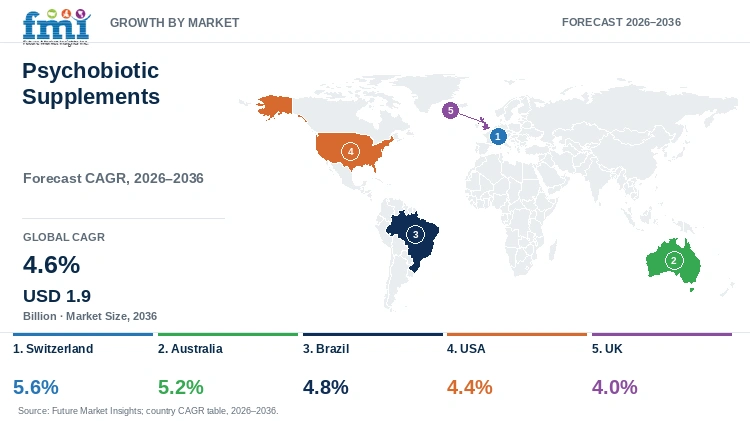
- Fastest-growing evaluated country: Switzerland, at 5.6% CAGR from 2026 to 2036, supported by high supplement literacy and premium strain positioning.
- By country: Australia follows at 5.2%, while Brazil records 4.8%, the USA 4.4%, and the UK 4.0% CAGR through 2036.
Market Size & Forecast
Table 1: Market Size and Forecast for the Psychobiotic Supplements Market (USD billion and CAGR percentage), 2025 to 2036
| Metric | Value |
|---|---|
| 2025 Market Size | USD 1.1 billion |
| Estimated Market Size in 2026 | USD 1.2 billion |
| Projected Market Size by 2036 | USD 1.9 billion |
| CAGR, 2026 to 2036 | 4.6% |
| Added Revenue, 2026 to 2036 | USD 0.7 billion |
As per the analysis from FMI, country growth will separate according to consumer health literacy and permissible structure-function claims across regional regulatory frameworks. In August 2026, the U.S. Centers for Disease Control and Prevention reported that 12.5% of adults regularly experienced feelings of worry, nervousness, or anxiety[2]. This substantial baseline population drives recurring interest in non-pharmaceutical mood support, encouraging formulators of gut health supplements to introduce targeted neuro-active blends that avoid prescription dependencies.
Commercial Demand and Clinical Evidence Indicators
Table 2: Commercial Demand and Clinical Evidence Indicators for the Psychobiotic Supplements Market (USD billion and index values), mixed historical and forecast years from 2025 to 2036
| Metric | 2025 | 2026 | 2036 |
|---|---|---|---|
| Market size (USD billion) | 1.1 | 1.2 | 1.9 |
| Clinical trial volume index | 100.0 | 112.0 | 185.0 |
| Named-strain commercial index | 100.0 | 110.5 | 192.0 |
| Daily spend per active user (USD) | 0.85 | 0.88 | 1.15 |
Calculation basis: Segment figures are analytical scenario modeling based on clinical trial registrations and verified retail adoption rates; they do not represent census-level consumer counts.
Per Capita & Mental Wellness Sizing
Psychobiotic supplements convert microbiota science into accessible daily self-care routines. Pharmacies and specialized wellness outlets provide crucial retail guidance where knowledgeable practitioners explain strain-specific mechanisms. The market intersects closely with brain health supplements as consumers seek integrated regimens that balance gut integrity with neurological focus.
Table 3: Per Capita and Wellness Spending Indicators for the Psychobiotic Supplements Market (USD), mixed historical and forecast years from 2025 to 2036
| Metric | 2025 | 2026 | 2036 |
|---|---|---|---|
| World population (billion) | 8.23 | 8.30 | 8.95 |
| Spend per capita (USD) | 0.13 | 0.14 | 0.21 |
| Spend per 1,000 people (USD) | 133.65 | 144.57 | 212.29 |
| Store-based retail revenue (USD billion) | 0.49 | 0.54 | 0.85 |
Table 4: Channel and Dosage Form Spending Indicators for the Psychobiotic Supplements Market (USD billion and percentages), 2026
| Metric | Value | Basis |
|---|---|---|
| Market size, 2026 | USD 1.2 billion | Report value |
| Probiotic psychobiotics revenue | USD 0.56 billion | 46.8% share |
| Capsules and tablets revenue | USD 0.61 billion | 51.2% share |
| Stress and anxiety support revenue | USD 0.46 billion | 38.6% share |
Analyst Perspective
“Psychobiotics will move from broad gut-health messaging toward strain-led claims that buyers can understand and manufacturers can document. In my experience, products need named strains, usable directions, and evidence matched to the benefit stated on pack.”
- Nandini Roy Choudhury, Principal Consultant, Future Market Insights.
How is the psychobiotic supplements market segmented?
Psychobiotic supplements are segmented by four primary commercial axes and region: product type, dosage form, health application, sales channel, and region. In 2026, probiotic psychobiotics, capsules and tablets, stress and anxiety support, and store-based retail are projected to lead their respective categories.
The market is segmented across four commercial axes and seven geographic regions:
- By product type: probiotic psychobiotics, prebiotic psychobiotics, synbiotic formulations, and postbiotic formulations.
- By dosage form: capsules and tablets, powders and stick packs, gummies and chewables, and liquids and drops.
- By health application: stress and anxiety support, mood support, sleep support, and cognitive and focus support.
- By sales channel: store-based retail, online retail, practitioner and clinic channels, and direct subscription.
- By region: North America, Latin America, Western Europe, Eastern Europe, East Asia, South Asia and Pacific, and Middle East and Africa.
Why do probiotic psychobiotics retain preference by product type?
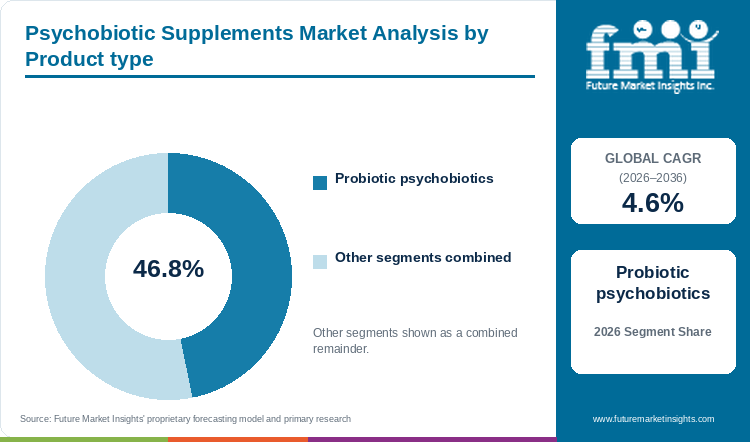
Probiotic psychobiotics are projected to account for 46.8% of product type revenue in 2026, supported by documented strain identity and established manufacturing scale.
Table 5: Product Type Share for the Psychobiotic Supplements Market (percentage share), 2026
| Product Type | Share (2026) |
|---|---|
| Probiotic psychobiotics | 46.8% |
| Other Segments Combined | 53.2%* |
| Total | 100.0% |
*Calculated as the balance remaining after deducting the leading segment's reported share from 100.0%.
Table 6: Product Type Leadership and Market Growth for the Psychobiotic Supplements Market (segment and CAGR percentage), 2026 to 2036
| Metric | Value |
|---|---|
| Global CAGR (2026 to 2036) | 4.6% |
| Leading Segment | Probiotic psychobiotics |
In the FMI report, live probiotic strains remain the primary choice for brands requiring patented microbial identities and documented clinical trial dossiers. Consumers readily evaluate strain codes, colony-forming unit counts, and shelf-stability parameters. The commercial viability of live cultures encourages formulators to evaluate complementary prebiotic ingredients to nourish beneficial strains throughout transit.
- Probiotic psychobiotics represent 46.8% of product type revenue in 2026 as live-strain products have broader consumer recognition.
- In September 2025, Novonesis announced that its ProbioBrain psychobiotic received a second NutraIngredients award for clinical evidence supporting Bifidobacterium longum 1714[3].
What supports capsules and tablets as the preferred dosage form?
Capsules and tablets are estimated to hold 51.2% of dosage form revenue in 2026, driven by superior moisture protection and precise unit dosing.
Encapsulated formats shield sensitive microbial cultures from ambient humidity and gastric acidity, preserving viable cell counts until the product reaches the intestinal tract. Solid oral formats streamline pharmacy shelving and subscription shipping without requiring refrigerated supply chains. In parallel, advancements in postbiotic supplements enable shelf-stable tablet tableting without compromising therapeutic metabolite activity.
- Capsules and tablets hold 51.2% of dosage-form revenue in 2026 through dose consistency and portable daily use.
- In 2026, Probi AB confirmed that its documented mental-wellness probiotic formulations can be processed across capsules, tablets, and powders[4].
How is stress support gaining use across health applications?
Stress and anxiety support is forecast to represent 38.6% of health application revenue in 2026, reflecting widespread demand for non-sedating emotional balance.
Stress management offers a broad addressable audience seeking non-prescription solutions to everyday occupational tension without sedative side effects. Products addressing daytime nervousness frequently pair psychobiotics with botanical adaptogens and amino acids. Demand also links with sleep aids as consumers seek holistic circadian rhythm support.
- Stress and anxiety support contributes 38.6% of health-application revenue in 2026 as buyers seek practical self-care routines.
- In September 2026, a comprehensive clinical review in Annals of Neurosciences established that targeted probiotic interventions significantly modulated perceived stress scores and salivary cortisol levels[5].
Why are buyers selecting store-based retail for psychobiotic products?
Store-based retail is expected to capture 44.8% of sales channel turnover in 2026, owing to professional pharmacist guidance and immediate physical product access.
Psychobiotic supplements require substantial consumer education regarding viable colony counts and strain documentation. Physical pharmacy shelves allow prospective buyers to consult licensed pharmacists regarding potential interactions and clinical trial support. Retailers increasingly curate synbiotics within dedicated digestive-mental wellness display bays.
- Store-based retail represents 44.8% of channel revenue in 2026 through advice-led purchase and immediate product access.
- In September 2025, the Swiss Health Observatory published its National Health Report emphasizing accessible community pharmacy guidance for preventive mental health support[6].
What are the drivers, restraints, and opportunities in the psychobiotic supplements market?
In the psychobiotic supplements market, the key driver is gut-brain awareness, the key restraint is evidence variability, and the opportunity is strain-specific personalization.
- Driver: Published human research is moving the gut-brain axis from specialist discussion into consumer wellness decisions.
- Restraint: Outcomes vary by strain, dose, study population, and endpoint, which limits broad product claims.
- Opportunity: Suppliers can build differentiated products around named strains, stable formats, and defined stress, sleep, or cognition uses.
Human Evidence Widens Consumer Interest
FMI data suggests that robust academic publishing is establishing psychobiotics as a clinically validated supplement category rather than an experimental wellness niche. A March 2026 review in Frontiers in Microbiology highlighted reproducible neurochemical modulation across human trials, showing improved sleep architecture and lower anxiety metrics[7]. This growing literature base compels consumers seeking stress management supplements to select evidence-backed probiotic strains over unstandardized herbal preparations.
Variable Outcomes Limit Broad Claims
According to FMI, outcome variability across commercial strains represents the primary technical barrier constraining category-wide adoption. A November 2025 systematic review of 72 randomized trials demonstrated that while certain Bifidobacterium and Lactobacillus strains demonstrated robust statistical significance, others showed minimal effect in healthy subjects[8]. Regulatory bodies consequently penalize exaggerated therapeutic claims, forcing brands to restrict marketing strictly to qualified structure-function statements.
Personalized Formats Create White Space
Commercial white space centers on developing benefit-specific formulation bundles tailored to distinct lifestyle friction points such as workplace fatigue or insomnia. In December 2025, Bened Biomedical announced that its sleep-targeted probiotic PS150 received Taiwan's National Innovation Award for demonstrating enhanced sleep quality through neurotransmitter pathway modulation[9]. Integrating gut-directed strains with digestive health supplements enables brands to address dual indications within a single daily capsule.
Psychobiotic Supplements Market by Country (2026 to 2036)
As noted by FMI, country conditions favor markets where consumers already understand probiotics and can access advice through pharmacies, practitioners, or credible digital channels. Switzerland and Australia exhibit the highest growth rates, while Brazil, the USA, and the UK offer substantial baseline consumer volumes.
Table 7: Country CAGR and Primary Growth Levers for the Psychobiotic Supplements Market (CAGR percentage and operational drivers), 2026 to 2036
| Country | CAGR (2026 to 2036) | Primary growth lever |
|---|---|---|
| Switzerland | 5.6% | Premium supplement use and mental-health literacy |
| Australia | 5.2% | High mental-health need and established complementary-health retail |
| Brazil | 4.8% | Large wellness audience and expanding digital supplement access |
| USA | 4.4% | Broad probiotic retail and high stress-related wellness demand |
| UK | 4.0% | Pharmacy access and active mental-wellbeing policy discussion |
Source: Industry analysis
How will country conditions shape psychobiotic supplement demand?
Commercial conditions diverge across the profiled nations as consumer health literacy and statutory claim boundaries dictate retail positioning:
- Swiss consumers prioritize documented pharmaceutical-grade strains, supporting premium pharmacy placement.
- Australian buyers utilize established complementary medicine aisles, navigating rigorous TGA regulatory standards.
- Brazilian consumers expand online supplement purchasing, driven by heightened awareness of workplace mental stress.
- United States shoppers drive high-volume retail through mass grocery chains and direct-to-consumer digital subscriptions.
- United Kingdom buyers rely on community pharmacy recommendations while facing household discretionary spending constraints.
Full report country CAGRs cover: North America; Latin America; Western Europe; Eastern Europe; East Asia; South Asia and Pacific; Middle East and Africa.
Switzerland Psychobiotic Supplements Market Outlook (2026 to 2036)
Switzerland’s psychobiotic supplements outlook is anticipated to advance at 5.6% CAGR over the assessment period, supported by strong health literacy and willingness to invest in premium healthcare formulations. In September 2025, the Swiss Health Observatory set out national guidelines prioritizing workplace mental health prevention and evidence-based self-care[10]. High disposable income allows consumers to afford documented premium strains over commodity probiotics. Strict Swissmedic prohibitions against unverified medical claims prevent unsubstantiated marketing, ensuring that only clinically substantiated brands secure shelf space in local apothekes.
- Key takeaway: In Switzerland, elevated consumer health literacy and rigorous regulatory scrutiny position documented premium strains for sustained pharmacy growth.
Australia Psychobiotic Supplements Market Outlook (2026 to 2036)
Australia is projected to grow at 5.2% CAGR through 2036, owing to high complementary health awareness and substantial domestic demand for non-prescription stress support. In August 2026, the Australian Institute of Health and Welfare reported that 22% of individuals aged 16 to 85 experienced a mental disorder during the preceding 12-month period, with anxiety disorders affecting 17%[11]. Strong consumer familiarity with listed complementary medicines facilitates rapid adoption. However, strict Therapeutic Goods Administration compliance requirements mandate rigorous stability evidence, limiting market entry to well-capitalized brand owners.
- Key takeaway: In Australia, high clinical anxiety prevalence and structured complementary medicine channels create a mature environment for substantiated psychobiotics.
Brazil Psychobiotic Supplements Market Outlook (2026 to 2036)
Psychobiotic supplement demand in Brazil is forecast to rise at 4.8% CAGR over the forecast period, influenced by a growing urban wellness cohort and expanding digital retail channels. In July 2025, the Brazilian Ministry of Social Security recorded a marked increase in workplace disability claims attributed to mental and behavioral stress[12]. This heightened public awareness creates strong consumer receptivity for non-pharmacological mood stabilizers. Currency volatility and household price sensitivity restrict premium imported brands, prompting domestic contract manufacturers to formulate affordable locally produced lines.
- Key takeaway: In Brazil, expanding digital distribution and heightened concern over workplace stress drive demand for accessible psychobiotic alternatives.
USA Psychobiotic Supplements Market Outlook (2026 to 2036)
Adoption of psychobiotic supplements in the USA is estimated to expand at 4.4% CAGR through 2036, enabled by extensive probiotic retail infrastructure and widespread direct-to-consumer subscription platforms. In May 2026, the CDC Mental Health Data Channel recorded that over 12% of American adults regularly experience anxiety symptoms[13]. High commercial visibility across mass retailers accelerates category discovery. However, intense competition from generic probiotics and FDA scrutiny regarding structure-function claims require producers to publish peer-reviewed clinical dossiers to maintain customer retention.
- Key takeaway: In the USA, broad retail access and consumer familiarity with digestive probiotics provide a solid springboard for targeted psychobiotic extensions.
UK Psychobiotic Supplements Market Outlook (2026 to 2036)
Sales of psychobiotic supplements in the UK are forecast to expand at 4.0% CAGR by 2036, linked to growing public discussion regarding preventative mental wellbeing. In October 2025, NHS England’s annual Mental Health Bulletin documented unprecedented demand across secondary public mental health services[14]. This systemic pressure encourages consumers to seek non-clinical self-care options through community pharmacies. Squeezed household disposable budgets create price resistance against expensive regimens, compelling brands to introduce affordable introductory pack sizes.
- Key takeaway: In the UK, high reliance on community pharmacy advice and preventative wellbeing policies support steady adoption of evidence-backed psychobiotics.
Who are the notable companies in the psychobiotic supplements market?
Novonesis, Lallemand Health Solutions, Probi, Bened Biomedical, BioGaia, Seed Health, Pendulum Therapeutics, and Nestlé Health Science are notable companies operating in the psychobiotic supplements market.
An FMI analyst notes that competition is moderately fragmented between specialized microbial strain developers and consumer-facing microbiome brand platforms. Upstream biotechnology suppliers focus on patented strain isolation, genetic sequencing, and double-blind clinical trials. Downstream consumer platforms differentiate through interactive digital marketing, elegant packaging, and subscription fulfillment. Sustainable market share depends on delivering verified live colony counts through full product shelf life.
- Psychobiotic strain specialists: Novonesis, Lallemand Health Solutions, Probi, and Bened Biomedical develop documented strains for licensed global partner brands.
- Consumer microbiome brands: Seed Health, Pendulum Therapeutics, and BioGaia deploy direct consumer education and digital subscription ecosystems.
- Diversified health and nutrition platform: Nestlé Health Science leverages global retail distribution to scale clinically validated wellness supplements.
Competitive Benchmarking: Psychobiotic Supplements Market
Table 8: Competitive Benchmarking for the Psychobiotic Supplements Market (qualitative capability ratings), 2026
| Company | Psychobiotic portfolio | Clinical documentation | Commercial access | Geographic reach |
|---|---|---|---|---|
| Novonesis | High | High | High | High |
| Lallemand Health Solutions | High | High | High | High |
| Probi | High | High | High | High |
| Bened Biomedical | High | High | Medium | Medium |
| BioGaia | Medium | High | High | High |
| Seed Health | Medium | High | High | Medium |
| Pendulum Therapeutics | Medium | High | High | Medium |
| Nestlé Health Science | Medium | High | High | High |
Scoring basis: High indicates broad current evidence or access across multiple markets. Medium indicates a narrower documented range or regional focus. Ratings describe public capability evidence and are not market-share or quality rankings.
Key Developments in the Psychobiotic Supplements Market
- In September 2026, Lallemand Health Solutions announced new clinical evidence for Cerebiome, reinforcing its gut-brain axis evidence for emotional balance[15].
- In May 2026, Novonesis presented its BioLens learning experience at Vitafoods Europe to explain everyday stress and its ProbioBrain psychobiotic to supplement audiences[16].
- In December 2025, Bened Biomedical reported that its sleep-aiding probiotic PS150 received the 22nd National Innovation Award in Taiwan[17].
- In September 2025, Novonesis announced a second NutraIngredients award for ProbioBrain in the mood and mind category[18].
Key Players in the Psychobiotic Supplements Market
Psychobiotic Strain and Ingredient Platforms
- Novonesis
- Lallemand Health Solutions
- Probi
- Bened Biomedical
Consumer Microbiome Supplement Brands
- BioGaia
- Seed Health
- Pendulum Therapeutics
Diversified Health and Nutrition Platform
- Nestlé Health Science
Psychobiotic Supplements Market - Report Scope
Table 9: Report Scope for the Psychobiotic Supplements Market (coverage fields and definitions), 2026 to 2036
| Coverage field | Report scope |
|---|---|
| Market breakdown | Product type; dosage form; health application; sales channel |
| Quantitative units | USD Billion |
| Market definition | Revenue from finished psychobiotic supplements and in-scope psychobiotic formulations sold for non-prescription mental-wellness support. |
| Exclusions | Prescription medicines, standalone general probiotics without a gut-brain positioning, and clinical services. |
| Regions covered | North America; Latin America; Western Europe; Eastern Europe; East Asia; South Asia and Pacific; Middle East and Africa |
| Countries highlighted | Switzerland, Australia, Brazil, USA, and UK |
| Forecast period | 2026 to 2036 |
As per FMI, the report scope covers non-prescription psychobiotic formulations sold across retail and digital channels, excluding pharmaceutical drugs and medical foods requiring physician supervision.
Psychobiotic Supplements Market - Research Methodology
Table 10: Research Methodology for the Psychobiotic Supplements Market (research methods and approach), 2026 edition
| Method | Approach |
|---|---|
| Primary Research | FMI analysts gathered input from manufacturers, service providers, technology developers, distributors, end users, procurement teams, and subject-matter experts. Interviews examined purchasing decisions, product or service evaluation, adoption barriers, approval requirements, pricing considerations, and expectations for technical or commercial support. |
| Desk Research | Desk research covered government statistics, regulatory publications, trade data, industry associations, technical literature, standards, company filings, product information, and official corporate announcements. Sources were reviewed for relevance, publication date, geographic coverage, and consistency with the defined market scope. |
| Market Sizing and Forecasting | The market model combined the baseline value with historical performance, segment structure, pricing and volume indicators, adoption levels, company participation, and country-level demand conditions. Segment and regional estimates were reconciled before the final market total was calculated. |
| Data Validation | Estimates were checked against multiple independent indicators, including public data, company activity, trade patterns, industry developments, and findings from primary interviews. Adjacent categories, unsupported claims, overlapping revenues, and activities without direct market relevance were excluded. |
Psychobiotic Supplements Market by Segments
Psychobiotic Supplements Market segmented by Product type:
- Probiotic psychobiotics
- Prebiotic psychobiotics
- Synbiotic formulations
- Postbiotic formulations
Psychobiotic Supplements Market segmented by Dosage form:
- Capsules and tablets
- Powders and stick packs
- Gummies and chewables
- Liquids and drops
Psychobiotic Supplements Market segmented by Health application:
- Stress and anxiety support
- Mood support
- Sleep support
- Cognitive and focus support
Psychobiotic Supplements Market segmented by Sales channel:
- Store-based retail
- Online retail
- Practitioner and clinic channels
- Direct subscription
Psychobiotic Supplements Market by Region
- North America
- United States
- Canada
- Latin America
- Brazil
- Mexico
- Argentina
- Chile
- Western Europe
- Germany
- France
- United Kingdom
- Switzerland
- Italy
- Spain
- Benelux
- Nordics
- Eastern Europe
- Poland
- Czech Republic
- Romania
- Hungary
- East Asia
- Japan
- South Korea
- South Asia and Pacific
- ASEAN
- Australia and New Zealand
- Middle East and Africa
- GCC Countries
- South Africa
- Türkiye
- Israel
Research Sources and Bibliography
- [1] Zhang, J., Zhu, L., Meng, Q., Wang, Z., & Zhu, H. (2025, November 27). The efficacy of probiotics, prebiotics, and synbiotics on anxiety, depression, and sleep: A systematic review and meta-analysis of randomized controlled trials. BMC Psychiatry, 25, 1199.
- [2] Centers for Disease Control and Prevention. (2026, August 28). FastStats: Mental health. National Center for Health Statistics.
- [3] Novonesis. (2025, September 26). ProbioBrain wins NutraIngredients second award, reinforcing global leadership in mental wellness. Corporate News.
- [4] Probi AB. (2026). Probiotics solutions for gut and brain health. Technical Product Literature.
- [5] Das, M., Thajuddin, N., Muralitharan, G., et al. (2026, September 1). From gut to mind: Impact of probiotics on depression, anxiety, mood, gut microbiota, sleep and stress. Annals of Neurosciences.
- [6] Swiss Health Observatory. (2025, September 4). Mental health in Switzerland: Trends, promotion, prevention and care. National Health Report 2025.
- [7] Sisubalan, N., Kesika, P., Sivamaruthi, B. S., & Chaiyasut, C. (2026, March 27). Psychobiotics in mental health: Insights from human clinical trials via the gut-brain axis. Frontiers in Microbiology, 17.
- [8] Zhang, J., Zhu, L., Meng, Q., Wang, Z., & Zhu, H. (2025). Supplementary methods and findings for the systematic review of probiotics, prebiotics, and synbiotics. BMC Psychiatry.
- [9] Bened Biomedical Co., Ltd. (2025, December 26). Sleep-aiding probiotic PS150 wins the 22nd National Innovation Award. Corporate Announcements.
- [10] Swiss Health Observatory. (2025). National Health Report 2025: Recommendations for mental-health evidence, prevention, workplaces, and care. Swiss Federal Publications.
- [11] Australian Institute of Health and Welfare. (2026, August 13). Prevalence and impact of mental illness in Australia. AIHW Statistical Releases.
- [12] Ministry of Social Security, Brazil. (2025, July). Mental health and social security in Brazil: Evolution of disability benefits for mental and behavioral disorders. Social Security Bulletin, 37(7).
- [13] Centers for Disease Control and Prevention. (2026, May 27). Mental Health Data Channel. U.S. Department of Health and Human Services.
- [14] NHS England. (2025, October 16). Mental Health Bulletin, 2024-25 annual report. National Health Service.
- [15] Lallemand Health Solutions. (2026, September 30). New clinical evidence strengthens Cerebiome in the mental health space. Press Room.
- [16] Nutrition Insight. (2026, May 25). Vitafoods Europe 2026: Novonesis shows psychobiotics’ mental health benefits. Industry Reports.
- [17] Bened Biomedical Co., Ltd. (2025, December 26). Bened Biomedical’s Sleep-Aiding Probiotic PS150 wins the 22nd National Innovation Award. Trade Release.
- [18] Novonesis. (2025, September 26). ProbioBrain wins NutraIngredients second award. Trade Announcements.
This bibliography is provided for reader reference. The full report contains the complete reference list and detailed citations.
This Report Answers
- How large is the psychobiotic supplements market in 2026?
- What valuation is forecast for psychobiotic supplements by 2036?
- Which product type leads psychobiotic supplement revenue in 2026?
- Which dosage form accounts for a notable 2026 market share?
- Which application supports current psychobiotic supplement demand?
- Which countries show notable expansion through the forecast period?
Frequently Asked Questions
How big is the psychobiotic supplements market in 2026?
Future Market Insights estimates that the psychobiotic supplements market will reach USD 1.2 billion in 2026. The market is projected to reach USD 1.9 billion by 2036.
What CAGR is forecast from 2026 to 2036?
As per FMI, psychobiotic supplement revenue will expand at a 4.6% CAGR from 2026 to 2036, supported by clinical strain verification and expanding mental wellbeing awareness.
Which product type leads the market in 2026?
Probiotic psychobiotics are projected to account for 46.8% of product type revenue in 2026, driven by verified live strain recognition and established consumer trust.
Which dosage form leads psychobiotic supplement sales?
Capsules and tablets are estimated to hold 51.2% of dosage-form revenue in 2026, offering dose consistency and superior live-cell protection.
Which country has a notable expansion outlook?
Switzerland is projected to register a 5.6% CAGR through 2036, supported by strong supplement literacy, high purchasing power, and premium pharmacy merchandising.
Who are notable companies in the market?
Notable participants include Novonesis, Lallemand Health Solutions, Probi AB, Bened Biomedical, BioGaia, Seed Health, Pendulum Therapeutics, and Nestlé Health Science.
Preview the report firsthand - request a free sample
Get SampleGet the brochure for pricing and purchase details.
Get PDFTable of Content
- Key Takeaways
- Market Size and CAGR
- Top Growth Driver
- Fastest Growing Segment
- Leading Region
- Key Companies
- Emerging Opportunities
- Executive Summary
- Global Market Outlook
- Demand-side Trends
- Supply-side Trends
- Technology Roadmap Analysis
- Analysis and Recommendations
- Analyst Perspective (What is happening? Why now? What should investors know?)
- Key Questions Answered
- How large is the market?
- What is the CAGR?
- What are key trends?
- Which region dominates?
- Who are the leaders?
- Market Overview
- Market Coverage / Taxonomy
- Market Definition / Scope / Limitations
- Research Methodology
- Chapter Orientation
- Analytical Lens and Working Hypotheses
- Market Structure, Signals, and Trend Drivers
- Benchmarking and Cross-market Comparability
- Market Sizing, Forecasting, and Opportunity Mapping
- Research Design and Evidence Framework
- Desk Research Programme (Secondary Evidence)
- Expert Input and Fieldwork (Primary Evidence)
- Tooling, Models, and Reference Databases
- Data Engineering and Model Build
- Quality Assurance and Audit Trail
- Market Background
- Market Dynamics (Drivers, Restraints, Opportunity, Trends)
- Scenario Forecast (Optimistic, Likely, Conservative)
- Impact Analysis
- AI Impact
- Sustainability Impact
- Regulatory Impact
- Technology Impact
- Consumer / Buyer Analysis
- Purchase Drivers
- Adoption Barriers
- Buyer Journey
- Opportunity Map Analysis
- Product Life Cycle Analysis
- Supply Chain Analysis
- Investment Feasibility Matrix
- Value Chain Analysis
- PESTLE and Porter's Analysis
- Regulatory Landscape
- Regional Parent Market Outlook
- Production and Consumption Statistics
- Import and Export Statistics
- Global Market Analysis and Forecast, 2021 to 2036
- Historical Market Size Value (USD Billion) Analysis, 2021 to 2025
- Current and Future Market Size Value (USD Billion) Projections, 2026 to 2036
- Y-o-Y Growth Trend Analysis
- Absolute $ Opportunity Analysis
- Global Market Pricing Analysis, 2021 to 2036
- Global Market Analysis and Forecast, By Product type, 2021 to 2036
- Introduction / Key Findings
- Historical Market Size Value (USD Billion) Analysis By Product type, 2021 to 2025
- Current and Future Market Size Value (USD Billion) Analysis and Forecast By Product type, 2026 to 2036
- Probiotic psychobiotics
- Prebiotic psychobiotics
- Synbiotic formulations
- Postbiotic formulations
- Y-o-Y Growth Trend Analysis By Product type, 2021 to 2025
- Absolute $ Opportunity Analysis By Product type, 2026 to 2036
- Global Market Analysis and Forecast, By Dosage form, 2021 to 2036
- Introduction / Key Findings
- Historical Market Size Value (USD Billion) Analysis By Dosage form, 2021 to 2025
- Current and Future Market Size Value (USD Billion) Analysis and Forecast By Dosage form, 2026 to 2036
- Capsules and tablets
- Powders and stick packs
- Gummies and chewables
- Liquids and drops
- Y-o-Y Growth Trend Analysis By Dosage form, 2021 to 2025
- Absolute $ Opportunity Analysis By Dosage form, 2026 to 2036
- Global Market Analysis and Forecast, By Health application, 2021 to 2036
- Introduction / Key Findings
- Historical Market Size Value (USD Billion) Analysis By Health application, 2021 to 2025
- Current and Future Market Size Value (USD Billion) Analysis and Forecast By Health application, 2026 to 2036
- Stress and anxiety support
- Mood support
- Sleep support
- Cognitive and focus support
- Y-o-Y Growth Trend Analysis By Health application, 2021 to 2025
- Absolute $ Opportunity Analysis By Health application, 2026 to 2036
- Global Market Analysis and Forecast, By Sales channel, 2021 to 2036
- Introduction / Key Findings
- Historical Market Size Value (USD Billion) Analysis By Sales channel, 2021 to 2025
- Current and Future Market Size Value (USD Billion) Analysis and Forecast By Sales channel, 2026 to 2036
- Store-based retail
- Online retail
- Practitioner and clinic channels
- Direct subscription
- Y-o-Y Growth Trend Analysis By Sales channel, 2021 to 2025
- Absolute $ Opportunity Analysis By Sales channel, 2026 to 2036
- Global Market Analysis and Forecast, By Region, 2021 to 2036
- Introduction
- Historical Market Size Value (USD Billion) Analysis By Region, 2021 to 2025
- Current Market Size Value (USD Billion) Analysis and Forecast By Region, 2026 to 2036
- North America
- Latin America
- Western Europe
- Eastern Europe
- East Asia
- South Asia and Pacific
- Middle East and Africa
- Market Attractiveness Analysis By Region
- North America Market Analysis and Forecast, By Country, 2021 to 2036
- Historical Market Size Value (USD Billion) Trend Analysis By Market Taxonomy, 2021 to 2025
- Market Size Value (USD Billion) Forecast By Market Taxonomy, 2026 to 2036
- By Country
- United States
- Canada
- By Product type
- By Dosage form
- By Health application
- By Sales channel
- By Country
- Market Attractiveness Analysis
- By Country
- By Product type
- By Dosage form
- By Health application
- By Sales channel
- Key Takeaways
- Latin America Market Analysis and Forecast, By Country
- Historical Market Size Value (USD Billion) Trend Analysis By Market Taxonomy, 2021 to 2025
- Market Size Value (USD Billion) Forecast By Market Taxonomy, 2026 to 2036
- By Country
- Brazil
- Mexico
- Argentina
- Chile
- By Product type
- By Dosage form
- By Health application
- By Sales channel
- By Country
- Market Attractiveness Analysis
- By Country
- By Product type
- By Dosage form
- By Health application
- By Sales channel
- Key Takeaways
- Western Europe Market Analysis and Forecast, By Country
- Historical Market Size Value (USD Billion) Trend Analysis By Market Taxonomy, 2021 to 2025
- Market Size Value (USD Billion) Forecast By Market Taxonomy, 2026 to 2036
- By Country
- Germany
- France
- United Kingdom
- Switzerland
- Italy
- Spain
- Benelux
- Nordics
- By Product type
- By Dosage form
- By Health application
- By Sales channel
- By Country
- Market Attractiveness Analysis
- By Country
- By Product type
- By Dosage form
- By Health application
- By Sales channel
- Key Takeaways
- Eastern Europe Market Analysis and Forecast, By Country
- Historical Market Size Value (USD Billion) Trend Analysis By Market Taxonomy, 2021 to 2025
- Market Size Value (USD Billion) Forecast By Market Taxonomy, 2026 to 2036
- By Country
- Poland
- Czech Republic
- Romania
- Hungary
- By Product type
- By Dosage form
- By Health application
- By Sales channel
- By Country
- Market Attractiveness Analysis
- By Country
- By Product type
- By Dosage form
- By Health application
- By Sales channel
- Key Takeaways
- East Asia Market Analysis and Forecast, By Country
- Historical Market Size Value (USD Billion) Trend Analysis By Market Taxonomy, 2021 to 2025
- Market Size Value (USD Billion) Forecast By Market Taxonomy, 2026 to 2036
- By Country
- Japan
- South Korea
- By Product type
- By Dosage form
- By Health application
- By Sales channel
- By Country
- Market Attractiveness Analysis
- By Country
- By Product type
- By Dosage form
- By Health application
- By Sales channel
- Key Takeaways
- South Asia and Pacific Market Analysis and Forecast, By Country
- Historical Market Size Value (USD Billion) Trend Analysis By Market Taxonomy, 2021 to 2025
- Market Size Value (USD Billion) Forecast By Market Taxonomy, 2026 to 2036
- By Country
- ASEAN
- Australia and New Zealand
- By Product type
- By Dosage form
- By Health application
- By Sales channel
- By Country
- Market Attractiveness Analysis
- By Country
- By Product type
- By Dosage form
- By Health application
- By Sales channel
- Key Takeaways
- Middle East and Africa Market Analysis and Forecast, By Country
- Historical Market Size Value (USD Billion) Trend Analysis By Market Taxonomy, 2021 to 2025
- Market Size Value (USD Billion) Forecast By Market Taxonomy, 2026 to 2036
- By Country
- GCC Countries
- South Africa
- Türkiye
- Israel
- By Product type
- By Dosage form
- By Health application
- By Sales channel
- By Country
- Market Attractiveness Analysis
- By Country
- By Product type
- By Dosage form
- By Health application
- By Sales channel
- Key Takeaways
- Key Countries Market Analysis
- United States
- Pricing Analysis
- Market Share Analysis, 2025
- By Product type
- By Dosage form
- By Health application
- By Sales channel
- Canada
- Pricing Analysis
- Market Share Analysis, 2025
- By Product type
- By Dosage form
- By Health application
- By Sales channel
- Mexico
- Pricing Analysis
- Market Share Analysis, 2025
- By Product type
- By Dosage form
- By Health application
- By Sales channel
- Brazil
- Pricing Analysis
- Market Share Analysis, 2025
- By Product type
- By Dosage form
- By Health application
- By Sales channel
- Chile
- Pricing Analysis
- Market Share Analysis, 2025
- By Product type
- By Dosage form
- By Health application
- By Sales channel
- Germany
- Pricing Analysis
- Market Share Analysis, 2025
- By Product type
- By Dosage form
- By Health application
- By Sales channel
- United Kingdom
- Pricing Analysis
- Market Share Analysis, 2025
- By Product type
- By Dosage form
- By Health application
- By Sales channel
- Italy
- Pricing Analysis
- Market Share Analysis, 2025
- By Product type
- By Dosage form
- By Health application
- By Sales channel
- Spain
- Pricing Analysis
- Market Share Analysis, 2025
- By Product type
- By Dosage form
- By Health application
- By Sales channel
- France
- Pricing Analysis
- Market Share Analysis, 2025
- By Product type
- By Dosage form
- By Health application
- By Sales channel
- ASEAN
- Pricing Analysis
- Market Share Analysis, 2025
- By Product type
- By Dosage form
- By Health application
- By Sales channel
- Australia and New Zealand
- Pricing Analysis
- Market Share Analysis, 2025
- By Product type
- By Dosage form
- By Health application
- By Sales channel
- Japan
- Pricing Analysis
- Market Share Analysis, 2025
- By Product type
- By Dosage form
- By Health application
- By Sales channel
- South Korea
- Pricing Analysis
- Market Share Analysis, 2025
- By Product type
- By Dosage form
- By Health application
- By Sales channel
- Poland
- Pricing Analysis
- Market Share Analysis, 2025
- By Product type
- By Dosage form
- By Health application
- By Sales channel
- Hungary
- Pricing Analysis
- Market Share Analysis, 2025
- By Product type
- By Dosage form
- By Health application
- By Sales channel
- Türkiye
- Pricing Analysis
- Market Share Analysis, 2025
- By Product type
- By Dosage form
- By Health application
- By Sales channel
- South Africa
- Pricing Analysis
- Market Share Analysis, 2025
- By Product type
- By Dosage form
- By Health application
- By Sales channel
- Switzerland
- Pricing Analysis
- Market Share Analysis, 2025
- By Product type
- By Dosage form
- By Health application
- By Sales channel
- Australia
- Pricing Analysis
- Market Share Analysis, 2025
- By Product type
- By Dosage form
- By Health application
- By Sales channel
- United States
- Market Structure Analysis
- Competition Dashboard
- Competition Benchmarking
- Market Share Analysis of Top Players
- By Regional
- By Product type
- By Dosage form
- By Health application
- By Sales channel
- Emerging Startups
- Innovation Benchmarking
- Competition Analysis
- Competition Deep Dive
- Novonesis
- Overview
- Product Portfolio
- Profitability by Market Segments
- Sales Footprint
- Strategy Overview
- Marketing Strategy
- Product Strategy
- Channel Strategy
- Lallemand Health Solutions
- Probi
- Bened Biomedical
- BioGaia
- Seed Health
- Pendulum Therapeutics
- Nestlé Health Science
- Novonesis
- Case Studies
- Success Stories
- Recent Developments
- Competition Deep Dive
- Assumptions & Acronyms Used


