

- Industry Size (2026)
- USD 4 Bn
- Forecast (2036)
- USD 9.6 Bn
- CAGR (2026 to 2036)
- 9.2%
Scope 3 Emission-Reducing PVC Solutions for Construction OEMs Market Forecast and Outlook 2026 to 2036
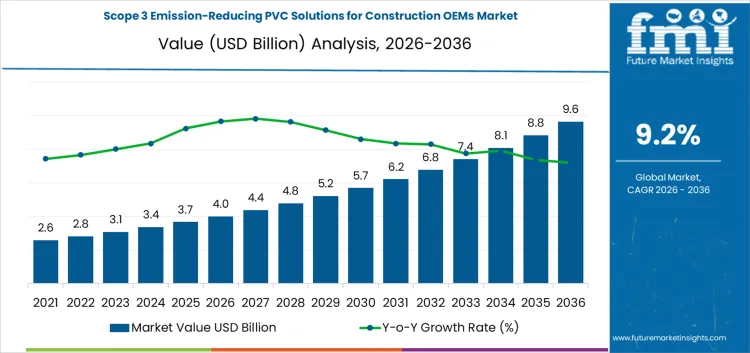
The Scope 3 emission-reducing PVC solutions for construction OEMs market is expected to experience steady growth from 2026 to 2036. Starting at USD 4 billion in 2026, the market is projected to reach USD 9.6 billion by 2036, reflecting a compound annual growth rate (CAGR) of 9.2%. This growth is driven by the increasing demand from construction OEMs (original equipment manufacturers) for sustainable solutions that help reduce Scope 3 emissions, which refer to indirect emissions from the supply chain. As construction companies face pressure to meet stringent sustainability targets and environmental regulations, they are turning to low-carbon alternatives like emission-reducing PVC to reduce the environmental impact of their operations.
The market’s expansion is supported by the growing regulatory push for greener building materials and the increasing demand for sustainable construction practices. Scope 3 emissions are a key focus of global climate action, and many construction OEMs are prioritizing the adoption of sustainable materials to meet regulatory and consumer demands. Low-carbon PVC solutions are an attractive option due to their sustainability benefits, durability, and performance in construction applications. Over the forecast period, the market is expected to grow steadily, driven by the continued focus on reducing carbon footprints, technological advancements in PVC production, and increasing consumer and regulatory pressure for greener construction practices.
Quick Stats of the Scope 3 Emission-Reducing PVC Solutions for Construction OEMs Market
- Scope 3 Emission-Reducing PVC Solutions for Construction OEMs Market Value (2026): USD 4 billion
- Scope 3 Emission-Reducing PVC Solutions for Construction OEMs Market Forecast Value (2036): USD 9.6 billion
- Scope 3 Emission-Reducing PVC Solutions for Construction OEMs Market Global Forecast CAGR (2026 to 2036): 9.2%
- Scope 3 Emission-Reducing PVC Solutions for Construction OEMs Market Leading Segment: End Market (Residential and Commercial Buildings) 52%
- Key Growth Regions in Scope 3 Emission-Reducing PVC Solutions for Construction OEMs Market: USA
- Top Players in Scope 3 Emission-Reducing PVC Solutions for Construction OEMs Market: Vynova Group, Solvay S.A., INEOS Group Ltd., The Dow Chemical Company, Shin-Etsu Chemical Co., Ltd., Westlake Chemical Corporation, Hanwha Solutions Chemical Division, Formosa Plastics Corporation, Renolit (bio-attributed PVC), Arkema S.A.
What is the Growth Forecast for the Scope 3 Emission-Reducing PVC Solutions for Construction OEMs Market through 2036?
The compound absolute growth analysis for the Scope 3 emission-reducing PVC solutions for construction OEMs market reveals significant growth in both the short and long terms. From 2026 to 2031, the market will grow from USD 4 billion to USD 6.7 billion, reflecting an increase of USD 2.7 billion over the first five years. This period will see a marked acceleration in the adoption of low-carbon PVC solutions, driven by heightened regulatory pressures to reduce Scope 3 emissions in the construction sector, as well as increasing consumer and industry demand for sustainable materials. During these early years, the market will witness rapid innovation and an increase in production capacity to meet the growing demand for emission-reducing PVC.
From 2031 to 2036, the market will continue to grow, increasing from USD 6.7 billion to USD 9.6 billion, representing an additional USD 2.9 billion in market value. While the pace of growth will moderate, it will still reflect significant expansion driven by the increasing integration of Scope 3 emission-reducing PVC solutions into standard construction practices. The steady growth in this phase will be supported by continued advancements in production technologies, improved material performance, and the ongoing shift toward greener, more sustainable construction practices. The compound absolute growth analysis highlights the overall market potential and the continued momentum of sustainability efforts in the construction industry.
Scope 3 Emission-Reducing PVC Solutions for Construction OEMs Market Key Takeaways
| Metric | Value |
|---|---|
| Industry Sales Value (2026) | USD 4 billion |
| Industry Forecast Value (2036) | USD 9.6 billion |
| Industry Forecast CAGR (2026 to 2036) | 9.2% |
What Is Driving the Demand for Scope 3 Emission-Reducing PVC Solutions for Construction OEMs Market?
Historical demand for conventional PVC in construction, including piping, siding, windows, flooring, and wall coverings, has been driven by the polymer’s durability, cost efficiency, and resistance to moisture and chemicals, making it a material of choice across residential and commercial projects. PVC accounts for part of the plastics portfolio that supports building component markets worldwide, with roughly 40 million tons of PVC produced globally per year.
As sustainability considerations emerged in the early 2000s, construction value chains began to account for indirect environmental impacts beyond direct energy use and on-site emissions, recognizing that a substantial portion of total corporate greenhouse gas emissions arises outside direct operations in Scope 3 categories such as purchased materials, upstream transport, and product use. Scope 3 emissions have become prominent in climate reporting frameworks because supply chain and product life cycle impacts often exceed direct emissions, underscoring the need for material-level strategies to reduce embodied carbon. Early responses included measuring and mapping Scope 3 emissions across value chains to identify hotspots tied to raw materials and manufacturing processes, laying groundwork for development of certified low-carbon polymer solutions and materials with traceable, verified environmental profiles.
Future demand for Scope 3 emission-reducing PVC solutions for construction OEMs is expected to expand as regulators, institutional investors, and large corporate buyers increasingly require transparent reporting and reduction of supply chain carbon footprints. PVC material producers and compounders are adopting mass-balance and sustainability certification schemes such as ISCC PLUS and bio-attributed feedstocks to help downstream OEMs quantify and reduce cradle-to-gate emissions associated with PVC components. Bio-attributed PVC grades have been reported to cut cradle-to-gate carbon emissions by as much as 58 % relative to traditional grades, while maintaining mechanical and thermal performance, enabling OEMs to align products with environmental, social, and governance (ESG) targets and embodied carbon benchmarks.
Growth drivers include corporate commitments to measurable Scope 3 reductions, stricter environmental regulations that incentivize low-carbon materials, and expanding green building standards that prioritize embodied emission disclosures in materials selection. The ability to meet procurement criteria with drop-in PVC solutions that deliver measurable life cycle benefits, without compromising performance or requiring major changes in production processes, is accelerating adoption. Challenges include ensuring adequate supply of certified low-carbon feedstocks, integrating life cycle assessment data into procurement decisions, and aligning diverse regional standards for carbon reporting. Continued advancement of PVC sustainability programs and certification frameworks is likely to reinforce demand from OEMs that prioritize Scope 3 emission reduction in construction materials.
What are the Leading Segments in the Global Scope 3 Emission-Reducing PVC Solutions for Construction OEMs Market?
The global Scope 3 emission-reducing PVC solutions for construction OEMs market is segmented by PVC solution type and end market. Among PVC solution types, bio-attributed or mass-balance PVC leads the market, capturing 40% of the share, followed by recycled content PVC, low-carbon additives & formulations, and standard PVC with Scope 3 reporting tools. Bio-attributed or mass-balance PVC is preferred for its ability to meet sustainability standards by ensuring a proportion of the raw materials come from renewable or recycled sources. On the end market side, residential and commercial buildings dominate the market, holding 52% of the share, followed by infrastructure & public works, industrial & institutional, and renovation & retrofit projects. The demand for emission-reducing PVC solutions in residential and commercial buildings is driven by the increasing focus on sustainability in construction and the growing need for materials that help reduce carbon footprints.
What Drives the Growth of Bio-Attributed or Mass-Balance PVC in the Scope 3 Emission-Reducing PVC Solutions for Construction OEMs Market?
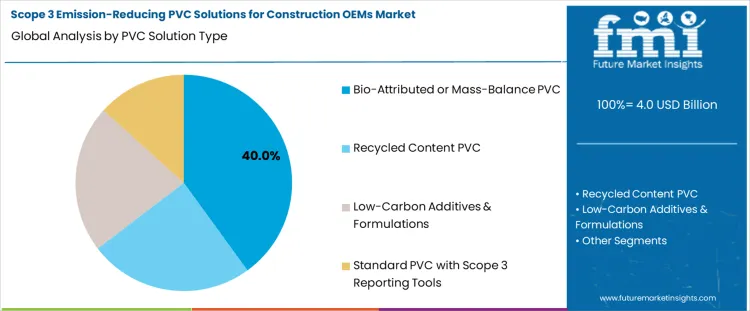
Bio-attributed or mass-balance PVC is the leading PVC solution type in the Scope 3 emission-reducing PVC solutions for construction OEMs market, holding 40% of the share. This growth is driven by the increasing demand for materials that help reduce carbon emissions, especially in construction, where the environmental impact of materials is a key concern. Bio-attributed or mass-balance PVC is produced using renewable and/or recycled feedstocks, offering a more sustainable alternative to traditional PVC. By certifying the renewable portion of the raw materials through mass-balance systems, these solutions help construction OEMs meet their sustainability targets and regulatory requirements related to carbon footprints and environmental impact. As the push for carbon-neutral construction materials intensifies, bio-attributed and mass-balance PVC are seen as key solutions to help manufacturers reduce Scope 3 emissions, particularly in the residential and commercial building sectors. The increased adoption of green building standards and regulations further drives the demand for these eco-friendly PVC solutions.
What is Driving the Demand for Residential and Commercial Buildings in the Scope 3 Emission-Reducing PVC Solutions for Construction OEMs Market?
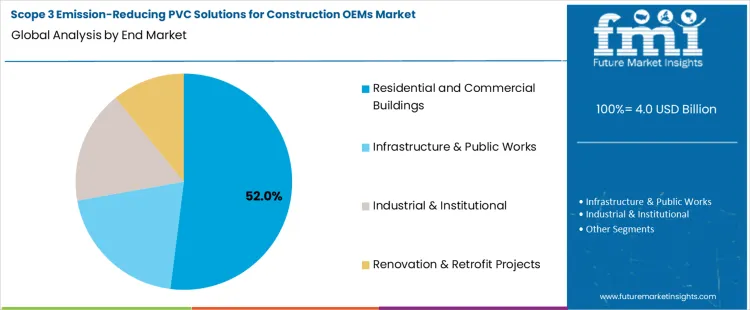
Residential and commercial buildings are the leading end market in the Scope 3 emission-reducing PVC solutions for construction OEMs market, capturing 52% of the share. This demand is driven by the growing emphasis on sustainability in the construction industry and the need for materials that reduce the carbon footprint of buildings. As governments and organizations worldwide implement stricter environmental regulations and standards for construction materials, residential and commercial building developers are increasingly seeking out sustainable alternatives, such as bio-attributed or mass-balance PVC, to meet these requirements. Additionally, consumer demand for eco-friendly and energy-efficient homes and buildings has led to an increase in the use of sustainable materials, including low-carbon PVC solutions. The focus on reducing the environmental impact of new buildings and improving the overall sustainability of the built environment continues to drive the demand for Scope 3 emission-reducing PVC solutions, particularly in the residential and commercial sectors, ensuring their dominance in the market.
What are the Key Dynamics in the Scope 3 Emission-Reducing PVC Solutions for Construction OEMs Market?
The scope 3 emission-reducing PVC solutions for construction OEMs market is defined by efforts to lower indirect greenhouse gas emissions associated with PVC used in building products. Scope 3 emissions include upstream material production and downstream use in roofs, facades, flooring, insulation, window frames, and piping systems. Construction original equipment manufacturers assess PVC solutions based on embodied carbon performance, material traceability, and compliance with sustainability reporting standards. Regulations and voluntary frameworks that require disclosure of lifecycle emissions influence adoption. Market activity reflects intersection of low-carbon material sourcing, product performance requirements, and construction sector targets for carbon reduction and circular economy outcomes.
What are the Main Drivers Supporting Growth in This Market?
Growth in the scope 3 emission-reducing PVC solutions market is driven by regulatory and corporate commitments to climate targets that include indirect emissions. Construction OEMs face pressure from building code updates, green building certification systems, and procurement policies that incorporate embodied carbon metrics. Demand for decarbonized materials aligns with broader industry transitions toward low-carbon infrastructure and sustainable construction practices. Advances in PVC resin production, including renewable-energy integration, recycled feedstocks, and process efficiencies, help reduce lifecycle carbon. Improved environmental product declarations, lifecycle assessments, and third-party verification enable OEMs to demonstrate progress on scope 3 emission reductions to stakeholders and clients.
What Restraints Are Limiting Market Expansion?
Market expansion is limited by cost differentials between emission-reducing PVC solutions and conventional PVC materials, which can deter price-sensitive projects. Infrastructure and supply chain constraints for low-carbon feedstocks and renewable energy sources restrict consistent availability of qualifying PVC grades. Differences in regional standards for carbon accounting, certification, and reporting create complexity for material suppliers and OEMs operating in multiple markets. Some OEMs prioritize short-term budget and schedule concerns over long-term carbon reduction goals, which can slow specification of low-carbon PVC. Technical challenges in quantifying and attributing scope 3 emissions to specific material improvements also constrain widespread adoption.
What Emerging Trends Are Shaping the Future of This Market?
Emerging trends include increased use of mass balance and chain-of-custody systems that attribute renewable, recycled, or low-carbon inputs through complex PVC supply chains to final construction products. Digital lifecycle assessment tools and carbon management platforms are enabling more accurate measurement of scope 3 emissions and informing material selection. Collaboration among OEMs, material producers, and certification bodies is expanding to harmonize performance standards and reporting frameworks for low-carbon PVC solutions. Interest in circular economy strategies, such as PVC recycling and upcycling, is influencing product design and end-of-life planning. Growing integration of low-carbon PVC materials with broader sustainability programs in construction, including net zero pathways and embodied carbon targets, is shaping investment and procurement decisions.
What is the Country-Wise Analysis of the Scope 3 Emission-Reducing PVC Solutions for Construction OEMs Market?
The Scope 3 emission-reducing PVC solutions for construction OEMs (Original Equipment Manufacturers) market is growing rapidly as the construction industry seeks to meet sustainability goals and reduce carbon emissions across its value chain. Scope 3 emissions refer to indirect emissions that occur in the supply chain, including the production and transportation of materials. PVC, commonly used in construction materials, is a significant contributor to these emissions. As governments and industries around the world increasingly focus on reducing carbon footprints and improving sustainability, the demand for Scope 3 emission-reducing PVC solutions is growing. Developed markets such as the USA, Germany, and Japan are leading the way in adopting these solutions due to strong regulatory frameworks, consumer demand for sustainable building materials, and commitments to achieving carbon reduction targets. Emerging markets like China and South Korea are also seeing growth, driven by growing awareness of environmental issues and increasing government support for green building initiatives. As global efforts to reduce emissions intensify, the market for Scope 3 emission-reducing PVC solutions in construction is expected to expand significantly.
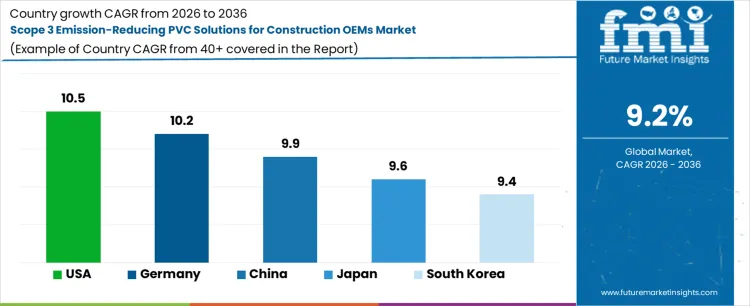
| Country | CAGR (2026-2036) |
|---|---|
| USA | 10.5% |
| Germany | 10.2% |
| China | 9.9% |
| Japan | 9.6% |
| South Korea | 9.4% |
What is the Growth Outlook for the Scope 3 Emission-Reducing PVC Solutions for Construction OEMs Market in the USA?
The Scope 3 emission-reducing PVC solutions for construction OEMs market in the USA is projected to grow steadily, with a projected CAGR of 10.5% from 2026 to 2036. The USA has a strong commitment to sustainability, with increasing government support for reducing carbon emissions and improving the environmental performance of the construction industry. As the construction sector in the USA seeks to meet its carbon reduction goals, there is a growing demand for PVC solutions that minimize Scope 3 emissions, particularly in materials used for construction projects. The USA government’s emphasis on sustainable infrastructure and green building practices, combined with consumer demand for eco-friendly products, is driving the adoption of Scope 3 emission-reducing PVC solutions. As industries continue to focus on reducing their carbon footprints, the market for Scope 3 emission-reducing PVC solutions for construction OEMs in the USA is expected to experience steady growth.
What is the Market Outlook for the Scope 3 Emission-Reducing PVC Solutions for Construction OEMs Market in Germany?
Germany is expected to see steady growth in the Scope 3 emission-reducing PVC solutions for construction OEMs market, with a projected CAGR of 10.2% from 2026 to 2036. Germany is a global leader in sustainability and green building technologies, and the demand for eco-friendly materials is rising in the construction sector. The German government has introduced policies to promote sustainable building practices and reduce carbon emissions, which is driving the adoption of Scope 3 emission-reducing PVC solutions. The construction industry in Germany is increasingly focusing on reducing its carbon footprint, and PVC solutions that minimize Scope 3 emissions are becoming more popular. With Germany’s strong regulatory framework and commitment to achieving sustainability targets, the market for emission-reducing PVC solutions is expected to grow steadily in the coming years.
What is the Growth Forecast for the Scope 3 Emission-Reducing PVC Solutions for Construction OEMs Market in China?
China is projected to experience steady growth in the Scope 3 emission-reducing PVC solutions for construction OEMs market, with a projected CAGR of 9.9% from 2026 to 2036. As the largest producer and consumer of PVC, China is increasingly focused on reducing its carbon emissions and improving the sustainability of its construction industry. The demand for Scope 3 emission-reducing PVC solutions is growing as the Chinese government encourages green building practices and sustainable manufacturing. The construction sector in China is rapidly evolving, and there is a rising need for materials that reduce Scope 3 emissions, particularly in high-demand sectors such as residential, commercial, and infrastructure construction. As China continues to implement policies supporting sustainability and reduces its environmental footprint, the market for emission-reducing PVC solutions in the construction industry is expected to grow steadily.
What is the Market Outlook for the Scope 3 Emission-Reducing PVC Solutions for Construction OEMs Market in Japan?
Japan is expected to see steady growth in the Scope 3 emission-reducing PVC solutions for construction OEMs market, with a projected CAGR of 9.6% from 2026 to 2036. Japan is committed to reducing its environmental impact and achieving carbon neutrality, and the construction industry is increasingly adopting green materials and practices to meet these goals. Scope 3 emissions, which occur in the supply chain, are a major concern in the construction sector, and there is growing demand for low-carbon PVC solutions to address these emissions. Government regulations and consumer demand for sustainable products are driving the adoption of emission-reducing PVC in Japan’s construction industry. As Japan continues to prioritize sustainability in construction projects, the market for Scope 3 emission-reducing PVC solutions is expected to expand steadily.
What is the Growth Forecast for the Scope 3 Emission-Reducing PVC Solutions for Construction OEMs Market in South Korea?
South Korea is projected to experience steady growth in the Scope 3 emission-reducing PVC solutions for construction OEMs market, with a projected CAGR of 9.4% from 2026 to 2036. South Korea has been proactive in adopting sustainable building practices and green technologies across its industries, and the demand for PVC solutions that reduce Scope 3 emissions is growing. The government’s strong focus on reducing carbon emissions and promoting renewable energy in manufacturing is driving the adoption of eco-friendly materials in construction. As the South Korean construction industry continues to embrace sustainability and works to meet its carbon reduction goals, the market for Scope 3 emission-reducing PVC solutions is expected to grow steadily.
What is the Competitive Landscape for the Scope 3 Emission-Reducing PVC Solutions for Construction OEMs Market?
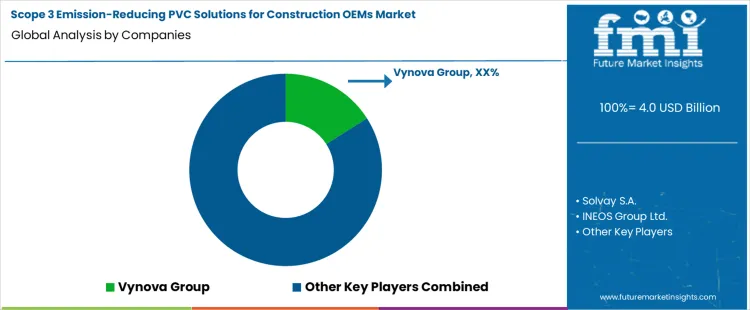
The Scope 3 emission-reducing PVC solutions for construction OEMs market is growing rapidly as the construction industry increasingly adopts strategies to reduce its carbon footprint and meet sustainability goals. Vynova Group leads the market with its innovative PVC solutions designed to reduce Scope 3 emissions in the construction sector, providing products that lower indirect emissions across the value chain. Their focus on sustainability, product performance, and meeting the stringent environmental regulations has positioned them as a dominant player in this market. Solvay S.A., INEOS Group Ltd., and The Dow Chemical Company are key competitors, each offering advanced PVC solutions for construction OEMs that contribute to reducing Scope 3 emissions. Solvay S.A. emphasizes the development of sustainable and low-emission PVC materials, while INEOS Group Ltd. and Dow Chemical Company provide eco-friendly alternatives for the construction industry.
Shin Etsu Chemical Co., Ltd., Westlake Chemical Corporation, and Hanwha Solutions Chemical Division further contribute to the competitive landscape by offering their own Scope 3 emission-reducing PVC solutions. Shin Etsu Chemical Co., Ltd. focuses on delivering sustainable PVC products that minimize environmental impact, while Westlake Chemical Corporation provides high-quality, low-emission materials for construction applications. Hanwha Solutions Chemical Division is advancing eco-friendly PVC solutions that support sustainability goals in construction. Formosa Plastics Corporation, Renolit (bio-attributed PVC), and Arkema S.A. also play key roles in the market by offering PVC solutions that help reduce Scope 3 emissions in the construction sector. Renolit specializes in bio-attributed PVC solutions, while Arkema S.A. focuses on advanced, sustainable materials for construction OEMs. These companies compete by focusing on product innovation, sustainability, and the growing demand for low-emission materials in the construction industry. As global environmental regulations become stricter, the market for Scope 3 emission-reducing PVC solutions is expected to expand, driving further innovation and competition in the sector.
Key Players of the Scope 3 Emission-Reducing PVC Solutions for Construction OEMs Market
- Vynova Group
- Solvay S.A.
- INEOS Group Ltd.
- The Dow Chemical Company
- Shin‑Etsu Chemical Co., Ltd.
- Westlake Chemical Corporation
- Hanwha Solutions Chemical Division
- Formosa Plastics Corporation
- Renolit (bio‑attributed PVC)
- Arkema S.A.
Scope of the Report
| Items | Values |
|---|---|
| Quantitative Units (2026) | USD Billion |
| PVC Solution Type | Bio-Attributed or Mass-Balance PVC, Recycled Content PVC, Low-Carbon Additives & Formulations, Standard PVC with Scope 3 Reporting Tools |
| Application | Pipes & Fittings, Profiles & Window Frames, Wall & Ceiling Panels, Flooring & Decking, Other Architectural Elements |
| End Market | Residential and Commercial Buildings, Infrastructure & Public Works, Industrial & Institutional, Renovation & Retrofit Projects |
| Companies | Vynova Group, Solvay S.A., INEOS Group Ltd., The Dow Chemical Company, Shin-Etsu Chemical Co., Ltd., Westlake Chemical Corporation, Hanwha Solutions Chemical Division, Formosa Plastics Corporation, Renolit (bio-attributed PVC), Arkema S.A. |
| Regions Covered | North America, Latin America, Western Europe, Eastern Europe, South Asia & Pacific, East Asia, Middle East & Africa |
| Countries Covered | United States, Canada, Mexico, Brazil, Argentina, Germany, France, United Kingdom, Italy, Spain, Netherlands, China, India, Japan, South Korea, ANZ, GCC Countries, South Africa |
| Additional Attributes | Dollar sales by PVC solution type, application, end market, and region. Includes analysis of market trends in Scope 3 emission-reducing PVC solutions for construction OEMs, performance of bio-attributed and recycled content PVC in construction materials, impact of low-carbon additives and formulations on lifecycle emissions, integration of Scope 3 reporting tools, cost and supply chain considerations, regulatory and sustainability frameworks influencing adoption, competitive positioning and market share of key companies, innovations in low-carbon PVC technologies, and assessment of influence on building performance, durability, carbon reporting outcomes, and demand across construction and infrastructure sectors. |
Scope 3 Emission-Reducing PVC Solutions for Construction OEMs Market Segmentation
PVC Solution Type
- Bio-Attributed or Mass-Balance PVC
- Recycled Content PVC
- Low-Carbon Additives & Formulations
- Standard PVC with Scope 3 Reporting Tools
Application
- Pipes & Fittings
- Profiles & Window Frames
- Wall & Ceiling Panels
- Flooring & Decking
- Other Architectural Elements
End Market
- Residential and Commercial Buildings
- Infrastructure & Public Works
- Industrial & Institutional
- Renovation & Retrofit Projects
Region
- Asia Pacific
- China
- Japan
- South Korea
- India
- Australia & New Zealand
- ASEAN
- Rest of Asia Pacific
- Europe
- Germany
- United Kingdom
- France
- Italy
- Spain
- Nordic
- BENELUX
- Rest of Europe
- North America
- United States
- Canada
- Mexico
- Latin America
- Brazil
- Chile
- Rest of Latin America
- Middle East & Africa
- Kingdom of Saudi Arabia
- Other GCC Countries
- Turkey
- South Africa
- Other African Union
- Rest of Middle East & Africa
Frequently Asked Questions
How big is the scope 3 emission-reducing pvc solutions for construction oems market in 2026?
The global scope 3 emission-reducing pvc solutions for construction oems market is estimated to be valued at USD 4.0 billion in 2026.
What will be the size of scope 3 emission-reducing pvc solutions for construction oems market in 2036?
The market size for the scope 3 emission-reducing pvc solutions for construction oems market is projected to reach USD 9.6 billion by 2036.
How much will be the scope 3 emission-reducing pvc solutions for construction oems market growth between 2026 and 2036?
The scope 3 emission-reducing pvc solutions for construction oems market is expected to grow at a 9.2% CAGR between 2026 and 2036.
What are the key PVC solution types in the scope 3 emission-reducing pvc solutions for construction oems market?
The key PVC solution types in scope 3 emission-reducing pvc solutions for construction oems market are bio‑attributed or mass‑balance pvc, recycled content pvc, low‑carbon additives & formulations and standard pvc with scope 3 reporting tools.
Which application segment will contribute significant share in the scope 3 emission-reducing pvc solutions for construction oems market in 2026?
In terms of application, pipes & fittings segment to command 37.0% share in the scope 3 emission-reducing pvc solutions for construction oems market in 2026.
Preview the report firsthand - request a free sample
Get SampleGet the brochure for pricing and purchase details.
Get PDFTable of Content
- Executive Summary
- Global Market Outlook
- Demand-side Trends
- Supply-side Trends
- Technology Roadmap Analysis
- Analysis and Recommendations
- Market Overview
- Market Coverage / Taxonomy
- Market Definition / Scope / Limitations
- Market Background
- Market Dynamics
- Drivers
- Restraints
- Opportunity
- Trends
- Scenario Forecast
- Demand in Optimistic Scenario
- Demand in Likely Scenario
- Demand in Conservative Scenario
- Opportunity Map Analysis
- Product Life Cycle Analysis
- Supply Chain Analysis
- Investment Feasibility Matrix
- Value Chain Analysis
- PESTLE and Porter’s Analysis
- Regulatory Landscape
- Regional Parent Market Outlook
- Production and Consumption Statistics
- Import and Export Statistics
- Market Dynamics
- Global Market Analysis 2021 to 2025 and Forecast, 2026 to 2036
- Historical Market Size Value (USD Million) Analysis, 2021 to 2025
- Current and Future Market Size Value (USD Million) Projections, 2026 to 2036
- Y-o-Y Growth Trend Analysis
- Absolute $ Opportunity Analysis
- Global Market Pricing Analysis 2021 to 2025 and Forecast 2026 to 2036
- Global Market Analysis 2021 to 2025 and Forecast 2026 to 2036, By PVC Solution Type
- Introduction / Key Findings
- Historical Market Size Value (USD Million) Analysis By PVC Solution Type , 2021 to 2025
- Current and Future Market Size Value (USD Million) Analysis and Forecast By PVC Solution Type , 2026 to 2036
- Bio‑Attributed or Mass‑Balance PVC
- Recycled Content PVC
- Low‑Carbon Additives & Formulations
- Standard PVC with Scope 3 Reporting Tools
- Bio‑Attributed or Mass‑Balance PVC
- Y-o-Y Growth Trend Analysis By PVC Solution Type , 2021 to 2025
- Absolute $ Opportunity Analysis By PVC Solution Type , 2026 to 2036
- Global Market Analysis 2021 to 2025 and Forecast 2026 to 2036, By Application
- Introduction / Key Findings
- Historical Market Size Value (USD Million) Analysis By Application, 2021 to 2025
- Current and Future Market Size Value (USD Million) Analysis and Forecast By Application, 2026 to 2036
- Pipes & Fittings
- Profiles & Window Frames
- Wall & Ceiling Panels
- Flooring & Decking
- Other Architectural Elements
- Pipes & Fittings
- Y-o-Y Growth Trend Analysis By Application, 2021 to 2025
- Absolute $ Opportunity Analysis By Application, 2026 to 2036
- Global Market Analysis 2021 to 2025 and Forecast 2026 to 2036, By End Market
- Introduction / Key Findings
- Historical Market Size Value (USD Million) Analysis By End Market, 2021 to 2025
- Current and Future Market Size Value (USD Million) Analysis and Forecast By End Market, 2026 to 2036
- Residential and Commercial Buildings
- Infrastructure & Public Works
- Industrial & Institutional
- Renovation & Retrofit Projects
- Residential and Commercial Buildings
- Y-o-Y Growth Trend Analysis By End Market, 2021 to 2025
- Absolute $ Opportunity Analysis By End Market, 2026 to 2036
- Global Market Analysis 2021 to 2025 and Forecast 2026 to 2036, By Region
- Introduction
- Historical Market Size Value (USD Million) Analysis By Region, 2021 to 2025
- Current Market Size Value (USD Million) Analysis and Forecast By Region, 2026 to 2036
- North America
- Latin America
- Western Europe
- Eastern Europe
- East Asia
- South Asia and Pacific
- Middle East & Africa
- Market Attractiveness Analysis By Region
- North America Market Analysis 2021 to 2025 and Forecast 2026 to 2036, By Country
- Historical Market Size Value (USD Million) Trend Analysis By Market Taxonomy, 2021 to 2025
- Market Size Value (USD Million) Forecast By Market Taxonomy, 2026 to 2036
- By Country
- USA
- Canada
- Mexico
- By PVC Solution Type
- By Application
- By End Market
- By Country
- Market Attractiveness Analysis
- By Country
- By PVC Solution Type
- By Application
- By End Market
- Key Takeaways
- Latin America Market Analysis 2021 to 2025 and Forecast 2026 to 2036, By Country
- Historical Market Size Value (USD Million) Trend Analysis By Market Taxonomy, 2021 to 2025
- Market Size Value (USD Million) Forecast By Market Taxonomy, 2026 to 2036
- By Country
- Brazil
- Chile
- Rest of Latin America
- By PVC Solution Type
- By Application
- By End Market
- By Country
- Market Attractiveness Analysis
- By Country
- By PVC Solution Type
- By Application
- By End Market
- Key Takeaways
- Western Europe Market Analysis 2021 to 2025 and Forecast 2026 to 2036, By Country
- Historical Market Size Value (USD Million) Trend Analysis By Market Taxonomy, 2021 to 2025
- Market Size Value (USD Million) Forecast By Market Taxonomy, 2026 to 2036
- By Country
- Germany
- UK
- Italy
- Spain
- France
- Nordic
- BENELUX
- Rest of Western Europe
- By PVC Solution Type
- By Application
- By End Market
- By Country
- Market Attractiveness Analysis
- By Country
- By PVC Solution Type
- By Application
- By End Market
- Key Takeaways
- Eastern Europe Market Analysis 2021 to 2025 and Forecast 2026 to 2036, By Country
- Historical Market Size Value (USD Million) Trend Analysis By Market Taxonomy, 2021 to 2025
- Market Size Value (USD Million) Forecast By Market Taxonomy, 2026 to 2036
- By Country
- Russia
- Poland
- Hungary
- Balkan & Baltic
- Rest of Eastern Europe
- By PVC Solution Type
- By Application
- By End Market
- By Country
- Market Attractiveness Analysis
- By Country
- By PVC Solution Type
- By Application
- By End Market
- Key Takeaways
- East Asia Market Analysis 2021 to 2025 and Forecast 2026 to 2036, By Country
- Historical Market Size Value (USD Million) Trend Analysis By Market Taxonomy, 2021 to 2025
- Market Size Value (USD Million) Forecast By Market Taxonomy, 2026 to 2036
- By Country
- China
- Japan
- South Korea
- By PVC Solution Type
- By Application
- By End Market
- By Country
- Market Attractiveness Analysis
- By Country
- By PVC Solution Type
- By Application
- By End Market
- Key Takeaways
- South Asia and Pacific Market Analysis 2021 to 2025 and Forecast 2026 to 2036, By Country
- Historical Market Size Value (USD Million) Trend Analysis By Market Taxonomy, 2021 to 2025
- Market Size Value (USD Million) Forecast By Market Taxonomy, 2026 to 2036
- By Country
- India
- ASEAN
- Australia & New Zealand
- Rest of South Asia and Pacific
- By PVC Solution Type
- By Application
- By End Market
- By Country
- Market Attractiveness Analysis
- By Country
- By PVC Solution Type
- By Application
- By End Market
- Key Takeaways
- Middle East & Africa Market Analysis 2021 to 2025 and Forecast 2026 to 2036, By Country
- Historical Market Size Value (USD Million) Trend Analysis By Market Taxonomy, 2021 to 2025
- Market Size Value (USD Million) Forecast By Market Taxonomy, 2026 to 2036
- By Country
- Kingdom of Saudi Arabia
- Other GCC Countries
- Turkiye
- South Africa
- Other African Union
- Rest of Middle East & Africa
- By PVC Solution Type
- By Application
- By End Market
- By Country
- Market Attractiveness Analysis
- By Country
- By PVC Solution Type
- By Application
- By End Market
- Key Takeaways
- Key Countries Market Analysis
- USA
- Pricing Analysis
- Market Share Analysis, 2025
- By PVC Solution Type
- By Application
- By End Market
- Canada
- Pricing Analysis
- Market Share Analysis, 2025
- By PVC Solution Type
- By Application
- By End Market
- Mexico
- Pricing Analysis
- Market Share Analysis, 2025
- By PVC Solution Type
- By Application
- By End Market
- Brazil
- Pricing Analysis
- Market Share Analysis, 2025
- By PVC Solution Type
- By Application
- By End Market
- Chile
- Pricing Analysis
- Market Share Analysis, 2025
- By PVC Solution Type
- By Application
- By End Market
- Germany
- Pricing Analysis
- Market Share Analysis, 2025
- By PVC Solution Type
- By Application
- By End Market
- UK
- Pricing Analysis
- Market Share Analysis, 2025
- By PVC Solution Type
- By Application
- By End Market
- Italy
- Pricing Analysis
- Market Share Analysis, 2025
- By PVC Solution Type
- By Application
- By End Market
- Spain
- Pricing Analysis
- Market Share Analysis, 2025
- By PVC Solution Type
- By Application
- By End Market
- France
- Pricing Analysis
- Market Share Analysis, 2025
- By PVC Solution Type
- By Application
- By End Market
- India
- Pricing Analysis
- Market Share Analysis, 2025
- By PVC Solution Type
- By Application
- By End Market
- ASEAN
- Pricing Analysis
- Market Share Analysis, 2025
- By PVC Solution Type
- By Application
- By End Market
- Australia & New Zealand
- Pricing Analysis
- Market Share Analysis, 2025
- By PVC Solution Type
- By Application
- By End Market
- China
- Pricing Analysis
- Market Share Analysis, 2025
- By PVC Solution Type
- By Application
- By End Market
- Japan
- Pricing Analysis
- Market Share Analysis, 2025
- By PVC Solution Type
- By Application
- By End Market
- South Korea
- Pricing Analysis
- Market Share Analysis, 2025
- By PVC Solution Type
- By Application
- By End Market
- Russia
- Pricing Analysis
- Market Share Analysis, 2025
- By PVC Solution Type
- By Application
- By End Market
- Poland
- Pricing Analysis
- Market Share Analysis, 2025
- By PVC Solution Type
- By Application
- By End Market
- Hungary
- Pricing Analysis
- Market Share Analysis, 2025
- By PVC Solution Type
- By Application
- By End Market
- Kingdom of Saudi Arabia
- Pricing Analysis
- Market Share Analysis, 2025
- By PVC Solution Type
- By Application
- By End Market
- Turkiye
- Pricing Analysis
- Market Share Analysis, 2025
- By PVC Solution Type
- By Application
- By End Market
- South Africa
- Pricing Analysis
- Market Share Analysis, 2025
- By PVC Solution Type
- By Application
- By End Market
- USA
- Market Structure Analysis
- Competition Dashboard
- Competition Benchmarking
- Market Share Analysis of Top Players
- By Regional
- By PVC Solution Type
- By Application
- By End Market
- Competition Analysis
- Competition Deep Dive
- Vynova Group
- Overview
- Product Portfolio
- Profitability by Market Segments (Product/Age /Sales Channel/Region)
- Sales Footprint
- Strategy Overview
- Marketing Strategy
- Product Strategy
- Channel Strategy
- Solvay S.A.
- INEOS Group Ltd.
- The Dow Chemical Company
- Shin‑Etsu Chemical Co., Ltd.
- Westlake Chemical Corporation
- Hanwha Solutions Chemical Division
- Formosa Plastics Corporation
- Renolit (bio‑attributed PVC)
- Arkema S.A.
- Vynova Group
- Competition Deep Dive
- Assumptions & Acronyms Used
- Research Methodology


