

- Industry Size (2026)
- USD 160.1 Mn
- Forecast (2036)
- USD 393.2 Mn
- CAGR (2026 to 2036)
- 9.4%
Demand for Electric Wheelchair in South Korea Forecast and Outlook 2026 to 2036
Expenditure on electric mobility devices in South Korea is anticipated to be valued at USD 160.1 million in 2026. The industry is poised to reach USD 393.2 million by 2036, expanding at a compound annual growth rate of 9.4%. South Korea is experiencing a demographic shift towards a super-aged society faster than any other developed nation, creating an urgent need for advanced mobility solutions. Government policies are increasingly focusing on enhancing the quality of life for the elderly and disabled populations through substantial subsidies for assistive devices.
Public administration efforts to improve barrier-free access in public spaces are synchronizing with private sector innovation. Municipalities are retrofitting sidewalks and public buildings, thereby incentivizing the adoption of powered mobility aids. Healthcare institutions are actively upgrading their rehabilitation equipment to provide better patient outcomes, leading to bulk purchases of advanced wheelchairs.
Increasing prevalence of lifestyle-related conditions such as stroke and spinal cord injuries further necessitates robust mobility support. Families are investing in premium electric wheelchairs to ensure their loved ones maintain autonomy and social participation. Consequently, the convergence of policy support, demographic necessity, and infrastructure development creates a fertile environment for sustained industry expansion over the coming decade.
Quick Stats for Demand for Electric Wheelchair in South Korea
- Demand for Electric Wheelchair in South Korea Value (2026): USD 160.1 million
- Demand for Electric Wheelchair in South Korea Forecast Value (2036): USD 393.2 million
- Demand for Electric Wheelchair in South Korea Forecast CAGR: 9.4%
- Leading Product Type Segment for Electric Wheelchair Industry in South Korea: Rear Wheel Drive (41.0%)
- Leading End User Segment for Electric Wheelchair Industry in South Korea: Hospitals & Clinics (48.6%)
- Key Growth Regions for Electric Wheelchair Industry in South Korea: Jeju, South Gyeongsang, South Jeolla, North Jeolla
- Electric Wheelchair Industry in South Korea Key Players: Invacare Corporation, Permobil AB, Pride Mobility Products Corp., Sunrise Medical LLC, Drive DeVilbiss Healthcare
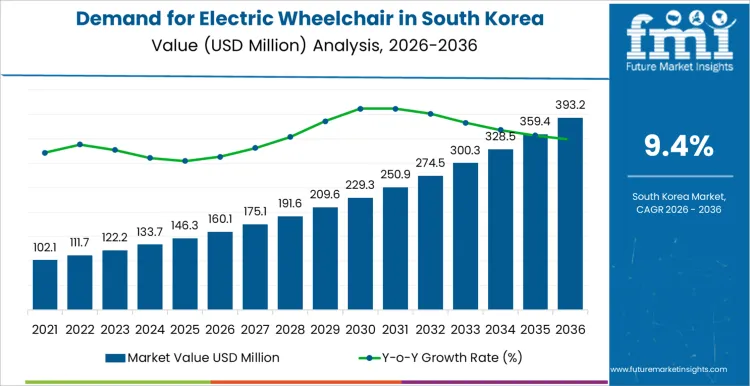
Technological integration is revolutionizing the user experience with the emergence of smart wheelchair models equipped with obstacle avoidance and navigation systems. Manufacturers are incorporating AI-driven diagnostics to predict maintenance needs, ensuring reliability for daily users. Robotic wheelchair technologies are gaining traction, offering autonomous navigation capabilities that are particularly beneficial for users with severe cognitive or motor impairments.
Connectivity features allowing integration with smartphones enable users to control chair settings and access emergency services seamlessly. Innovation in personal mobility devices is blurring the lines between traditional wheelchairs and modern electric vehicles, offering sleek designs that reduce stigma. These advancements are crucial for attracting younger users and tech-savvy seniors who demand both functionality and style.
Demand for Electric Wheelchair in South Korea Key Takeaways
South Korea's assistive technology domain is defined by a strong preference for high-performance and safe mobility solutions. Rear-wheel drive configurations hold the largest portion of sales due to their stability and ease of maneuvering in diverse terrains. Hospitals and clinics represent the primary distribution channel, reflecting the medical necessity of these devices for rehabilitation. Regional growth is robust in areas with high elderly concentrations and tourism infrastructure. Competitive dynamics are led by global manufacturers who leverage advanced R&D, while local distributors play a vital role in after-sales service.
| Metric | Value |
|---|---|
| Industry Size (2026) | USD 160.1 million |
| Industry Value (2036) | USD 393.2 million |
| CAGR (2026 to 2036) | 9.4% |
What Specific Socio-Economic Factors Are Fueling Electric Wheelchair Adoption?
Rapidly aging population structures serve as the primary catalyst for increased demand in mobility aids. South Korea's transition to a super-aged society means a significant portion of the populace requires mobility aids and transportation equipment to perform daily activities. Rising disposable incomes allow families to opt for premium electric models over manual alternatives, prioritizing comfort and independence. Government subsidies provided through the National Health Insurance Service significantly reduce the financial burden on end-users, making high-end devices accessible. Furthermore, social initiatives promoting the rights of people with disabilities are reducing the stigma associated with wheelchair use, encouraging more individuals to utilize wheelchairs for social and professional engagement.
How is the Sector Structured Across Key Segments?
Structure of this domain is categorized by drive mechanism, end-user facility, and specific functionality. Product segmentation distinguishes between front, rear, and mid-wheel drives, each catering to different environmental needs. End-user classification highlights the role of medical institutions versus direct homecare usage. Functionality segmentation includes specialized standing chairs that offer physiological benefits. Understanding this segmentation helps manufacturers tailor their product lines; for instance, robust rear-wheel drives are marketed for outdoor use, while compact mid-wheel drives are targeted at indoor users. This division underscores the diverse requirements of the user base, ranging from clinical rehabilitation to active independent living.
Why Does the Rear Wheel Drive Category Maintain Dominance?
Rear Wheel Drive configurations command a 41.0% share of the industry. Stability offered by this design makes it the preferred choice for navigating South Korea's varied terrain, which includes steep gradients and uneven sidewalks. Users appreciate the higher speed capabilities and smoother ride quality associated with rear-wheel propulsion. Bariatric transport wheelchairs often utilize this configuration to ensure safety and durability under heavier loads. Manufacturing simplicity of rear-wheel drive systems also keeps costs competitive compared to complex mid-wheel drive mechanisms. Consequently, both clinicians and users favor this established technology for its reliability and all-terrain performance.
How are Hospitals and Clinics Contributing to Sector Growth?
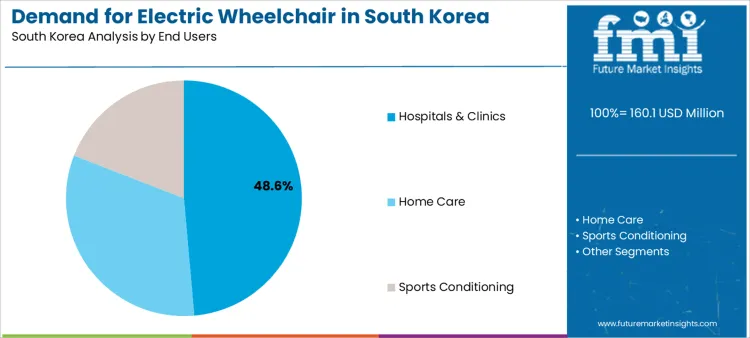
Hospitals and Clinics account for 48.6% of the usage share. Rehabilitation centers are the first point of contact for patients recovering from spinal cord injuries or strokes, influencing their long-term device choices. Medical facilities require a fleet of durable electric wheelchairs to transport patients efficiently within large hospital complexes. Patient handling equipment budgets in these institutions prioritize powered mobility to reduce physical strain on nursing staff. Comprehensive rehabilitation programs often include training on electric wheelchair operation, directly leading to sales upon patient discharge. Trust in medical recommendations ensures that hospitals remain the most influential channel for high-specification device procurement.
Will the Shift to Homecare Redefine Future Sales?
Usage of homecare medical devices is steadily increasing as policy encourages aging in place. Elderly individuals prefer to remain in their own homes rather than move to nursing facilities, necessitating mobility aids that function well in residential settings. Compact electric wheelchairs with tight turning radii are becoming essential for navigating smaller Korean apartments. United States homecare medical devices trends influence local preferences, with a growing demand for portable and foldable models that can be stored easily. This shift drives innovation towards lightweight materials and modular designs, expanding the potential customer base beyond those with severe disabilities to those with moderate mobility limitations.
How Do Battery Innovations Impact Design?
Advancements in lithium-ion battery technology are transforming device portability and range. Users demand wheelchairs that can support an entire day's activity without frequent recharging. Lighter, high-density batteries reduce the overall weight of the chair, facilitating transport in standard vehicles. Research into fast-charging capabilities aims to minimize downtime for active users. Safety concerns regarding battery fires are prompting manufacturers to invest in advanced battery management systems. These energy storage improvements are critical for enabling the adoption of high-power features like standing functions or tilt-in-space mechanisms without compromising travel distance, making electric wheelchairs more versatile than ever.
Is the Trend Towards Standing Wheelchairs Affecting Demand?
Standing electric wheelchairs are gaining traction, currently holding a 20.0% share. Clinical benefits of standing, such as improved circulation, bone density, and pressure relief, are driving this adoption. Users value the psychological and social benefits of interacting with others at eye level. Reimbursement policies are beginning to recognize the therapeutic value of these devices, slowly expanding coverage. Although standing mechanisms increase the complexity and cost of the chair, the health outcomes justify the investment for many long-term users. This trend pushes manufacturers to engineer robust, safe standing mechanisms that fit within standard wheelchair footprints.
How is the Mobility Landscape Evolving Across South Korea's Regions?
Regional consumption reflects the distribution of elderly populations and the accessibility of local infrastructure. Metropolitan areas lead in the adoption of high-tech devices, while provincial regions focus on durable, all-terrain solutions. Government support for regional welfare centers ensures that assistive technology reaches remote communities.
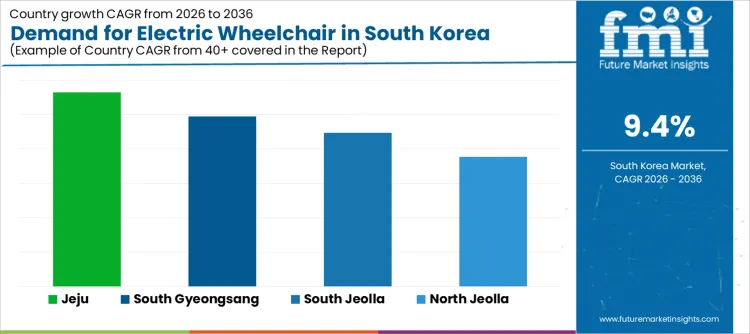
| Region | CAGR (2026 to 2036) |
|---|---|
| Jeju | 11.3% |
| South Gyeongsang | 9.9% |
| South Jeolla | 8.9% |
| North Jeolla | 7.5% |
Why is the Tourism Infrastructure in Jeju Driving Rapid Growth?
Adoption of electric wheelchairs in Jeju is projected to expand at a CAGR of 11.3%. Jeju Island is actively promoting "barrier-free" tourism to attract elderly and disabled visitors. Rental services for electric wheelchairs are expanding at major tourist sites, driving commercial procurement. Local government initiatives to make the island accessible for all residents include subsidies for personal mobility devices. An aging local population also contributes to the steady demand for reliable mobility aids. This dual demand from the tourism sector and local residents creates a vibrant environment for mobility device sales.
How is Industrial Demographics in South Gyeongsang Influencing Sales?
Sales of mobility aids in South Gyeongsang are likely to reach a CAGR of 9.9%. This region has a high concentration of industrial workers who are now reaching retirement age, often with occupational musculoskeletal issues. Industrial accident insurance often covers advanced rehabilitation equipment, including electric wheelchairs. Cities in this region are investing in age-friendly infrastructure, encouraging the use of powered mobility devices. Regional hospitals specializing in trauma and rehabilitation are major purchasers, ensuring that patients have access to top-tier equipment for recovery and daily living.
What Specific Factors Drive Demand in South Jeolla?
Expansion in South Jeolla is anticipated to rise at a CAGR of 8.9%. South Jeolla has the highest proportion of super-aged population in the nation. This demographic reality creates a massive, natural demand for assistive technologies. Rural nature of many communities here makes electric wheelchairs vital for maintaining independence where public transport is limited. Public health centers are instrumental in distributing subsidized devices to low-income elderly residents. Focus on keeping seniors active and integrated in their communities drives the adoption of rugged, easy-to-use electric wheelchairs suitable for semi-rural environments.
Why is North Jeolla Modernizing its Welfare Services?
Deployment of assistive devices in North Jeolla is expected to increase at a CAGR of 7.5%. Local governments are prioritizing welfare programs for the disabled and elderly to improve quality of life. Expansion of disability support centers provides a platform for showcasing and distributing modern electric wheelchairs. Educational programs on device usage and maintenance are increasing user confidence. While growth is steady, the focus is on providing cost-effective, durable solutions that meet the basic mobility needs of the region's aging population, ensuring no one is left behind due to mobility impairments.
What Strategic Initiatives Define Industry Leadership?
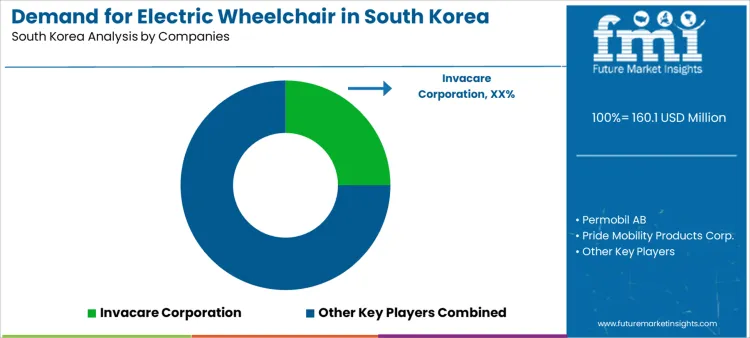
Invacare Corporation commands a dominant position with a 25.0% share, leveraging its reputation for durability and clinical efficacy. Strategy focuses on offering a wide range of customizable seating options to meet specific patient needs. Invacare invests in strong relationships with rehabilitation specialists who influence prescription habits. Competitors like Permobil and Pride Mobility differentiate through technological innovation, such as front-wheel drive tech and sleek, modern aesthetics. Strategic partnerships with local Korean distributors are essential for navigating the complex reimbursement landscape and providing timely maintenance services.
How Are Global Players Adapting to Local Needs?
International firms are customizing their products to fit the physical stature of the Asian population and the compact nature of Korean living spaces. Providing narrower bases and tighter turning circles is a key adaptation. Companies are also integrating Korean language interfaces into smart controllers. Marketing efforts highlight the improved quality of life and independence offered by their devices, resonating with cultural values of dignity in aging. By offering robust after-sales support and parts availability, global players build the trust necessary to succeed in this discerning and regulated sector.
Key Companies
- Invacare Corporation
- Permobil AB
- Pride Mobility Products Corp.
- Sunrise Medical LLC
- Drive DeVilbiss Healthcare
Scope of Report
| Items | Values |
|---|---|
| Quantitative Units | USD Million |
| Product Type | Front Wheel Drive, Rear Wheel Drive, Standing Electric Wheelchairs |
| End Users | Hospitals & Clinics, Home Care, Sports Conditioning |
| Regions Covered | Jeju, South Gyeongsang, South Jeolla, North Jeolla |
| Key Companies Profiled | Invacare, Permobil, Pride Mobility, Sunrise Medical, Drive DeVilbiss |
Demand for Electric Wheelchair in South Korea by Segments
By Product Type:
- Front Wheel Drive
- Rear Wheel Drive
- Standing Electric Wheelchairs
By End Users:
- Hospitals & Clinics
- Home Care
- Sports Conditioning
Bibliography
- Ministry of Health and Welfare. (2024, December 26). 2024 health and welfare statistical yearbook (including long-term care insurance statistics tables). Ministry of Health and Welfare, Republic of Korea.
- Ministry of Health and Welfare. (2023, October 30). 2024 long-term care insurance contribution rate and fee schedule decision (Long-Term Care Insurance Committee results). Ministry of Health and Welfare, Republic of Korea.
- Statistics Korea. (2025, July 28). 2024 population and housing census register-based results. Statistics Korea, Republic of Korea.
- Korea Employment Agency for Persons with Disabilities. (2025). Assistive technology device support program overview (eligibility, limits, and supported costs). Korea Employment Agency for Persons with Disabilities, Republic of Korea.
Frequently Asked Questions
How big is the demand for Electric Wheelchair in South Korea in 2026?
The demand for Electric Wheelchair in South Korea is estimated to be valued at USD 160.1 million in 2026.
What will be the size of Electric Wheelchair in South Korea in 2036?
The industry size for the Electric Wheelchair in South Korea is projected to reach USD 393.2 million by 2036.
How much will be the demand for Electric Wheelchair in South Korea growth between 2026 and 2036?
The demand for Electric Wheelchair in South Korea is expected to grow at a 9.4% CAGR between 2026 and 2036.
What are the key product types in the Electric Wheelchair in South Korea?
The key product types in Electric Wheelchair in South Korea are Rear Wheel Drive and Front Wheel Drive.
Which end user segment is expected to contribute significant share in the Electric Wheelchair in South Korea in 2026?
By end user, Hospitals & Clinics segment is expected to command 48.6% share in the Electric Wheelchair in South Korea in 2026.
Preview the report firsthand - request a free sample
Get SampleGet the brochure for pricing and purchase details.
Get PDFTable of Content
- Executive Summary
- South Korea Market Outlook
- Demand-side Trends
- Supply-side Trends
- Technology Roadmap Analysis
- Analysis and Recommendations
- Market Overview
- Market Coverage / Taxonomy
- Market Definition / Scope / Limitations
- Market Background
- Market Dynamics
- Drivers
- Restraints
- Opportunity
- Trends
- Scenario Forecast
- Demand in Optimistic Scenario
- Demand in Likely Scenario
- Demand in Conservative Scenario
- Opportunity Map Analysis
- Product Life Cycle Analysis
- Supply Chain Analysis
- Investment Feasibility Matrix
- Value Chain Analysis
- PESTLE and Porter’s Analysis
- Regulatory Landscape
- Regional Parent Market Outlook
- Production and Consumption Statistics
- Import and Export Statistics
- Market Dynamics
- South Korea Market Analysis 2021 to 2025 and Forecast, 2026 to 2036
- Historical Market Size Value (USD Million) Analysis, 2021 to 2025
- Current and Future Market Size Value (USD Million) Projections, 2026 to 2036
- Y-o-Y Growth Trend Analysis
- Absolute $ Opportunity Analysis
- South Korea Market Pricing Analysis 2021 to 2025 and Forecast 2026 to 2036
- South Korea Market Analysis 2021 to 2025 and Forecast 2026 to 2036, By Product Type
- Introduction / Key Findings
- Historical Market Size Value (USD Million) Analysis By Product Type , 2021 to 2025
- Current and Future Market Size Value (USD Million) Analysis and Forecast By Product Type , 2026 to 2036
- Front Wheel Drive
- Rear Wheel Drive
- Standing Electric Wheelchairs
- Front Wheel Drive
- Y-o-Y Growth Trend Analysis By Product Type , 2021 to 2025
- Absolute $ Opportunity Analysis By Product Type , 2026 to 2036
- South Korea Market Analysis 2021 to 2025 and Forecast 2026 to 2036, By End Users
- Introduction / Key Findings
- Historical Market Size Value (USD Million) Analysis By End Users, 2021 to 2025
- Current and Future Market Size Value (USD Million) Analysis and Forecast By End Users, 2026 to 2036
- Hospitals & Clinics
- Home Care
- Sports Conditioning
- Hospitals & Clinics
- Y-o-Y Growth Trend Analysis By End Users, 2021 to 2025
- Absolute $ Opportunity Analysis By End Users, 2026 to 2036
- Market Structure Analysis
- Competition Dashboard
- Competition Benchmarking
- Market Share Analysis of Top Players
- By Regional
- By Product Type
- By End Users
- Competition Analysis
- Competition Deep Dive
- Invacare Corporation
- Overview
- Product Portfolio
- Profitability by Market Segments (Product/Age /Sales Channel/Region)
- Sales Footprint
- Strategy Overview
- Marketing Strategy
- Product Strategy
- Channel Strategy
- Permobil AB
- Pride Mobility Products Corp.
- Sunrise Medical LLC
- Drive DeVilbiss Healthcare
- Invacare Corporation
- Competition Deep Dive
- Assumptions & Acronyms Used
- Research Methodology


