

- Industry Size (2026)
- USD 2.4 Mn
- Forecast (2036)
- USD 4.1 Mn
- CAGR (2026 to 2036)
- 5.4%
Demand for Endoluminal Suturing Device in South Korea Forecast and Outlook 2026 to 2036
Expenditure on endoluminal suturing devices in South Korea is projected to reach USD 2.4 million by the end of 2026. Financial valuations for the industry are anticipated to climb to USD 4.1 million by 2036, progressing at a compound annual growth rate of 5.4%. South Korean healthcare landscape is currently witnessing a significant paradigm shift toward minimally invasive therapeutic interventions, particularly within the field of gastroenterology.
Endoscopic procedures have become the standard of care for early-stage gastric cancers, which have a high incidence rate in the region due to dietary habits and genetic factors. This clinical preference drives the adoption of advanced suturing technologies that allow surgeons to close mucosal defects internally without the need for open surgery, thereby reducing patient recovery times and hospitalization costs.
Expansion of this sector is heavily influenced by the increasing prevalence of obesity and the subsequent demand for endoscopic bariatric procedures. Medical professionals are increasingly utilizing endoscopic sleeve gastroplasty as a less invasive alternative to traditional laparoscopic surgeries, necessitating robust suturing tools capable of durable tissue approximation.
Government continues to expand coverage for various endoscopic treatments, which incentivizes hospitals to upgrade their equipment inventories with the latest closure technologies. Innovation in the sector is also being driven by the need for precise closure mechanisms in complex locations within the gastrointestinal tract. Surgeons require devices that offer high maneuverability and reliable knot security to manage complications such as perforations or leaks during endoscopic submucosal dissection.
Quick Stats for Demand for Endoluminal Suturing Device in South Korea
- Demand for Endoluminal Suturing Device in South Korea Industry Value (2026): USD 2.4 million
- Demand for Endoluminal Suturing Device in South Korea Industry Forecast Value (2036): USD 4.1 million
- Demand for Endoluminal Suturing Device in South Korea Forecast CAGR: 5.4%
- Demand for Endoluminal Suturing Device in South Korea Leading Product: Needle-based Suturing Devices (62.0%)
- Demand for Endoluminal Suturing Device in South Korea Leading Application: Bariatric (45.0%)
- Demand for Endoluminal Suturing Device in South Korea Leading End User: Hospitals (55.0%)
- Demand for Endoluminal Suturing Device in South Korea Key Growth Regions: Jeju, South Gyeongsang, South Jeolla, North Jeolla
- Demand for Endoluminal Suturing Device in South Korea Key Players: Boston Scientific Corporation, Medtronic, Olympus, Ovesco Endoscopy AG, EndoRobotics Co., LTD.
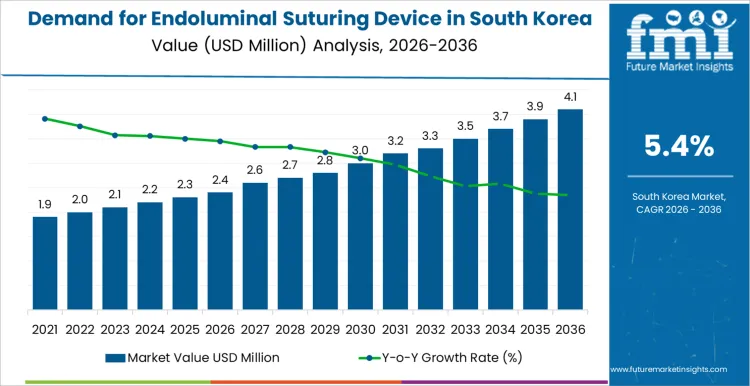
Adoption of these sophisticated tools facilitates complex intraluminal operations that were previously deemed too risky or technically challenging. Manufacturers are focusing on developing ergonomic handle designs and intuitive actuation mechanisms to shorten the learning curve for endoscopists. Integration with mobile endoscopic workstations allows for seamless deployment in varied clinical settings ranging from large university hospitals to smaller specialized clinics. The trend toward outpatient procedures further bolsters the requirement for reliable hemostasis and closure provided by these devices.
Demand for Endoluminal Suturing Device in South Korea Key Takeaways
| Metric | Value |
|---|---|
| Industry Size (2026) | USD 2.4 million |
| Industry Value (2036) | USD 4.1 million |
| CAGR (2026 to 2036) | 5.4% |
What Clinical Drivers Support Device Utilization?
A primary catalyst for growth is the national cancer screening program which detects gastric lesions at early stages suitable for endoscopic removal. South Korea has one of the highest survival rates for stomach cancer globally due to aggressive screening and the proficiency of its endoscopists in techniques like Endoscopic Submucosal Dissection (ESD). Large mucosal defects created during ESD require immediate and secure closure to prevent delayed bleeding and perforation. Endoscopic closure systems allow physicians to suture these defects effectively. The rising burden of metabolic disorders drives the uptake of bariatric surgery devices tailored for endoscopic approaches. Surgeons prefer these minimally invasive options as they preserve organ anatomy and significantly reduce post-operative pain for the patient.
How is the Sector Structured Across Key Segments?
The sector is segmented to address the specific mechanical requirements of tissue approximation in the digestive tract. It is primarily categorized by product type reflecting the mechanism of action. The application segment highlights the clinical indications driving volume. The end user segment underscores the healthcare facilities procuring these technologies. Each segment plays a vital role where needle-based systems provide versatility for complex defect closures and hospitals drive volume through high-acuity caseloads.
Why Do Needle-Based Devices Dominate the Product Landscape?
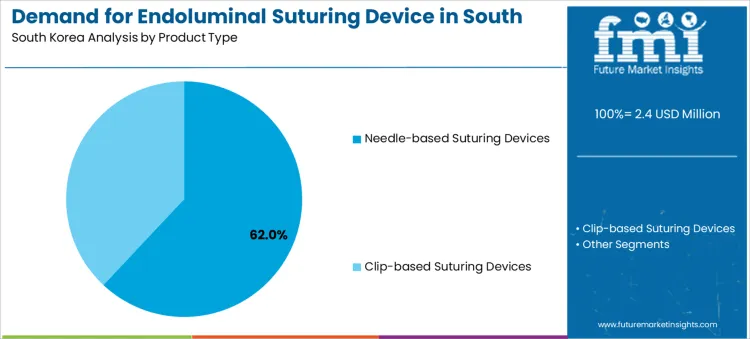
Needle-based Suturing Devices command a 62.0% share of the industry. This prevalence is attributed to their ability to mimic surgical hand-suturing capabilities through an endoscope. Surgeons value the full-thickness bites these devices achieve which is critical for secure tissue apposition in bariatric procedures and large defect closures. The re-loadable nature of these systems allows for multiple stitches without removing the scope improving procedural efficiency. While surgical clips are useful for small mucosal defects the needle-based approach remains the gold standard for closing larger perforations or creating plications for stomach volume reduction.
How Does Bariatric Application Fuel Growth?
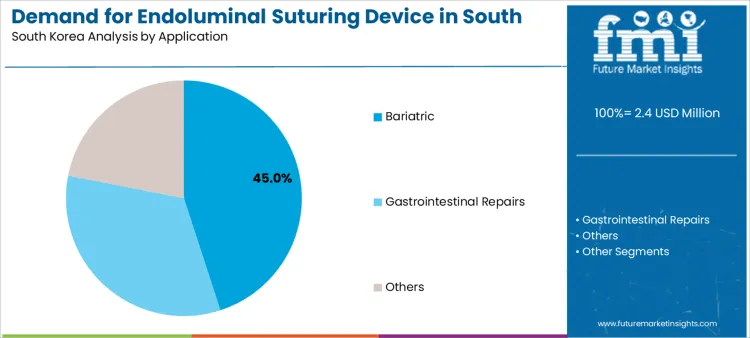
Bariatric applications account for 45.0% of the procedure volume. South Korea is experiencing a gradual increase in morbid obesity rates leading to a demand for weight management interventions. Endoscopic Sleeve Gastroplasty (ESG) utilizes endoluminal suturing device technology to suture the stomach wall internally reducing its capacity. This procedure is gaining traction as it avoids external incisions and offers a faster return to daily activities compared to laparoscopic sleeve gastrectomy. The aesthetic consciousness of the South Korean population further drives the preference for scarless endoscopic weight loss solutions over traditional surgical methods.
Why Are Hospitals the Primary Procurement Hubs?
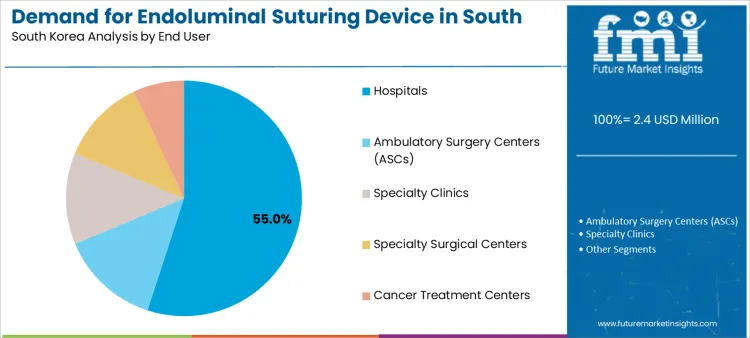
Hospitals represent the dominant end user segment with 55.0% of the total value. Large tertiary care centers in Seoul and other major cities are equipped with advanced endoscopy units and specialized centers for gastrointestinal oncology. These institutions handle the most complex cases including complications referred from smaller clinics. The procurement power of these hospital networks allows for the consistent acquisition of high-cost consumables like automated suturing devices. The availability of multidisciplinary teams including nutritionists and surgeons supports comprehensive bariatric programs that heavily utilize these devices.
Will Robotic Integration Enhance Precision?
A significant trend is the development of robotic-assisted endoscopy platforms. South Korean medical device companies are investing in flexible robotic systems that offer greater degrees of freedom compared to traditional endoscopes. These platforms integrate powered surgical staplers and suturing arms that can be controlled with high precision. This evolution addresses the technical difficulty of manual endoscopic suturing allowing for more consistent stitch placement. The integration of robotic assistance is expected to lower the skill barrier for complex procedures expanding the pool of physicians capable of performing advanced endoscopic closures.
Does Reimbursement Policy Impact Adoption Rates?
The most significant restraint is the limited reimbursement coverage for prophylactic suturing. While therapeutic closure of perforations is generally covered purely preventative closure of large mucosal defects after resection may face scrutiny regarding medical necessity. This economic pressure can deter physicians from using premium absorbable pga surgical sutures devices in marginal cases preferring cheaper clip-based methods. Overcoming this requires generating robust clinical data demonstrating the cost-effectiveness of suturing in preventing delayed complications and reducing readmission rates to justify broader insurance coverage.
How Can Specialized Clinics Unlock New Value?
The emerging field of specialized outpatient endoscopy centers presents a frontier of opportunity. As simple procedures move out of hospitals into Ambulatory Surgery Centers (ASCs) there is a need for efficient closure devices that ensure patient safety upon discharge. Suppliers who provide cost-effective single-use disposable laparoscopic instruments and suturing kits tailored for the ASC environment stand to capture significant revenue. These clinics prioritize throughput and patient turnover making rapid and reliable closure devices essential for their operational model.
How is the Medical Device Landscape Evolving Across South Korea's Regions?
The regional sphere shows a distinct pattern where metropolitan medical hubs drive innovation in complex procedures while provincial centers focus on standard cancer care. High-growth areas are characterizing their development by establishing specialized medical tourism zones. As distinct provinces invest in healthcare infrastructure the utilization of advanced endoscopic tools is becoming tailored to regional demographic health profiles.
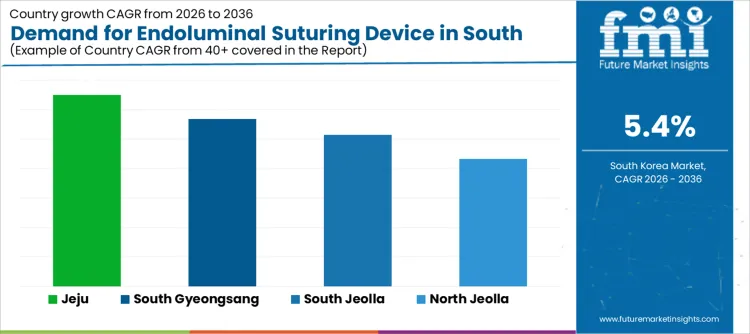
| Region | CAGR (2026 to 2036) |
|---|---|
| Jeju | 6.5% |
| South Gyeongsang | 5.7% |
| South Jeolla | 5.1% |
| North Jeolla | 4.3% |
Why is Medical Tourism Driving Demand in Jeju?
Adoption of advanced medical devices in Jeju is projected to expand at a CAGR of 6.5%. As a designated special self-governing province Jeju is actively promoting medical tourism. International patients visit the island for health checkups and minimally invasive cosmetic or weight loss procedures. The demand is driven by clinics offering premium endoscopic bariatric packages that include laparoscopic devices and advanced suturing technologies. The focus on high-end service delivery necessitates the use of top-tier medical equipment to ensure optimal outcomes for foreign patients.
How is Industrial Healthcare Influencing South Gyeongsang?
Sales of surgical consumables in South Gyeongsang are likely to reach a CAGR of 5.7%. This region hosts major industrial complexes with a large workforce requiring occupational health support. The demand is fueled by university hospitals in cities like Changwon and Jinju upgrading their gastroenterology departments to treat industrial workers. The prevalence of stress-related gastric conditions among the workforce drives a steady volume of therapeutic endoscopy procedures. Investment in reusable laparoscopic instruments and suturing devices ensures these facilities can manage high patient loads efficiently.
What Role Does Aging Population Play in South Jeolla?
The medical device sector in South Jeolla is anticipated to rise at a CAGR of 5.1%. With a demographic profile skewing significantly older the region faces a high incidence of age-related gastrointestinal cancers. Regional medical centers are adopting endoscopic resection techniques to treat elderly patients who may not tolerate open surgery well. The use of hemostats for wound closure and suturing devices is critical in this fragile population to prevent post-procedural bleeding. Government support for rural healthcare modernization facilitates the acquisition of these necessary technologies.
How is Cancer Care Shaping North Jeolla?
Deployment of endoscopic tools in North Jeolla is expected to increase at a CAGR of 4.3%. The region is strengthening its specialized cancer treatment capabilities to reduce patient outflow to the capital. Hospitals are establishing dedicated centers for digestive diseases adopting surgical stapling devices and advanced suturing systems. The focus is on providing comprehensive care for gastric and colorectal cancers locally. This strategic development ensures that patients in the region have access to the same standard of minimally invasive care available in Seoul.
What Strategies Define Leadership in Endoscopic Suturing?
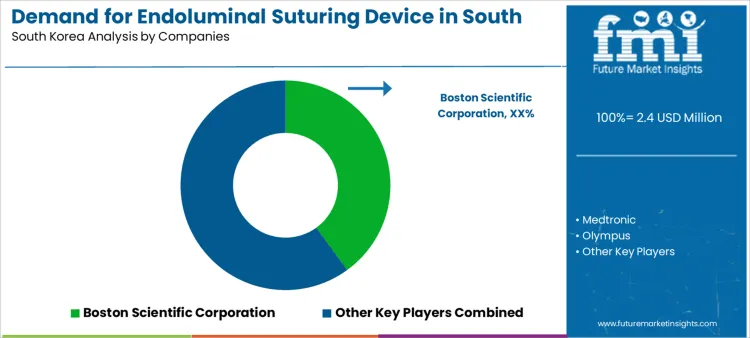
The competitive landscape is firmly anchored by Boston Scientific Corporation which commands a dominant 40.0% share of the sector. Their strategy focuses on clinical education and physician training programs centered around the OverStitch™ system. By investing in hands-on workshops and proctoring they ensure a high level of proficiency among Korean endoscopists creating a loyal user base. Olympus competes by leveraging its dominance in the endoscope capital equipment sector to bundle suturing devices with their imaging platforms. They emphasize system compatibility and ease of integration into existing endoscopy suites.
How Are Domestic Innovators Challenging Global Giants?
Domestic players like EndoRobotics Co., LTD. are emerging with robotic-assisted solutions tailored for the Asian market. These companies are focusing on developing flexible robotic systems that can perform precise suturing tasks with greater dexterity than manual tools. They actively collaborate with leading Korean university hospitals to conduct clinical trials and gather user feedback for rapid iteration. A key opportunity lies in developing cost-effective single-use suture needles and accessories that reduce the per-procedure cost making advanced suturing accessible to smaller community hospitals.
Key Companies
- Boston Scientific Corporation
- Medtronic
- Olympus
- Ovesco Endoscopy AG
- EndoRobotics Co., LTD.
- Apollo Endosurgery (acquired by Boston Scientific)
- Cook Medical
- Steris
- Erbe Elektromedizin GmbH
- Fujifilm Holdings Corporation
Scope of Report
| Items | Values |
|---|---|
| Quantitative Units | USD Million |
| Product Type | Needle-based Suturing Devices, Clip-based Suturing Devices, Others |
| Application | Bariatric, Gastrointestinal Repairs, Gastroesophageal Reflux Disease |
| End User | Hospitals, Ambulatory Surgery Centers (ASCs), Specialty Clinics, Specialty Surgical Centers, Cancer Treatment Centers |
| Regions Covered | Jeju, South Gyeongsang, South Jeolla, North Jeolla |
| Key Companies Profiled | Boston Scientific, Medtronic, Olympus, Ovesco, EndoRobotics, and others. |
Demand for Endoluminal Suturing Device in South Korea by Segments
By Product Type:
- Needle-based Suturing Devices
- Clip-based Suturing Devices
- Others
By Application:
- Bariatric
- Gastrointestinal Repairs
- Gastroesophageal Reflux Disease
By End User:
- Hospitals
- Ambulatory Surgery Centers (ASCs)
- Specialty Clinics
- Specialty Surgical Centers
- Cancer Treatment Centers
Bibliography
- Statistics Korea. (2024, October 3). Causes of death statistics in 2023. Statistics Korea, Republic of Korea.
- Statistics Korea. (2025, September 24). Causes of death statistics results for 2024. Statistics Korea, Republic of Korea.
- Ministry of Health and Welfare. (2025, March 20). Toward a cancer-free society through cancer prevention. Ministry of Health and Welfare, Republic of Korea.
- Health Insurance Review and Assessment Service. (2024, April 1). Health insurance benefit criteria for simultaneous surgeries under gastrointestinal endoscopy. Health Insurance Review and Assessment Service, Republic of Korea.
- Health Insurance Review and Assessment Service. (2025, March 13). Meeting results disclosure on coverage decision for endoscopic hemostasis methods. Health Insurance Review and Assessment Service, Republic of Korea.
Frequently Asked Questions
How big is the demand for Endoluminal Suturing Device in South Korea in 2026?
The demand for endoluminal suturing device in South Korea is estimated to be valued at USD 2.4 million in 2026.
What will be the size of Endoluminal Suturing Device in South Korea in 2036?
The industry size for the endoluminal suturing device in South Korea is projected to reach USD 4.1 million by 2036.
How much will be the demand for Endoluminal Suturing Device in South Korea growth between 2026 and 2036?
The demand for endoluminal suturing device in South Korea is expected to grow at a 5.4% CAGR between 2026 and 2036.
What are the key product types in the Endoluminal Suturing Device in South Korea?
The key product types in endoluminal suturing device in South Korea are needle-based suturing devices, clip-based suturing devices, and others.
Which end user segment is expected to contribute significant share in the Endoluminal Suturing Device in South Korea in 2026?
By end user, the hospitals segment is expected to command 55.0% share in the endoluminal suturing device in South Korea in 2026.
Preview the report firsthand - request a free sample
Get SampleGet the brochure for pricing and purchase details.
Get PDFTable of Content
- Executive Summary
- South Korea Market Outlook
- Demand-side Trends
- Supply-side Trends
- Technology Roadmap Analysis
- Analysis and Recommendations
- Market Overview
- Market Coverage / Taxonomy
- Market Definition / Scope / Limitations
- Market Background
- Market Dynamics
- Drivers
- Restraints
- Opportunity
- Trends
- Scenario Forecast
- Demand in Optimistic Scenario
- Demand in Likely Scenario
- Demand in Conservative Scenario
- Opportunity Map Analysis
- Product Life Cycle Analysis
- Supply Chain Analysis
- Investment Feasibility Matrix
- Value Chain Analysis
- PESTLE and Porter’s Analysis
- Regulatory Landscape
- Regional Parent Market Outlook
- Production and Consumption Statistics
- Import and Export Statistics
- Market Dynamics
- South Korea Market Analysis 2021 to 2025 and Forecast, 2026 to 2036
- Historical Market Size Value (USD Million) Analysis, 2021 to 2025
- Current and Future Market Size Value (USD Million) Projections, 2026 to 2036
- Y-o-Y Growth Trend Analysis
- Absolute $ Opportunity Analysis
- South Korea Market Pricing Analysis 2021 to 2025 and Forecast 2026 to 2036
- South Korea Market Analysis 2021 to 2025 and Forecast 2026 to 2036, By Product Type
- Introduction / Key Findings
- Historical Market Size Value (USD Million) Analysis By Product Type , 2021 to 2025
- Current and Future Market Size Value (USD Million) Analysis and Forecast By Product Type , 2026 to 2036
- Needle-based Suturing Devices
- Clip-based Suturing Devices
- Needle-based Suturing Devices
- Y-o-Y Growth Trend Analysis By Product Type , 2021 to 2025
- Absolute $ Opportunity Analysis By Product Type , 2026 to 2036
- South Korea Market Analysis 2021 to 2025 and Forecast 2026 to 2036, By Application
- Introduction / Key Findings
- Historical Market Size Value (USD Million) Analysis By Application, 2021 to 2025
- Current and Future Market Size Value (USD Million) Analysis and Forecast By Application, 2026 to 2036
- Bariatric
- Gastrointestinal Repairs
- Others
- Bariatric
- Y-o-Y Growth Trend Analysis By Application, 2021 to 2025
- Absolute $ Opportunity Analysis By Application, 2026 to 2036
- South Korea Market Analysis 2021 to 2025 and Forecast 2026 to 2036, By End User
- Introduction / Key Findings
- Historical Market Size Value (USD Million) Analysis By End User, 2021 to 2025
- Current and Future Market Size Value (USD Million) Analysis and Forecast By End User, 2026 to 2036
- Hospitals
- Ambulatory Surgery Centers (ASCs)
- Specialty Clinics
- Specialty Surgical Centers
- Cancer Treatment Centers
- Hospitals
- Y-o-Y Growth Trend Analysis By End User, 2021 to 2025
- Absolute $ Opportunity Analysis By End User, 2026 to 2036
- Market Structure Analysis
- Competition Dashboard
- Competition Benchmarking
- Market Share Analysis of Top Players
- By Regional
- By Product Type
- By Application
- By End User
- Competition Analysis
- Competition Deep Dive
- Boston Scientific Corporation
- Overview
- Product Portfolio
- Profitability by Market Segments (Product/Age /Sales Channel/Region)
- Sales Footprint
- Strategy Overview
- Marketing Strategy
- Product Strategy
- Channel Strategy
- Medtronic
- Olympus
- Ovesco Endoscopy AG
- EndoRobotics Co., LTD.
- Boston Scientific Corporation
- Competition Deep Dive
- Assumptions & Acronyms Used
- Research Methodology


