

- Industry Size (2026)
- USD 466 Mn
- Forecast (2036)
- USD 1353 Mn
- CAGR (2026 to 2036)
- 11.2%
Thermoform-Embedded Electronics Market Forecast and Outlook 2026 to 2036
The Thermoform-Embedded Electronics market is projected to expand from USD 466 million in 2026 to USD 1,353 million by 2036, registering a CAGR of 11.2%. Growth is propelled by increasing integration of electronic functionalities directly into packaging, automotive interiors, and consumer products, enabling smart sensing, connectivity, and interactive features. Advances in flexible circuit embedding, conductive traces, and low-profile sensors allow manufacturers to produce lightweight, compact, and multifunctional components without compromising structural integrity.
Consumer electronics and automotive sectors are the largest adopters, with thermoforming platforms accommodating printed sensors, LEDs, and RFID components. Packaging applications for smart, interactive consumer products are gaining traction, while industrial and medical device integration continues to expand. Companies focus on process standardization, scalable production, and enhanced material compatibility to improve reliability and reduce defect rates, supporting higher adoption of embedded electronics in thermoformed substrates across diverse industries.
Quick Stats of the Thermoform-Embedded Electronics Market:
- Thermoform-Embedded Electronics Market Value (2026): USD 466 million
- Thermoform-Embedded Electronics Forecast Value (2036): USD 1,353 million
- Thermoform-Embedded Electronics Market Forecast CAGR (2026 to 2036): 11.2%
- Leading Packaging Format in the Market: Thermoformed Trays with Embedded Circuits (45%)
- Key Growth Regions in the Market: India, China, USA, Brazil, Germany, Japan
- Top Players in the Market: Sonoco, Klöckner Pentaplast, Shenzhen In-Mold Tech, Mold-Tek, Panasonic Packaging, DuPont, TactoTek, Mirek Thermoformers
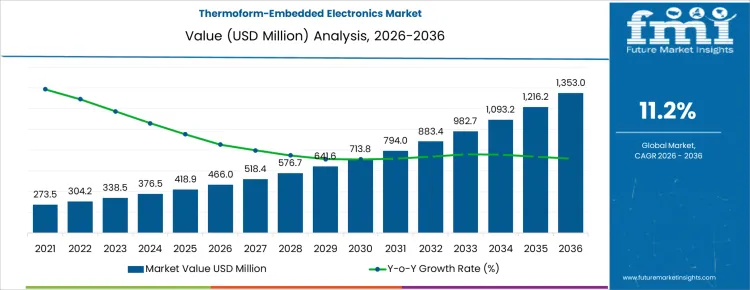
What is the Growth Forecast for the Thermoform-Embedded Electronics Market through 2036?
From 2026 to 2031, the thermoform-embedded electronics market grows from USD 466 million to approximately USD 701 million, representing the early adoption phase. Annual value additions increase from USD 32 million in 2026 to USD 57 million in 2031. Growth is driven by applications in consumer electronics, wearable devices, and smart packaging, where embedding sensors and circuits into thermoformed substrates enables functional integration and product differentiation. Adoption is concentrated in North America and Europe, which account for roughly 65% of early market value, with pilot deployments validating reliability, durability, and manufacturing process compatibility.
Between 2031 and 2036, the market expands from roughly USD 701 million to USD 1,353 million, illustrating the late adoption phase characterized by structural scaling and broad commercialization. Annual increments rise from USD 57 million to USD 173 million, supported by portfolio-wide integration, multi-region deployment, and repeat procurement. Growth is reinforced by expansion into automotive, medical, and industrial applications, increased automation in thermoforming production lines, and adoption of embedded electronics as a standard feature. Early-stage growth relied on selective high-value projects, while later expansion is driven by mass-scale adoption and normalized integration across multiple product sectors.
Thermoform Embedded Electronics Market Key Takeaways
| Metric | Value |
|---|---|
| Market Value (2026) | USD 466 million |
| Forecast Value (2036) | USD 1,353 million |
| Forecast CAGR (2026 to 2036) | 11.2% |
Why Is Thermoform Embedded Electronics Emerging as a Design Constraint Rather Than a Feature?
Early use of thermoform embedded electronics was not driven by demand for smart products but by physical design limits. Product designers struggled to place labels, sensors, or identification elements on thin thermoformed parts without adding secondary assemblies. External tags detached, cracked, or interfered with stacking and sealing. Embedding conductive paths or simple electronic elements during forming solved placement and durability problems in specific cases, such as medical trays or returnable packaging. Historical demand remained narrow and engineering led. Adoption followed manufacturing pain points, not electronics strategy, and projects moved forward only when conventional integration failed.
Future demand reflects a shift in how thermoformed products are specified. Packaging, medical devices, and industrial components increasingly require built in identification, traceability, or condition monitoring without added parts. Embedding electronics during forming eliminates post assembly and protects components inside the structure. This changes cost models and reliability expectations. Designers now treat electronic integration as part of material selection and tooling, not as a later addition. Growth follows specification driven requirements rather than experimentation.
What Factors Are Affecting the Demand for Thermoform Embedded Electronics Market in Terms of End Use Application and Packaging Format and Type?
Demand for thermoform embedded electronics is segmented by end use application and packaging format and type across smart packaging and device protection use cases. Smart food and pharma packs account for about 38% of total demand, making them the leading end use segment. Medical and diagnostics, consumer electronics packaging, emerging smart packaging, appliance packaging, and high precision electronics represent additional applications without disclosed share splits. These segments differ in sensing requirements, data functionality, and regulatory constraints. Packaging format and type determine integration feasibility and protection level. Thermoformed trays with embedded circuits account for about 45% of demand, followed by blister and device trays, protective thermoformed packs, trays and inserts, and other formats. Together, these segments explain demand formation shaped by functional integration needs rather than packaging volume alone.
What Drives Demand by End Use Application in the Thermoform Embedded Electronics Market?
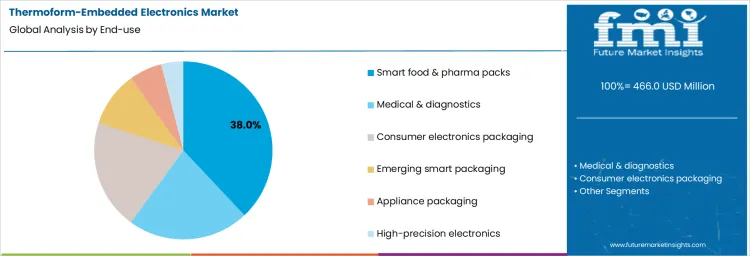
Smart food and pharma packs lead demand with a 38% share because embedded electronics support monitoring, traceability, and condition tracking. These applications require integration of sensors or circuits without compromising hygiene or pack integrity. Medical and diagnostics packaging adopts embedded electronics to support device tracking and handling accuracy. Consumer electronics packaging applies embedded features selectively for authentication or damage monitoring. Emerging smart packaging pilots electronics to test new functionality. Appliance packaging and high precision electronics remain niche due to cost and integration complexity. End use demand therefore reflects value placed on embedded functionality and compliance requirements rather than packaging turnover rates.
Application driven demand remains stable because integration decisions are made early in product design. Food and pharma applications embed electronics where monitoring adds measurable value. Medical applications qualify solutions through extended validation cycles. Consumer electronics adoption remains selective due to cost sensitivity. Emerging applications scale cautiously. These patterns limit short term volatility. End use segmentation highlights dependence on functional benefit justification rather than experimentation across all packaging categories.
How Does Packaging Format and Type Shape Demand for Thermoform Embedded Electronics Market?
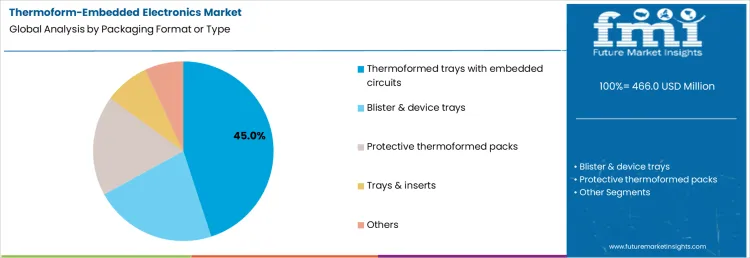
Thermoformed trays with embedded circuits account for about 45% of total demand, making them the leading packaging format. Their dominance reflects structural rigidity and surface area suitable for circuit integration. Blister and device trays adopt embedded electronics where precision placement is required. Protective thermoformed packs support consumer electronics with integrated tracking or sensing features. Trays and inserts serve emerging smart packaging concepts with modular design needs. Other formats address specialized protection or handling requirements. Packaging format selection depends on circuit protection, forming complexity, and assembly compatibility. Demand follows integration reliability and protection performance rather than novelty of form.
Thermoformed trays maintain leadership due to compatibility with automated assembly and electronics protection. Blister formats scale in regulated applications. Protective packs adopt selectively where value justification exists. Inserts remain flexible for pilots. Producers avoid altering formats once integration is validated. This stabilizes format driven demand. Packaging format and type therefore reinforces concentration in rigid thermoformed structures suitable for embedded electronics.
How Are Thermoform Embedded Electronics Being Applied Across Consumer and Industrial Products?
Use appears in applications where electronic components are integrated directly into thermoformed plastic parts to reduce assembly complexity and improve durability. Automotive interiors, appliance panels, and control interfaces embed sensors, LEDs, or conductive traces within molded housings. Consumer electronics such as remote controls, wearable devices, and smart packaging integrate components into thermoformed shells to protect electronics while maintaining form factor. These applications reflect operational and functional priorities rather than decorative purposes, with adoption driven by reliability, assembly efficiency, and space optimization.
What Operational and Material Conditions Support Adoption of Thermoform Embedded Electronics?
Selection aligns with plastics and electronics capable of withstanding thermoforming temperatures and pressure without degrading performance. Manufacturers optimize polymer selection, mold design, and electronic placement to maintain signal integrity and mechanical strength. Production lines require precise registration and thermal control to prevent component damage. Quality control teams monitor alignment, adhesion, and electrical functionality after molding. These conditions emerge from operational reliability, component protection, and integration efficiency priorities in structured manufacturing workflows.
Which Practical Considerations Limit Wider Use of Thermoform Embedded Electronics?
Component sensitivity to heat and pressure can restrict usable electronics and materials. Design complexity increases tooling costs and requires precise mold calibration. Repair or replacement of embedded electronics is challenging, affecting maintenance strategies. Initial capital investment and development time are higher than conventional assembly. Compatibility with high-volume automated lines may be limited by component geometry. These factors lead to selective deployment where integration efficiency, product durability, and functional performance justify additional cost and process control.
What is the Demand for Thermoform Embedded Electronics by Country?
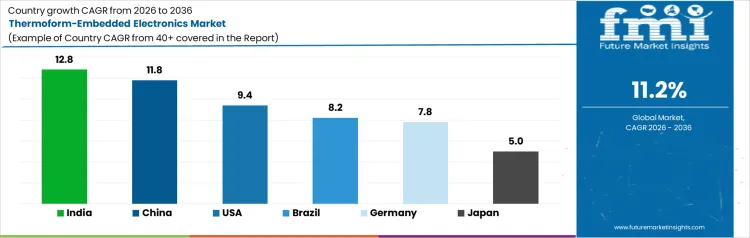
| Country | CAGR (%) |
|---|---|
| USA | 9.4% |
| Germany | 7.8% |
| China | 11.8% |
| India | 12.8% |
| Brazil | 8.2% |
| Japan | 5.0% |
The demand for thermoform embedded electronics varies across countries, driven by adoption in smart packaging, consumer electronics, and industrial applications. India leads with a 12.8% CAGR, supported by increasing use of embedded sensors and smart packaging solutions across FMCG and electronics sectors. China follows at 11.8%, driven by large scale manufacturing, automation, and integration of electronics into packaging and industrial products. The USA grows at 9.4%, reflecting adoption in consumer electronics and advanced packaging applications. Brazil records 8.2%, shaped by expanding industrial and packaging sectors. Germany posts 7.8%, supported by structured manufacturing and technology integration, while Japan grows at 5.0%, reflecting mature electronics and packaging markets.
How Is Thermoform-Embedded Electronics Driving Growth in the United States?
In the United States, revenue from the Thermoform-Embedded Electronics Market is expanding at a CAGR of 9.4% through 2036, driven by adoption of integrated electronics within thermoformed components for packaging, automotive, and consumer goods applications. Manufacturers are embedding sensors, circuits, and smart features into thermoformed plastics to improve functionality, monitoring, and interactivity. Demand is concentrated in food and beverage packaging, automotive interiors, and industrial consumer products. Domestic suppliers provide high-performance, processing-compatible materials and electronics integration solutions. Advancements in manufacturing processes, recurring production of embedded components, and regulatory compliance are sustaining predictable procurement nationwide.
- Food and beverage packaging, automotive interiors, and industrial consumer products drive adoption
- Embedded electronics improve functionality, monitoring, and interactivity
- Domestic suppliers provide high-performance, processing-compatible integration solutions
- Recurring production cycles sustain predictable procurement
How Are Packaging and Industrial Standards Supporting Growth in Germany?
Germany continues to record steady growth in the Thermoform-Embedded Electronics Market at a CAGR of 7.8% through 2036, supported by industrial manufacturing standards and automation in packaging and automotive sectors. Manufacturers are integrating electronics into thermoformed plastics to enhance product functionality, monitoring capabilities, and user interaction. Demand is concentrated in food and beverage packaging, automotive interiors, and industrial consumer products. Domestic suppliers provide high-quality, processing-compatible integration solutions suitable for extrusion, injection molding, and thermoforming processes. Compliance with manufacturing and industrial standards, along with recurring embedded component production, is sustaining measured adoption nationwide.
- Food and beverage packaging, automotive interiors, and industrial consumer products anchor demand
- Embedded electronics enhance functionality, monitoring, and interactivity
- Domestic suppliers provide processing-compatible, high-quality integration solutions
- Recurring production cycles sustain steady adoption
How Is Industrial and Consumer Manufacturing Expansion Accelerating Adoption in China?
In China, revenue from the Thermoform-Embedded Electronics Market is growing at a CAGR of 11.8% through 2036, driven by rapid adoption of embedded electronics in thermoformed plastics for packaging, automotive, and consumer applications. Manufacturers are integrating sensors, circuits, and smart features to improve product functionality and user interaction. Demand is strong across food and beverage packaging, automotive interiors, and industrial consumer products. Domestic suppliers are scaling production of high-performance, integration-compatible systems suitable for extrusion, injection molding, and thermoforming processes. Expanding manufacturing facilities and recurring embedded component production are sustaining rapid adoption nationwide.
- Food and beverage packaging, automotive interiors, and industrial consumer products drive adoption
- Embedded electronics improve product functionality and user interaction
- Domestic suppliers scale high-performance, integration-compatible systems
- Recurring production cycles sustain consistent adoption
How Is Embedded Electronics and Industrial Application Supporting Growth in India?
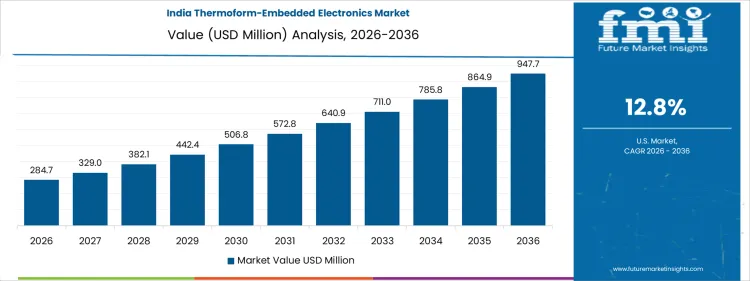
In India, revenue from the Thermoform-Embedded Electronics Market is expanding at a CAGR of 12.8% through 2036, supported by increasing adoption of embedded electronics in thermoformed packaging, automotive, and industrial consumer goods. Manufacturers are integrating sensors and circuits into plastics to enhance monitoring, interactivity, and product functionality. Demand is concentrated in food and beverage packaging, automotive interiors, and industrial consumer products. Domestic suppliers provide high-performance, processing-compatible integration solutions for extrusion, injection molding, and thermoforming. Growth in manufacturing infrastructure, recurring embedded component production, and product innovation are sustaining robust adoption nationwide.
- Food and beverage packaging, automotive interiors, and industrial consumer products drive adoption
- Embedded electronics enhance monitoring, interactivity, and functionality
- Domestic suppliers provide processing-compatible, high-performance integration solutions
- Recurring production cycles sustain robust adoption
How Is Recycling and Industrial Manufacturing Supporting Adoption in Brazil?
Brazil is seeing strong growth in the Thermoform-Embedded Electronics Market at a CAGR of 8.2% through 2036, supported by increasing use of embedded electronics in thermoformed packaging, automotive, and industrial consumer products. Manufacturers are integrating circuits and sensors to improve product functionality, monitoring, and interactivity. Demand is concentrated in food and beverage packaging, automotive interiors, and industrial applications. Domestic suppliers are expanding production of high-performance, technology-compatible integration solutions suitable for extrusion, injection molding, and thermoforming processes. Growth in manufacturing infrastructure and recurring embedded component production are sustaining robust procurement nationwide.
- Food and beverage packaging, automotive interiors, and industrial applications drive adoption
- Embedded electronics improve functionality, monitoring, and interactivity
- Domestic suppliers expand processing-compatible, high-performance integration solutions
- Recurring production cycles sustain robust procurement
How Is Industrial and Consumer Electronics Integration Driving Growth in Japan?
Japan is witnessing growth in the Thermoform-Embedded Electronics Market at a CAGR of 5% through 2036, driven by adoption of embedded electronics in thermoformed plastics for packaging, automotive, and consumer applications. Manufacturers are integrating sensors and circuits to enhance product functionality, interactivity, and monitoring. Demand is concentrated in food and beverage packaging, automotive interiors, and industrial consumer goods. Domestic suppliers provide high-performance, processing-compatible solutions for extrusion, injection molding, and thermoforming processes. Recurring production of embedded components, manufacturing standards, and technology adoption are sustaining predictable procurement nationwide.
- Food and beverage packaging, automotive interiors, and industrial consumer products anchor demand
- Embedded electronics enhance functionality, monitoring, and interactivity
- Domestic suppliers provide high-performance, processing-compatible integration solutions
- Recurring embedded component production sustains predictable procurement
Which Companies Shape Competition in The Thermoform Embedded Electronics Market Through Manufacturing Integration and Design Constraints?
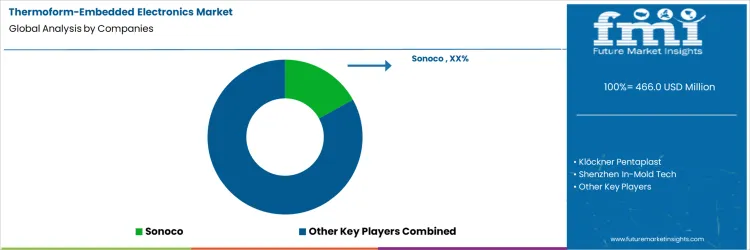
Competition in the Thermoform Embedded Electronics Market is defined by how electronics are incorporated without disrupting forming speed, material integrity, or recyclability. Sonoco and Klöckner Pentaplast influence this space through thermoform packaging platforms adapted to accept conductive layers, sensors, or decorative electronics during forming. TactoTek occupies a distinct role by supplying in mold structural electronics concepts that guide how circuits survive heat, pressure, and deformation. Panasonic Packaging contributes through electronic component know how applied selectively to smart packaging formats rather than mass thermoforming output. Material and process compatibility determines adoption, as electronics must tolerate forming temperatures, draw ratios, and downstream sealing without functional loss.
Execution is driven largely by manufacturing capability and regional specialization. Shenzhen In Mold Tech and Mold Tek participate through tooling, in mold labeling, and process integration expertise that enables electronics placement at scale. Local thermoformers play a decisive role by validating embedded electronics within real production constraints, including cycle time, scrap rates, and quality inspection. DuPont supports the ecosystem through materials used in conductive inks, films, and protective layers rather than finished packaging. Competitive positioning depends on yield stability, tooling precision, and coordination between electronics suppliers and formers. Market progress is constrained by qualification cycles and manufacturability limits rather than concept readiness or component availability.
Key Players in the Thermoform Embedded Electronics Market
- Sonoco
- Klöckner Pentaplast
- Shenzhen In-Mold Tech
- Mold-Tek
- Local thermoformers
- Panasonic Packaging
- DuPont
- TactoTek
Scope of the Report
| Items | Values |
|---|---|
| Quantitative Units (2026) | USD million |
| End-use / Application | Smart food & pharma packs, Medical & diagnostics, Consumer electronics packaging, Emerging smart packaging, Appliance packaging, High-precision electronics |
| Packaging Format / Type | Thermoformed trays with embedded circuits, Blister & device trays, Protective thermoformed packs, Trays & inserts, Others |
| Material | PET / APET / rPET, PETG & multilayer sheets, PET / PS blends, PET, Others |
| Technology | In-mould electronics & printed circuitry, Thermoform-integrated sensors, Printed electronics lamination, Low-cost printed electronics, Others |
| Region | Asia Pacific (China, Japan, South Korea, India, Australia & New Zealand, ASEAN, Rest of Asia Pacific), Europe (Germany, United Kingdom, France, Italy, Spain, Nordic, BENELUX, Rest of Europe), North America (United States, Canada, Mexico), Latin America (Brazil, Chile, Rest of Latin America), Middle East & Africa (KSA, Other GCC Countries, Turkey, South Africa, Other African Union, Rest of Middle East & Africa) |
| Key Companies Profiled | Sonoco, Klöckner Pentaplast, Shenzhen In-Mold Tech, Mold-Tek, Local thermoformers, Panasonic Packaging, DuPont, TactoTek |
| Additional Attributes | Dollar by sales by end-use application, Dollar by sales by packaging format, Dollar by sales by material, Dollar by sales by technology adoption, Dollar by sales by region, Reliability and functional performance, Integration with automated thermoforming lines, Production scalability and repeatability, Embedded electronics adoption in multi-sector applications, Process standardization and defect reduction |
Thermoform Embedded Electronics Market Segmentation
End-use / Application:
- Smart food & pharma packs
- Medical & diagnostics
- Consumer electronics packaging
- Emerging smart packaging
- Appliance packaging
- High-precision electronics
Packaging Format / Type:
- Thermoformed trays with embedded circuits
- Blister & device trays
- Protective thermoformed packs
- Trays & inserts
- Others
Material:
- PET / APET / rPET
- PETG & multilayer sheets
- PET / PS blends
- PET
- Others
Technology:
- In-mould electronics & printed circuitry
- Thermoform-integrated sensors
- Printed electronics lamination
- Low-cost printed electronics
- Others
Region
- Asia Pacific
- China
- Japan
- South Korea
- India
- Australia & New Zealand
- ASEAN
- Rest of Asia Pacific
- Europe
- Germany
- United Kingdom
- France
- Italy
- Spain
- Nordic
- BENELUX
- Rest of Europe
- North America
- United States
- Canada
- Mexico
- Latin America
- Brazil
- Chile
- Rest of Latin America
- Middle East & Africa
- Kingdom of Saudi Arabia
- Other GCC Countries
- Turkey
- South Africa
- Other African Union
- Rest of Middle East & Africa
Frequently Asked Questions
How big is the thermoform-embedded electronics market in 2026?
The global thermoform-embedded electronics market is estimated to be valued at USD 466.0 million in 2026.
What will be the size of thermoform-embedded electronics market in 2036?
The market size for the thermoform-embedded electronics market is projected to reach USD 1,353.0 million by 2036.
How much will be the thermoform-embedded electronics market growth between 2026 and 2036?
The thermoform-embedded electronics market is expected to grow at a 11.2% CAGR between 2026 and 2036.
What are the key product types in the thermoform-embedded electronics market?
The key product types in thermoform-embedded electronics market are smart food & pharma packs, medical & diagnostics, consumer electronics packaging, emerging smart packaging, appliance packaging and high-precision electronics.
Which packaging format or type segment to contribute significant share in the thermoform-embedded electronics market in 2026?
In terms of packaging format or type, thermoformed trays with embedded circuits segment to command 45.0% share in the thermoform-embedded electronics market in 2026.
Preview the report firsthand - request a free sample
Get SampleGet the brochure for pricing and purchase details.
Get PDFTable of Content
- Executive Summary
- Global Market Outlook
- Demand-side Trends
- Supply-side Trends
- Technology Roadmap Analysis
- Analysis and Recommendations
- Market Overview
- Market Coverage / Taxonomy
- Market Definition / Scope / Limitations
- Market Background
- Market Dynamics
- Drivers
- Restraints
- Opportunity
- Trends
- Scenario Forecast
- Demand in Optimistic Scenario
- Demand in Likely Scenario
- Demand in Conservative Scenario
- Opportunity Map Analysis
- Product Life Cycle Analysis
- Supply Chain Analysis
- Investment Feasibility Matrix
- Value Chain Analysis
- PESTLE and Porter’s Analysis
- Regulatory Landscape
- Regional Parent Market Outlook
- Production and Consumption Statistics
- Import and Export Statistics
- Market Dynamics
- Global Market Analysis 2021 to 2025 and Forecast, 2026 to 2036
- Historical Market Size Value (USD Million) Analysis, 2021 to 2025
- Current and Future Market Size Value (USD Million) Projections, 2026 to 2036
- Y-o-Y Growth Trend Analysis
- Absolute $ Opportunity Analysis
- Global Market Pricing Analysis 2021 to 2025 and Forecast 2026 to 2036
- Global Market Analysis 2021 to 2025 and Forecast 2026 to 2036, By End-use
- Introduction / Key Findings
- Historical Market Size Value (USD Million) Analysis By End-use , 2021 to 2025
- Current and Future Market Size Value (USD Million) Analysis and Forecast By End-use , 2026 to 2036
- Smart food & pharma packs
- Medical & diagnostics
- Consumer electronics packaging
- Emerging smart packaging
- Appliance packaging
- High-precision electronics
- Y-o-Y Growth Trend Analysis By End-use , 2021 to 2025
- Absolute $ Opportunity Analysis By End-use , 2026 to 2036
- Global Market Analysis 2021 to 2025 and Forecast 2026 to 2036, By Packaging Format or Type
- Introduction / Key Findings
- Historical Market Size Value (USD Million) Analysis By Packaging Format or Type, 2021 to 2025
- Current and Future Market Size Value (USD Million) Analysis and Forecast By Packaging Format or Type, 2026 to 2036
- Thermoformed trays with embedded circuits
- Blister & device trays
- Protective thermoformed packs
- Trays & inserts
- Others
- Y-o-Y Growth Trend Analysis By Packaging Format or Type, 2021 to 2025
- Absolute $ Opportunity Analysis By Packaging Format or Type, 2026 to 2036
- Global Market Analysis 2021 to 2025 and Forecast 2026 to 2036, By Material
- Introduction / Key Findings
- Historical Market Size Value (USD Million) Analysis By Material, 2021 to 2025
- Current and Future Market Size Value (USD Million) Analysis and Forecast By Material, 2026 to 2036
- PET / APET / rPET
- PETG & multilayer sheets
- PET / PS blends
- PET
- Others
- Y-o-Y Growth Trend Analysis By Material, 2021 to 2025
- Absolute $ Opportunity Analysis By Material, 2026 to 2036
- Global Market Analysis 2021 to 2025 and Forecast 2026 to 2036, By Technology
- Introduction / Key Findings
- Historical Market Size Value (USD Million) Analysis By Technology, 2021 to 2025
- Current and Future Market Size Value (USD Million) Analysis and Forecast By Technology, 2026 to 2036
- In-mould electronics & printed circuitry
- Thermoform-integrated sensors
- Printed electronics lamination
- Low-cost printed electronics
- Others
- Y-o-Y Growth Trend Analysis By Technology, 2021 to 2025
- Absolute $ Opportunity Analysis By Technology, 2026 to 2036
- Global Market Analysis 2021 to 2025 and Forecast 2026 to 2036, By Region
- Introduction
- Historical Market Size Value (USD Million) Analysis By Region, 2021 to 2025
- Current Market Size Value (USD Million) Analysis and Forecast By Region, 2026 to 2036
- North America
- Latin America
- Western Europe
- Eastern Europe
- East Asia
- South Asia and Pacific
- Middle East & Africa
- Market Attractiveness Analysis By Region
- North America Market Analysis 2021 to 2025 and Forecast 2026 to 2036, By Country
- Historical Market Size Value (USD Million) Trend Analysis By Market Taxonomy, 2021 to 2025
- Market Size Value (USD Million) Forecast By Market Taxonomy, 2026 to 2036
- By Country
- USA
- Canada
- Mexico
- By End-use
- By Packaging Format or Type
- By Material
- By Technology
- By Country
- Market Attractiveness Analysis
- By Country
- By End-use
- By Packaging Format or Type
- By Material
- By Technology
- Key Takeaways
- Latin America Market Analysis 2021 to 2025 and Forecast 2026 to 2036, By Country
- Historical Market Size Value (USD Million) Trend Analysis By Market Taxonomy, 2021 to 2025
- Market Size Value (USD Million) Forecast By Market Taxonomy, 2026 to 2036
- By Country
- Brazil
- Chile
- Rest of Latin America
- By End-use
- By Packaging Format or Type
- By Material
- By Technology
- By Country
- Market Attractiveness Analysis
- By Country
- By End-use
- By Packaging Format or Type
- By Material
- By Technology
- Key Takeaways
- Western Europe Market Analysis 2021 to 2025 and Forecast 2026 to 2036, By Country
- Historical Market Size Value (USD Million) Trend Analysis By Market Taxonomy, 2021 to 2025
- Market Size Value (USD Million) Forecast By Market Taxonomy, 2026 to 2036
- By Country
- Germany
- UK
- Italy
- Spain
- France
- Nordic
- BENELUX
- Rest of Western Europe
- By End-use
- By Packaging Format or Type
- By Material
- By Technology
- By Country
- Market Attractiveness Analysis
- By Country
- By End-use
- By Packaging Format or Type
- By Material
- By Technology
- Key Takeaways
- Eastern Europe Market Analysis 2021 to 2025 and Forecast 2026 to 2036, By Country
- Historical Market Size Value (USD Million) Trend Analysis By Market Taxonomy, 2021 to 2025
- Market Size Value (USD Million) Forecast By Market Taxonomy, 2026 to 2036
- By Country
- Russia
- Poland
- Hungary
- Balkan & Baltic
- Rest of Eastern Europe
- By End-use
- By Packaging Format or Type
- By Material
- By Technology
- By Country
- Market Attractiveness Analysis
- By Country
- By End-use
- By Packaging Format or Type
- By Material
- By Technology
- Key Takeaways
- East Asia Market Analysis 2021 to 2025 and Forecast 2026 to 2036, By Country
- Historical Market Size Value (USD Million) Trend Analysis By Market Taxonomy, 2021 to 2025
- Market Size Value (USD Million) Forecast By Market Taxonomy, 2026 to 2036
- By Country
- China
- Japan
- South Korea
- By End-use
- By Packaging Format or Type
- By Material
- By Technology
- By Country
- Market Attractiveness Analysis
- By Country
- By End-use
- By Packaging Format or Type
- By Material
- By Technology
- Key Takeaways
- South Asia and Pacific Market Analysis 2021 to 2025 and Forecast 2026 to 2036, By Country
- Historical Market Size Value (USD Million) Trend Analysis By Market Taxonomy, 2021 to 2025
- Market Size Value (USD Million) Forecast By Market Taxonomy, 2026 to 2036
- By Country
- India
- ASEAN
- Australia & New Zealand
- Rest of South Asia and Pacific
- By End-use
- By Packaging Format or Type
- By Material
- By Technology
- By Country
- Market Attractiveness Analysis
- By Country
- By End-use
- By Packaging Format or Type
- By Material
- By Technology
- Key Takeaways
- Middle East & Africa Market Analysis 2021 to 2025 and Forecast 2026 to 2036, By Country
- Historical Market Size Value (USD Million) Trend Analysis By Market Taxonomy, 2021 to 2025
- Market Size Value (USD Million) Forecast By Market Taxonomy, 2026 to 2036
- By Country
- Kingdom of Saudi Arabia
- Other GCC Countries
- Turkiye
- South Africa
- Other African Union
- Rest of Middle East & Africa
- By End-use
- By Packaging Format or Type
- By Material
- By Technology
- By Country
- Market Attractiveness Analysis
- By Country
- By End-use
- By Packaging Format or Type
- By Material
- By Technology
- Key Takeaways
- Key Countries Market Analysis
- USA
- Pricing Analysis
- Market Share Analysis, 2025
- By End-use
- By Packaging Format or Type
- By Material
- By Technology
- Canada
- Pricing Analysis
- Market Share Analysis, 2025
- By End-use
- By Packaging Format or Type
- By Material
- By Technology
- Mexico
- Pricing Analysis
- Market Share Analysis, 2025
- By End-use
- By Packaging Format or Type
- By Material
- By Technology
- Brazil
- Pricing Analysis
- Market Share Analysis, 2025
- By End-use
- By Packaging Format or Type
- By Material
- By Technology
- Chile
- Pricing Analysis
- Market Share Analysis, 2025
- By End-use
- By Packaging Format or Type
- By Material
- By Technology
- Germany
- Pricing Analysis
- Market Share Analysis, 2025
- By End-use
- By Packaging Format or Type
- By Material
- By Technology
- UK
- Pricing Analysis
- Market Share Analysis, 2025
- By End-use
- By Packaging Format or Type
- By Material
- By Technology
- Italy
- Pricing Analysis
- Market Share Analysis, 2025
- By End-use
- By Packaging Format or Type
- By Material
- By Technology
- Spain
- Pricing Analysis
- Market Share Analysis, 2025
- By End-use
- By Packaging Format or Type
- By Material
- By Technology
- France
- Pricing Analysis
- Market Share Analysis, 2025
- By End-use
- By Packaging Format or Type
- By Material
- By Technology
- India
- Pricing Analysis
- Market Share Analysis, 2025
- By End-use
- By Packaging Format or Type
- By Material
- By Technology
- ASEAN
- Pricing Analysis
- Market Share Analysis, 2025
- By End-use
- By Packaging Format or Type
- By Material
- By Technology
- Australia & New Zealand
- Pricing Analysis
- Market Share Analysis, 2025
- By End-use
- By Packaging Format or Type
- By Material
- By Technology
- China
- Pricing Analysis
- Market Share Analysis, 2025
- By End-use
- By Packaging Format or Type
- By Material
- By Technology
- Japan
- Pricing Analysis
- Market Share Analysis, 2025
- By End-use
- By Packaging Format or Type
- By Material
- By Technology
- South Korea
- Pricing Analysis
- Market Share Analysis, 2025
- By End-use
- By Packaging Format or Type
- By Material
- By Technology
- Russia
- Pricing Analysis
- Market Share Analysis, 2025
- By End-use
- By Packaging Format or Type
- By Material
- By Technology
- Poland
- Pricing Analysis
- Market Share Analysis, 2025
- By End-use
- By Packaging Format or Type
- By Material
- By Technology
- Hungary
- Pricing Analysis
- Market Share Analysis, 2025
- By End-use
- By Packaging Format or Type
- By Material
- By Technology
- Kingdom of Saudi Arabia
- Pricing Analysis
- Market Share Analysis, 2025
- By End-use
- By Packaging Format or Type
- By Material
- By Technology
- Turkiye
- Pricing Analysis
- Market Share Analysis, 2025
- By End-use
- By Packaging Format or Type
- By Material
- By Technology
- South Africa
- Pricing Analysis
- Market Share Analysis, 2025
- By End-use
- By Packaging Format or Type
- By Material
- By Technology
- USA
- Market Structure Analysis
- Competition Dashboard
- Competition Benchmarking
- Market Share Analysis of Top Players
- By Regional
- By End-use
- By Packaging Format or Type
- By Material
- By Technology
- Competition Analysis
- Competition Deep Dive
- Sonoco
- Overview
- Product Portfolio
- Profitability by Market Segments (Product/Age /Sales Channel/Region)
- Sales Footprint
- Strategy Overview
- Marketing Strategy
- Product Strategy
- Channel Strategy
- Klöckner Pentaplast
- Shenzhen In-Mold Tech
- Mold-Tek
- Local thermoformers
- Panasonic Packaging
- DuPont
- TactoTek
- Sonoco
- Competition Deep Dive
- Assumptions & Acronyms Used
- Research Methodology


