

- Industry Size (2026)
- USD 2.07 Bn
- Forecast (2036)
- USD 2.98 Bn
- CAGR (2026 to 2036)
- 3.70%
Demand for Beverage Emulsion in USA Market Size, Market Forecast and Outlook By FMI
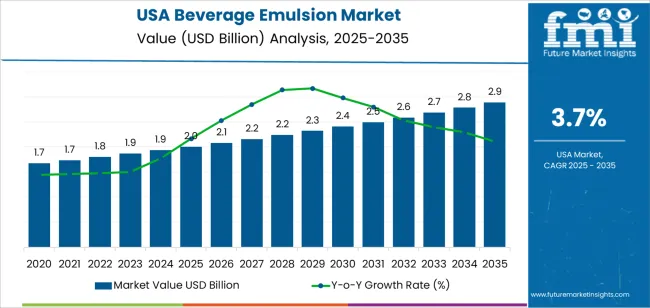
The demand for beverage emulsion in usa market was valued at USD 2.00 billion in 2025, projected to reach USD 2.07 billion in 2026, and is forecast to expand to USD 2.98 billion by 2036 at a 3.70% CAGR. As per FMI, this trajectory creates an incremental opportunity of USD 0.91 billion over the forecast period. Beverage emulsions are the technical backbone enabling flavor delivery, cloud formation, and color dispersion in the USA liquid refreshment sector. As per FMI, the ongoing reformulation cycle across carbonated and non-alcoholic beverage categories to replace brominated vegetable oil with clean-label emulsion systems is creating a sustained procurement upgrade cycle.
Summary of Demand for Beverage Emulsion in USA Market
- Market Snapshot
- The demand for beverage emulsion in usa market is valued at USD 2.00 billion in 2025 and is projected to reach USD 2.98 billion by 2036.
- The industry is expected to grow at a 3.70% CAGR from 2026 to 2036, creating an incremental opportunity of USD 0.91 billion.
- The market is a reformulation-driven, regulatory-accelerated ingredient category where BVO replacement mandates, clean-label stabilizer transitions, and flavor delivery precision define competitive positioning.
- Demand and Growth Drivers
- FDA revocation of GRAS status for brominated vegetable oil is forcing major beverage manufacturers to transition to clean-label emulsion stabilizer systems on a compressed timeline.
- Growth in functional and specialty non-alcoholic beverages is expanding the technical specifications for emulsion systems that deliver precise flavor and cloud profiles.
- Clean-label consumer expectations are shifting beverage manufacturers toward plant-derived emulsion stabilizers like pectin and xanthan gum.
- Among regions, West USA leads at 4.3% CAGR, followed by South USA at 3.8%, Northeast USA at 3.4%, Midwest USA at 3.0%.
- Product and Segment View
- The market covers beverage emulsion systems including flavor emulsions, cloud emulsions, and color emulsions formulated with stabilizer sources including xanthan gum, pectin, carboxymethyl cellulose, and carrageenan for non-alcoholic and carbonated beverage applications in the United States.
- Non-Alcoholic leads by Application with 63.0% share in 2026.
- Flavor Emulsion leads by Emulsion Type with 45.0% share in 2026.
- The scope includes beverage-specific emulsion systems across all types and stabilizer sources, excluding general food emulsifiers, pharmaceutical emulsions, and cosmetic emulsion products.
- Geography and Competitive Outlook
- West USA and South USA are the fastest-growing regions driven by craft beverage innovation and major bottling operations, while Northeast and Midwest reflect steady demand from established production infrastructure.
- Competition is shaped by emulsion stabilizer portfolio breadth, regulatory pre-qualification for BVO replacement formulations, and technical application support for flavor profile matching, with key players including Cargill, Inc., Kerry Group plc, ADM (Archer Daniels Midland Company), Ingredion Incorporated, Tate & Lyle PLC.
- Analyst Opinion at FMI
- Nandini Roy Choudhury, Principal Consultant for Food Ingredients, opines: 'In my analysis, I have observed that the FDA's brominated vegetable oil revocation has fundamentally compressed the beverage emulsion procurement cycle in ways most manufacturers did not anticipate. Beverage companies that delayed their BVO replacement programs now face a simultaneous scramble for qualified alternative emulsion systems, creating a temporary supplier's market where pre-qualified replacement formulations command pricing premiums. Procurement directors still relying on single-source emulsion stabilizer agreements are exposed to reformulation timeline risks that could delay product re-launches and forfeit shelf space to competitors who secured multi-source supply agreements earlier.'
- Strategic Implications / Executive Takeaways
- Beverage manufacturers must secure multi-source emulsion stabilizer supply agreements to mitigate reformulation timeline risks created by the compressed BVO replacement cycle.
- Emulsion ingredient suppliers should pre-qualify replacement formulations across multiple beverage categories to capture the pricing premiums available during the mandatory transition window.
- R&D teams must develop flavor-profile-matching protocols that replicate existing beverage taste characteristics when substituting BVO-based systems with clean-label alternatives.
FMI analysts observe that the USA beverage emulsion market is being reshaped by a regulatory and consumer-driven reformulation wave. The FDA's 2024 revocation of GRAS status for brominated vegetable oil forced major beverage manufacturers including PepsiCo and Keurig Dr Pepper to accelerate the transition to alternative emulsion stabilizers based on xanthan gum, pectin, and modified cellulose systems. This regulatory action converted a voluntary reformulation trend into a mandatory compliance timeline, compressing what would have been a five-year transition into a two-year procurement overhaul. FMI is of the opinion that this compressed reformulation cycle is creating a temporary supply tightness in food-grade emulsion stabilizers that favors suppliers with pre-qualified, ready-to-deploy replacement systems.
All major regions reflect differentiated adoption trajectories. West USA sets a 4.3% CAGR pace, South USA sets a 3.8% CAGR pace, Northeast USA sets a 3.4% CAGR pace, Midwest USA sets a 3.0% CAGR pace. West USA leads at 4.3% CAGR, driven by California's concentration of craft beverage manufacturers and functional drink startups that specify premium emulsion systems. South USA follows at 3.8%, supported by major beverage bottling and manufacturing operations in Georgia, Texas, and Florida. Midwest reflects steady 3.0% growth from established beverage production facilities.
Demand for Beverage Emulsion in USA Market Key Takeaways
| Metric | Details |
|---|---|
| Industry Size (2026) | USD 2.07 billion |
| Industry Value (2036) | USD 2.98 billion |
| CAGR (2026 to 2036) | 3.70% |
Source: Future Market Insights, 2026
Demand for Beverage Emulsion in USA Market Definition
Demand for beverage emulsion in the USA covers the procurement of emulsion systems by beverage manufacturers for flavor delivery, cloud formation, and color dispersion in liquid refreshment products. These systems use stabilizer ingredients to maintain homogeneous suspension of flavor oils, cloud agents, and colorants throughout product shelf life.
Demand for Beverage Emulsion in USA Market Inclusions
Market scope includes flavor emulsions, cloud emulsions, and color emulsions formulated with xanthan gum, pectin, carboxymethyl cellulose, and carrageenan for non-alcoholic and carbonated beverage production in the United States.
Demand for Beverage Emulsion in USA Market Exclusions
General food emulsifiers not specific to beverages, pharmaceutical emulsion systems, cosmetic emulsions, and industrial emulsification equipment are excluded from the defined scope.
Demand for Beverage Emulsion in USA Market Research Methodology
- Primary Research: Analysts engaged with beverage formulation chemists, emulsion ingredient procurement managers, and bottling facility technical directors to map the reformulation timelines and stabilizer specification decisions shaping beverage emulsion demand.
- Desk Research: Data collection aggregated FDA regulatory action documentation, American Beverage Association industry reports, and major beverage company reformulation disclosures.
- Market-Sizing and Forecasting: Baseline values derive from a bottom-up aggregation of emulsion ingredient supply contracts and beverage manufacturer reformulation pipeline data, applying category-specific transition curves to project future demand velocity.
- Data Validation and Update Cycle: Projections are tested against publicly reported ingredient division revenues from major suppliers and cross-referenced with FDA compliance timeline documentation.
Why is the Demand for Beverage Emulsion in USA Growing?
The demand for beverage emulsion in the USA is growing as the beverage industry continues to innovate with new flavors, functional drinks, and health-oriented products. Beverage emulsions, which are used to combine ingredients that do not naturally mix (like oil and water), are essential for creating stable, homogenous products in beverages such as flavored waters, energy drinks, smoothies, and alcoholic beverages. As consumers seek more complex flavors and functional benefits, the demand for emulsions that can enhance taste, texture, and nutritional value is on the rise.
A key driver of this growth is the increasing consumer preference for beverages that offer both sensory appeal and functional benefits, such as energy-boosting ingredients, electrolytes, vitamins, and probiotics. Beverage emulsions help incorporate ingredients like oils, flavors, and other nutrients that are essential for these functional drinks. With the popularity of beverages that support health and wellness, including weight management and hydration, emulsions are becoming critical to meeting the diverse needs of the industry.
The shift toward more natural and clean-label products is contributing to the demand for beverage emulsions. As consumers become more conscious of ingredient transparency and sustainability, there is an increasing focus on using natural, safe emulsifiers in beverages. This trend is pushing beverage manufacturers to develop emulsions that meet both consumer preferences for healthier ingredients and the need for product stability and shelf life. As the industry for functional and innovative beverages continues to grow, the demand for beverage emulsion in the USA is expected to rise steadily through 2035.
What is the Segment-Wise Analysis of Demand for Beverage Emulsion in USA?
Demand for beverage emulsion in the USA is segmented by emulsion type, application, source, and region. By emulsion type, demand is divided into flavor emulsion, cloud emulsion, and color emulsion, with flavor emulsion holding the largest share at 45%. The demand is also segmented by application, including non-alcoholic and carbonated beverages, with non-alcoholic beverages leading at 63%. In terms of source, xanthan gum, pectin, carboxymethyl cellulose, and carrageenan are the primary ingredients used in emulsions. Regionally, demand is distributed across West USA, South USA, Northeast USA, and Midwest USA.
Why Does Flavor Emulsion Lead the Demand for Beverage Emulsion?
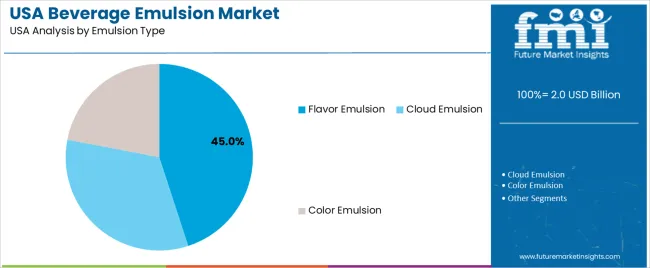
Flavor emulsion accounts for 45% of the demand for beverage emulsion in the USA. The dominant share is primarily driven by the increasing need for flavor enhancement in both non-alcoholic and carbonated beverages. As consumer preferences for diverse and innovative flavors grow, flavor emulsions provide a consistent and stable means of incorporating concentrated flavors into liquid products. These emulsions enable a more intense, uniform distribution of flavor throughout the beverage, enhancing taste and mouthfeel. Flavor emulsions are essential in products like fruit juices, energy drinks, and flavored water, where bold and long-lasting flavors are key to consumer satisfaction. The growth of the beverage industry, coupled with the expanding variety of flavored products, ensures that flavor emulsions remain the leading type in the industry, meeting the rising demand for new and exciting beverage options.
Why Do Non-Alcoholic Beverages Lead the Demand for Beverage Emulsion?
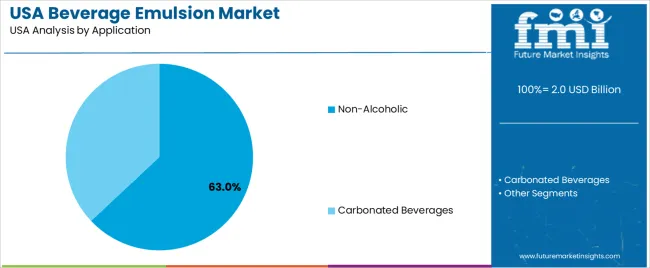
Non-alcoholic beverages account for 63% of the demand for beverage emulsion in the USA. This segment’s dominance is driven by the widespread consumption of beverages like fruit juices, bottled water, soft drinks, and flavored teas. Non-alcoholic beverages are a growing category, with consumers increasingly seeking refreshing, flavorful, and functional drink options. Emulsions play a key role in enhancing flavor, cloudiness, and color, improving the overall sensory experience of these drinks. The demand for healthy and innovative non-alcoholic beverages, such as low-sugar, vitamin-enriched, or plant-based options, further supports the need for beverage emulsions. As consumers seek variety in their drink choices, emulsions help provide stable and appealing textures and flavors in non-alcoholic beverages. The increasing focus on wellness and hydration is also contributing to the growth of non-alcoholic beverages, further fueling the demand for emulsions.
What are the Key Trends, Drivers, and Restraints in Demand for Beverage Emulsion in USA?
Demand for beverage emulsion in the USA is growing as beverage producers increasingly turn to emulsifiers to ensure consistency in flavor, texture, color, and stability in a wide variety of drinks. These emulsions enable water-insoluble ingredients like oils, vitamins, botanicals, and flavor compounds to remain evenly dispersed in water-based beverages such as juices, flavored waters, dairy alternatives, and functional drinks. The demand for ready-to-drink (RTD) beverages and functional drinks, as well as the popularity of plant-based, low-sugar, and novel flavor options, is boosting the use of beverage emulsions. As beverage formulations become more diverse, emulsions play a key role in maintaining the desired quality, appearance, and shelf life of drinks. Formulation complexity and regulatory pressures on additives may pose challenges to broader adoption.
Why is Demand for Beverage Emulsion Growing in USA?
Demand is rising as more beverage producers look for ways to create drinks that maintain a consistent taste, texture, and visual appeal over time. The growing popularity of functional beverages, such as those containing added nutrients, vitamins, or botanicals, is a significant driver for emulsifiers. These ingredients often do not mix easily with water, requiring emulsions to ensure stability and prevent separation. The shift towards plant-based beverages, low-calorie formulations, and novel flavor profiles further increases the need for emulsifiers. The trend toward healthier and more convenient beverage options are fueling the demand for emulsified drinks that maintain quality while offering added nutritional value.
How are Technological & Industry Innovations Driving Beverage Emulsion Demand in USA?
Technological advancements in emulsification techniques and ingredient formulation are driving the demand for beverage emulsions in the USA. Improved emulsifiers, such as those based on natural or plant-derived sources, are gaining popularity as clean-label and non-synthetic alternatives. These innovations help beverage producers create more stable, visually appealing, and palatable products, particularly in functional beverages and plant-based drinks. Advances in processing methods allow for the inclusion of new, complex ingredients like functional oils, proteins, and herbal extracts, which are more effectively integrated into beverages through emulsification. These technological improvements are expanding the range of beverage products that can benefit from emulsions, thus increasing demand.
What are the Key Challenges and Risks That Could Limit Beverage Emulsion Demand in USA?
Despite the growing demand, there are challenges that could limit the broader adoption of beverage emulsions in the USA. One significant hurdle is the complexity of formulating beverages with multiple functional ingredients, such as vitamins, oils, or botanical extracts, which can affect stability, taste, and appearance. Regulatory restrictions and growing demand for clean-label products may limit the use of certain emulsifiers, especially synthetic ones, requiring the development of more expensive natural alternatives. Consumer preferences for minimal additives or simple ingredient lists may limit the appeal of emulsified beverages. The cost of production and formulation, particularly for premium or specialized emulsifiers, could also restrict their adoption by smaller producers or price-sensitive industrys.
What is the Regional Demand Outlook for Beverage Emulsion in USA?
| Region | CAGR (%) |
|---|---|
| West USA | 4.3% |
| South USA | 3.8% |
| Northeast USA | 3.4% |
| Midwest USA | 3.0% |
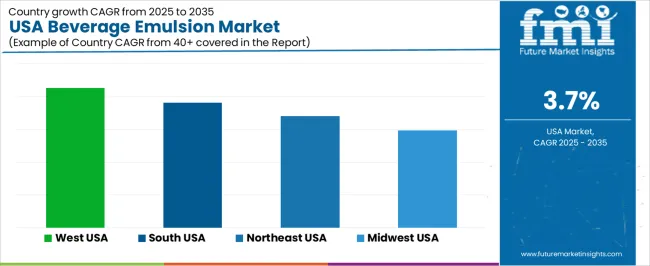
Demand for beverage emulsion in the USA is growing steadily, with West USA leading at a 4.3% CAGR, driven by the region’s strong beverage industry and health-conscious consumer base seeking stable and natural products. South USA follows with a 3.8% CAGR, supported by the region’s increasing production of ready-to-drink beverages and energy drinks, where emulsions are essential for texture and flavor stability. Northeast USA shows a 3.4% CAGR, driven by the region’s demand for innovative, clean-label, and functional drinks, while Midwest USA experiences a 3.0% CAGR, supported by the region’s focus on mass-produced drinks and functional beverages. As demand for healthier, convenient, and functional beverages continues to rise, beverage emulsions will play a key role in maintaining product consistency and quality across the country.
How is Demand for Beverage Emulsion Growing in West USA?
West USA leads the demand for beverage emulsion, growing at a 4.3% CAGR. The region’s strong food and beverage industry, particularly in states like California, Oregon, and Washington, is a key driver of this growth. Beverage emulsions are widely used in the production of flavored drinks, energy beverages, and functional drinks, which are increasingly popular in the West due to the health-conscious consumer base. The demand is further supported by the rise of plant-based, organic, and natural products, with emulsions playing a crucial role in stabilizing ingredients and improving the texture of these beverages. The growing trend of wellness and functional beverages, such as probiotics, detox drinks, and enhanced waters, contributes to the expanding industry for beverage emulsions. As West USA continues to innovate in the beverage industry, demand for emulsions is expected to remain strong.
Why is Demand for Beverage Emulsion Rising in South USA?
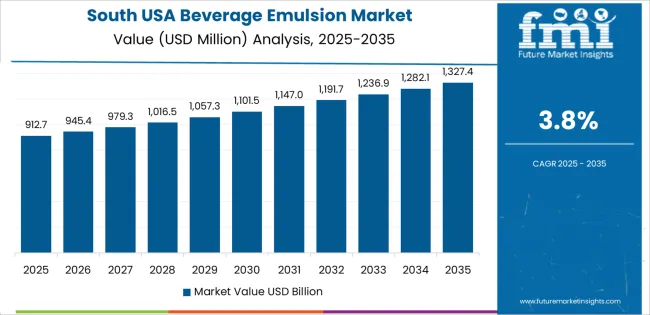
South USA is experiencing steady demand for beverage emulsion, with a 3.8% CAGR. The region’s growing beverage industry, including soft drinks, fruit juices, and energy beverages, is fueling this growth. Beverage emulsions are crucial for creating stable formulations, particularly in beverages that contain multiple ingredients like oils, flavors, and colorants. The demand for beverage emulsions is further supported by the rising popularity of ready-to-drink beverages, which are convenient for consumers with busy lifestyles. The South’s strong food and beverage manufacturing base, especially in states like Texas and Florida, also contributes to the increasing use of emulsions in mass production. As consumers seek healthier, more functional drinks, emulsions play a vital role in enhancing taste, texture, and consistency in these products. As demand for flavored and functional beverages continues to rise, South USA will see continued growth in the beverage emulsion industry.
How is Demand for Beverage Emulsion Expanding in Northeast USA?
Northeast USA is seeing moderate growth in demand for beverage emulsion, with a 3.4% CAGR. The region’s diverse consumer base, particularly in urban centers like New York and Boston, is driving the demand for flavored and functional beverages, where emulsions are essential for ensuring stability and consistency. The growing popularity of organic, plant-based, and health-focused drinks, such as smoothies, plant milks, and energy drinks, is boosting the use of beverage emulsions. Northeast USA’s emphasis on innovation in food and beverage products, as well as the growing demand for premium, natural beverages, contributes to the rise in emulsion use. As more consumers seek natural and sustainable ingredients in their drinks, emulsions are becoming a vital ingredient to maintain product quality. This demand for emulsions is expected to rise steadily as more beverage manufacturers focus on clean-label formulations and functional ingredients.
Why is Beverage Emulsion Demand Growing in Midwest USA?
Midwest USA is experiencing steady demand for beverage emulsion, with a 3.0% CAGR. The region’s large food and beverage manufacturing base, particularly in states like Illinois and Ohio, plays a key role in driving the demand for emulsions. Beverage emulsions are widely used in mass-produced drinks, including sodas, juices, and flavored water, to improve texture, flavor stability, and appearance. The Midwest’s growing interest in functional beverages, including fortified waters and energy drinks, contributes to the rise in demand for beverage emulsions. As the region’s beverage industry continues to innovate with new flavors and formulations, emulsions play a vital role in maintaining product consistency. Although the growth rate in the Midwest is slower than in other regions, steady consumer demand for a variety of flavored and functional drinks ensures a consistent industry for beverage emulsions in the region.
What is the Competitive Landscape of Beverage Emulsion Demand in USA?
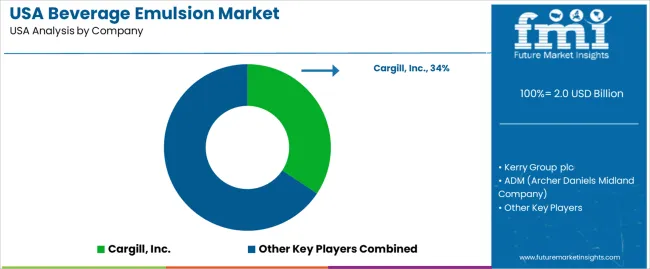
The demand for beverage emulsions in the USA is rising as manufacturers seek to create stable, flavorful, and visually appealing beverages with improved texture and mouthfeel. Beverage emulsions are essential in the formulation of flavored drinks, energy drinks, juices, and alcoholic beverages, enabling the uniform dispersion of ingredients such as oils, flavors, and colorants. As consumer preferences shift towards more complex flavors, healthier alternatives, and clean-label ingredients, the demand for beverage emulsions is growing. The increasing popularity of functional beverages, including low-sugar, fortified, and plant-based drinks, further boosts the need for high-quality emulsions to enhance product stability and consumer appeal.
Leading companies in the beverage emulsion industry in the USA include Cargill, Inc., Kerry Group plc, ADM (Archer Daniels Midland Company), Ingredion Incorporated, and Tate & Lyle PLC. Cargill, Inc. leads the industry with a share of 34.3%, providing a wide range of beverage emulsions designed to enhance the flavor, texture, and stability of beverages. Kerry Group plc offers emulsions for various applications, focusing on flavor enhancement and consumer-friendly ingredients. ADM specializes in emulsions that support beverage formulation with clean-label solutions, while Ingredion Incorporated provides emulsions tailored to meet the evolving needs of the beverage industry, including natural and organic solutions. Tate & Lyle PLC offers a variety of emulsions for the beverage sector, focusing on functionality, quality, and sustainability.
Competition in the beverage emulsion industry is driven by factors such as innovation, flavor development, and the demand for cleaner, more sustainable products. Companies compete by offering emulsions that improve beverage texture, prevent ingredient separation, and enhance the sensory experience of the drink. The growing trend toward health-conscious and functional beverages is pushing manufacturers to develop emulsions that cater to dietary needs, such as low-calorie, plant-based, or sugar-free options.
Key Players in USA Beverage Emulsion Demand
- Cargill, Inc.
- Kerry Group plc
- ADM (Archer Daniels Midland Company)
- Ingredion Incorporated
- Tate & Lyle PLC
Scope of the Report
| Metric | Value |
|---|---|
| Quantitative Units | USD 2.07 billion to USD 2.98 billion, at a CAGR of 3.70% |
| Market Definition | Demand for beverage emulsion in the USA covers emulsion systems for flavor delivery, cloud formation, and color dispersion in beverage manufacturing, spanning flavor, cloud, and color emulsion types across multiple stabilizer sources. |
| Application Segmentation | Non-Alcoholic, Carbonated Beverages |
| Emulsion Type Segmentation | Flavor Emulsion, Cloud Emulsion, Color Emulsion |
| Source Segmentation | Xanthan Gum, Pectin, Carboxymethyl Cellulose, Carrageenan |
| Regions Covered | West USA, South USA, Northeast USA, Midwest USA |
| Key Companies Profiled | Cargill, Inc., Kerry Group plc, ADM (Archer Daniels Midland Company), Ingredion Incorporated, Tate & Lyle PLC |
| Forecast Period | 2026 to 2036 |
| Approach | Forecasting models apply a bottom-up methodology starting with emulsion ingredient supply contracts and beverage manufacturer reformulation pipeline data, projecting the BVO-replacement transition rate and new product adoption across USA beverage categories. |
USA Beverage Emulsion Demand by Key Segments
Source:
- Xanthan Gum
- Pectin
- Carboxymethyl Cellulose
- Carrageenan
Application:
- Non-Alcoholic
- Carbonated Beverages
Emulsion Type:
- Flavor Emulsion
- Cloud Emulsion
- Color Emulsion
Region:
- West USA
- South USA
- Northeast USA
- Midwest USA
Bibliography
- Food and Drug Administration. (2024). Revocation of GRAS Status for Brominated Vegetable Oil. FDA Federal Register.
- American Beverage Association. (2025). USA Beverage Industry Annual Report. ABA.
- United States Department of Agriculture. (2024). Non-Alcoholic Beverage Production Statistics. USDA.
- International Society of Beverage Technologists. (2024). Emulsion Stability Standards for Beverage Applications. ISBT.
- Environmental Protection Agency. (2024). Food-Grade Chemical Safety Assessment Framework. EPA.
This bibliography is provided for reader reference. The full Future Market Insights report contains the complete reference list with primary research documentation.
Frequently Asked Questions
How large is the demand for beverage emulsion in USA in 2026?
Demand for beverage emulsion in the USA is estimated to be valued at USD 2.07 billion in 2026.
What will be the market size of beverage emulsion in USA by 2036?
Market size for beverage emulsion in the USA is projected to reach USD 2.98 billion by 2036.
What is the expected demand growth between 2026 and 2036?
Demand for beverage emulsion in the USA is expected to grow at a CAGR of 3.70% between 2026 and 2036.
Which Application segment leads in 2026?
Non-Alcoholic accounts for 63.0% share in 2026, driven by the broad category scope covering functional waters, juice-based drinks, ready-to-drink teas, and sports beverages.
Which Emulsion Type leads?
Flavor Emulsion holds 45.0% share in 2026 as flavor delivery remains the primary technical function of beverage emulsion systems across all beverage categories.
Which region is growing fastest?
West USA leads at 4.3% CAGR through 2036, driven by craft beverage manufacturer concentration and functional drink startup activity in California.
What is included in this report?
The market covers flavor, cloud, and color emulsion systems formulated with xanthan gum, pectin, CMC, and carrageenan for non-alcoholic and carbonated beverage applications.
What is excluded?
General food emulsifiers, pharmaceutical emulsions, cosmetic emulsions, and industrial emulsification equipment are excluded.
Preview the report firsthand - request a free sample
Get SampleGet the brochure for pricing and purchase details.
Get PDFTable of Content
- Executive Summary
- USA Market Outlook
- Demand-side Trends
- Supply-side Trends
- Technology Roadmap Analysis
- Analysis and Recommendations
- Market Overview
- Market Coverage / Taxonomy
- Market Definition / Scope / Limitations
- Research Methodology
- Chapter Orientation
- Analytical Lens and Working Hypotheses
- Market Structure, Signals, and Trend Drivers
- Benchmarking and Cross-market Comparability
- Market Sizing, Forecasting, and Opportunity Mapping
- Research Design and Evidence Framework
- Desk Research Programme (Secondary Evidence)
- Company Annual and Sustainability Reports
- Peer-reviewed Journals and Academic Literature
- Corporate Websites, Product Literature, and Technical Notes
- Earnings Decks and Investor Briefings
- Expert Input and Fieldwork (Primary Evidence)
- Primary Modes
- Qualitative Interviews and Expert Elicitation
- Quantitative Surveys and Structured Data Capture
- Blended Approach
- Why Primary Evidence is Used
- Field Techniques
- Interviews
- Surveys
- Focus Groups
- Observational and In-context Research
- Social and Community Interactions
- Stakeholder Universe Engaged
- C-suite Leaders
- Board Members
- Presidents and Vice Presidents
- R&D and Innovation Heads
- Technical Specialists
- Domain Subject-matter Experts
- Scientists
- Physicians and Other Healthcare Professionals
- Governance, Ethics, and Data Stewardship
- Research Ethics
- Data Integrity and Handling
- Primary Modes
- Tooling, Models, and Reference Databases
- Data Engineering and Model Build
- Data Acquisition and Ingestion
- Cleaning, Normalisation, and Verification
- Synthesis, Triangulation, and Analysis
- Quality Assurance and Audit Trail
- Desk Research Programme (Secondary Evidence)
- Market Background
- Market Dynamics
- Drivers
- Restraints
- Opportunity
- Trends
- Scenario Forecast
- Demand in Optimistic Scenario
- Demand in Likely Scenario
- Demand in Conservative Scenario
- Opportunity Map Analysis
- Product Life Cycle Analysis
- Supply Chain Analysis
- Investment Feasibility Matrix
- Value Chain Analysis
- PESTLE and Porter’s Analysis
- Regulatory Landscape
- Regional Parent Market Outlook
- Production and Consumption Statistics
- Import and Export Statistics
- Market Dynamics
- USA Market Analysis 2021 to 2025 and Forecast, 2026 to 2036
- Historical Market Size Value (USD Million) Analysis, 2021 to 2025
- Current and Future Market Size Value (USD Million) Projections, 2026 to 2036
- Y-o-Y Growth Trend Analysis
- Absolute $ Opportunity Analysis
- USA Market Pricing Analysis 2021 to 2025 and Forecast 2026 to 2036
- USA Market Analysis 2021 to 2025 and Forecast 2026 to 2036, By Application
- Introduction / Key Findings
- Historical Market Size Value (USD Million) Analysis By Application , 2021 to 2025
- Current and Future Market Size Value (USD Million) Analysis and Forecast By Application , 2026 to 2036
- Non-Alcoholic
- Carbonated Beverages
- Non-Alcoholic
- Y-o-Y Growth Trend Analysis By Application , 2021 to 2025
- Absolute $ Opportunity Analysis By Application , 2026 to 2036
- USA Market Analysis 2021 to 2025 and Forecast 2026 to 2036, By Emulsion Type
- Introduction / Key Findings
- Historical Market Size Value (USD Million) Analysis By Emulsion Type, 2021 to 2025
- Current and Future Market Size Value (USD Million) Analysis and Forecast By Emulsion Type, 2026 to 2036
- Flavor Emulsion
- Cloud Emulsion
- Color Emulsion
- Flavor Emulsion
- Y-o-Y Growth Trend Analysis By Emulsion Type, 2021 to 2025
- Absolute $ Opportunity Analysis By Emulsion Type, 2026 to 2036
- USA Market Analysis 2021 to 2025 and Forecast 2026 to 2036, By Source
- Introduction / Key Findings
- Historical Market Size Value (USD Million) Analysis By Source, 2021 to 2025
- Current and Future Market Size Value (USD Million) Analysis and Forecast By Source, 2026 to 2036
- Xanthan Gum
- Pectin
- Carboxymethyl Cellulose
- Carrageenan
- Xanthan Gum
- Y-o-Y Growth Trend Analysis By Source, 2021 to 2025
- Absolute $ Opportunity Analysis By Source, 2026 to 2036
- USA Market Analysis 2021 to 2025 and Forecast 2026 to 2036, By Region
- Introduction
- Historical Market Size Value (USD Million) Analysis By Region, 2021 to 2025
- Current Market Size Value (USD Million) Analysis and Forecast By Region, 2026 to 2036
- West
- South
- Northeast
- Midwest
- Market Attractiveness Analysis By Region
- West Market Analysis 2021 to 2025 and Forecast 2026 to 2036, By Country
- Historical Market Size Value (USD Million) Trend Analysis By Market Taxonomy, 2021 to 2025
- Market Size Value (USD Million) Forecast By Market Taxonomy, 2026 to 2036
- By Country
- By Application
- By Emulsion Type
- By Source
- By Country
- Market Attractiveness Analysis
- By Country
- By Application
- By Emulsion Type
- By Source
- Key Takeaways
- South Market Analysis 2021 to 2025 and Forecast 2026 to 2036, By Country
- Historical Market Size Value (USD Million) Trend Analysis By Market Taxonomy, 2021 to 2025
- Market Size Value (USD Million) Forecast By Market Taxonomy, 2026 to 2036
- By Country
- By Application
- By Emulsion Type
- By Source
- By Country
- Market Attractiveness Analysis
- By Country
- By Application
- By Emulsion Type
- By Source
- Key Takeaways
- Northeast Market Analysis 2021 to 2025 and Forecast 2026 to 2036, By Country
- Historical Market Size Value (USD Million) Trend Analysis By Market Taxonomy, 2021 to 2025
- Market Size Value (USD Million) Forecast By Market Taxonomy, 2026 to 2036
- By Country
- By Application
- By Emulsion Type
- By Source
- By Country
- Market Attractiveness Analysis
- By Country
- By Application
- By Emulsion Type
- By Source
- Key Takeaways
- Midwest Market Analysis 2021 to 2025 and Forecast 2026 to 2036, By Country
- Historical Market Size Value (USD Million) Trend Analysis By Market Taxonomy, 2021 to 2025
- Market Size Value (USD Million) Forecast By Market Taxonomy, 2026 to 2036
- By Country
- By Application
- By Emulsion Type
- By Source
- By Country
- Market Attractiveness Analysis
- By Country
- By Application
- By Emulsion Type
- By Source
- Key Takeaways
- Key Countries Market Analysis
- West
- Pricing Analysis
- Market Share Analysis, 2025
- By Application
- By Emulsion Type
- By Source
- South
- Pricing Analysis
- Market Share Analysis, 2025
- By Application
- By Emulsion Type
- By Source
- Northeast
- Pricing Analysis
- Market Share Analysis, 2025
- By Application
- By Emulsion Type
- By Source
- Midwest
- Pricing Analysis
- Market Share Analysis, 2025
- By Application
- By Emulsion Type
- By Source
- West
- Market Structure Analysis
- Competition Dashboard
- Competition Benchmarking
- Market Share Analysis of Top Players
- By Regional
- By Application
- By Emulsion Type
- By Source
- Competition Analysis
- Competition Deep Dive
- Cargill, Inc.
- Overview
- Product Portfolio
- Profitability by Market Segments (Product/Age /Sales Channel/Region)
- Sales Footprint
- Strategy Overview
- Marketing Strategy
- Product Strategy
- Channel Strategy
- Kerry Group plc
- ADM (Archer Daniels Midland Company)
- Ingredion Incorporated
- Tate & Lyle PLC
- Cargill, Inc.
- Competition Deep Dive
- Assumptions & Acronyms Used


