

- Industry Size (2025)
- USD 5.2 Bn
- Forecast (2035)
- USD 10.6 Bn
- CAGR (2025 to 2035)
- 7.4%
Demand for Data Center CPU in USA Forecast and Outlook 2025 to 2035
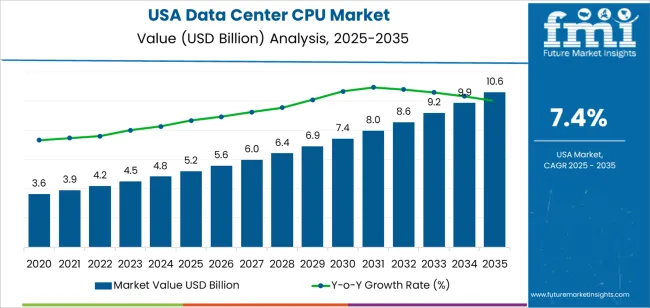
The demand for Data Center CPUs in the USA is projected to increase from USD 5.2 billion in 2025 to USD 10.6 billion by 2035, reflecting a compound annual growth rate (CAGR) of 7.4%. Data center CPUs are essential components in data centers, providing the computing power required to manage large-scale data storage, processing, and transmission for businesses and cloud service providers. As the demand for cloud computing, big data, and AI-driven applications continues to grow, the need for high-performance CPUs will rise significantly. The expansion of data centers to support increased internet traffic, enterprise computing, and edge computing is further contributing to the need for robust data center CPUs.
The demand for CPUs in data centers is primarily driven by the need to scale infrastructure, improve processing power, and support complex workloads. With advancements in processor architecture, multi-core capabilities, and energy efficiency, the industry for data center CPUs is poised for continuous growth. The adoption of next-generation CPUs to support 5G networks, edge computing, and AI applications is also expected to contribute significantly to industry expansion.
Quick Stats of the Demand for Data Center CPUs in USA
- Demand for Data Center CPUs in USA Value (2025): USD 5.2 billion
- Demand for Data Center CPUs in USA Forecast Value (2035): USD 10.6 billion
- Demand for Data Center CPUs in USA Forecast CAGR (2025-2035): 7.4%
- Demand for Data Center CPUs in USA Leading Number of CPU Cores Segment: 16-Core CPUs
- Demand for Data Center CPUs in USA Key Growth Regions: West USA, South USA, Northeast USA, Midwest USA
- Demand for Data Center CPUs in USA Top Players: Advanced Micro Devices, Inc. (AMD), Amazon Web Services (AWS), NVIDIA Corporation, Oracle Corporation, Intel Corporation
What is the Growth Forecast for the Demand for Data Center CPU in USA through 2035?
Between 2025 and 2030, the demand for Data Center CPUs in the USA is expected to grow steadily, increasing from USD 5.2 billion to USD 5.6 billion. This phase will experience moderate acceleration, driven by the continued expansion of cloud services and data storage infrastructure. The demand will see consistent, incremental increases as businesses invest in upgrading data center hardware and optimizing cloud computing capabilities. As organizations shift to more scalable and efficient computing solutions, the need for high-performance CPUs will rise steadily, supporting the growing demand for cloud storage, big data processing, and enterprise computing.
From 2030 to 2035, the demand for data center CPUs is expected to experience faster acceleration, growing from USD 5.6 billion to USD 10.6 billion. This significant rise will be driven by increased data traffic, AI integration, and the expanding need for edge computing. The adoption of more powerful CPUs to support data-intensive applications will further drive demand, especially in industries such as telecommunications, technology, and financial services. Advancements in processor technology, such as smaller transistor sizes, higher core counts, and improved energy efficiency, will allow data centers to process larger volumes of data more efficiently.
Demand for Data Center CPUs in USA Key Takeaways
| Metric | Value |
|---|---|
| Demand for Data Center CPUs in USA Value (2025) | USD 5.2 billion |
| Demand for Data Center CPUs in USA Forecast Value (2035) | USD 10.6 billion |
| Demand for Data Center CPUs in USA Forecast CAGR (2025-2035) | 7.4% |
Why is the Demand for Data Center CPUs in USA Growing?
The demand for data center CPUs in the USA is increasing due to the rapid expansion of data centers driven by the growing need for cloud services, data storage, and high-performance computing applications. Data centers are central to the operation of cloud service providers, enterprises, and content delivery networks, all of which are seeing explosive growth in demand for computing power to support digital transformation, big data, AI applications, and 5G connectivity. As the USA continues to lead in digital infrastructure, the need for powerful and efficient CPUs for data center operations is expanding.
A key driver of this growth is the continuous rise in data traffic and the increasing adoption of cloud-based solutions by businesses and consumers. As companies shift toward cloud computing, remote work, and digital services, the demand for data centers to handle large volumes of data and support mission-critical applications is growing. This directly impacts the need for advanced CPUs that offer high processing power, energy efficiency, and scalability to meet the performance requirements of modern data centers.
The transition to high-performance and energy-efficient computing solutions is also influencing the demand for data center CPUs. As companies seek to reduce operational costs and improve sustainability, CPUs designed for optimal power efficiency and performance are becoming more essential. Furthermore, the ongoing advancements in CPU architecture, such as multi-core processors and specialized chips for AI and machine learning tasks, are making data center CPUs even more attractive to meet the evolving demands of enterprise computing. With the rapid expansion of digital technologies and the growing reliance on cloud services, the demand for data center CPUs in the USA is expected to continue growing through 2035.
What is the Segment-Wise Analysis of Demand for Data Center CPUs in USA?
Demand for data center CPUs in the USA is segmented by the number of CPU cores, component type, and server form factor. By the number of CPU cores, demand is divided into 16-core CPUs, 4-core CPUs, 8-core CPUs, 32-core CPUs, and 64-core CPUs. The demand is also segmented by component type, including x86 processors, ARM processors, and power processors. In terms of server form factor, demand is divided into 2-socket servers, 1-socket servers, and 4-socket servers. Regionally, demand is divided into West USA, South USA, Northeast USA, and Midwest USA.
Why Do 16-Core CPUs Lead the Demand for Data Center CPUs?
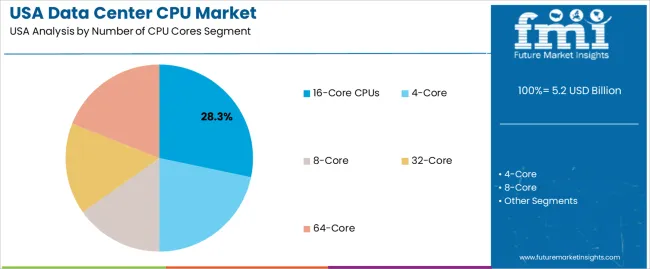
16-core CPUs account for 28% of the demand for data center CPUs in the USA. These CPUs are favored for their ability to provide high computational power, making them ideal for data centers that require efficient processing of large amounts of data. The 16-core architecture strikes a balance between performance and cost, offering enough cores for tasks such as virtualization, cloud computing, and enterprise applications, without the expense and power requirements of larger core counts. The increasing demand for high-performance computing and the growing reliance on cloud services and big data analytics in industries like finance, healthcare, and technology are driving the demand for 16-core CPUs. As data centers continue to scale their operations, 16-core CPUs will remain a key choice for meeting the processing needs of modern digital infrastructure.
How Do x86 Processors Lead the Component Demand for Data Center CPUs?

x86 processors account for 72.5% of the demand for data center CPUs in the USA. x86 architecture is the most widely used in data centers due to its compatibility with a wide range of applications and operating systems, including Windows, Linux, and virtualization platforms. x86 processors offer strong performance, scalability, and cost-efficiency, which makes them ideal for handling a broad spectrum of tasks such as web hosting, cloud computing, and enterprise applications. x86 processors are backed by a large ecosystem of software and hardware support, providing data centers with a reliable and flexible solution for their computing needs. As demand for cloud services, high-performance computing, and enterprise data solutions continues to rise, x86 processors will remain the dominant choice for data center infrastructure.
What are the Key Trends, Drivers, and Restraints in Demand for Data‑Center CPUs in USA?
Demand for data‑center CPUs in the USA is rising sharply as cloud infrastructure, enterprise IT, and AI/ML workloads expand. Growth of cloud computing, big data analytics, and generative AI/ML has pushed data centers to install more servers, increasing demand for high‑performance CPUs. The shift toward AI‑ready data centers and HPC workloads which require high core‑count, multi‑threaded CPUs with strong compute density is a major driver. At the same time, heavy investment in power, cooling, and infrastructure to support growing compute loads raises capital and operational costs. For smaller data‑center operators, high upfront costs can restrain CPU upgrades or expansion, limiting uptake in cost‑sensitive settings.
Why is Demand for Data‑Center CPUs Growing in the USA?
In the USA, demand for data‑center CPUs is growing because organizations increasingly rely on cloud services, AI/ML workloads, big data processing, and digital‑transformation initiatives all of which require robust server computing capability. As demand for real‑time analytics, large‑scale data storage, and computational performance rises, data centers are scaling up their infrastructure. The trend for enterprises to outsource computing to cloud providers and hyperscalers boosts demand for more server CPUs. Newer applications including generative AI, machine learning pipelines, big‑data analytics, and high‑performance enterprise workloads require CPUs with high core counts and energy‑efficient performance, making modern data‑center CPUs essential.
How are Technological and Design Innovations Driving Growth of Data‑Center CPUs in the USA?
Technological innovations are accelerating demand by increasing CPU performance, efficiency, and suitability for modern workloads. New server‑grade CPUs offer higher core density, better multithreading, power‑efficient architectures, and support for virtualization and AI workloads making them ideal for cloud, AI, and mixed compute/data‑heavy tasks. Advances in processor design, thermal management, and energy efficiency allow data centers to achieve more compute per watt, reducing total cost of ownership and improving scalability. Modularity and support for heterogeneous computing (CPUs alongside accelerators/GPUs) enable flexible infrastructure scaling. These innovations make modern data‑center CPUs more attractive and future‑proof for operators in the USA.
What are the Key Challenges Limiting Wider Adoption of Data‑Center CPUs in the USA?
Despite strong demand, there are challenges limiting growth. High capital and operating costs including advanced air‑conditioning, power delivery, and cooling required for dense compute clusters raise the total cost of ownership, which can deter smaller data‑center operators. Rapid evolution of workloads (AI, GPU‑heavy tasks) sometimes shifts demand toward accelerators or mixed CPU‑GPU architectures, reducing pure CPU spend in some cases. Energy consumption and sustainability concerns may lead to regulatory and permission hurdles for building new data‑center capacity. Supply‑chain vulnerabilities (chip shortages, lead times) and component cost volatility may delay CPU procurement and expansion plans.
What is the Regional Demand Outlook for Data Center CPUs in the USA?
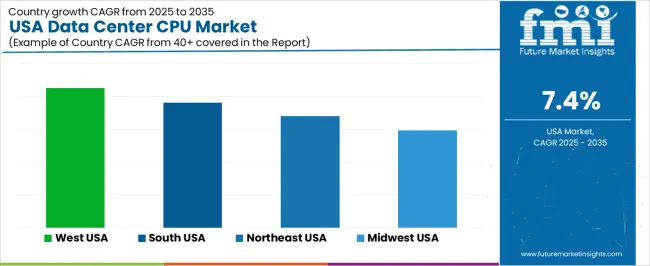
| Region | CAGR (%) |
|---|---|
| West USA | 8.5% |
| South USA | 7.6% |
| Northeast USA | 6.8% |
| Midwest USA | 5.9% |
Demand for data center CPUs in the USA is growing across all regions, with the West leading at an 8.5% CAGR, driven by the concentration of tech industries and data centers. The South follows with a 7.6% CAGR, supported by the growing presence of cloud infrastructure and data centers. The Northeast experiences a 6.8% CAGR, fueled by its strong financial and tech industries, while the Midwest shows a 5.9% CAGR, driven by expanding enterprise data centers and regional demand for cloud services. As the need for cloud computing, big data analytics, and AI continues to rise, demand for data center CPUs is expected to increase steadily across all regions in the USA.
What is Driving Data Center CPU Demand in the West USA?
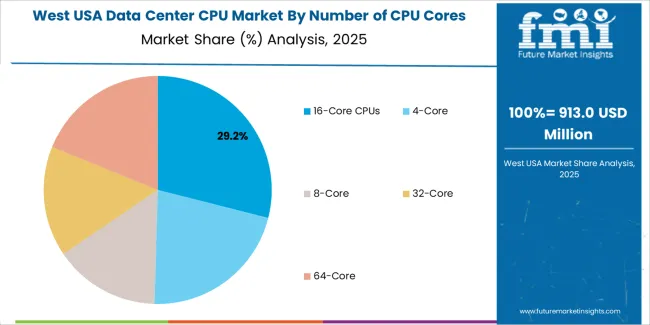
The West USA leads the demand for data center CPUs, with an 8.5% CAGR. The region’s demand is primarily driven by the concentration of major cloud service providers, tech giants, and data centers in states like California, Washington, and Oregon. The region’s strong presence in the technology and internet industries, particularly in areas like Silicon Valley, is fueling the need for high-performance data center CPUs to support increasing demand for cloud computing, big data analytics, and artificial intelligence. The rapid expansion of data centers to support 5G technologies and edge computing further contributes to the demand for advanced CPUs. As the demand for data processing and storage continues to rise in the West, data center CPUs are essential for maintaining the performance and scalability of these systems, leading to steady growth in demand.
How is Data Center CPU Demand Growing in the South USA?
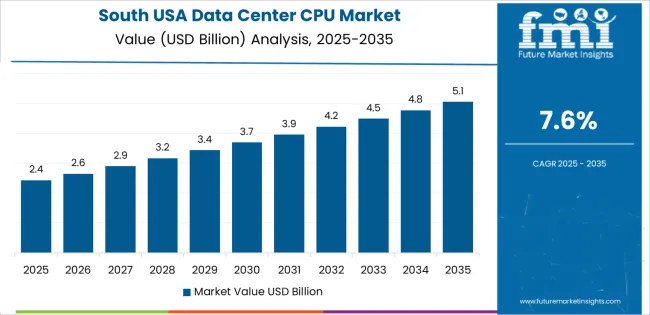
The South USA is experiencing strong demand for data center CPUs, with a 7.6% CAGR. This growth is primarily driven by the expanding data center industry in states like Texas, Georgia, and Florida, where major cloud service providers and enterprises are investing heavily in infrastructure. As the demand for cloud storage, hosting services, and edge computing grows, the need for powerful processors to support these services is also increasing. The South’s appeal as a location for data centers, due to favorable tax incentives and lower operational costs, has made it an attractive region for businesses seeking to expand their IT infrastructure. The growing focus on 5G networks and the need for real-time data processing are driving the demand for advanced data center CPUs in the South. As industries in the region continue to grow and embrace digital transformation, demand for data center CPUs is expected to remain strong.
Why is Data Center CPU Demand Growing in the Northeast USA?

The Northeast USA is seeing steady demand for data center CPUs, with a 6.8% CAGR. The region’s high concentration of financial institutions, healthcare providers, and technology companies is driving the demand for data center infrastructure, requiring powerful CPUs to support the growing need for data processing and storage. States like New York, Massachusetts, and New Jersey are home to numerous data centers that support both local businesses and global enterprises. The region’s emphasis on data security, compliance, and regulatory standards in industries like finance and healthcare is also contributing to the growing demand for advanced processing power. As the Northeast continues to focus on digital transformation, artificial intelligence, and big data, the adoption of more powerful data center CPUs is expected to grow steadily to support these initiatives. The region’s strong technological base ensures continued demand for data center CPUs.
What is Driving Data Center CPU Demand in the Midwest USA?
The Midwest USA is seeing moderate demand for data center CPUs, with a 5.9% CAGR. The demand in this region is largely driven by the growth in enterprise data centers, regional businesses expanding their IT infrastructure, and the increasing need for cloud services. Cities like Chicago, Detroit, and Indianapolis are home to several key data centers supporting various industries, including automotive, manufacturing, and healthcare, which rely on data processing for operational efficiency. As businesses in the Midwest continue to adopt cloud computing, big data analytics, and AI, the demand for data center CPUs is steadily increasing. The region’s focus on improving digital infrastructure and enhancing connectivity further drives the need for high-performance processing solutions. While the growth rate is slower compared to other regions, the steady rise in demand for computing power and the expansion of data center operations are driving moderate growth in the demand for data center CPUs in the Midwest.
What is the Competitive Landscape of Data Center CPU Demand in USA?
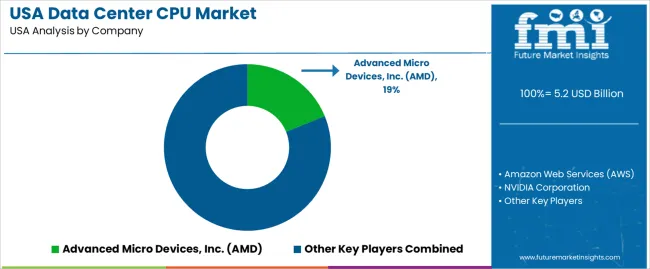
Demand for data center CPUs in the USA has surged due to the growing need for high-performance computing, big data processing, and cloud services. With the increasing adoption of cloud computing, artificial intelligence (AI), and machine learning applications, data centers require advanced, scalable CPU solutions to support these data-heavy workloads. The expansion of cloud providers and the growing need for improved efficiency and power management in data centers have driven significant investments in the development of next-generation CPUs optimized for data center environments.
The key players in the data center CPU industry in the USA include Advanced Micro Devices, Inc. (AMD), Amazon Web Services (AWS), NVIDIA Corporation, Oracle Corporation, and Intel Corporation. AMD holds a significant share of 18.9%, offering high-performance processors with superior price-to-performance ratios, particularly in the server and data center industry. Amazon Web Services (AWS) provides custom-designed processors, like its Graviton chips, tailored for cloud computing. NVIDIA is prominent for its GPUs, but also for its growing presence in the CPU industry for data centers, especially with AI workloads. Oracle offers cloud infrastructure solutions with optimized CPUs for enterprise applications, while Intel continues to dominate the industry with its Xeon processors, known for their reliability and scalability in data centers.
Competition in the data center CPU industry is primarily driven by the demand for higher processing power, energy efficiency, and performance in cloud services, AI, and data-heavy applications. The increasing use of virtualization, big data analytics, and AI-based technologies pushes companies to offer cutting-edge processors that can handle these high-demand workloads. Companies differentiate themselves through innovation, power efficiency, and specialized solutions for specific applications such as AI, machine learning, or cloud-based services. As cloud computing and AI continue to grow, data center CPUs must evolve to meet the performance and scalability needs of these technologies.
Key Players in USA Data Center CPU Demand
- Advanced Micro Devices, Inc. (AMD)
- Amazon Web Services (AWS)
- NVIDIA Corporation
- Oracle Corporation
- Intel Corporation
Scope of Report
| Items | Values |
|---|---|
| Quantitative Units (2025) | USD billion |
| Number of CPU Cores Segment | 16-Core CPUs, 4-Core, 8-Core, 32-Core, 64-Core |
| Component | x86 Processor, ARM Processors, Power Processors |
| Server Form Factor | 2-Socket Servers, 1-Socket, 4-Socket |
| Region | West USA, South USA, Northeast USA, Midwest USA |
| Countries Covered | USA |
| Key Companies Profiled | Advanced Micro Devices, Inc. (AMD), Amazon Web Services (AWS), NVIDIA Corporation, Oracle Corporation, Intel Corporation |
| Additional Attributes | Dollar sales by number of CPU cores, component, and server form factor; regional CAGR and adoption trends; demand trends in data center CPUs; growth in cloud computing, server infrastructure, and enterprise sectors; technology adoption for processing power in data centers; vendor offerings including CPU solutions, processors, and services; regulatory influences and industry standards |
USA Data Center CPU Demand by Key Segments
Number of CPU Cores Segment
- 16-Core CPUs
- 4-Core
- 8-Core
- 32-Core
- 64-Core
Component
- x86 Processor
- ARM Processors
- Power Processors
Server Form Factor
- 2-Socket Servers
- 1-socket
- 4-socket
Region
- West USA
- South USA
- Northeast USA
- Midwest USA
Frequently Asked Questions
How big is the demand for data center CPU in USA in 2025?
The demand for data center CPU in USA is estimated to be valued at USD 5.2 billion in 2025.
What will be the size of data center CPU in USA in 2035?
The market size for the data center CPU in USA is projected to reach USD 10.6 billion by 2035.
How much will be the demand for data center CPU in USA growth between 2025 and 2035?
The demand for data center CPU in USA is expected to grow at a 7.4% CAGR between 2025 and 2035.
What are the key product types in the data center CPU in USA?
The key product types in data center CPU in USA are 16-core cpus, 4-core, 8-core, 32-core and 64-core.
Which component segment is expected to contribute significant share in the data center CPU in USA in 2025?
In terms of component , x86 processor segment is expected to command 72.5% share in the data center CPU in USA in 2025.
Preview the report firsthand - request a free sample
Get SampleGet the brochure for pricing and purchase details.
Get PDFTable of Content
- Executive Summary
- USA Market Outlook
- Demand-side Trends
- Supply-side Trends
- Technology Roadmap Analysis
- Analysis and Recommendations
- Market Overview
- Market Coverage / Taxonomy
- Market Definition / Scope / Limitations
- Market Background
- Market Dynamics
- Drivers
- Restraints
- Opportunity
- Trends
- Scenario Forecast
- Demand in Optimistic Scenario
- Demand in Likely Scenario
- Demand in Conservative Scenario
- Opportunity Map Analysis
- Product Life Cycle Analysis
- Supply Chain Analysis
- Investment Feasibility Matrix
- Value Chain Analysis
- PESTLE and Porter’s Analysis
- Regulatory Landscape
- Regional Parent Market Outlook
- Production and Consumption Statistics
- Import and Export Statistics
- Market Dynamics
- USA Market Analysis 2020 to 2024 and Forecast, 2025 to 2035
- Historical Market Size Value (USD Million) Analysis, 2020 to 2024
- Current and Future Market Size Value (USD Million) Projections, 2025 to 2035
- Y-o-Y Growth Trend Analysis
- Absolute $ Opportunity Analysis
- USA Market Pricing Analysis 2020 to 2024 and Forecast 2025 to 2035
- USA Market Analysis 2020 to 2024 and Forecast 2025 to 2035, By Number of CPU Cores Segment
- Introduction / Key Findings
- Historical Market Size Value (USD Million) Analysis By Number of CPU Cores Segment , 2020 to 2024
- Current and Future Market Size Value (USD Million) Analysis and Forecast By Number of CPU Cores Segment , 2025 to 2035
- 16-Core CPUs
- 4-Core
- 8-Core
- 32-Core
- 64-Core
- Y-o-Y Growth Trend Analysis By Number of CPU Cores Segment , 2020 to 2024
- Absolute $ Opportunity Analysis By Number of CPU Cores Segment , 2025 to 2035
- USA Market Analysis 2020 to 2024 and Forecast 2025 to 2035, By Component
- Introduction / Key Findings
- Historical Market Size Value (USD Million) Analysis By Component, 2020 to 2024
- Current and Future Market Size Value (USD Million) Analysis and Forecast By Component, 2025 to 2035
- x86 Processor
- ARM Processors
- Power Processors
- Y-o-Y Growth Trend Analysis By Component, 2020 to 2024
- Absolute $ Opportunity Analysis By Component, 2025 to 2035
- USA Market Analysis 2020 to 2024 and Forecast 2025 to 2035, By Server Form Factor
- Introduction / Key Findings
- Historical Market Size Value (USD Million) Analysis By Server Form Factor, 2020 to 2024
- Current and Future Market Size Value (USD Million) Analysis and Forecast By Server Form Factor, 2025 to 2035
- 2-Socket Servers
- 1-socket
- 4-socket
- Y-o-Y Growth Trend Analysis By Server Form Factor, 2020 to 2024
- Absolute $ Opportunity Analysis By Server Form Factor, 2025 to 2035
- Market Structure Analysis
- Competition Dashboard
- Competition Benchmarking
- Market Share Analysis of Top Players
- By Regional
- By Number of CPU Cores Segment
- By Component
- By Server Form Factor
- Competition Analysis
- Competition Deep Dive
- Advanced Micro Devices, Inc. (AMD)
- Overview
- Product Portfolio
- Profitability by Market Segments (Product/Age /Sales Channel/Region)
- Sales Footprint
- Strategy Overview
- Marketing Strategy
- Product Strategy
- Channel Strategy
- Amazon Web Services (AWS)
- NVIDIA Corporation
- Oracle Corporation
- Intel Corporation
- Advanced Micro Devices, Inc. (AMD)
- Competition Deep Dive
- Assumptions & Acronyms Used
- Research Methodology


