

- Industry Size (2026)
- USD 86.6 Mn
- Forecast (2036)
- USD 157.9 Mn
- CAGR (2026 to 2036)
- 6.2%
Demand for Nano Bubble Generators in USA 2026 to 2036
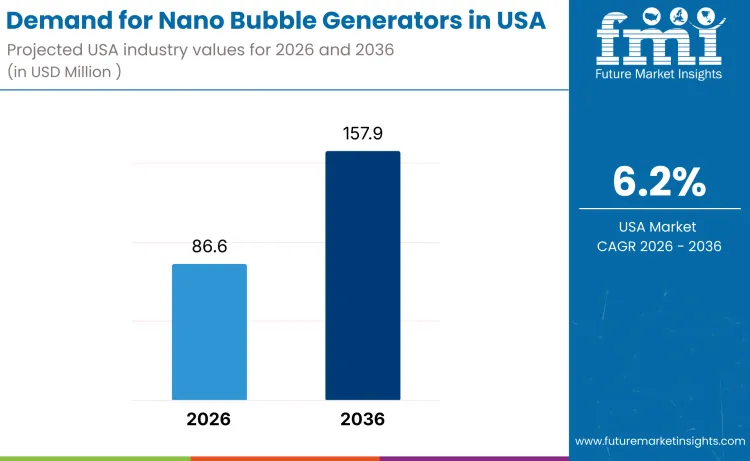
Demand for Nano Bubble Generators in USA is valued at USD 86.6 million in 2026 and is projected to reach USD 157.9 million by 2036, reflecting a CAGR of 6.2%. Demand expands due to rising adoption across water treatment, aquaculture, agriculture, and industrial cleaning applications where enhanced oxygen transfer efficiency improves process outcomes. Utilities and industrial operators deploy nano bubble technology to reduce chemical usage, improve dissolved gas stability, and enhance biological treatment efficiency.
Gas–water circulation type systems lead product-type adoption because this configuration delivers consistent nano-scale bubble generation with high gas dissolution rates and lower energy consumption. Systems support uniform dispersion of oxygen, ozone, or air, enabling improved oxidation, biofilm control, and nutrient uptake. Reliability in continuous-operation environments strengthens usage across wastewater plants, fish farms, and large-scale irrigation systems.
West USA, South USA, Northeast USA, and Midwest USA represent key growth regions driven by water scarcity management initiatives, intensive agriculture activity, and industrial sustainability programs. Moleaer, Nanobubble Solutions Inc., AquaPro Solutions, Nikuni America, and Atlas Copco shape competitive dynamics through system efficiency improvements, scalable generator designs, and integration of nano bubble technology into existing water and process infrastructure across multiple end-use sectors.
Quick Stats for Demand for Nano Bubble Generators in USA
- USA Nano Bubble Generators Sales Value (2026): USD 86.6 million
- USA Nano Bubble Generators Forecast Value (2036): USD 157.9 million
- USA Nano Bubble Generators Forecast CAGR (2026 to 2036): 6.2%
- Leading Product Type in USA Demand: Gas-water circulation type systems
- Key Growth Regions in USA Demand: West USA, South USA, Northeast USA, Midwest USA
- Top Players in USA Demand: Moleaer, Nanobubble Solutions Inc., AquaPro Solutions, Nikuni America, Atlas Copco
USA Nano Bubble Generators Key Takeaways
| Metric | Value |
|---|---|
| USA Nano Bubble Generators Sales Value (2026) | USD 86.6 million |
| USA Nano Bubble Generators Forecast Value (2036) | USD 157.9 million |
| USA Nano Bubble Generators Forecast CAGR (2026 to 2036) | 6.2% |
How Are the Segments Classified in the Demand for Nano Bubble Generators in the USA?
Demand for nano bubble generators in the USA is shaped by water-efficiency requirements, process optimization needs, and adoption of advanced gas-liquid interaction technologies. Buyers evaluate bubble stability, gas transfer efficiency, energy consumption, and integration into existing treatment or production systems. Adoption patterns reflect usage across municipal water treatment, controlled agriculture, healthcare applications, and precision manufacturing environments within regulated USA operational settings.
Which Product Type Accounts for the Largest Share of Demand in the USA?
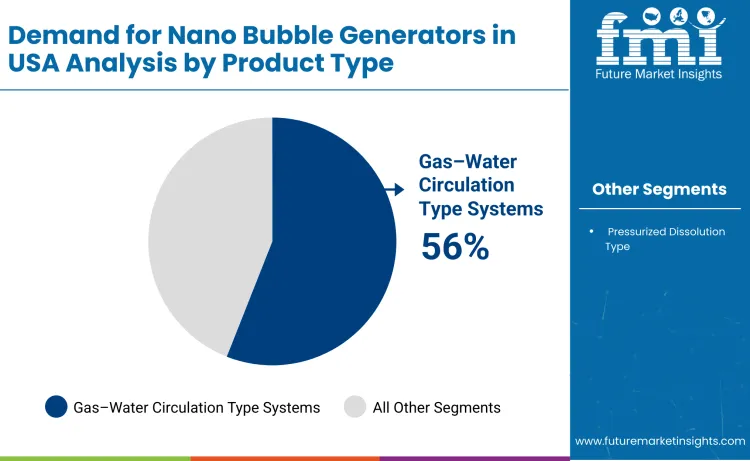
Gas-water circulation type systems hold 56.0%, making them the leading product-type segment in USA demand. These systems recirculate gas and water to generate stable nano bubbles with consistent size distribution. Design simplicity supports installation in water-treatment plants, agricultural irrigation systems, and industrial process loops. Pressurized dissolution type systems rely on pressure differentials to dissolve gas, supporting niche applications requiring compact designs. Product-type distribution reflects preference for circulation-based systems due to scalability, operational stability, and lower maintenance complexity across USA facilities.
Key Points:
- Gas-water circulation systems dominate due to stable nano bubble output.
- Circulation designs support scalable industrial and municipal use.
- Pressurized systems serve compact or specialized installations.
Which Technology Accounts for the Largest Share of Demand in the USA?
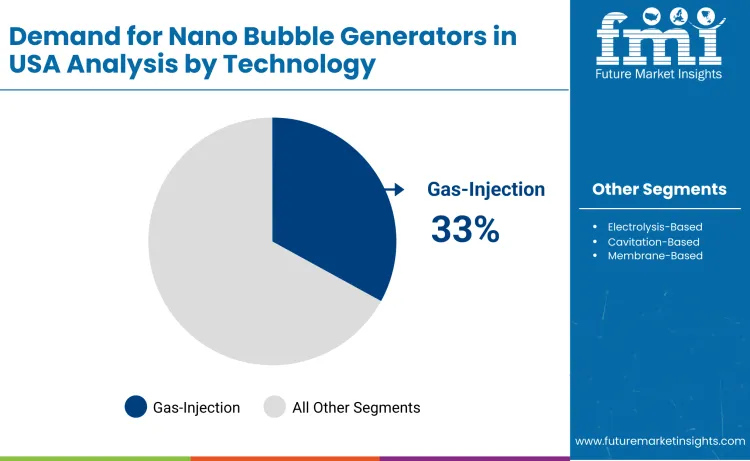
Gas-injection nano bubble generation holds 33.0%, making it the leading technology segment in the USA. This approach injects gas directly into liquid streams, enabling efficient nano bubble formation with controlled gas concentration. Electrolysis-based systems support applications requiring reactive gas species generation. Cavitation-based technologies use pressure variation to create bubbles suited for industrial cleaning or processing. Membrane-based and plasma systems address specialized medical, research, or high-purity environments. Technology distribution reflects reliance on gas-injection methods due to energy efficiency and adaptability across USA operational settings.
Key Points:
- Gas-injection technology offers efficient and controllable bubble generation.
- Electrolysis systems support reactive gas applications.
- Cavitation and membrane systems serve specialized industrial needs.
Which Application Accounts for the Largest Share of Demand in the USA?
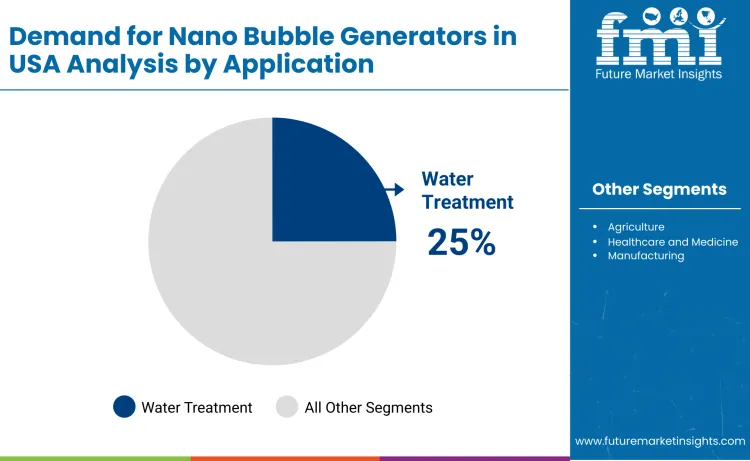
Water treatment holds 25.0%, making it the leading application segment in the USA. Nano bubble generators improve dissolved oxygen levels, contaminant breakdown, and treatment efficiency in municipal and industrial water systems. Agriculture applications use nano bubbles to enhance nutrient uptake and irrigation efficiency. Healthcare and medicine adopt systems for sterilization and therapeutic research. Manufacturing applications focus on surface treatment and process enhancement. Food, beverage, cosmetics, and personal care sectors use nano bubbles for quality and process control. Application distribution reflects strong infrastructure-driven demand within USA water treatment systems.
Key Points:
- Water treatment drives primary adoption in the USA.
- Agriculture uses nano bubbles for efficiency improvements.
- Healthcare and manufacturing apply systems for precision processes.
What are the Key Dynamics in the Nano Bubble Generators Industry in USA?
Demand increases across water treatment, agriculture, aquaculture, and industrial cleaning applications in the USA. Nano bubble generators support oxygen transfer efficiency, contaminant removal, and process optimization in regulated environments. Municipal utilities, farms, and industrial operators evaluate the technology to improve performance without chemical intensity. Adoption remains concentrated in regions with water stress, advanced wastewater infrastructure, and sustainability-driven operational targets.
How do water treatment efficiency need and industrial process optimization drive demand in USA?
US wastewater utilities adopt nano bubble generators to enhance dissolved oxygen levels, improve biological treatment efficiency, and reduce aeration energy consumption. Industrial facilities use the technology for surface cleaning, flotation, and separation processes requiring fine gas dispersion. Agricultural operations apply nano bubbles in irrigation systems to improve nutrient uptake and root oxygenation. Aquaculture facilities use generators to stabilize oxygen levels in high-density fish farming environments. Food processing plants evaluate nano bubbles for sanitation processes that reduce chemical usage. Research institutions and pilot programs supported by state water agencies contribute to technology validation. Regions facing groundwater stress show higher interest in efficiency-driven water technologies.
How do capital costs, technical validation requirements, and adoption barriers affect scalability in USA?
Initial equipment investment remains a constraint for small municipalities and farms with limited capital budgets. Buyers require site-specific performance validation due to variability in water chemistry and operating conditions. Lack of standardized performance metrics complicates procurement decisions across utilities. Maintenance requirements and integration with existing systems influence adoption timelines. Regulatory approvals for drinking water applications require extensive testing and documentation. Operators require trained personnel to manage optimization and monitoring. Competitive alternatives such as advanced aeration and chemical treatment limit adoption in cost-sensitive settings. Demand growth depends on demonstrated lifecycle cost benefits, utility-scale case studies, and clearer technical standards within USA water and industrial markets.
How Is Demand for Nano Bubble Generators in USA Evolving by Region?
Demand for nano bubble generators in the USA is increasing due to expanding use across water treatment, agriculture, aquaculture, food processing, and surface-cleaning applications. West USA leads with a 7.1% CAGR, supported by water reuse initiatives, high-value agriculture, and advanced industrial adoption. South USA follows at 6.4%, driven by agriculture-intensive states, wastewater treatment upgrades, and aquaculture expansion. Northeast USA records a 5.7% CAGR, shaped by municipal water-quality mandates and industrial process optimization. Midwest USA posts a 4.9% CAGR, reflecting steady uptake in agriculture, food processing, and industrial water management. Regional variation reflects water-stress intensity, regulatory pressure, crop patterns, and infrastructure investment across the USA.
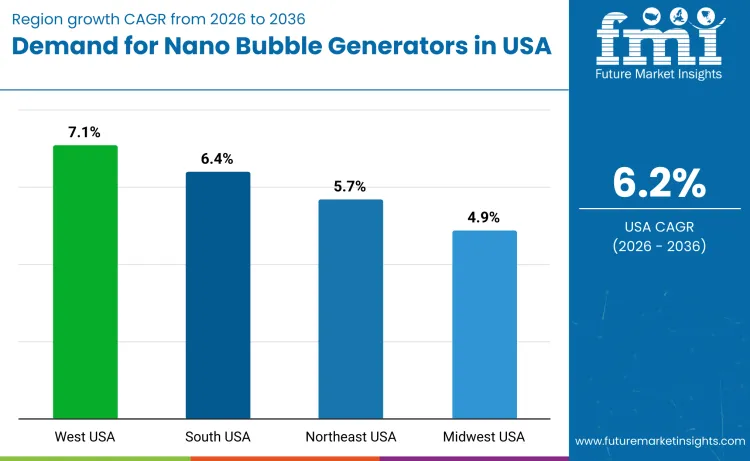
| Region | CAGR (2026 to 2036) |
|---|---|
| West USA | 7.1% |
| South USA | 6.4% |
| Northeast USA | 5.7% |
| Midwest USA | 4.9% |
How is West USA driving demand for Nano Bubble Generators?
West USA demand is driven by water scarcity, advanced sustainability programs, and high adoption of precision technologies. The region’s CAGR of 7.1% reflects strong deployment of nano bubble generators in water reuse systems, desalination pretreatment, and industrial wastewater polishing. Agriculture operations use oxygen and ozone nano bubbles to improve irrigation efficiency, root-zone oxygenation, and crop yield in high-value fruits and vegetables. Municipal utilities adopt nano bubble systems to reduce chemical usage and improve dissolved oxygen levels. Industrial facilities apply the technology for biofilm control and enhanced flotation. Demand favors high-capacity generators with digital monitoring and corrosion-resistant materials.
- Water reuse and desalination pretreatment applications
- Precision agriculture and high-value crop irrigation
- Municipal adoption for chemical-reduction strategies
- Preference for advanced, sensor-integrated systems
How is South USA driving demand for Nano Bubble Generators?
South USA demand is shaped by large-scale agriculture, aquaculture, and wastewater treatment requirements. The region’s CAGR of 6.4% reflects increased use of nano bubble generators in pond aeration, shrimp and fish farming, and nutrient management systems. Municipalities deploy nano bubble technology to improve wastewater treatment efficiency and odor control under warm-climate conditions. Agricultural producers use air and oxygen nano bubbles to enhance soil health and reduce fertilizer runoff. Food processing facilities apply nano bubbles for cleaning-in-place operations and microbial control. Demand prioritizes robust systems capable of continuous operation in high-temperature environments.
- Aquaculture pond aeration and water-quality improvement
- Agricultural soil and irrigation enhancement
- Wastewater odor and nutrient management
- Demand for durable, high-throughput equipment
How is Northeast USA driving demand for Nano Bubble Generators?
Northeast USA demand is driven by regulatory compliance, infrastructure modernization, and industrial efficiency objectives. The region’s CAGR of 5.7% reflects adoption of nano bubble generators in municipal drinking-water treatment, stormwater management, and industrial effluent polishing. Utilities use nano bubbles to enhance dissolved oxygen levels and reduce reliance on chemical oxidants. Manufacturing plants apply the technology for precision cleaning, flotation separation, and biofilm suppression. Adoption remains selective, with emphasis on pilot-scale validation and measurable performance outcomes. Systems with documented energy efficiency and compliance certification are preferred.
- Municipal water and stormwater treatment upgrades
- Industrial effluent polishing and flotation separation
- Focus on regulatory compliance and performance validation
- Preference for certified, energy-efficient systems
How is Midwest USA driving demand for Nano Bubble Generators?
Midwest USA demand reflects stable, application-specific adoption across agriculture, food processing, and industrial water systems. The region’s CAGR of 4.9% is supported by use of nano bubble generators in crop irrigation, livestock water treatment, and ethanol and food-processing wastewater management. Agricultural operators apply the technology to improve nutrient uptake and reduce pathogen load. Industrial users focus on flotation efficiency and reduced chemical consumption. Budget sensitivity influences purchasing decisions, favoring modular and retrofittable systems. Growth remains steady rather than rapid, aligned with incremental infrastructure upgrades.
- Agricultural irrigation and livestock water applications
- Food and biofuel processing wastewater treatment
- Emphasis on cost-effective, modular installations
- Predictable adoption tied to infrastructure replacement cycles
What is the competitive landscape of demand for nano bubble generators in the USA?
Demand for nano bubble generators in the USA is shaped by applications across water treatment, aquaculture, agriculture irrigation, food processing, and industrial cleaning systems. Usage depends on dissolved oxygen transfer efficiency, bubble size stability, energy consumption, and compatibility with existing fluid-handling infrastructure. Buyers evaluate gas-liquid mixing performance, operating pressure requirements, maintenance intervals, and system scalability across municipal and industrial settings. Procurement teams prioritize suppliers with domestic installation capability, application engineering support, and compliance with USA water and process standards. Trend in the USA market reflects adoption in wastewater aeration, algae control, soil oxygenation, and flotation processes that require efficient mass transfer.
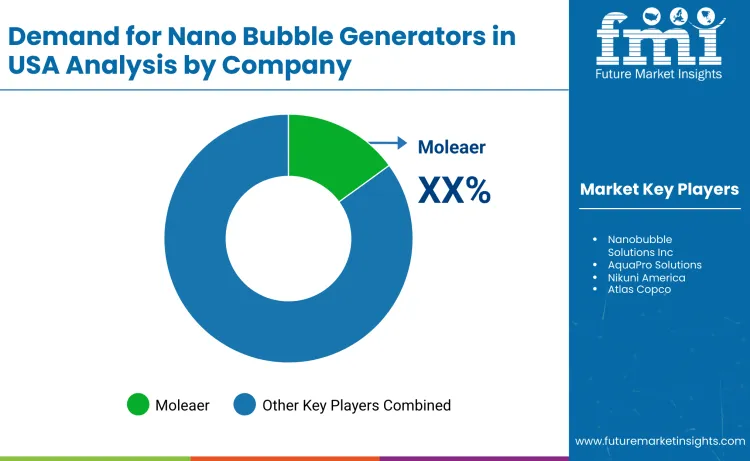
Moleaer operates extensive installations across USA municipal water facilities, lakes, and industrial sites, supported by proprietary nanobubble generation technology and field service teams. Nanobubble Solutions Inc. supplies modular systems used in agriculture, food processing, and industrial wastewater applications requiring adaptable deployment. AquaPro Solutions maintains activity through oxygenation and nanobubble systems applied in environmental remediation and aquaculture operations within the USA. Nikuni America participates with regenerative turbine-based nanobubble generators used in industrial water treatment and process applications. Atlas Copco supports demand through engineered gas-injection and process aeration solutions integrated into industrial systems requiring precise gas dispersion. Competitive positioning in the USA reflects installation track record, system reliability, energy efficiency, and technical support aligned with diverse water and process requirements.
Key Players in USA Nano Bubble Generators Demand
- Moleaer
- Nanobubble Solutions Inc.
- AquaPro Solutions
- Nikuni America
- Atlas Copco
Scope of the Report
| Items | Values |
|---|---|
| Quantitative Units | USD million |
| Product Types | Gas-Water Circulation Type; Pressurized Dissolution Type |
| Technologies | Gas Injection Nano Bubble Generation; Electrolysis-Based Nano Bubble Generation; Cavitation-Based Nano Bubble Generation; Membrane-Based Nano Bubble Generation; Plasma Nano Bubble Generation |
| Application | Water Treatment; Agriculture; Healthcare and Medicine; Manufacturing; Food and Beverage Processing; Cosmetics and Personal Care |
| Regions Covered | West USA; South USA; Northeast USA; Midwest USA |
| Key Companies Profiled | Moleaer; Nanobubble Solutions Inc.; AquaPro Solutions; Nikuni America; Atlas Copco |
| Additional Attributes | Dollar sales by product type and nano bubble generation technology across West USA, South USA, Northeast USA, and Midwest USA; technology adoption patterns in municipal water treatment, controlled-environment agriculture, and industrial process water optimization; application-driven demand for oxygen transfer efficiency, biofilm control, and chemical usage reduction; regional deployment trends influenced by water scarcity management, wastewater regulations, and high-value crop cultivation; competitive differentiation based on system scalability, energy efficiency, integration with existing water infrastructure, and after-sales technical support within USA industrial and municipal sectors. |
USA Nano Bubble Generators Demand by Segments
By Product Types:
- Gas-Water Circulation Type
- Pressurized Dissolution Type
By Technologies:
- Gas Injection Nano Bubble Generation
- Electrolysis-Based Nano Bubble Generation
- Cavitation-Based Nano Bubble Generation
- Membrane-Based Nano Bubble Generation
- Plasma Nano Bubble Generation
By Application:
- Water Treatment
- Agriculture
- Healthcare and Medicine
- Manufacturing
- Food and Beverage Processing
- Cosmetics and Personal Care
By Region:
- West USA
- South USA
- Northeast USA
- Midwest USA
Frequently Asked Questions
How big is the demand for nano bubble generators in USA in 2026?
The demand for nano bubble generators in USA is estimated to be valued at USD 86.6 million in 2026.
What will be the size of nano bubble generators demand in USA in 2036?
The demand size for nano bubble generators in USA is projected to reach USD 157.9 million by 2036.
How much will the demand for nano bubble generators in USA grow between 2026 and 2036?
The demand for nano bubble generators in USA is expected to grow at a 6.2% CAGR between 2026 and 2036.
What are the key product types in the nano bubble generators demand in USA?
The key product types in nano bubble generators demand in USA include gas-water circulation type systems and other nano bubble generator configurations.
Which technology segment is expected to contribute a significant share in the nano bubble generators demand in USA in 2026?
In terms of technology, gas injection nano bubble generation is expected to command 33.0% share in the nano bubble generators demand in USA in 2026.
Preview the report firsthand - request a free sample
Get SampleGet the brochure for pricing and purchase details.
Get PDFTable of Content
- Executive Summary
- USA Market Outlook
- Demand Side Trends
- Supply Side Trends
- Technology Roadmap Analysis
- Analysis and Recommendations
- Market Overview
- Market Coverage and Taxonomy
- Market Definition, Scope, and Limitations
- Market Background
- Market Dynamics
- Drivers
- Restraints
- Opportunities
- Trends
- Scenario Forecast
- Demand in Optimistic Scenario
- Demand in Likely Scenario
- Demand in Conservative Scenario
- Opportunity Map Analysis
- Product Life Cycle Analysis
- Supply Chain Analysis
- Investment Feasibility Matrix
- Value Chain Analysis
- PESTLE and Porter Analysis
- Regulatory Landscape
- Regional Parent Market Outlook
- Production and Consumption Statistics
- Import and Export Statistics
- USA Nano Bubble Generators Demand Analysis 2020 to 2024 and Forecast 2025 to 2035
- Historical Market Size Value (USD Million) Analysis 2020 to 2024
- Current and Future Market Size Value (USD Million) Projections 2025 to 2035
- Year to Year Growth Trend Analysis
- Absolute Dollar Opportunity Analysis
- USA Nano Bubble Generators Pricing Analysis 2020 to 2024 and Forecast 2025 to 2035
- USA Nano Bubble Generators Demand Analysis 2020 to 2024 and Forecast 2025 to 2035, By Product Type
- Introduction and Key Findings
- Historical Market Size Value (USD Million) Analysis By Product Type 2020 to 2024
- Current and Future Market Size Value (USD Million) Analysis and Forecast By Product Type 2025 to 2035
- Gas–Water Circulation Type
- Pressurized Dissolution Type
- Year to Year Growth Trend Analysis By Product Type 2020 to 2024
- Absolute Dollar Opportunity Analysis By Product Type 2025 to 2035
- USA Nano Bubble Generators Demand Analysis 2020 to 2024 and Forecast 2025 to 2035, By Technology
- Introduction and Key Findings
- Historical Market Size Value (USD Million) Analysis By Technology 2020 to 2024
- Current and Future Market Size Value (USD Million) Analysis and Forecast By Technology 2025 to 2035
- Gas Injection Nano Bubble Generation
- Electrolysis-Based Nano Bubble Generation
- Cavitation-Based Nano Bubble Generation
- Membrane-Based Nano Bubble Generation
- Plasma Nano Bubble Generation
- Year to Year Growth Trend Analysis By Technology 2020 to 2024
- Absolute Dollar Opportunity Analysis By Technology 2025 to 2035
- USA Nano Bubble Generators Demand Analysis 2020 to 2024 and Forecast 2025 to 2035, By Application
- Introduction and Key Findings
- Historical Market Size Value (USD Million) Analysis By Application 2020 to 2024
- Current and Future Market Size Value (USD Million) Analysis and Forecast By Application 2025 to 2035
- Water Treatment
- Agriculture
- Healthcare and Medicine
- Manufacturing
- Food and Beverage Processing
- Cosmetics and Personal Care
- Year to Year Growth Trend Analysis By Application 2020 to 2024
- Absolute Dollar Opportunity Analysis By Application 2025 to 2035
- Market Structure Analysis
- Competition Dashboard
- Competition Benchmarking
- Market Share Analysis of Key Players
- By Product Type
- By Technology
- By Application
- By Region
- Competition Analysis
- Competition Deep Dive
- Moleaer
- Nanobubble Solutions Inc.
- AquaPro Solutions
- Nikuni America
- Atlas Copco
- Assumptions and Acronyms Used
- Research Methodology


