

- Industry Size (2025)
- USD 2.0 Bn
- Forecast (2035)
- USD 3.0 Bn
- CAGR (2025 to 2035)
- 3.9%
Demand for Paint Cans in USA 2025 to 2035
The demand for paint cans in the USA is valued at USD 2.0 billion in 2025 and is forecasted to reach USD 3.0 billion by 2035, reflecting a CAGR of 3.9%. Renovation projects, construction activity, and steady consumption of decorative and protective coatings across residential, commercial, and industrial applications influence demand. Infrastructure refurbishment programs and the continued use of solvent- and water-based formulations further sustain requirements for rigid packaging formats.
Metal cans represent the leading packaging type. They are preferred due to durability, compatibility with diverse coating chemistries, and strong barrier protection against environmental exposure. These cans secure paint integrity during transport and storage while meeting labelling, handling, and recyclability requirements across professional and retail channels. Design improvements continue to address weight optimization, stackability, and leak-prevention performance.
Demand is concentrated in the West, South, and Northeast, where construction spending, home-improvement activity, and manufacturing output remain significant. Distribution networks in these regions supply large retail hardware outlets and industrial end-users that rely on resilient packaging for high-volume paint consumption. Key suppliers include Ball Corporation, RPC Group Plc., Silgan Containers LLC, Kian Joo Can Factory Berhad, and Colep Portugal S.A. Their portfolios support varying can size, interior linings suited to coating materials, and compliance with regulatory and environmental packaging standards.
Quick Stats for USA Paint Cans Demand
- USA Paint Cans Sales Value (2025): USD 2.0 billion
- USA Paint Cans Forecast Value (2035): USD 3.0 billion
- USA Paint Cans Forecast CAGR (2025–2035): 3.9%
- Leading Type in USA Paint Cans Demand: Metal Cans
- Key Growth Regions in USA Paint Cans Demand: West USA, South USA, Northeast USA
- Top Players in USA Paint Cans Demand: Ball Corporation, RPC Group Plc., Silgan Containers LLC, Kian Joo Can Factory Berhad, Colep Portugal S.A.
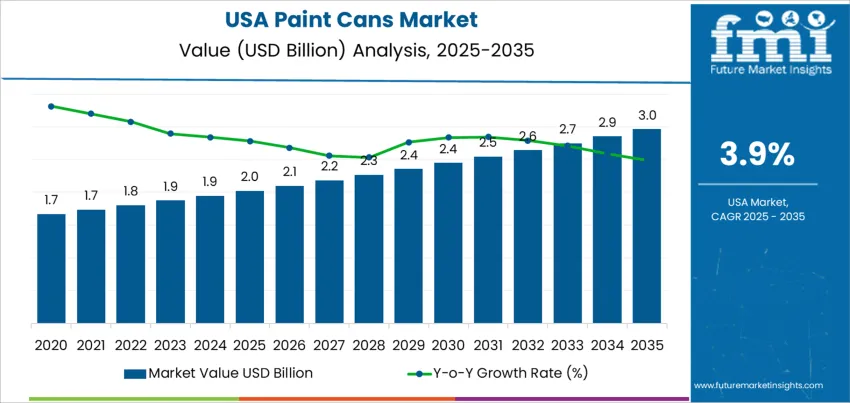
What is the Growth Forecast for Paint Cans Industry in USA through 2035?
Demand for paint cans in the United States operates near a moderate saturation point due to the stable maturity of the architectural and industrial coatings industries. Core demand comes from residential repainting cycles, commercial maintenance, and automotive refinishing, which remain steady rather than rapidly expanding. New housing construction adds incremental volume but does not significantly shift long-term container requirements because repainting demand dominates overall consumption. Saturation pressure increases with the broader transition toward eco-efficient packaging and bulk dispensing systems. Paint manufacturers introduce reusable containers and direct-to-applicator formats that reduce reliance on traditional metal cans. Growth in digital color-matching and factory-filled cartridges for professional contractors also channels a portion of volume away from standard can packaging.
Recycling improvements extend the lifecycle of metal cans, slowing replacement rates. At the same time, environmental regulations encourage lightweight alternatives, creating minor substitution effects. Despite these moderating influences, construction renovation frequency and DIY retail activity maintain a reliable baseline. The saturation effect is therefore characterized by slow incremental growth rather than contraction, with demand stabilizing around established consumption patterns supported by durable packaging preferences and widespread compatibility with existing distribution networks.
USA Paint Cans Key Takeaways
| Metric | Value |
|---|---|
| USA Paint Cans Sales Value (2025) | USD 2.0 billion |
| USA Paint Cans Forecast Value (2035) | USD 3.0 billion |
| USA Paint Cans Forecast CAGR (2025-2035) | 3.9% |
Why is the Demand for Paint Cans in the USA Growing?
Demand for paint cans in the USA is increasing because both residential and commercial painting projects require durable, sealed containers for storing and transporting paint and coatings safely. Home improvement activity, renovation trends and do-it-yourself (DIY) culture support steady demand for cans sized for both small and large jobs. Contractors and professional painters rely on standard 1-gal and 5-gal metal or plastic cans for bulk and on-site usage. Growth in industrial coatings, protective paints and specialty finishes for automotive, maritime and infrastructure projects drives demand for heavy-duty cans and pails designed to resist corrosion and ensure long shelf life. Manufacturers and supply houses depend on standardized containers to maintain quality and regulatory compliance for volatile or solvent-based coatings.
Retail channels and hardware stores stock a wide range of paint can size and formats to accommodate varied consumer needs, including eco-friendly low-VOC paints and stain blocking primers. The trend toward small-batch custom color mixing at stores also supports frequent use of smaller cans and disposable containers. Constraints include increasing costs of steel, plastic resin and packaging materials that can raise final paint prices. Environmental regulations and recycling mandates encourage manufacturers to explore alternative packaging such as recyclable or refillable containers, which may gradually shift demand away from traditional metal cans.
Which Product Types, Materials, and Capacities Lead Demand for Paint Cans in the USA?
Demand for paint cans in the United States is shaped by continued growth in residential renovation, commercial construction, and DIY home-improvement activities. Packaging selection is guided by container strength, chemical resistance, dent protection, and recyclability. Regulations on solvent-based products also influence packaging durability and compatibility. Retail distribution trends emphasize user-friendly opening systems and labeling space, supporting brand visibility in large hardware chains and e-commerce platforms.
By Product Type, Metal Cans Hold the Largest Share
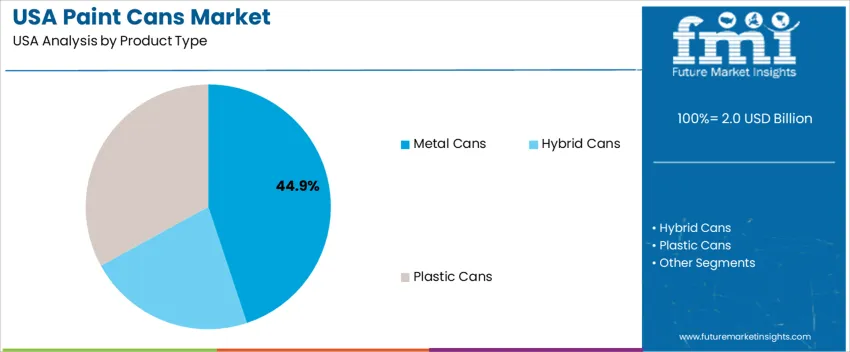
Metal cans account for 44.9%, supported by strong adoption in solvent-based paints, primers, varnishes, and industrial coatings requiring airtight sealing and corrosion resistance. Their durability supports repeated handling in professional environments, reducing leakage risks. Plastic cans represent 33.0%, driven by water-based formulations, light-weighting goals, and safer transport for retail consumers. Hybrid cans contribute 22.1%, offering improved performance with combination structural designs that balance weight reduction and dent protection. The distribution of product types reflects the USA shift toward waterborne paint technologies, while metal formats retain priority for volatile formulations and long-term storage requirements.
Key Points:
- Metal formats maintain leadership due to industrial-grade protection
- Plastics align with water-based paints and consumer USAbility
- Hybrid options optimize performance with weight reductions
By Material Type, Plastic Leads the Paint Cans Industry
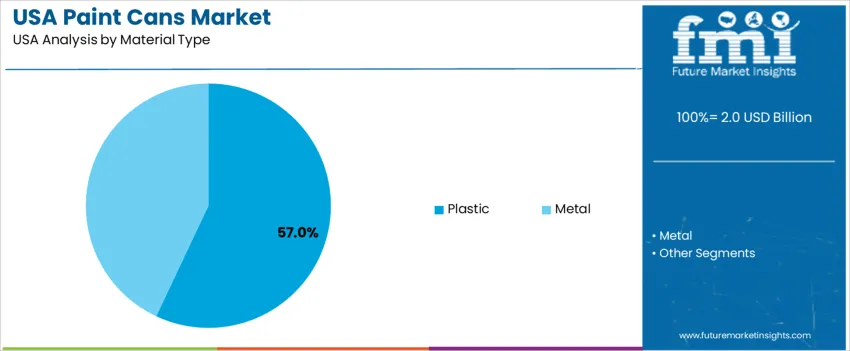
Plastic accounts for 57.0%, driven by cost advantages, dent resistance, and compatibility with a broad range of decorative and household paints. Lightweight features also reduce logistics cost and improve retail handling. Metal holds 43.0%, sustaining use in protective coatings where resistance to permeation and long-duration storage is essential. Material choices reflect USA buyer expectations emphasizing safety, recyclability, and branding flexibility. Growing preference for sustainable plastics with enhanced chemical barrier properties continues to expand adoption in consumer-packaged paint containers.
Key Points:
- Plastic offers lower weight and improved consumer convenience
- Metal retained for stronger chemical and vapor barrier performance
- Material use aligns with formulation transitions across USA coatings
By Capacity, 1000 ml and Below Is the Most Popular Format
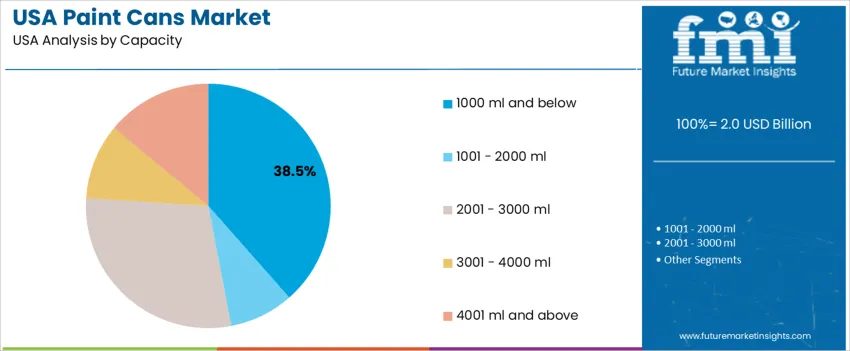
Cans 1000 ml and below hold 38.5%, supported by frequent DIY applications, repair work, and small-batch project needs in households. The 2001–3000 ml segment follows with 29.0%, serving retail and contractor-grade usage for regular repainting work. 4001 ml and above account for 14.0%, predominantly in professional environments requiring high-volume supply. The 3001–4000 ml category holds 10.0%, while 1001–2000 ml formats represent 8.5%, a niche for intermediate workloads. USA demand distribution reflects a strong consumer repainting cycle and multi-size retail assortment strategies supporting both casual and professional users.
Key Points:
- Small-size packs dominate due to rising DIY demand
- Medium-volume formats support contractor and maintenance needs
- High-capacity cans serve industrial and commercial repaint cycles
What are the Drivers, Restraints, and Key Trends of the Demand for Paint Cans in the USA?
Growth of residential remodeling, expansion of commercial construction and consistent DIY project activity drive demand.
In the United States, demand for paint cans is supported by strong repainting cycles in homes, apartments and public buildings. Homeowners frequently repaint interiors to support real estate resale value, refresh décor or maintain rental properties, which sustains recurring purchases of packaged paint products. DIY channels in hardware and home-improvement retailers encourage consumers to handle painting projects without contractors, supporting stable demand for one-gallon and quart cans. Commercial and infrastructure renovations also contribute to volume, especially in educational, retail and office facilities that update visual appearance for occupancy compliance or brand standards. Private-label and premium paint lines both rely heavily on metal cans for storage durability and transport resilience in domestic distribution networks.
Cost pressure from raw-material pricing, packaging waste concerns and growth of contractor bulk containers restrain demand.
Steel and coating materials used in paint cans experience pricing volatility, which may increase manufacturing cost and lead to selective packaging reduction in lower-margin paint products. Regulatory and consumer expectations for reduced packaging waste create scrutiny of single-use metal containers. Some professional painters prefer five-gallon pails and refillable systems because they lower per-project packaging needs. These shifts moderate volume growth in standard retail paint cans despite continuous painting activity nationwide.
Shift toward lightweight and recyclable metal formats, increased adoption of safety and spill-control features and rising demand for convenience-focused smaller container sizes define key trends.
Manufacturers develop lighter gauge steel cans to reduce material usage while maintaining seal integrity and stack stability. Enhanced sealing systems and child-resistant lids support safety requirements in homes with children or pets. Small portion packaging such as half-pint and sample cans grows in popularity for accent walls and trial colors, reducing leftover waste and encouraging experimentation. Digital color-matching platforms in retail locations drive more frequent purchases of smaller paint quantities suited to targeted projects. These developments indicate steady, renovation-driven demand for paint cans across the United States supported by home improvement culture and resilient construction activity.
Analysis of the Demand for Paint Cans in the USA by Region
Demand for paint cans in the United States is driven by renovations, infrastructure upgrades, and consistent packaging needs across architectural and industrial coatings. Growth aligns with construction spending patterns, do-it-yourself (DIY) activity, and distribution through hardware and professional contractor channels. West USA leads at 4.5% CAGR, followed by South USA at 4.0%, Northeast USA at 3.6%, and Midwest USA at 3.1%. Sustainability priorities encourage coatings brands to shift toward lightweight steel, increased recycled content, and compatibility with low-VOC paint systems. Supply chains rely on regional steel availability, conversion facilities, and distribution through retail and commercial paint networks.
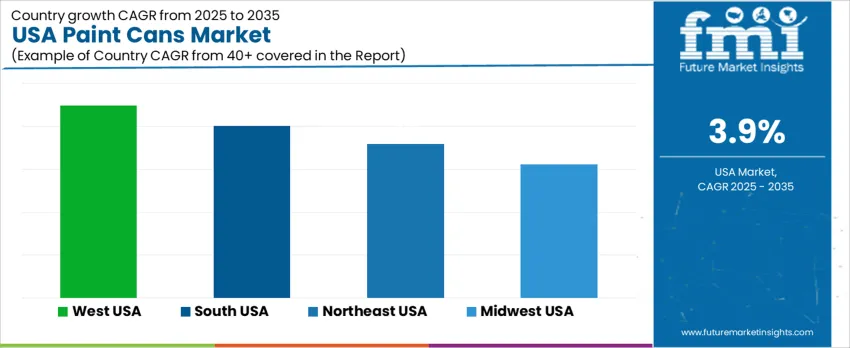
| Region | CAGR (2025-2035) |
|---|---|
| West USA | 4.5% |
| South USA | 4.0% |
| Northeast USA | 3.6% |
| Midwest USA | 3.1% |
How is the West USA driving demand for paint cans?
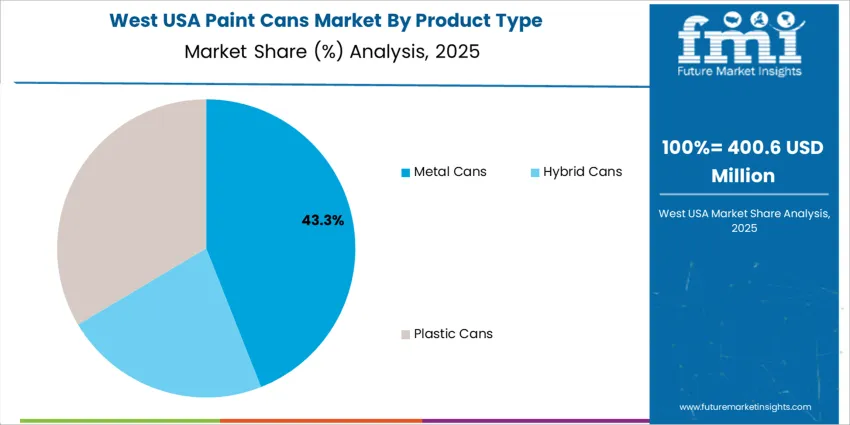
West USA holds the highest expansion rate at 4.5% CAGR, supported by residential remodeling in California, Nevada, and Washington, where home improvement spending remains elevated. DIY consumers purchase smaller-format metal cans for interior repainting linked to frequent rental turnover and open-plan living redesigns. Commercial developments in fast-growing metros drive procurement of large-volume steel cans for contractor-led paint application. Ports located along the Pacific enable consistent inbound steel sheet supply required for can manufacturing and coating compatibility. Sustainability regulation encourages packaging that supports recycling quality for leftover paints. Retail chains emphasize stock diversification across decorative finishes, waterproofing solutions, and protective coatings used in wildfire-resilient construction materials. Procurement teams compare coating-resistant linings that improve product shelf stability and limit leakage risk during transportation across varied climate zones.
- Strong remodeling and DIY expenditure driving can turnover
- Distribution efficiency supported by Pacific Coast logistics
- Increased commercial paint consumption in expanding metros
- Sustainability mandates encouraging recyclable steel packaging
How is the South USA shaping demand for paint cans?
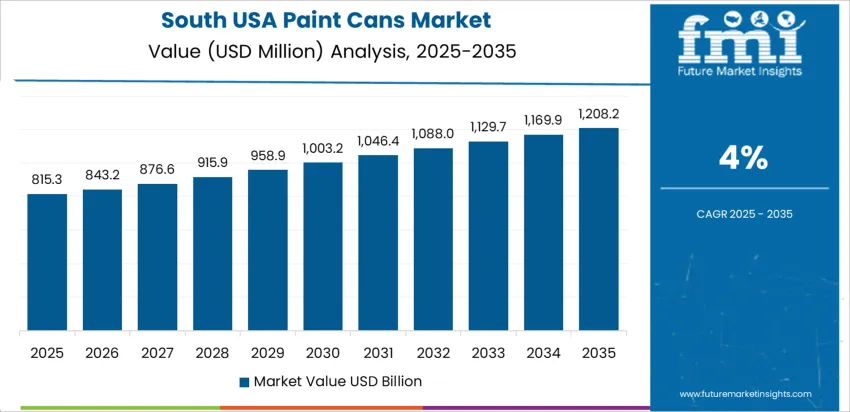
South USA expands at 4.0% CAGR, supported by high-volume residential construction in Texas, Florida, Georgia, and the Carolinas. Warm climates accelerate exterior repainting cycles, increasing contractor purchases of larger metal cans designed for high-coverage formulations. Coastal building maintenance reinforces protective coating demand for humidity- and corrosion-resistant structures. Industrial coating activity in petrochemical and automotive zones such as Houston and Alabama contributes to consistent procurement of steel paint cans. Retail and pro-dealer networks leverage distribution hubs near ports and interstate corridors to support rapid stock replacement. Price-sensitive contractors evaluate durability, rim-seal design, and opening mechanisms compatible with repeated reuse during large project work phases.
- New-housing growth supporting contractor paint can usage
- High-moisture environments require maintenance repaint cycles
- Industrial coatings maintaining baseline steel can consumption
- Logistics infrastructure supporting reliable replenishment flows
How is the Northeast USA influencing packaging demand?
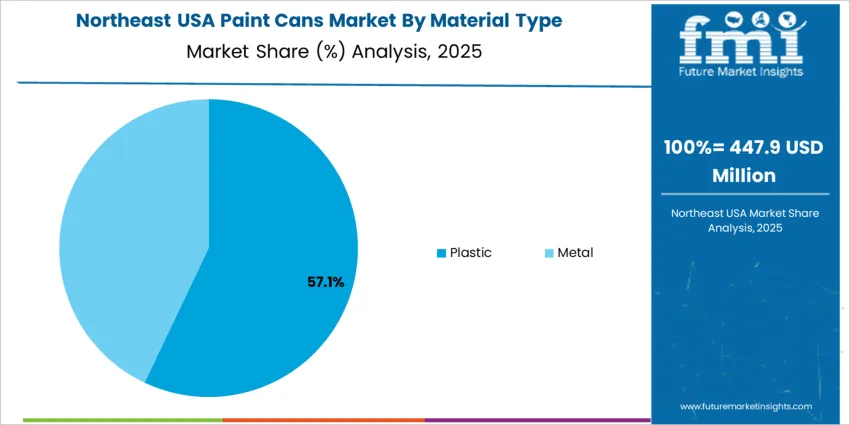
Northeast USA records 3.6% CAGR, driven by urban renovation cycles across New York, New Jersey, and Massachusetts. Space-efficient living supports demand for quart- and pint-size cans suited for interior refresh projects. Cold-weather exposure prompts seasonal purchasing of weatherproof and specialty coatings to protect building exteriors and wood installations. Professional painters prioritize packaging that retains paint integrity during storage in compact work vans and mixed-temperature conditions. Retailers adapt procurement to fluctuating seasonal demand and short lead times for peak renovation months. Recycled-content cans gain traction as state-level sustainability guidelines evolve, requiring manufacturers to enhance compatibility with responsible leftover-paint collection programs.
- High renovation activity in dense urban housing
- Cold-climate conditions driving protective coating needs
- Compact-package formats supporting small-area upgrades
- Sustainability standards encouraging recycled steel packaging
How is the Midwest USA contributing to demand stability?
Midwest USA grows at 3.1% CAGR, supported by manufacturing-driven coating needs and steady repainting cycles for residential structures in Illinois, Ohio, Michigan, and Wisconsin. Durable steel cans remain the preferred format for contractor-grade paint used in infrastructure repairs and community facility upgrades. Agricultural and industrial asset maintenance increases demand for protective coatings requiring robust packaging that withstands rugged handling. Retail purchasing occurs consistently through regional hardware store networks, with procurement decisions focused on value and product longevity over rapid product turnover. Supply chain stability connects manufacturing plants to central USA distribution, ensuring predictable availability.
- Infrastructure maintenance sustaining protective coating demand
- Contractor preference for durable steel packaging
- Value-driven procurement guiding product selection
- Regional logistics supporting continuous supply availability
How is competitive control distributed among suppliers of paint cans in the United States, and which capabilities define leadership?
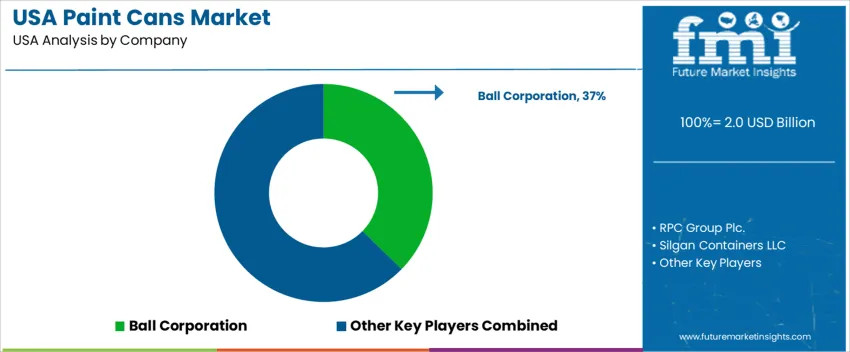
Competitive positioning in USA paint-can supply is linked to production scale, nationwide freight access, and the ability to meet technical requirements from architectural and industrial coatings manufacturers. Ball Corporation holds an estimated 37.3%, supported by integrated metal-packaging operations and long-term contracts with major coatings brands. Its advantage reflects high output capacity, reliable tinplate sourcing, and established logistics networks serving national distribution hubs.
RPC Group Plc. participates in metal and plastic formats positioned for smaller volumes and specialty finishes. Its presence links to packaging flexibility across private-label and niche coatings segments that prioritize ergonomic designs and compliance with volatility-related packaging standards. Silgan Containers LLC has strong regional penetration due to close supply proximity to paint-manufacturing clusters. Competitive strength arises from sturdy can-body manufacturing and consistency in seaming and lining quality.
Kian Joo Can Factory Berhad supplies USA buyers through import-supported distribution. Adoption centers on cost positioning and the ability to deliver bulk quantities for value-focused brands that do not require extensive customization. Colep Portugal S.A. focuses on higher-specification formats for aerosol paints and protective coatings, gaining participation where corrosion-resistant internal linings and tight-tolerance closures are required.
Key Players in USA Paint Cans Demand
- Ball Corporation
- RPC Group Plc.
- Silgan Containers LLC
- Kian Joo Can Factory Berhad
- Colep Portugal, S.A.
Scope of the Report
| Items | Values |
|---|---|
| Quantitative Units | USD billion |
| Product Type | Metal Cans, Hybrid Cans, Plastic Cans |
| Material Type | Plastic, Metal |
| Capacity | 1000 ml and below, 1001–2000 ml, 2001–3000 ml, 3001–4000 ml, 4001 ml and above |
| Regions Covered | West USA, South USA, Northeast USA, Midwest USA |
| Key Companies Profiled | Ball Corporation, RPC Group Plc., Silgan Containers LLC, Kian Joo Can Factory Berhad, Colep Portugal S.A. |
| Additional Attributes | Dollar sales by product type, material type, and capacity segment; regional penetration across West, South, Northeast, and Midwest; growth in hybrid packaging formats to support sustainability and durability; demand shifts due to rising home renovation and DIY activities; competitive strategies among metal and plastic can manufacturers including lightweighting, recyclability improvements, and distribution via hardware and industrial supply networks. |
USA Paint Cans Demand by Segments
Product Type:
- Metal Cans
- Hybrid Cans
- Plastic Cans
Material Type:
- Plastic
- Metal
Capacity:
- 1000 ml and below
- 1001 - 2000 ml
- 2001 - 3000 ml
- 3001 - 4000 ml
- 4001 ml and above
Region:
- West USA
- South USA
- Northeast USA
- Midwest USA
Frequently Asked Questions
How big is the demand for paint cans in USA in 2025?
The demand for paint cans in USA is estimated to be valued at USD 2.0 billion in 2025.
What will be the size of paint cans in USA in 2035?
The market size for the paint cans in USA is projected to reach USD 3.0 billion by 2035.
How much will be the demand for paint cans in USA growth between 2025 and 2035?
The demand for paint cans in USA is expected to grow at a 3.9% CAGR between 2025 and 2035.
What are the key product types in the paint cans in USA?
The key product types in paint cans in USA are metal cans, hybrid cans and plastic cans.
Which material type segment is expected to contribute significant share in the paint cans in USA in 2025?
In terms of material type, plastic segment is expected to command 57.0% share in the paint cans in USA in 2025.
Preview the report firsthand - request a free sample
Get SampleGet the brochure for pricing and purchase details.
Get PDFTable of Content
- Executive Summary
- USA Market Outlook
- Demand-side Trends
- Supply-side Trends
- Technology Roadmap Analysis
- Analysis and Recommendations
- Market Overview
- Market Coverage / Taxonomy
- Market Definition / Scope / Limitations
- Market Background
- Market Dynamics
- Drivers
- Restraints
- Opportunity
- Trends
- Scenario Forecast
- Demand in Optimistic Scenario
- Demand in Likely Scenario
- Demand in Conservative Scenario
- Opportunity Map Analysis
- Product Life Cycle Analysis
- Supply Chain Analysis
- Investment Feasibility Matrix
- Value Chain Analysis
- PESTLE and Porter’s Analysis
- Regulatory Landscape
- Regional Parent Market Outlook
- Production and Consumption Statistics
- Import and Export Statistics
- Market Dynamics
- USA Market Analysis 2020 to 2024 and Forecast, 2025 to 2035
- Historical Market Size Value (USD Million) Analysis, 2020 to 2024
- Current and Future Market Size Value (USD Million) Projections, 2025 to 2035
- Y-o-Y Growth Trend Analysis
- Absolute $ Opportunity Analysis
- USA Market Pricing Analysis 2020 to 2024 and Forecast 2025 to 2035
- USA Market Analysis 2020 to 2024 and Forecast 2025 to 2035, By Product Type
- Introduction / Key Findings
- Historical Market Size Value (USD Million) Analysis By Product Type , 2020 to 2024
- Current and Future Market Size Value (USD Million) Analysis and Forecast By Product Type , 2025 to 2035
- Metal Cans
- Hybrid Cans
- Plastic Cans
- Y-o-Y Growth Trend Analysis By Product Type , 2020 to 2024
- Absolute $ Opportunity Analysis By Product Type , 2025 to 2035
- USA Market Analysis 2020 to 2024 and Forecast 2025 to 2035, By Material Type
- Introduction / Key Findings
- Historical Market Size Value (USD Million) Analysis By Material Type, 2020 to 2024
- Current and Future Market Size Value (USD Million) Analysis and Forecast By Material Type, 2025 to 2035
- Plastic
- Metal
- Y-o-Y Growth Trend Analysis By Material Type, 2020 to 2024
- Absolute $ Opportunity Analysis By Material Type, 2025 to 2035
- USA Market Analysis 2020 to 2024 and Forecast 2025 to 2035, By Capacity
- Introduction / Key Findings
- Historical Market Size Value (USD Million) Analysis By Capacity, 2020 to 2024
- Current and Future Market Size Value (USD Million) Analysis and Forecast By Capacity, 2025 to 2035
- 1000 ml and below
- 1001 - 2000 ml
- 2001 - 3000 ml
- 3001 - 4000 ml
- 4001 ml and above
- Y-o-Y Growth Trend Analysis By Capacity, 2020 to 2024
- Absolute $ Opportunity Analysis By Capacity, 2025 to 2035
- Market Structure Analysis
- Competition Dashboard
- Competition Benchmarking
- Market Share Analysis of Top Players
- By Regional
- By Product Type
- By Material Type
- By Capacity
- Competition Analysis
- Competition Deep Dive
- Ball Corporation
- Overview
- Product Portfolio
- Profitability by Market Segments (Product/Age /Sales Channel/Region)
- Sales Footprint
- Strategy Overview
- Marketing Strategy
- Product Strategy
- Channel Strategy
- RPC Group Plc.
- Silgan Containers LLC
- Kian Joo Can Factory Berhad
- Colep Portugal, S.A.
- Ball Corporation
- Competition Deep Dive
- Assumptions & Acronyms Used
- Research Methodology


