

- Industry Size (2026)
- USD 5.39 Bn
- Forecast (2036)
- USD 9.65 Bn
- CAGR (2026 to 2036)
- 6.0%
Industrial Wireless Broken Signal Solutions Market Size, Market Forecast and Outlook By FMI
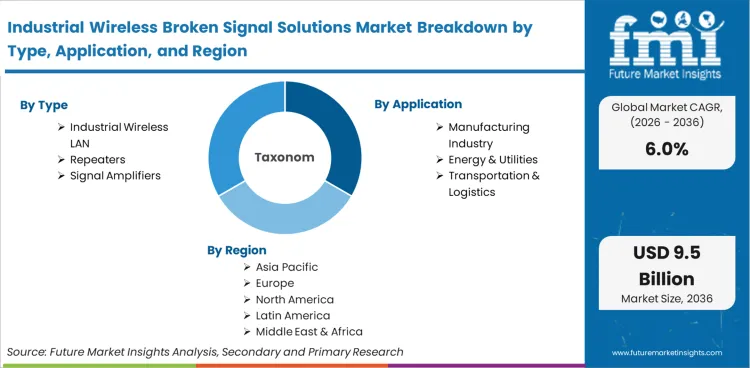
In 2025, the industrial wireless broken signal solutions market was valued at USD 5.08 billion. Based on Future Market Insights' analysis, demand for industrial wireless broken signal solutions is estimated to grow to USD 5.39 billion in 2026 and USD 9.65 billion by 2036. FMI projects a CAGR of 6.0% during the forecast period. Demand outlook is projected to add USD 4.57 billion in new revenue between 2025 and 2036. This represents steady, structural expansion rather than a disruptive surge, driven by ongoing industrial automation and wireless infrastructure upgrades, while growth remains moderated by capital expenditure cycles and the gradual pace of brownfield system retrofits.
Industrial wireless broken signal solutions focus on eliminating dropouts, interference-induced losses, and latency spikes in harsh factory environments, enabling true wireless equivalence to wired for AGVs, safety PLCs, and mobile automation without compromising uptime or determinism. Demonstrating this breakthrough in real-world testing (99.999% reliability, zero connection loss amid interference), Dr. Giannoulis (CEO, Better Than Wired) declares: “We are redefining what ‘wireless reliability' means in industrial environments. Our platform proves that wireless safety communication can not only surpass traditional wireless systems but even rival wired connections in both reliability and determinism.” [1].
Summary of Industrial Wireless Broken Signal Solutions Market
- Market Definition:
- The industrial wireless broken signal solutions market comprises specialized hardware and software deployed within factories to detect, prevent, and correct wireless communication failures between machines, sensors, and control systems.
- Demand Drivers:
- Expansion of smart manufacturing programs is prompting plant managers to invest in resilient wireless LAN systems to prevent production downtime caused by signal interruptions.
- Rising deployment of IIoT sensors in automotive and electronics plants is increasing the need for continuous, low-latency connectivity across shop floors.
- Safety and compliance requirements in process industries are driving adoption of network monitoring tools that detect signal loss in hazardous operating environments.
- Key Segments Analyzed:
- By Type: Industrial Wireless LAN is projected to lead with a 34.1% share in 2026, supported by its central role in plant-wide connectivity architecture.
- By Application: Manufacturing is estimated to dominate in 2026, reflecting high automation intensity and dense machine-to-machine communication.
- By Geography: Asia Pacific is expected to account for the fastest expansion, underpinned by ongoing industrial capacity additions.
- Analyst Opinion at FMI:
- Nikhil Kaitwade, Principal Consultant for Industrial Automation at Future Market Insights, opines, “Signal reliability has evolved beyond an IT performance metric, it is now a defining benchmark of industrial leadership. Forward‑looking CXOs increasingly evaluate wireless stability through its direct impact on production continuity, downtime risk, and asset utilization, positioning resilient connectivity as a core driver of competitive advantage.”
- Strategic Implications/Executive Takeaways:
- Integrate wireless diagnostics with predictive maintenance platforms to quantify the cost of signal loss in production terms.
- Prioritize retrofitting legacy plants with industrial-grade access points and repeaters to reduce brownfield integration risk.
- Develop partnerships with automation software providers to embed signal analytics within broader plant performance dashboards.
- Methodology:
- Market estimates were triangulated using supplier revenue mapping and validation against industrial automation expenditure benchmarks.
- Country-level CAGRs were cross-checked through primary interviews with regional system integrators.
- Forecast assumptions were stress-tested against historical capex cycles and disclosed company investment plans.
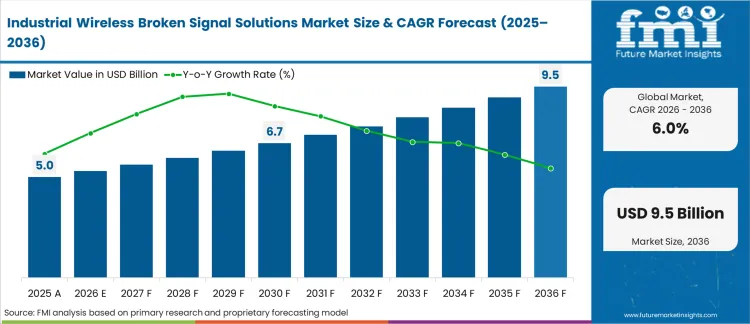
Industrial network reliability is becoming central to plant-level digitalization, particularly as automation platforms converge with advanced industrial software. In this context, consolidation among automation and analytics providers is reshaping how wireless signal resilience, network diagnostics, and predictive failure mitigation are delivered across manufacturing sites.
India is projected to register a CAGR of 7.8% through 2036, supported by rapid factory automation upgrades and government-backed smart manufacturing initiatives. China follows with a CAGR of 7.2%, driven by large-scale industrial IoT deployment across electronics, automotive, and process manufacturing clusters. Mexico is expected to expand at 6.6% CAGR, as nearshoring-led industrial expansion increases demand for stable wireless infrastructure in new production facilities. Germany and USA are projected to grow at 5.4% and 5.1% CAGR, respectively, reflecting mature adoption cycles where spending is concentrated on replacement and system optimization rather than greenfield expansion. In these mature markets, integration complexity within legacy control architectures acts as a structural constraint, moderating incremental deployment velocity.
Key Takeways
| Metric | Value |
|---|---|
| Estimated Value (2026E) | USD 5.39 billion |
| Forecast Value (2036F) | USD 9.65 billion |
| CAGR (2026 to 2036) | 6.0% |
Source: FMI analysis based on primary research and proprietary forecasting model
Industrial Wireless Broken Signal Solutions Market Definition
The industrial wireless broken signal solutions market covers hardware and software systems designed to detect, prevent, and correct wireless communication failures inside industrial facilities. These solutions include industrial wireless LAN equipment, signal repeaters, network monitoring platforms, and diagnostic tools that ensure uninterrupted data transmission between machines, sensors, and control systems. Their primary function is to maintain stable connectivity in harsh factory environments. The main end-use is manufacturing, where real-time machine communication supports automation, safety monitoring, and production efficiency.
Industrial Wireless Broken Signal Solutions Market Inclusions
This report covers global and regional market size estimates for the industrial wireless broken signal solutions market, with forecasts from 2026 to 2036. It provides segment breakdowns by type, including industrial wireless LAN and related systems, and by application, led by manufacturing. The study also includes pricing analysis, trade flow assessment, and country-level CAGR comparisons, supported by primary research and FMI’s proprietary forecasting model.
Industrial Wireless Broken Signal Solutions Market Exclusions
The scope excludes consumer-grade Wi-Fi routers, residential mesh systems, and general enterprise IT networking hardware not designed for industrial environments. It also omits downstream finished automation equipment such as programmable logic controllers, industrial robots, and complete manufacturing execution systems. Standalone telecom infrastructure, public cellular networks, and satellite communication services are excluded unless specifically deployed as part of plant-level wireless signal stabilization solutions.
Industrial Wireless Broken Signal Solutions Market Research Methodology
- Primary research: FMI analysts conducted structured interviews with plant automation managers, industrial IT heads, wireless infrastructure vendors, system integrators, and procurement officers across manufacturing, energy, and logistics sectors. Inputs were gathered on deployment cycles, retrofit demand, pricing benchmarks, and signal failure mitigation priorities.
- Desk research: Publicly available sources reviewed include company annual reports, investor presentations, earnings call transcripts, regulatory filings, industrial standards documentation, and government manufacturing output statistics. Trade association publications and technology white papers were also assessed to map adoption trends.
- Market-sizing and forecasting: The market size was derived using a hybrid model combining bottom-up revenue aggregation from key suppliers with top-down validation against industrial automation spending benchmarks. Forecasts were generated through scenario-based modeling aligned with capital expenditure cycles and plant digitalization rates.
- Data validation and update cycle: All estimates were triangulated through cross-verification with primary interviews and historical shipment data. Forecast assumptions are reviewed periodically, with updates incorporated as new company disclosures, regulatory changes, or macroeconomic indicators become available.
Segmental Analysis
Industrial Wireless Broken Signal Solutions Market Analysis by Type
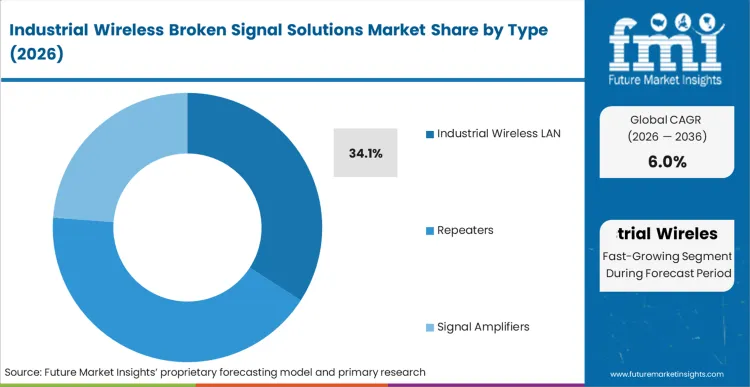
Based on FMI's industrial wireless broken signal solutions market report, consumption of industrial wireless LAN is estimated to hold a 34.1% share in 2026. This sub-segment leads because it is the default backbone for shop-floor connectivity, and it solves the most common buyer pain point, maintaining stable, low-latency links for sensors, HMIs, and mobile assets inside interference-heavy plants.
- Portfolio acquisition: HPE’s announced acquisition of Juniper Networks signaled continued consolidation in enterprise-to-industrial WLAN stacks, with buyers increasingly prioritizing AI-native network operations to detect performance degradation before it becomes a broken-signal event. This type of deal matters in industrial WLAN because wireless assurance and automated fault isolation are becoming procurement criteria, not add-ons. [2]
- Wi-Fi 6 modules: Phoenix Contact expanded its industrial network portfolio with WLAN 1000 client modules aligned with Wi-Fi 6 (IEEE 802.11ax), explicitly positioning throughput, security, and reliability upgrades for industrial automation use cases. These component-level releases directly support faster retrofits of legacy wireless nodes that are commonly implicated in intermittent signal loss. [3]
- Factory node mix: HMS Networks’ 2024 industrial network analysis reported wireless technologies at 7% of newly installed nodes in factory automation, and described typical wireless use cases such as cable replacement, wireless machine access, and connectivity to mobile equipment. This installed-base reality explains why industrial WLAN remains a leading first fix category when plants target broken-signal reduction. [4]
Industrial Wireless Broken Signal Solutions Market Analysis by Application
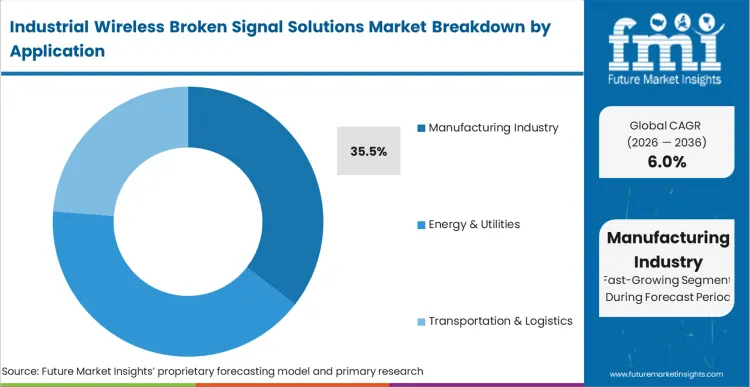
The manufacturing industry is slated to hold a 35.5% share in 2026, according to FMI’s analysis. Manufacturing dominates because downtime has immediate throughput costs, and broken-signal events can disrupt closed-loop control, traceability, and safety interlocks across densely connected lines.
- Connectivity investment: HMS Networks highlighted integration actions tied to its Red Lion acquisition, indicating continued investment and organizational focus around networking, edge platforms, and related infrastructure for industrial users. For manufacturing sites, these moves support bundled deployments where signal monitoring, segmentation, and diagnostics are treated as part of production continuity, not standalone IT upgrades. [5]
- Industrial WLAN rollout: Siemens issued a delivery release covering expansion of its industrial WLAN portfolio to include IEEE 802.11ax components for industrial environments, reinforcing the shift toward newer WLAN architectures in plant networks. In practice, these upgrades reduce the frequency of broken-signal incidents caused by legacy access points and insufficient redundancy in high-client-density areas. [6]
- Security convergence: Fortinet announced a secure networking solution integrated with Wi-Fi 7, underscoring how wireless reliability is increasingly managed alongside security controls. In manufacturing, this convergence matters because authentication, segmentation, and secure roaming policies can be a direct contributor to either stable handoffs or recurring disconnects in mobile and multi-cell coverage zones. [7]
Industrial Wireless Broken Signal Solutions Market Drivers, Restraints, and Opportunities
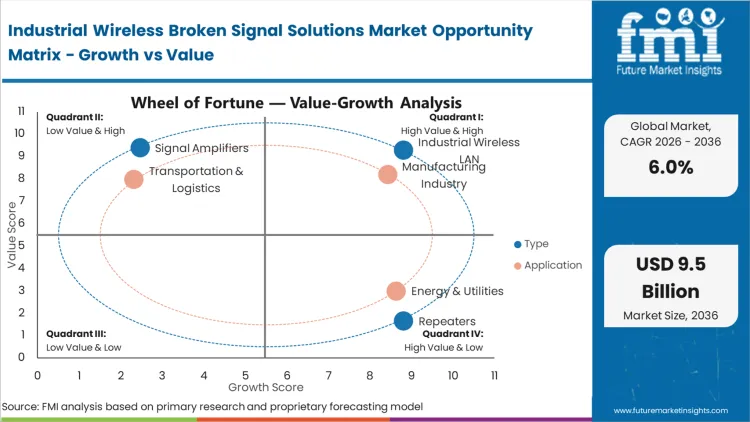
Current valuation reflects a decade-long rise in connected assets across factory floors, where sensors, AGVs, handheld terminals, and edge gateways now depend on stable wireless backhaul for synchronized control. As plants migrate from isolated PLC islands to networked production cells, signal continuity becomes linked to throughput, traceability, and safety performance. This structural dependence explains why wireless fault mitigation now commands a defined budget line within automation capex programs.
The transition underway is from reactive troubleshooting toward engineered resilience embedded into network architecture. Spending on unmanaged access points and ad-hoc repeaters is flattening, while investment is shifting to centrally managed WLAN, deterministic wireless overlays, and policy-driven segmentation aligned with industrial control requirements. Although advanced platforms carry higher upfront pricing, they reduce incident frequency and shorten recovery cycles, allowing revenue expansion even where total node additions remain moderated by brownfield integration limits.
Plant operators benchmarking hybrid wired-wireless performance increasingly draw comparisons with architectures in industrial ethernet, especially where closed-loop control spans both media types. New-build facilities are evaluating deterministic spectrum approaches associated with Private 5G Network deployments for latency-sensitive workloads. Reliability assurance is also converging with capabilities typical of network monitoring where centralized analytics identify packet loss patterns before production impact occurs. Device-level robustness mirror categories seen in industrial wireless transmitters, particularly in process sectors where signal integrity under harsh conditions defines network stability.
- Deterministic connectivity demand: Service requirements defined in 3GPP specifications for cyber-physical control applications are reinforcing the need for ultra-reliable, low-latency wireless performance in industrial settings. This structural shift supports migration toward architectures that minimize jitter and packet loss in time-sensitive control loops. [11]
- Operational risk formalization: National cybersecurity guidance such as NIST SP 800-82 frames industrial control resilience as a governance responsibility, influencing how boards evaluate wireless reliability within broader OT risk frameworks. As governance expectations rise, broken-signal mitigation becomes embedded in audit and risk management processes rather than treated as routine IT maintenance.
- Asia capacity expansion: Electronics and automotive manufacturing growth in Asia is embedding wireless infrastructure at the design stage of new facilities. By contrast, mature regions generate steadier replacement demand constrained by legacy topology and change-control windows, creating a divergence between greenfield acceleration and brownfield moderation.
Regional Analysis
The industrial wireless broken signal solutions market is analyzed across North America, Latin America, Europe, East Asia, South Asia & Pacific, and the Middle East & Africa. Geographically, it is segmented by country within each region to assess relative adoption intensity, capital expenditure cycles, regulatory influence, and industrial automation maturity levels.
.webp "Top Country Growth Comparison Industrial Wireless Broken Signal Solutions Market Cagr (2026 2036)")
| Country | CAGR (2026 to 2036) |
|---|---|
| India | 7.8% |
| China | 7.2% |
| Mexico | 6.6% |
| Germany | 5.4% |
| United States | 5.1% |
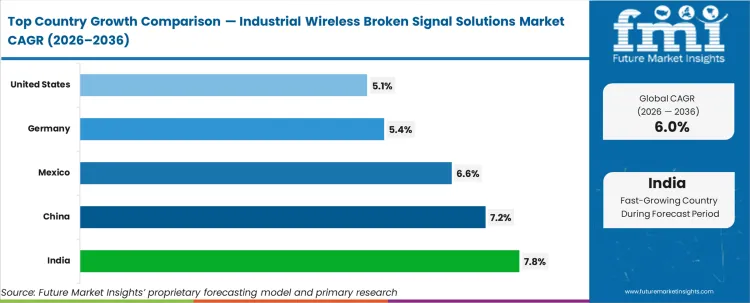
Source: Future Market Insights analysis, supported by a proprietary forecasting model and primary research
North America Industrial Wireless Broken Signal Solutions Market Analysis
North America acts as the OT governance lab for wireless reliability, where broken-signal mitigation is specified alongside cybersecurity and resilience requirements. Key players include Rockwell Automation, strong in manufacturing connectivity ecosystems, Cisco, a leading supplier of industrial wireless and network management stacks, and Honeywell, which ties wireless uptime to plant safety and performance systems.
- United States: Demand for industrial wireless broken signal solutions in the United States is projected to rise at a 5.1% CAGR through 2036. Adoption is supported by updated OT security guidance that emphasizes reliability, safety, and secure network topologies in operational environments, shaping how plants design monitoring and segmentation in mixed wired-wireless architectures. [14]
Spectrum policy also matters for private wireless and industrial connectivity, with the FCC’s CBRS-related rulemaking activity in August 2024 reinforcing active evolution in shared-spectrum frameworks used by enterprises. [15] Uptake is strongest in automotive, food processing, and logistics hubs where wireless continuity is treated as a production KPI, while constraints remain around legacy integration and downtime windows for brownfield upgrades.
Europe Industrial Wireless Broken Signal Solutions Market Analysis
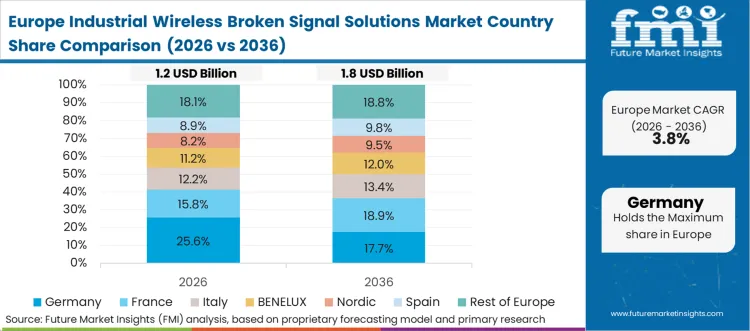
Europe is the private-network engineering region where plants emphasize deterministic connectivity and interoperability in mixed-vendor environments. Key players include Siemens, with broad industrial connectivity portfolios, ABB, which integrates networking into automation and electrification programs, and Nokia, a major supplier of private wireless systems across European industrial sites.
- Germany: Demand for industrial wireless broken signal solutions in Germany is projected to rise at a 5.4% CAGR through 2036. Policy-backed innovation programs are accelerating industrial private network development and reference deployments, including BMWK-linked initiatives highlighted around Hannover Messe 2024 under the “5G Campus Networks” technology programme. [12]
Germany’s R&D ecosystem is advancing modular campus network concepts, as seen in BMWK-funded efforts such as Fraunhofer FOKUS’ CampusOS work, which targets open and interoperable private 5G campus networks. [13] Growth is strongest in advanced manufacturing corridors where uptime and roaming reliability are essential, while constraints are driven by change-control rigor and integration complexity inside legacy automation stacks.
East Asia Industrial Wireless Broken Signal Solutions Market Analysis
East Asia is the scale deployment engine, where large industrial clusters operationalize wireless reliability at volume across electronics, automotive, and process manufacturing. Key players include Huawei, strong in enterprise connectivity infrastructure, Yokogawa Electric, which links network health to process control environments, and Mitsubishi Electric, which supports factory automation connectivity layers.
- China: Demand for industrial wireless broken signal solutions in China is projected to rise at 7.2% CAGR through 2036. Government-led scale programs are accelerating integrated “5G + industrial internet” deployments, including a pilot program launched in November 2024 spanning 10 cities to expand integrated application and large-scale rollout. [10]
MIIT-reported data shows continued national buildout of 5G infrastructure, with official reporting in June 2024 citing more than 3.8 million 5G base stations by end-May 2024. [11] Demand is driven by new-build capacity and digitized production lines, while constraints tend to be site-level radio planning complexity and interference management in dense industrial zones.
South Asia and Pacific Industrial Wireless Broken Signal Solutions Market Analysis
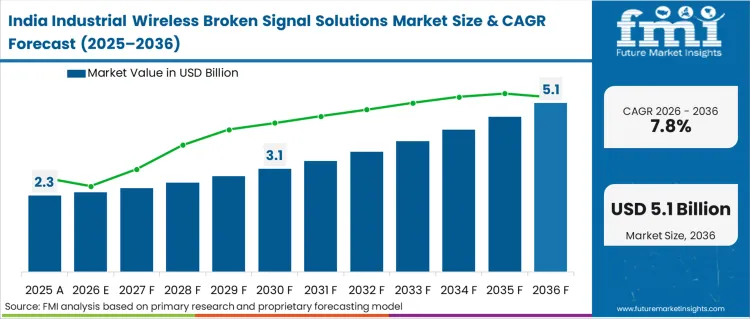
South Asia and Pacific is the brownfield-to-smart-factory conversion zone, where plants modernize existing lines while adding new digital capacity. Key players include Schneider Electric, which packages OT connectivity with energy management, Emerson, strong in automation software integration, and Tata Communications, a major provider supporting enterprise connectivity and industrial network services in the region.
- India: Demand for industrial wireless broken signal solutions in India is projected to rise at 7.8% CAGR through 2036. Adoption is supported by national Industry 4.0 enablement efforts, with the Ministry of Heavy Industries positioning SAMARTH Udyog Bharat 4.0 as an Industry 4.0 initiative under its competitiveness scheme for the capital goods sector. [9]
Government updates in December 2024 also highlighted a growing network of Industry 4.0 labs and approved cluster experience centres, indicating continued institutional buildout for smart manufacturing adoption. [8] Growth is strongest in automotive and electronics manufacturing clusters, while constraints include uneven legacy infrastructure across older plants and skills gaps in OT network diagnostics.
Latin America Industrial Wireless Broken Signal Solutions Market Analysis
Latin America is the nearshoring reliability region, where new factories and expanded export capacity raise expectations for stable industrial connectivity. Key players include Bosch, with strong manufacturing footprints, Siemens, active in industrial digitalization programs, and América Móvil, which supports enterprise connectivity services that can underpin industrial deployments.
- Mexico: Industrial wireless broken signal solutions in Mexico is projected to rise at a 6.6% CAGR through 2036. Policy-driven investment incentives tied to nearshoring have strengthened the case for new production facilities and modernization, including fiscal stimulus modifications published in the Diario Oficial in December 2024 that explicitly reference nearshoring-oriented productivity and investment aims. [16]
Earlier measures published via the federal government framework in September 2024 outline incentives for key export-oriented sectors, reinforcing capex decisions around new fixed assets and training. [17]
As a practical demand signal, the U.S. government’s market intelligence note from December 2023 summarizes the October 2023 decree mechanism that supported nearshoring-linked investment, which continues to shape supplier localization strategies. [18] Constraints remain around utilities and site readiness in high-demand industrial corridors.
Competitive Aligners for Market Players
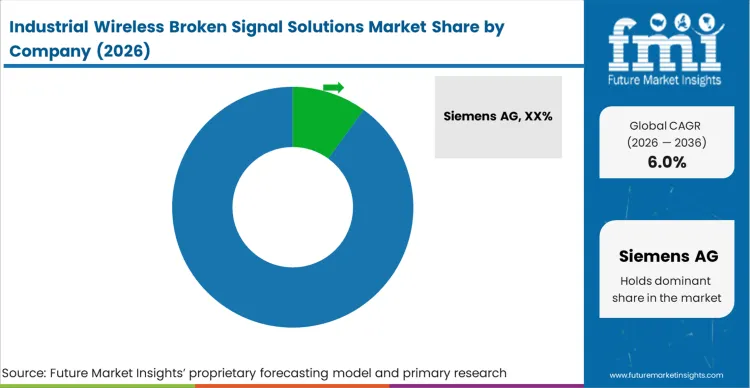
The competitive structure is moderately fragmented, with global networking majors, industrial automation OEMs, and OT-focused connectivity specialists all competing for plant-floor budgets. No single supplier dictates the category, and buyers typically multi-source across access infrastructure, management software, and onsite services. The primary competitive variable is measurable uptime, how quickly a vendor can detect, isolate, and remediate intermittent wireless faults without disrupting production workflows.
Companies with structural advantages tend to be those that can bundle connectivity with adjacent OT stacks and deliver repeatable deployments at scale. Vendors with installed bases in industrial switching, remote access, and OT software platforms can shorten qualification cycles, while those that pair connectivity with observability capabilities can win on reduced incident resolution time and audit-ready reporting. This is also where overlap with industrial IoT and IoT in manufacturing becomes material, since customers demand broken-signal mitigation to sit inside broader device management and plant analytics programs.
Consumer behaviour is procurement-led and risk-averse. Large manufacturers reduce supplier dependency through dual-vendor architectures, framework agreements with defined SLAs, and phased rollouts tied to line shutdown schedules. Pricing power remains limited on hardware-only offers, while suppliers with managed services, monitoring, and integration support can protect margins by selling outcomes such as faster root-cause analysis and lower downtime exposure. Interest in 5G industrial IoT architectures adds pressure on WLAN-only players to justify performance and lifecycle cost across mixed wireless footprints.
Recent Developments:
- Cisco (March 2024): Completed the acquisition of Splunk to deepen full-stack visibility and monitoring capabilities, a move that strengthens enterprise-to-OT observability propositions where wireless fault attribution and incident response are procurement criteria. [19]
- Nokia (April 2024): Announced pre-tested and pre-integrated segment solutions for manufacturing and logistics digital transformation, positioning private wireless plus edge and application ecosystems as a packaged pathway to reliable industrial connectivity. [20]
- Rockwell Automation (September 2024): Expanded Stratix 4300 Remote Access Router options to include Wi-Fi and LTE interfaces, targeting industrial remote access and continuity use cases where wired links are impractical and downtime risk is high. [21]
Key Players Profiled
- Siemens AG
- Rockwell Automation, Inc.
- Honeywell International Inc.
- ABB Ltd.
- Emerson Electric Co.
- Schneider Electric SE
- Cisco Systems, Inc.
- Moxa Inc.
- Belden Inc.
- Phoenix Contact GmbH & Co. KG
- Red Lion Controls, Inc.
- Westermo Network Technologies AB
- Sierra Wireless, Inc.
- Digi International Inc.
- Calnex Solutions plc
Scope of the Report
| Metric | Value |
|---|---|
| Quantitative Units | USD 5.39 billion (2026) to USD 9.65 billion (2036), at a CAGR of 6.0%, with 2025 historic value of USD 5.08 billion |
| Market Definition | The industrial wireless broken signal solutions market comprises the global development, deployment, and maintenance of hardware and software systems that detect, prevent, and restore wireless communication disruptions in industrial environments. |
| Type Segmentation | Industrial Wireless LAN, Repeaters, Signal Amplifiers, Mesh Routers, Failover Modules |
| Application Segmentation | Manufacturing Industry, Energy & Utilities, Transportation & Logistics, Oil & Gas, Mining & Metals |
| Regions Covered | North America, Latin America, Europe, East Asia, South Asia, Oceania, Middle East & Africa |
| Countries Covered | United States, Canada, Mexico, Brazil, Germany, France, United Kingdom, Italy, Spain, China, India, Japan, South Korea, Australia, and 40 plus countries |
| Key Companies Profiled | Siemens, Rockwell Automation, Honeywell, ABB, Emerson, Schneider Electric, Cisco, Moxa, Belden, Phoenix Contact, Red Lion Controls, Westermo, Sierra Wireless, Digi International, Calnex Solutions |
| Forecast Period | 2026 to 2036 |
| Approach | Hybrid top-down and bottom-up market modeling validated through primary interviews with industrial automation engineers, plant IT managers, and solution providers, supported by deployment data benchmarking and end-use industry analysis |
Industrial Wireless Broken Signal Solutions Market Analysis by Segments
Type:
- Industrial Wireless LAN
- Repeaters
- Signal Amplifiers
- Mesh Routers
- Failover Modules
Application:
- Manufacturing Industry
- Energy & Utilities
- Transportation & Logistics
- Oil & Gas
- Mining & Metals
Region:
- North America
- Latin America
- Europe
- East Asia
- South Asia
- Oceania
- Middle East & Africa
Bibliography
- [1] Robotics Tomorrow. (2025, November 5). Better Than Wired achieves groundbreaking wireless reliability with OpenSafety PLCs.
- [2] Hewlett Packard Enterprise. (2024, January 19). HPE to acquire Juniper Networks to accelerate AI-driven innovation.
- [3] Phoenix Contact. (2024, April 16). New WLAN 1000 client modules with Wi-Fi 6 for industrial applications.
- [4] HMS Networks. (2024, June 13). Industrial network market shares 2024
- [5] HMS Networks. (2025, April 24). HMS Networks highlights integration following Red Lion acquisition.
- [6] Siemens support note on industrial WLAN portfolio expansion with 802.11ax components (April 2024)
- [7] Fortinet press release on Wi-Fi 7 secure networking solution (Jan 2024)
- [8] Press Information Bureau, Government of India. (2024, December 13). Samarth Udyog Bharat 4.0 initiative.
- [9] Ministry of Heavy Industries, Government of India. (n.d.). SAMARTH Udyog Bharat 4.0.
- [10] The State Council, The People’s Republic of China. (2024, November 19). China starts 5G+ industrial internet pilot program in 10 cities.
- [11] The State Council, The People’s Republic of China. (2024, June 26). China has more than 3.8 mln 5G base stations.
- [12] Federal Ministry for Economic Affairs and Climate Action (BMWK). (2024, April 10). 5G campus networks, highlights of the BMWK technology programmes at Hannover Messe 2024.
- [13] Fraunhofer FOKUS. (2024, April 8). CampusOS flagship project shows 5G campus network ecosystem at Hannover Messe 2024.
- [14] National Institute of Standards and Technology. (2023). SP 800-82 Rev. 3: Guide to operational technology (OT) security.
- [15] Federal Communications Commission. (2024, August 16). FCC 24-86, Notice of Proposed Rulemaking (CBRS related).
- [16] Diario Oficial de la Federación. (2024, December 24). Decreto por el que se modifica el diverso por el que se otorgan estímulos fiscales a sectores clave de la industria exportadora…
- [17] Gobierno de México. (2024, September 4). Decreto por el que se otorgan estímulos fiscales a sectores clave de la industria exportadora…
- [18] International Trade Administration, U.S. Department of Commerce. (2023, December 18). Mexico nearshoring incentives.
- [19] Cisco. (2024, March 18). Cisco completes acquisition of Splunk. Cisco Newsroom.
- [20] Nokia. (2024, April 22). Nokia expands segment solutions to include digital transformation of manufacturing and logistics. Nokia Newsroom.
- [21] Rockwell Automation. (2024, September 27). Rockwell Automation brings new wireless interfaces, new edge to Stratix® 4300. Rockwell Automation Press Release.
This bibliography is provided for reader reference and is not exhaustive. The full report contains the complete reference list and detailed citations.
This Report Addresses
- Market intelligence to enable structured strategic decision-making across mature and emerging industrial wireless markets.
- Market size estimation and 10-year revenue forecasts from 2026 to 2036, supported by validated industrial facility counts and wireless device penetration benchmarks.
- Growth opportunity mapping across solution types and applications with emphasis on predictive diagnostics and mesh networking.
- Segment and regional revenue forecasts covering manufacturing, energy, and logistics applications.
- Competition strategy assessment including hardware capability, software intelligence, and system integration partnerships.
- Regulatory impact analysis covering industrial wireless standards and spectrum allocation frameworks.
- Market report delivery in PDF, Excel, PPT, and interactive dashboard formats for executive and operational use.
Frequently Asked Questions
How large is the industrial wireless broken signal solutions market today?
In 2025, the industrial wireless broken signal solutions market was valued at USD 5.08 billion.
What will the market size be in 2026?
Demand is estimated to reach USD 5.39 billion in 2026.
What is the projected market size by 2036?
The market is forecasted to grow to USD 9.65 billion by 2036.
What is the expected CAGR during the forecast period?
FMI projects a CAGR of 6.0% during the forecast period from 2026 to 2036.
How much absolute growth is expected between 2025 and 2036?
The market is expected to expand from USD 5.08 billion in 2025 to USD 9.65 billion by 2036, adding USD 4.57 billion in new revenue.
Is the market growth incremental or high acceleration?
With a CAGR of 6.0% from 2026 to 2036, growth is steady and structurally driven rather than short-term or speculative.
Which type segment is poised to lead in 2026?
Industrial wireless LAN is expected to lead with a 34.1% share in 2026.
Which application segment dominates demand?
Manufacturing is estimated to lead the application segment in 2026 due to high automation intensity.
How significant is the market expansion over the next decade?
The market is projected to rise from USD 5.39 billion in 2026 to USD 9.65 billion by 2036 at a CAGR of 6.0%.
What is the near-term growth outlook?
Following its valuation of USD 5.08 billion in 2025, the market is expected to reach USD 5.39 billion in 2026, reflecting stable year-on-year expansion.
What is the revenue outlook over the long term?
Over the forecast period, the market is projected to grow from USD 5.39 billion in 2026 to USD 9.65 billion by 2036.
Does the forecast suggest resilience in demand?
Yes, a CAGR of 6.0% through 2036 indicates consistent demand growth tied to industrial digitalization.
How attractive is this market for long-term investment?
The projected increase from USD 5.08 billion in 2025 to USD 9.65 billion by 2036 highlights sustained revenue expansion.
What role does Industrial Wireless LAN play in the market structure?
Industrial Wireless LAN is projected to account for 34.1% of the market in 2026, making it the leading type segment.
How does the forecast period define the growth window?
The forecast spans 2026 to 2036, during which the market is expected to grow at a CAGR of 6.0%, reaching USD 9.65 billion by 2036.
Preview the report firsthand - request a free sample
Get SampleGet the brochure for pricing and purchase details.
Get PDFTable of Content
- Executive Summary
- Global Market Outlook
- Demand-side Trends
- Supply-side Trends
- Technology Roadmap Analysis
- Analysis and Recommendations
- Market Overview
- Market Coverage / Taxonomy
- Market Definition / Scope / Limitations
- Research Methodology
- Chapter Orientation
- Analytical Lens and Working Hypotheses
- Market Structure, Signals, and Trend Drivers
- Benchmarking and Cross-market Comparability
- Market Sizing, Forecasting, and Opportunity Mapping
- Research Design and Evidence Framework
- Desk Research Programme (Secondary Evidence)
- Company Annual and Sustainability Reports
- Peer-reviewed Journals and Academic Literature
- Corporate Websites, Product Literature, and Technical Notes
- Earnings Decks and Investor Briefings
- Statutory Filings and Regulatory Disclosures
- Technical White Papers and Standards Notes
- Trade Journals, Industry Magazines, and Analyst Briefs
- Conference Proceedings, Webinars, and Seminar Materials
- Government Statistics Portals and Public Data Releases
- Press Releases and Reputable Media Coverage
- Specialist Newsletters and Curated Briefings
- Sector Databases and Reference Repositories
- FMI Internal Proprietary Databases and Historical Market Datasets
- Subscription Datasets and Paid Sources
- Social Channels, Communities, and Digital Listening Inputs
- Additional Desk Sources
- Expert Input and Fieldwork (Primary Evidence)
- Primary Modes
- Qualitative Interviews and Expert Elicitation
- Quantitative Surveys and Structured Data Capture
- Blended Approach
- Why Primary Evidence is Used
- Field Techniques
- Interviews
- Surveys
- Focus Groups
- Observational and In-context Research
- Social and Community Interactions
- Stakeholder Universe Engaged
- C-suite Leaders
- Board Members
- Presidents and Vice Presidents
- R&D and Innovation Heads
- Technical Specialists
- Domain Subject-matter Experts
- Scientists
- Physicians and Other Healthcare Professionals
- Governance, Ethics, and Data Stewardship
- Research Ethics
- Data Integrity and Handling
- Primary Modes
- Tooling, Models, and Reference Databases
- Desk Research Programme (Secondary Evidence)
- Data Engineering and Model Build
- Data Acquisition and Ingestion
- Cleaning, Normalisation, and Verification
- Synthesis, Triangulation, and Analysis
- Quality Assurance and Audit Trail
- Market Background
- Market Dynamics
- Drivers
- Restraints
- Opportunity
- Trends
- Scenario Forecast
- Demand in Optimistic Scenario
- Demand in Likely Scenario
- Demand in Conservative Scenario
- Opportunity Map Analysis
- Product Life Cycle Analysis
- Supply Chain Analysis
- Investment Feasibility Matrix
- Value Chain Analysis
- PESTLE and Porter’s Analysis
- Regulatory Landscape
- Regional Parent Market Outlook
- Production and Consumption Statistics
- Import and Export Statistics
- Market Dynamics
- Global Market Analysis 2021 to 2025 and Forecast, 2026 to 2036
- Historical Market Size Value (USD Million) Analysis, 2021 to 2025
- Current and Future Market Size Value (USD Million) Projections, 2026 to 2036
- Y-o-Y Growth Trend Analysis
- Absolute $ Opportunity Analysis
- Global Market Pricing Analysis 2021 to 2025 and Forecast 2026 to 2036
- Global Market Analysis 2021 to 2025 and Forecast 2026 to 2036, By Type
- Introduction / Key Findings
- Historical Market Size Value (USD Million) Analysis By Type , 2021 to 2025
- Current and Future Market Size Value (USD Million) Analysis and Forecast By Type , 2026 to 2036
- Industrial Wireless LAN
- Repeaters
- Signal Amplifiers
- Industrial Wireless LAN
- Y-o-Y Growth Trend Analysis By Type , 2021 to 2025
- Absolute $ Opportunity Analysis By Type , 2026 to 2036
- Global Market Analysis 2021 to 2025 and Forecast 2026 to 2036, By Application
- Introduction / Key Findings
- Historical Market Size Value (USD Million) Analysis By Application, 2021 to 2025
- Current and Future Market Size Value (USD Million) Analysis and Forecast By Application, 2026 to 2036
- Manufacturing Industry
- Energy & Utilities
- Transportation & Logistics
- Manufacturing Industry
- Y-o-Y Growth Trend Analysis By Application, 2021 to 2025
- Absolute $ Opportunity Analysis By Application, 2026 to 2036
- Global Market Analysis 2021 to 2025 and Forecast 2026 to 2036, By Region
- Introduction
- Historical Market Size Value (USD Million) Analysis By Region, 2021 to 2025
- Current Market Size Value (USD Million) Analysis and Forecast By Region, 2026 to 2036
- North America
- Latin America
- Western Europe
- Eastern Europe
- East Asia
- South Asia and Pacific
- Middle East & Africa
- Market Attractiveness Analysis By Region
- North America Market Analysis 2021 to 2025 and Forecast 2026 to 2036, By Country
- Historical Market Size Value (USD Million) Trend Analysis By Market Taxonomy, 2021 to 2025
- Market Size Value (USD Million) Forecast By Market Taxonomy, 2026 to 2036
- By Country
- USA
- Canada
- Mexico
- By Type
- By Application
- By Country
- Market Attractiveness Analysis
- By Country
- By Type
- By Application
- Key Takeaways
- Latin America Market Analysis 2021 to 2025 and Forecast 2026 to 2036, By Country
- Historical Market Size Value (USD Million) Trend Analysis By Market Taxonomy, 2021 to 2025
- Market Size Value (USD Million) Forecast By Market Taxonomy, 2026 to 2036
- By Country
- Brazil
- Chile
- Rest of Latin America
- By Type
- By Application
- By Country
- Market Attractiveness Analysis
- By Country
- By Type
- By Application
- Key Takeaways
- Western Europe Market Analysis 2021 to 2025 and Forecast 2026 to 2036, By Country
- Historical Market Size Value (USD Million) Trend Analysis By Market Taxonomy, 2021 to 2025
- Market Size Value (USD Million) Forecast By Market Taxonomy, 2026 to 2036
- By Country
- Germany
- UK
- Italy
- Spain
- France
- Nordic
- BENELUX
- Rest of Western Europe
- By Type
- By Application
- By Country
- Market Attractiveness Analysis
- By Country
- By Type
- By Application
- Key Takeaways
- Eastern Europe Market Analysis 2021 to 2025 and Forecast 2026 to 2036, By Country
- Historical Market Size Value (USD Million) Trend Analysis By Market Taxonomy, 2021 to 2025
- Market Size Value (USD Million) Forecast By Market Taxonomy, 2026 to 2036
- By Country
- Russia
- Poland
- Hungary
- Balkan & Baltic
- Rest of Eastern Europe
- By Type
- By Application
- By Country
- Market Attractiveness Analysis
- By Country
- By Type
- By Application
- Key Takeaways
- East Asia Market Analysis 2021 to 2025 and Forecast 2026 to 2036, By Country
- Historical Market Size Value (USD Million) Trend Analysis By Market Taxonomy, 2021 to 2025
- Market Size Value (USD Million) Forecast By Market Taxonomy, 2026 to 2036
- By Country
- China
- Japan
- South Korea
- By Type
- By Application
- By Country
- Market Attractiveness Analysis
- By Country
- By Type
- By Application
- Key Takeaways
- South Asia and Pacific Market Analysis 2021 to 2025 and Forecast 2026 to 2036, By Country
- Historical Market Size Value (USD Million) Trend Analysis By Market Taxonomy, 2021 to 2025
- Market Size Value (USD Million) Forecast By Market Taxonomy, 2026 to 2036
- By Country
- India
- ASEAN
- Australia & New Zealand
- Rest of South Asia and Pacific
- By Type
- By Application
- By Country
- Market Attractiveness Analysis
- By Country
- By Type
- By Application
- Key Takeaways
- Middle East & Africa Market Analysis 2021 to 2025 and Forecast 2026 to 2036, By Country
- Historical Market Size Value (USD Million) Trend Analysis By Market Taxonomy, 2021 to 2025
- Market Size Value (USD Million) Forecast By Market Taxonomy, 2026 to 2036
- By Country
- Kingdom of Saudi Arabia
- Other GCC Countries
- Turkiye
- South Africa
- Other African Union
- Rest of Middle East & Africa
- By Type
- By Application
- By Country
- Market Attractiveness Analysis
- By Country
- By Type
- By Application
- Key Takeaways
- Key Countries Market Analysis
- USA
- Pricing Analysis
- Market Share Analysis, 2025
- By Type
- By Application
- Canada
- Pricing Analysis
- Market Share Analysis, 2025
- By Type
- By Application
- Mexico
- Pricing Analysis
- Market Share Analysis, 2025
- By Type
- By Application
- Brazil
- Pricing Analysis
- Market Share Analysis, 2025
- By Type
- By Application
- Chile
- Pricing Analysis
- Market Share Analysis, 2025
- By Type
- By Application
- Germany
- Pricing Analysis
- Market Share Analysis, 2025
- By Type
- By Application
- UK
- Pricing Analysis
- Market Share Analysis, 2025
- By Type
- By Application
- Italy
- Pricing Analysis
- Market Share Analysis, 2025
- By Type
- By Application
- Spain
- Pricing Analysis
- Market Share Analysis, 2025
- By Type
- By Application
- France
- Pricing Analysis
- Market Share Analysis, 2025
- By Type
- By Application
- India
- Pricing Analysis
- Market Share Analysis, 2025
- By Type
- By Application
- ASEAN
- Pricing Analysis
- Market Share Analysis, 2025
- By Type
- By Application
- Australia & New Zealand
- Pricing Analysis
- Market Share Analysis, 2025
- By Type
- By Application
- China
- Pricing Analysis
- Market Share Analysis, 2025
- By Type
- By Application
- Japan
- Pricing Analysis
- Market Share Analysis, 2025
- By Type
- By Application
- South Korea
- Pricing Analysis
- Market Share Analysis, 2025
- By Type
- By Application
- Russia
- Pricing Analysis
- Market Share Analysis, 2025
- By Type
- By Application
- Poland
- Pricing Analysis
- Market Share Analysis, 2025
- By Type
- By Application
- Hungary
- Pricing Analysis
- Market Share Analysis, 2025
- By Type
- By Application
- Kingdom of Saudi Arabia
- Pricing Analysis
- Market Share Analysis, 2025
- By Type
- By Application
- Turkiye
- Pricing Analysis
- Market Share Analysis, 2025
- By Type
- By Application
- South Africa
- Pricing Analysis
- Market Share Analysis, 2025
- By Type
- By Application
- USA
- Market Structure Analysis
- Competition Dashboard
- Competition Benchmarking
- Market Share Analysis of Top Players
- By Regional
- By Type
- By Application
- Competition Analysis
- Competition Deep Dive
- Siemens AG
- Overview
- Product Portfolio
- Profitability by Market Segments (Product/Age /Sales Channel/Region)
- Sales Footprint
- Strategy Overview
- Marketing Strategy
- Product Strategy
- Channel Strategy
- Rockwell Automation, Inc.
- Honeywell International Inc.
- ABB Ltd.
- Emerson Electric Co.
- Schneider Electric SE
- Cisco Systems, Inc.
- Moxa Inc.
- Siemens AG
- Competition Deep Dive
- Assumptions & Acronyms Used


