

- Industry Size (2026):
- USD 26.5 Bn
- Forecast (2036):
- USD 45.3 Bn
- CAGR (2026 to 2036)
- 5.5%
Air Insulated Power Distribution Component Market Forecast and Outlook 2026 to 2036
The air insulated power distribution component market is likely to be valued at USD 26.5 billion in 2026 and is forecast to reach USD 45.3 billion by 2036 at a CAGR of 5.5 %. Value behavior is shaped by the functional necessity of air insulated components in conventional distribution systems rather than discretionary upgrades. Demand formation reflects ongoing expansion and reinforcement of electrical distribution networks to support increasing load from industrial, commercial, and residential sectors. Utilities and grid operators prioritize components such as switchgear, circuit breakers, and disconnectors that deliver reliable dielectric performance under standard atmospheric conditions. Purchasing decisions align with equipment compatibility with existing substations, ease of access for maintenance personnel, and alignment with insulation clearance standards critical for safety and outage reduction. Adoption intensity correlates with regional grid extension, industrial electrification activity, and infrastructure replacement cycles where legacy equipment no longer meets performance or safety expectations.
Constraints on market expansion arise from factors intrinsic to air insulation design and deployment environments. Air insulated components require larger clearances and spatial separation to maintain dielectric strength, limiting applicability where right of way or enclosure space is constrained relative to gas insulated alternatives. Exposure to moisture, dust, corrosive atmospheres, and wildlife interference increases the risk of tracking and surface flashovers, necessitating more frequent maintenance and protective measures in challenging outdoor settings. Arc flash containment and personnel safety considerations raise engineering requirements for air insulated assemblies, especially in confined indoor substations. Component performance is sensitive to atmospheric conditions, and meeting evolving arc rating and insulation coordination standards adds testing and design complexity. These factors, coupled with lifecycle maintenance needs and comparative footprint inefficiencies, moderate uptake in environments where sealed or encapsulated solutions offer lower long term operational overhead.
Quick Stats for Air Insulated Power Distribution Component Market
- Air Insulated Power Distribution Component Market Value (2026): USD 26.5 billion
- Air Insulated Power Distribution Component Market Forecast Value (2036): USD 45.3 billion
- Air Insulated Power Distribution Component Market Forecast CAGR 2026 to 2036: 5.5%
- Leading Component Type by Demand Share: Switchgear
- Fastest-Growing Countries: India, China, Vietnam, USA, Germany
- Top Players in Global Demand: ABB, Siemens, Schneider Electric, Eaton, Mitsubishi Electric
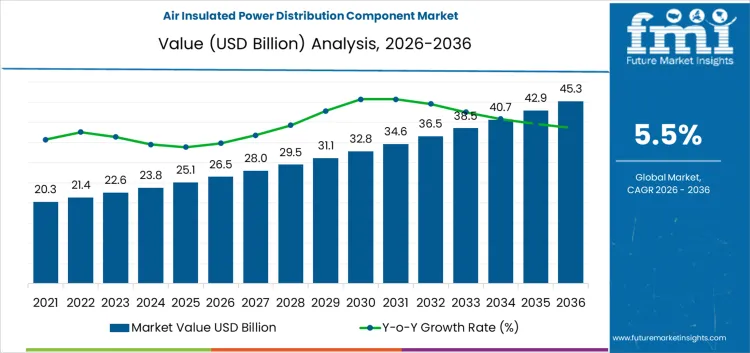
Air Insulated Power Distribution Component Market Key Takeaways
| Metric | Value |
|---|---|
| Market Value (2026) | USD 26.5 billion |
| Market Forecast Value (2036) | USD 45.3 billion |
| Forecast CAGR 2026 to 2036 | 5.5% |
Why is the Demand for Air Insulated Power Distribution Component Market Growing?
Demand for air insulated power distribution components is rising as electricity networks expand to support industrial, commercial and residential load growth. Utilities and grid operators prioritize insulation systems that manage medium and high voltage distribution with proven reliability and lower lifecycle servicing needs. Urbanization and industrial electrification projects require switchgear, circuit breakers, disconnectors and busbars designed for air insulation to maintain safety and continuity in distribution substations. Power producers integrate these components into new substation builds and retrofit programs to replace aging equipment that no longer meets modern load or safety expectations. Developers of renewable energy farms connect generation to distribution networks using air insulated devices that withstand variable operating conditions without complex cooling systems.
Growth in data center deployment and large commercial campuses contributes to market expansion as facility managers select air insulated distribution hardware that aligns with operational uptime goals and standardized maintenance practices. Manufacturers respond with compact designs that fit constrained footprints and offer modular connection options to support phased capacity increases. Regulatory frameworks governing electrical safety and grid performance encourage adherence to recognized insulation standards that prioritize clearances and dielectric strength. Service providers extend testing, commissioning and training services to support specification and integration in diverse electrical environments.
How Are the Segments Classified in the Air Insulated Power Distribution Component Market?
Demand for air insulated power distribution components rises due to infrastructure modernization, grid expansion, and cost effective medium voltage switching needs. Utilities and industrial operators adopt air insulated systems for reliability under normal atmospheric conditions. Simpler design, lower maintenance, and straightforward fault management favor deployment in substations, switch rooms, and outdoor installations. Project feasibility and lifecycle economics often determine preference over more complex gas insulated alternatives.
Which component type represents the largest share of demand?
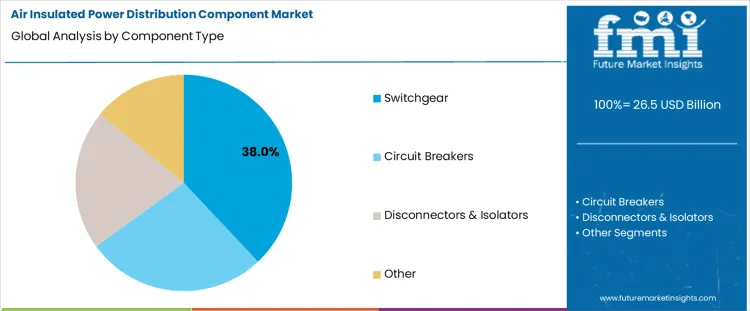
Switchgear leads component type demand with a 38.0% share due to its central role in power distribution and protection. Air insulated switchgear provides accessible operation, ease of maintenance, and reduced risk in controlled environments. It supports integration across primary and secondary distribution networks. Scalability for medium voltage applications enhances suitability for utilities and industrial facilities. Mechanical simplicity and visible disconnection capability remain key factors in operational environments prioritizing safety and cost control.
Key Points
- Delivers primary distribution control across diverse voltage levels
- Supports accessible operation and simplified maintenance
- Preferred in safety focused environments with cost constraints
Which voltage level accounts for the highest share of demand?
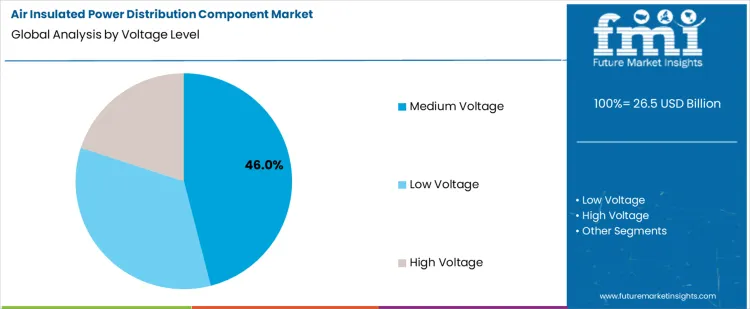
Medium voltage systems represent a 46.0% share, driven by widespread use in regional grid distribution and industrial infrastructure. Voltage levels in this range balance coverage with manageable equipment size and installation costs. Medium voltage networks support primary feeder distribution, transformer interconnections, and facility-level power delivery. Air insulated designs offer effective operation where space and ventilation requirements are met. Regulatory alignment and project scale continue to support standardization at this voltage tier.
Key Points
- Serves core grid and facility distribution functions
- Balances capacity with equipment and installation feasibility
- Standardizes across regional utility and industrial projects
Which end use holds the largest share of demand?
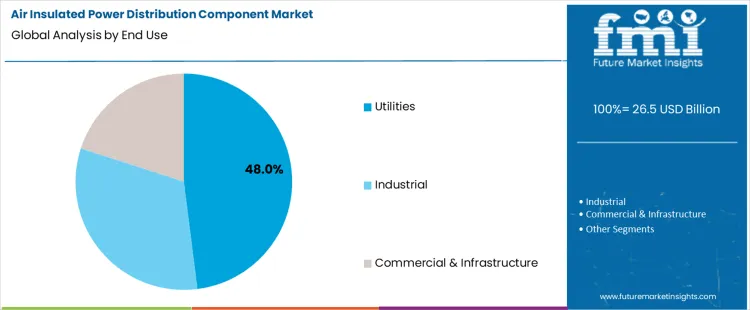
Utilities account for a 48.0% share, reflecting primary responsibility for transmission and distribution network operations. Utilities deploy air insulated components in substations and distribution nodes requiring modularity and ease of access. Network upgrades, electrification efforts, and rural grid extensions reinforce installation rates. Serviceability and visible isolation features support safety protocols during scheduled maintenance and fault response. Budget constraints and environmental considerations also influence selection over enclosed alternatives.
Key Points
- Used in substation and feeder-level distribution infrastructure
- Aligns with utility safety and accessibility standards
- Supports scalable deployment across new and upgraded grids
What are the Key Dynamics in the air insulated power distribution component market?
Demand dynamics in the air insulated power distribution component market reflect infrastructure expansion, grid modernization, and industrial electrification trends. Global activity centers on medium-voltage and low-voltage distribution networks across utilities, commercial buildings, and manufacturing facilities. Value formation depends on dielectric performance, fault tolerance, and ease of integration within established grid configurations. Purchasing behavior aligns with system voltage class, environmental conditions, and lifecycle maintenance requirements.
How do infrastructure reliability and modular integration need shape adoption?
Adoption increases as utilities and facility operators require cost-effective solutions for sectionalizing, switching, and protecting distribution circuits. Demand strengthens where air insulated components offer reliable performance under standard atmospheric conditions without the need for sealed enclosures. Indoor substations, pole-mounted systems, and panelboards adopt air insulated switches, circuit breakers, disconnectors, and busbars for modularity and accessibility. Retrofit compatibility with legacy infrastructure supports scalable deployment. Maintenance personnel favor air insulated assemblies for visual inspection access and simplified service routines. Standardization across voltage ratings and interface dimensions facilitates multi-vendor procurement. Compact designs for space-constrained applications enable use in urban substations, data centers, and institutional facilities.
How do environmental exposure and arc safety constraints influence market scalability?
Market scalability faces constraints from operational exposure to moisture, dust, corrosive agents, and wildlife interference. Demand encounters resistance in harsh outdoor or high-contamination environments where gas-insulated or sealed components offer better reliability. Arc flash containment and personnel safety considerations increase engineering requirements for air insulated units in confined areas. Space requirements for safe air gaps limit compactness compared to alternative insulation technologies. Installation in seismic or vibration-prone regions demands additional structural reinforcement. Evolving safety regulations and arc classification standards impose design and testing complexity. Higher lifetime maintenance frequency compared to encapsulated systems raises total ownership cost over long-duration deployments.
How Is Demand for the Air Insulated Power Distribution Component Market Evolving Globally?
Global demand for air insulated power distribution components is growing as grid modernization, infrastructure expansion, and decentralized energy deployment increase equipment replacement and installation needs. Growth reflects utility and industrial requirements for reliable medium-voltage switching, protection, and isolation under constrained space and cost-sensitive conditions. Demand remains structurally tied to regional electrification targets, renewable integration, and capital allocation toward substations and secondary distribution systems. India records 7.4% CAGR, China records 6.8% CAGR, Vietnam records 6.2% CAGR, USA records 4.9% CAGR, and Germany records 4.6% CAGR. Adoption remains aligned with public infrastructure investment and system resilience needs globally.
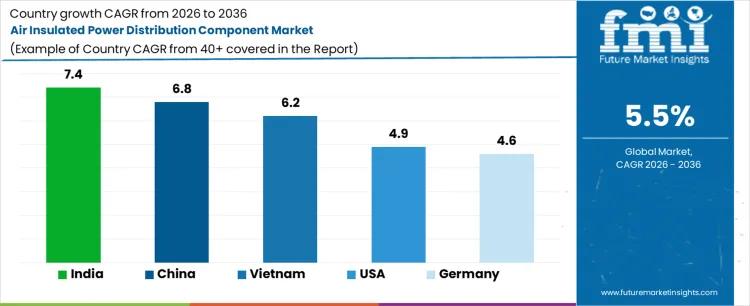
| Country | CAGR (%) |
|---|---|
| India | 7.4% |
| China | 6.8% |
| Vietnam | 6.2% |
| USA | 4.9% |
| Germany | 4.6% |
What is driving growth of air insulated power distribution components in India?
Demand for air insulated power distribution components in India is rising as transmission and distribution upgrades align with national electrification and industrialization goals. Growth at 7.4% CAGR reflects widespread deployment across substations, smart grid zones, and urban network extensions. Utilities prioritize compact, low-maintenance switchgear solutions to support mixed rural-urban load profiles. Infrastructure programs such as Deendayal Upadhyaya Gram Jyoti Yojana reinforce procurement of standardized distribution gear. Private sector expansion in metro rail, data centers, and industrial parks sustains recurring demand. Domestic manufacturing ecosystem supports cost-efficient supply and short lead times. Reliability, thermal performance, and ease of installation remain key selection criteria.
- Electrification of underserved regions
- Urban infrastructure expansion
- Growth of domestic manufacturing base
- Standardization in public procurement
Why is China seeing expansion in air insulated power distribution component adoption?
Air insulated power distribution component demand in China is expanding due to large-scale grid reinforcement and industrial electrification. Growth at 6.8% CAGR aligns with energy transition efforts supporting renewable energy zones and urban load centers. Government mandates favor modular, low-loss switchgear designs to enhance substation efficiency. Industrial and transportation sectors install medium-voltage gear in localized distribution networks. Domestic OEMs benefit from procurement volumes and rapid technology iteration. Urban redevelopment and data center clustering drive higher component density. Installation scale supports economies of scale and lifecycle cost reduction. Replacement demand persists through regulatory updates and operational reliability targets.
- Industrial electrification policy focus
- High-density urban energy demand
- Grid reinforcement in renewable zones
- Strong local OEM capacity
How is Vietnam supporting growth of air insulated power distribution component demand?
Demand for air insulated power distribution components in Vietnam is increasing as energy infrastructure builds out to support economic and industrial development. Growth at 6.2% CAGR reflects national grid expansion and rural electrification goals. Industrial parks and commercial construction projects require modular medium-voltage gear for reliable distribution. Foreign direct investment into manufacturing clusters increases installation of standard-compliant switchgear systems. Public-private partnerships accelerate deployment across public infrastructure and transit projects. Procurement preferences include compact dimensions, simplified operation, and thermal endurance. Market growth remains driven by grid extension projects and sector-specific facility electrification.
- Grid expansion into rural areas
- Industrial park development
- Public infrastructure electrification
- Preference for modular installations
What factors are shaping air insulated power distribution component sales in the USA?
Air insulated power distribution component demand in the USA is shaped by aging grid infrastructure and renewable energy integration. Growth at 4.9% CAGR reflects replacement of legacy systems across substations and distribution feeders. Utilities prioritize equipment supporting modular upgrades and minimal field servicing. Decentralized generation and microgrid development drive medium-voltage installations in community and industrial contexts. Regulatory incentives for resilience and energy efficiency support switchgear retrofits. Compact air insulated units are adopted in urban settings with space constraints. Demand is steady across utility and large commercial segments, with growth tied to grid modernization budgets and lifecycle replacement schedules.
- Aging substation infrastructure
- Rise in decentralized energy deployment
- Urban space optimization needs
- Equipment lifecycle replacement
How is Germany supporting growth of air insulated power distribution component demand?
Air insulated power distribution component market demand in Germany is advancing through energy transition implementation and industrial energy efficiency programs. Growth at 4.6% CAGR reflects adoption in grid reinforcement, building electrification, and decentralized power distribution. Utilities prioritize compact, low-loss switchgear with proven performance history. Smart grid initiatives require adaptable medium-voltage equipment for flexible control. Industrial operators upgrade legacy systems for automation and reliability. Preference for tested components from certified manufacturers remains strong. Demand is concentrated in retrofit projects and digital substation applications. Component sourcing emphasizes durability, modular integration, and compliance with EU energy directives.
- Integration with smart grid infrastructure
- Industrial energy efficiency retrofits
- Focus on product durability and certification
- Retrofit demand in urban substations
What is the competitive landscape of demand for the air insulated power distribution component market globally?
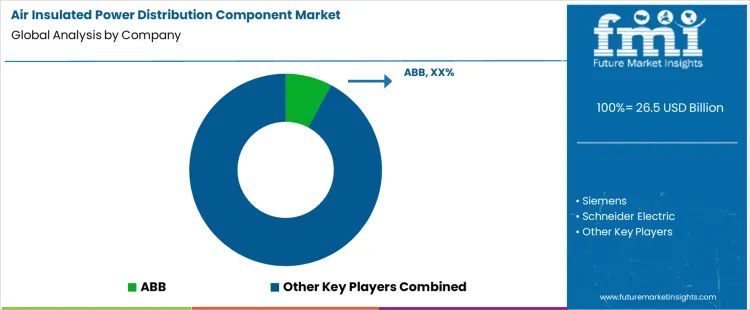
Demand for air insulated power distribution components is driven by grid infrastructure upgrades, industrial power reliability needs, and urban electrification. Buyers evaluate arc fault resistance, insulation reliability, ease of installation, modularity, voltage handling, and maintenance requirements. Procurement behavior emphasizes compliance with IEC or ANSI standards, supply continuity, field serviceability, and compatibility with smart grid systems. Purchasing teams prioritize lifecycle cost efficiency, footprint optimization, support for digital monitoring, and integration with low and medium voltage distribution frameworks. Trend in the air insulated power distribution component market reflects increased automation readiness, emphasis on safety, and adaptation to renewable power integration.
ABB leads competitive positioning through broad voltage coverage, modular switchgear platforms, and strong presence in utility and industrial sectors. Siemens supports demand with digital-ready air insulated systems aligned with energy transition and automation requirements. Schneider Electric competes using compact component design, energy efficiency features, and global support networks. Eaton maintains relevance through flexible configurations, industrial sector alignment, and integration with monitoring technologies. Mitsubishi Electric participates with engineered air insulated switchgear and distribution solutions tailored for heavy-duty and high-reliability applications. Competitive differentiation depends on compliance reliability, configurability, footprint efficiency, and integration with smart distribution environments.
Key Players in the Air Insulated Power Distribution Component Market
- ABB
- Siemens
- Schneider Electric
- Eaton
- Mitsubishi Electric
Scope of the Report
| Items | Values |
|---|---|
| Quantitative Units | USD billion |
| Component Type | Switchgear; Circuit Breakers; Disconnectors & Isolators; Other |
| Voltage Level | Medium Voltage; Low Voltage; High Voltage |
| End Use | Utilities; Industrial; Commercial & Infrastructure |
| Regions Covered | Asia Pacific, Europe, North America, Latin America, Middle East & Africa |
| Countries Covered | India, China, Vietnam, USA, Germany, and 40+ countries |
| Key Companies Profiled | ABB; Siemens; Schneider Electric; Eaton; Mitsubishi Electric |
| Additional Attributes | Dollar sales by component type, voltage level, end use, and sales channel; insulation performance and arc quenching reliability across medium and low voltage classes; enclosure durability, temperature tolerance, and compliance with IEC and ANSI standards; integration with substation automation systems and smart grid interfaces; procurement trends driven by utility infrastructure upgrades, industrial plant expansions, and commercial building electrification. |
Air Insulated Power Distribution Component Market by Segment
Component Type:
- Switchgear
- Circuit Breakers
- Disconnectors & Isolators
- Other
Voltage Level:
- Medium Voltage
- Low Voltage
- High Voltage
End Use:
- Utilities
- Industrial
- Commercial & Infrastructure
Region:
- Asia Pacific
- China
- Japan
- South Korea
- India
- Australia & New Zealand
- ASEAN
- Rest of Asia Pacific
- Europe
- Germany
- United Kingdom
- France
- Italy
- Spain
- Nordic
- BENELUX
- Rest of Europe
- North America
- United States
- Canada
- Mexico
- Latin America
- Brazil
- Chile
- Rest of Latin America
- Middle East & Africa
- Kingdom of Saudi Arabia
- Other GCC Countries
- Turkey
- South Africa
- Other African Union
- Rest of Middle East & Africa
Bibliography
- International Electrotechnical Commission. (2024). IEC 62271-200:2021/AMD1:2024: High-voltage switchgear and controlgear—Part 200: AC metal-enclosed switchgear and controlgear for rated voltages above 1 kV and up to and including 52 kV (Amendment 1). IEC.
- International Energy Agency. (2023). Electricity grids and secure energy transitions: Enhancing the foundations of resilient, sustainable and affordable power systems. IEA.
- U.S. Department of Energy. (2024). Grid modernization strategy 2024. U.S. Department of Energy.
- Federal Ministry for Economic Affairs and Climate Action. (2023). Federal government report on energy research 2023. BMWK.
Frequently Asked Questions
How big is the air insulated power distribution component market in 2026?
The global air insulated power distribution component market is estimated to be valued at USD 26.5 billion in 2026.
What will be the size of air insulated power distribution component market in 2036?
The market size for the air insulated power distribution component market is projected to reach USD 45.3 billion by 2036.
How much will be the air insulated power distribution component market growth between 2026 and 2036?
The air insulated power distribution component market is expected to grow at a 5.5% CAGR between 2026 and 2036.
What are the key product types in the air insulated power distribution component market?
The key product types in air insulated power distribution component market are switchgear, circuit breakers, disconnectors & isolators and other.
Which voltage level segment to contribute significant share in the air insulated power distribution component market in 2026?
In terms of voltage level, medium voltage segment to command 46.0% share in the air insulated power distribution component market in 2026.
Preview the report firsthand - request a free sample
Get SampleGet the brochure for pricing and purchase details.
Get PDFTable of Content
- Executive Summary
- Global Market Outlook
- Demand-side Trends
- Supply-side Trends
- Technology Roadmap Analysis
- Analysis and Recommendations
- Market Overview
- Market Coverage / Taxonomy
- Market Definition / Scope / Limitations
- Market Background
- Market Dynamics
- Drivers
- Restraints
- Opportunity
- Trends
- Scenario Forecast
- Demand in Optimistic Scenario
- Demand in Likely Scenario
- Demand in Conservative Scenario
- Opportunity Map Analysis
- Product Life Cycle Analysis
- Supply Chain Analysis
- Investment Feasibility Matrix
- Value Chain Analysis
- PESTLE and Porter’s Analysis
- Regulatory Landscape
- Regional Parent Market Outlook
- Production and Consumption Statistics
- Import and Export Statistics
- Market Dynamics
- Global Market Analysis 2021 to 2025 and Forecast, 2026 to 2036
- Historical Market Size Value (USD Million) Analysis, 2021 to 2025
- Current and Future Market Size Value (USD Million) Projections, 2026 to 2036
- Y-o-Y Growth Trend Analysis
- Absolute $ Opportunity Analysis
- Global Market Pricing Analysis 2021 to 2025 and Forecast 2026 to 2036
- Global Market Analysis 2021 to 2025 and Forecast 2026 to 2036, By Component Type
- Introduction / Key Findings
- Historical Market Size Value (USD Million) Analysis By Component Type, 2021 to 2025
- Current and Future Market Size Value (USD Million) Analysis and Forecast By Component Type, 2026 to 2036
- Switchgear
- Circuit Breakers
- Disconnectors & Isolators
- Other
- Switchgear
- Y-o-Y Growth Trend Analysis By Component Type, 2021 to 2025
- Absolute $ Opportunity Analysis By Component Type, 2026 to 2036
- Global Market Analysis 2021 to 2025 and Forecast 2026 to 2036, By Voltage Level
- Introduction / Key Findings
- Historical Market Size Value (USD Million) Analysis By Voltage Level, 2021 to 2025
- Current and Future Market Size Value (USD Million) Analysis and Forecast By Voltage Level, 2026 to 2036
- Medium Voltage
- Low Voltage
- High Voltage
- Medium Voltage
- Y-o-Y Growth Trend Analysis By Voltage Level, 2021 to 2025
- Absolute $ Opportunity Analysis By Voltage Level, 2026 to 2036
- Global Market Analysis 2021 to 2025 and Forecast 2026 to 2036, By End Use
- Introduction / Key Findings
- Historical Market Size Value (USD Million) Analysis By End Use, 2021 to 2025
- Current and Future Market Size Value (USD Million) Analysis and Forecast By End Use, 2026 to 2036
- Utilities
- Industrial
- Commercial & Infrastructure
- Utilities
- Y-o-Y Growth Trend Analysis By End Use, 2021 to 2025
- Absolute $ Opportunity Analysis By End Use, 2026 to 2036
- Global Market Analysis 2021 to 2025 and Forecast 2026 to 2036, By Region
- Introduction
- Historical Market Size Value (USD Million) Analysis By Region, 2021 to 2025
- Current Market Size Value (USD Million) Analysis and Forecast By Region, 2026 to 2036
- North America
- Latin America
- Western Europe
- Eastern Europe
- East Asia
- South Asia and Pacific
- Middle East & Africa
- Market Attractiveness Analysis By Region
- North America Market Analysis 2021 to 2025 and Forecast 2026 to 2036, By Country
- Historical Market Size Value (USD Million) Trend Analysis By Market Taxonomy, 2021 to 2025
- Market Size Value (USD Million) Forecast By Market Taxonomy, 2026 to 2036
- By Country
- USA
- Canada
- Mexico
- By Component Type
- By Voltage Level
- By End Use
- By Country
- Market Attractiveness Analysis
- By Country
- By Component Type
- By Voltage Level
- By End Use
- Key Takeaways
- Latin America Market Analysis 2021 to 2025 and Forecast 2026 to 2036, By Country
- Historical Market Size Value (USD Million) Trend Analysis By Market Taxonomy, 2021 to 2025
- Market Size Value (USD Million) Forecast By Market Taxonomy, 2026 to 2036
- By Country
- Brazil
- Chile
- Rest of Latin America
- By Component Type
- By Voltage Level
- By End Use
- By Country
- Market Attractiveness Analysis
- By Country
- By Component Type
- By Voltage Level
- By End Use
- Key Takeaways
- Western Europe Market Analysis 2021 to 2025 and Forecast 2026 to 2036, By Country
- Historical Market Size Value (USD Million) Trend Analysis By Market Taxonomy, 2021 to 2025
- Market Size Value (USD Million) Forecast By Market Taxonomy, 2026 to 2036
- By Country
- Germany
- UK
- Italy
- Spain
- France
- Nordic
- BENELUX
- Rest of Western Europe
- By Component Type
- By Voltage Level
- By End Use
- By Country
- Market Attractiveness Analysis
- By Country
- By Component Type
- By Voltage Level
- By End Use
- Key Takeaways
- Eastern Europe Market Analysis 2021 to 2025 and Forecast 2026 to 2036, By Country
- Historical Market Size Value (USD Million) Trend Analysis By Market Taxonomy, 2021 to 2025
- Market Size Value (USD Million) Forecast By Market Taxonomy, 2026 to 2036
- By Country
- Russia
- Poland
- Hungary
- Balkan & Baltic
- Rest of Eastern Europe
- By Component Type
- By Voltage Level
- By End Use
- By Country
- Market Attractiveness Analysis
- By Country
- By Component Type
- By Voltage Level
- By End Use
- Key Takeaways
- East Asia Market Analysis 2021 to 2025 and Forecast 2026 to 2036, By Country
- Historical Market Size Value (USD Million) Trend Analysis By Market Taxonomy, 2021 to 2025
- Market Size Value (USD Million) Forecast By Market Taxonomy, 2026 to 2036
- By Country
- China
- Japan
- South Korea
- By Component Type
- By Voltage Level
- By End Use
- By Country
- Market Attractiveness Analysis
- By Country
- By Component Type
- By Voltage Level
- By End Use
- Key Takeaways
- South Asia and Pacific Market Analysis 2021 to 2025 and Forecast 2026 to 2036, By Country
- Historical Market Size Value (USD Million) Trend Analysis By Market Taxonomy, 2021 to 2025
- Market Size Value (USD Million) Forecast By Market Taxonomy, 2026 to 2036
- By Country
- India
- ASEAN
- Australia & New Zealand
- Rest of South Asia and Pacific
- By Component Type
- By Voltage Level
- By End Use
- By Country
- Market Attractiveness Analysis
- By Country
- By Component Type
- By Voltage Level
- By End Use
- Key Takeaways
- Middle East & Africa Market Analysis 2021 to 2025 and Forecast 2026 to 2036, By Country
- Historical Market Size Value (USD Million) Trend Analysis By Market Taxonomy, 2021 to 2025
- Market Size Value (USD Million) Forecast By Market Taxonomy, 2026 to 2036
- By Country
- Kingdom of Saudi Arabia
- Other GCC Countries
- Turkiye
- South Africa
- Other African Union
- Rest of Middle East & Africa
- By Component Type
- By Voltage Level
- By End Use
- By Country
- Market Attractiveness Analysis
- By Country
- By Component Type
- By Voltage Level
- By End Use
- Key Takeaways
- Key Countries Market Analysis
- USA
- Pricing Analysis
- Market Share Analysis, 2025
- By Component Type
- By Voltage Level
- By End Use
- Canada
- Pricing Analysis
- Market Share Analysis, 2025
- By Component Type
- By Voltage Level
- By End Use
- Mexico
- Pricing Analysis
- Market Share Analysis, 2025
- By Component Type
- By Voltage Level
- By End Use
- Brazil
- Pricing Analysis
- Market Share Analysis, 2025
- By Component Type
- By Voltage Level
- By End Use
- Chile
- Pricing Analysis
- Market Share Analysis, 2025
- By Component Type
- By Voltage Level
- By End Use
- Germany
- Pricing Analysis
- Market Share Analysis, 2025
- By Component Type
- By Voltage Level
- By End Use
- UK
- Pricing Analysis
- Market Share Analysis, 2025
- By Component Type
- By Voltage Level
- By End Use
- Italy
- Pricing Analysis
- Market Share Analysis, 2025
- By Component Type
- By Voltage Level
- By End Use
- Spain
- Pricing Analysis
- Market Share Analysis, 2025
- By Component Type
- By Voltage Level
- By End Use
- France
- Pricing Analysis
- Market Share Analysis, 2025
- By Component Type
- By Voltage Level
- By End Use
- India
- Pricing Analysis
- Market Share Analysis, 2025
- By Component Type
- By Voltage Level
- By End Use
- ASEAN
- Pricing Analysis
- Market Share Analysis, 2025
- By Component Type
- By Voltage Level
- By End Use
- Australia & New Zealand
- Pricing Analysis
- Market Share Analysis, 2025
- By Component Type
- By Voltage Level
- By End Use
- China
- Pricing Analysis
- Market Share Analysis, 2025
- By Component Type
- By Voltage Level
- By End Use
- Japan
- Pricing Analysis
- Market Share Analysis, 2025
- By Component Type
- By Voltage Level
- By End Use
- South Korea
- Pricing Analysis
- Market Share Analysis, 2025
- By Component Type
- By Voltage Level
- By End Use
- Russia
- Pricing Analysis
- Market Share Analysis, 2025
- By Component Type
- By Voltage Level
- By End Use
- Poland
- Pricing Analysis
- Market Share Analysis, 2025
- By Component Type
- By Voltage Level
- By End Use
- Hungary
- Pricing Analysis
- Market Share Analysis, 2025
- By Component Type
- By Voltage Level
- By End Use
- Kingdom of Saudi Arabia
- Pricing Analysis
- Market Share Analysis, 2025
- By Component Type
- By Voltage Level
- By End Use
- Turkiye
- Pricing Analysis
- Market Share Analysis, 2025
- By Component Type
- By Voltage Level
- By End Use
- South Africa
- Pricing Analysis
- Market Share Analysis, 2025
- By Component Type
- By Voltage Level
- By End Use
- USA
- Market Structure Analysis
- Competition Dashboard
- Competition Benchmarking
- Market Share Analysis of Top Players
- By Regional
- By Component Type
- By Voltage Level
- By End Use
- Competition Analysis
- Competition Deep Dive
- ABB
- Overview
- Product Portfolio
- Profitability by Market Segments (Product/Age /Sales Channel/Region)
- Sales Footprint
- Strategy Overview
- Marketing Strategy
- Product Strategy
- Channel Strategy
- Siemens
- Schneider Electric
- Eaton
- Mitsubishi Electric
- ABB
- Competition Deep Dive
- Assumptions & Acronyms Used
- Research Methodology


