

- Industry Size (2026)
- USD 933.1 Mn
- Forecast (2036)
- USD 2109.7 Mn
- CAGR (2026 to 2036)
- 8.5%
Bio-Based Bicomponent Sheath-Core Fiber Market Forecast and Outlook 2026 to 2036
The bio-based bicomponent sheath-core fiber market opens 2026 at USD 933.1 million and is projected to reach USD 2,109.7 million by 2036 at an 8.5% CAGR. Demand is defined by bonding temperature targets, hand feel requirements, and recyclability constraints in nonwovens, hygiene products, and technical textiles. Program teams specify sheath chemistry, core stiffness, and draw ratios during product definition. Once a web or fabric construction receives approval, later fiber changes require renewed bonding trials and performance checks. Volume expansion follows substitution of fossil-based binders, growth of thermal bonding lines, and wider use in filtration, medical, and packaging substrates.
Product architecture decisions govern participation in the bio-based bicomponent sheath-core fiber market through controlled material lists and long qualification cycles. Acceptance depends on evidence covering peel strength, aging behavior, and compatibility with downstream finishing steps. Approved constructions remain stable across multi-year supply programs. Replacement occurs during platform redesign windows rather than during routine purchasing rounds. Revenue growth tracks the number of lines converted to bio-based bonding solutions. Competitive position depends on access to early development work with converters and on retention inside standardized specifications. Supplier selection emphasizes continuity of approvals, documentation quality, and consistency across production lots delivered to distributed manufacturing sites.
Bio-Based Bicomponent Sheath-Core Fiber Market Quick Stats
- Bio-Based Bicomponent Sheath-Core Fiber Market Value (2026): USD 933.1 million
- Bio-Based Bicomponent Sheath-Core Fiber Market Forecast Value (2036): USD 2,109.7 million
- Bio-Based Bicomponent Sheath-Core Fiber Market Forecast CAGR (2026 to 2036): 8.5%
- Leading Type in Bio-Based Bicomponent Sheath-Core Fiber Market: Bio-based sheath and fossil core
- Key Growth Regions in Bio-Based Bicomponent Sheath-Core Fiber Market: China, USA, Germany, South Korea, Japan
- Top Players in Bio-Based Bicomponent Sheath-Core Fiber Market: Far Eastern New Century, Indorama Ventures, Toray Industries, Teijin, NatureWorks (via partners), Sateri, Advansa, Kelheim Fibres, Huvis
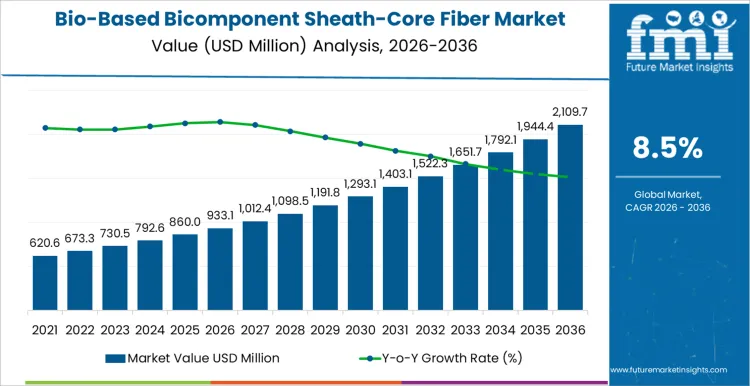
What is the Growth Forecast for the Bio Based Bicomponent Sheath Core Fiber Market through 2036?
The bio based bicomponent sheath core fiber market in 2026 stands near USD 933.1 million, anchored in bonding, filtration, hygiene, and thermal bonding textiles where controlled melt behavior sets process limits. Engineers select this fiber architecture to separate strength from bonding response inside one filament. Grade choice depends on melt point spacing, core stiffness, sheath flow stability, and draw consistency. Product approvals link to line trials and downstream bonding windows. Volume expands inside wipes, nonwovens, insulation, and technical laminates where process stability protects yield. Value growth follows higher fiber content per square meter and wider substitution of single polymer fibers. The climb to USD 2,109.7 million in 2036 aligns with an 8.5% growth profile supported by deeper penetration inside established production platforms.
Commercial planning governs the spending pattern of the bio based bicomponent sheath core fiber market. Orders track program lifetimes, qualification cycles, and long campaign runs. Inventory policy favors continuity of certified grades and color matched lots. Cost structure reflects polymer pairing, spinning control, sheath thickness tolerance, and inspection load. Annual values move through the low and mid billions during the early 2030s as more lines convert permanent recipes. Purchasing teams focus on lot traceability, bonding repeatability, and processing latitude. The rise to USD 2,109.7 million in 2036 comes from higher basis weight constructions, broader use inside composite webs, and longer contracts that lock this fiber type into standard bill of materials positions across multiple product families.
Bio-Based Bicomponent Sheath-Core Fiber Market Key Takeaways
| Metric | Value |
|---|---|
| Market Value (2026) | USD 933.1 million |
| Forecast Value (2036) | USD 2,109.7 million |
| Forecast CAGR (2026 to 2036) | 8.5% |
How Is the Bio Based Bicomponent Sheath Core Fiber Market Being Used to Control Bonding Behavior and Thermal Response in Nonwoven and Textile Structures?
The bio based bicomponent sheath core fiber market is specified in production chains that already depend on nonwoven hygiene materials, thermal bonding fibers, bio based polymer resins, fiber spinning equipment systems, sustainable textile raw materials, and industrial filtration media. Converters select these fibers to separate structural strength from surface activation during heating cycles. Qualification focuses on melt point separation, sheath uniformity, and core continuity because small deviations change bonding windows and fabric stiffness. Spinning lines monitor eccentricity and filament break rates since both affect web uniformity and downstream yield. Calendering and through air bonding operations track temperature sensitivity and sticking behavior. Purchasing teams require lot traceability and thermal response curves because inconsistent activation forces speed reductions, rework, and off grade output during high volume campaigns.
The bio based bicomponent sheath core fiber market is evaluated through line stability, bonding consistency, and waste control rather than through material claims. Programs linked to circular nonwoven production systems and compostable fiber product standards require predictable separation between structural and bonding functions. Operators measure value through start up scrap, bonding uniformity, and tensile spread across finished rolls. A fiber that shifts activation temperature narrows process windows and forces conservative machine settings. Producers tighten polymer feed control, spinneret maintenance, and quench conditions to limit drift. Storage and handling rules matter because pellet moisture and contamination change spin behavior. Contracts define acceptable ranges for sheath thickness and activation onset. Demand concentrates in applications where fabric integrity and bonding repeatability determine inspection results, shipment release, and long run production scheduling.
How Do specification control and qualification scope shape demand in the Bio-Based Bicomponent Sheath-Core Fiber Market by sheath and core combination and polymer family in 2026?
In the Bio-Based Bicomponent Sheath-Core Fiber Market, buying decisions begin with claim scope, audit coverage, and the risk assigned to product labeling. Specifications used in hygiene nonwoven materials, filtration media production, and thermal bonding fiber applications require proof that the sheath and the core perform their assigned functions without compromising downstream processing. By sheath and core combination, usage spans bio-based sheath with fossil core, bio-based sheath with bio-based core, fossil sheath with bio-based core, and other systems, each with different validation burdens. By polymer family, consumption divides among PLA and derivatives, bio-polyesters and copolymers, bio-polyamides, and other bio-based polymers. Procurement teams align contracts with spunbond and meltblown nonwovens, automotive interior textiles, and medical disposable products that impose fixed test plans. Once a construction is written into a drawing and a label, change triggers requalification, retesting, and customer approvals, which slows substitution and stabilizes portfolios.
Why do sheath and core combinations track qualification risk more than material cost?
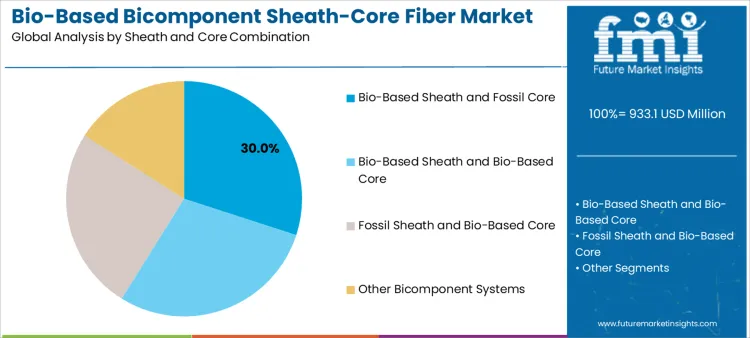
Bio-based sheath with fossil core holds about 30% share because it allows mills to place the claim on the surface while keeping a familiar mechanical backbone. In production lines feeding thermal bonding fiber applications and hygiene nonwoven materials, this construction preserves bonding windows and line speed while limiting the scope of change in spinning packs and quench settings. A fully bio-based sheath and core increases the audit footprint because both components enter the claim boundary. A fossil sheath with bio-based core supports niche designs where the surface must keep legacy behavior. Other constructions remain tied to specific customers. Engineers evaluate combinations by melt stability, interfacial adhesion, and sheath flow control.
Quality managers evaluate them by test matrices, sample retention, and re-audit frequency. Operations evaluate them by start-up waste and pack life. A construction that satisfies all three groups becomes the default. Substitution requires new draw ratios, new bonding trials, and new durability files. That sequence explains why the mixed construction keeps volume. It limits the change surface while delivering a visible claim. The pattern repeats in lines serving filtration media production and medical disposable products where approvals govern schedules. Demand follows combinations that keep certification clocks running without resetting. Portfolios expand through width, denier, and cut-length variants inside the same construction rather than through frequent architecture changes across plants and customers.
How do polymer families become embedded in specifications and purchasing contracts?
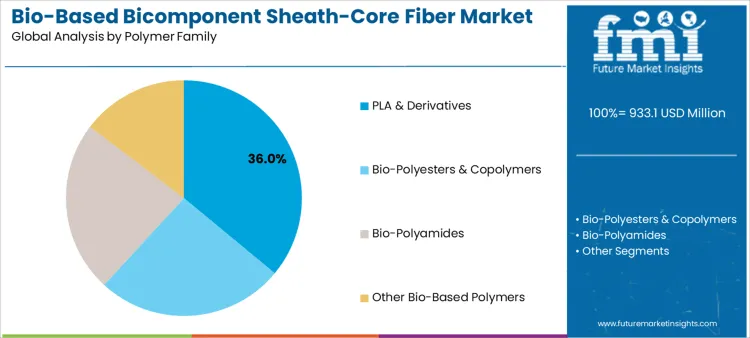
PLA and derivatives represent about 36% share because their melting range and crystallization behavior fit existing bicomponent spinning and bonding windows. In programs supplying spunbond and meltblown nonwovens and automotive interior textiles, this family supports predictable sheath flow and stable fiber geometry. Bio-polyesters and copolymers address designs that need broader temperature tolerance or specific hand feel. Bio-polyamides appear where abrasion resistance or higher service temperature is written into the requirement. Other bio-based polymers serve pilot programs with narrow volumes. Procurement embeds the family choice in contracts that define test methods, color limits, and rework rules.
Planning embeds it in pack configurations and spare part lists. Sales embeds it in labels and declarations. A change in family forces a cascade of updates across these documents. Mills also align inventory policies to avoid mixing families in the same lot. This keeps scheduling simple and reduces the chance of claim disputes. Capacity increases usually occur by adding positions within the same family rather than switching chemistry. Customers accept that approach because it preserves comparability of results. The outcome is steady growth inside established families. Movement between families remains rare and deliberate because each shift resets evidence packs, customer sign-offs, and production settings across sites.
Why Are Material Substitution Programs Expanding the Bio-Based Bicomponent Sheath-Core Fiber Market?
Bio-Based Bicomponent Sheath-Core Fiber Market demand grows as fiber buyers restructure raw material sourcing to reduce dependence on petrochemical inputs while preserving mechanical and processing performance. Sheath-core architecture allows producers to assign strength to the core and surface behavior to the sheath without redesigning entire product platforms. Nonwovens, hygiene products, and technical textiles use these fibers to control bonding behavior, hand feel, and durability through material selection rather than post treatment. Procurement teams focus on supply continuity, melt behavior consistency, and bonding window stability. Value concentrates in fibers that run on existing spinning and thermal bonding lines without forcing equipment changes or yield penalties.
What Factors Are Limiting Volume Expansion in the Bio-Based Bicomponent Sheath-Core Fiber Market?
Bio-Based Bicomponent Sheath-Core Fiber Market scaling is restricted by feedstock consistency, processing sensitivity, and unit cost discipline in high volume textile categories. Bio derived polymers show narrower thermal processing windows and different crystallization behavior, which increases line setup time and scrap risk. Maintaining stable sheath to core ratios at industrial speeds requires precise extrusion control and disciplined quality systems. Feedstock price swings complicate long term contracts and margin planning for fiber producers. Buyers in hygiene and packaging segments evaluate these fibers against strict cost ceilings, which slows substitution when performance benefits do not directly convert into measurable production savings.
How Are Product Portfolios and Supply Models Changing in the Bio-Based Bicomponent Sheath-Core Fiber Market?
Bio-Based Bicomponent Sheath-Core Fiber Market development centers on portfolio rationalization around a limited number of high volume, process stable fiber constructions. Producers focus on standard sheath chemistries for bonding and surface control paired with core materials optimized for tensile strength and dimensional stability. Custom variants exist, though most growth comes from platform grades qualified across multiple product lines. Supply agreements increasingly lock both polymer sourcing and fiber output to protect customers from variability. Technical service shifts toward line startup support, bonding window tuning, and scrap reduction rather than experimental development work, reflecting a move toward industrial scale deployment and predictable operating economics.
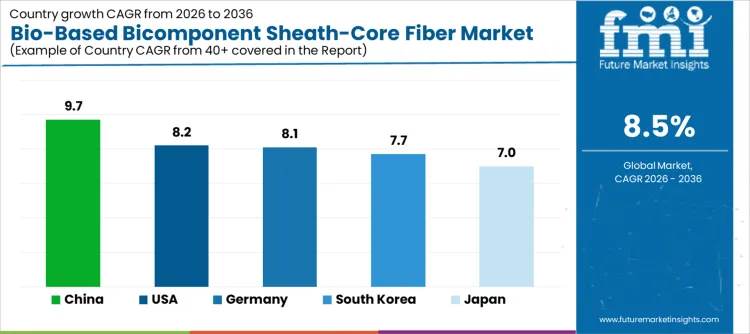
What is the Demand for Bio Based Bicomponent Sheath Core Fiber by Country?
| Country | CAGR (%) |
|---|---|
| USA | 8.2% |
| Japan | 7.0% |
| South Korea | 7.7% |
| Germany | 8.1% |
| China | 9.7% |
The demand for bio based bicomponent sheath core fiber is rising across hygiene, nonwovens, and technical textile applications where bonding performance and material differentiation are important. China leads at 9.7% CAGR, supported by large scale nonwoven production and increasing use of bio based components in hygiene and medical products. The USA grows at 8.2% as producers integrate these fibers into wipes, hygiene products, and thermal bonding nonwovens. Germany records 8.1%, driven by high specification technical textiles and hygiene materials. South Korea advances at 7.7%, reflecting steady demand from nonwovens and specialty fabrics. Japan posts 7.0%, shaped by a mature but quality focused fiber and nonwoven manufacturing sector.
How Do Binder Fiber Qualification and Process Window Control Shape Buying in the Bio Based Bicomponent Sheath Core Fiber Market in the USA?
In the United States, procurement programs are now scaling the Bio Based Bicomponent Sheath Core Fiber Market at a rate consistent with an 8.2% CAGR. Adoption is governed by certification files tied to bonding temperature windows and web integrity audits rather than by price negotiations. Process owners test sheath softening range, core strength retention, cut length stability, and crimp behavior on full production lines. Once a fiber grade clears these trials, the same data package anchors downstream approvals and substitution becomes rare. Volumes increase only when qualified products secure new supply programs. Technical committees retain control of any change request. Supplier access depends on documentation depth and audit readiness. Inventory planning follows line schedules, not spot orders. Commercial success depends on specification entry and repeatable batch behavior across multiple plants.
How Do Factory Governance Rules Determine Adoption in the Bio Based Bicomponent Sheath Core Fiber Market in Japan?
Inside Japanese operations, material change discipline is shaping the Bio Based Bicomponent Sheath Core Fiber Market along a path equivalent to a 7% CAGR. Fiber selection is treated as a manufacturing control variable. Any proposed change enters a formal review cycle that includes long run bonding stability checks and lint generation assessments. Engineers focus on web strength distribution, bonding uniformity, and tolerance to line speed variation. Once approved, the same fiber remains embedded in identical constructions for extended production cycles. Change requests trigger full revalidation. Supplier access depends on documentation completeness and inspection outcomes. Local sources benefit from proximity to audit teams. Volume growth follows slow portfolio renewal rather than replacement campaigns. Commercial positioning relies on consistency and disciplined process support over long operating periods.
How Do Platform Definitions Drive Volume in the Bio Based Bicomponent Sheath Core Fiber Market in South Korea?
Product platform strategy explains why the Bio Based Bicomponent Sheath Core Fiber Market in South Korea is tracking growth consistent with a 7.7% CAGR. Development groups define standard fiber sets that apply across several product families. A single grade decision can affect multiple lines without separate approvals. Evaluation centers on sheath flow behavior, bonding response, core load retention, and run speed tolerance. When a fiber enters the platform baseline, scale follows through synchronized launches. Plant level changes are limited because the platform file governs material use. Suppliers secure positions through joint trials and documentation alignment. Volume growth mirrors platform rollout schedules. Inventory planning aligns with coordinated startups. Commercial success depends on early inclusion in platform definitions and stable execution during multi line introductions.
How Do Central Approval Structures Control Material Choice in the Bio Based Bicomponent Sheath Core Fiber Market in Germany?
In Germany, corporate technical governance is steering the Bio Based Bicomponent Sheath Core Fiber Market in line with an 8.1% CAGR. Material access is controlled through central approval registers. Individual plants cannot introduce new fibers independently. Reviews focus on reproducibility, bonding performance, and audit completeness across sites. After approval, the same fiber grade is released for use in several factories under identical process rules. Volume expansion follows program growth rather than local purchasing initiatives. Supplier positioning depends on audit performance and documentation discipline. Change control remains formal and slow. Inventory policies reflect coordinated production planning. Commercial success depends on passing central reviews and maintaining identical behavior across distributed manufacturing environments over extended production cycles.
How Do Replication Programs Create Scale in the Bio Based Bicomponent Sheath Core Fiber Market in China?
Replication speed across manufacturing networks explains why the Bio Based Bicomponent Sheath Core Fiber Market in China is advancing in line with a 9.7% CAGR. Once a fiber performs within defined bonding and throughput limits in one plant, it moves into parallel lines with limited redesign. Approval focuses on consistency and tolerance to high speed operation rather than incremental optimization. Expansion teams rely on standardized process transfer files and commissioning checklists. Domestic suppliers dominate because they can follow capacity additions and line moves. Imports remain concentrated in higher specification uses. Volume growth comes from repeating approved constructions across sites. Commercial advantage depends on being present when a construction becomes a template rather than competing for each individual line.
How Do Suppliers Compete in the Bio-Based Bicomponent Sheath-Core Fiber Market?
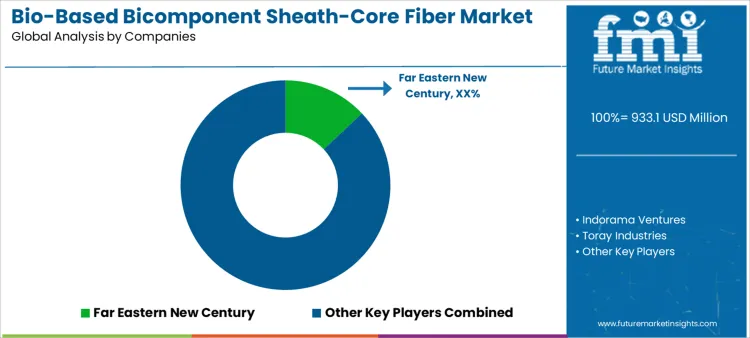
Fiber adoption in the Bio-Based Bicomponent Sheath-Core Fiber Market depends on sheath-core composition control, tensile properties, and sustainable sourcing rather than brand presence. Far Eastern New Century, Indorama Ventures, Toray Industries, Teijin, NatureWorks (via partners), Sateri, Advansa, Kelheim Fibres, and Huvis compete during laboratory testing, pilot spinning, and industrial line trials. Once a bicomponent fiber enters product lines, fiber uniformity, thermal behavior, and processing stability anchor supplier selection. Far Eastern New Century focuses on high-performance bicomponent fibers for hygiene and technical textiles. Indorama Ventures delivers bio-based polyester blends for apparel and industrial fabrics. Toray and Teijin emphasize process-ready fibers for high-speed spinning. NatureWorks supplies PLA-based sheaths through partner networks. Sateri provides wood pulp-derived sheaths with consistent quality. Advansa targets specialty PET and co-polymer fibers. Kelheim Fibres focuses on custom viscose bicomponent solutions. Huvis supports filtration, hygiene, and nonwoven segments.
Quality assurance, scalability, and bio-content certification determine competitive positioning in the Bio-Based Bicomponent Sheath-Core Fiber Market rather than cost alone. Manufacturers assess sheath-to-core ratio consistency, elongation, modulus, moisture uptake, and compatibility with downstream processes during qualification. Production teams prioritize suppliers who can deliver reproducible lots with reliable lead times. Far Eastern New Century secures adoption through technical support and pilot line integration. Indorama Ventures holds share where sustainable polyester content is a procurement requirement. Toray and Teijin compete in high-volume spinning operations requiring precise fiber control. NatureWorks gains adoption through biopolymer integration and partner coordination. Sateri and Advansa maintain positions in specialty applications needing stable mechanical performance. Kelheim Fibres attracts customers requiring customized viscose blends. Huvis captures adoption in industrial nonwoven and hygiene product applications. Market positions vary by fiber composition, processing method, end-use sector, and regulatory compliance requirements.
Key Players in Bio-Based Bicomponent Sheath-Core Fiber Market
- Far Eastern New Century
- Indorama Ventures
- Toray Industries
- Teijin
- NatureWorks (via partners)
- Sateri
- Advansa
- Kelheim Fibres
- Huvis
Scope of the Report
| Items | Values |
|---|---|
| Quantitative Units (2026) | USD million |
| Sheath and Core Combination | Bio-based sheath and fossil core, bio-based sheath and bio-based core, fossil sheath and bio-based core, other bicomponent systems |
| Polymer Family | PLA and derivatives, bio-polyesters and copolymers, bio-polyamides, other bio-based polymers |
| End Use | Staple fiber nonwovens, textured yarn and apparel, hygiene and wipes, other applications |
| Function | Bonding and loft control, softness and hand, moisture and comfort functions, other functional roles |
| Regions Covered | Asia Pacific, Europe, North America, Latin America, Middle East & Africa |
| Countries Covered | United States, Canada, Mexico, Germany, United Kingdom, France, Italy, Spain, Nordics, BENELUX, China, Japan, South Korea, India, Australia & New Zealand, ASEAN, Brazil, Chile, Saudi Arabia, Turkey, South Africa, and other regional markets |
| Key Companies Profiled | Far Eastern New Century, Indorama Ventures, Toray Industries, Teijin, NatureWorks (via partners), Sateri, Advansa, Kelheim Fibres, Huvis |
| Additional Attributes | Dollar sales by sheath-core combination, polymer family, end use, and function, qualification-driven adoption in nonwovens, hygiene, and technical textiles, bonding window and thermal activation control requirements, processing constraints tied to sheath thickness and core continuity, lot traceability and audit documentation expectations, integration into spunbond, meltblown, and thermal bonding production lines, substitution of fossil-based binders in filtration, medical, and packaging substrates, and regional demand patterns linked to conversion of high-volume nonwoven lines to bio-based bonding systems |
Bio-Based Bicomponent Sheath-Core Fiber Market Segmentation
Sheath and Core Combination:
- Bio-Based Sheath and Fossil Core
- Bio-Based Sheath and Bio-Based Core
- Fossil Sheath and Bio-Based Core
- Other Bicomponent Systems
Polymer Family:
- PLA & Derivatives
- Bio-Polyesters & Copolymers
- Bio-Polyamides
- Other Bio-Based Polymers
End Use:
- Staple Fiber Nonwovens
- Textured Yarn & Apparel
- Hygiene & Wipes
- Other Applications
Function:
- Bonding & Loft Control
- Softness & Hand
- Moisture & Comfort Functions
- Other Functional Roles
Region
- Asia Pacific
- China
- Japan
- South Korea
- India
- Australia & New Zealand
- ASEAN
- Rest of Asia Pacific
- Europe
- Germany
- United Kingdom
- France
- Italy
- Spain
- Nordic
- BENELUX
- Rest of Europe
- North America
- United States
- Canada
- Mexico
- Latin America
- Brazil
- Chile
- Rest of Latin America
- Middle East & Africa
- Kingdom of Saudi Arabia
- Other GCC Countries
- Turkey
- South Africa
- Other African Union
- Rest of Middle East & Africa
Bibliography
- International Organization for Standardization. (2023). ISO 9073‑1: Textiles—Test methods for nonwovens—Part 1: Determination of mass per unit area. International Organization for Standardization.
- Organisation for Economic Co-operation and Development. (2025). Biobased chemicals and bioplastics. OECD Publishing.
- United States Department of Energy. (2024). 2016–2023 Billion‑Ton report: An assessment of U.S. renewable carbon resources. U.S. Department of Energy.
- United Nations Environment Programme. (2023). Sustainability and circularity in the textile value chain: A global roadmap. United Nations Environment Programme.
Frequently Asked Questions
How big is the bio-based bicomponent sheath-core fiber market in 2026?
The global bio-based bicomponent sheath-core fiber market is estimated to be valued at USD 933.1 million in 2026.
What will be the size of bio-based bicomponent sheath-core fiber market in 2036?
The market size for the bio-based bicomponent sheath-core fiber market is projected to reach USD 2,109.7 million by 2036.
How much will be the bio-based bicomponent sheath-core fiber market growth between 2026 and 2036?
The bio-based bicomponent sheath-core fiber market is expected to grow at a 8.5% CAGR between 2026 and 2036.
What are the key product types in the bio-based bicomponent sheath-core fiber market?
The key product types in bio-based bicomponent sheath-core fiber market are bio-based sheath and fossil core, bio-based sheath and bio-based core, fossil sheath and bio-based core and other bicomponent systems.
Which polymer family segment to contribute significant share in the bio-based bicomponent sheath-core fiber market in 2026?
In terms of polymer family, pla & derivatives segment to command 36.0% share in the bio-based bicomponent sheath-core fiber market in 2026.
Preview the report firsthand - request a free sample
Get SampleGet the brochure for pricing and purchase details.
Get PDFTable of Content
- Executive Summary
- Global Market Outlook
- Demand-side Trends
- Supply-side Trends
- Technology Roadmap Analysis
- Analysis and Recommendations
- Market Overview
- Market Coverage / Taxonomy
- Market Definition / Scope / Limitations
- Market Background
- Market Dynamics
- Drivers
- Restraints
- Opportunity
- Trends
- Scenario Forecast
- Demand in Optimistic Scenario
- Demand in Likely Scenario
- Demand in Conservative Scenario
- Opportunity Map Analysis
- Product Life Cycle Analysis
- Supply Chain Analysis
- Investment Feasibility Matrix
- Value Chain Analysis
- PESTLE and Porter’s Analysis
- Regulatory Landscape
- Regional Parent Market Outlook
- Production and Consumption Statistics
- Import and Export Statistics
- Market Dynamics
- Global Market Analysis 2021 to 2025 and Forecast, 2026 to 2036
- Historical Market Size Value (USD Million) Analysis, 2021 to 2025
- Current and Future Market Size Value (USD Million) Projections, 2026 to 2036
- Y-o-Y Growth Trend Analysis
- Absolute $ Opportunity Analysis
- Global Market Pricing Analysis 2021 to 2025 and Forecast 2026 to 2036
- Global Market Analysis 2021 to 2025 and Forecast 2026 to 2036, By Sheath and Core Combination
- Introduction / Key Findings
- Historical Market Size Value (USD Million) Analysis By Sheath and Core Combination , 2021 to 2025
- Current and Future Market Size Value (USD Million) Analysis and Forecast By Sheath and Core Combination , 2026 to 2036
- Bio-Based Sheath and Fossil Core
- Bio-Based Sheath and Bio-Based Core
- Fossil Sheath and Bio-Based Core
- Other Bicomponent Systems
- Bio-Based Sheath and Fossil Core
- Y-o-Y Growth Trend Analysis By Sheath and Core Combination , 2021 to 2025
- Absolute $ Opportunity Analysis By Sheath and Core Combination , 2026 to 2036
- Global Market Analysis 2021 to 2025 and Forecast 2026 to 2036, By Polymer Family
- Introduction / Key Findings
- Historical Market Size Value (USD Million) Analysis By Polymer Family, 2021 to 2025
- Current and Future Market Size Value (USD Million) Analysis and Forecast By Polymer Family, 2026 to 2036
- PLA & Derivatives
- Bio-Polyesters & Copolymers
- Bio-Polyamides
- Other Bio-Based Polymers
- PLA & Derivatives
- Y-o-Y Growth Trend Analysis By Polymer Family, 2021 to 2025
- Absolute $ Opportunity Analysis By Polymer Family, 2026 to 2036
- Global Market Analysis 2021 to 2025 and Forecast 2026 to 2036, By End Use
- Introduction / Key Findings
- Historical Market Size Value (USD Million) Analysis By End Use, 2021 to 2025
- Current and Future Market Size Value (USD Million) Analysis and Forecast By End Use, 2026 to 2036
- Staple Fiber Nonwovens
- Textured Yarn & Apparel
- Hygiene & Wipes
- Other Applications
- Staple Fiber Nonwovens
- Y-o-Y Growth Trend Analysis By End Use, 2021 to 2025
- Absolute $ Opportunity Analysis By End Use, 2026 to 2036
- Global Market Analysis 2021 to 2025 and Forecast 2026 to 2036, By Function
- Introduction / Key Findings
- Historical Market Size Value (USD Million) Analysis By Function, 2021 to 2025
- Current and Future Market Size Value (USD Million) Analysis and Forecast By Function, 2026 to 2036
- Bonding & Loft Control
- Softness & Hand
- Moisture & Comfort Functions
- Other Functional Roles
- Bonding & Loft Control
- Y-o-Y Growth Trend Analysis By Function, 2021 to 2025
- Absolute $ Opportunity Analysis By Function, 2026 to 2036
- Global Market Analysis 2021 to 2025 and Forecast 2026 to 2036, By Region
- Introduction
- Historical Market Size Value (USD Million) Analysis By Region, 2021 to 2025
- Current Market Size Value (USD Million) Analysis and Forecast By Region, 2026 to 2036
- North America
- Latin America
- Western Europe
- Eastern Europe
- East Asia
- South Asia and Pacific
- Middle East & Africa
- Market Attractiveness Analysis By Region
- North America Market Analysis 2021 to 2025 and Forecast 2026 to 2036, By Country
- Historical Market Size Value (USD Million) Trend Analysis By Market Taxonomy, 2021 to 2025
- Market Size Value (USD Million) Forecast By Market Taxonomy, 2026 to 2036
- By Country
- USA
- Canada
- Mexico
- By Sheath and Core Combination
- By Polymer Family
- By End Use
- By Function
- By Country
- Market Attractiveness Analysis
- By Country
- By Sheath and Core Combination
- By Polymer Family
- By End Use
- By Function
- Key Takeaways
- Latin America Market Analysis 2021 to 2025 and Forecast 2026 to 2036, By Country
- Historical Market Size Value (USD Million) Trend Analysis By Market Taxonomy, 2021 to 2025
- Market Size Value (USD Million) Forecast By Market Taxonomy, 2026 to 2036
- By Country
- Brazil
- Chile
- Rest of Latin America
- By Sheath and Core Combination
- By Polymer Family
- By End Use
- By Function
- By Country
- Market Attractiveness Analysis
- By Country
- By Sheath and Core Combination
- By Polymer Family
- By End Use
- By Function
- Key Takeaways
- Western Europe Market Analysis 2021 to 2025 and Forecast 2026 to 2036, By Country
- Historical Market Size Value (USD Million) Trend Analysis By Market Taxonomy, 2021 to 2025
- Market Size Value (USD Million) Forecast By Market Taxonomy, 2026 to 2036
- By Country
- Germany
- UK
- Italy
- Spain
- France
- Nordic
- BENELUX
- Rest of Western Europe
- By Sheath and Core Combination
- By Polymer Family
- By End Use
- By Function
- By Country
- Market Attractiveness Analysis
- By Country
- By Sheath and Core Combination
- By Polymer Family
- By End Use
- By Function
- Key Takeaways
- Eastern Europe Market Analysis 2021 to 2025 and Forecast 2026 to 2036, By Country
- Historical Market Size Value (USD Million) Trend Analysis By Market Taxonomy, 2021 to 2025
- Market Size Value (USD Million) Forecast By Market Taxonomy, 2026 to 2036
- By Country
- Russia
- Poland
- Hungary
- Balkan & Baltic
- Rest of Eastern Europe
- By Sheath and Core Combination
- By Polymer Family
- By End Use
- By Function
- By Country
- Market Attractiveness Analysis
- By Country
- By Sheath and Core Combination
- By Polymer Family
- By End Use
- By Function
- Key Takeaways
- East Asia Market Analysis 2021 to 2025 and Forecast 2026 to 2036, By Country
- Historical Market Size Value (USD Million) Trend Analysis By Market Taxonomy, 2021 to 2025
- Market Size Value (USD Million) Forecast By Market Taxonomy, 2026 to 2036
- By Country
- China
- Japan
- South Korea
- By Sheath and Core Combination
- By Polymer Family
- By End Use
- By Function
- By Country
- Market Attractiveness Analysis
- By Country
- By Sheath and Core Combination
- By Polymer Family
- By End Use
- By Function
- Key Takeaways
- South Asia and Pacific Market Analysis 2021 to 2025 and Forecast 2026 to 2036, By Country
- Historical Market Size Value (USD Million) Trend Analysis By Market Taxonomy, 2021 to 2025
- Market Size Value (USD Million) Forecast By Market Taxonomy, 2026 to 2036
- By Country
- India
- ASEAN
- Australia & New Zealand
- Rest of South Asia and Pacific
- By Sheath and Core Combination
- By Polymer Family
- By End Use
- By Function
- By Country
- Market Attractiveness Analysis
- By Country
- By Sheath and Core Combination
- By Polymer Family
- By End Use
- By Function
- Key Takeaways
- Middle East & Africa Market Analysis 2021 to 2025 and Forecast 2026 to 2036, By Country
- Historical Market Size Value (USD Million) Trend Analysis By Market Taxonomy, 2021 to 2025
- Market Size Value (USD Million) Forecast By Market Taxonomy, 2026 to 2036
- By Country
- Kingdom of Saudi Arabia
- Other GCC Countries
- Turkiye
- South Africa
- Other African Union
- Rest of Middle East & Africa
- By Sheath and Core Combination
- By Polymer Family
- By End Use
- By Function
- By Country
- Market Attractiveness Analysis
- By Country
- By Sheath and Core Combination
- By Polymer Family
- By End Use
- By Function
- Key Takeaways
- Key Countries Market Analysis
- USA
- Pricing Analysis
- Market Share Analysis, 2025
- By Sheath and Core Combination
- By Polymer Family
- By End Use
- By Function
- Canada
- Pricing Analysis
- Market Share Analysis, 2025
- By Sheath and Core Combination
- By Polymer Family
- By End Use
- By Function
- Mexico
- Pricing Analysis
- Market Share Analysis, 2025
- By Sheath and Core Combination
- By Polymer Family
- By End Use
- By Function
- Brazil
- Pricing Analysis
- Market Share Analysis, 2025
- By Sheath and Core Combination
- By Polymer Family
- By End Use
- By Function
- Chile
- Pricing Analysis
- Market Share Analysis, 2025
- By Sheath and Core Combination
- By Polymer Family
- By End Use
- By Function
- Germany
- Pricing Analysis
- Market Share Analysis, 2025
- By Sheath and Core Combination
- By Polymer Family
- By End Use
- By Function
- UK
- Pricing Analysis
- Market Share Analysis, 2025
- By Sheath and Core Combination
- By Polymer Family
- By End Use
- By Function
- Italy
- Pricing Analysis
- Market Share Analysis, 2025
- By Sheath and Core Combination
- By Polymer Family
- By End Use
- By Function
- Spain
- Pricing Analysis
- Market Share Analysis, 2025
- By Sheath and Core Combination
- By Polymer Family
- By End Use
- By Function
- France
- Pricing Analysis
- Market Share Analysis, 2025
- By Sheath and Core Combination
- By Polymer Family
- By End Use
- By Function
- India
- Pricing Analysis
- Market Share Analysis, 2025
- By Sheath and Core Combination
- By Polymer Family
- By End Use
- By Function
- ASEAN
- Pricing Analysis
- Market Share Analysis, 2025
- By Sheath and Core Combination
- By Polymer Family
- By End Use
- By Function
- Australia & New Zealand
- Pricing Analysis
- Market Share Analysis, 2025
- By Sheath and Core Combination
- By Polymer Family
- By End Use
- By Function
- China
- Pricing Analysis
- Market Share Analysis, 2025
- By Sheath and Core Combination
- By Polymer Family
- By End Use
- By Function
- Japan
- Pricing Analysis
- Market Share Analysis, 2025
- By Sheath and Core Combination
- By Polymer Family
- By End Use
- By Function
- South Korea
- Pricing Analysis
- Market Share Analysis, 2025
- By Sheath and Core Combination
- By Polymer Family
- By End Use
- By Function
- Russia
- Pricing Analysis
- Market Share Analysis, 2025
- By Sheath and Core Combination
- By Polymer Family
- By End Use
- By Function
- Poland
- Pricing Analysis
- Market Share Analysis, 2025
- By Sheath and Core Combination
- By Polymer Family
- By End Use
- By Function
- Hungary
- Pricing Analysis
- Market Share Analysis, 2025
- By Sheath and Core Combination
- By Polymer Family
- By End Use
- By Function
- Kingdom of Saudi Arabia
- Pricing Analysis
- Market Share Analysis, 2025
- By Sheath and Core Combination
- By Polymer Family
- By End Use
- By Function
- Turkiye
- Pricing Analysis
- Market Share Analysis, 2025
- By Sheath and Core Combination
- By Polymer Family
- By End Use
- By Function
- South Africa
- Pricing Analysis
- Market Share Analysis, 2025
- By Sheath and Core Combination
- By Polymer Family
- By End Use
- By Function
- USA
- Market Structure Analysis
- Competition Dashboard
- Competition Benchmarking
- Market Share Analysis of Top Players
- By Regional
- By Sheath and Core Combination
- By Polymer Family
- By End Use
- By Function
- Competition Analysis
- Competition Deep Dive
- Far Eastern New Century
- Overview
- Product Portfolio
- Profitability by Market Segments (Product/Age /Sales Channel/Region)
- Sales Footprint
- Strategy Overview
- Marketing Strategy
- Product Strategy
- Channel Strategy
- Indorama Ventures
- Toray Industries
- Teijin
- NatureWorks (via partners)
- Sateri
- Advansa
- Kelheim Fibres
- Huvis
- Far Eastern New Century
- Competition Deep Dive
- Assumptions & Acronyms Used
- Research Methodology


