

- Industry Size (2026)
- USD 985.0 Mn
- Forecast (2036)
- USD 2166.3 Mn
- CAGR (2026 to 2036)
- 8.2%
Bitter Blockers for Plant-Based Foods Market Forecast and Outlook 2026 to 2036
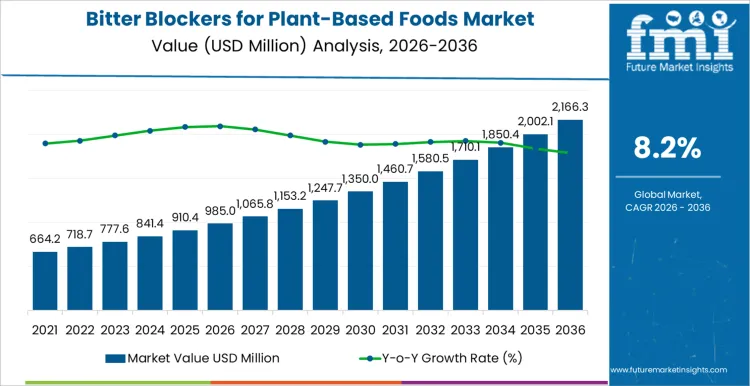
The bitter blockers for plant-based foods market is likely to reach USD 985.0 million in 2026 and reach USD 2,166.3 million by 2036 at 8.2% CAGR. Value behavior reflects structural taste correction needs embedded within plant protein processing rather than discretionary flavor enhancement. Legume and pulse proteins expose bitter peptides during isolation, extrusion, and fermentation, creating persistent sensory liabilities across meat analogs and dairy substitutes. Formulation budgets allocate spend toward receptor-level suppression where sweetness reduction and salt reduction limit traditional masking. Processing intensity magnifies bitterness variability, increasing reliance on standardized blocker systems to stabilize taste outcomes across batches and facilities.
Scaling patterns depend on regulatory acceptance, label strategy, and cost tolerance within mass plant-based portfolios. Clean label expectations restrict usable chemistries, narrowing supplier options and extending validation cycles. High protein inclusion rates reduce blocker efficacy ceilings, requiring multi-layer solutions that raise formulation cost. Geographic climate variation and distribution length influence dosage decisions, especially for frozen and shelf-stable products. Procurement favors suppliers offering protein-specific sensory data and rapid reformulation support, reinforcing concentration among technically integrated providers rather than broad commoditization. These constraints anchor demand in performance assurance rather than experimentation, shaping cautious adoption trajectories across mainstream categories over extended planning horizons.
Quick Stats for Bitter Blockers for Plant-Based Foods Market
- Bitter Blockers for Plant-Based Foods Market Value (2026): USD 985.0 million
- Bitter Blockers for Plant-Based Foods Market Forecast Value (2036): USD 2,166.3 million
- Bitter Blockers for Plant-Based Foods Market Forecast CAGR 2026 to 2036: 8.2%
- Leading Blocking Mechanism by Demand Share: Taste receptor blockers
- Fastest-Growing Countries: India, China, Brazil, USA, UK
- Top Players in Global Demand: Givaudan, IFF, Symrise, DSM-Firmenich, Sensient Technologies
Bitter Blockers for Plant-Based Foods Market Key Takeaways
| Metric | Value |
|---|---|
| Market Value (2026) | USD 985.0 million |
| Market Forecast Value (2036) | USD 2,166.3 million |
| Forecast CAGR 2026 to 2036 | 8.2% |
Why is the Demand for Bitter Blockers for Plant-Based Foods Market Growing?
Plant-based proteins and botanically derived ingredients often bring bitterness or astringent notes that influence consumer acceptance of alternative meat, dairy substitutes, and high-protein snacks. Bitter blockers are used to adjust flavor perception by interacting with taste receptors so that undesirable, sharp notes are reduced without adding sweetness or additional calories. Producers of pea, soy, and fava protein products integrate targeted bitter blocking compounds to improve palatability in burgers, sausages, yogurts, and beverage formats where underlying bitterness can otherwise dominate the sensory profile. High moisture extrusion, fermentation, and enzymatic treatments that enhance texture in plant formulations can expose or intensify bitter compounds. Application of bitter blockers helps maintain balanced taste in products positioned for mainstream adoption, supporting retention rates across repeated purchase occasions and diversified diet preferences.
Functional and fortified plant-based snacks and nutrition bars further boost demand as their ingredient matrices often include fiber, vitamins, or botanicals that carry flavor challenges. Ingredient technologists refine delivery systems and blocker efficacy across pH, temperature, and processing conditions typical of industrial food systems. Sensory teams conduct profiling to match specific blockers with target off-notes present in plant protein fractions. Clean label positioning and transparent ingredient communication influence selection, encouraging solutions that regulate bitter perception while aligning with consumer expectations for balanced flavor in plant-based foods.
How Is the Bitter Blockers for Plant-Based Foods Industry Segmented by Blocking Mechanism, Plant Protein Target, and Application?
Demand for bitter blockers in plant-based foods is shaped by increasing use of high-protein formulations and diversified botanical protein sources. Off-notes associated with legumes and pulses require targeted sensory management to maintain consumer acceptance. Ingredient selection reflects interaction with protein matrices, processing conditions, and label constraints. Segmentation by blocking mechanism, plant protein target, and application explains how bitterness mitigation strategies differ across product formats, protein sources, and formulation objectives within plant-based food development.
Which Blocking Mechanism Accounts for the Largest Share in Bitter Reduction Solutions?
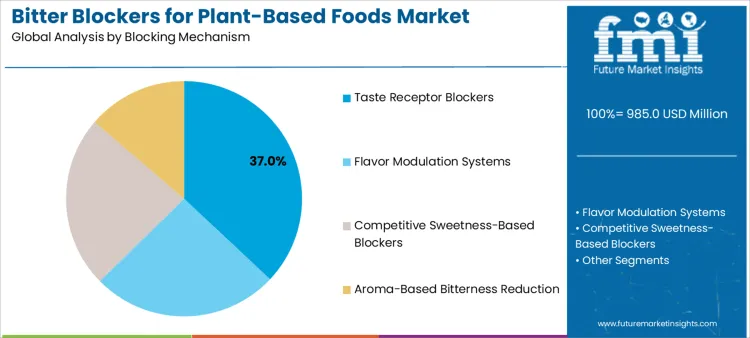
Taste receptor blockers hold 37.0%, driven by their direct interaction with human bitterness perception pathways. Flavor modulation systems account for 29.0%, supporting broader sensory balancing rather than direct receptor inhibition. Competitive sweetness-based blockers represent 19.0%, relying on sweetness perception to offset bitter notes without masking core flavors. Aroma-based bitterness reduction holds 15.0%, applied where volatile profile adjustment improves overall flavor acceptance. Blocking mechanism segmentation reflects differing formulation philosophies focused on sensory precision, ingredient interaction, and regulatory alignment.
Key Points
- Receptor blockers directly target bitterness perception.
- Modulation systems balance overall flavor profiles.
- Aroma approaches adjust volatile sensory cues.
How Do Plant Protein Targets Influence Bitter Blocker Utilization?
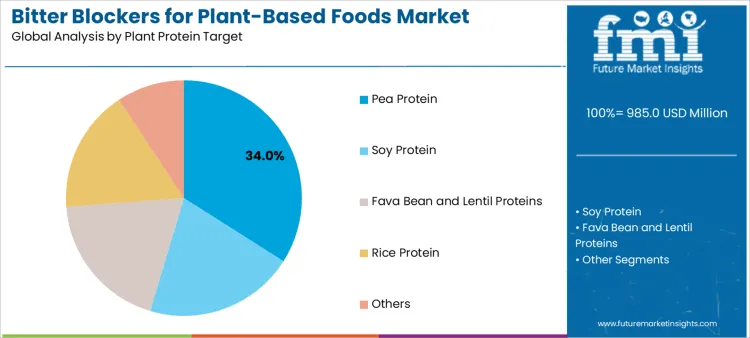
Pea protein accounts for 34.0%, reflecting its widespread use and inherent bitterness challenges in meat and beverage analogs. Soy protein represents 26.0%, where bitterness varies with processing and protein isolation methods. Fava bean and lentil proteins hold 18.0%, driven by diversification beyond soy and pea sources. Rice protein accounts for 12.0%, requiring milder bitterness control due to neutral baseline flavor. Other plant proteins represent 10.0%, covering emerging and blended protein sources. Protein target segmentation highlights variability in bitterness intensity and mitigation requirements.
Key Points
- Pea protein drives the highest bitterness management demand.
- Soy formulations require adaptable blocking strategies.
- Alternative legumes expand blocker application scope.
Which Applications Drive Adoption of Bitter Blockers in Plant-Based Foods?
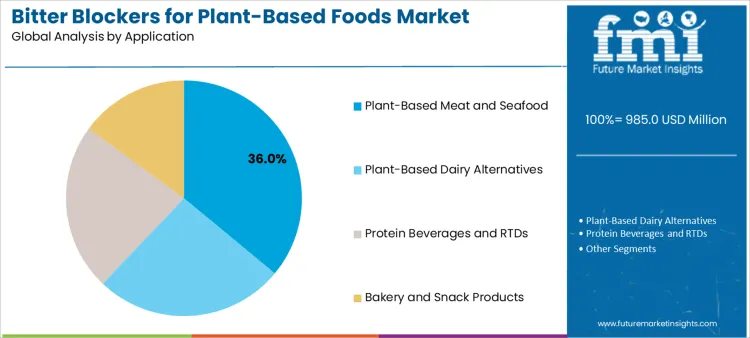
Plant-based meat and seafood applications represent 36.0%, where high protein loading amplifies bitterness perception. Plant-based dairy alternatives account for 28.0%, requiring clean taste profiles for repeat consumption. Protein beverages and RTDs hold 20.0%, emphasizing rapid flavor perception and aftertaste control. Bakery and snack products represent 16.0%, where bitterness emerges during thermal processing and storage. Application segmentation reflects how consumption format and protein concentration influence bitterness mitigation priorities.
Key Points
- Meat analogs require intensive bitterness control.
- Dairy alternatives emphasize clean, neutral taste.
- Beverages prioritize aftertaste management.
What are the Key Dynamics in the bitter blockers for plant-based foods market?
Demand in the bitter blockers for plant-based foods market is shaped by increasing consumer expectation for palatable meat and dairy alternatives that mask inherent off-notes from plant proteins, fibers, and bioactives. Formulators face specific sensory hurdles with pea, soy, fava bean, and lupin protein systems where bitter, beany, or green notes detract from expected flavor. Ingredient selection is performance-driven, emphasizing effective suppression of targeted bitter compounds without introducing sweetness or flavor distortion. Procurement decisions hinge on compatibility with pH, temperature, and processing conditions unique to each plant-based matrix.
How do plant protein sensory challenges and category expansion influence adoption?
In plant-based meat analogs, bitter blockers are critical to achieve a neutral base that supports subsequent flavor layering, particularly where thermomechanical extrusion exposes hydrophobic residues that elevate off-notes. Dairy alternatives such as plant milks and yogurts require agents that manage lingering bitterness when protein content is elevated to improve nutritional profiles. Snack bars and nutrition beverages with concentrated plant proteins depend on suppressing woody or nutty bitterness to maintain repeat purchase. Developers evaluate blocking systems under processing stresses, including high shear and heat treatments, to ensure taste stability throughout shelf life. As plant-based portfolios expand into adult nutrition, meal replacements, and savory applications, these sensory control ingredients become tools for maintaining consistency across formats.
What formulation boundaries and regulatory labeling demands affect market scalability?
Scalability is influenced by the functional limits of bitter blockers within complex food systems and by regional labeling requirements that influence ingredient declaration strategies. Certain blockers are less effective at very high protein concentrations or in the presence of polyphenols common to some plant sources, prompting iterative pairing with flavor carriers or masking blends that add formulation complexity. Regulatory treatment of sensory modifiers can vary, affecting how ingredients are presented on labels in key markets and shaping where brands can align with clean label positioning. Cost pressures emerge where multi-component solutions are required to balance bitterness suppression with texture and mouthfeel demands in plant-based foods, which influences deployment in mainstream versus premium segments. Sensory validation using trained panels adds time to development, especially where nuanced bitter profiles differ across protein types, influencing speed to market in a category driven by rapid innovation.
How Is Demand for the Bitter Blockers for Plant-Based Foods Market Evolving Globally?
Global demand for bitter blockers for plant-based foods is increasing as manufacturers expand meat alternatives, dairy substitutes, and protein-enriched products. Growth reflects rising use of pea, soy, fava, and pulse proteins that introduce bitterness and astringency. Sensory optimization becomes critical as sugar and salt reduction intensifies flavor challenges. Ingredient strategies prioritize bitterness suppression without muting desired taste notes. India records 9.2% CAGR, China records 8.9% CAGR, Brazil records 8.5% CAGR, USA records 7.1% CAGR, and UK records 6.8% CAGR. Adoption is driven by formulation precision needs and consumer acceptance thresholds rather than expansion of plant-based volumes alone.
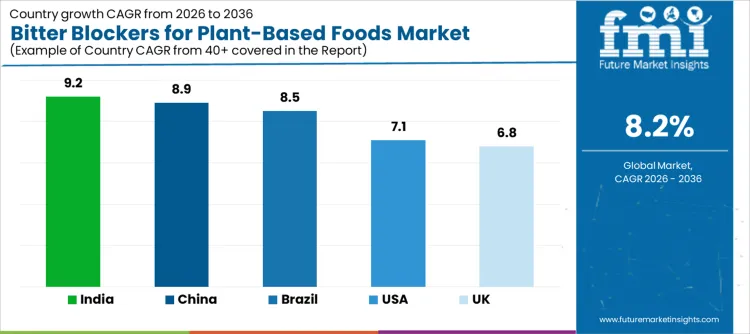
| Country | CAGR (%) |
|---|---|
| India | 9.2% |
| China | 8.9% |
| Brazil | 8.5% |
| USA | 7.1% |
| UK | 6.8% |
What is driving growth of bitter blockers for plant-based foods demand in India?
Demand for bitter blockers for plant-based foods in India is expanding as vegetarian and flexitarian product development accelerates. Growth at 9.2% CAGR reflects increased use of pea, chickpea, and soy proteins in meat analogs, beverages, and fortified snacks. Indigenous pulse proteins introduce pronounced bitterness requiring targeted blocking solutions. Cost sensitivity encourages blockers that work at low inclusion levels while preserving spice-forward flavor systems. Domestic processors prioritize compatibility with extrusion and high-temperature cooking. Demand remains concentrated within affordable plant-based foods positioned for urban consumption and quick-service applications.
- Expansion of pulse-based protein usage
- Growth of affordable meat analogs
- Need for bitterness suppression in extrusion
- Cost-efficient sensory correction systems
Why is China seeing expansion in bitter blockers for plant-based foods adoption?
Bitter blockers demand in China is rising as large-scale food processors expand plant-based meat and dairy alternatives. Growth at 8.9% CAGR reflects extensive use of soy, pea, and blended proteins creating bitterness and metallic notes. Industrial processing requires consistent sensory outcomes across high-volume production. Clean taste delivery becomes critical for mainstream consumer acceptance. Domestic ingredient suppliers scale bitterness suppression technologies aligned with beverage and meat analog applications. Demand centers on centralized manufacturing supplying national retail and foodservice channels.
- Large-scale plant-based protein processing
- Sensory consistency across production batches
- Growth of soy and pea protein applications
- Expansion of domestic ingredient capabilities
What factors are shaping bitter blockers for plant-based foods sales in Brazil?
Sales of bitter blockers for plant-based foods in Brazil are increasing as manufacturers reformulate products aligned with nutrition labeling and reduced salt strategies. Growth at 8.5% CAGR reflects rising plant-based burgers, sausages, and protein beverages. Tropical flavor profiles amplify bitterness perception when sugar levels decline. Producers focus on maintaining savory impact and mouthfeel without added sodium. Demand remains strongest in mass-market meat alternatives targeting price-sensitive consumers. Ingredient selection emphasizes stability under frozen and ambient storage.
- Reformulation of plant-based meat products
- Reduced salt driven bitterness challenges
- Preservation of savory flavor intensity
- Mass-market sensory acceptance focus
How is the USA supporting growth of bitter blockers for plant-based foods demand?
Bitter blockers for plant-based foods market demand in the USA is advancing as brands scale premium and mainstream alternatives. Growth at 7.1% CAGR reflects extensive use in plant-based meats, dairy substitutes, and protein snacks. High inclusion of pea and legume proteins introduces bitterness requiring precise sensory correction. Clean label positioning influences blocker selection. Large brands prioritize solutions that protect established flavor profiles across reformulated SKUs. Demand is driven by taste consistency and brand risk management rather than category expansion.
- Expansion of premium plant-based foods
- High usage of pea protein systems
- Clean label sensory correction needs
- Brand flavor consistency priorities
What is driving expansion of bitter blockers for plant-based foods demand in the UK?
Demand for bitter blockers for plant-based foods in the UK is rising as retailer standards and nutrition policies influence formulation strategies. Growth at 6.8% CAGR reflects reformulation of plant-based ready meals, dairy alternatives, and meat substitutes. Sugar and salt reduction increases reliance on bitterness suppression technologies. Retail acceptance benchmarks emphasize clean taste and minimal aftertaste. Ingredient selection prioritizes regulatory approval and label transparency. Demand remains linked to compliance-driven reformulation cycles rather than shifts in overall plant-based consumption.
- Retail sensory quality benchmarks
- Sugar and salt reduction reformulation
- Growth of plant-based ready meals
- Regulatory compliant ingredient selection
What is the competitive landscape of demand for the bitter blockers for plant-based foods market globally?
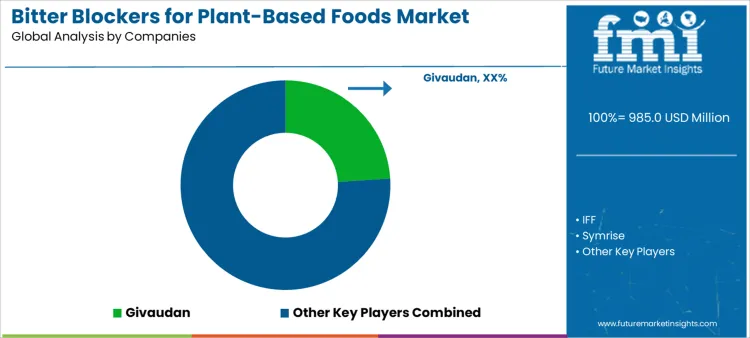
Plant protein expansion across meat alternatives, dairy substitutes, and nutrition products is driving demand for bitter blockers tailored to botanical sources. Formulators evaluate bitterness suppression against alkaloids and phenolics, effectiveness across pea, soy, fava, and oat bases, and stability during extrusion and thermal processing. Buyer assessment includes clean label feasibility, sensory neutrality, dosage efficiency, and consistency across batch variability. Procurement behavior reflects extended sensory testing, close collaboration with application teams, and preference for suppliers supporting rapid iteration. Trend in the bitter blockers for plant-based foods market reflects intensified reformulation to improve repeat consumption and brand acceptance.
Givaudan leads competitive positioning through plant-protein-specific bitter blocking platforms supported by advanced sensory analytics and application expertise. IFF competes by integrating bitterness suppression within broader taste modulation systems addressing sweetness, astringency, and aftertaste persistence. Symrise supports demand with targeted blockers optimized for legume-derived proteins and ready-to-eat formats. DSM-Firmenich maintains relevance through protein-centric flavor science combined with co-development support for alternative protein manufacturers. Sensient Technologies participates with scalable bitter blocking solutions emphasizing repeatable sensory performance across global production sites. Competitive differentiation centers on protein specificity, sensory effectiveness, customization speed, and depth of collaborative formulation support.
Key Players in the Bitter Blockers for Plant-Based Foods Market
- Givaudan
- IFF
- Symrise
- DSM-Firmenich
- Sensient Technologies
- Others
Scope of the Report
| Items | Values |
|---|---|
| Quantitative Units | USD million |
| Blocking Mechanism | Taste Receptor Blockers; Flavor Modulation Systems; Competitive Sweetness-Based Blockers; Aroma-Based Bitterness Reduction |
| Plant Protein Target | Pea Protein; Soy Protein; Fava Bean and Lentil Proteins; Rice Protein; Others |
| Application | Plant-Based Meat and Seafood; Plant-Based Dairy Alternatives; Protein Beverages and RTDs; Bakery and Snack Products |
| Regions Covered | Asia Pacific, Europe, North America, Latin America, Middle East & Africa |
| Countries Covered | India, China, Brazil, USA, UK, and 40+ countries |
| Key Companies Profiled | Givaudan; IFF; Symrise; DSM-Firmenich; Sensient Technologies; Others |
| Additional Attributes | Dollar sales by blocking mechanism, plant protein target, and application; effectiveness in suppressing bitterness, astringency, and green notes associated with legume and cereal proteins; performance of receptor blockers and aroma-based systems under heat and shear processing; compatibility with high-protein formulations in meat analogues and RTDs; clean-label and regulatory considerations influencing adoption; procurement dynamics driven by rapid expansion of plant-based food portfolios and long-term collaboration with global flavor houses. |
Bitter Blockers for Plant-Based Foods Market by Segment
Blocking Mechanism:
- Taste Receptor Blockers
- Flavor Modulation Systems
- Competitive Sweetness-Based Blockers
- Aroma-Based Bitterness Reduction
Plant Protein Target:
- Pea Protein
- Soy Protein
- Fava Bean and Lentil Proteins
- Rice Protein
- Others
Application:
- Plant-Based Meat and Seafood
- Plant-Based Dairy Alternatives
- Protein Beverages and RTDs
- Bakery and Snack Products
Region:
- Asia Pacific
- China
- Japan
- South Korea
- India
- Australia & New Zealand
- ASEAN
- Rest of Asia Pacific
- Europe
- Germany
- United Kingdom
- France
- Italy
- Spain
- Nordic
- BENELUX
- Rest of Europe
- North America
- United States
- Canada
- Mexico
- Latin America
- Brazil
- Chile
- Rest of Latin America
- Middle East & Africa
- Kingdom of Saudi Arabia
- Other GCC Countries
- Turkey
- South Africa
- Other African Union
- Rest of Middle East & Africa
Bibliography
- Food and Agriculture Organization of the United Nations. (2023). Plant-based protein ingredients: Sensory challenges and mitigation strategies. FAO Food and Nutrition Paper.
- International Organization for Standardization. (2023). ISO 13301: Sensory analysis - Methodology for measuring bitterness and aftertaste in food products (current edition). ISO.
- McClements, D. J. (2023). Improving palatability of plant-based foods: Flavor masking and taste modulation strategies. Food Research International, 168, 112780.
- Roland, W. S. U., Vincken, J.-P., & Gruppen, H. (2023). Bitter taste receptors and bitter-blocking strategies in food applications. Trends in Food Science & Technology, 134, 1-12.
- Roudnitzky, N., Behrens, M., Engel, A., & Meyerhof, W. (2024). Modulation of human bitter taste perception by receptor-level inhibitors. Chemical Senses, 49(2), bjae004.
- Zhang, Y., Li, S., & Huang, X. (2024). Sensory challenges of legume-derived proteins and approaches for bitterness reduction. Journal of Food Science, 89(1), 145-158.
Frequently Asked Questions
How big is the bitter blockers for plant-based foods market in 2026?
The global bitter blockers for plant-based foods market is estimated to be valued at USD 985.0 million in 2026.
What will be the size of bitter blockers for plant-based foods market in 2036?
The market size for the bitter blockers for plant-based foods market is projected to reach USD 2,166.3 million by 2036.
How much will be the bitter blockers for plant-based foods market growth between 2026 and 2036?
The bitter blockers for plant-based foods market is expected to grow at a 8.2% CAGR between 2026 and 2036.
What are the key product types in the bitter blockers for plant-based foods market?
The key product types in bitter blockers for plant-based foods market are taste receptor blockers, flavor modulation systems, competitive sweetness-based blockers and aroma-based bitterness reduction.
Which plant protein target segment to contribute significant share in the bitter blockers for plant-based foods market in 2026?
In terms of plant protein target, pea protein segment to command 34.0% share in the bitter blockers for plant-based foods market in 2026.
Preview the report firsthand - request a free sample
Get SampleGet the brochure for pricing and purchase details.
Get PDFTable of Content
- Executive Summary
- Global Market Outlook
- Demand-side Trends
- Supply-side Trends
- Technology Roadmap Analysis
- Analysis and Recommendations
- Market Overview
- Market Coverage / Taxonomy
- Market Definition / Scope / Limitations
- Market Background
- Market Dynamics
- Drivers
- Restraints
- Opportunity
- Trends
- Scenario Forecast
- Demand in Optimistic Scenario
- Demand in Likely Scenario
- Demand in Conservative Scenario
- Opportunity Map Analysis
- Product Life Cycle Analysis
- Supply Chain Analysis
- Investment Feasibility Matrix
- Value Chain Analysis
- PESTLE and Porter’s Analysis
- Regulatory Landscape
- Regional Parent Market Outlook
- Production and Consumption Statistics
- Import and Export Statistics
- Market Dynamics
- Global Market Analysis 2021 to 2025 and Forecast, 2026 to 2036
- Historical Market Size Value (USD Million) Analysis, 2021 to 2025
- Current and Future Market Size Value (USD Million) Projections, 2026 to 2036
- Y-o-Y Growth Trend Analysis
- Absolute $ Opportunity Analysis
- Global Market Pricing Analysis 2021 to 2025 and Forecast 2026 to 2036
- Global Market Analysis 2021 to 2025 and Forecast 2026 to 2036, By Blocking Mechanism
- Introduction / Key Findings
- Historical Market Size Value (USD Million) Analysis By Blocking Mechanism , 2021 to 2025
- Current and Future Market Size Value (USD Million) Analysis and Forecast By Blocking Mechanism , 2026 to 2036
- Taste Receptor Blockers
- Flavor Modulation Systems
- Competitive Sweetness-Based Blockers
- Aroma-Based Bitterness Reduction
- Taste Receptor Blockers
- Y-o-Y Growth Trend Analysis By Blocking Mechanism , 2021 to 2025
- Absolute $ Opportunity Analysis By Blocking Mechanism , 2026 to 2036
- Global Market Analysis 2021 to 2025 and Forecast 2026 to 2036, By Plant Protein Target
- Introduction / Key Findings
- Historical Market Size Value (USD Million) Analysis By Plant Protein Target, 2021 to 2025
- Current and Future Market Size Value (USD Million) Analysis and Forecast By Plant Protein Target, 2026 to 2036
- Pea Protein
- Soy Protein
- Fava Bean and Lentil Proteins
- Rice Protein
- Others
- Pea Protein
- Y-o-Y Growth Trend Analysis By Plant Protein Target, 2021 to 2025
- Absolute $ Opportunity Analysis By Plant Protein Target, 2026 to 2036
- Global Market Analysis 2021 to 2025 and Forecast 2026 to 2036, By Application
- Introduction / Key Findings
- Historical Market Size Value (USD Million) Analysis By Application, 2021 to 2025
- Current and Future Market Size Value (USD Million) Analysis and Forecast By Application, 2026 to 2036
- Plant-Based Meat and Seafood
- Plant-Based Dairy Alternatives
- Protein Beverages and RTDs
- Bakery and Snack Products
- Plant-Based Meat and Seafood
- Y-o-Y Growth Trend Analysis By Application, 2021 to 2025
- Absolute $ Opportunity Analysis By Application, 2026 to 2036
- Global Market Analysis 2021 to 2025 and Forecast 2026 to 2036, By Region
- Introduction
- Historical Market Size Value (USD Million) Analysis By Region, 2021 to 2025
- Current Market Size Value (USD Million) Analysis and Forecast By Region, 2026 to 2036
- North America
- Latin America
- Western Europe
- Eastern Europe
- East Asia
- South Asia and Pacific
- Middle East & Africa
- Market Attractiveness Analysis By Region
- North America Market Analysis 2021 to 2025 and Forecast 2026 to 2036, By Country
- Historical Market Size Value (USD Million) Trend Analysis By Market Taxonomy, 2021 to 2025
- Market Size Value (USD Million) Forecast By Market Taxonomy, 2026 to 2036
- By Country
- USA
- Canada
- Mexico
- By Blocking Mechanism
- By Plant Protein Target
- By Application
- By Country
- Market Attractiveness Analysis
- By Country
- By Blocking Mechanism
- By Plant Protein Target
- By Application
- Key Takeaways
- Latin America Market Analysis 2021 to 2025 and Forecast 2026 to 2036, By Country
- Historical Market Size Value (USD Million) Trend Analysis By Market Taxonomy, 2021 to 2025
- Market Size Value (USD Million) Forecast By Market Taxonomy, 2026 to 2036
- By Country
- Brazil
- Chile
- Rest of Latin America
- By Blocking Mechanism
- By Plant Protein Target
- By Application
- By Country
- Market Attractiveness Analysis
- By Country
- By Blocking Mechanism
- By Plant Protein Target
- By Application
- Key Takeaways
- Western Europe Market Analysis 2021 to 2025 and Forecast 2026 to 2036, By Country
- Historical Market Size Value (USD Million) Trend Analysis By Market Taxonomy, 2021 to 2025
- Market Size Value (USD Million) Forecast By Market Taxonomy, 2026 to 2036
- By Country
- Germany
- UK
- Italy
- Spain
- France
- Nordic
- BENELUX
- Rest of Western Europe
- By Blocking Mechanism
- By Plant Protein Target
- By Application
- By Country
- Market Attractiveness Analysis
- By Country
- By Blocking Mechanism
- By Plant Protein Target
- By Application
- Key Takeaways
- Eastern Europe Market Analysis 2021 to 2025 and Forecast 2026 to 2036, By Country
- Historical Market Size Value (USD Million) Trend Analysis By Market Taxonomy, 2021 to 2025
- Market Size Value (USD Million) Forecast By Market Taxonomy, 2026 to 2036
- By Country
- Russia
- Poland
- Hungary
- Balkan & Baltic
- Rest of Eastern Europe
- By Blocking Mechanism
- By Plant Protein Target
- By Application
- By Country
- Market Attractiveness Analysis
- By Country
- By Blocking Mechanism
- By Plant Protein Target
- By Application
- Key Takeaways
- East Asia Market Analysis 2021 to 2025 and Forecast 2026 to 2036, By Country
- Historical Market Size Value (USD Million) Trend Analysis By Market Taxonomy, 2021 to 2025
- Market Size Value (USD Million) Forecast By Market Taxonomy, 2026 to 2036
- By Country
- China
- Japan
- South Korea
- By Blocking Mechanism
- By Plant Protein Target
- By Application
- By Country
- Market Attractiveness Analysis
- By Country
- By Blocking Mechanism
- By Plant Protein Target
- By Application
- Key Takeaways
- South Asia and Pacific Market Analysis 2021 to 2025 and Forecast 2026 to 2036, By Country
- Historical Market Size Value (USD Million) Trend Analysis By Market Taxonomy, 2021 to 2025
- Market Size Value (USD Million) Forecast By Market Taxonomy, 2026 to 2036
- By Country
- India
- ASEAN
- Australia & New Zealand
- Rest of South Asia and Pacific
- By Blocking Mechanism
- By Plant Protein Target
- By Application
- By Country
- Market Attractiveness Analysis
- By Country
- By Blocking Mechanism
- By Plant Protein Target
- By Application
- Key Takeaways
- Middle East & Africa Market Analysis 2021 to 2025 and Forecast 2026 to 2036, By Country
- Historical Market Size Value (USD Million) Trend Analysis By Market Taxonomy, 2021 to 2025
- Market Size Value (USD Million) Forecast By Market Taxonomy, 2026 to 2036
- By Country
- Kingdom of Saudi Arabia
- Other GCC Countries
- Turkiye
- South Africa
- Other African Union
- Rest of Middle East & Africa
- By Blocking Mechanism
- By Plant Protein Target
- By Application
- By Country
- Market Attractiveness Analysis
- By Country
- By Blocking Mechanism
- By Plant Protein Target
- By Application
- Key Takeaways
- Key Countries Market Analysis
- USA
- Pricing Analysis
- Market Share Analysis, 2025
- By Blocking Mechanism
- By Plant Protein Target
- By Application
- Canada
- Pricing Analysis
- Market Share Analysis, 2025
- By Blocking Mechanism
- By Plant Protein Target
- By Application
- Mexico
- Pricing Analysis
- Market Share Analysis, 2025
- By Blocking Mechanism
- By Plant Protein Target
- By Application
- Brazil
- Pricing Analysis
- Market Share Analysis, 2025
- By Blocking Mechanism
- By Plant Protein Target
- By Application
- Chile
- Pricing Analysis
- Market Share Analysis, 2025
- By Blocking Mechanism
- By Plant Protein Target
- By Application
- Germany
- Pricing Analysis
- Market Share Analysis, 2025
- By Blocking Mechanism
- By Plant Protein Target
- By Application
- UK
- Pricing Analysis
- Market Share Analysis, 2025
- By Blocking Mechanism
- By Plant Protein Target
- By Application
- Italy
- Pricing Analysis
- Market Share Analysis, 2025
- By Blocking Mechanism
- By Plant Protein Target
- By Application
- Spain
- Pricing Analysis
- Market Share Analysis, 2025
- By Blocking Mechanism
- By Plant Protein Target
- By Application
- France
- Pricing Analysis
- Market Share Analysis, 2025
- By Blocking Mechanism
- By Plant Protein Target
- By Application
- India
- Pricing Analysis
- Market Share Analysis, 2025
- By Blocking Mechanism
- By Plant Protein Target
- By Application
- ASEAN
- Pricing Analysis
- Market Share Analysis, 2025
- By Blocking Mechanism
- By Plant Protein Target
- By Application
- Australia & New Zealand
- Pricing Analysis
- Market Share Analysis, 2025
- By Blocking Mechanism
- By Plant Protein Target
- By Application
- China
- Pricing Analysis
- Market Share Analysis, 2025
- By Blocking Mechanism
- By Plant Protein Target
- By Application
- Japan
- Pricing Analysis
- Market Share Analysis, 2025
- By Blocking Mechanism
- By Plant Protein Target
- By Application
- South Korea
- Pricing Analysis
- Market Share Analysis, 2025
- By Blocking Mechanism
- By Plant Protein Target
- By Application
- Russia
- Pricing Analysis
- Market Share Analysis, 2025
- By Blocking Mechanism
- By Plant Protein Target
- By Application
- Poland
- Pricing Analysis
- Market Share Analysis, 2025
- By Blocking Mechanism
- By Plant Protein Target
- By Application
- Hungary
- Pricing Analysis
- Market Share Analysis, 2025
- By Blocking Mechanism
- By Plant Protein Target
- By Application
- Kingdom of Saudi Arabia
- Pricing Analysis
- Market Share Analysis, 2025
- By Blocking Mechanism
- By Plant Protein Target
- By Application
- Turkiye
- Pricing Analysis
- Market Share Analysis, 2025
- By Blocking Mechanism
- By Plant Protein Target
- By Application
- South Africa
- Pricing Analysis
- Market Share Analysis, 2025
- By Blocking Mechanism
- By Plant Protein Target
- By Application
- USA
- Market Structure Analysis
- Competition Dashboard
- Competition Benchmarking
- Market Share Analysis of Top Players
- By Regional
- By Blocking Mechanism
- By Plant Protein Target
- By Application
- Competition Analysis
- Competition Deep Dive
- Givaudan
- Overview
- Product Portfolio
- Profitability by Market Segments (Product/Age /Sales Channel/Region)
- Sales Footprint
- Strategy Overview
- Marketing Strategy
- Product Strategy
- Channel Strategy
- IFF
- Symrise
- DSM-Firmenich
- Sensient Technologies
- Others
- Givaudan
- Competition Deep Dive
- Assumptions & Acronyms Used
- Research Methodology


