

- Industry Size (2026)
- USD 310.7 Mn
- Forecast (2036)
- USD 577.8 Mn
- CAGR (2026 to 2036)
- 6.4%
Central Vacuum Receivers Market Size, Market Forecast and Outlook By FMI
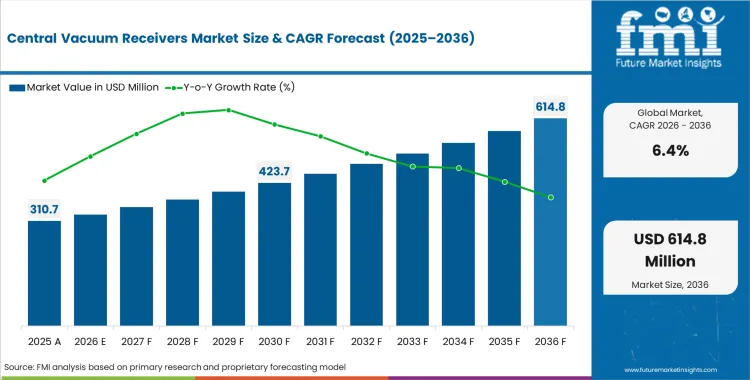
The central vacuum receivers market recorded a valuation of USD 292.0 million in 2025 and is projected to reach USD 310.7 million in 2026. Industry is expected to expand at a CAGR of 6.4% during 2026 to 2036, with total valuation projected at USD 577.8 million by 2036. Demand is supported by the shift toward centralized material handling systems in plastics and compounding operations where contamination control and dust management are critical.
Summary of Central Vacuum Receivers Market
- The market is estimated at USD 292.0 million in 2025.
- The market is projected to reach USD 577.8 million by 2036.
- The market is expected to grow at a CAGR of 6.4% from 2026 to 2036.
- The forecast period represents an incremental opportunity of USD 267.1 million.
- Filter-based receivers lead the type segment with a 42.0% share.
- 50-150 L systems dominate the capacity segment with a 46.0% share.
- Plastics processing leads the end-use segment with a 41.0% share.
- Machine-mounted configurations lead the installation segment with a 57.0% share.
- Food and pharmaceutical applications are key supporting end-use segments.
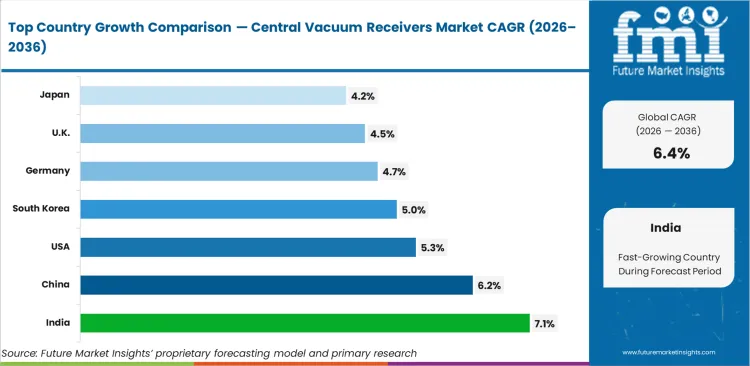
- India (7.1%), China (6.2%), and the United States (5.3%) are among the fastest-growing markets.
Air quality regulations and handling requirements are increasing the use of enclosed conveying systems. Open or semi-automated loading methods generate dust emissions and reduce material consistency during transfer. Central vacuum receivers improve containment and support uniform blending by minimizing segregation during movement. Facilities processing regrind or mixed materials benefit from controlled transfer conditions that maintain product quality.
System design changes become necessary as production complexity increases. Operations handling multiple resin streams require centralized routing to maintain continuous feed without congestion. Machine-mounted loaders limit scalability and increase floor-level complexity in multi-line setups. Centralized receiver networks support higher throughput and more efficient space utilization. Transition decisions are often triggered when multiple materials are processed simultaneously.
India is estimated to record a CAGR of 7.1% in the central vacuum receivers market during 2026 to 2036, supported by expansion in contract compounding and export-oriented production. China is projected to grow at 6.2%, driven by increased molding capacity in industrial applications. The United States is expected to register 5.3%, reflecting upgrades in existing facilities. South Korea is anticipated to grow at 5.0%, followed by Germany at 4.7%, the United Kingdom at 4.5%, and Japan at 4.2% over the forecast period. Regional trends reflect new installations in emerging markets and system upgrades in established manufacturing hubs.
Segmental Analysis
Central Vacuum Receivers Market Analysis by Receiver Type
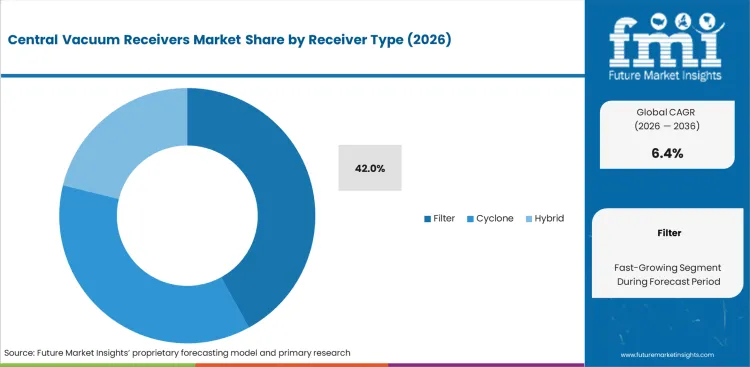
Handling fine powders and recycled materials requires containment systems that prevent dust escape and maintain airflow stability. Filter receivers dominate due to their ability to capture particulates while sustaining continuous operation. Self-cleaning mechanisms improve system reliability by reducing manual intervention frequency. Filter receivers hold an estimated 42.0% share of the central vacuum receivers market in 2026. Increasing use of regrind materials introduces additional filtration demands, as particle variability affects performance. System efficiency depends on maintaining consistent airflow without blockage, especially in automated processing environments where downtime disrupts entire production sequences.
- Filter blinding prevention: Self-cleaning pulse-jet mechanisms blast compressed air through the filter media between loading cycles. Plant engineering heads avoid the vacuum loss associated with saturated screens.
- Abrasive wear vulnerability: Handling sharp post-consumer regrind gradually degrades the internal mesh despite automatic cleaning. Maintenance supervisors must schedule routine inspections to prevent compromised screens from passing dust to the central pump.
- Total lifecycle retention: Integrating transparent polyamide bodies allows visual confirmation of filter health during operation. Operations managers capture full equipment value by identifying blockages before they trigger a system-wide fault.
Central Vacuum Receivers Market Analysis by Capacity
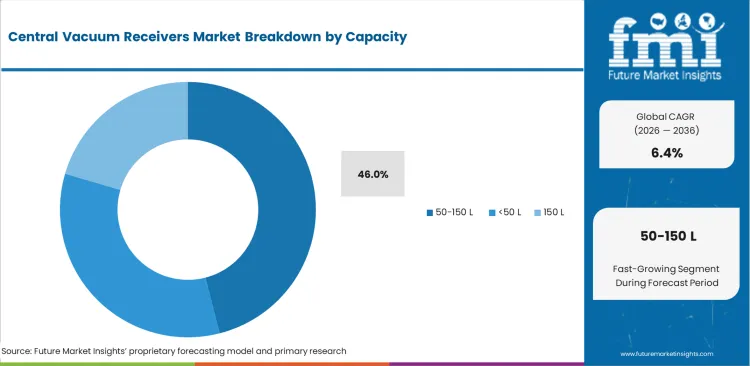
Sizing of vacuum receivers depends on alignment with batch delivery requirements of downstream equipment. Capacity selection is linked to how material is fed into processing units such as injection molding machines and blenders. Systems in the 50-150 L range are commonly configured to deliver controlled quantities directly into machine hoppers without causing material hold-up or overheating. Proper sizing supports consistent feed timing and reduces the risk of resin degradation during processing. The 50-150 L segment is expected to account for 46.0% share, reflecting its fit with typical batch sizes used in compounding and molding operations. Matching receiver capacity with blender batch size helps maintain material uniformity and prevents segregation during holding. Oversizing can create flow issues, including bridging in lightweight materials, while also increasing space requirements. Capacity selection is therefore driven by batch precision and process stability rather than throughput alone.
- Batch alignment savings: Matching the receiver volume to the gravimetric blender cycle prevents material starvation. Procurement directors eliminate the hidden costs of scrapped, off-spec parts caused by inconsistent resin feeding.
- Vertical clearance constraints: Oversized receivers demand significant headroom above the processing machinery. Engineering teams often discover this hidden cost only when forced to modify expensive overhead crane pathways.
- Energy optimization reality: Right-sizing the receiver minimizes the required vacuum generation cycle time. Facility managers who implement exact-match capacities drastically reduce the electrical load on the central pump station.
Central Vacuum Receivers Market Analysis by End Use
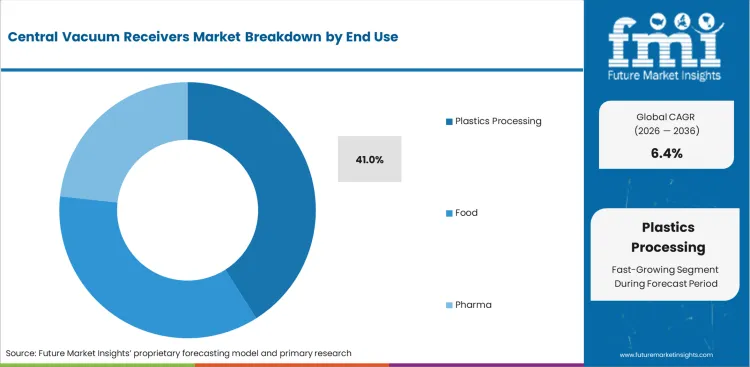
Complex material handling requirements drive adoption across plastics processing environments where multiple resin types are used simultaneously. Automated conveying systems reduce manual handling and improve operational consistency. Plastics processing accounts for an estimated 41.0% share of central vacuum receiver demand in 2026. Increased use of specialty additives introduces challenges related to flowability and clogging within pneumatic lines. System upgrades focus on improving handling of low-melting or cohesive materials. Operational flexibility becomes essential as production shifts toward smaller batch sizes with varied formulations.
- Early automated adopters: High-volume commodity plastic compounders pioneered centralized receivers to reduce forklift traffic. Operations managers immediately gained floor space and eliminated massive dust generation.
- Cleanroom standard followers: Medical device molders subsequently adopted transparent, tool-less receivers to meet ISO certification. Quality control heads rely on these units to guarantee zero cross-contamination between medical-grade runs.
- Specialty additive laggards: Facilities handling highly cohesive, low-melting powders are the last to convert. Formulation officers finally adopt hybrid receivers when internal bridge-breaking agitation mechanisms prove capable of handling these difficult ingredients.
Central Vacuum Receivers Market Analysis by Mounting
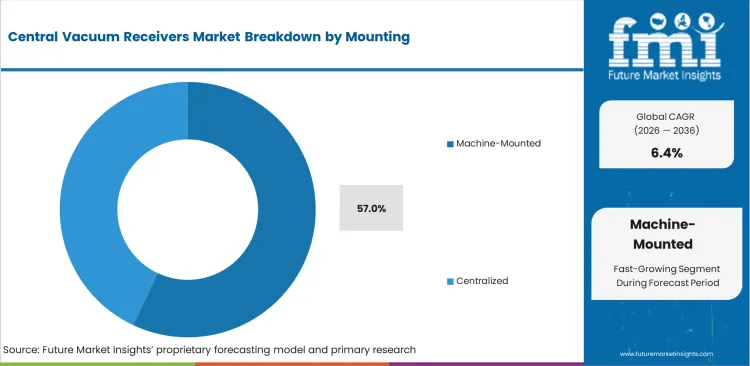
A sharp contradiction exists between the theoretical efficiency of central floor-mounted receivers and the physical layout of older manufacturing sites. This space limitation is likely to reach 57.0% share in 2026. Maintenance supervisors strongly favor mounting the receiver directly on the machine throat to minimize the distance material must travel after separation. Directly feeding the process equipment eliminates the need for secondary gravity piping, reducing the risk of static build-up in corrugated plastic trays and clear plastic boxes packaging lines.
A detail frequently missed by modernization consultants is that while centralized floor setups are theoretically more efficient, facility height restrictions and the reluctance to redesign overhead catwalks keep machine-mounted units dominant in legacy plants. Facility planners who force centralized ground mounting in cramped legacy buildings face severe routing bottlenecks and constant material bridging in the extended drop tubes.
- Direct feed efficiency: Throat-mounted receivers eliminate the need for intermediate holding bins. Molding supervisors achieve superior resin temperature control by minimizing the time material spends outside the dryer.
- Vibration fatigue limits: Mounting heavy, stainless-steel receivers directly on rapidly cycling machinery introduces intense mechanical stress. Maintenance engineers constantly monitor mounting flanges to prevent vacuum leaks caused by harmonic vibration.
- Cleanout speed standards: Acceptable machine-mounted units require quick-release latches accessible from a ladder. Operators demand designs that drop the discharge cone entirely for rapid wipe-downs during aggressive color changes.
Central Vacuum Receivers Market Drivers, Restraints, and Opportunities
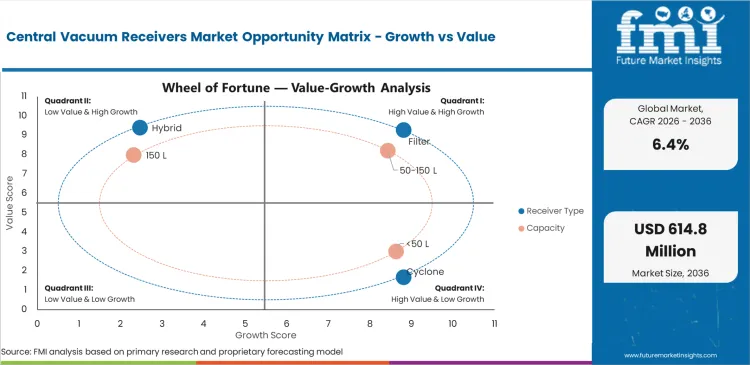
Combustible dust regulations and indoor air quality standards are accelerating the shift toward enclosed conveying systems. Open pneumatic loaders increase exposure to airborne particles and raise compliance risk during inspections. Central vacuum receivers support containment by directing dust into controlled filtration systems instead of allowing accumulation on equipment. Facilities handling abrasive or fine materials increasingly replace open systems to maintain operational compliance and reduce safety exposure.
Installation challenges arise when integrating centralized systems into existing plant layouts. Limited vertical clearance in older facilities restricts placement of receivers above processing equipment. Structural modifications such as mezzanine platforms or support frames are often required, extending deployment timelines. Low-profile receiver designs address height constraints but may reduce holding capacity, affecting batch consistency. System design therefore involves balancing spatial limitations with material flow requirements to maintain stable processing operations.
Opportunities in the Central Vacuum Receivers Market
- Transparent body integration: Polyamide and borosilicate glass receiver bodies allow immediate visual inspection of material flow. Quality control heads gain the ability to spot color-change contamination instantly without breaking the vacuum seal.
- Data-linked traceability: Connecting receiver fill-level sensors directly to plant-wide material passport systems for circular plastics provides unalterable audit trails. Procurement directors leverage this granular tracking to certify recycled content percentages for packaging clients.
- Bridge-breaking agitators: Adding pneumatic or mechanical agitation to the discharge cone prevents cohesive flakes from rat-holing. Operations managers unlock the ability to smoothly process notoriously difficult regrind without constant manual hammering on the receiver body.
Regional Analysis
Based on regional analysis, Central Vacuum Receivers Market is segmented into North America, Latin America, Western Europe, Eastern Europe, Asia Pacific, Middle East, and Africa across 40 plus countries.
.webp "Top Country Growth Comparison Central Vacuum Receivers Market Cagr (2026 2036)")
| Country | CAGR (2026 to 2036) |
|---|---|
| India | 7.1% |
| China | 6.2% |
| USA | 5.3% |
| South Korea | 5.0% |
| Germany | 4.7% |
| UK | 4.5% |
| Japan | 4.2% |
Source: Future Market Insights (FMI) analysis, based on proprietary forecasting model and primary research
North America Central Vacuum Receivers Market Analysis
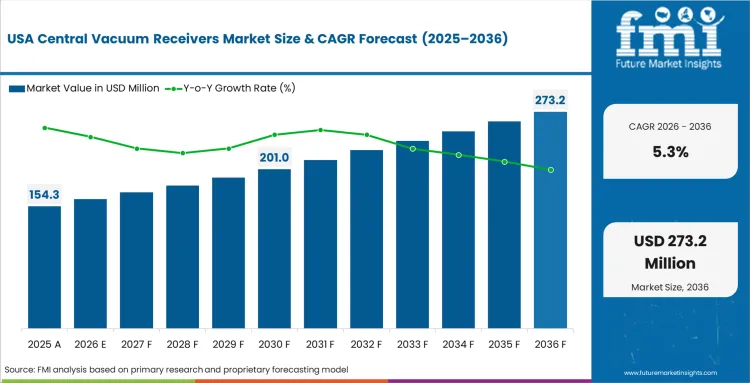
Aging domestic manufacturing infrastructure forces USA plant operators to aggressively modernize their auxiliary equipment to remain competitive against highly automated offshore facilities. In FMI's view, this wave of retrofitting prioritizes smart, sensor-equipped vacuum receivers that integrate flawlessly with legacy extrusion and molding lines.
- USA: The central vacuum receivers market in the United States is estimated to grow at a CAGR of 5.3% during the forecast period. Strict enforcement around airborne particulate control accelerates replacement of decentralized loaders with sealed conveying networks across plastics processing operations. Retrofitting strategies focus on minimizing disruption while improving system efficiency. Compatibility with existing extrusion and molding lines remains critical. Continuous operation requirements push demand toward systems that maintain consistent vacuum stability under fluctuating load conditions across high-throughput industrial environments.
Asia Pacific Central Vacuum Receivers Market Analysis
Rapid industrialization and the establishment of massive, purpose-built manufacturing hubs define the conveying equipment landscape across this region. Facility planners design these new mega-plants with centralized vacuum architectures from day one, completely bypassing the standalone hopper loader phase.
- India: Expansion of contract manufacturing clusters is reshaping material handling priorities across India. The central vacuum receivers market in India is expected to register a 7.1% CAGR over the forecast timeline. Export-oriented operations require strict contamination control, driving direct adoption of centralized conveying infrastructure. Facility design increasingly incorporates automated resin transfer systems from initial planning stages. Foreign investment flows reinforce adoption of standardized equipment configurations aligned with international production benchmarks across high-growth polymer processing zones requiring uninterrupted throughput.
- China: High-volume industrial capacity expansion continues to strengthen demand for centralized vacuum receivers across China. Continuous production lines require uninterrupted material flow, pushing adoption of high-throughput conveying systems. China is projected to expand at a CAGR of 6.2% in central vacuum receivers market during the study period. Advanced automation reduces dependency on manual handling while improving operational efficiency. System scalability supports integration across expanding manufacturing clusters operating near peak capacity.
- Japan: Japan is estimated to record a CAGR of 4.2% in the central vacuum receivers market during 2026 to 2036, supported by increasing automation across labor-constrained manufacturing environments. Reliability remains a key factor in equipment selection within precision-driven facilities. Compact receiver designs enable installation in space-limited layouts, while long service life supports stable operation with lower maintenance requirements.
- South Korea: Competitive manufacturing environments require rapid material changeovers across production cycles in South Korea. Flexibility in conveying systems becomes essential in supporting multi-material workflows. The market in South Korea is likely to reach 5.0% growth rate during the forecast period. Transparent receiver configurations improve operational visibility. Quick-clean designs reduce downtime, enabling efficient switching across high-frequency production sequences without compromising material integrity.
Western Europe Central Vacuum Receivers Market Analysis
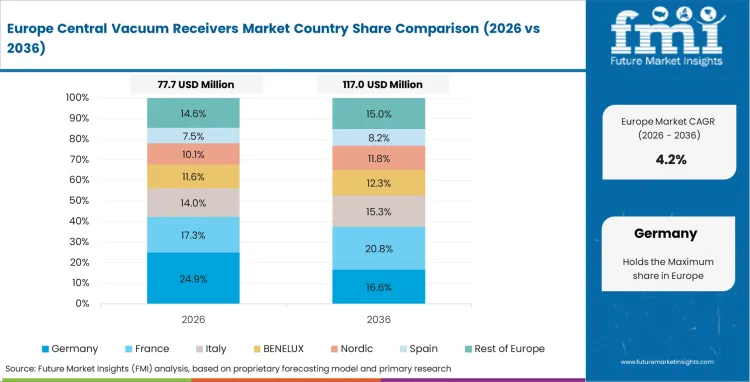
Rigid environmental directives and strict energy-consumption targets dictate equipment selection across European manufacturing floors. FMI analysts note that engineering teams evaluate vacuum receivers not just on throughput, but on their ability to maintain optimal vacuum seals and prevent energy waste at the central pump.
- Germany: Integration of Industry 4.0 systems continues to reshape equipment selection across compounding operations, increasing demand for vacuum receivers equipped with ethernet-linked demand sensors. Real-time connectivity enables synchronization with central control systems, ensuring vacuum activation aligns precisely with material requirements. Performance progression reflects a 4.7% CAGR over the forecast period. Intelligent receiver systems increasingly function as active components within automated production networks. This shift enhances process efficiency while supporting continuous monitoring, reinforcing the transition toward data-driven material handling across high-performance industrial environments.
- UK: Sustainability-driven material transitions are redefining equipment requirements across processing facilities, particularly with increased use of abrasive recycled inputs. Reinforced receiver structures become essential to withstand continuous exposure to post-consumer flakes without operational degradation. Expansion in market remains close to 4.5% CAGR during the forecast timeline, supported by wider integration of recycled materials across production lines. Durable construction improves lifecycle performance under demanding conditions. Reliable handling capability strengthens operational consistency while enabling manufacturers to meet environmental targets without compromising throughput across circular production systems..
FMI's report includes extensive analysis of emerging auxiliary equipment adoption across Latin America and the Middle East. Specialized applications in medical tubing extrusion are forcing these emerging regions to adopt filter-less, medical-grade receivers faster than broad industrial metrics suggest.
Competitive Aligners for Market Players
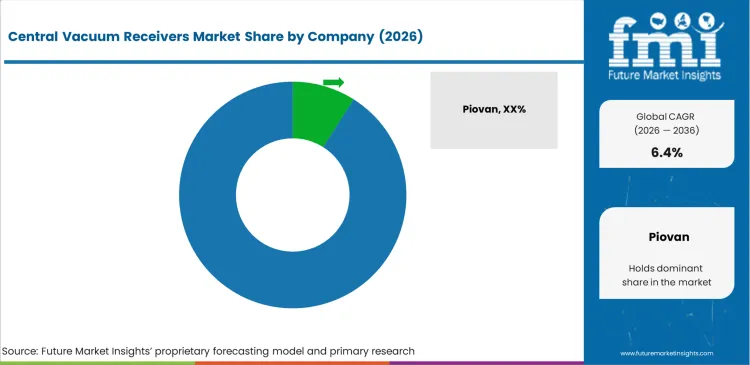
System integration capability defines competitive positioning in centralized conveying environments. End users favor receiver designs that connect easily with existing plant automation systems without requiring dedicated controllers. Suppliers such as Piovan and Conair strengthen adoption by offering control interfaces that support quick commissioning and automatic recognition of added receiver units. Compatibility with existing infrastructure often outweighs incremental performance differences in suction or throughput.
Engineering expertise in material flow behavior remains a key differentiator. Companies such as motan and WITTMANN develop receiver geometries based on extensive experience with difficult materials, including glass-filled resins and high-temperature flakes. Internal design elements such as cone angles and discharge mechanisms are optimized to prevent bridging and ensure consistent flow. Replicating this level of performance requires long-term testing across multiple material types and processing conditions.
Large processing groups increasingly specify interoperability across conveying systems. Standard flange dimensions and open communication protocols allow mixing of equipment from suppliers such as Maguire and Shini within a single plant. This approach reduces dependency on a single supplier and simplifies future upgrades. As a result, competition shifts toward mechanical performance, ease of maintenance, and cleaning efficiency rather than reliance on proprietary control systems.
Key Players in Central Vacuum Receivers Market
- Piovan
- Conair
- motan
- WITTMANN
- Maguire
- Shini
- Matsui
Scope of the Report
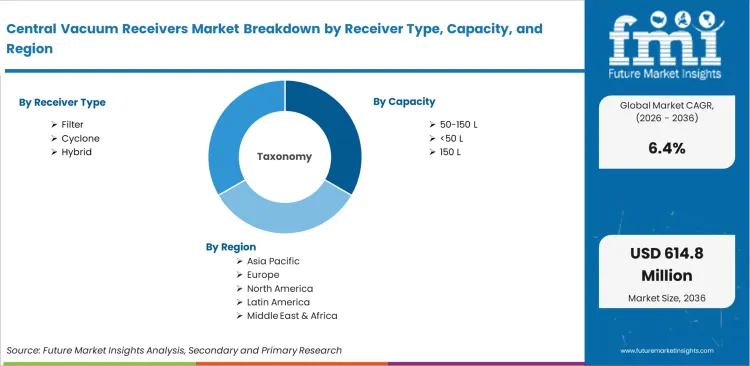
| Metric | Value |
|---|---|
| Quantitative Units | USD 310.7 million to USD 577.8 million, at a CAGR of 6.4% |
| Market Definition | Central vacuum receivers are negative-pressure separation vessels integrated into centralized pneumatic conveying systems, designed to transport and discharge bulk solids to processing machinery without integral blowers. |
| Segmentation | By Receiver Type, Capacity, End Use, and Mounting |
| Regions Covered | North America, Latin America, Western Europe, Eastern Europe, Asia Pacific, Middle East, and Africa |
| Countries Covered | USA, Germany, UK, China, India, Japan, South Korea |
| Key Companies Profiled | Piovan, Conair, motan, WITTMANN, Maguire, Shini, Matsui |
| Forecast Period | 2026 to 2036 |
| Approach | Top-down material handling integration analysis cross-validated with compounding facility installation rates |
Source: Future Market Insights (FMI) analysis, based on proprietary forecasting model and primary research
Central Vacuum Receivers Market Analysis by Segments
Receiver Type
- Cyclone Receivers
- Filter Receivers
- Hybrid Receivers
Capacity
- <50 L
- 50-150 L
- 150 L
End Use
- Plastics Processing
- Food
- Pharma
- Other Industries
Mounting
- Machine-mounted
- Centralized
Region
- North America
- USA
- Canada
- Latin America
- Brazil
- Mexico
- Rest of Latin America
- Western Europe
- Germany
- UK
- France
- Spain
- Italy
- Rest of Western Europe
- Eastern Europe
- Russia
- Poland
- Rest of Eastern Europe
- Asia Pacific
- China
- India
- Japan
- South Korea
- Australia
- ASEAN
- Rest of Asia Pacific
- Middle East
- GCC Countries
- Turkey
- Rest of Middle East
- Africa
- South Africa
- North Africa
- Rest of Africa
Bibliography
- EUROMAP. (2025). EUROMAP 82 - OPC UA companion specifications for peripheral devices in plastics and rubber machinery. European Committee of Machinery Manufacturers for the Plastics and Rubber Industries.
- EUROMAP. (2025, October 11). EUROMAP press release at K 2025.
- USA Commercial Service. (2024, June). Plastics materials and machinery export guide: A reference for USA exporters. International Trade Administration, USA Department of Commerce.
- VDMA. (2025, June). Annual Review: Plastics and Rubber Machinery 2025. Verband Deutscher Maschinen- und Anlagenbau.
- Walker, B. (2026, February 3). EUROMAP and digitalisation in plastics machinery. Modern Plastics Network.
This bibliography is provided for reader reference. The full FMI report contains the complete reference list with primary source documentation.
This Report Addresses
- Tool-less cleanability standards dictating procurement decisions.
- Abrasive regrind forcing the transition to heavy-duty filter receivers.
- Facility clearance constraints capping centralized ground-mounted installations.
- Exact capacity matching between 50-150 L receivers and gravimetric blenders.
- Self-cleaning pulse-jet mechanisms preventing vacuum loss.
- Combustible dust regulations accelerating standalone loader replacement cycles.
- Multi-resin compounding creating immediate bottlenecks in legacy layouts.
- Transparent polyamide bodies enabling visual cross-contamination checks.
Frequently Asked Questions
What are central vacuum receivers used for?
Central vacuum receivers operate as the terminal separation chambers in pneumatic conveying networks. They maintain negative pressure to pull powders, pellets, or regrind from storage silos directly to processing equipment, removing the bulk solid from the air stream before it reaches the central vacuum pump.
How do central vacuum receivers work in plastics plants?
These units rely on a remote, centralized pump to generate suction. Once the material enters the receiver body, a combination of cyclonic action and physical filtration separates the plastic resin from the conveying air, dropping the resin into the hopper below via a discharge flapper valve.
What is the size of the central vacuum receivers industry?
Total revenue is projected to hit USD 577.8 million by 2036. This growth signals a permanent structural shift away from localized manual resin loading toward fully integrated, dust-free pneumatic conveying networks across all major compounding facilities.
Which receiver type leads installations?
Filter receivers account for 42.0% of demand because their self-cleaning pulse-jet mechanisms guarantee continuous conveying without triggering vacuum failures at the central pump, which is especially critical when handling highly abrasive post-consumer regrind.
Why do machine-mounted receivers hold the largest share?
Mounting the receiver directly onto the machine throat eliminates secondary gravity piping. Molding supervisors strongly prefer this setup as it prevents static build-up and maintains strict temperature control of the resin just before it enters the extrusion barrel.
Which countries are growing fastest in this space?
Tracking at a 7.1% compound rate, India's expansion is driven by a massive influx of foreign direct investment in contract manufacturing. These export-focused facilities bypass legacy mechanical loaders entirely, installing comprehensive centralized vacuum networks to guarantee zero cross-contamination.
Who are the top companies in central vacuum receivers?
Key innovators dominating the sector include Piovan, Conair, motan, WITTMANN, Maguire, Shini, and Matsui. These manufacturers compete heavily on the speed of tool-less dismantling and the seamless integration of their proprietary receivers into open-architecture factory data networks.
What is the difference between filter, cyclone, and hybrid receivers?
Cyclone units use centrifugal force to separate clean pellets without screens, while filter units use mesh to trap fine, dusty powders. Hybrid receivers combine both mechanisms, utilizing initial cyclonic separation followed by active filtration, making them ideal for cohesive, low-melting additives.
How do buyers choose vacuum receiver capacity?
Engineering teams specifically target volumes like the 50-150 L category because it perfectly aligns with the batch delivery requirements of high-speed gravimetric blenders. This exact matching eliminates dangerous material stratification that occurs during idle holding times in oversized bins.
Are central vacuum receivers mainly used in plastics processing?
While plastics processing commands 41.0% of the volume, pharmaceutical batching and food handling are critical end uses. Stringent FDA regulations regarding airborne particulate exposure prohibit open-air transfers, forcing these sectors to deploy fully sealed vacuum receivers for hygiene compliance.
How does central conveying reduce energy costs?
Replacing dozens of fractional-horsepower integral hopper loader motors with a single, highly efficient variable frequency drive (VFD) vacuum pump drastically lowers base electrical consumption. Facility managers see an immediate drop in their overall energy footprint when migrating to centralized pneumatic architecture.
What forces the transition away from standalone loaders?
As a facility adds more processing machines, individual hopper loaders generate overwhelming ambient noise and excessive localized heat. Upgrading to a centralized vacuum network relocates the noisy generating pump to an isolated utility room, significantly improving the plant floor working environment.
How do quick-release mechanisms affect plant output?
Dismantling a receiver using tools adds unacceptable downtime between production runs. Receivers designed with quick-release latches allow an operator to drop the discharge cone, wipe the interior, and restart the line in under five minutes, directly maximizing available machine uptime.
What is the impact of multi-resin compounding?
Modern extrusion lines often require four or five simultaneous material inputs. Managing this complexity with individual hoppers is physically impossible due to space constraints, forcing engineering teams to route all materials through a compact array of centralized vacuum receivers.
Why do legacy plants struggle with central floor mounting?
Older facilities were designed around local gravity feeds rather than complex pneumatic routing. Forcing a central floor-mounted receiver system requires extensive horizontal pipe runs that inevitably lead to material degradation, pushing engineers to rely heavily on machine-mounted units.
How does South Korea maintain its competitive edge?
Molders in the region face intense pressure to execute rapid, flawless color changes for consumer electronics casings. By investing in receivers that can be cleaned and re-certified in minutes, operations directors lock in a distinct agility advantage over slower, legacy-equipped regional competitors.
What hidden cost plagues oversized receiver installations?
Procurement teams often specify excessively large receivers hoping to build a safety margin for future capacity. In reality, oversized units sit idle between blender cycles, allowing blended resins to separate by weight and causing severe quality defects in the final molded part.
How do OSHA combustible dust regulations affect procurement?
Fines for fugitive dust emissions can cripple a compounding operation overnight. Safety directors leverage these strict mandates to justify the capital expenditure required to replace leaky mechanical loaders with hermetically sealed vacuum receivers equipped with advanced filtration.
What prevents immediate adoption of hybrid receivers?
The complexity of combining cyclonic separation with active filtration adds significant upfront cost. Operations managers typically delay purchasing hybrid units until their specific material mix becomes so dusty that standard filter receivers fail, at which point the upgrade becomes mandatory.
Why is data-linked traceability becoming standard?
Consumer packaging brands increasingly demand verified proof of recycled content percentages. Connecting receiver fill-level sensors directly to plant-wide data tracking systems allows procurement directors to generate unalterable audit trails for every batch processed through the facility.
How do European energy directives shape adoption?
Strict industrial power consumption targets force U.K. and German plant operators to scrutinize the efficiency of their auxiliary equipment. This regulatory pressure heavily favors smart receivers that only trigger the central vacuum pump precisely when a material refill is required.
What happens when a filter blind goes undetected?
If a receiver filter becomes saturated with dust, the central pump must work exponentially harder to pull the same volume of material. Eventually, the vacuum pressure drops below the threshold needed for transport, starving the processing machine and ruining the current production run.
Why is the USA sector experiencing a retrofit boom?
Decades-old domestic plastics plants are facing a critical turning point where their legacy material handling systems can no longer support high-speed modern extruders. Plant engineering heads are ripping out manual systems and installing centralized vacuum networks to remain competitive with newly built offshore mega-plants.
Preview the report firsthand - request a free sample
Get SampleGet the brochure for pricing and purchase details.
Get PDFTable of Content
- Executive Summary
- Global Market Outlook
- Demand-side Trends
- Supply-side Trends
- Technology Roadmap Analysis
- Analysis and Recommendations
- Market Overview
- Market Coverage / Taxonomy
- Market Definition / Scope / Limitations
- Research Methodology
- Chapter Orientation
- Analytical Lens and Working Hypotheses
- Market Structure, Signals, and Trend Drivers
- Benchmarking and Cross-market Comparability
- Market Sizing, Forecasting, and Opportunity Mapping
- Research Design and Evidence Framework
- Desk Research Programme (Secondary Evidence)
- Company Annual and Sustainability Reports
- Peer-reviewed Journals and Academic Literature
- Corporate Websites, Product Literature, and Technical Notes
- Earnings Decks and Investor Briefings
- Statutory Filings and Regulatory Disclosures
- Technical White Papers and Standards Notes
- Trade Journals, Industry Magazines, and Analyst Briefs
- Conference Proceedings, Webinars, and Seminar Materials
- Government Statistics Portals and Public Data Releases
- Press Releases and Reputable Media Coverage
- Specialist Newsletters and Curated Briefings
- Sector Databases and Reference Repositories
- FMI Internal Proprietary Databases and Historical Market Datasets
- Subscription Datasets and Paid Sources
- Social Channels, Communities, and Digital Listening Inputs
- Additional Desk Sources
- Expert Input and Fieldwork (Primary Evidence)
- Primary Modes
- Qualitative Interviews and Expert Elicitation
- Quantitative Surveys and Structured Data Capture
- Blended Approach
- Why Primary Evidence is Used
- Field Techniques
- Interviews
- Surveys
- Focus Groups
- Observational and In-context Research
- Social and Community Interactions
- Stakeholder Universe Engaged
- C-suite Leaders
- Board Members
- Presidents and Vice Presidents
- R&D and Innovation Heads
- Technical Specialists
- Domain Subject-matter Experts
- Scientists
- Physicians and Other Healthcare Professionals
- Governance, Ethics, and Data Stewardship
- Research Ethics
- Data Integrity and Handling
- Primary Modes
- Tooling, Models, and Reference Databases
- Desk Research Programme (Secondary Evidence)
- Data Engineering and Model Build
- Data Acquisition and Ingestion
- Cleaning, Normalisation, and Verification
- Synthesis, Triangulation, and Analysis
- Quality Assurance and Audit Trail
- Market Background
- Market Dynamics
- Drivers
- Restraints
- Opportunity
- Trends
- Scenario Forecast
- Demand in Optimistic Scenario
- Demand in Likely Scenario
- Demand in Conservative Scenario
- Opportunity Map Analysis
- Product Life Cycle Analysis
- Supply Chain Analysis
- Investment Feasibility Matrix
- Value Chain Analysis
- PESTLE and Porter’s Analysis
- Regulatory Landscape
- Regional Parent Market Outlook
- Production and Consumption Statistics
- Import and Export Statistics
- Market Dynamics
- Global Market Analysis 2021 to 2025 and Forecast, 2026 to 2036
- Historical Market Size Value (USD Million) Analysis, 2021 to 2025
- Current and Future Market Size Value (USD Million) Projections, 2026 to 2036
- Y-o-Y Growth Trend Analysis
- Absolute $ Opportunity Analysis
- Global Market Pricing Analysis 2021 to 2025 and Forecast 2026 to 2036
- Global Market Analysis 2021 to 2025 and Forecast 2026 to 2036, By Receiver Type
- Introduction / Key Findings
- Historical Market Size Value (USD Million) Analysis By Receiver Type , 2021 to 2025
- Current and Future Market Size Value (USD Million) Analysis and Forecast By Receiver Type , 2026 to 2036
- Filter
- Cyclone
- Hybrid
- Filter
- Y-o-Y Growth Trend Analysis By Receiver Type , 2021 to 2025
- Absolute $ Opportunity Analysis By Receiver Type , 2026 to 2036
- Global Market Analysis 2021 to 2025 and Forecast 2026 to 2036, By Capacity
- Introduction / Key Findings
- Historical Market Size Value (USD Million) Analysis By Capacity, 2021 to 2025
- Current and Future Market Size Value (USD Million) Analysis and Forecast By Capacity, 2026 to 2036
- 50-150 L
- <50 L
- 150 L
- 50-150 L
- Y-o-Y Growth Trend Analysis By Capacity, 2021 to 2025
- Absolute $ Opportunity Analysis By Capacity, 2026 to 2036
- Global Market Analysis 2021 to 2025 and Forecast 2026 to 2036, By End Use
- Introduction / Key Findings
- Historical Market Size Value (USD Million) Analysis By End Use, 2021 to 2025
- Current and Future Market Size Value (USD Million) Analysis and Forecast By End Use, 2026 to 2036
- Plastics Processing
- Food
- Pharma
- Plastics Processing
- Y-o-Y Growth Trend Analysis By End Use, 2021 to 2025
- Absolute $ Opportunity Analysis By End Use, 2026 to 2036
- Global Market Analysis 2021 to 2025 and Forecast 2026 to 2036, By Mounting
- Introduction / Key Findings
- Historical Market Size Value (USD Million) Analysis By Mounting, 2021 to 2025
- Current and Future Market Size Value (USD Million) Analysis and Forecast By Mounting, 2026 to 2036
- Machine-Mounted
- Centralized
- Machine-Mounted
- Y-o-Y Growth Trend Analysis By Mounting, 2021 to 2025
- Absolute $ Opportunity Analysis By Mounting, 2026 to 2036
- Global Market Analysis 2021 to 2025 and Forecast 2026 to 2036, By Region
- Introduction
- Historical Market Size Value (USD Million) Analysis By Region, 2021 to 2025
- Current Market Size Value (USD Million) Analysis and Forecast By Region, 2026 to 2036
- North America
- Latin America
- Western Europe
- Eastern Europe
- East Asia
- South Asia and Pacific
- Middle East & Africa
- Market Attractiveness Analysis By Region
- North America Market Analysis 2021 to 2025 and Forecast 2026 to 2036, By Country
- Historical Market Size Value (USD Million) Trend Analysis By Market Taxonomy, 2021 to 2025
- Market Size Value (USD Million) Forecast By Market Taxonomy, 2026 to 2036
- By Country
- USA
- Canada
- Mexico
- By Receiver Type
- By Capacity
- By End Use
- By Mounting
- By Country
- Market Attractiveness Analysis
- By Country
- By Receiver Type
- By Capacity
- By End Use
- By Mounting
- Key Takeaways
- Latin America Market Analysis 2021 to 2025 and Forecast 2026 to 2036, By Country
- Historical Market Size Value (USD Million) Trend Analysis By Market Taxonomy, 2021 to 2025
- Market Size Value (USD Million) Forecast By Market Taxonomy, 2026 to 2036
- By Country
- Brazil
- Chile
- Rest of Latin America
- By Receiver Type
- By Capacity
- By End Use
- By Mounting
- By Country
- Market Attractiveness Analysis
- By Country
- By Receiver Type
- By Capacity
- By End Use
- By Mounting
- Key Takeaways
- Western Europe Market Analysis 2021 to 2025 and Forecast 2026 to 2036, By Country
- Historical Market Size Value (USD Million) Trend Analysis By Market Taxonomy, 2021 to 2025
- Market Size Value (USD Million) Forecast By Market Taxonomy, 2026 to 2036
- By Country
- Germany
- UK
- Italy
- Spain
- France
- Nordic
- BENELUX
- Rest of Western Europe
- By Receiver Type
- By Capacity
- By End Use
- By Mounting
- By Country
- Market Attractiveness Analysis
- By Country
- By Receiver Type
- By Capacity
- By End Use
- By Mounting
- Key Takeaways
- Eastern Europe Market Analysis 2021 to 2025 and Forecast 2026 to 2036, By Country
- Historical Market Size Value (USD Million) Trend Analysis By Market Taxonomy, 2021 to 2025
- Market Size Value (USD Million) Forecast By Market Taxonomy, 2026 to 2036
- By Country
- Russia
- Poland
- Hungary
- Balkan & Baltic
- Rest of Eastern Europe
- By Receiver Type
- By Capacity
- By End Use
- By Mounting
- By Country
- Market Attractiveness Analysis
- By Country
- By Receiver Type
- By Capacity
- By End Use
- By Mounting
- Key Takeaways
- East Asia Market Analysis 2021 to 2025 and Forecast 2026 to 2036, By Country
- Historical Market Size Value (USD Million) Trend Analysis By Market Taxonomy, 2021 to 2025
- Market Size Value (USD Million) Forecast By Market Taxonomy, 2026 to 2036
- By Country
- China
- Japan
- South Korea
- By Receiver Type
- By Capacity
- By End Use
- By Mounting
- By Country
- Market Attractiveness Analysis
- By Country
- By Receiver Type
- By Capacity
- By End Use
- By Mounting
- Key Takeaways
- South Asia and Pacific Market Analysis 2021 to 2025 and Forecast 2026 to 2036, By Country
- Historical Market Size Value (USD Million) Trend Analysis By Market Taxonomy, 2021 to 2025
- Market Size Value (USD Million) Forecast By Market Taxonomy, 2026 to 2036
- By Country
- India
- ASEAN
- Australia & New Zealand
- Rest of South Asia and Pacific
- By Receiver Type
- By Capacity
- By End Use
- By Mounting
- By Country
- Market Attractiveness Analysis
- By Country
- By Receiver Type
- By Capacity
- By End Use
- By Mounting
- Key Takeaways
- Middle East & Africa Market Analysis 2021 to 2025 and Forecast 2026 to 2036, By Country
- Historical Market Size Value (USD Million) Trend Analysis By Market Taxonomy, 2021 to 2025
- Market Size Value (USD Million) Forecast By Market Taxonomy, 2026 to 2036
- By Country
- Kingdom of Saudi Arabia
- Other GCC Countries
- Turkiye
- South Africa
- Other African Union
- Rest of Middle East & Africa
- By Receiver Type
- By Capacity
- By End Use
- By Mounting
- By Country
- Market Attractiveness Analysis
- By Country
- By Receiver Type
- By Capacity
- By End Use
- By Mounting
- Key Takeaways
- Key Countries Market Analysis
- USA
- Pricing Analysis
- Market Share Analysis, 2025
- By Receiver Type
- By Capacity
- By End Use
- By Mounting
- Canada
- Pricing Analysis
- Market Share Analysis, 2025
- By Receiver Type
- By Capacity
- By End Use
- By Mounting
- Mexico
- Pricing Analysis
- Market Share Analysis, 2025
- By Receiver Type
- By Capacity
- By End Use
- By Mounting
- Brazil
- Pricing Analysis
- Market Share Analysis, 2025
- By Receiver Type
- By Capacity
- By End Use
- By Mounting
- Chile
- Pricing Analysis
- Market Share Analysis, 2025
- By Receiver Type
- By Capacity
- By End Use
- By Mounting
- Germany
- Pricing Analysis
- Market Share Analysis, 2025
- By Receiver Type
- By Capacity
- By End Use
- By Mounting
- UK
- Pricing Analysis
- Market Share Analysis, 2025
- By Receiver Type
- By Capacity
- By End Use
- By Mounting
- Italy
- Pricing Analysis
- Market Share Analysis, 2025
- By Receiver Type
- By Capacity
- By End Use
- By Mounting
- Spain
- Pricing Analysis
- Market Share Analysis, 2025
- By Receiver Type
- By Capacity
- By End Use
- By Mounting
- France
- Pricing Analysis
- Market Share Analysis, 2025
- By Receiver Type
- By Capacity
- By End Use
- By Mounting
- India
- Pricing Analysis
- Market Share Analysis, 2025
- By Receiver Type
- By Capacity
- By End Use
- By Mounting
- ASEAN
- Pricing Analysis
- Market Share Analysis, 2025
- By Receiver Type
- By Capacity
- By End Use
- By Mounting
- Australia & New Zealand
- Pricing Analysis
- Market Share Analysis, 2025
- By Receiver Type
- By Capacity
- By End Use
- By Mounting
- China
- Pricing Analysis
- Market Share Analysis, 2025
- By Receiver Type
- By Capacity
- By End Use
- By Mounting
- Japan
- Pricing Analysis
- Market Share Analysis, 2025
- By Receiver Type
- By Capacity
- By End Use
- By Mounting
- South Korea
- Pricing Analysis
- Market Share Analysis, 2025
- By Receiver Type
- By Capacity
- By End Use
- By Mounting
- Russia
- Pricing Analysis
- Market Share Analysis, 2025
- By Receiver Type
- By Capacity
- By End Use
- By Mounting
- Poland
- Pricing Analysis
- Market Share Analysis, 2025
- By Receiver Type
- By Capacity
- By End Use
- By Mounting
- Hungary
- Pricing Analysis
- Market Share Analysis, 2025
- By Receiver Type
- By Capacity
- By End Use
- By Mounting
- Kingdom of Saudi Arabia
- Pricing Analysis
- Market Share Analysis, 2025
- By Receiver Type
- By Capacity
- By End Use
- By Mounting
- Turkiye
- Pricing Analysis
- Market Share Analysis, 2025
- By Receiver Type
- By Capacity
- By End Use
- By Mounting
- South Africa
- Pricing Analysis
- Market Share Analysis, 2025
- By Receiver Type
- By Capacity
- By End Use
- By Mounting
- USA
- Market Structure Analysis
- Competition Dashboard
- Competition Benchmarking
- Market Share Analysis of Top Players
- By Region
- By Receiver Type
- By Capacity
- By End Use
- By Mounting
- Competition Analysis
- Competition Deep Dive
- Piovan
- Overview
- Product Portfolio
- Profitability by Market Segments (Product/Age /Sales Channel/Region)
- Sales Footprint
- Strategy Overview
- Marketing Strategy
- Product Strategy
- Channel Strategy
- Conair
- motan
- WITTMANN
- Maguire
- Shini
- Piovan
- Competition Deep Dive
- Assumptions & Acronyms Used


