

- Industry Size (2026)
- USD 410.7 Mn
- Forecast (2036)
- USD 695.0 Mn
- CAGR (2026 to 2036)
- 5.40%
Chilled Beam System Market Size, Market Forecast and Outlook By FMI
The chilled beam system market was valued at USD 389.7 million in 2025. The industry is poised to reach USD 410.7 million in 2026 at a CAGR of 5.40% during the forecast period. Revenue expansion propels the total opportunity to USD 695.0 million through 2036 as commercial building developers transition from air-heavy ventilation to hydronic heat transfer to meet aggressive energy-efficiency benchmarks.
Building owners are currently being forced to decide between maintaining legacy all-air HVAC architectures or investing in water-based terminal cooling to reduce the energy intensity of their real estate portfolios. This shift is not merely a technical preference but a strategic response to rising operational costs and the institutional pressure to improve building energy ratings. Delaying this transition risks leaving assets under-equipped for the requirements of high-tier corporate tenants who prioritize indoor environmental quality and low background noise levels. According to FMI's analysis, the integration of chilled beams into multi-service ceiling systems allows facility managers to consolidate lighting, sensors, and climate control into a single manageable infrastructure. One non-obvious observation is that the adoption of these systems is often limited by the specific humidity thresholds of the local climate rather than the cooling capacity of the hardware itself.
The structural gate for self-reinforcing growth is the standardization of hydronic infrastructure in speculative commercial developments. Once a critical mass of "Class A" office stock adopts water-based distribution, the secondary ecosystem of specialized mechanical contractors and maintenance providers achieves the scale necessary to lower installation premiums. This threshold is typically triggered by institutional developers who view hydronic cooling as a way to maximize leasable floor space by reducing the vertical height required for ductwork.
Summary of Chilled Beam System Market
- Chilled Beam System Market Definition
- Chilled beam systems represent a specialized terminal cooling technology within the hydronic HVAC sector that uses water-to-air heat exchange to maintain thermal comfort in commercial interiors while minimizing fan energy.
- Demand Drivers in the Market
- Institutional pressure to reduce carbon intensity forces real estate developers to replace air-heavy cooling with high-efficiency hydronic systems.
- Stricter indoor acoustic standards in healthcare and corporate environments compel facility managers to adopt low-noise terminal cooling.
- Regional energy benchmarking mandates require procurement directors to prioritize HVAC technologies that lower the total energy use intensity of commercial buildings.
- Key Segments Analyzed in the FMI Report
- Active chilled beam: Active chilled beam is expected to hold 46.2% share in 2026, as it provides the necessary induction to combine cooling with essential fresh air ventilation.
- Offices: Commercial office buildings lead the end-use segment because chilled beams allow for reduced floor-to-ceiling heights and quieter workspace environments.
- Cooling-only: Cooling-only configurations represent 49.1% of the market in 2026, serving as primary terminal cooling in buildings with separate ventilation systems.
- China: 6.8% compound growth, driven by rapid urban development and state-mandated building efficiency targets for new commercial districts.
- Analyst Opinion at FMI
- Nikhil Kaitwade, Associate Vice President, at FMI, opines, "The industry consensus often overlooks the fact that chilled beam adoption is as much a floor-space optimization strategy as it is an energy-saving one. By significantly reducing the vertical profile of the HVAC distribution layer, developers can effectively reclaim ceiling height, which in high-rise commercial construction translates directly into increased leasable volume. Our research indicates that the most successful vendors are those who move beyond equipment sales to provide integrated hydronic design support that simplifies the commissioning process for mechanical contractors."
- Strategic Implications / Executive Takeaways
- Mechanical engineering firms must develop specialized hydronic commissioning expertise to avoid the installation bottlenecks often associated with water-based ceiling systems.
- HVAC manufacturers should design modular chilled beam units that can be integrated into pre-fabricated ceiling assemblies to reduce on-site labor costs.
- Facility directors face a widening skills gap in the maintenance of hydronic cooling loops, requiring targeted retraining of on-site technical staff.
- Methodology
- Market estimates were derived from primary interviews with HVAC manufacturers and building consultants, supplemented by secondary analysis of commercial construction activity and building energy codes.
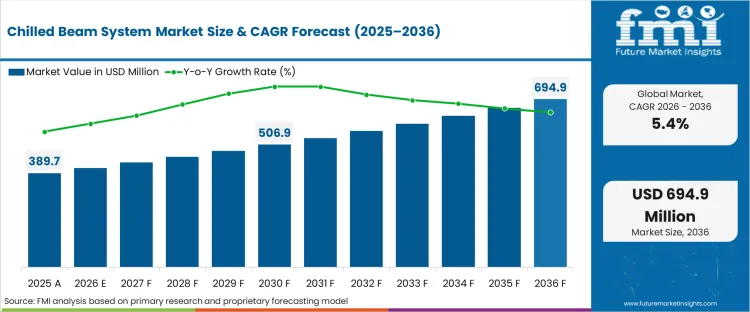
Chilled Beam System Market Key Takeaways
| Metric | Details |
|---|---|
| Industry Size (2026) | USD 410.7 million |
| Industry Value (2036) | USD 695.0 million |
| CAGR (2026–2036) | 5.40% |
Source: Future Market Insights (FMI) analysis, based on proprietary forecasting model and primary research
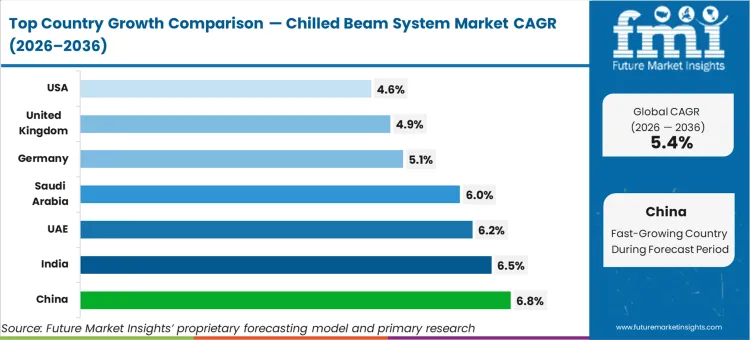
China is anticipated to record a 6.8% CAGR through 2036 as urban expansion in tier-1 cities prioritizes high-efficiency institutional infrastructure. India follows with a 6.5% compound annual rate as corporate office developments align with international sustainability certifications. The UAE is expected to garner a 6.2% CAGR through 2036, effectively pairing hydronic distribution with established district cooling networks. Saudi Arabia is projected to track a 6.0% annual expansion as Vision 2030 projects incorporate energy-efficient climate technologies. Germany is poised to post a 5.1% CAGR, while the United Kingdom follows at 4.9%, both driven by the modernization of existing commercial assets. Japan is estimated to follow at a 4.4% CAGR to 2036, reflecting a replacement-driven landscape in mature urban centers. This structural divergence reflects a market split between rapid new construction in emerging economies and technically complex retrofitting in developed regions.
Chilled Beam System Market Definition
Chilled beam systems are ceiling-mounted hydronic heat exchangers designed to regulate indoor temperatures by circulating chilled water through specialized coils. Unlike conventional air-conditioning systems that rely on large volumes of forced air, chilled beams utilize natural convection or primary air induction to facilitate heat transfer. This distinction makes them a critical component in energy-efficient HVAC designs for commercial buildings where reducing fan energy and mechanical noise is a priority.
Chilled Beam System Market Inclusions
The market scope includes active, passive, and multi-service chilled beam configurations utilized across commercial, industrial, and residential sectors. It encompasses valuations for cooling-only units and those integrated with heating or ventilation capabilities. FMI analysis also includes adoption trends for absorption chillers and other primary cooling sources that feed hydronic terminal units. The valuation accounts for both new installations in greenfield projects and components used in high-performance building retrofits.
Chilled Beam System Market Exclusions
The report explicitly excludes traditional air-based cooling systems such as variable refrigerant flow (VRF) units, rooftop packaged systems, and standalone window or split air conditioners. Functional exclusions also apply to large-scale infrastructure like centralized air handling units or cooling towers, focusing instead on terminal chilled beam devices. Components designed for residential-scale window cooling or portable air conditioning are outside the scope to ensure an analytical focus on commercial-grade hydronic climate control.
Chilled Beam System Market Research Methodology
- Primary Research: FMI conducted targeted interviews with HVAC engineering consultants, commercial building mechanical contractors, and institutional facility directors responsible for large-scale cooling infrastructure.
- Desk Research: Analysts aggregated data from building energy performance registries, national construction statistics, HVAC technology patent filings, and regulatory databases governing commercial building efficiency.
- Market-Sizing and Forecasting: The baseline anchors to observable mechanical contract awards and institutional construction spending, triangulated with manufacturer-reported revenue for terminal hydronic units.
- Data Validation and Update Cycle: Projections were cross-validated using longitudinal studies of commercial real estate trends and verified against the capital expenditure cycles of global property development firms.
Segmental Analysis
Chilled Beam System Market Analysis by Type
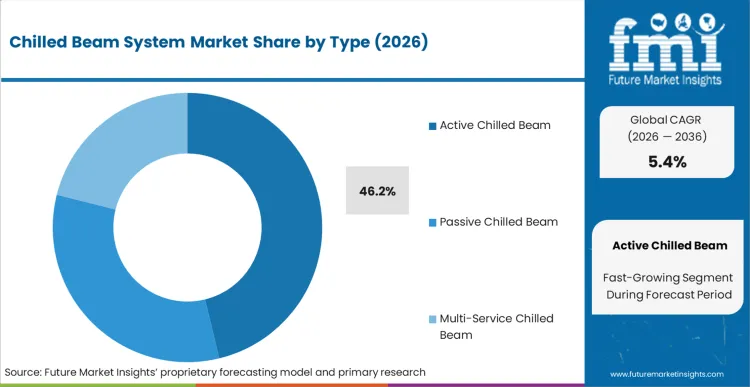
Active chilled beam systems are expected to account for 46.2% of the market in 2026. This dominant position is maintained because active units allow building engineers to solve two problems simultaneously: sensible cooling and primary air ventilation. By using high-velocity air induction to draw room air across a cooling coil, these systems enable a much higher cooling capacity per unit than passive alternatives. FMI notes that the shift toward industrial chiller systems integrated with terminal units reflects a broader move toward centralized hydronic efficiency. Commercial developers specify active beams because they reduce the total airflow volume required, allowing for smaller air-handling units and less ductwork. Those who ignore these architectural efficiencies face higher structural costs in new high-rise developments.
- Ventilation induction: Primary air delivery through active beams creates a localized induction effect that ensures consistent air mixing without the draft risks of conventional diffusers.
- Ductwork reduction: Higher cooling density allows mechanical designers to specify smaller duct diameters, preserving precious plenum space in modern office buildings.
- Energy density: Shifting the sensible cooling load to water circulation allows the system to transport thermal energy more efficiently than air-only systems.
Chilled Beam System Market Analysis by Application
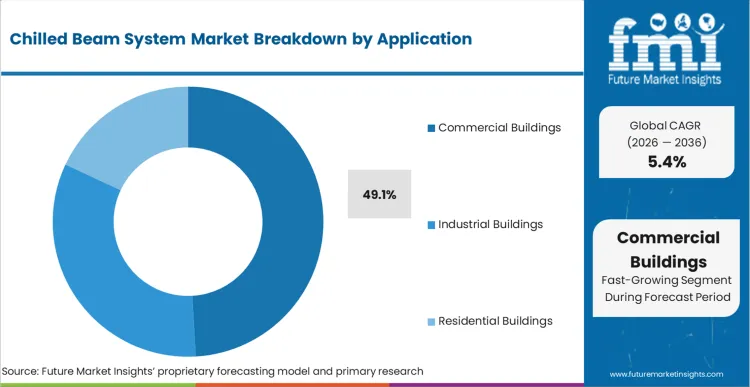
The commercial buildings segment with a share of 49.1% is currently undergoing a structural transformation as tenants demand better acoustic and thermal performance. This displacement of legacy VAV (Variable Air Volume) systems is most visible in "Class A" office developments where the incumbent air-based approach fails to deliver the quiet environment required for open-plan workspaces. According to FMI, the integration of chilled water storage allows these applications to manage peak loads with greater flexibility. Procurement leads in the corporate sector are increasingly using indoor environmental quality as a recruitment and retention tool. The consequence of sticking with traditional noisy ventilation is a direct reduction in the asset's marketability to high-value tenants.
- Acoustic stability: Reduced mechanical airflow velocity eliminates the background "white noise" common in fan-coil or VAV environments, supporting focused cognitive work.
- Thermal zoning: Chilled beams provide localized temperature control that can be adjusted for specific floor zones without disrupting the building's overall ventilation balance.
- Lifecycle maintenance: Removing fans and filters from the terminal units reduces the long-term maintenance burden on facility staff, as there are no moving parts in the ceiling plenum.
Chilled Beam System Market Analysis by End Use
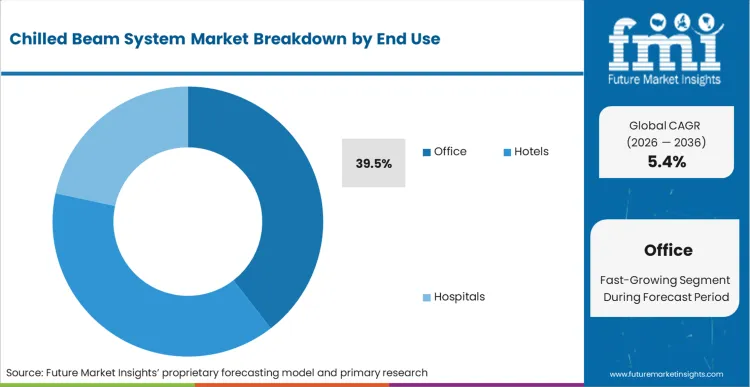
Office environments lead the end-use segment, garnering a share of 39.5% in 2026 because they provide the ideal conditions for hydronic cooling: high sensible heat loads and a need for quiet operation. The structural reason for this concentration is the predictable occupancy patterns and the high value placed on ceiling height in urban office towers. The deployment of HVAC insulation within these systems ensures that hydronic loops remain efficient even in high-humidity regions. Buyers who choose these systems are typically looking to validate their investment through green building certifications. A failure to optimize terminal cooling leads to higher energy spend and potential disqualification from premium sustainability frameworks.
- Qualification triggers: Procurement of chilled beams is often triggered by the pursuit of LEED or BREEAM points related to energy performance and indoor comfort.
- Operational validation: Post-occupancy evaluations consistently show higher tenant satisfaction in offices using chilled beams due to the absence of noticeable drafts.
- Renewal dynamics: The ease of reconfiguring modular chilled beam layouts makes them a favorite for developers who expect frequent tenant turnover and office redesigns.
Chilled Beam System Market Drivers, Restraints, and Opportunities
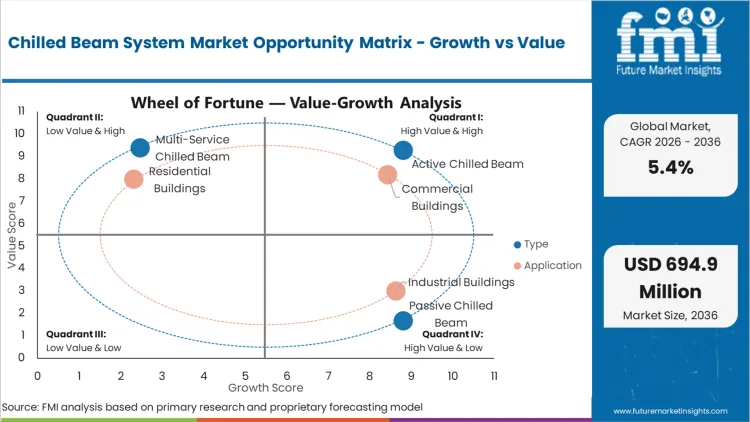
The primary driver for the chilled beam market is the structural forcing condition created by urban energy disclosure mandates. In cities where commercial building owners must publicly report energy use intensity, the pressure to reduce fan power consumption has become an economic necessity. Procurement directors at major property firms are now required to evaluate HVAC systems not just on purchase price, but on their ability to lower the building's operational carbon footprint. The commercial stakes are high; buildings that fail to meet evolving efficiency standards face higher taxes or reduced valuations in an increasingly climate-conscious investment market.
The most significant structural restraint is the complexity of hydronic commissioning and the associated risk of condensation. Unlike air-based systems, chilled beams require a sophisticated control strategy to ensure the water temperature remains above the room's dew point. This operational friction is structural because it requires a higher level of coordination between the HVAC contractor and the building automation specialist. While smart sensors and HVAC blower systems offer partial solutions, the fear of "raining" in the office remains a psychological barrier that prevents more rapid adoption in high-humidity climates.
Opportunities in the Chilled Beam System Market
- Retrofit-specific modules: The development of slim-profile chilled beams tailored for the shallow plenums of older commercial buildings allows owners to modernize without extensive structural changes.
- Multi-service integration: Engineering firms that combine cooling, lighting, and fire suppression into a single "service raft" provide a high-value solution for fast-track construction projects.
- Smart sensing adaptation: Incorporating real-time air quality monitoring directly into chilled beam units allows facility managers to optimize ventilation based on actual occupancy rather than fixed schedules.
Regional Analysis
.webp "Top Country Growth Comparison Chilled Beam System Market Cagr (2026 2036)")
Based on the regional analysis, the Chilled Beam System Market market is segmented into North America, Latin America, Europe, East Asia, South Asia and Pacific, and the Middle East and Africa across 40 plus countries.
| Country | CAGR (2026 to 2036) |
|---|---|
| China | 6.8% |
| India | 6.5% |
| UAE | 6.2% |
| Saudi Arabia | 6.0% |
| Germany | 5.1% |
| United Kingdom | 4.9% |
| United States | 4.6% |
| Japan | 4.4% |
Source: Future Market Insights (FMI) analysis, based on proprietary forecasting model and primary research
East Asia and South Asia Pacific Chilled Beam System Market Analysis
Infrastructure-led growth defines the adoption pattern in this region, as massive new urban centers are designed with centralized hydronic cooling from the ground up. The leading position of China signals a broader regional transition where traditional decentralized cooling is being abandoned for high-efficiency district cooling interfaces. A procurement director in this region is likely to prioritize systems that can handle the extreme sensible heat loads of high-density cities while maintaining minimal spatial footprints. FMI's assessment of ventilation equipment in the region shows a clear trend toward integrated terminal units.
- China: China's state-led push for "Green Urbanism" forces commercial developers to adopt technologies that reduce the carbon intensity of new skyscrapers. The market is advancing at a 6.8% compound annual rate through 2036. Developers who move first capture preferred supplier status in government-linked procurement frameworks.
- India: Corporate office developers in India's technology hubs are adopting chilled beams to differentiate their properties in a competitive rental market. The industry is expanding at 6.5% between 2026 and 2036. This trajectory positions Indian property firms as leaders in sustainable office design within the broader South Asian context.
- Japan: Japan's focus on healthcare infrastructure redevelopment requires cooling solutions that offer superior hygiene and acoustic stability for hospital wards. The market is sustaining a 4.4% CAGR to 2036. This reflects a practitioner reality where technical performance in sensitive environments outweighs simple cost-per-unit considerations.
FMI's report includes assessment for South Korea, Australia, and ASEAN. These markets show a structural shift toward energy-efficient HVAC as domestic energy prices rise.
Middle East & Africa Chilled Beam System Market Analysis
Buyer behavior-led dynamics characterize this region, where the integration of chilled beams is heavily influenced by the presence of large-scale district cooling infrastructure. The UAE and Saudi Arabia are utilizing chilled beams to bridge the gap between centralized chilled water plants and premium indoor environments. FMI notes that the use of natural refrigerant chillers as primary sources is gaining traction in luxury developments.
- United Arab Emirates: The UAE's reliance on district cooling makes chilled beams a natural terminal choice for large mixed-use developments that seek to minimize on-site mechanical footprints. The market is projected at 6.2% compound growth over the forecast period. Adoption achieved here clears a major bottleneck for developers trying to meet "Net Zero" building targets in desert climates.
- Saudi Arabia: National development programs under Vision 2030 are creating new "smart cities" where energy-efficient cooling is a foundational requirement. The market is advancing at 6.0% compound between 2026 and 2036. Contractors who act now establish a structural trajectory that will define the Kingdom's mechanical landscape for a decade.
FMI's report includes analysis for South Africa, Israel, and GCC. These regions are increasingly adopting hydronic systems to combat the high operational costs of traditional air conditioning.
Europe Chilled Beam System Market Analysis
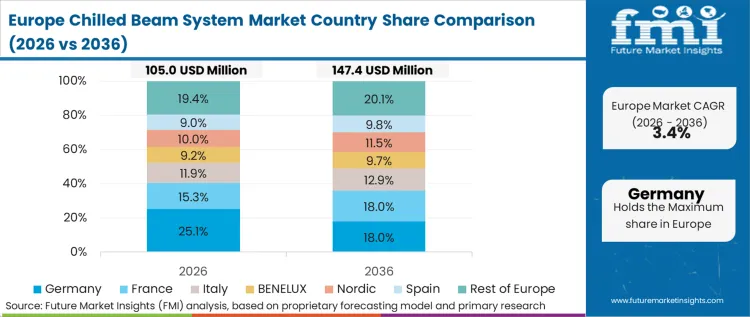
Policy-led adoption is the primary driver in Europe, where the Energy Performance of Buildings Directive (EPBD) has made high-efficiency HVAC a mandatory consideration for all major renovations. The region is more focused on the complex economics of retrofitting older office stock than on new construction. FMI analysts observe that air conditioning systems are being systematically replaced by hydronic terminal units during major lease breaks.
- Germany: Germany's rigorous energy auditing requirements for commercial property make chilled beams an attractive option for owners looking to preserve asset value. The market is expanding at a 5.1% CAGR through 2036. This transition simplifies the process of achieving high energy ratings in heritage building refurbishments.
- United Kingdom: The UK's focus on institutional retrofits, particularly in universities and hospitals, is driving demand for quieter and more hygienic cooling solutions. The market is advancing at 4.9% compound between 2026 and 2036. Successful adoption here provides an operational outcome that significantly reduces background noise in lecture halls and patient rooms.
FMI's report includes evaluations for France, Italy, and Spain. The structural pattern across these markets is a shift toward water-based cooling to meet regional decarbonization goals.
Competitive Aligners for Market Players
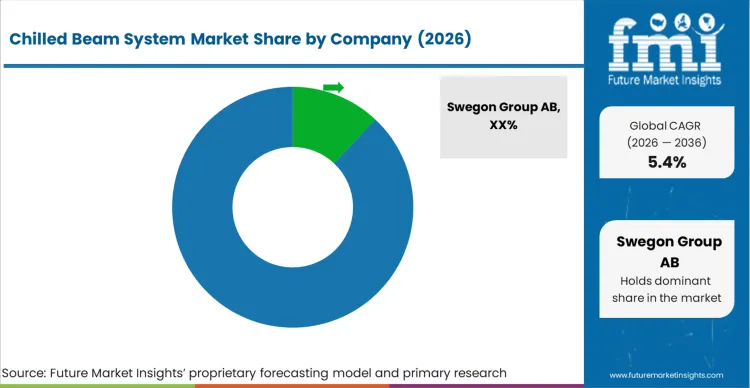
The chilled beam system market is structurally concentrated among a tier of specialized HVAC manufacturers because the technology requires a deep understanding of induction aerodynamics and hydronic balancing. Buyers do not simply select a product; they select a vendor who can provide the engineering simulation data required to prove the system will not cause condensation under peak latent loads. This reliance on technical verification creates a high barrier to entry for generalist HVAC manufacturers. Leading companies like Swegon Group AB and Halton Group maintain their positions by offering proprietary airflow modelling tools that allow consultants to "de-risk" the specification of chilled beams in complex projects.
Challengers in this market must build more than just a better heat exchanger; they must develop a robust support network of mechanical engineers who can assist with on-site commissioning. Incumbents have the advantage of long-standing relationships with tier-1 engineering firms, which ensures their products are "written into" the basis of design for major global projects. FMI notes that the development of HVAC coil coatings has become a key area of differentiation for vendors looking to improve the durability of their units in coastal or industrial environments. Replicating this technical depth requires a commitment to R&D that smaller entrants often struggle to sustain.
The competitive trajectory toward 2036 suggests a market that will become increasingly integrated with digital building management systems. Large buyers are resisting vendor lock-in by demanding open-protocol controls that allow chilled beams from multiple manufacturers to be managed by a single automation platform. This structural tension between proprietary performance and interoperability will force vendors to focus on the modularity of their hardware. As the market matures, the primary competitive variable will shift from pure thermal performance to the ease with which a unit can be integrated into a "smart" ceiling that manages everything from lighting to occupancy-based airflow.
Key Players in Chilled Beam System Market
- Swegon Group AB
- Halton Group
- TROX GmbH
- Lindab Group AB
- FläktGroup Holding GmbH
- Johnson Controls International plc
- Carrier Global Corporation
- Zehnder Group AG
- Systemair AB
- Titus HVAC
Scope of the Report
| Metric | Value |
|---|---|
| Quantitative Units | USD 410.7 million to USD 695.0 million, at a CAGR of 5.40% |
| Market Definition | A segment of the hydronic HVAC market focusing on ceiling-mounted terminal units that utilize chilled water to provide sensible cooling and ventilation air through convection or induction. |
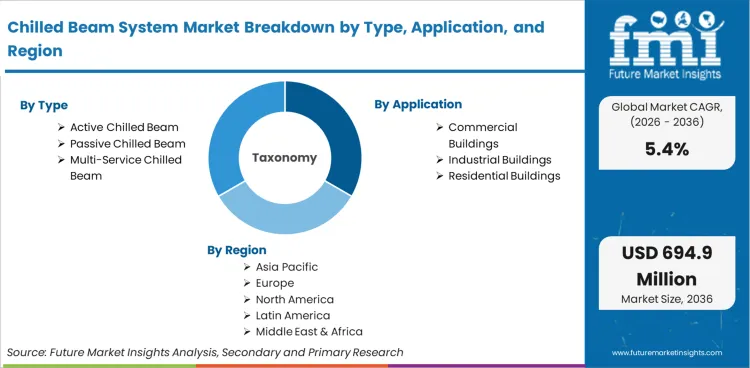
| Type Segmentation | Active Chilled Beam, Passive Chilled Beam, Multi-Service Chilled Beam |
| Application Segmentation | Commercial Buildings, Industrial Buildings, Residential Buildings |
| End Use Segmentation | Offices, Hotels, Hospitals, Educational Institutions, Retail Spaces |
| Regions Covered | North America, Latin America, Europe, East Asia, South Asia and Pacific, Middle East and Africa |
| Countries Covered | United States, Germany, United Kingdom, China, India, UAE, Saudi Arabia, and 40 plus countries |
| Key Companies Profiled | Swegon Group AB, Halton Group, TROX GmbH, Lindab Group AB, FläktGroup, Johnson Controls, Carrier, Zehnder, Systemair, Titus |
| Forecast Period | 2026 to 2036 |
| Approach | FMI utilizes a hybrid methodology involving primary interviews with HVAC designers and secondary tracking of commercial construction permits. Data is validated against manufacturer revenue reports and national building energy efficiency databases. |
Source: Future Market Insights (FMI) analysis, based on proprietary forecasting model and primary research
Chilled Beam System Market Segmentation
By Type:
- Active Chilled Beam
- Passive Chilled Beam
- Multi-Service Chilled Beam
By Application:
- Commercial Buildings
- Industrial Buildings
- Residential Buildings
By End Use:
- Offices
- Hotels
- Hospitals
- Educational Institutions
- Retail Spaces
- Others
Region:
- North America
- Europe
- Asia-Pacific
- Rest of the World
- Latin America
- Middle East, and Africa
Bibliography
- Bureau of Energy Efficiency. (2024, February). Eco-Niwas Samhita 2024: Energy conservation building code for residential buildings. Government of India.
- Department for Energy Security and Net Zero. (2024, May). National non-domestic energy efficiency data framework (ND-NEED) 2024 report. UK Government.
- Dubai Municipality. (2023, November). Al Sa’fat Dubai green building system: Regulations and specifications. Government of Dubai.
- Energy Information Administration. (2023, December). Commercial Buildings Energy Consumption Survey (CBECS): Energy use in commercial buildings. USA Department of Energy.
- General Services Administration. (2024, January). Facilities standards for the public buildings service (P100). USA General Services Administration
- Ministry of Housing and Urban&-Rural Development. (2023, October). China building energy efficiency development report. Government of the People’s Republic of China.
- Saudi Energy Efficiency Center. (2024, March). Saudi building energy codes SBC 601–602: Energy efficiency and conservation in buildings. Government of Saudi Arabia.
- World Green Building Council. (2023, September). Global status report for buildings and construction 2023. WorldGBC
This bibliography is provided for reader reference. The full FMI report contains the complete reference list with primary source documentation.
This Report Addresses
- Market intelligence to support strategic decision making across terminal hydronic units and active ventilation induction technologies
- Market size estimation and 10-year revenue forecasts from 2026 to 2036, supported by tracking of commercial construction permits and mechanical contract awards
- Growth opportunity mapping across type, application, and end-use dimensions with emphasis on the standardization of hydronic infrastructure
- Segment and regional revenue forecasts covering active and passive configurations across tightening urban energy disclosure mandates
- Competition strategy assessment including engineering simulation capability, consultant influence, and integrated ceiling service compatibility
- Technology development tracking including modular "service raft" designs, high-efficiency coil coatings, and smart sensor integration
- Market access analysis covering regional building energy performance directives and green building certification requirements
- Market report delivery in PDF, Excel, PPT, and interactive dashboard formats for executive strategy, mechanical engineering planning, and operational benchmarking use
Frequently Asked Questions
How large is the Chilled Beam System Market in 2026?
The market is estimated to reach USD 410.7 million in 2026. This figure reflects a steady recovery in commercial construction activity and the increasing mandate for energy-efficient terminal units in high-performance building designs.
What will it be valued at by 2036?
FMI projects the market will be valued at USD 695.0 million by 2036. This growth signals a long-term shift toward hydronic cooling as the global standard for low-carbon commercial infrastructure.
What CAGR is projected for the market?
A CAGR of 5.40% is expected during the forecast period. This rate is anchored to the 10-to-15-year capital refresh cycles of commercial buildings and the pace of urban energy legislation.
Which system type leads the market?
Active chilled beam systems lead with a 46.2% share in 2026. This is because they offer the most practical way to combine sensible cooling with fresh air delivery, which is essential for modern ventilation standards.
Which application segment leads the market?
Commercial office buildings represent the largest application because they benefit most from the quiet operation and floor-to-ceiling height savings offered by chilled beam technology.
Which end-use segment leads the market?
Offices are expected to hold 32.4% of demand in 2026. The predictability of office cooling loads and the high tenant demand for thermal comfort make this the primary sector for hydronic terminal units.
What drives rapid growth in this market?
Growth is driven by the structural forcing condition of energy disclosure laws. When owners are forced to report energy intensity, they move toward water-based cooling to eliminate the high energy cost of large fan-driven systems.
What is the primary restraint on adoption?
The primary restraint is the operational friction of humidity control. Building operators fear condensation issues, which requires a more sophisticated and often more expensive control infrastructure to manage successfully.
Which country grows fastest in this market?
China is the fastest-growing market at a 6.8% CAGR, compared to India's 6.5%. The difference is driven by China's larger volume of state-backed institutional construction that strictly follows high-efficiency design mandates.
How does humidity affect the deployment of these systems?
Chilled beams require the incoming water temperature to be kept above the room's dew point. In high-humidity regions, this necessitates advanced building automation and dehumidification, which can increase the initial design complexity and cost.
What is the difference between active and passive chilled beams?
Active beams use a primary air supply to induce room air through the cooling coil, providing both cooling and ventilation. Passive beams rely on natural convection alone, offering only sensible cooling without air movement.
How do chilled beams contribute to green building certifications?
They earn points in frameworks like LEED by reducing fan energy consumption-often by 20% or more-and by providing superior acoustic comfort and individual thermal control for building occupants.
Preview the report firsthand - request a free sample
Get SampleGet the brochure for pricing and purchase details.
Get PDFTable of Content
- Executive Summary
- Global Market Outlook
- Demand-side Trends
- Supply-side Trends
- Technology Roadmap Analysis
- Analysis and Recommendations
- Market Overview
- Market Coverage / Taxonomy
- Market Definition / Scope / Limitations
- Research Methodology
- Chapter Orientation
- Analytical Lens and Working Hypotheses
- Market Structure, Signals, and Trend Drivers
- Benchmarking and Cross-market Comparability
- Market Sizing, Forecasting, and Opportunity Mapping
- Research Design and Evidence Framework
- Desk Research Programme (Secondary Evidence)
- Company Annual and Sustainability Reports
- Peer-reviewed Journals and Academic Literature
- Corporate Websites, Product Literature, and Technical Notes
- Earnings Decks and Investor Briefings
- Statutory Filings and Regulatory Disclosures
- Technical White Papers and Standards Notes
- Trade Journals, Industry Magazines, and Analyst Briefs
- Conference Proceedings, Webinars, and Seminar Materials
- Government Statistics Portals and Public Data Releases
- Press Releases and Reputable Media Coverage
- Specialist Newsletters and Curated Briefings
- Sector Databases and Reference Repositories
- FMI Internal Proprietary Databases and Historical Market Datasets
- Subscription Datasets and Paid Sources
- Social Channels, Communities, and Digital Listening Inputs
- Additional Desk Sources
- Expert Input and Fieldwork (Primary Evidence)
- Primary Modes
- Qualitative Interviews and Expert Elicitation
- Quantitative Surveys and Structured Data Capture
- Blended Approach
- Why Primary Evidence is Used
- Field Techniques
- Interviews
- Surveys
- Focus Groups
- Observational and In-context Research
- Social and Community Interactions
- Stakeholder Universe Engaged
- C-suite Leaders
- Board Members
- Presidents and Vice Presidents
- R&D and Innovation Heads
- Technical Specialists
- Domain Subject-matter Experts
- Scientists
- Physicians and Other Healthcare Professionals
- Governance, Ethics, and Data Stewardship
- Research Ethics
- Data Integrity and Handling
- Primary Modes
- Tooling, Models, and Reference Databases
- Desk Research Programme (Secondary Evidence)
- Data Engineering and Model Build
- Data Acquisition and Ingestion
- Cleaning, Normalisation, and Verification
- Synthesis, Triangulation, and Analysis
- Quality Assurance and Audit Trail
- Market Background
- Market Dynamics
- Drivers
- Restraints
- Opportunity
- Trends
- Scenario Forecast
- Demand in Optimistic Scenario
- Demand in Likely Scenario
- Demand in Conservative Scenario
- Opportunity Map Analysis
- Product Life Cycle Analysis
- Supply Chain Analysis
- Investment Feasibility Matrix
- Value Chain Analysis
- PESTLE and Porter’s Analysis
- Regulatory Landscape
- Regional Parent Market Outlook
- Production and Consumption Statistics
- Import and Export Statistics
- Market Dynamics
- Global Market Analysis 2021 to 2025 and Forecast, 2026 to 2036
- Historical Market Size Value (USD Million) Analysis, 2021 to 2025
- Current and Future Market Size Value (USD Million) Projections, 2026 to 2036
- Y-o-Y Growth Trend Analysis
- Absolute $ Opportunity Analysis
- Global Market Pricing Analysis 2021 to 2025 and Forecast 2026 to 2036
- Global Market Analysis 2021 to 2025 and Forecast 2026 to 2036, By Type
- Introduction / Key Findings
- Historical Market Size Value (USD Million) Analysis By Type , 2021 to 2025
- Current and Future Market Size Value (USD Million) Analysis and Forecast By Type , 2026 to 2036
- Active Chilled Beam
- Passive Chilled Beam
- Multi-Service Chilled Beam
- Active Chilled Beam
- Y-o-Y Growth Trend Analysis By Type , 2021 to 2025
- Absolute $ Opportunity Analysis By Type , 2026 to 2036
- Global Market Analysis 2021 to 2025 and Forecast 2026 to 2036, By Application
- Introduction / Key Findings
- Historical Market Size Value (USD Million) Analysis By Application, 2021 to 2025
- Current and Future Market Size Value (USD Million) Analysis and Forecast By Application, 2026 to 2036
- Commercial Buildings
- Industrial Buildings
- Residential Buildings
- Commercial Buildings
- Y-o-Y Growth Trend Analysis By Application, 2021 to 2025
- Absolute $ Opportunity Analysis By Application, 2026 to 2036
- Global Market Analysis 2021 to 2025 and Forecast 2026 to 2036, By End Use
- Introduction / Key Findings
- Historical Market Size Value (USD Million) Analysis By End Use, 2021 to 2025
- Current and Future Market Size Value (USD Million) Analysis and Forecast By End Use, 2026 to 2036
- Office
- Hotels
- Hospitals
- Office
- Y-o-Y Growth Trend Analysis By End Use, 2021 to 2025
- Absolute $ Opportunity Analysis By End Use, 2026 to 2036
- Global Market Analysis 2021 to 2025 and Forecast 2026 to 2036, By Region
- Introduction
- Historical Market Size Value (USD Million) Analysis By Region, 2021 to 2025
- Current Market Size Value (USD Million) Analysis and Forecast By Region, 2026 to 2036
- North America
- Latin America
- Western Europe
- Eastern Europe
- East Asia
- South Asia and Pacific
- Middle East & Africa
- Market Attractiveness Analysis By Region
- North America Market Analysis 2021 to 2025 and Forecast 2026 to 2036, By Country
- Historical Market Size Value (USD Million) Trend Analysis By Market Taxonomy, 2021 to 2025
- Market Size Value (USD Million) Forecast By Market Taxonomy, 2026 to 2036
- By Country
- USA
- Canada
- Mexico
- By Type
- By Application
- By End Use
- By Country
- Market Attractiveness Analysis
- By Country
- By Type
- By Application
- By End Use
- Key Takeaways
- Latin America Market Analysis 2021 to 2025 and Forecast 2026 to 2036, By Country
- Historical Market Size Value (USD Million) Trend Analysis By Market Taxonomy, 2021 to 2025
- Market Size Value (USD Million) Forecast By Market Taxonomy, 2026 to 2036
- By Country
- Brazil
- Chile
- Rest of Latin America
- By Type
- By Application
- By End Use
- By Country
- Market Attractiveness Analysis
- By Country
- By Type
- By Application
- By End Use
- Key Takeaways
- Western Europe Market Analysis 2021 to 2025 and Forecast 2026 to 2036, By Country
- Historical Market Size Value (USD Million) Trend Analysis By Market Taxonomy, 2021 to 2025
- Market Size Value (USD Million) Forecast By Market Taxonomy, 2026 to 2036
- By Country
- Germany
- UK
- Italy
- Spain
- France
- Nordic
- BENELUX
- Rest of Western Europe
- By Type
- By Application
- By End Use
- By Country
- Market Attractiveness Analysis
- By Country
- By Type
- By Application
- By End Use
- Key Takeaways
- Eastern Europe Market Analysis 2021 to 2025 and Forecast 2026 to 2036, By Country
- Historical Market Size Value (USD Million) Trend Analysis By Market Taxonomy, 2021 to 2025
- Market Size Value (USD Million) Forecast By Market Taxonomy, 2026 to 2036
- By Country
- Russia
- Poland
- Hungary
- Balkan & Baltic
- Rest of Eastern Europe
- By Type
- By Application
- By End Use
- By Country
- Market Attractiveness Analysis
- By Country
- By Type
- By Application
- By End Use
- Key Takeaways
- East Asia Market Analysis 2021 to 2025 and Forecast 2026 to 2036, By Country
- Historical Market Size Value (USD Million) Trend Analysis By Market Taxonomy, 2021 to 2025
- Market Size Value (USD Million) Forecast By Market Taxonomy, 2026 to 2036
- By Country
- China
- Japan
- South Korea
- By Type
- By Application
- By End Use
- By Country
- Market Attractiveness Analysis
- By Country
- By Type
- By Application
- By End Use
- Key Takeaways
- South Asia and Pacific Market Analysis 2021 to 2025 and Forecast 2026 to 2036, By Country
- Historical Market Size Value (USD Million) Trend Analysis By Market Taxonomy, 2021 to 2025
- Market Size Value (USD Million) Forecast By Market Taxonomy, 2026 to 2036
- By Country
- India
- ASEAN
- Australia & New Zealand
- Rest of South Asia and Pacific
- By Type
- By Application
- By End Use
- By Country
- Market Attractiveness Analysis
- By Country
- By Type
- By Application
- By End Use
- Key Takeaways
- Middle East & Africa Market Analysis 2021 to 2025 and Forecast 2026 to 2036, By Country
- Historical Market Size Value (USD Million) Trend Analysis By Market Taxonomy, 2021 to 2025
- Market Size Value (USD Million) Forecast By Market Taxonomy, 2026 to 2036
- By Country
- Kingdom of Saudi Arabia
- Other GCC Countries
- Turkiye
- South Africa
- Other African Union
- Rest of Middle East & Africa
- By Type
- By Application
- By End Use
- By Country
- Market Attractiveness Analysis
- By Country
- By Type
- By Application
- By End Use
- Key Takeaways
- Key Countries Market Analysis
- USA
- Pricing Analysis
- Market Share Analysis, 2025
- By Type
- By Application
- By End Use
- Canada
- Pricing Analysis
- Market Share Analysis, 2025
- By Type
- By Application
- By End Use
- Mexico
- Pricing Analysis
- Market Share Analysis, 2025
- By Type
- By Application
- By End Use
- Brazil
- Pricing Analysis
- Market Share Analysis, 2025
- By Type
- By Application
- By End Use
- Chile
- Pricing Analysis
- Market Share Analysis, 2025
- By Type
- By Application
- By End Use
- Germany
- Pricing Analysis
- Market Share Analysis, 2025
- By Type
- By Application
- By End Use
- UK
- Pricing Analysis
- Market Share Analysis, 2025
- By Type
- By Application
- By End Use
- Italy
- Pricing Analysis
- Market Share Analysis, 2025
- By Type
- By Application
- By End Use
- Spain
- Pricing Analysis
- Market Share Analysis, 2025
- By Type
- By Application
- By End Use
- France
- Pricing Analysis
- Market Share Analysis, 2025
- By Type
- By Application
- By End Use
- India
- Pricing Analysis
- Market Share Analysis, 2025
- By Type
- By Application
- By End Use
- ASEAN
- Pricing Analysis
- Market Share Analysis, 2025
- By Type
- By Application
- By End Use
- Australia & New Zealand
- Pricing Analysis
- Market Share Analysis, 2025
- By Type
- By Application
- By End Use
- China
- Pricing Analysis
- Market Share Analysis, 2025
- By Type
- By Application
- By End Use
- Japan
- Pricing Analysis
- Market Share Analysis, 2025
- By Type
- By Application
- By End Use
- South Korea
- Pricing Analysis
- Market Share Analysis, 2025
- By Type
- By Application
- By End Use
- Russia
- Pricing Analysis
- Market Share Analysis, 2025
- By Type
- By Application
- By End Use
- Poland
- Pricing Analysis
- Market Share Analysis, 2025
- By Type
- By Application
- By End Use
- Hungary
- Pricing Analysis
- Market Share Analysis, 2025
- By Type
- By Application
- By End Use
- Kingdom of Saudi Arabia
- Pricing Analysis
- Market Share Analysis, 2025
- By Type
- By Application
- By End Use
- Turkiye
- Pricing Analysis
- Market Share Analysis, 2025
- By Type
- By Application
- By End Use
- South Africa
- Pricing Analysis
- Market Share Analysis, 2025
- By Type
- By Application
- By End Use
- USA
- Market Structure Analysis
- Competition Dashboard
- Competition Benchmarking
- Market Share Analysis of Top Players
- By Regional
- By Type
- By Application
- By End Use
- Competition Analysis
- Competition Deep Dive
- Swegon Group AB
- Overview
- Product Portfolio
- Profitability by Market Segments (Product/Age /Sales Channel/Region)
- Sales Footprint
- Strategy Overview
- Marketing Strategy
- Product Strategy
- Channel Strategy
- Halton Group
- TROX GmbH
- Lindab Group AB
- FläktGroup Holding GmbH
- Johnson Controls International plc
- Carrier Global Corporation
- Zehnder Group AG
- Swegon Group AB
- Competition Deep Dive
- Assumptions & Acronyms Used


