

- CAGR (2025 to 2035)
- 17.3%
Clinical Oncology Next-generation Sequencing Market Size, Market Forecast and Outlook By FMI
The clinical oncology next-generation sequencing market is expected to expand from USD 744.4 million in 2025 to USD 3.13 billion by 2035. The market is anticipated to register a 17.3% CAGR during the forecast period. Kits and reagents are likely to lead component with a 60.9% share, while synthesis sequencing is projected to account for 68.5% share of the technology segment in 2025.
Summary of the Clinical Oncology Next-generation Sequencing Market
- Demand and Growth Drivers
- Precision oncology adoption is expected to support clinical oncology NGS use across tumor profiling and therapy selection.
- Liquid biopsy innovation is likely to increase testing demand as clinicians seek less invasive cancer monitoring options.
- AI-enabled genomic interpretation is anticipated to improve workflow speed and support clinical decision-making in oncology care.
- Product and Segment View
- Kits and reagents are expected to lead the component segment due to recurring use in clinical sequencing workflows.
- Synthesis sequencing is likely to remain the leading technology because it supports scalable and cost-effective oncology testing.
- Tumor profiling applications are anticipated to gain wider use as targeted therapy selection becomes more genomics-led.
- Geography and Competitive Outlook
- France is expected to lead country-level expansion due to government support and strong oncology genomics infrastructure.
- The United States is likely to record strong growth as liquid biopsy and companion diagnostic adoption continue to expand.
- Companies with integrated sequencing platforms and AI-supported interpretation are anticipated to improve their position.
- Analyst Opinion
- Sabyasachi Ghosh, Principal consultant for Healthcare at FMI, suggests, “The clinical oncology next-generation sequencing market is likely to move toward integrated platforms that connect sample processing, variant interpretation, and therapy matching. Suppliers with validated kits, scalable sequencing workflows, and strong clinical decision-support tools are expected to gain advantage as precision oncology testing becomes more routine.”
- Clinical Oncology Next-generation Sequencing Market Value Analysis
- The clinical oncology next-generation sequencing market is moving from specialist genomic testing toward routine oncology workflow integration.
- Demand is likely to rise as hospitals and laboratories use NGS to support tumor profiling and companion diagnostics.
- Adoption is expected to improve where platforms reduce turnaround time and simplify genomic data interpretation.
- Spending is anticipated to be supported by liquid biopsy growth and wider use of targeted oncology therapies.
| Metric | Value |
|---|---|
| Industry Size (2025E) | USD 744.4 million |
| Industry Value (2035F) | USD 3.13 billion |
| CAGR (2025 to 2035) | 17.3% |
Leading Clinical Oncology Next-generation Sequencing Companies Leveraging Smart Technology
Illumina is investing heavily in intelligent NGS platforms to simplify oncology workflows and accelerate genomic insights. By embedding artificial intelligence and machine learning into its platforms, the company aims to reduce turnaround time while maintaining analytical accuracy. Its smart sequencing tools are designed to support real-time clinical decision-making and improve cancer patient outcomes.
- Uses AI-powered software for variant interpretation in clinical oncology
- Deploys machine learning algorithms for tumor-only and tumor-normal analysis
- Offers cloud-based DRAGEN Bio-IT platform for high-speed, scalable genomic data processing
- Enables real-time sequencing with intelligent automation for lab efficiency
Thermo Fisher Scientific integrates smart software, robotics, and predictive analytics into its NGS platforms tailored for oncology. Its solutions aim to minimize manual steps in cancer diagnostics and enhance detection of low-frequency variants. Through intelligent systems, Thermo Fisher supports both liquid biopsy and solid tumor profiling at scale.
- Uses Ion Torrent Genexus System with end-to-end automation and real-time data analysis
- Employs AI-driven classifiers to identify rare mutations in liquid biopsy samples
- Integrates cloud genomics for streamlined panel updates and data sharing
- Implements digital pathology integration for AI-guided tumor profiling
F. Hoffmann-La Roche continues to build its smart oncology portfolio through the NAVIFY digital ecosystem. This platform combines sequencing data, electronic health records, and AI to create personalized insights for cancer treatment planning. The company emphasizes smart interpretation of NGS data for more effective therapy guidance.
- Applies AI models to match genomic findings with targeted therapies
- Uses ML for advanced mutation calling and therapy resistance prediction
- Connects NGS outputs to clinical decision support systems for personalized oncology pathways
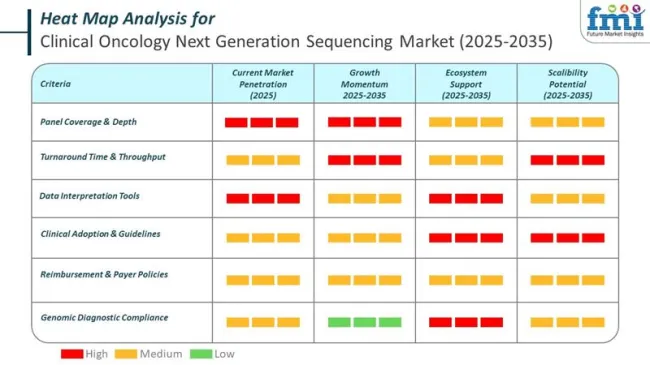
Clinical Oncology Next-generation Sequencing Market Regulatory Scenario
Government regulations in the clinical oncology next-generation sequencing (NGS) market are becoming more stringent to ensure accuracy, patient safety, and data integrity. Regulatory authorities across major regions such as the US, EU, and Asia Pacific are introducing frameworks for diagnostic validity, software integration, and data interoperability in clinical sequencing platforms.
- In the United States, the Food and Drug Administration (FDA) classifies certain NGS-based oncology diagnostics as Class II or III medical devices, requiring premarket approval or 510(k) clearance. It mandates analytical validation, clinical performance data, and software transparency, especially when algorithms drive diagnostic outcomes. The Clinical Laboratory Improvement Amendments (CLIA) also enforce laboratory quality standards and personnel qualifications.
- In the European Union, In Vitro Diagnostic Regulation (IVDR) requires that oncology NGS systems, especially companion diagnostics, undergo conformity assessment with a Notified Body. It enforces data reporting on diagnostic sensitivity, specificity, and alignment with treatment protocols.
- In China, the National Medical Products Administration (NMPA) mandates approval for NGS platforms used in oncology, focusing on traceability, software safety, and reproducibility in clinical environments.
- Globally, regulatory bodies are aligning on frameworks for data privacy, cybersecurity in cloud NGS platforms, and AI validation standards, ensuring that NGS-driven oncology decisions are accurate, reproducible, and ethically managed.
Analyzing Clinical Oncology NGS Market by Top Investment Segments
Kits and Reagents Drive Clinical Oncology NGS Market Growth
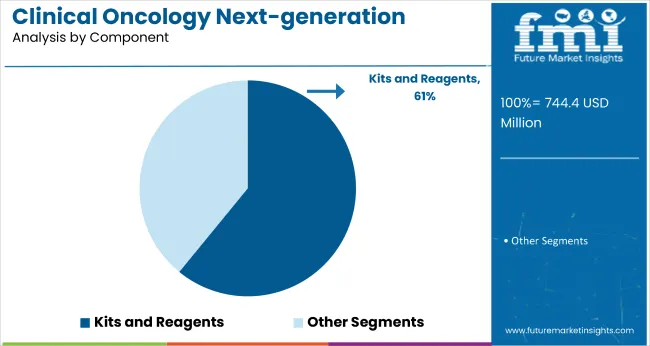
The kits and reagents segment is forecasted to hold around 60.9% market share in 2024, positioning it as the leading component in clinical oncology next-generation sequencing (NGS). The expanding use of NGS for tumor profiling, liquid biopsy, and companion diagnostics fuels demand for these consumables. Each application requires specialized kits and reagents designed to meet precise assay needs, making them critical to testing accuracy and reliability.
Technological progress and assay customization have led to advanced, high-performance consumables that enhance sensitivity and specificity. Automation and high-throughput solutions streamline laboratory workflows, increasing testing efficiency and throughput. Rising volumes of clinical research and diagnostic testing further escalate demand for these consumables.
As NGS integrates deeper into oncology diagnostics and personalized medicine, kits and reagents remain indispensable for achieving accurate, reproducible results. Their crucial role in clinical workflows ensures sustained market growth and continued innovation in product development throughout the forecast period.
Synthesis Sequencing Leads Clinical Oncology NGS Technology Segment
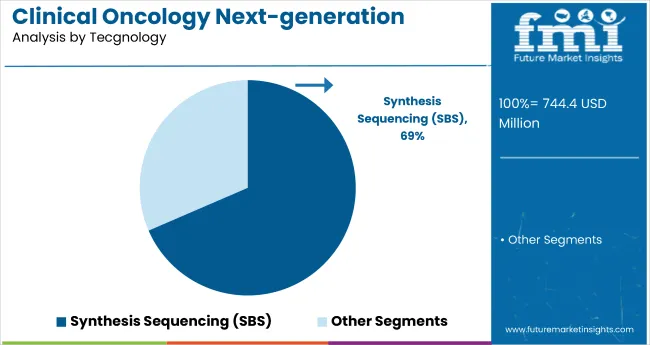
Synthesis sequencing technology is projected to dominate with an estimated 68.5% market share in 2024 within clinical oncology NGS. Its rapid analysis capabilities, cost-effectiveness, and scalability make it highly suitable for oncology diagnostics. The technology supports flexible workflows that accommodate diverse clinical sample types and volumes, requiring reduced sample inputs, which benefits clinical laboratories.
Recent advancements have improved sequencing accuracy and read lengths, expanding its clinical relevance in mutation detection and tumor profiling. These features streamline laboratory operations and reduce turnaround times, critical for timely diagnosis and treatment planning.
The technology’s adaptability allows deployment in both small research labs and large diagnostic centers, driving widespread adoption. As clinical demand for efficient and precise NGS testing grows, synthesis sequencing remains the preferred technology, expected to maintain dominance and propel innovation in oncology diagnostics over the forecast period.
Key Industry Highlights
Liquid Biopsy Technology Makes Advances in the Industry
One of the most revolutionary solutions in terms of cancer diagnostics and monitoring is liquid biopsies. Clinical oncology NGS technologies undoubtedly play a central role in liquid biopsies. They involve analyzing circulating tumor DNA or other biomarkers from blood or bodily fluids. It means that tumor dynamics and responses to treatment can be tracked in a minimally invasive manner.
As NGS technologies can detect genetic mutations in ctDNA with high sensitivity, they help better understand tumor heterogeneity and evolution on a regular basis. For this reason, the non-invasive nature of liquid biopsies opens uniquely new perspectives for cancer patient care. It can help detect tumor recurrence early and adjust treatment dynamically, which enhances patient outcomes significantly.
In February 2024, Twist Bioscience Corporation launched the cfDNA Library Preparation Kit to enable liquid biopsy research. It is designed to maximize the number of unique cfDNA molecules captured in library preparation.
Development of New Approaches Creates Opportunities in the Industry
The contributions to innovations in clinical oncology NGS by the investment in research and development have been steady and prolific. This has led to the introduction of new sequencing platforms that are considered revolutionary.
Advanced bioinformatics tools and non-traditional applications in the field of oncology continue to appear in the clinical oncology next-generation sequencing market. Key areas driving research include performance, throughput, and scalability, which has led to the clinical use of NGS technologies. Their utility is addressing challenges like data analysis plus interpretation.
Partnerships among academic institutions, industry partners, and government agencies have highly expedited efforts in NGS-based cancer research. In July 2023, a group of researchers from the Perelman School of Medicine at the University of Pennsylvania developed a new approach to mapping specific DNA marks known as 5-methylcytosine (5mC).
These marks play a regulatory role in gene expression and are pivotal in health and disease. This ground-breaking technique enables scientists to create a profile of DNA using minuscule samples that are virtually non-damageable. This new approach named Direct Methylation Sequencing (DM-Seq) has opened doors of opportunities of players.
Artificial Intelligence is Making Inroads in the Industry
Integration of artificial intelligence in NGS data analysis for cancer research continues to rise in the industry. Increasingly sophisticated artificial intelligence and machine learning algorithms allow geneticists to gain deeper insights into NGS data. They help improve the accuracy and precision of variant calling, annotation, and interpretation.
This allows the detection of medically relevant mutations and the prediction of therapeutic responses based on underlying molecular biology. They help in the identification of patient populations for tailored treatment selection/assignment.
The integration of these AI algorithms into NGS workflows can increase the level of clinical efficacy of NGS assays and empower precision oncology initiatives in general. These technologies are, therefore, witnessing more integration in the industry.
In September 2023, QIAGEN expanded its clinical decision support software to include AI-enhanced coverage of thousands of rare disease genes. Advancement of somatic NGS testing with QCI interpretation for oncology can lead to streamlined filtering of structural variants.
Country-wise Insights
This section covers the future forecast of the clinical oncology next-generation sequencing industry in the top three countries. Information on regions like North America, Europe, Asia Pacific, and others is granulated, focusing on the top countries.
France is anticipated to be at the forefront with a 21.6% CAGR through 2035. The United States follows next at a 19.4% CAGR projected through 2035. Germany secures third place, expanding at a 19.2% CAGR through 2035. Analysis indicates that Europe is likely to be the most revenue generation region for the coming decade.
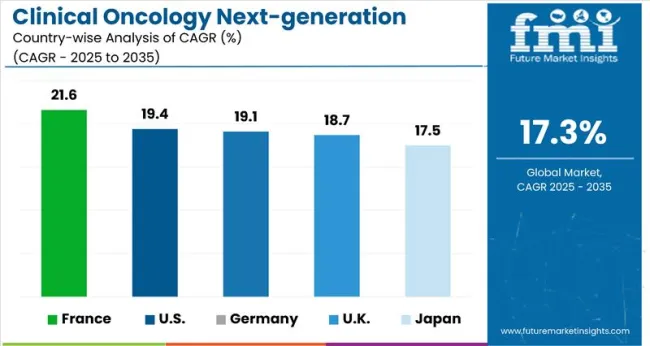
| Countries | CAGR 2025 to 2035 |
|---|---|
| France | 21.6% |
| United States | 19.4% |
| Germany | 19.1% |
Government Funding and Initiatives Foster Growth in France
The clinical oncology next-generation sequencing market expansion in France is anticipated at 21.6% through 2035. In France, a network of Next Generation Sequencing (NGS) interests is aligning to drive the technology forward in oncology research and clinical practice. This includes government initiatives and very generous funding programs, such as the National Cancer Institute and Investments for the Future.
There is a robust academic research infrastructure and premier research institutions for biomedical research. These include the Curie Institute and the Gustave Roussy Cancer Center, which are renowned for genomic and cancer biology innovation and excellence. Demand is growing for NGS-based genetic testing in rare and familial cancers, helping the industry thrive in France.
Rising Demand for Liquid Biopsy Supports Expansion in the United States
The clinical oncology next-generation sequencing market in the United States is anticipated to rise at a 19.4% CAGR through 2035. Initiatives such as ORIEN and NCI MATCH support genomic research studies and the recruitment of participants for trials.
Currently, genetic testing services offered directly to consumers are raising awareness among the public and creating a demand for NGS-based oncology testing.
FDA initiatives like the Breakthrough Devices Program speed up the introduction of assays into the industry. Also, linking with Electronic Health Records (EHRs) improves decision-making support and patient care. This diverse landscape establishes the United States as a runner in clinical oncology NGS. The country is promoting progress in precision medicine and research on genomic-driven oncology.
Greater Emphasis on Diagnosing and Treating Diseases Spurs Adoption in Germany
The clinical oncology next-generation sequencing market in Germany is expected to rise at a 19.1% CAGR through 2035. The robust healthcare system emphasizes diagnosing and treating diseases. This emphasis has led to an increase in the use of clinical oncology NGS technology in clinical genetics and cancer care.
Specialized centers and genetic testing programs provide NGS-based testing and counseling services, leading to a higher interest in precision medicine. Additionally, strict standardization and quality assurance measures ensure the precision and dependability of NGS results. This helps in building trust among healthcare professionals and patients. This holistic approach highlights Germany’s dedication to delivering top-notch healthcare services.
Leading Clinical Oncology Next-generation Sequencing Brands
- Illumina Inc.
- Thermo Fisher Scientific Inc.
- Qiagen N.V.
- F. Hoffmann-La Roche Ltd.
- Pacific Biosciences of California, Inc.
- Oxford Nanopore Technologies Ltd.
- Agilent Technologies, Inc.
- BGI Group
- PerkinElmer, Inc.
- Bio-Rad Laboratories, Inc.
Report Scope Table - Clinical Oncology Next-generation Sequencing Market
| Report Attributes | Details |
|---|---|
| Current Total Market Size (2025) | USD 744.4 million |
| Projected Market Size (2035) | USD 3.13 billion |
| CAGR (2025 to 2035) | 17.3% |
| Base Year for Estimation | 2024 |
| Historical Period | 2020 to 2024 |
| Projections Period | 2025 to 2035 |
| Quantitative Units | USD million for value |
| Components Analyzed (Segment 1) | Sequencing Platforms, Sequencing Products, Kits and Reagents, Services |
| Technologies Covered (Segment 2) | Ion Semiconductor, Pyro-Sequencing, Synthesis Sequencing (SBS), Real-Time (SMRT), Ligation, Reversible Dye Termination, Nanopore Sequencing |
| Applications Covered (Segment 3) | Whole Tumor Genome Sequencing, Whole Tumor Exome Sequencing, Targeted Tumor Genome Profiling, Tumor Transcriptome Sequencing, Tumor-Normal Comparisons |
| End Users Covered (Segment 4) | Hospitals, Laboratories, Clinical Research Organizations, Diagnostic Laboratories |
| Regions Covered | North America; Europe; Asia Pacific; Latin America; Middle East & Africa |
| Countries Covered | United States, Germany, France, China, India, Japan |
| Key Players Influencing the Market | Illumina, Thermo Fisher Scientific, Qiagen, F. Hoffmann-La Roche, Pacific Biosciences, Oxford Nanopore, Agilent Technologies, BGI Group, PerkinElmer, Bio-Rad Laboratories |
| Additional Attributes | Dollar sales by component and technology, advances in liquid biopsy, AI integration, government funding impact, precision medicine trends |
| Customization and Pricing | Customization and Pricing Available on Request |
Key Segments of Market Report
By Component:
Based on component, the industry fragments into sequencing platforms, sequencing products, kits and reagents, and services.
By Technology:
Depending on technology, the sector is segmented into ion semiconductor sequencing, pyro-sequencing, synthesis sequencing (SBS), real time sequencing (SMRT), ligation sequencing, reversible dye termination sequencing, and Nano-pore sequencing.
By Application:
Clinical oncology next-generation sequencing finds application in whole tumor genome sequencing, whole tumor exome sequencing, targeted tumor genome profiling, tumor transcriptome sequencing, tumor-normal comparisons, and others.
By End User:
Top end user existing in this industry are hospitals, laboratories, clinical research organizations, diagnostic laboratories, and others.
By Region:
Analysis of the market has been conducted in the countries of North America, Latin America, Europe, East Asia, South Asia & Pacific, and Middle East & Africa (MEA).
Frequently Asked Questions
How Big is the Clinical Oncology NGS Market?
Industry is set to reach USD 744.4 million in 2025.
What is the Sales Forecast through 2035?
The industry is expected to reach USD 3.13 billion by 2035.
What is the Potential CAGR of the Clinical Oncology Next-generation Sequencing Market?
Industry is set to report a CAGR of 17.3% from 2025 to 2035.
Which is the Leading Clinical Oncology NGS Component?
Kits and reagents lead the industry, with a share of 60.9% for 2025.
How will the Industry in France Progress?
The market in France is expected to advance at a CAGR of 21.6% through 2035.
Preview the report firsthand - request a free sample
Get SampleGet the brochure for pricing and purchase details.
Get PDFTable of Content
- Executive Summary
- Industry Introduction, including Taxonomy and Market Definition
- Market Trends and Success Factors, including Macro-economic Factors, Market Dynamics, and Recent Industry Developments
- Global Market Demand Analysis 2020 to 2024 and Forecast 2025 to 2035, including Historical Analysis and Future Projections
- Global Market Analysis 2020 to 2024 and Forecast 2025 to 2035
- Component
- Technology
- Application
- End User
- Global Market Analysis 2020 to 2024 and Forecast 2025 to 2035, By Component
- Sequencing Platforms
- Sequencing Products
- Kits and Reagents
- Services
- Global Market Analysis 2020 to 2024 and Forecast 2025 to 2035, By Technology
- Ion Semiconductor Sequencing
- Pyro-Sequencing
- Synthesis Sequencing (SBS)
- Real Time Sequencing (SMRT)
- Ligation Sequencing
- Reversible Dye Termination Sequencing
- Nano-Pore Sequencing
- Global Market Analysis 2020 to 2024 and Forecast 2025 to 2035, By Application
- Whole Tumor Genome Sequencing
- Whole Tumor Exome Sequencing
- Targeted Tumor Genome Profiling
- Tumor Transcriptome Sequencing
- Tumor-normal Comparisons
- Others
- Global Market Analysis 2020 to 2024 and Forecast 2025 to 2035, By End User
- Hospital Laboratories
- Clinical Research Organizations
- Diagnostic Laboratories
- Others
- Global Market Analysis 2020 to 2024 and Forecast 2025 to 2035, By Region
- North America
- Latin America
- Western Europe
- South Asia
- East Asia
- Eastern Europe
- Middle East & Africa
- North America Sales Analysis 2020 to 2024 and Forecast 2025 to 2035, by Key Segments and Countries
- Latin America Sales Analysis 2020 to 2024 and Forecast 2025 to 2035, by Key Segments and Countries
- Western Europe Sales Analysis 2020 to 2024 and Forecast 2025 to 2035, by Key Segments and Countries
- South Asia Sales Analysis 2020 to 2024 and Forecast 2025 to 2035, by Key Segments and Countries
- East Asia Sales Analysis 2020 to 2024 and Forecast 2025 to 2035, by Key Segments and Countries
- Eastern Europe Sales Analysis 2020 to 2024 and Forecast 2025 to 2035, by Key Segments and Countries
- Middle East & Africa Sales Analysis 2020 to 2024 and Forecast 2025 to 2035, by Key Segments and Countries
- Sales Forecast 2025 to 2035 by Component, Technology, Application, and End User for 30 Countries
- Competition Outlook, including Market Structure Analysis, Company Share Analysis by Key Players, and Competition Dashboard
- Company Profile
- Illumina, Inc.
- F. Hoffmann-La Roche Ltd
- Oxford Nanopore Technologies
- Agilent Technologies
- Thermo Fisher Scientific Inc
- QIAGEN N.V.
- Pacific Biosciences of California, Inc.
- BGI Group
- Takara Bio, Inc.
- Creative-Biolabs
- Mogene LC


