


About The Report
Compact Loader Market Forecast and Outlook 2026 to 2036
The compact loader market is valued at USD 5.6 billion in 2026 and is projected to reach USD 7.6 billion by 2036, expanding at a CAGR of 3.1% over the forecast period. Demand is supported by steady adoption of compact loaders across construction, landscaping, agriculture, municipal services, and material handling applications where maneuverability and versatility remain critical. Compact loaders are preferred for operating in confined spaces, urban job sites, and indoor environments that limit the use of larger equipment.
Construction represents a major demand segment, with compact loaders used for excavation, site preparation, debris handling, and material transport in residential and light commercial projects. Landscaping and grounds maintenance activities also contribute significantly, driven by urban development, infrastructure maintenance, and commercial property management. Agricultural applications include feed handling, cleaning operations, and light-duty material movement within farms and livestock facilities.
Quick Stats for Compact Loader Market
- Market Value (2026): USD 5.6 billion
- Market Forecast Value (2036): USD 7.6 billion
- Forecast CAGR (2026 to 2036): 3.1%
- Leading Segment in Global Demand: Compact Track Loaders 38.5% share
- Key Growth Regions in Global Demand: North America, Asia Pacific, Europe
- Top Key Players in Global Demand: Caterpillar Inc., Komatsu Ltd., Hitachi Construction Machinery Co. Ltd., Yanmar Holding Co. Ltd., Volvo Construction Equipment, Liebherr Group, Deere and Company, Xuzhou Construction Machinery Group Co. Ltd., Sany Heavy Industry Co. Ltd., Doosan Corporation
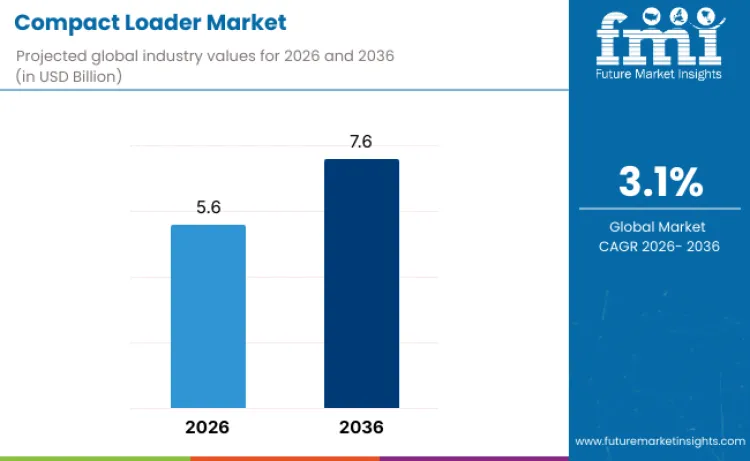
Equipment design focuses on hydraulic performance, attachment compatibility, operator comfort, and fuel efficiency. Skid steer loaders and compact track loaders remain widely used due to their adaptability across multiple attachments such as buckets, forks, augers, and trenchers. Rental services play an important role in market activity, as contractors and small operators prefer flexible access to compact equipment without long-term ownership commitments.
Market dynamics reflect construction spending trends, infrastructure maintenance activity, and equipment replacement cycles. Manufacturers emphasize product durability, ease of maintenance, and dealer network expansion to support customer access and service coverage. Demand outlook reflects stable growth supported by urban construction activity, landscaping services, and continued reliance on compact equipment solutions through 2036.
Compact Loader Market Key Takeaways
| Metric | Value |
|---|---|
| Market Value (2026) | USD 5.6 billion |
| Market Forecast Value (2036) | USD 7.6 billion |
| Forecast CAGR (2026 to 2036) | 3.1% |
How Is The Compact Loader Market Segmented?
The compact loader market is segmented by type, application, and region, reflecting equipment usage patterns across construction, agricultural, and industrial environments. By type, the industry includes compact track loaders, skid steer loaders, backhoe loaders, and wheeled loaders, each designed to address specific terrain conditions, load requirements, and operational preferences. Application-based segmentation covers construction, agriculture and forestry, industrial operations, and utilities, highlighting the versatility of compact loaders across job sites. Regional segmentation spans North America, Latin America, Western Europe, Eastern Europe, Balkan and Baltic countries, Russia and Belarus, Central Asia, East Asia, South Asia and Pacific, and the Middle East and Africa. Market structure is shaped by infrastructure activity levels, mechanization trends, and rental equipment penetration. This segmentation framework supports targeted investment analysis across high-utilization industries and regions with sustained equipment demand.
Why Do Compact Track Loaders Lead The Industry By Type?
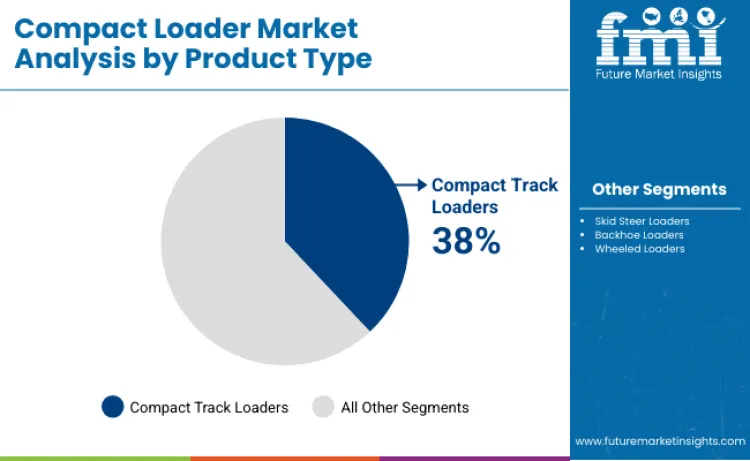
Compact track loaders hold about 38.5% share of the type segment due to strong traction performance and operational stability across challenging surfaces. These machines operate effectively on soft soil, uneven terrain, and muddy conditions where wheeled equipment faces limitations. Improved undercarriage durability and enhanced load-handling capability support higher productivity and longer service intervals. Compact track loaders support diverse attachments through quick-coupler systems, increasing job-site flexibility. Agriculture, landscaping, and construction sectors favor these machines for year-round usability and reduced ground disturbance. Advanced hydraulic systems improve control and attachment performance. Operator comfort features also influence purchasing decisions. These performance and adaptability benefits position compact track loaders as the leading equipment type within the compact loader market.
Why Does Construction Dominate Compact Loader Applications?
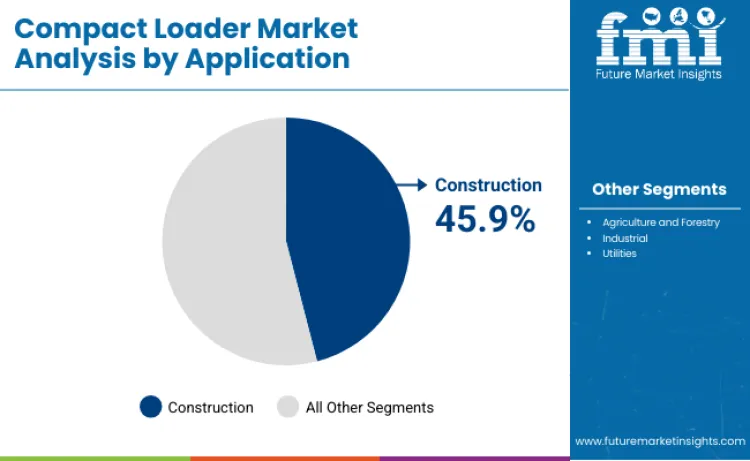
The construction segment accounts for about 45.9% of compact loader demand due to consistent need for versatile equipment in confined and urban job sites. Compact loaders perform grading, digging, lifting, and material handling tasks efficiently in limited spaces. Infrastructure development, residential construction, and road maintenance projects drive steady equipment utilization. Contractors favor compact loaders for their maneuverability and multi-function capability. Rental fleet expansion supports broader access to compact loaders among small and mid-sized contractors. Fuel efficiency and simplified maintenance improve total cost control. Ongoing construction activity across developed and emerging regions sustains demand. These factors reinforce construction as the dominant application segment in the compact loader market.
What Factors Drive Compact Loader Market Growth?
Market growth is supported by rising infrastructure development and increased focus on efficient job-site operations. Demand grows for equipment offering versatility across multiple tasks. Operator comfort and safety features influence fleet upgrade decisions. Expansion of rental services increases accessibility for short-term projects. Growth in landscaping, municipal services, and utility maintenance supports steady equipment usage. Home improvement and small-scale land management activities contribute incremental demand. Technological improvements enhance productivity and machine control. These drivers collectively support continued adoption of compact loaders across construction, agriculture, and industrial sectors.
What Opportunities Shape The Compact Loader Market?
Opportunities emerge from technological upgrades that improve machine efficiency and usability. Integration of telematics supports equipment monitoring and maintenance planning. Automation features enhance operational precision. Customizable attachments expand application scope across industries. Demand grows for machines with reduced fuel consumption and lower operating costs. Training programs offered by manufacturers improve operator proficiency and equipment utilization. Growth in emerging markets presents new sales potential. These opportunities support product differentiation and long-term growth strategies within the compact loader market.
What Challenges Affect The Compact Loader Market?
Market expansion faces challenges linked to economic cycles affecting construction investment. Fluctuations in raw material costs influence manufacturing expenses and pricing strategies. Limited infrastructure development in certain regions restricts equipment demand. Skilled operator shortages affect utilization efficiency. Project delays tied to political or financial constraints influence procurement decisions. Maintenance requirements and ownership costs affect buyer preferences. These challenges shape cautious investment planning and influence adoption rates across different regions and applications within the compact loader market.
How Is the Compact Loader Market Expected to Perform Across Key Countries from 2026 to 2036?
The compact loader market from 2026 to 2036 reflects steady expansion across construction, agriculture, logistics, and landscaping activities. Compact loaders are valued for maneuverability, versatility, and ability to operate in space-constrained environments. Demand growth is closely linked to urban development, mechanization of farming activities, infrastructure maintenance, and material handling needs. Countries with expanding cities, active agricultural sectors, and organized construction ecosystems show stronger adoption. Developed economies focus on replacement demand and specialized applications, while developing regions emphasize fleet expansion and multi-purpose usage. Manufacturing capability, dealer networks, and application diversity play a central role in shaping country-level demand patterns during the forecast period.
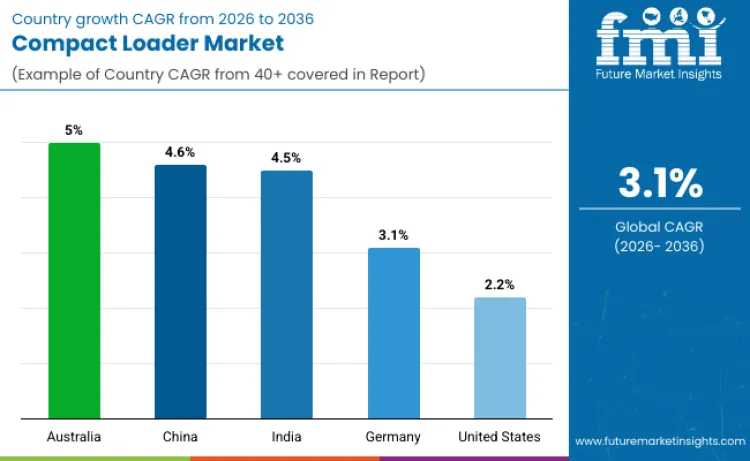
| Country | CAGR |
|---|---|
| Australia | 5.0% |
| China | 4.6% |
| India | 4.5% |
| Germany | 3.1% |
| United States | 2.2% |
Why Does Australia Represent a High-Potential Compact Loader Market?
Australia is projected to grow at a CAGR of 5.0% from 2026 to 2036. Urban expansion across major cities drives demand for compact loaders in residential construction and municipal maintenance activities. Landscaping services rely on compact loaders for site preparation, material movement, and surface leveling in both commercial and residential projects. Agriculture remains a key demand contributor, with compact loaders used for feed handling, fencing support, and general farm operations. Mining-adjacent infrastructure and rural development programs support consistent equipment utilization. Strong preference for versatile machinery across construction and land management applications sustains steady adoption across Australian end-user segments.
How Is China Supporting Growth of the Compact Loader Market?
China is expected to record a CAGR of 4.6% during 2026 to 2036. Dense urban construction zones create demand for compact loaders capable of operating in confined job sites. Infrastructure upgrades in interior provinces increase equipment usage for road maintenance, drainage work, and public utilities. Warehousing and logistics facilities adopt compact loaders for pallet movement and material handling operations. Agricultural mechanization programs encourage equipment use in small and mid-sized farming operations. Domestic manufacturing capacity supports availability across price segments, strengthening penetration across construction contractors, municipal bodies, and logistics operators.
What Is Driving Compact Loader Adoption in India?
India is projected to grow at a CAGR of 4.5% from 2026 to 2036. Rapid urbanization supports compact loader usage in municipal services such as waste handling, road cleaning, and drainage maintenance. Construction activity across housing, commercial buildings, and infrastructure projects increases demand for compact material handling equipment. Agriculture continues to rely on compact loaders for crop handling, farm maintenance, and transport tasks. Growth of domestic equipment manufacturing improves affordability and regional availability. Contractor preference for multi-application machinery supports wider adoption across urban and semi-urban regions.
Why Does Germany Maintain Steady Demand for Compact Loaders?
Germany is expected to expand at a CAGR of 3.1% during 2026 to 2036. Compact loaders are widely used in construction, industrial facilities, and municipal operations requiring precise material handling. Snow removal applications contribute to seasonal demand across urban and suburban regions. Manufacturing and logistics facilities rely on compact loaders for internal material movement and yard management. Emphasis on equipment efficiency and operator safety supports demand for advanced models with improved control systems. Strong dealer networks and maintenance infrastructure sustain replacement demand across professional user segments.
How Is the United States Shaping the Compact Loader Market?
The United States is projected to grow at a CAGR of 2.2% from 2026 to 2036. Landscaping services represent a major demand segment, with compact loaders used for grading, soil movement, and property maintenance. Residential construction and renovation projects increase equipment utilization across suburban regions. Forestry and land clearing activities adopt compact loaders for log handling and site preparation. Rental fleets play an important role in market accessibility, supporting demand from small contractors and homeowners. Mature construction practices and widespread equipment availability sustain consistent usage across diverse applications.
Who Are the Leading Suppliers in the Compact Loader Market?
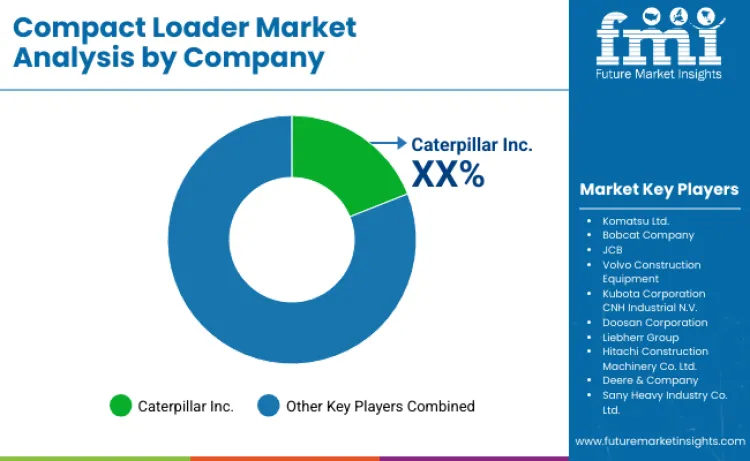
The compact loader market is shaped by a group of global construction equipment manufacturers that compete through machine performance, attachment versatility, dealer coverage, and long-term service capabilities. Caterpillar Inc. holds a leading position through a broad range of skid steer loaders, compact track loaders, and wheel loaders designed for construction, landscaping, agriculture, and municipal applications. Its strength lies in machine durability, advanced control systems, and a dense dealer network that supports uptime and parts availability.
Komatsu Ltd. and Bobcat Company are influential suppliers with strong emphasis on operator comfort, precision hydraulics, and compact loader platforms compatible with a wide range of attachments. Bobcat maintains a particularly strong reputation in skid steer and compact track loader categories, while Komatsu integrates digital monitoring and fleet management features into its compact equipment lineup.
JCB and Volvo Construction Equipment compete through efficient powertrains, visibility-focused cab designs, and compact loaders optimized for material handling and urban construction environments. Kubota Corporation and CNH Industrial N.V. address demand from agriculture, infrastructure maintenance, and rental fleets with compact loaders known for reliability and ease of maintenance.
Asian and European suppliers such as Doosan Corporation, Liebherr Group, and Hitachi Construction Machinery Co. Ltd. strengthen competitive intensity through engineering-driven designs, regional manufacturing bases, and expanding compact loader portfolios. Across suppliers, competition centers on lifting capacity, machine stability, attachment compatibility, operator ergonomics, and digital diagnostics, with continuous product upgrades shaping purchasing decisions among contractors and equipment rental providers.
Key Manufacturers in the Compact Loader Market
- Caterpillar Inc.
- Komatsu Ltd.
- Bobcat Company
- JCB
- Volvo Construction Equipment
- Kubota Corporation
- CNH Industrial N.V.
- Doosan Corporation
- Liebherr Group
- Hitachi Construction Machinery Co. Ltd.
- Deere & Company
- Sany Heavy Industry Co. Ltd.
- Xuzhou Construction Machinery Group Co. Ltd.
Scope of Report
| Attribute | Details |
|---|---|
| Unit of Measurement | USD billion |
| Market Size 2026 | USD 5.6 billion |
| Market Size 2036 | USD 7.6 billion |
| CAGR 2026 to 2036 | 3.1% |
| Segments Covered | By Product Type, By Application, By Region |
| Product Types Analyzed | Compact Track Loaders, Skid Steer Loaders |
| Applications Analyzed | Construction, Agriculture, Landscaping, Municipal Use |
| Regions Covered | North America, Latin America, Europe, East Asia, South Asia and Pacific, Middle East and Africa |
| Top Countries Analyzed | United States, China, Germany, Japan, India, United Kingdom, France, Brazil, Italy, Canada |
| Leading Companies | Caterpillar Inc., Komatsu Ltd., Hitachi Construction Machinery Co. Ltd., Yanmar Holding Co. Ltd., Volvo Construction Equipment, Liebherr Group, Deere and Company, Xuzhou Construction Machinery Group Co. Ltd., Sany Heavy Industry Co. Ltd., Doosan Corporation, Kubota Corporation, CNH Industrial N.V., Takeuchi Manufacturing Co. Ltd. |
Compact Loader Market by Segments
By Application:
- Construction
- Agriculture and Forestry
- Industrial
- Utilities
By Product Type:
- Compact Track Loaders
- Skid Steer Loaders
- Backhoe Loaders
- Wheeled Loaders
By Region:
- North America
- Latin America
- Western Europe
- Eastern Europe
- Asia Pacific excluding Japan
- Middle East and Africa
- Japan
Bibliography
- USA Census Bureau. (2023). Construction spending, equipment usage patterns, and infrastructure activity indicators. USA Department of Commerce.
- USA Department of Transportation. (2023). Infrastructure construction activity and equipment utilization in public works projects. Federal Highway Administration.
- Food and Agriculture Organization of the United Nations. (2022). Agricultural mechanization trends and use of compact machinery in farming operations. FAO Agricultural Engineering Series.
- International Labour Organization. (2022). Machinery use, productivity, and equipment adoption in construction and landscaping sectors. ILO Sectoral Studies.
- Organisation for Economic Co-operation and Development. (2023). Construction industry dynamics, capital equipment investment, and rental market development. OECD Industry Analysis Papers.
Frequently Asked Questions
How big is the compact loader market in 2026?
The global compact loader market is valued at USD 5.6 billion in 2026.
What will be the size of the compact loader market in 2036?
The compact loader market is projected to reach USD 7.6 billion by 2036.
How much will the compact loader market grow between 2026 and 2036?
The compact loader market is expected to grow at a CAGR of 3.1% between 2026 and 2036.
What are the key product types in the compact loader market?
Key product types include compact track loaders and skid steer loaders, which together account for the majority of global demand.
Which application segment contributes the largest share in the compact loader market?
Construction represents the leading application segment, accounting for approximately 45.9% share due to extensive use in residential, commercial, and infrastructure projects.
Table of Content
- Executive Summary
- Compact Loader Market Size and Growth Overview
- Market Value, Forecast, and CAGR Summary
- Key Product Type and Application Share Highlights
- Regional Growth Overview
- Compact Loader Market Forecast and Outlook (2026-2036)
- Market Valuation and Growth Trajectory
- Role of Compact Loaders Across Construction, Landscaping, and Agriculture
- Demand Patterns Across Confined and Urban Job Sites
- Equipment Design, Performance, and Attachment Compatibility
- Long-Term Demand Outlook Through 2036
- Market Key Takeaways
- Market Overview
- Market Definition and Scope
- Compact Loader Value Proposition and Usage Characteristics
- Linkage with Construction Activity and Equipment Rental Markets
- Market Segmentation Analysis
- Segmentation by Product Type
- Segmentation by Application
- Segmentation by Region
- Market Analysis by Product Type
- Compact Track Loaders
- Skid Steer Loaders
- Backhoe Loaders
- Wheeled Loaders
- Market Analysis by Application
- Construction
- Agriculture and Forestry
- Industrial Operations
- Utilities and Municipal Services
- Market Dynamics
- Key Growth Drivers
- Market Opportunities
- Market Challenges and Constraints
- Compact Loader Market Outlook and Performance Assessment (2026-2036)
- Regional and Country-Level Market Analysis
- Australia
- China
- India
- Germany
- United States
- Competitive Landscape Analysis
- Industry Structure and Competitive Environment
- Key Competitive Parameters and Differentiation
- Role of Dealer Networks and Rental Services
- Company Profiles
- Caterpillar Inc.
- Komatsu Ltd.
- Bobcat Company
- JCB
- Volvo Construction Equipment
- Kubota Corporation
- CNH Industrial N.V.
- Doosan Corporation
- Liebherr Group
- Hitachi Construction Machinery Co. Ltd.
- Deere and Company
- Sany Heavy Industry Co. Ltd.
- Xuzhou Construction Machinery Group Co. Ltd.
- Scope of Report
- Compact Loader Market Segmentation Summary
- Frequently Asked Questions
- Bibliography
List of Tables
- Table 1: Compact Loader Market Value (USD Billion), 2026 and 2036
- Table 2: Compact Loader Market Forecast CAGR (%), 2026-2036
- Table 3: Compact Loader Market Key Takeaways
- Table 4: Compact Loader Market Segmentation Framework by Product Type, Application, and Region
- Table 5: Product Type Definitions and Operating Characteristics of Compact Loaders
- Table 6: Application Coverage and Job-Site Usage Patterns of Compact Loaders
- Table 7: Regional Coverage and Equipment Penetration Characteristics
- Table 8: Compact Loader Market Share by Product Type (%), 2026
- Table 9: Compact Track Loaders Demand Share and Performance Rationale
- Table 10: Skid Steer Loaders Demand Share and Use Case Analysis
- Table 11: Backhoe Loaders Demand Profile within Compact Equipment Category
- Table 12: Wheeled Loaders Demand Profile within Compact Equipment Category
- Table 13: Compact Loader Market Share by Application (%), 2026
- Table 14: Construction Application Demand Share and Equipment Utilization Logic
- Table 15: Agriculture and Forestry Application Demand Profile
- Table 16: Industrial Application Demand Profile
- Table 17: Utilities and Municipal Application Demand Profile
- Table 18: Market Drivers and Demand Impact Mapping for Compact Loaders
- Table 19: Market Opportunities and Strategic Implications for Manufacturers
- Table 20: Market Challenges and Risk Factors Affecting Compact Loader Adoption
- Table 21: Compact Loader Market Outlook Interpretation by Country
- Table 22: Country-Level CAGR Comparison (%), 2026-2036
- Table 23: Australia Compact Loader Market Growth Outlook and Demand Drivers
- Table 24: China Compact Loader Market Growth Outlook and Urban Infrastructure Influence
- Table 25: India Compact Loader Market Growth Outlook and Mechanization Trends
- Table 26: Germany Compact Loader Market Growth Outlook and Replacement Demand
- Table 27: United States Compact Loader Market Growth Outlook and Rental Market Role
- Table 28: Competitive Landscape Summary of the Compact Loader Market
- Table 29: Competitive Differentiation Parameters Including Attachments, Hydraulics, and Dealer Coverage
- Table 30: Key Manufacturer Product Portfolio Overview
- Table 31: Regional Presence of Leading Compact Loader Manufacturers
- Table 32: Scope of Report
- Table 33: Compact Loader Market Segmentation List by Product Type, Application, and Region
List of Figures
- Figure 1: Compact Loader Market Value Growth Trend (USD Billion), 2026-2036
- Figure 2: Compact Loader Market CAGR Visualization (%), 2026-2036
- Figure 3: Compact Loader Market Share Distribution by Product Type (%)
- Figure 4: Compact Track Loaders Share Highlight and Demand Concentration (%)
- Figure 5: Skid Steer Loaders Share Highlight and Application Spread (%)
- Figure 6: Other Compact Loader Types Share Comparison
- Figure 7: Compact Loader Market Share Distribution by Application (%)
- Figure 8: Construction Application Demand Concentration for Compact Loaders
- Figure 9: Agriculture and Forestry Application Demand Positioning
- Figure 10: Industrial Application Demand Positioning
- Figure 11: Utilities and Municipal Application Demand Positioning
- Figure 12: Driver Impact Framework for Compact Loader Adoption
- Figure 13: Opportunity Mapping for Technology Integration and Attachment Expansion
- Figure 14: Challenge Impact Framework Affecting Compact Loader Procurement
- Figure 15: Country-Level CAGR Comparison for Compact Loader Market (%), 2026-2036
- Figure 16: Australia Compact Loader Market Growth Trajectory
- Figure 17: China Compact Loader Market Growth Trajectory
- Figure 18: India Compact Loader Market Growth Trajectory
- Figure 19: Germany Compact Loader Market Growth Trajectory
- Figure 20: United States Compact Loader Market Growth Trajectory
- Figure 21: Regional Demand Footprint of the Compact Loader Market
- Figure 22: Asia Pacific Demand Positioning in Global Compact Loader Usage
- Figure 23: Europe Demand Positioning in Global Compact Loader Usage
- Figure 24: North America Demand Positioning in Global Compact Loader Usage
- Figure 25: Competitive Landscape Map of Compact Loader Manufacturers
- Figure 26: Competitive Positioning Matrix Based on Product Breadth and Dealer Network Strength
- Figure 27: Manufacturer Role Mapping Across Construction, Agriculture, and Rental Segments
Our Research Products

The "Full Research Suite" delivers actionable market intel, deep dives on markets or technologies, so clients act faster, cut risk, and unlock growth.

The Leaderboard benchmarks and ranks top vendors, classifying them as Established Leaders, Leading Challengers, or Disruptors & Challengers.

Locates where complements amplify value and substitutes erode it, forecasting net impact by horizon

We deliver granular, decision-grade intel: market sizing, 5-year forecasts, pricing, adoption, usage, revenue, and operational KPIs—plus competitor tracking, regulation, and value chains—across 60 countries broadly.

Spot the shifts before they hit your P&L. We track inflection points, adoption curves, pricing moves, and ecosystem plays to show where demand is heading, why it is changing, and what to do next across high-growth markets and disruptive tech

Real-time reads of user behavior. We track shifting priorities, perceptions of today’s and next-gen services, and provider experience, then pace how fast tech moves from trial to adoption, blending buyer, consumer, and channel inputs with social signals (#WhySwitch, #UX).

Partner with our analyst team to build a custom report designed around your business priorities. From analysing market trends to assessing competitors or crafting bespoke datasets, we tailor insights to your needs.
Supplier Intelligence
Discovery & Profiling
Capacity & Footprint
Performance & Risk
Compliance & Governance
Commercial Readiness
Who Supplies Whom
Scorecards & Shortlists
Playbooks & Docs
Category Intelligence
Definition & Scope
Demand & Use Cases
Cost Drivers
Market Structure
Supply Chain Map
Trade & Policy
Operating Norms
Deliverables
Buyer Intelligence
Account Basics
Spend & Scope
Procurement Model
Vendor Requirements
Terms & Policies
Entry Strategy
Pain Points & Triggers
Outputs
Pricing Analysis
Benchmarks
Trends
Should-Cost
Indexation
Landed Cost
Commercial Terms
Deliverables
Brand Analysis
Positioning & Value Prop
Share & Presence
Customer Evidence
Go-to-Market
Digital & Reputation
Compliance & Trust
KPIs & Gaps
Outputs
Full Research Suite comprises of:

Market outlook & trends analysis
Interviews & case studies
Strategic recommendations
Vendor profiles & capabilities analysis
5-year forecasts
8 regions and 60+ country-level data splits
Market segment data splits
12 months of continuous data updates
DELIVERED AS:
PDF EXCEL ONLINE


