

- Industry Size (2026)
- USD 3.22 Bn
- Forecast (2036)
- USD 39.77 Bn
- CAGR (2026 to 2036)
- 28.6%
Counter Drone System Market size, market forecast and outlook by FMI
The counter drone system market was valued at USD 2.50 billion in 2025, projected to reach USD 3.22 billion in 2026, and is forecast to expand to USD 39.77 billion by 2036 at a 28.6% CAGR.
Summary of Counter Drone System Market
- Market valuation is expected to climb to USD 39.77 billion by 2036.
- The industry is expected to expand at 28.6% annually from 2026 through 2036.
- The 2025 baseline valuation came in at USD 2.50 billion.
- The ten-year outlook presents a cumulative growth opportunity of USD 36.55 billion.
- Detection systems lead by type with 51.7% share in 2026 as radar, RF sensor, and electro-optical tracking technologies form the foundation layer of all C-UAS architectures.
- Military end use commands 58.4% share in 2026 as armed forces remain the primary procurement channel for integrated detect-and-neutralize counter-drone platforms.
- Demand is accelerating as defence ministries worldwide reclassify counter-drone capability from emerging technology research into mandatory procurement line items in national defence budgets.
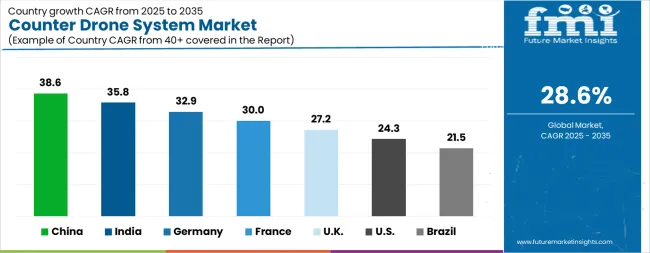
- Among key countries, China leads at 38.6% CAGR, followed by India at 35.8%, Germany at 32.9%, France at 30.0%, the UK at 27.2%, the USA at 24.3%, and Brazil at 21.5%.
Counter Drone System Market key takeaways
| Metric | Details |
|---|---|
| Industry Size (2026) | USD 3.22 billion |
| Industry Value (2036) | USD 39.77 billion |
| CAGR (2026-2036) | 28.6% |
Source: Future Market Insights, 2026
Escalating asymmetric threat profiles from commercial drone misuse across military installations, critical infrastructure, and civilian airspace are compelling defence ministries and homeland security agencies worldwide to allocate dedicated counter-unmanned aerial system (C-UAS) procurement budgets. The category has transitioned from niche defence research programmes into a standing line item in national defence procurement schedules.
FMI analysts observe that the counter drone system market is experiencing a procurement acceleration cycle driven by the convergence of three factors: documented combat deployment of armed commercial drones in active conflict zones, rising drone incursion incidents at airports and government facilities, and the decreasing cost of weaponizable consumer drone platforms. Military procurement agencies that previously categorized C-UAS as an emerging technology line are now classifying it as a mandatory capability requirement. As per FMI, the shift from detection-only systems to integrated detect-and-neutralize platforms is the primary value driver in current procurement cycles, with layered defence architectures combining radar, radio frequency sensors, electro-optical trackers, and kinetic or electronic countermeasures becoming the standard specification for military and critical infrastructure contracts.
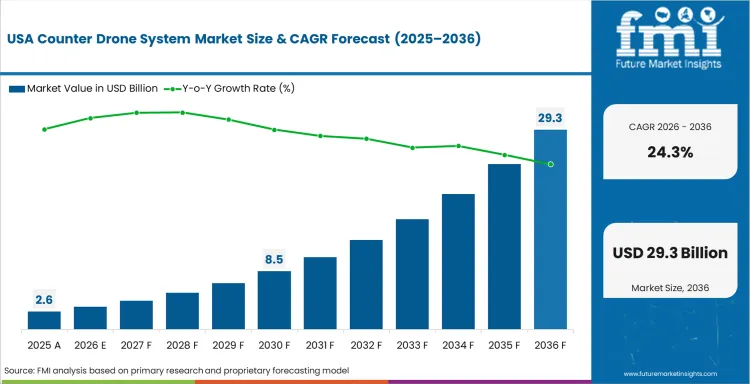
All major markets reflect accelerated deployment parameters. China sets a 38.6% CAGR, India sets a 35.8% CAGR, Germany sets a 32.9% CAGR, France sets a 30.0% CAGR, UK sets a 27.2% CAGR, USA sets a 24.3% CAGR, and Brazil sets a 21.5% CAGR. China leads at 38.6% CAGR as military modernization programmes incorporate layered C-UAS architecture across border and coastal defence networks. India follows at 35.8%, where defence procurement fast-tracking for counter-drone systems is responding to cross-border drone incursion incidents. Germany at 32.9% reflects NATO-aligned procurement acceleration. France at 30.0% is driven by critical infrastructure protection mandates. The UK at 27.2% maintains steady expansion through integrated airspace defence procurement. The USA at 24.3% sustains the largest absolute procurement base. Brazil at 21.5% invests in border security C-UAS capabilities.
Counter Drone System Market definition
Counter drone systems are integrated technology platforms designed to detect, track, identify, and neutralize unauthorized unmanned aerial vehicles operating in restricted or protected airspace. System categories span detection subsystems using radar, radio frequency sensors, acoustic sensors, and electro-optical/infrared cameras, and neutralization subsystems employing electronic jamming, GPS spoofing, directed energy, net capture, or kinetic intercept methods. These systems are deployed across military installations, government facilities, airports, critical infrastructure sites, and public event venues.
Counter Drone System Market inclusions
Market scope includes all counter-drone detection and neutralization hardware, software, and integrated system platforms sold for military, government, and critical infrastructure applications. Regional and country-level market sizes, forecast period 2026 to 2036, and segment breakdowns by type and end use are fully incorporated.
Counter Drone System Market exclusions
The scope excludes general-purpose air defence systems designed for manned aircraft, drone manufacturing and assembly equipment, commercial drone traffic management software, and recreational drone accessories.
Counter Drone System Market research methodology
- Primary Research:Analysts conducted interviews with defence procurement officers, military C-UAS programme managers, critical infrastructure security directors, and counter-drone system integrators to map acquisition cycles and performance specification requirements.
- Desk Research:Data collection aggregated national defence budget allocations, military procurement contract databases, airport security incident reports, and defence contractor annual reports and investor disclosures.
- Market-Sizing and Forecasting:Baseline values derive from a bottom-up aggregation of military and civilian C-UAS procurement contract values by region, applying end-use-specific adoption curves and defence budget allocation trajectories.
- Data Validation and Update Cycle:Projections are tested against publicly reported defence contract awards, confirmed programme-of-record designations, and defence industry analyst consensus on C-UAS budget allocation trends.
Why is the Counter Drone System Market Growing?
The Counter Drone System market is experiencing substantial growth as the demand for protection against unauthorized and potentially hazardous drone activity rises across defense, commercial, and critical infrastructure sectors. The market is being driven by increasing concerns over airspace security, the proliferation of consumer and commercial drones, and the adoption of drone technology by malicious actors. Advanced systems that can detect, track, and neutralize drones without physical engagement are becoming central to national security strategies.
Investment in smart detection and mitigation solutions, including AI-enabled sensing and automated response technologies, is supporting market expansion. The market’s future outlook is shaped by ongoing innovations in radar, radio frequency, and optical detection technologies that allow for rapid threat assessment and precise neutralization.
Heightened government and military initiatives to secure sensitive areas, along with regulatory frameworks promoting drone control, are creating opportunities for vendors to deploy scalable and modular counter drone systems These factors collectively provide a strong foundation for continued market growth globally.
Segmental Analysis
The counter drone system market is segmented by type, end use, and geographic regions. By type, counter drone system market is divided into Detection Systems and Neutralizing Systems. In terms of end use, counter drone system market is classified into Military, Government, Airfields, and Others. Regionally, the counter drone system industry is classified into North America, Latin America, Western Europe, Eastern Europe, Balkan & Baltic Countries, Russia & Belarus, Central Asia, East Asia, South Asia & Pacific, and the Middle East & Africa.
Insights into the Detection Systems Segment
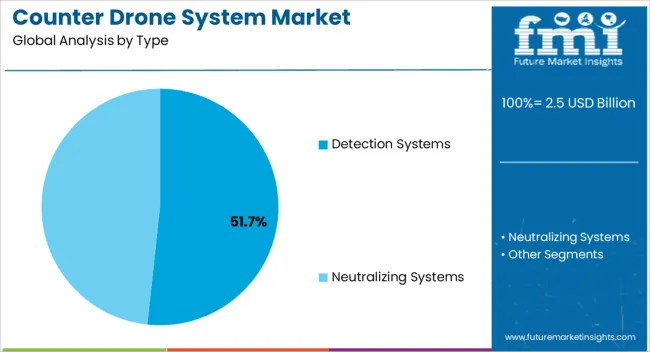
Detection Systems are projected to hold 51.70% of the Counter Drone System market revenue share in 2026, making them the leading type segment. This position is being attributed to the increasing need for early threat identification and situational awareness in both military and civilian contexts. Detection systems provide comprehensive monitoring capabilities, combining radar, radio frequency, and optical technologies to identify unauthorized drone activity in real-time.
The adoption of these systems has been accelerated by the rising number of drone incidents, including security breaches and safety hazards in sensitive areas. The growth of this segment is further reinforced by technological advances in AI-based analytics and automated alerts, which enhance accuracy and response time. Their deployment allows organizations to take preventive measures before drones enter restricted zones or engage in malicious activity.
Furthermore, detection systems are highly scalable, permitting integration with other counter drone technologies such as mitigation and neutralization solutions As airspace security continues to be a top priority, detection systems are expected to maintain dominance, supported by their reliability, adaptability, and the critical role they play in protecting assets from evolving aerial threats.
Insights into the Military Segment
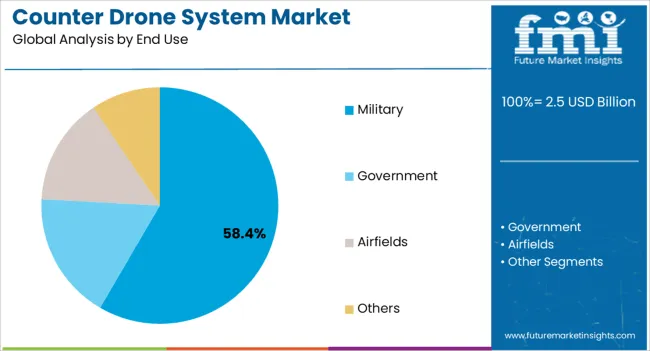
The Military end-use industry is expected to hold 58.40% of the Counter Drone System market revenue share in 2026, positioning it as the largest end-user segment. This leadership is being driven by the increasing reliance on counter drone systems to protect bases, borders, and critical defense infrastructure against unauthorized or hostile drones. Military operations are being increasingly challenged by drones used for surveillance, smuggling, and potential attacks, which necessitates the deployment of sophisticated detection and mitigation solutions.
Adoption is further supported by government initiatives to enhance national security and the growing integration of automated systems capable of identifying and neutralizing airborne threats with minimal human intervention. The growth of this segment is also fueled by the high budget allocations for defense modernization programs and the need for systems that can be rapidly deployed across diverse terrains and operational scenarios.
The military sector’s preference for advanced counter drone technologies reflects a strategic approach to ensuring airspace security, preventing intelligence breaches, and maintaining operational superiority Consequently, the Military end-use segment is projected to continue leading market adoption, driven by the ongoing prioritization of drone threat management and security preparedness.
Market Overview
Counter Drone System Market: Introduction
Counter drone system technology is also known as counter-UAS, C-UAS or counter-UAV technology. Counter drone technology is a system that is used to detect or monitor unmanned aircrafts. Companies in the counter drone system market are relying on new technologies to remain progressive and smart.
As concerns regarding security are on the rise, drones are likely to create threats to civilian as well as military entities. The counter drone system market is emerging to help decrease these threats. The growth of the counter drone system market is directly correlated to security, especially in defence. Defence organisations of several countries have significantly increased their investments in C-UAS counter drone system technology following an increase in threats from terrorist organisations such as ISIS and others. Counter drone system technology is already being used in multiple applications in different sectors. C-UAS counter drone systems have, so far, been used most commonly for base protection as they complement existing weapons such as counter-mortar systems and surveillance platforms. In addition, there is growing interest in portable and mobile systems that can be used to protect ground units and convoys. Apart from military and government, the commercial sector is also expected to contribute significantly to the counter drone system market in the coming years. Counter drone system technology has so far primarily been used to provide protection to the airspace at airports as well as to events such as parties & sports games, protection to VIPs and counter-smuggling operations.
Counter drone systems are adopted by people and are expected to evolve with advancements in aerial technology. Counter drone systems are most commonly used for detection and disruption, which are also expected to be the fastest-growing applications in the counter drone system market. The counter drone system market is also witnessing the entry of start-ups with new innovations, and this is expected to intensify the competition in the counter drone system market.
Analysis of Counter Drone System Market By Key Countries
.webp "Top Country Growth Comparison Counter Drone System Market Cagr (2026 2036)")
| Country | CAGR |
|---|---|
| China | 38.6% |
| India | 35.8% |
| Germany | 32.9% |
| France | 30.0% |
| UK | 27.2% |
| USA | 24.3% |
| Brazil | 21.5% |
Country-wise Analysis
The Counter Drone System Market is expected to register a CAGR of 28.6% during the forecast period, exhibiting varied country level momentum. China leads with the highest CAGR of 38.6%, followed by India at 35.8%. Developed markets such as Germany, France, and the UK continue to expand steadily, while the USA is likely to grow at consistent rates. Brazil posts the lowest CAGR at 21.5%, yet still underscores a broadly positive trajectory for the global Counter Drone System Market. In 2024, Germany held a dominant revenue in the Western Europe market and is expected to grow with a CAGR of 32.9%.
Key Players in the Counter Drone System Market
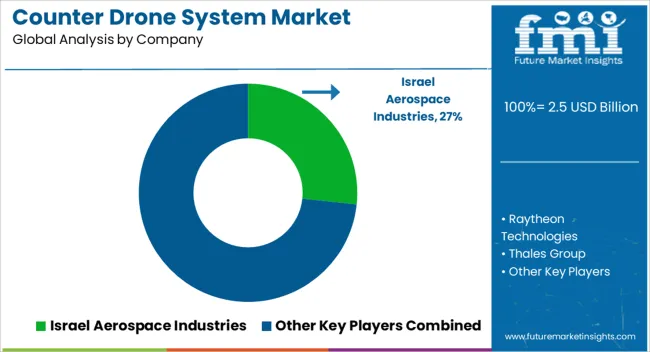
- Israel Aerospace Industries
- Raytheon Technologies
- Thales Group
- Lockheed Martin
- Northrop Grumman
- Dedrone
- DroneShield
- Blighter Surveillance Systems
Scope of the Report
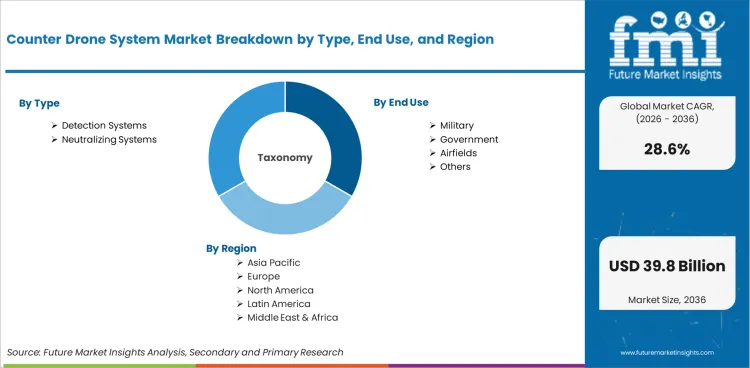
| Metric | Value |
|---|---|
| Quantitative Units | USD 3.22 billion to USD 39.77 billion, at a CAGR of 28.6% |
| Market Definition | Counter drone systems encompass integrated technology platforms for detection, tracking, identification, and neutralization of unauthorized unmanned aerial vehicles, deployed across military, government, airport, and critical infrastructure security applications. |
| Type Segmentation | Detection Systems, Neutralizing Systems |
| End Use Segmentation | Military, Government, Airfields, Others |
| Regions Covered | North America, Latin America, Europe, East Asia, South Asia, Oceania, Middle East & Africa |
| Countries Covered | China, India, Germany, France, UK, USA, Brazil, and 40 plus countries |
| Key Companies Profiled | Israel Aerospace Industries, Raytheon Technologies, Thales Group, Lockheed Martin, Northrop Grumman, Dedrone, DroneShield, Blighter Surveillance Systems |
| Forecast Period | 2026 to 2036 |
| Approach | Forecasting models apply a bottom-up methodology starting with confirmed defence procurement contract values and civilian security budget allocations, cross-validated against defence contractor revenue disclosures and programme-of-record designations. |
Counter Drone System Market by Segments
Type:
- Detection Systems
- Neutralizing Systems
End Use:
- Military
- Government
- Airfields
- Others
Region:
- North America
- USA
- Canada
- Mexico
- Latin America
- Brazil
- Chile
- Rest of Latin America
- Western Europe
- Germany
- UK
- Italy
- Spain
- France
- Nordic
- BENELUX
- Rest of Western Europe
- Eastern Europe
- Russia
- Poland
- Hungary
- Balkan & Baltic
- Rest of Eastern Europe
- East Asia
- China
- Japan
- South Korea
- South Asia and Pacific
- India
- ASEAN
- Australia & New Zealand
- Rest of South Asia and Pacific
- Middle East & Africa
- Kingdom of Saudi Arabia
- Other GCC Countries
- Turkiye
- South Africa
- Other African Union
- Rest of Middle East & Africa
Bibliography
- 1. USA Department of Defense. (2024). Counter-small unmanned aircraft systems strategy. Department of Defense.
- 2. North Atlantic Treaty Organization. (2024). NATO counter-UAS capability development priorities. NATO Allied Command Transformation.
- 3. European Defence Agency. (2024). Counter-drone technology: Capability development plan. EDA.
- 4. Ministry of Defence, Government of India. (2024). Annual report 2023-2024: Defence procurement and modernization. Ministry of Defence India.
- 5. Federal Aviation Administration. (2024). UAS detection and mitigation systems: Airport deployment guidance. FAA.
- 6. International Civil Aviation Organization. (2024). Guidance on unmanned aircraft system traffic management and counter-UAS integration. ICAO.
This bibliography is provided for reader reference. The full Future Market Insights report contains the complete reference list with primary research documentation.
Frequently Asked Questions
How large is the demand for counter drone systems in the global market in 2026?
Demand for counter drone systems in the global market is estimated to be valued at USD 3.22 billion in 2026.
What will be the market size of counter drone systems in the global market by 2036?
Market size for counter drone systems is projected to reach USD 39.77 billion by 2036.
What is the expected demand growth for counter drone systems between 2026 and 2036?
Demand for counter drone systems is expected to grow at a CAGR of 28.6% between 2026 and 2036.
Which type is poised to lead global sales by 2026?
Detection systems account for 51.7% share in 2026 as radar, RF sensor, and electro-optical tracking technologies form the mandatory foundation layer of all counter-drone defence architectures.
How significant is the military end use in driving counter drone system adoption?
Military end use commands 58.4% share in 2026 as armed forces worldwide reclassify C-UAS from emerging technology research into mandatory procurement capability requirements.
What is driving demand in China?
China is incorporating layered C-UAS architecture across border and coastal defence networks as part of its military modernization programme, pushing the country to a 38.6% CAGR through 2036.
What is India's growth outlook in this report?
India is projected to grow at a CAGR of 35.8% during 2026 to 2036, driven by defence procurement fast-tracking for counter-drone systems in response to cross-border drone incursion incidents.
What is included in the scope of this counter drone system report?
The market covers all counter-drone detection and neutralization hardware, software, and integrated system platforms for military, government, and critical infrastructure applications, with segment breakdowns by type and end use.
Preview the report firsthand - request a free sample
Get SampleGet the brochure for pricing and purchase details.
Get PDFTable of Content
- Executive Summary
- Global Market Outlook
- Demand-side Trends
- Supply-side Trends
- Technology Roadmap Analysis
- Analysis and Recommendations
- Market Overview
- Market Coverage / Taxonomy
- Market Definition / Scope / Limitations
- Research Methodology
- Chapter Orientation
- Analytical Lens and Working Hypotheses
- Market Structure, Signals, and Trend Drivers
- Benchmarking and Cross-market Comparability
- Market Sizing, Forecasting, and Opportunity Mapping
- Research Design and Evidence Framework
- Desk Research Programme (Secondary Evidence)
- Company Annual and Sustainability Reports
- Peer-reviewed Journals and Academic Literature
- Corporate Websites, Product Literature, and Technical Notes
- Earnings Decks and Investor Briefings
- Statutory Filings and Regulatory Disclosures
- Technical White Papers and Standards Notes
- Trade Journals, Industry Magazines, and Analyst Briefs
- Conference Proceedings, Webinars, and Seminar Materials
- Government Statistics Portals and Public Data Releases
- Press Releases and Reputable Media Coverage
- Specialist Newsletters and Curated Briefings
- Sector Databases and Reference Repositories
- FMI Internal Proprietary Databases and Historical Market Datasets
- Subscription Datasets and Paid Sources
- Social Channels, Communities, and Digital Listening Inputs
- Additional Desk Sources
- C-suite Leaders
- Board Members
- Presidents and Vice Presidents
- R&D and Innovation Heads
- Technical Specialists
- Domain Subject-matter Experts
- Scientists
- Physicians and Other Healthcare Professionals
- Desk Research Programme (Secondary Evidence)
- Governance, Ethics, and Data Stewardship
- Research Ethics
- Data Integrity and Handling
- Tooling, Models, and Reference Databases
- Data Engineering and Model Build
- Data Acquisition and Ingestion
- Cleaning, Normalisation, and Verification
- Synthesis, Triangulation, and Analysis
- Quality Assurance and Audit Trail
- Market Background
- Market Dynamics
- Drivers
- Restraints
- Opportunity
- Trends
- Scenario Forecast
- Demand in Optimistic Scenario
- Demand in Likely Scenario
- Demand in Conservative Scenario
- Opportunity Map Analysis
- Product Life Cycle Analysis
- Supply Chain Analysis
- Investment Feasibility Matrix
- Value Chain Analysis
- PESTLE and Porter’s Analysis
- Regulatory Landscape
- Regional Parent Market Outlook
- Production and Consumption Statistics
- Import and Export Statistics
- Market Dynamics
- Global Market Analysis 2021 to 2025 and Forecast, 2026 to 2036
- Historical Market Size Value (USD Million) Analysis, 2021 to 2025
- Current and Future Market Size Value (USD Million) Projections, 2026 to 2036
- Y-o-Y Growth Trend Analysis
- Absolute $ Opportunity Analysis
- Global Market Pricing Analysis 2021 to 2025 and Forecast 2026 to 2036
- Global Market Analysis 2021 to 2025 and Forecast 2026 to 2036, By Type
- Introduction / Key Findings
- Historical Market Size Value (USD Million) Analysis By Type , 2021 to 2025
- Current and Future Market Size Value (USD Million) Analysis and Forecast By Type , 2026 to 2036
- Detection Systems
- Neutralizing Systems
- Detection Systems
- Y-o-Y Growth Trend Analysis By Type , 2021 to 2025
- Absolute $ Opportunity Analysis By Type , 2026 to 2036
- Global Market Analysis 2021 to 2025 and Forecast 2026 to 2036, By End Use
- Introduction / Key Findings
- Historical Market Size Value (USD Million) Analysis By End Use, 2021 to 2025
- Current and Future Market Size Value (USD Million) Analysis and Forecast By End Use, 2026 to 2036
- Military
- Government
- Airfields
- Others
- Military
- Y-o-Y Growth Trend Analysis By End Use, 2021 to 2025
- Absolute $ Opportunity Analysis By End Use, 2026 to 2036
- Global Market Analysis 2021 to 2025 and Forecast 2026 to 2036, By Region
- Introduction
- Historical Market Size Value (USD Million) Analysis By Region, 2021 to 2025
- Current Market Size Value (USD Million) Analysis and Forecast By Region, 2026 to 2036
- North America
- Latin America
- Western Europe
- Eastern Europe
- East Asia
- South Asia and Pacific
- Middle East & Africa
- Market Attractiveness Analysis By Region
- North America Market Analysis 2021 to 2025 and Forecast 2026 to 2036, By Country
- Historical Market Size Value (USD Million) Trend Analysis By Market Taxonomy, 2021 to 2025
- Market Size Value (USD Million) Forecast By Market Taxonomy, 2026 to 2036
- By Country
- USA
- Canada
- Mexico
- By Type
- By End Use
- By Country
- Market Attractiveness Analysis
- By Country
- By Type
- By End Use
- Key Takeaways
- Latin America Market Analysis 2021 to 2025 and Forecast 2026 to 2036, By Country
- Historical Market Size Value (USD Million) Trend Analysis By Market Taxonomy, 2021 to 2025
- Market Size Value (USD Million) Forecast By Market Taxonomy, 2026 to 2036
- By Country
- Brazil
- Chile
- Rest of Latin America
- By Type
- By End Use
- By Country
- Market Attractiveness Analysis
- By Country
- By Type
- By End Use
- Key Takeaways
- Western Europe Market Analysis 2021 to 2025 and Forecast 2026 to 2036, By Country
- Historical Market Size Value (USD Million) Trend Analysis By Market Taxonomy, 2021 to 2025
- Market Size Value (USD Million) Forecast By Market Taxonomy, 2026 to 2036
- By Country
- Germany
- UK
- Italy
- Spain
- France
- Nordic
- BENELUX
- Rest of Western Europe
- By Type
- By End Use
- By Country
- Market Attractiveness Analysis
- By Country
- By Type
- By End Use
- Key Takeaways
- Eastern Europe Market Analysis 2021 to 2025 and Forecast 2026 to 2036, By Country
- Historical Market Size Value (USD Million) Trend Analysis By Market Taxonomy, 2021 to 2025
- Market Size Value (USD Million) Forecast By Market Taxonomy, 2026 to 2036
- By Country
- Russia
- Poland
- Hungary
- Balkan & Baltic
- Rest of Eastern Europe
- By Type
- By End Use
- By Country
- Market Attractiveness Analysis
- By Country
- By Type
- By End Use
- Key Takeaways
- East Asia Market Analysis 2021 to 2025 and Forecast 2026 to 2036, By Country
- Historical Market Size Value (USD Million) Trend Analysis By Market Taxonomy, 2021 to 2025
- Market Size Value (USD Million) Forecast By Market Taxonomy, 2026 to 2036
- By Country
- China
- Japan
- South Korea
- By Type
- By End Use
- By Country
- Market Attractiveness Analysis
- By Country
- By Type
- By End Use
- Key Takeaways
- South Asia and Pacific Market Analysis 2021 to 2025 and Forecast 2026 to 2036, By Country
- Historical Market Size Value (USD Million) Trend Analysis By Market Taxonomy, 2021 to 2025
- Market Size Value (USD Million) Forecast By Market Taxonomy, 2026 to 2036
- By Country
- India
- ASEAN
- Australia & New Zealand
- Rest of South Asia and Pacific
- By Type
- By End Use
- By Country
- Market Attractiveness Analysis
- By Country
- By Type
- By End Use
- Key Takeaways
- Middle East & Africa Market Analysis 2021 to 2025 and Forecast 2026 to 2036, By Country
- Historical Market Size Value (USD Million) Trend Analysis By Market Taxonomy, 2021 to 2025
- Market Size Value (USD Million) Forecast By Market Taxonomy, 2026 to 2036
- By Country
- Kingdom of Saudi Arabia
- Other GCC Countries
- Turkiye
- South Africa
- Other African Union
- Rest of Middle East & Africa
- By Type
- By End Use
- By Country
- Market Attractiveness Analysis
- By Country
- By Type
- By End Use
- Key Takeaways
- Key Countries Market Analysis
- USA
- Pricing Analysis
- Market Share Analysis, 2025
- By Type
- By End Use
- Canada
- Pricing Analysis
- Market Share Analysis, 2025
- By Type
- By End Use
- Mexico
- Pricing Analysis
- Market Share Analysis, 2025
- By Type
- By End Use
- Brazil
- Pricing Analysis
- Market Share Analysis, 2025
- By Type
- By End Use
- Chile
- Pricing Analysis
- Market Share Analysis, 2025
- By Type
- By End Use
- Germany
- Pricing Analysis
- Market Share Analysis, 2025
- By Type
- By End Use
- UK
- Pricing Analysis
- Market Share Analysis, 2025
- By Type
- By End Use
- Italy
- Pricing Analysis
- Market Share Analysis, 2025
- By Type
- By End Use
- Spain
- Pricing Analysis
- Market Share Analysis, 2025
- By Type
- By End Use
- France
- Pricing Analysis
- Market Share Analysis, 2025
- By Type
- By End Use
- India
- Pricing Analysis
- Market Share Analysis, 2025
- By Type
- By End Use
- ASEAN
- Pricing Analysis
- Market Share Analysis, 2025
- By Type
- By End Use
- Australia & New Zealand
- Pricing Analysis
- Market Share Analysis, 2025
- By Type
- By End Use
- China
- Pricing Analysis
- Market Share Analysis, 2025
- By Type
- By End Use
- Japan
- Pricing Analysis
- Market Share Analysis, 2025
- By Type
- By End Use
- South Korea
- Pricing Analysis
- Market Share Analysis, 2025
- By Type
- By End Use
- Russia
- Pricing Analysis
- Market Share Analysis, 2025
- By Type
- By End Use
- Poland
- Pricing Analysis
- Market Share Analysis, 2025
- By Type
- By End Use
- Hungary
- Pricing Analysis
- Market Share Analysis, 2025
- By Type
- By End Use
- Kingdom of Saudi Arabia
- Pricing Analysis
- Market Share Analysis, 2025
- By Type
- By End Use
- Turkiye
- Pricing Analysis
- Market Share Analysis, 2025
- By Type
- By End Use
- South Africa
- Pricing Analysis
- Market Share Analysis, 2025
- By Type
- By End Use
- USA
- Market Structure Analysis
- Competition Dashboard
- Competition Benchmarking
- Market Share Analysis of Top Players
- By Regional
- By Type
- By End Use
- Competition Analysis
- Competition Deep Dive
- Israel Aerospace Industries
- Overview
- Product Portfolio
- Profitability by Market Segments (Product/Age /Sales Channel/Region)
- Sales Footprint
- Strategy Overview
- Marketing Strategy
- Product Strategy
- Channel Strategy
- Raytheon Technologies
- Thales Group
- Lockheed Martin
- Northrop Grumman
- Dedrone
- DroneShield
- Blighter Surveillance Systems
- Israel Aerospace Industries
- Competition Deep Dive
- Assumptions & Acronyms Used


