

- Industry Size (2026)
- USD 806.3 Mn
- Forecast (2036)
- USD 1661.8 Mn
- CAGR (2026 to 2036)
- 7.5%
Enzyme-Ready Reactive Finishing Fiber Market Forecast and Outlook 2026 to 2036
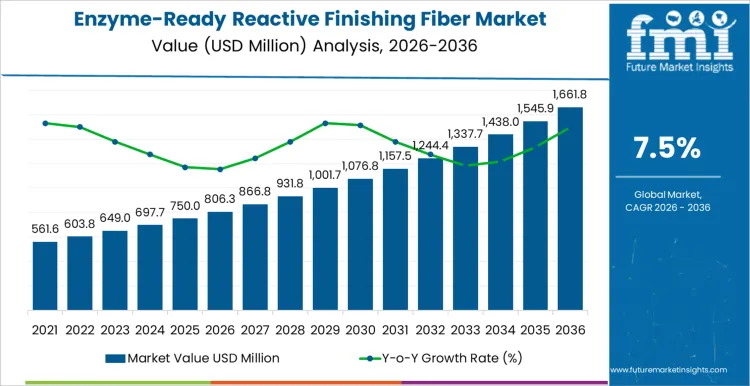
The enzyme-ready reactive finishing fiber market is likely to be valued at USD 806.3 million in 2026 and is projected to reach USD 1,661.8 million by 2036 at a 7.5% CAGR. Demand is driven by the need to define fabric surface behavior and appearance outcomes at the material selection stage rather than during garment finishing. Textile development teams increasingly lock finishing response into the fiber choice itself. This approach reduces variability across production sites and collections. Once a fabric concept is approved, later fiber changes affect development calendars, test protocols, and claim substantiation. Growth follows the spread of standardized fabric platforms that require predictable enzymatic response across multiple product families.
Program access in the enzyme-ready reactive finishing fiber market is controlled through internal material libraries, fabric standards, and cross-season continuity rules set by brand and textile groups. Adoption takes place through collection planning cycles rather than through short-term purchasing decisions. Fabric families remain in use across several seasons because visual and tactile signatures are tied to specific fiber selections. Supplier changes occur during concept resets rather than during routine sourcing. Revenue expansion reflects the number of fabric architectures built around enzyme-reactive behavior. Competitive standing depends on participation in early fabric definition work and continued inclusion in approved material systems used across design portfolios.
Enzyme-Ready Reactive Finishing Fiber Market Quick Stats
- Enzyme-Ready Reactive Finishing Fiber Market Value (2026): USD 806.3 million
- Enzyme-Ready Reactive Finishing Fiber Market Forecast Value (2036): USD 1,661.8 million
- Enzyme-Ready Reactive Finishing Fiber Market Forecast CAGR (2026 to 2036): 7.5%
- Leading Fiber Chemistry in Enzyme-Ready Reactive Finishing Fiber Market: Modified polyester
- Leading Finishing Function in Enzyme-Ready Reactive Finishing Fiber Market: Softness and hand modification
- Key Growth Regions in Enzyme-Ready Reactive Finishing Fiber Market: China, USA, Germany, South Korea, Japan
- Top Players in Enzyme-Ready Reactive Finishing Fiber Market: Lenzing AG, Birla Cellulose (Grasim Industries), Indorama Ventures, Eastman Chemical Company
What is the Growth Forecast for the Enzyme Ready Reactive Finishing Fiber Market through 2036?
The enzyme ready reactive finishing fiber market in 2026 stands near USD 806.3 million, built around textile programs that depend on controlled surface modification after fabric formation. Mills choose this fiber to shift part of value creation from spinning to finishing rooms. Material evaluation focuses on reactive site stability, yarn strength retention, and behavior during repeated wet processing. Adoption follows mill qualification rather than brand seasonality. Production planners integrate this fiber into platforms that already run large volumes, which limits short term volatility. The path to USD 1,661.8 million in 2036 follows a 7.5% growth profile supported by wider use in denim, workwear, and casual fabrics where finishing recipes define appearance and hand feel.
Operating structure shapes purchasing behavior in the enzyme ready reactive finishing fiber market. Orders align with long finishing programs and fabric platform lifetimes. Inventory policy favors steady access to approved grades that hold performance across dye lots and batch sizes. Cost structure reflects polymer preparation, reactive site control, spinning yield, and testing load. Finishing houses value predictable reaction windows and low rework rates. Annual values move through the low and mid one billions during the early 2030s as more mills redesign base fabrics around post process modification. The rise to USD 1,661.8 million in 2036 comes from broader integration into standard fabric constructions, higher functional fiber share in some styles, and longer supply agreements that place this fiber into fixed production recipes.
Enzyme-Ready Reactive Finishing Fiber Market Key Takeaways
| Metric | Value |
|---|---|
| Market Value (2026) | USD 806.3 million |
| Forecast Value (2036) | USD 1,661.8 million |
| Forecast CAGR (2026-2036) | 7.5% |
How Is the Enzyme Ready Reactive Finishing Fiber Market Being Used to Control Surface Modification and Process Repeatability in Textile Manufacturing?
The enzyme ready reactive finishing fiber market is specified where controlled surface change must occur without damaging the underlying fiber structure. Textile processors use these fibers to achieve predictable softening, cleaning, or functional activation during wet processing rather than relying on harsh chemical routes. Spinning and fabric formation focus on keeping reactive sites stable until finishing, because premature activation reduces yield and consistency. Dyeing and finishing plants evaluate these fibers for enzyme accessibility, reaction uniformity, and strength retention after treatment. Production teams monitor fabric weight loss, handle change, and shade stability because each indicates whether the reaction window remains under control. Qualification centers on reproducible response curves, storage stability, and resistance to unintended activation since variability forces recipe changes, reprocessing, and tighter operating margins.
The enzyme ready reactive finishing fiber market is managed through process discipline and finishing yield rather than through laboratory reactivity alone. A fiber that reacts too quickly or unevenly disrupts line scheduling and increases off grade output. Finishing plants track enzyme consumption, cycle time, and rework rates to measure practical value. Garment producers evaluate usable fabric life after repeated care cycles because over reaction reduces durability. Storage and handling receive attention because humidity and temperature history influence surface behavior before processing. Contracts define acceptance limits for reaction onset, strength loss, and appearance change after treatment. Demand concentrates in supply chains where consistent handle, controlled surface effects, and predictable finishing costs determine delivery schedules and customer acceptance, which places fiber selection inside routine production planning and quality control rather than experimental development.
How do throughput constraints and rework exposure shape demand in the Enzyme-Ready Reactive Finishing Fiber Market by fiber chemistry and finishing function in 2026?
In the Enzyme-Ready Reactive Finishing Fiber Market, adoption decisions often originate from queue length, rewash rates, and shade recovery stability rather than laboratory optimization. Finishing plants operating apparel fabric finishing lines prioritize substrates that maintain predictable cycle time and limit secondary passes. By fiber chemistry, usage spans modified polyester, modified cellulosic, blended reactive systems, and other functional fibers. By finishing function, demand covers softness and hand modification, easy-care and anti-pilling, functional effects such as anti-odor and moisture management, and other enzymatic finishes. Portfolio choices reflect the need to keep machines loaded with repeatable work, control bath turnover, and protect delivery commitments. When performance variance raises reprocessing risk, planners favor chemistries that preserve schedule integrity and keep shipment dates intact.
Why does modified polyester remain the reference substrate in high-volume routes?
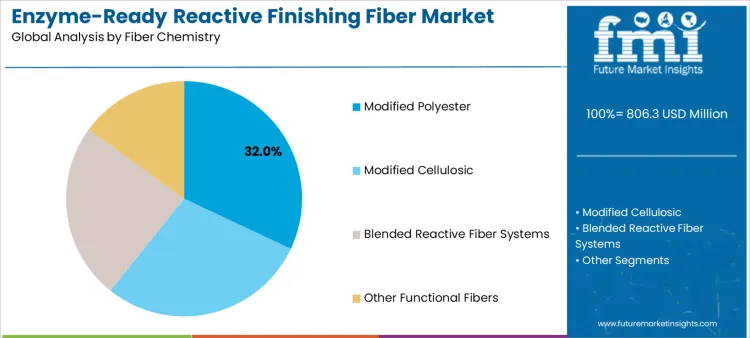
Modified polyester holds about 32% share since it offers a broad operating window and stable reaction depth across common enzyme recipes. This behavior keeps pad pressure, dwell, and rinse steps aligned with planned takt and reduces the probability of off-shade lots. Modified cellulosic options support polishing and defibrillation routes, yet they require tighter timing control to protect strength. Blended reactive systems provide multiple effects in one pass, though the combined chemistry narrows the acceptable window. Other functional fibers remain linked to specific machines. Engineers qualify substrates using weight loss and pilling index. Process teams qualify through pickup stability and bath life. Quality teams qualify through lot behavior and storage aging. A substrate that clears these screens becomes standard.
Once selected, machine setpoints, recipe libraries, and inspection limits assume the same response. Any change introduces new trials and retraining cycles. Schedulers then extend campaign lengths to limit disturbance. Inventory policies restrict mixing to reduce rework. Capacity growth follows added lanes and shifts rather than chemistry changes. The operating result favors substrates that preserve flow and protect committed ship dates across multiple styles and colors in continuous programs.
How do finishing objectives compete for limited machine time and rinse capacity?
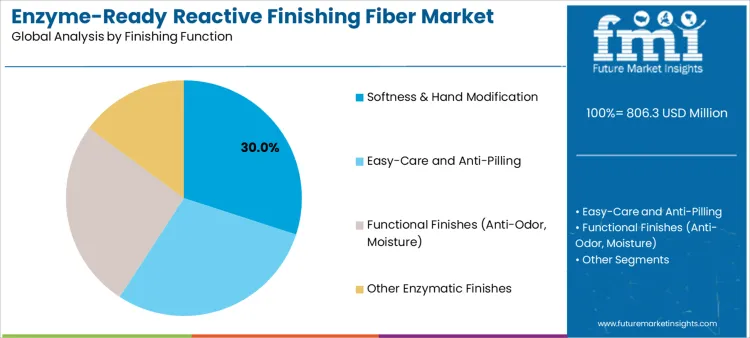
Softness and hand modification represent about 30% of demand since these routes close quickly and clear queues without secondary processing. Easy-care and anti-pilling follow where surface control governs long-term appearance after repeated cycles. Functional effects addressing odor or moisture occupy slots when garments are routed through industrial garment laundry services, where durability across many washes is reviewed before release. Other enzymatic finishes remain seasonal. Planners allocate machine time using yield risk, rinse load, and rework probability. Converters approve objectives through cutting yield and sewing behavior. Product teams approve through handle panels and post-wash appearance. Compliance teams define sampling and records for traceability.
A change in objective requires updates to recipes, rinse sequences, and shade standards. Tooling and staffing plans also require revision. Supervisors then stabilize schedules to protect flow. Orders expand through additional colors and volumes rather than frequent objective switches. Demand concentrates in functions that preserve throughput and limit reprocessing inside technical textile manufacturing, where stable queues, predictable yields, and controlled documentation determine commercial reliability.
Why Are Finishing Process Requirements Supporting the Enzyme-Ready Reactive Finishing Fiber Market?
Enzyme-Ready Reactive Finishing Fiber Market demand is growing because textile mills and garment processors require fibers that can undergo targeted finishing processes to achieve desired surface effects such as softness, texture, or functional modification. Enzyme-ready reactive fibers are engineered to interact predictably with finishing enzymes used in wash-off, bio-polishing, and surface modification steps. Apparel producers and mills evaluate these fibers for consistent enzyme uptake, retention of mechanical strength through finishing, and compatibility with existing wash systems. Buyers value fibers that reduce variability in enzyme finishing outcomes, simplify lot-to-lot adjustments, and shorten time-to-quality targets on high throughput dyeing and finishing lines.
What Challenges Are Restricting Adoption in the Enzyme-Ready Reactive Finishing Fiber Market?
Enzyme-Ready Reactive Finishing Fiber Market growth is influenced by processing integration complexity, cost considerations, and extended qualification cycles required by converters and brand owners. Reactive finishing fibers must balance chemical reactivity with filament strength and dimensional stability during wet processing, which narrows acceptable production windows and demands strict quality control. Variability in enzyme take-up behavior can lead to inconsistent fabric appearance or hand feel, forcing additional testing and adjustment runs. Cost differences relative to conventional fibers affect adoption in volume product categories like basic knits and woven shirtings. Mill and brand qualification timelines lengthen as enzyme finishing outcomes must be validated across fabrics, constructions, and wash protocols.
How Are Product Portfolios and Supply Practices Shaping the Enzyme-Ready Reactive Finishing Fiber Market?
enzyme-ready reactive finishing fiber market offerings are being organized around defined performance profiles that link reactive fiber attributes to finishing process parameters to help converters and mills make faster selection decisions. Producers provide detailed data sets that include enzyme reaction behavior under specified conditions, retention of tensile properties, and filament consistency metrics that align with wash-off and bio-polishing protocols. Portfolio segmentation by application such as denim wash, performance knit, and specialty textiles reduces trial requirements and aligns fibers with known finishing routines. Commercial engagement emphasizes supply continuity, batch consistency, and planned delivery schedules that fit dyeing and finishing calendars. Technical service focuses on process parameter mapping, controlling defects, and optimizing finishing outcomes while preserving throughput.
What is the Demand for Enzyme Ready Reactive Finishing Fiber by Country?
| Country | CAGR (%) |
|---|---|
| USA | 7.2% |
| Japan | 6.0% |
| South Korea | 6.7% |
| Germany | 7.1% |
| China | 8.7% |
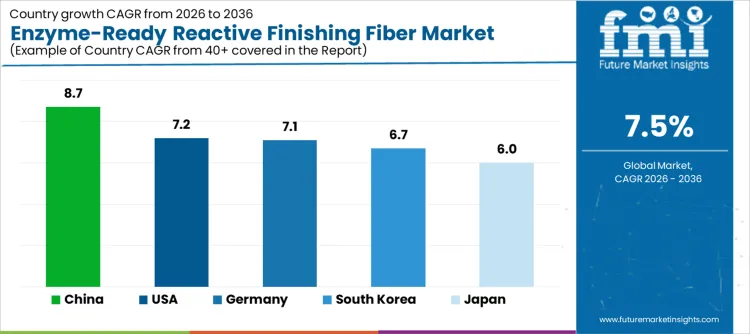
The demand for enzyme ready reactive finishing fiber is rising across apparel and textile processing chains where controlled surface modification and consistent finishing results are required. China leads at 8.7% CAGR, supported by its large scale textile finishing industry and increasing integration of standardized processing routes in export oriented mills. The USA grows at 7.2%, driven by demand for performance textiles and consistent finishing quality in apparel and home textiles. Germany records 7.1%, shaped by technical textile and high quality garment manufacturing. South Korea advances at 6.7%, reflecting steady use in functional fabrics. Japan posts 6.0%, within a mature but specification driven textile processing environment focused on precision and repeatability.
How Do Finishing Line Qualification Rules Shape Procurement in the Enzyme-Ready Reactive Finishing Fiber Market in the USA?
Qualification of finishing lines now sets the pace for the enzyme-ready reactive finishing fiber market in the United States, where adoption corresponds to a 7.2% CAGR. Entry into routine production depends on evidence that enzyme compatibility, reaction uniformity, and property retention remain within controlled limits across repeated cycles. Technical teams review reactivity window control, tensile preservation, shade reproducibility, and surface integrity after treatment. Once a fiber grade satisfies these requirements, the same approval file governs subsequent sourcing and material substitution becomes uncommon. Volume increases when apparel, home textile, or workwear programs extend finishing capacity or introduce new platforms. Specification committees retain authority over any change request. Supplier access depends on documentation quality and audit outcomes. Production planning follows contracted finishing schedules rather than opportunistic demand. Commercial success depends on specification inclusion and consistent lot behavior across multiple mills.
How Do Process Control Frameworks Determine Adoption in the Enzyme-Ready Reactive Finishing Fiber Market in Japan?
Process stability requirements are directing the enzyme-ready reactive finishing fiber market in Japan along a path aligned with a 6% CAGR. Fiber selection is treated as a controlled manufacturing variable rather than a procurement preference. Any proposal for change enters a structured review sequence that includes extended enzyme reaction consistency checks and fabric property retention testing. Engineers examine treatment uniformity, strength preservation, pilling behavior, and tolerance to repeated finishing cycles. Approval requires evidence from production-scale runs. Once accepted, the same fiber remains embedded in identical constructions for long operating periods. Requalification is required for any deviation. Supplier participation depends on documentation completeness and inspection results. Local sources benefit from proximity to quality oversight teams. Volume growth follows gradual portfolio expansion rather than replacement cycles.
How Do Platform Finishing Architectures Drive Scale in the Enzyme-Ready Reactive Finishing Fiber Market in South Korea?
Platform definition within finishing operations explains why the enzyme-ready reactive finishing fiber market in South Korea is advancing in line with a 6.7% CAGR. Development groups establish standard material sets that support several product families processed on shared lines. A single fiber decision can influence multiple programs without separate mill approvals. Technical assessment focuses on enzyme response predictability, processing window width, mechanical property retention, and compatibility with installed equipment. When a grade becomes part of the platform baseline, scale follows through synchronized product introductions. Plant-level changes remain limited because the platform file governs material use. Suppliers secure positions through joint trials and documentation alignment. Output planning tracks launch calendars. Commercial results depend on early inclusion in platform definitions and reliable execution during coordinated production ramps.
How Do Central Approval Lists Shape Supplier Access in the Enzyme-Ready Reactive Finishing Fiber Market in Germany?
Governance through centrally maintained approval lists is guiding the enzyme-ready reactive finishing fiber market in Germany in line with a 7.1% CAGR. Access to production programs is controlled by registers applied across multiple sites, and individual mills do not introduce new fibers independently. Reviews examine repeatability, finishing performance consistency, and audit completeness. After approval, the same grade is released for use in several factories under uniform processing conditions. Volume growth follows program expansion rather than local sourcing initiatives. Supplier standing depends on audit outcomes and documentation discipline. Change control remains formal and closely monitored. Production planning reflects coordinated capacity allocation. Commercial success depends on maintaining identical behavior across distributed manufacturing environments over extended operating periods.
How Do Program Replication Models Accelerate Uptake in the Enzyme-Ready Reactive Finishing Fiber Market in China?
Replication of validated finishing programs across sites explains why the enzyme-ready reactive finishing fiber market in China is advancing in line with an 8.7% CAGR. Once a fiber meets defined finishing performance and processing stability limits in one plant, it is introduced into parallel operations with limited redesign. Approval emphasizes consistency and tolerance to high-volume finishing conditions. Expansion teams rely on standardized qualification packages and line commissioning procedures. Domestic suppliers hold an advantage because they can follow rapid capacity additions and site expansions. Imported materials remain concentrated in higher specification uses. Volume increases through repetition of approved constructions across sites. Commercial advantage depends on being present when a configuration becomes a reference program rather than competing for each individual finishing line.
How Do Suppliers Compete in the Enzyme-Ready Reactive Finishing Fiber Market?
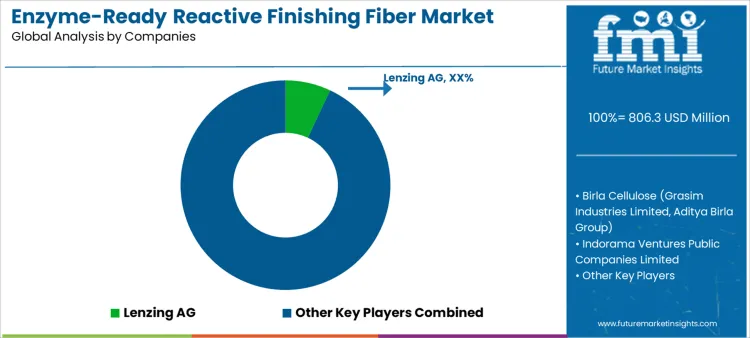
Performance in the Enzyme-Ready Reactive Finishing Fiber Market is determined by fiber reactivity, durability, and processing compatibility rather than catalog breadth. Lenzing AG, Birla Cellulose (Grasim Industries), Indorama Ventures, and Eastman Chemical Company compete during fiber qualification, pilot production, and textile finishing trials. Once incorporated into apparel or technical fabrics, enzyme affinity, fiber uniformity, and mechanical stability anchor supplier selection. Lenzing AG emphasizes viscose and specialty cellulose fibers optimized for reactive finishing. Birla Cellulose supplies bio-based fibers tailored for sustainable textile processing. Indorama Ventures delivers polyester-based fibers designed for enzymatic finishing workflows. Eastman Chemical Company provides polymer solutions compatible with reactive fiber surfaces and finishing enzymes.
Process consistency, enzyme compatibility, and technical support shape competitive positioning in the Enzyme-Ready Reactive Finishing Fiber Market. Textile engineers evaluate chemical reactivity, uniform finish uptake, fiber integrity, and wash durability during validation. Production teams favor suppliers capable of reproducible lot quality and scalable supply. Lenzing AG secures adoption through process validation and technical guidance for reactive finishing. Birla Cellulose maintains share where sustainable cellulose fibers are required for enzymatic processes. Indorama Ventures competes in polyester blends with predictable finishing behavior. Eastman Chemical Company supports chemical integration and enzyme-ready fiber applications. Market positions vary by fiber composition, finishing process, application type, and regional regulatory compliance.
Key Players in the Enzyme-Ready Reactive Finishing Fiber Market
- Lenzing AG
- Birla Cellulose (Grasim Industries Limited, Aditya Birla Group)
- Indorama Ventures Public Company Limited
- Eastman Chemical Company
Scope of the Report
| Items | Values |
|---|---|
| Quantitative Units (2026) | USD million |
| Fiber Chemistry | Modified polyester, modified cellulosic, blended reactive fiber systems, other functional fibers |
| Finishing Function | Softness and hand modification, easy-care and anti-pilling, functional finishes (anti-odor, moisture), other enzymatic finishes |
| Process Route | In-bath enzymatic finishing, pad-dry-cure with enzymes, spray and foam application |
| End Use | Apparel, home textiles, technical and industrial textiles |
| Regions Covered | Asia Pacific, Europe, North America, Latin America, Middle East & Africa |
| Countries Covered | United States, Canada, Mexico, Germany, United Kingdom, France, Italy, Spain, Nordics, BENELUX, China, Japan, South Korea, India, Australia & New Zealand, ASEAN, Brazil, Chile, Saudi Arabia, Turkey, South Africa, and other regional markets |
| Key Companies Profiled | Lenzing AG, Birla Cellulose (Grasim Industries), Indorama Ventures, Eastman Chemical Company |
| Additional Attributes | Dollar sales by fiber chemistry, finishing function, process route, and end use, enzyme reaction window control and reproducibility, strength retention and fabric weight loss control after finishing, rework and reprocessing rates, integration into standardized fabric platforms, finishing line qualification requirements, batch consistency and storage stability, and regional demand patterns driven by denim, workwear, casual fabrics, and technical textile finishing programs |
Enzyme-Ready Reactive Finishing Fiber Market Segmentation
Fiber Chemistry:
- Modified Polyester
- Modified Cellulosic
- Blended Reactive Fiber Systems
- Other Functional Fibers
Finishing Function:
- Softness & Hand Modification
- Easy-Care and Anti-Pilling
- Functional Finishes (Anti-Odor, Moisture)
- Other Enzymatic Finishes
Process Route:
- In-Bath Enzymatic Finishing
- Pad-Dry-Cure with Enzymes
- Spray & Foam Application
End Use:
- Apparel
- Home Textiles
- Technical & Industrial Textiles
Region
- Asia Pacific
- China
- Japan
- South Korea
- India
- Australia & New Zealand
- ASEAN
- Rest of Asia Pacific
- Europe
- Germany
- United Kingdom
- France
- Italy
- Spain
- Nordic
- BENELUX
- Rest of Europe
- North America
- United States
- Canada
- Mexico
- Latin America
- Brazil
- Chile
- Rest of Latin America
- Middle East & Africa
- Kingdom of Saudi Arabia
- Other GCC Countries
- Turkey
- South Africa
- Other African Union
- Rest of Middle East & Africa
Bibliography
- American Association of Textile Chemists and Colorists. (2025). AATCC TM130‑2025: Test method for soil release—Oily stain release method. AATCC.
- American Association of Textile Chemists and Colorists. (2025). AATCC TM135‑2025: Dimensional changes of fabrics after home laundering. AATCC.
- International Organization for Standardization. (2023). ISO 3758:2023—Textiles: Care labelling code using symbols. ISO.
Frequently Asked Questions
How big is the global enzyme-ready reactive finishing fiber market in 2026?
The global enzyme-ready reactive finishing fiber market is expected to reach a valuation of USD 806.3 million in 2026.
What will be the size of the enzyme-ready reactive finishing fiber market in 2036?
The enzyme-ready reactive finishing fiber market is forecast to attain a value of USD 1,661.8 million by 2036.
How much will the demand for enzyme-ready reactive finishing fiber grow between 2026 and 2036?
Demand for enzyme-ready reactive finishing fiber is anticipated to rise at a 7.5% CAGR between 2026 and 2036.
Which fiber chemistry holds a significant share in the enzyme-ready reactive finishing fiber market in 2026?
Based on fiber chemistry, modified polyester is projected to hold about a 32% share in 2026.
Which finishing function contributes a major share in the enzyme-ready reactive finishing fiber market in 2026?
Softness and hand modification is expected to account for about 30% of total demand in the enzyme-ready reactive finishing fiber market in 2026.
Preview the report firsthand - request a free sample
Get SampleGet the brochure for pricing and purchase details.
Get PDFTable of Content
- Executive Summary
- Global Market Outlook
- Demand-side Trends
- Supply-side Trends
- Technology Roadmap Analysis
- Analysis and Recommendations
- Market Overview
- Market Coverage / Taxonomy
- Market Definition / Scope / Limitations
- Market Background
- Market Dynamics
- Drivers
- Restraints
- Opportunity
- Trends
- Scenario Forecast
- Demand in Optimistic Scenario
- Demand in Likely Scenario
- Demand in Conservative Scenario
- Opportunity Map Analysis
- Product Life Cycle Analysis
- Supply Chain Analysis
- Investment Feasibility Matrix
- Value Chain Analysis
- PESTLE and Porter’s Analysis
- Regulatory Landscape
- Regional Parent Market Outlook
- Production and Consumption Statistics
- Import and Export Statistics
- Market Dynamics
- Global Market Analysis 2021 to 2025 and Forecast, 2026 to 2036
- Historical Market Size Value (USD Million) Analysis, 2021 to 2025
- Current and Future Market Size Value (USD Million) Projections, 2026 to 2036
- Y-o-Y Growth Trend Analysis
- Absolute $ Opportunity Analysis
- Global Market Pricing Analysis 2021 to 2025 and Forecast 2026 to 2036
- Global Market Analysis 2021 to 2025 and Forecast 2026 to 2036, By Fiber Chemistry
- Introduction / Key Findings
- Historical Market Size Value (USD Million) Analysis By Fiber Chemistry , 2021 to 2025
- Current and Future Market Size Value (USD Million) Analysis and Forecast By Fiber Chemistry , 2026 to 2036
- Modified Polyester
- Modified Cellulosic
- Blended Reactive Fiber Systems
- Other Functional Fibers
- Modified Polyester
- Y-o-Y Growth Trend Analysis By Fiber Chemistry , 2021 to 2025
- Absolute $ Opportunity Analysis By Fiber Chemistry , 2026 to 2036
- Global Market Analysis 2021 to 2025 and Forecast 2026 to 2036, By Finishing Function
- Introduction / Key Findings
- Historical Market Size Value (USD Million) Analysis By Finishing Function, 2021 to 2025
- Current and Future Market Size Value (USD Million) Analysis and Forecast By Finishing Function, 2026 to 2036
- Softness & Hand Modification
- Easy-Care and Anti-Pilling
- Functional Finishes (Anti-Odor, Moisture)
- Other Enzymatic Finishes
- Softness & Hand Modification
- Y-o-Y Growth Trend Analysis By Finishing Function, 2021 to 2025
- Absolute $ Opportunity Analysis By Finishing Function, 2026 to 2036
- Global Market Analysis 2021 to 2025 and Forecast 2026 to 2036, By Process Route
- Introduction / Key Findings
- Historical Market Size Value (USD Million) Analysis By Process Route, 2021 to 2025
- Current and Future Market Size Value (USD Million) Analysis and Forecast By Process Route, 2026 to 2036
- In-Bath Enzymatic Finishing
- Pad-Dry-Cure with Enzymes
- Spray & Foam Application
- In-Bath Enzymatic Finishing
- Y-o-Y Growth Trend Analysis By Process Route, 2021 to 2025
- Absolute $ Opportunity Analysis By Process Route, 2026 to 2036
- Global Market Analysis 2021 to 2025 and Forecast 2026 to 2036, By End Use
- Introduction / Key Findings
- Historical Market Size Value (USD Million) Analysis By End Use, 2021 to 2025
- Current and Future Market Size Value (USD Million) Analysis and Forecast By End Use, 2026 to 2036
- Apparel
- Home Textiles
- Technical & Industrial Textiles
- Apparel
- Y-o-Y Growth Trend Analysis By End Use, 2021 to 2025
- Absolute $ Opportunity Analysis By End Use, 2026 to 2036
- Global Market Analysis 2021 to 2025 and Forecast 2026 to 2036, By Region
- Introduction
- Historical Market Size Value (USD Million) Analysis By Region, 2021 to 2025
- Current Market Size Value (USD Million) Analysis and Forecast By Region, 2026 to 2036
- North America
- Latin America
- Western Europe
- Eastern Europe
- East Asia
- South Asia and Pacific
- Middle East & Africa
- Market Attractiveness Analysis By Region
- North America Market Analysis 2021 to 2025 and Forecast 2026 to 2036, By Country
- Historical Market Size Value (USD Million) Trend Analysis By Market Taxonomy, 2021 to 2025
- Market Size Value (USD Million) Forecast By Market Taxonomy, 2026 to 2036
- By Country
- USA
- Canada
- Mexico
- By Fiber Chemistry
- By Finishing Function
- By Process Route
- By End Use
- By Country
- Market Attractiveness Analysis
- By Country
- By Fiber Chemistry
- By Finishing Function
- By Process Route
- By End Use
- Key Takeaways
- Latin America Market Analysis 2021 to 2025 and Forecast 2026 to 2036, By Country
- Historical Market Size Value (USD Million) Trend Analysis By Market Taxonomy, 2021 to 2025
- Market Size Value (USD Million) Forecast By Market Taxonomy, 2026 to 2036
- By Country
- Brazil
- Chile
- Rest of Latin America
- By Fiber Chemistry
- By Finishing Function
- By Process Route
- By End Use
- By Country
- Market Attractiveness Analysis
- By Country
- By Fiber Chemistry
- By Finishing Function
- By Process Route
- By End Use
- Key Takeaways
- Western Europe Market Analysis 2021 to 2025 and Forecast 2026 to 2036, By Country
- Historical Market Size Value (USD Million) Trend Analysis By Market Taxonomy, 2021 to 2025
- Market Size Value (USD Million) Forecast By Market Taxonomy, 2026 to 2036
- By Country
- Germany
- UK
- Italy
- Spain
- France
- Nordic
- BENELUX
- Rest of Western Europe
- By Fiber Chemistry
- By Finishing Function
- By Process Route
- By End Use
- By Country
- Market Attractiveness Analysis
- By Country
- By Fiber Chemistry
- By Finishing Function
- By Process Route
- By End Use
- Key Takeaways
- Eastern Europe Market Analysis 2021 to 2025 and Forecast 2026 to 2036, By Country
- Historical Market Size Value (USD Million) Trend Analysis By Market Taxonomy, 2021 to 2025
- Market Size Value (USD Million) Forecast By Market Taxonomy, 2026 to 2036
- By Country
- Russia
- Poland
- Hungary
- Balkan & Baltic
- Rest of Eastern Europe
- By Fiber Chemistry
- By Finishing Function
- By Process Route
- By End Use
- By Country
- Market Attractiveness Analysis
- By Country
- By Fiber Chemistry
- By Finishing Function
- By Process Route
- By End Use
- Key Takeaways
- East Asia Market Analysis 2021 to 2025 and Forecast 2026 to 2036, By Country
- Historical Market Size Value (USD Million) Trend Analysis By Market Taxonomy, 2021 to 2025
- Market Size Value (USD Million) Forecast By Market Taxonomy, 2026 to 2036
- By Country
- China
- Japan
- South Korea
- By Fiber Chemistry
- By Finishing Function
- By Process Route
- By End Use
- By Country
- Market Attractiveness Analysis
- By Country
- By Fiber Chemistry
- By Finishing Function
- By Process Route
- By End Use
- Key Takeaways
- South Asia and Pacific Market Analysis 2021 to 2025 and Forecast 2026 to 2036, By Country
- Historical Market Size Value (USD Million) Trend Analysis By Market Taxonomy, 2021 to 2025
- Market Size Value (USD Million) Forecast By Market Taxonomy, 2026 to 2036
- By Country
- India
- ASEAN
- Australia & New Zealand
- Rest of South Asia and Pacific
- By Fiber Chemistry
- By Finishing Function
- By Process Route
- By End Use
- By Country
- Market Attractiveness Analysis
- By Country
- By Fiber Chemistry
- By Finishing Function
- By Process Route
- By End Use
- Key Takeaways
- Middle East & Africa Market Analysis 2021 to 2025 and Forecast 2026 to 2036, By Country
- Historical Market Size Value (USD Million) Trend Analysis By Market Taxonomy, 2021 to 2025
- Market Size Value (USD Million) Forecast By Market Taxonomy, 2026 to 2036
- By Country
- Kingdom of Saudi Arabia
- Other GCC Countries
- Turkiye
- South Africa
- Other African Union
- Rest of Middle East & Africa
- By Fiber Chemistry
- By Finishing Function
- By Process Route
- By End Use
- By Country
- Market Attractiveness Analysis
- By Country
- By Fiber Chemistry
- By Finishing Function
- By Process Route
- By End Use
- Key Takeaways
- Key Countries Market Analysis
- USA
- Pricing Analysis
- Market Share Analysis, 2025
- By Fiber Chemistry
- By Finishing Function
- By Process Route
- By End Use
- Canada
- Pricing Analysis
- Market Share Analysis, 2025
- By Fiber Chemistry
- By Finishing Function
- By Process Route
- By End Use
- Mexico
- Pricing Analysis
- Market Share Analysis, 2025
- By Fiber Chemistry
- By Finishing Function
- By Process Route
- By End Use
- Brazil
- Pricing Analysis
- Market Share Analysis, 2025
- By Fiber Chemistry
- By Finishing Function
- By Process Route
- By End Use
- Chile
- Pricing Analysis
- Market Share Analysis, 2025
- By Fiber Chemistry
- By Finishing Function
- By Process Route
- By End Use
- Germany
- Pricing Analysis
- Market Share Analysis, 2025
- By Fiber Chemistry
- By Finishing Function
- By Process Route
- By End Use
- UK
- Pricing Analysis
- Market Share Analysis, 2025
- By Fiber Chemistry
- By Finishing Function
- By Process Route
- By End Use
- Italy
- Pricing Analysis
- Market Share Analysis, 2025
- By Fiber Chemistry
- By Finishing Function
- By Process Route
- By End Use
- Spain
- Pricing Analysis
- Market Share Analysis, 2025
- By Fiber Chemistry
- By Finishing Function
- By Process Route
- By End Use
- France
- Pricing Analysis
- Market Share Analysis, 2025
- By Fiber Chemistry
- By Finishing Function
- By Process Route
- By End Use
- India
- Pricing Analysis
- Market Share Analysis, 2025
- By Fiber Chemistry
- By Finishing Function
- By Process Route
- By End Use
- ASEAN
- Pricing Analysis
- Market Share Analysis, 2025
- By Fiber Chemistry
- By Finishing Function
- By Process Route
- By End Use
- Australia & New Zealand
- Pricing Analysis
- Market Share Analysis, 2025
- By Fiber Chemistry
- By Finishing Function
- By Process Route
- By End Use
- China
- Pricing Analysis
- Market Share Analysis, 2025
- By Fiber Chemistry
- By Finishing Function
- By Process Route
- By End Use
- Japan
- Pricing Analysis
- Market Share Analysis, 2025
- By Fiber Chemistry
- By Finishing Function
- By Process Route
- By End Use
- South Korea
- Pricing Analysis
- Market Share Analysis, 2025
- By Fiber Chemistry
- By Finishing Function
- By Process Route
- By End Use
- Russia
- Pricing Analysis
- Market Share Analysis, 2025
- By Fiber Chemistry
- By Finishing Function
- By Process Route
- By End Use
- Poland
- Pricing Analysis
- Market Share Analysis, 2025
- By Fiber Chemistry
- By Finishing Function
- By Process Route
- By End Use
- Hungary
- Pricing Analysis
- Market Share Analysis, 2025
- By Fiber Chemistry
- By Finishing Function
- By Process Route
- By End Use
- Kingdom of Saudi Arabia
- Pricing Analysis
- Market Share Analysis, 2025
- By Fiber Chemistry
- By Finishing Function
- By Process Route
- By End Use
- Turkiye
- Pricing Analysis
- Market Share Analysis, 2025
- By Fiber Chemistry
- By Finishing Function
- By Process Route
- By End Use
- South Africa
- Pricing Analysis
- Market Share Analysis, 2025
- By Fiber Chemistry
- By Finishing Function
- By Process Route
- By End Use
- USA
- Market Structure Analysis
- Competition Dashboard
- Competition Benchmarking
- Market Share Analysis of Top Players
- By Regional
- By Fiber Chemistry
- By Finishing Function
- By Process Route
- By End Use
- Competition Analysis
- Competition Deep Dive
- Lenzing AG
- Overview
- Product Portfolio
- Profitability by Market Segments (Product/Age /Sales Channel/Region)
- Sales Footprint
- Strategy Overview
- Marketing Strategy
- Product Strategy
- Channel Strategy
- Birla Cellulose (Grasim Industries Limited, Aditya Birla Group)
- Indorama Ventures Public Companies Limited
- Eastman Chemical Company
- Lenzing AG
- Competition Deep Dive
- Assumptions & Acronyms Used
- Research Methodology


