

- Industry Size (2026)
- USD 586 Mn
- Forecast (2036)
- USD 1325 Mn
- CAGR (2026 to 2036)
- 8.5%
Isosorbide-Based Engineering Polymer Monomers Market Size, Market Forecast and Outlook By FMI
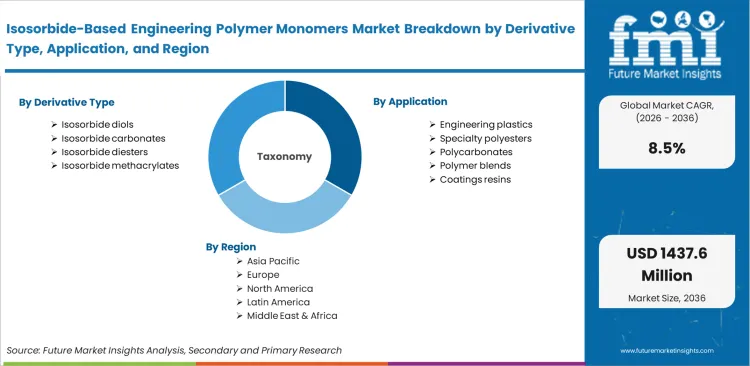
The isosorbide-based engineering polymer monomers market was established at USD 540 billion in 2025. Consistently increasing sales are propelling the industry revenue to surpass USD 586 million in 2026 at a CAGR of 8.5% during the forecast period. Increase in profits carries total market valuation to USD 1,325 million through 2036 as regulatory restrictions on bisphenol A force material substitutions across high-durability applications.
Summary of Isosorbide-Based Engineering Polymer Monomers Market
- The market is forecast to reach USD 1,325 million by 2036.
- The market is expected to grow at a CAGR of 8.5% from 2026 to 2036.
- The market was estimated at USD 540 million in 2025.
- The market represents an incremental opportunity of USD 739 million over the forecast period.
- Isosorbide diols lead by derivative type with an estimated 38.0% share.
- Engineering plastics dominate by application with a 32.0% share.
- Polycarbonates lead the polymer family segment with a 34.0% share.
- Automotive leads the end-use segment with a 28.0% share.
- Asia Pacific accounts for a leading 41.0% share of the global market.
- China is the fastest-growing market at 9.7%, followed by Brazil at 9.3% and India at 9.1%.
- The market is driven by rising demand for plant-based, high-performance polymers, regulatory restrictions on toxic chemicals, and increasing adoption in automotive and electronics applications.
- Key companies in the market include Roquette Frères, Mitsubishi Chemical Group, SK Chemicals, and Mitsui Chemicals.
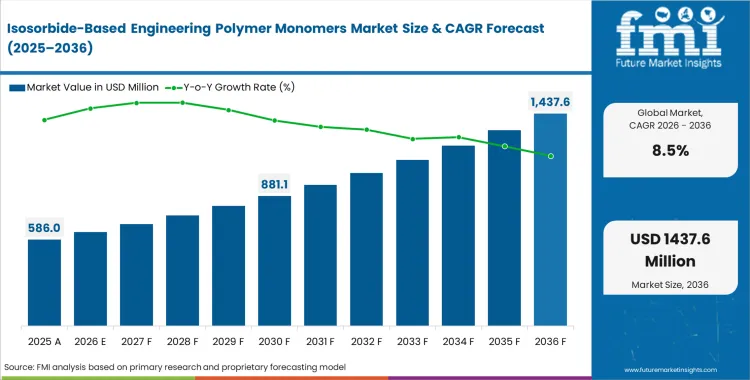
Car and electronics manufacturers are reassessing the chemical base used in plastic components as product safety standards tighten across regulated markets. Continued dependence on conventional fossil-based inputs raises compliance pressure, especially where upcoming European rules are narrowing tolerance for materials linked to health concerns. BPA-free engineering polymer monomers are drawing stronger interest because they allow plastic processors to maintain clarity, impact resistance, and application performance without compromising regulatory acceptability. Supply security is becoming a central procurement issue as more manufacturers look for bio-based alternatives that can move beyond pilot-scale use and support commercial production programs.
Commercial adoption still depends on whether suppliers can deliver material with the purity needed for standard factory processing. Plastic manufacturers need these monomers to perform under high melt temperatures, which puts strict limits on residual moisture, color bodies, and other impurities that can affect consistency. Monomer purity requirements for isosorbide polymers remain critical for that reason. Once purity levels meet industrial processing standards, manufacturers can replace legacy plastics with less disruption to installed equipment and existing conversion lines.
Regional growth is closely tied to local regulatory timing, downstream manufacturing strength, and feedstock availability. China is projected to witness a CAGR of 9.7% in isosorbide monomer demand through 2036, supported by rising use in electric vehicle interior applications. Brazil is forecast to register 9.3% CAGR during the study period, helped by domestic sugar refining capacity that supports feedstock continuity. Demand for isosorbide monomers in India is anticipated to rise at a CAGR of 9.1% through 2036 as consumer electronics manufacturing expands. United States adoption is likely to advance at a CAGR of 8.4% over the forecast period, reflecting stronger preference for lower-carbon material inputs. Germany is expected to post a CAGR of 8.1% in isosorbide monomers by 2036, with engineering plastics demand supported by strict automotive recycling requirements. South Korea is set to record 7.7% CAGR during the forecast period, while Japan is projected to witness 7.0% CAGR in the isosorbide monomer market through 2036. Regional differences remain tied to how quickly regulation, materials qualification, and industrial demand move into alignment.
Segmental Analysis
Isosorbide-Based Engineering Polymer Monomers Market Analysis by Derivative Type
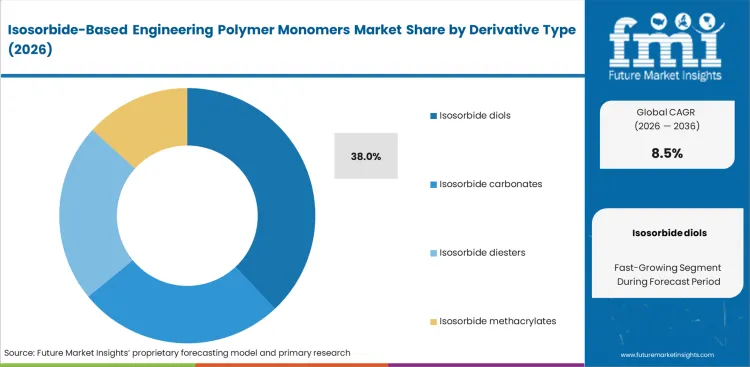
Chemical manufacturers strongly prefer direct esterification processes because the synthesis setup matches their existing factory equipment. The isosorbide diols segment is estimated to account for an anticipated 38.0% share in 2026 as plant operators successfully feed these molecules directly into standard polycondensation reactors without friction. Avoiding massive new capital investments remains the primary reason for this high commercial adoption rate. Versatile reactivity within these diols allows material formulators to precisely control the final melting points of the plastics they produce. High production volumes often hide a major operational weakness, which is the extreme sensitivity of these materials to ambient moisture during warehouse storage. Compounding facilities must operate strict climate-controlled environments to prevent the raw materials from pulling water from the air. Failing to control humidity leads directly to inconsistent coloring in the final plastic batches, resulting in expensive material waste.
- Reactor Compatibility: Direct drop-in capabilities allow existing polyester plants to utilize diol derivatives. Chemical plant operators avoid massive capital expenditures on new synthesis hardware.
- Moisture Degradation: High hygroscopicity creates severe handling challenges during storage and transport. Logistics planners face increased costs for specialized climate-controlled shipping containers.
- Color Variation: Impurities introduced through improper handling manifest as yellowing in the final polymer. Quality control technicians reject compromised batches, causing significant material waste and production delays.
Isosorbide-Based Engineering Polymer Monomers Market Analysis by Application
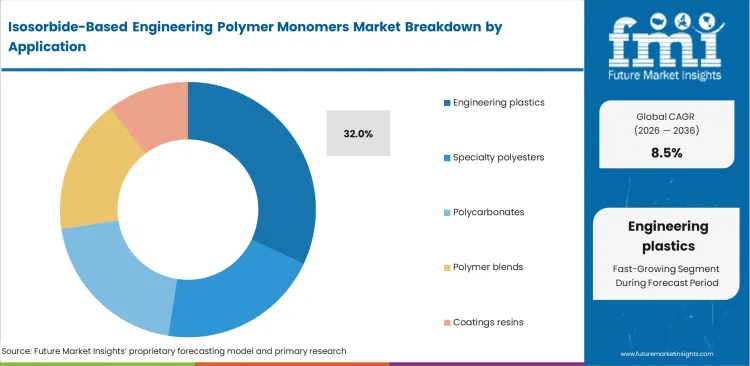
In 2026, the engineering plastics category is expected to contribute a projected 32.0% of total market share, driven primarily by the severe performance limits of standard bioplastics in high-heat environments. Material scientists actively choose these plant-based monomers to bridge the functional gap between cheap commodity resins and expensive ultra-high-performance plastics. Adding the rigid ring structure of isosorbide fundamentally raises the melting point of the final part to meet strict automotive interior heat standards. Optical clarity functions as a useful marketing feature, but the true commercial value for vehicle manufacturers is the resulting resistance to chemical stress-cracking. Factory buyers who prioritize low raw material costs over high purity levels frequently watch their molded components fail early during routine cleaning protocols. Dense molecular packing prevents harsh industrial solvents from penetrating the plastic surface, preventing accidental stress fractures when maintenance crews clean the parts.
- Thermal Elevation: Incorporating bicyclic rings pushes the glass transition temperature significantly higher. Material scientists qualify these engineering plastics for components exposed to engine-adjacent heat zones.
- Chemical Resistance: The dense molecular packing prevents solvent penetration during routine exposure. Maintenance crews avoid causing accidental stress fractures when applying industrial cleaning solutions.
- Purity Requirements: Trace impurities catalyze severe degradation during the compounding phase. Polymer formulation scientists must source highly refined grades to prevent catastrophic part failure in the field.
Isosorbide-Based Engineering Polymer Monomers Market Analysis by Polymer Family
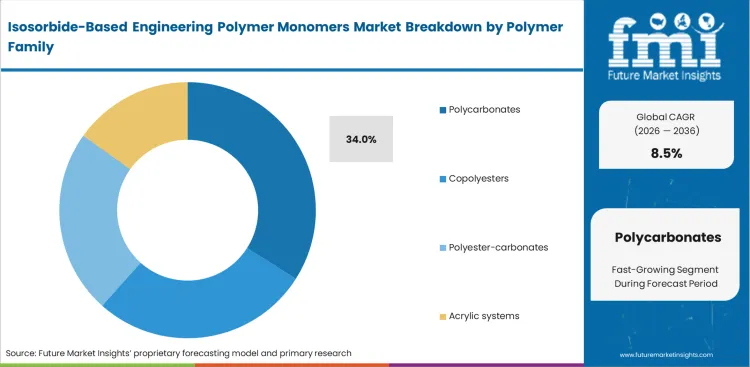
Consumer product designers urgently need to remove toxic precursor chemicals from clear plastic parts like reusable water bottles and electronic screens. Achieving absolute transparency alongside high impact strength relies heavily on the unique chemical geometry of polycarbonate resins formulated with isosorbide. One major operational hurdle rarely mentioned in sustainability reports is that molding these specific bio-plastics requires much higher injection pressures than older materials. Pushing thicker, hotter material into legacy metal molds causes rapid tool wear and high rates of incomplete parts. Factory floors attempting a direct material swap without upgrading their injection molding equipment face high scrap rates and constant mold maintenance downtime. Despite these severe processing challenges, aggressive substitution mandates mean the polycarbonates segment is forecast to command an estimated 34.0% share in 2026. Resolving the high-pressure molding limitations remains critical for long-term production profitability.
- Optical Clarity: Stereochemical properties allow light transmission equivalent to glass. Product designers specify these resins for transparent medical devices requiring regular visual inspection.
- Mold Wear: Higher melt viscosities necessitate elevated injection pressures during part formation. Tooling engineers experience accelerated degradation of mold surfaces, requiring more frequent maintenance cycles.
- Impact Strength: The rigid molecular structure absorbs kinetic energy without shattering. Consumer goods manufacturers utilize polycarbonate films to produce durable, shatter-resistant display components.
Isosorbide-Based Engineering Polymer Monomers Market Analysis by End Use
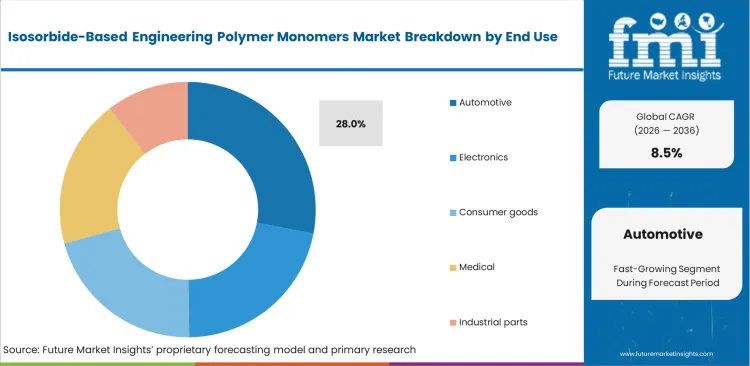
Vehicle weight reduction programs are pushing automakers toward structural plastics that can meet safety targets alongside tighter environmental requirements. Automotive demand is expected to account for 28.0% share in 2026 as manufacturers replace heavier metal brackets and older plastic systems with bio-based alternatives in interior applications. Lower vehicle mass remains important for fleet efficiency targets, especially where lightweight polycarbonate composites can reduce part weight without introducing long-term chemical concerns inside the cabin. Adoption still moves cautiously because any new material entering the vehicle supply chain must pass a long and expensive qualification process. New formulations are required to withstand extended UV exposure, repeated temperature swings, and prolonged performance testing before they receive final approval for production use. Suppliers that underestimate this validation cycle often struggle to convert development work into timely commercial orders.
- Weight Reduction: Replacing metal components with high-strength bio-polymers reduces overall vehicle mass. Automakers use these materials to support efficiency targets and improve electric vehicle range.
- Weathering Endurance: Interior components must perform under sustained UV exposure and repeated temperature cycling. New formulations go through long accelerated aging programs before production approval.
- Qualification Cycles: Safety and performance standards extend material validation over multiple years. Chemical suppliers often face delayed revenue realization until vehicle platforms complete final approval.
Isosorbide-Based Engineering Polymer Monomers Market Drivers, Restraints, and Opportunities
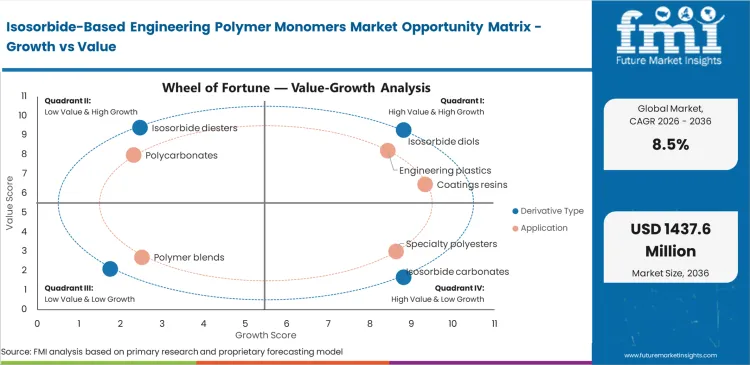
European regulation is tightening around chemicals linked to health concerns, and rigid plastics manufacturers are being pushed to reconsider legacy raw materials. Consumer brands face rising compliance pressure when older fossil-based inputs remain in packaging and household goods, especially in categories where product safety scrutiny is increasing. Isosorbide is drawing more attention because it gives manufacturers a plant-based route to maintain legal compliance without giving up the strength and heat resistance expected from established materials. Much of the shift away from bisphenol A comes from this regulatory pressure. Manufacturers still need new monomers to match the performance of BPA-based systems under real processing and end-use conditions, which is why isosorbide monomers are being tested closely for heat tolerance, stress resistance, and long-term product stability. Reliable access to bio-based polymers is becoming more important as buyers try to reduce recall risk and keep production lines aligned with changing material requirements.
Purity remains the main obstacle to broader commercial adoption. Plant-based feedstocks often carry trace impurities that can turn finished plastics yellow under high processing temperatures, which creates a direct problem in clear and performance-sensitive applications. Removing those residues requires energy-intensive refining and filtration, and that pushes production cost well above older petrochemical alternatives. Buyers looking for high-purity isosorbide monomer often hesitate at that premium, particularly when downstream converters still benchmark new inputs against the cost structure of conventional materials. Supplier qualification also becomes narrower because only a limited group can consistently deliver the clarity and processing consistency required for industrial use. Resolving this isosorbide polymerization challenge will depend on continued investment in purification technology and larger-scale refining capacity.
- Specialty Medical Devices: High-purity plant-based materials help manufacturers produce clear components that can withstand repeated sterilization. BPA-free monomers support transparent engineering plastics suited to diagnostic and medical equipment where safety and clarity both matter.
- Advanced Composite Matrices: Rigid bio-resins combined with natural fibers can support lightweight composite structures with good strength retention. Aerospace applications value that balance where lower cabin weight must still meet fire and safety requirements.
- Electronic Component Integration: Durable, heat-resistant plastics remain essential in compact electronic products. Isosorbide in electronic housings helps support casings that can handle repeated temperature changes without cracking or losing structural stability.
Regional Analysis
Global regulatory shifts and the push for sustainable materials shape adoption rates uniquely across different geographies. Regional manufacturing footprints and localized feedstock availability dictate how quickly these bio-based monomers replace traditional petrochemicals.
.webp "Top Country Growth Comparison Isosorbide Based Engineering Polymer Monomers Market Cagr (2026 2036)")
| Country | CAGR (2026 to 2036) |
|---|---|
| China | 9.7% |
| Brazil | 9.3% |
| India | 9.1% |
| United States | 8.4% |
| Germany | 8.1% |
| South Korea | 7.7% |
| Japan | 7.0% |
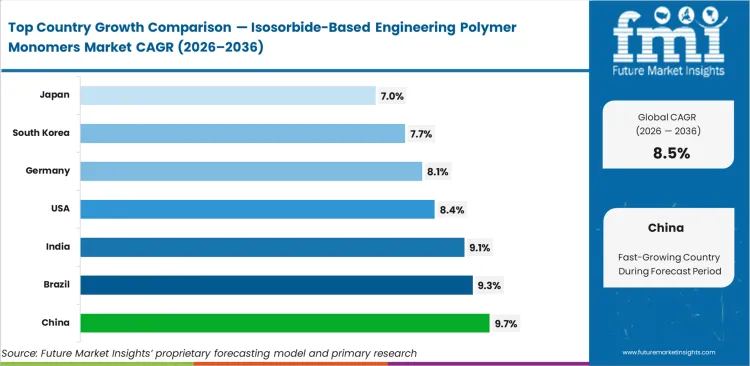
Source: Future Market Insights (FMI) analysis, based on proprietary forecasting model and primary research
Asia Pacific Isosorbide-Based Engineering Polymer Monomers Market Analysis
Massive expansions in localized chemical synthesis infrastructure define the adoption curve across Asian manufacturing hubs. Regional governments actively subsidize bio-refineries to reduce dependence on imported petrochemical derivatives, giving local polymer manufacturers a secure supply. The rapid growth of electric vehicle production creates a captive audience for high-performance, sustainable resins. Chemical producers leverage abundant regional biomass resources to feed these large-scale plants.
- China: Domestic electric vehicle producers specify bio-based interior components to meet regional sustainability targets. China isosorbide monomer consumption is poised to expand at a CAGR of 9.7% through 2036, driven by the need to achieve strict interior air quality standards. Localized supply chains grant automakers a distinct cost advantage over international competitors.
- India: Rapid expansion in consumer electronics manufacturing demands high-heat performance resins. Establishing reliable local compounding facilities remains the primary operational hurdle yet demand in India is anticipated to rise at a CAGR of 9.1% by 2036 as component designers utilize bio-polycarbonates for durable device housings.
- South Korea: Advanced electronics manufacturing continues to support demand for BPA-free transparent materials across display-related applications. Close coordination between technology companies and chemical producers also helps shorten material qualification cycles for new grades. Demand for isosorbide monomers in South Korea is projected to rise at a CAGR of 7.7% during the assessment period.
- Japan: Stringent recycling directives force automotive manufacturers to select easily identifiable polymer blends. Japan’s market demand is expected to grow at an estimated CAGR of 7.0% from 2026 to 2036 because materials scientists focus on copolymer formulations that maintain impact resistance over long lifecycles.
The broader transition toward circular manufacturing frameworks across the region compels suppliers to document the exact carbon footprint of their production processes. Integrating circular specialty plastics for textiles and packaging ensures long-term compliance with international export standards.
North America & Latin America Isosorbide-Based Engineering Polymer Monomers Market Analysis
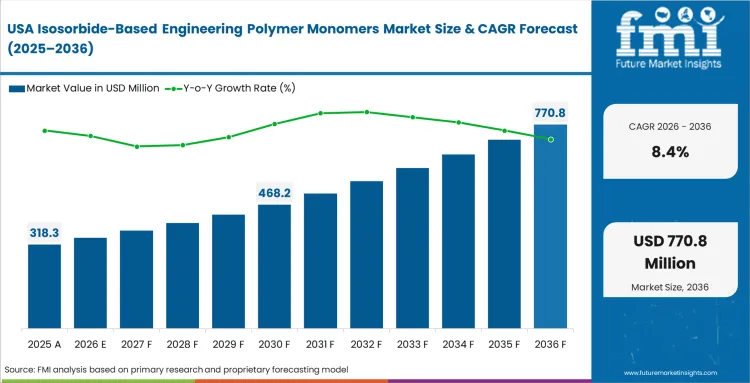
Combining the agricultural scale of the southern hemisphere with the corporate sustainability mandates of the north creates a highly integrated cross-border supply chain. Abundant agricultural feedstock in South America provides a steady flow of raw materials for chemical synthesis. Massive retail corporations in the north force packaging and component manufacturers to replace fossil-based plastics with verified bio-derived alternatives. This vertical integration buffers regional manufacturers against volatile global energy prices.
- United States: Consumer brand commitments to decarbonized supply chains drive aggressive material substitution efforts across multiple industries. With United States isosorbide monomer adoption poised to scale at an anticipated 8.4% CAGR through 2036, early movers in the compounding space capture lucrative long-term supply agreements with major consumer labels. Packaging engineers qualify these rigid bio-plastics for premium cosmetics and durable goods.
- Brazil: Localized sugar refining infrastructure supports continuous feedstock availability for monomer synthesis. Controlling the raw material source provides a structural advantage in global pricing negotiations, predicting Brazil’s isosorbide polymer monomer demand set to record a projected CAGR of 9.3% over the forecast period.
Export-focused supply networks prioritize bulk shipping logistics to move purified monomers northward for specialized domestic compounding. Stringent FDA requirements for food-contact materials dictate long approval timelines for new applications across this combined geography.
Europe Isosorbide-Based Engineering Polymer Monomers Market Analysis
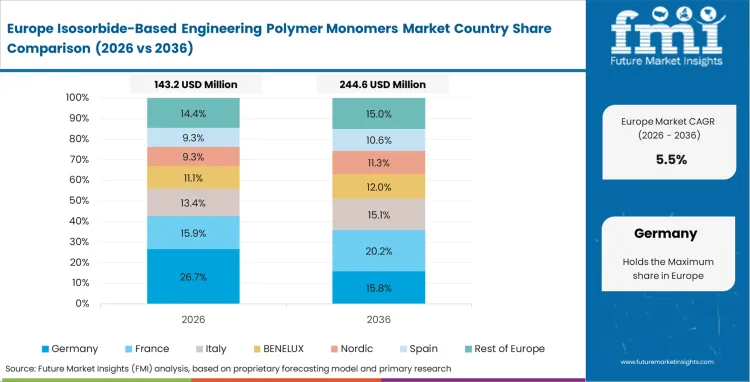
Aggressive regulatory frameworks explicitly banning endocrine disruptors dictate the material choices of European product designers. The European Chemical Agency's restrictive stance on bisphenol variants forces a mandatory transition toward safer cyclic diols. Regional automotive manufacturers lead the global push for bio-based interior components, integrating these requirements directly into their purchasing specifications. This legislative environment creates a guaranteed commercial pathway for isosorbide derivatives in structural applications.
- Germany: Stringent automotive recycling requirements continue to support demand for more sustainable polymer systems across vehicle interior applications. Manufacturers are specifying hybrid PCR and bio-resin materials for interior panels where consistency, compliance, and supply reliability are all matter. Sales of isosorbide monomers in Germany are expected to increase at a CAGR of 8.1% during the forecast period.
Strict chemical registration protocols continue to limit the entry of low-cost, low-purity imports into the European market. Domestic suppliers are also placing greater emphasis on life-cycle assessment work to demonstrate that their production routes deliver credible carbon reductions against petrochemical alternatives.
Competitive Aligners for Market Players
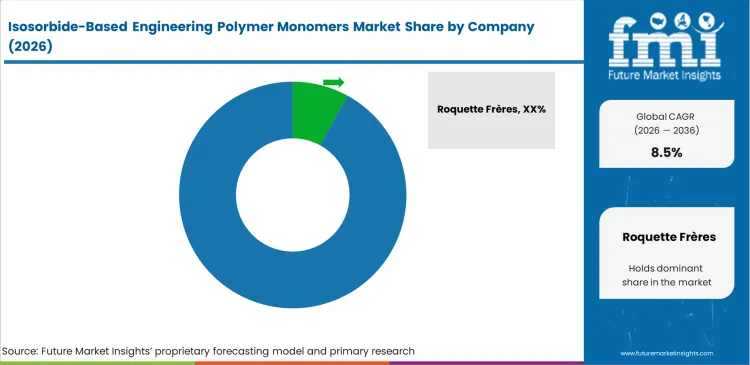
Established isosorbide monomer suppliers retain an advantage in high-purity production because consistent output depends on tightly controlled purification and crystallization capability. Building that capacity requires heavy investment in distillation systems able to process plant-based feedstocks without repeated fouling or unstable run conditions. New entrants often struggle to meet strict color and purity requirements during early production, which limits qualification with downstream manufacturers. High equipment costs and narrow quality tolerance keep supply concentrated among a relatively small group of industrial producers.
Extensive technical data built over years of commercial production also strengthens the position of incumbent suppliers. Downstream manufacturers value that support because heat-sensitive polymer systems often need precise formulation and processing adjustments during scale-up. Changing suppliers can force revalidation of molding conditions, material behavior, and quality consistency across production runs. Reliable processing guidance gives established producers a practical advantage even when additional market capacity comes online.
Automotive and electronics manufacturers also try to avoid overdependence on a single source by qualifying multiple suppliers early in the design cycle. New structural applications often require at least two approved material sources before moving into full production, and that raises the benchmark for purity and consistency across the sector. Volume contracts are more likely to go to suppliers that can show stable output from geographically diversified production networks.
Key Players in Isosorbide-Based Engineering Polymer Monomers Market
- Roquette Frères
- Mitsubishi Chemical Group
- SK chemicals
- Mitsui Chemicals
Scope of the Report
| Metric | Value |
|---|---|
| Quantitative Units | USD 586 million to USD 1,325 million, at a CAGR of 8.5% |
| Market Definition | Bio-derived cyclic organic compounds utilized as building blocks for high-performance thermoplastics, replacing bisphenol A in structural applications to improve environmental compliance. |
| Segmentation | Derivative type, Application, Polymer family, End use, Region |
| Regions Covered | North America, Latin America, Europe, Asia Pacific, Middle East & Africa |
| Countries Covered | United States, Canada, Brazil, Mexico, Argentina, Germany, France, Italy, United Kingdom, China, Japan, India, South Korea |
| Key Companies Profiled | Roquette Frères, Mitsubishi Chemical Group, SK chemicals, Mitsui Chemicals |
| Forecast Period | 2026 to 2036 |
| Approach | Installed production capacity of high-purity isosorbide mapped against chemical conversion yields. |
Source: Future Market Insights (FMI) analysis, based on proprietary forecasting model and primary research
Segments
Derivative Type
- Isosorbide diols
- Isosorbide carbonates
- Isosorbide diesters
- Isosorbide methacrylates
Application
- Engineering plastics
- Specialty polyesters
- Polycarbonates
- Polymer blends
- Coatings resins
Polymer Family
- Polycarbonates
- Copolyesters
- Polyester-carbonates
- Acrylic systems
End Use
- Automotive
- Electronics
- Consumer goods
- Medical
- Industrial parts
Regions
- Asia Pacific
- India
- China
- Japan
- South Korea
- Indonesia
- Australia & New Zealand
- ASEAN
- Rest of Asia Pacific
- Europe
- Germany
- Italy
- France
- United Kingdom
- Spain
- Benelux
- Nordics
- Central & Eastern Europe
- Rest of Europe
- North America
- United States
- Canada
- Mexico
- Latin America
- Brazil
- Argentina
- Chile
- Rest of Latin America
- Middle East & Africa
- Kingdom of Saudi Arabia
- United Arab Emirates
- South Africa
- Turkey
- Rest of Middle East & Africa
Bibliography
- Qian, W., Ma, X., Fu, M., Chen, M., Yang, Z., Su, Q., & Cheng, W. (2024). Tailoring the molecular weight of isosorbide-derived polycarbonates via regulating the H-bond donor/acceptor ability of task-specific ionic liquid catalysts. Green Chemistry, 26, 3406-3417.
- Lee, H. Y., Myung, H., Kim, J., Lee, J., & colleagues. (2024). Synthesis and alkaline hydrolytic degradation of isosorbide-based polycarbonates via incorporation of ethoxylated isosorbide as a comonomer. Journal of Applied Polymer Science.
- Jašek, V., and colleagues. (2024). Improvements in the Production of Isosorbide Monomethacrylate Using a Biobased Catalyst and Liquid-Liquid Extraction Isolation for Modifications of Oil-Based Resins. ACS Omega.
- Hammami, N., and colleagues. (2025). Isosorbide as a Molecular Glass: New Insights into the Physicochemical Behavior of a Biobased Diol. Molecules, 30(22), 4364.
- Yang, Z., Zhang, J., Jiang, M., Wang, H., Ding, W., Zhang, X., He, H., & Xu, F. (2025). Green synthesis of isosorbide-based polycarbonate via dimethyl carbonate by dual imidazolate ionic liquid catalyst. Chemical Engineering Science, 309, 121491.
- Ma, X. J., Hao, X. Q., Wang, H. J., Yao, H. Y., Wang, Z. Q., & Lv, Y. (2025). An Excellent Biobased Copolymerization Monomer Module: Synthesis of Biobased Copolymers with Excellent Heat Resistance and Hydrophilic Properties. Chinese Journal of Polymer Science, 43, 2102-2109.
- Lim, W.-B., Lee, G.-Y., Choi, J.-S., Lee, J.-R., Min, J.-G., Lee, J.-H., Bae, J.-H., & Huh, P. (2026). An effective strategy to synthesize a novel biodegradable isosorbide-based polycarbonate. Polymer Chemistry, 17, 456-464.
This bibliography is provided for reader reference. The full FMI report contains the complete reference list with primary source documentation.
This Report Addresses
- Chemical synthesis engineers requiring safe, regulatory-compliant alternatives to bisphenol A for high-durability polymer resins.
- Automotive component specifiers mandated to increase bio-based interior content without compromising high-heat resistance.
- Polymer compounding facilities facing strict optical clarity requirements for food-contact packaging and consumer goods.
- Investors evaluating chemical producers scaling proprietary crystallization and distillation capacities for bio-derived diols.
- Packaging engineers responding to consumer brand demands for decarbonized, traceable supply chains in rigid plastics.
- Original equipment manufacturers seeking long-term supply resilience against volatile petrochemical feedstock pricing.
- Medical device designers substituting legacy materials with compliant, sterilizable bio-polycarbonates for transparent equipment.
- Chemical plant operators upgrading polycondensation reactors to integrate drop-in bio-monomers seamlessly.
Frequently Asked Questions
What is the isosorbide monomer forecast 2036 valuation?
Sales are expected to expand from USD 586 million in 2026 to USD 1,325 million by the end of the forecast period.
Why is isosorbide replacing bisphenol A across engineering plastics?
Strict regulatory bans in Europe explicitly target endocrine-disrupting chemicals, forcing an immediate transition toward safe, plant-based cyclic diols.
How does isosorbide compare with BPA and CHDM in engineering polymers?
Incorporating this rigid bicyclic ring structure pushes the continuous use temperature significantly higher than standard aliphatics while avoiding the toxicity profile of BPA.
What is slowing wider commercialization of isosorbide monomers?
Achieving the extreme purity required for optical applications demands complex, energy-intensive distillation steps that bottleneck consistent supply.
How much share do isosorbide diols control?
This derivative type is estimated to hold 38.0% share in 2026 based on broad compounding applicability.
Why are engineering plastics the primary application area?
Material scientists select these bio-resins specifically to bridge the performance gap between commodity plastics and ultra-high-performance polymers.
What share does the engineering plastics segment capture?
This application is expected to account for 32.0% share in 2026 due to extensive use in high-heat environments.
Why do polycarbonates represent the leading polymer family?
Product designers specify these resins to achieve absolute optical clarity without utilizing toxic chemical precursors.
How large is the polycarbonate segment?
Polycarbonates are poised to secure 34.0% share in 2026 as consumer brands demand safer transparent materials.
What drives adoption in the automotive end use?
Vehicle interior designers substitute heavy metal brackets with these lightweight bio-polymers to hit strict fleet emission targets.
What is the expected share for automotive applications?
The automotive segment is anticipated to capture 28.0% share in 2026.
Why does Asia Pacific lead regional adoption?
Regional governments actively subsidize the construction of massive bio-refineries, securing cost-competitive localized supply chains.
What share does the Asia Pacific region hold?
Asia Pacific is estimated to record 41.0% share in 2026 through rapid expansion of chemical synthesis infrastructure.
Which countries are leading isosorbide-based polymer monomer adoption?
China likely to expands at an anticipated 9.7% CAGR, while Brazil poised to record an estimated 9.3% CAGR supported by extensive localized sugar refining infrastructure.
Why is India showing strong demand?
India set to advance at a projected 9.1% CAGR driven by the expansion of consumer electronics manufacturing requiring durable device housings.
What forces adoption in the United States?
United States adoption seemingly tracks at an assessed 8.4% CAGR due to intense pressure from retail corporations mandating decarbonized supply chains.
How does Germany compare structurally?
Germany poised to grow at an expected 8.1% CAGR supported by extremely stringent automotive recycling directives that favor bio-derived formulations.
Which companies are active in this sector today?
Leading suppliers include Roquette Frères, Mitsubishi Chemical Group, and SK chemicals who dominate the high-purity tier.
How do incumbent chemical giants maintain control?
Established manufacturers possess deep formulation libraries that significantly reduce the compounding qualification burden for downstream buyers.
How important is monomer purity in isosorbide polymerization?
Impurities introduced through improper handling manifest as severe yellowing in the final polymer, causing unacceptable batch rejection rates.
How do automotive buyers resist supplier lock-in?
Operations departments mandate dual-sourcing capabilities early in the design phase to force standardization regarding monomer purity.
Preview the report firsthand - request a free sample
Get SampleGet the brochure for pricing and purchase details.
Get PDFTable of Content
- Executive Summary
- Global Market Outlook
- Demand-side Trends
- Supply-side Trends
- Technology Roadmap Analysis
- Analysis and Recommendations
- Market Overview
- Market Coverage / Taxonomy
- Market Definition / Scope / Limitations
- Research Methodology
- Chapter Orientation
- Analytical Lens and Working Hypotheses
- Market Sizing, Forecasting, and Opportunity Mapping
- Research Design and Evidence Framework
- Desk Research Programme (Secondary Evidence)
- Company Annual and Sustainability Reports
- Peer-reviewed Journals and Academic Literature
- Corporate Websites, Product Literature, and Technical Notes
- Earnings Decks and Investor Briefings
- Statutory Filings and Regulatory Disclosures
- Technical White Papers and Standards Notes
- Trade Journals, Industry Magazines, and Analyst Briefs
- Conference Proceedings, Webinars, and Seminar Materials
- Government Statistics Portals and Public Data Releases
- Press Releases and Reputable Media Coverage
- Specialist Newsletters and Curated Briefings
- Sector Databases and Reference Repositories
- FMI Internal Proprietary Databases and Historical Market Datasets
- Subscription Datasets and Paid Sources
- Social Channels, Communities, and Digital Listening Inputs
- Additional Desk Sources
- Expert Input and Fieldwork (Primary Evidence)
- Primary Modes
- Qualitative Interviews and Expert Elicitation
- Quantitative Surveys and Structured Data Capture
- Blended Approach
- Why Primary Evidence is Used
- Field Techniques
- Interviews
- Surveys
- Board Members
- Presidents and Vice Presidents
- R&D and Innovation Heads
- Technical Specialists
- Domain Subject-matter Experts
- Scientists
- Physicians and Other Healthcare Professionals
- Governance, Ethics, and Data Stewardship
- Research Ethics
- Data Integrity and Handling
- Primary Modes
- Tooling, Models, and Reference Databases
- Desk Research Programme (Secondary Evidence)
- Data Engineering and Model Build
- Data Acquisition and Ingestion
- Cleaning, Normalisation, and Verification
- Synthesis, Triangulation, and Analysis
- Quality Assurance and Audit Trail
- Market Background
- Market Dynamics
- Drivers
- Restraints
- Opportunity
- Trends
- Scenario Forecast
- Demand in Optimistic Scenario
- Demand in Likely Scenario
- Demand in Conservative Scenario
- Opportunity Map Analysis
- Product Life Cycle Analysis
- Supply Chain Analysis
- Investment Feasibility Matrix
- Value Chain Analysis
- PESTLE and Porter’s Analysis
- Regulatory Landscape
- Regional Parent Market Outlook
- Production and Consumption Statistics
- Import and Export Statistics
- Market Dynamics
- Global Market Analysis 2021 to 2025 and Forecast, 2026 to 2036
- Historical Market Size Value (USD Million) Analysis, 2021 to 2025
- Current and Future Market Size Value (USD Million) Projections, 2026 to 2036
- Y-o-Y Growth Trend Analysis
- Absolute $ Opportunity Analysis
- Global Market Pricing Analysis 2021 to 2025 and Forecast 2026 to 2036
- Global Market Analysis 2021 to 2025 and Forecast 2026 to 2036, By Derivative Type
- Introduction / Key Findings
- Historical Market Size Value (USD Million) Analysis By Derivative Type , 2021 to 2025
- Current and Future Market Size Value (USD Million) Analysis and Forecast By Derivative Type , 2026 to 2036
- Isosorbide diols
- Isosorbide carbonates
- Isosorbide diesters
- Isosorbide methacrylates
- Isosorbide diols
- Y-o-Y Growth Trend Analysis By Derivative Type , 2021 to 2025
- Absolute $ Opportunity Analysis By Derivative Type , 2026 to 2036
- Global Market Analysis 2021 to 2025 and Forecast 2026 to 2036, By Application
- Introduction / Key Findings
- Historical Market Size Value (USD Million) Analysis By Application, 2021 to 2025
- Current and Future Market Size Value (USD Million) Analysis and Forecast By Application, 2026 to 2036
- Engineering plastics
- Specialty polyesters
- Polycarbonates
- Polymer blends
- Coatings resins
- Engineering plastics
- Y-o-Y Growth Trend Analysis By Application, 2021 to 2025
- Absolute $ Opportunity Analysis By Application, 2026 to 2036
- Global Market Analysis 2021 to 2025 and Forecast 2026 to 2036, By Polymer Family
- Introduction / Key Findings
- Historical Market Size Value (USD Million) Analysis By Polymer Family, 2021 to 2025
- Current and Future Market Size Value (USD Million) Analysis and Forecast By Polymer Family, 2026 to 2036
- Polycarbonates
- Copolyesters
- Polyester-carbonates
- Acrylic systems
- Polycarbonates
- Y-o-Y Growth Trend Analysis By Polymer Family, 2021 to 2025
- Absolute $ Opportunity Analysis By Polymer Family, 2026 to 2036
- Global Market Analysis 2021 to 2025 and Forecast 2026 to 2036, By End Use
- Introduction / Key Findings
- Historical Market Size Value (USD Million) Analysis By End Use, 2021 to 2025
- Current and Future Market Size Value (USD Million) Analysis and Forecast By End Use, 2026 to 2036
- Automotive
- Electronics
- Consumer goods
- Medical
- Industrial parts
- Automotive
- Y-o-Y Growth Trend Analysis By End Use, 2021 to 2025
- Absolute $ Opportunity Analysis By End Use, 2026 to 2036
- Global Market Analysis 2021 to 2025 and Forecast 2026 to 2036, By Region
- Introduction
- Historical Market Size Value (USD Million) Analysis By Region, 2021 to 2025
- Current Market Size Value (USD Million) Analysis and Forecast By Region, 2026 to 2036
- North America
- Latin America
- Western Europe
- Eastern Europe
- East Asia
- South Asia and Pacific
- Middle East & Africa
- Market Attractiveness Analysis By Region
- North America Market Analysis 2021 to 2025 and Forecast 2026 to 2036, By Country
- Historical Market Size Value (USD Million) Trend Analysis By Market Taxonomy, 2021 to 2025
- Market Size Value (USD Million) Forecast By Market Taxonomy, 2026 to 2036
- By Country
- USA
- Canada
- Mexico
- By Derivative Type
- By Application
- By Polymer Family
- By End Use
- By Country
- Market Attractiveness Analysis
- By Country
- By Derivative Type
- By Application
- By Polymer Family
- By End Use
- Key Takeaways
- Latin America Market Analysis 2021 to 2025 and Forecast 2026 to 2036, By Country
- Historical Market Size Value (USD Million) Trend Analysis By Market Taxonomy, 2021 to 2025
- Market Size Value (USD Million) Forecast By Market Taxonomy, 2026 to 2036
- By Country
- Brazil
- Chile
- Rest of Latin America
- By Derivative Type
- By Application
- By Polymer Family
- By End Use
- By Country
- Market Attractiveness Analysis
- By Country
- By Derivative Type
- By Application
- By Polymer Family
- By End Use
- Key Takeaways
- Western Europe Market Analysis 2021 to 2025 and Forecast 2026 to 2036, By Country
- Historical Market Size Value (USD Million) Trend Analysis By Market Taxonomy, 2021 to 2025
- Market Size Value (USD Million) Forecast By Market Taxonomy, 2026 to 2036
- By Country
- Germany
- UK
- Italy
- Spain
- France
- Nordic
- BENELUX
- Rest of Western Europe
- By Derivative Type
- By Application
- By Polymer Family
- By End Use
- By Country
- Market Attractiveness Analysis
- By Country
- By Derivative Type
- By Application
- By Polymer Family
- By End Use
- Key Takeaways
- Eastern Europe Market Analysis 2021 to 2025 and Forecast 2026 to 2036, By Country
- Historical Market Size Value (USD Million) Trend Analysis By Market Taxonomy, 2021 to 2025
- Market Size Value (USD Million) Forecast By Market Taxonomy, 2026 to 2036
- By Country
- Russia
- Poland
- Hungary
- Balkan & Baltic
- Rest of Eastern Europe
- By Derivative Type
- By Application
- By Polymer Family
- By End Use
- By Country
- Market Attractiveness Analysis
- By Country
- By Derivative Type
- By Application
- By Polymer Family
- By End Use
- Key Takeaways
- East Asia Market Analysis 2021 to 2025 and Forecast 2026 to 2036, By Country
- Historical Market Size Value (USD Million) Trend Analysis By Market Taxonomy, 2021 to 2025
- Market Size Value (USD Million) Forecast By Market Taxonomy, 2026 to 2036
- By Country
- China
- Japan
- South Korea
- By Derivative Type
- By Application
- By Polymer Family
- By End Use
- By Country
- Market Attractiveness Analysis
- By Country
- By Derivative Type
- By Application
- By Polymer Family
- By End Use
- Key Takeaways
- South Asia and Pacific Market Analysis 2021 to 2025 and Forecast 2026 to 2036, By Country
- Historical Market Size Value (USD Million) Trend Analysis By Market Taxonomy, 2021 to 2025
- Market Size Value (USD Million) Forecast By Market Taxonomy, 2026 to 2036
- By Country
- India
- ASEAN
- Australia & New Zealand
- Rest of South Asia and Pacific
- By Derivative Type
- By Application
- By Polymer Family
- By End Use
- By Country
- Market Attractiveness Analysis
- By Country
- By Derivative Type
- By Application
- By Polymer Family
- By End Use
- Key Takeaways
- Middle East & Africa Market Analysis 2021 to 2025 and Forecast 2026 to 2036, By Country
- Historical Market Size Value (USD Million) Trend Analysis By Market Taxonomy, 2021 to 2025
- Market Size Value (USD Million) Forecast By Market Taxonomy, 2026 to 2036
- By Country
- Kingdom of Saudi Arabia
- Other GCC Countries
- Turkiye
- South Africa
- Other African Union
- Rest of Middle East & Africa
- By Derivative Type
- By Application
- By Polymer Family
- By End Use
- By Country
- Market Attractiveness Analysis
- By Country
- By Derivative Type
- By Application
- By Polymer Family
- By End Use
- Key Takeaways
- Key Countries Market Analysis
- USA
- Pricing Analysis
- Market Share Analysis, 2025
- By Derivative Type
- By Application
- By Polymer Family
- By End Use
- Canada
- Pricing Analysis
- Market Share Analysis, 2025
- By Derivative Type
- By Application
- By Polymer Family
- By End Use
- Mexico
- Pricing Analysis
- Market Share Analysis, 2025
- By Derivative Type
- By Application
- By Polymer Family
- By End Use
- Brazil
- Pricing Analysis
- Market Share Analysis, 2025
- By Derivative Type
- By Application
- By Polymer Family
- By End Use
- Chile
- Pricing Analysis
- Market Share Analysis, 2025
- By Derivative Type
- By Application
- By Polymer Family
- By End Use
- Germany
- Pricing Analysis
- Market Share Analysis, 2025
- By Derivative Type
- By Application
- By Polymer Family
- By End Use
- UK
- Pricing Analysis
- Market Share Analysis, 2025
- By Derivative Type
- By Application
- By Polymer Family
- By End Use
- Italy
- Pricing Analysis
- Market Share Analysis, 2025
- By Derivative Type
- By Application
- By Polymer Family
- By End Use
- Spain
- Pricing Analysis
- Market Share Analysis, 2025
- By Derivative Type
- By Application
- By Polymer Family
- By End Use
- France
- Pricing Analysis
- Market Share Analysis, 2025
- By Derivative Type
- By Application
- By Polymer Family
- By End Use
- India
- Pricing Analysis
- Market Share Analysis, 2025
- By Derivative Type
- By Application
- By Polymer Family
- By End Use
- ASEAN
- Pricing Analysis
- Market Share Analysis, 2025
- By Derivative Type
- By Application
- By Polymer Family
- By End Use
- Australia & New Zealand
- Pricing Analysis
- Market Share Analysis, 2025
- By Derivative Type
- By Application
- By Polymer Family
- By End Use
- China
- Pricing Analysis
- Market Share Analysis, 2025
- By Derivative Type
- By Application
- By Polymer Family
- By End Use
- Japan
- Pricing Analysis
- Market Share Analysis, 2025
- By Derivative Type
- By Application
- By Polymer Family
- By End Use
- South Korea
- Pricing Analysis
- Market Share Analysis, 2025
- By Derivative Type
- By Application
- By Polymer Family
- By End Use
- Russia
- Pricing Analysis
- Market Share Analysis, 2025
- By Derivative Type
- By Application
- By Polymer Family
- By End Use
- Poland
- Pricing Analysis
- Market Share Analysis, 2025
- By Derivative Type
- By Application
- By Polymer Family
- By End Use
- Hungary
- Pricing Analysis
- Market Share Analysis, 2025
- By Derivative Type
- By Application
- By Polymer Family
- By End Use
- Kingdom of Saudi Arabia
- Pricing Analysis
- Market Share Analysis, 2025
- By Derivative Type
- By Application
- By Polymer Family
- By End Use
- Turkiye
- Pricing Analysis
- Market Share Analysis, 2025
- By Derivative Type
- By Application
- By Polymer Family
- By End Use
- South Africa
- Pricing Analysis
- Market Share Analysis, 2025
- By Derivative Type
- By Application
- By Polymer Family
- By End Use
- USA
- Market Structure Analysis
- Competition Dashboard
- Competition Benchmarking
- Market Share Analysis of Top Players
- By Regional
- By Derivative Type
- By Application
- By Polymer Family
- By End Use
- Competition Analysis
- Competition Deep Dive
- Roquette Frères
- Overview
- Product Portfolio
- Profitability by Market Segments (Product/Age /Sales Channel/Region)
- Sales Footprint
- Strategy Overview
- Marketing Strategy
- Product Strategy
- Channel Strategy
- Mitsubishi Chemical Group
- SK chemicals
- Mitsui Chemicals
- Roquette Frères
- Competition Deep Dive
- Assumptions & Acronyms Used


