

- Industry Size (2025)
- USD 4.2 Mn
- Forecast (2035)
- USD 7.6 Mn
- CAGR (2025 to 2035)
- 6.1%
Demand for Barrel Liner in Japan 2025 to 2035
The Japan barrel liner demand is valued at USD 4.2 million in 2025 and is projected to reach USD 7.6 million by 2035, indicating a CAGR of 6.1%. Demand reflects increased emphasis on contamination control, safe material handling, and enhanced productivity in industrial packaging workflows. Barrel liners enable reuse of metal and plastic drums while protecting stored materials from direct contact with container walls. Their utilization supports compliance with hygiene and purity requirements in chemicals, food processing, pharmaceuticals, and specialty materials.
High-density polyethylene liners hold the leading share, driven by chemical resistance, load durability, and compatibility with both hazardous and non-hazardous contents. HDPE liners support secure storage of liquids, powders, and pastes transported through industrial supply chains. Product development centers on puncture resistance, anti-static properties, and improved form-fit designs that reduce liner displacement during filling and dispensing operations.
Kyushu & Okinawa, Kanto, and Kansai record the highest uptake, supported by concentrated chemical production zones, food-processing clusters, and port-linked distribution centers. These areas maintain strong adoption in both export-oriented and domestic industrial activities. Key suppliers include Taiyo Kogyo Co., Ltd., Maeda Kosen Co., Ltd., Okura Industrial Co., Ltd., Sekisui Seikei Co., Ltd., and Greif. Their portfolios include straight-sided, conical, and anti-static liners used in batch manufacturing, storage, and clean-handling applications across Japan’s industrial sectors.
Quick Stats for Japan Barrel Liner Demand
- Japan Barrel Liner Sales Value (2025): USD 4.2 million
- Japan Barrel Liner Forecast Value (2035): USD 7.6 million
- Japan Barrel Liner Forecast CAGR (2025 to 2035): 6.1%
- Leading Material Type in Japan Barrel Liner Demand: High-Density Polyethylene (HDPE)
- Key Growth Regions in Japan Barrel Liner Demand: Kyushu & Okinawa, Kanto, Kansai
- Top Players in Japan Barrel Liner Demand: Taiyo Kogyo Co., Ltd., Maeda Kosen Co., Ltd., Okura Industrial Co., Ltd., Sekisui Seikei Co., Ltd., Greif

What is the Growth Forecast for Barrel Liner Industry in Japan through 2035?
Demand for barrel liners in Japan presents a steady but segmented growth pattern when comparing the early and late halves of the forecast period. Early growth is supported by industrial handling needs in chemicals, lubricants, and food-processing materials. Regulatory expectations for contamination control and safer storage drive baseline adoption, though order cycles remain moderate in the first years because major users already operate containment systems.
During the later period, growth becomes more notable as recycling requirements and materials-handling automation lead to more frequent liner replacement and product redesign. Hazard-sensitive sectors, including pharmaceuticals and specialty chemicals, expand usage of high-purity liners. Transition to sustainable and easily separable inner-layer formats increases replacement intensity over expansion of physical drum fleets. The later phase therefore contributes a greater share of total growth, with higher adoption among mid-sized users complementing the established base. Growth shifts from compliance-anchored purchasing in the early stage to performance and sustainability-driven deployment in the second half. This creates a gradual upward step in contribution, reflecting a controlled but improving long-term demand trajectory within Japan’s industrial packaging operations.
Japan Barrel Liner Key Takeaways
| Metric | Value |
|---|---|
| Japan Barrel Liner Sales Value (2025) | USD 4.2 million |
| Japan Barrel Liner Forecast Value (2035) | USD 7.6 million |
| Japan Barrel Liner Forecast CAGR (2025 to 2035) | 6.1% |
Why is the Demand for Barrel Liners in Japan Growing?
Demand for barrel liners in Japan is increasing because chemical producers, food processors and waste management companies seek reliable containment that prevents contamination and simplifies handling. Barrel liners allow reusable steel or plastic drums to carry different materials without the need for extensive cleaning, which reduces turnaround time in facilities with frequent batch changes. Manufacturers handling adhesives, inks, powders and specialty chemicals value liners for protecting product purity and preventing residues that could react with new contents. The food and beverage sector uses liners to maintain hygiene standards in transporting syrups, oils and granular ingredients.
Industrial sites and logistics providers adopt liners to support safe storage and spill prevention during internal transport. Interest in controlled waste disposal and recycling also strengthens usage, since liners create a barrier that makes drum cleaning easier and reduces water and chemical use for sanitation. Constraints include cost sensitivity among smaller operators, particularly when single-use liners increase per-drum expense. Some companies already equipped with dedicated drums for specific materials may not require liners. Supply variability for specialty liner materials can influence purchasing decisions when chemical compatibility tests are needed.
Which Material Types, Packaging Types, and Capacities Lead Demand for Barrel Liners in Japan?
Demand for barrel liners in Japan is driven by strict contamination prevention standards across chemical, pharmaceutical, food-contact, and industrial packaging segments. Japanese manufacturers and importers prioritize hygiene protection, leak resistance, and compatibility with hazardous or sensitive contents. Ecofriendly initiatives shape raw material selection, favoring recyclable polymers. Storage space efficiency, transport regulations, and automated handling systems also influence liner adoption to extend drum lifecycle and reduce cleaning requirements.
By Material Type, High-Density Polyethylene Leads Demand
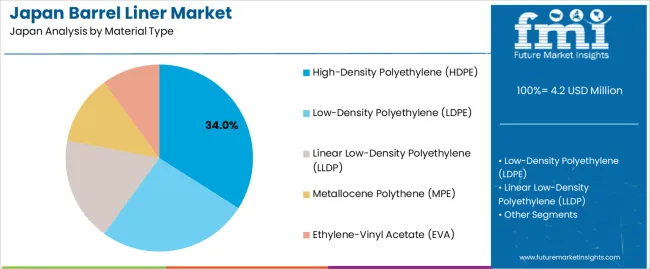
High-density polyethylene (HDPE) accounts for 34.0%, supported by strong chemical resistance and structural durability for handling solvents, powders, and semi-viscous materials. Low-density polyethylene (LDPE) holds 26.0%, preferred where flexibility and puncture mitigation support cleaner dispensing. Linear low-density polyethylene (LLDPE) represents 18.0%, used in impact-resistant formats that tolerate fluctuating fill weights. Metallocene polyethylene (MPE) accounts for 12.0%, valued for precise thickness control and enhanced mechanical strength in automated filling environments. Ethylene-vinyl acetate (EVA) holds 10.0%, serving goods needing reduced friction and sealing adaptability. Material choice reflects product reactivity, fill mechanism design, and ecofriendly waste management in regulated Japanese industries.
Key Points:
- HDPE selected for high-strength, chemical-compatible protection
- LDPE used for flexible handling with reduced liner tearing
- LLDPE and MPE support performance optimization in rigorous industrial use
By Packaging Type, Flexible Barrel Liners Hold the Largest Share
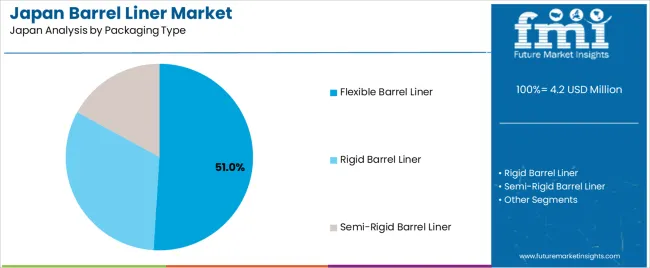
Flexible liners represent 51.0%, driven by their lightweight storage efficiency, easy disposal, and ability to accommodate diverse drum geometries. They reduce cleaning labor and align with Japan’s space-saving logistics systems. Rigid liners hold 32.0%, used for contents requiring structural stability during shipping, including paste-grade chemicals and adhesives. Semi-rigid liners, at 17.0%, provide hybrid flexibility and shape retention for controlled dispensing. Packaging selection is guided by required rigidity, fill temperature, and contamination control across food, paint, and specialty chemical operations.
Key Points:
- Flexible liners optimize handling efficiency in compact facilities
- Rigid formats protect high-viscosity and fragile materials
- Semi-rigid systems support applications balancing flexibility and stability
By Capacity, Above 50-Liter Liners Account for the Largest Share
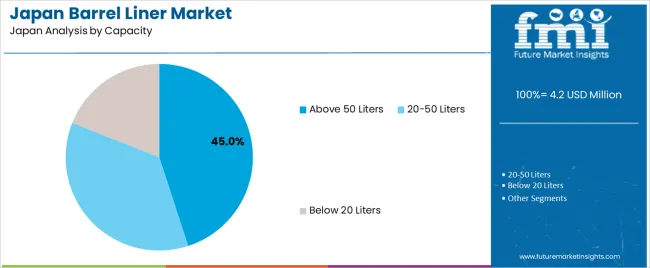
Liners designed for above 50 liters hold 45.0%, supporting bulk industrial ingredients handled in steel or plastic drums for export and domestic distribution. The 20–50 liter segment accounts for 36.0%, used for medium-batch product cycles in pharmaceuticals, food processing, and paint sectors. Below 20 liters represent 19.0%, serving small-scale specialty inputs, laboratory packaging, and end-user refill programs. Capacity selection reflects batch size, material flow requirements, and ergonomic handling protocols prevalent in Japanese processing plants.
Key Points:
- Large-capacity drums dominate chemical and industrial logistics
- Mid-volume liners serve regulated commercial processing
- Small units support precision packaging and limited-volume usage
What are the Drivers, Restraints, and Key Trends of the Demand for Barrel Liners in Japan?
Expansion of specialty chemical and electronics-material production, increased hygiene standards in food manufacturing and rising preference for contamination-free bulk handling are driving demand.
In Japan, barrel liners gain steady adoption as producers of high-purity chemicals, photoresists and battery materials require packaging that prevents contamination during storage and internal transport. Industrial clusters in Chiba, Kanagawa and Aichi use liners to protect drums that carry solvents, lubricants and functional materials for electronics and automotive supply chains. Food processors and beverage producers apply durable liners in ingredient handling to maintain hygiene and reduce cleaning labor, especially in plants working with syrups, cocoa and fermentation inputs. Pharmaceutical and cosmetic manufacturers use liners for powders and liquid concentrates to comply with strict cleanliness protocols and reduce cross-batch risks. These industrial demands maintain consistent procurement from liner suppliers serving chemical and food-grade packaging channels.
High sensitivity to material cost, long replacement cycles for reusable drums and limited awareness among smaller factories restrain adoption.
Manufacturers managing tight margins may avoid liners if frequent replacement increases cost per shipment, especially when existing containers already meet regulatory requirements. Many Japanese facilities maintain steel drums for years through rigorous cleaning programs, reducing the need for disposable or semi-disposable liners. Smaller plants with limited handling of hazardous or sensitive materials may not prioritize liner upgrades, delaying adoption despite operational benefits. These budget and usage factors moderate rapid expansion across the broader industrial base.
Shift toward antistatic and high-barrier liners, increased adoption in battery-material logistics and rising interest in waste-reduction initiatives define key trends.
Producers are expanding antistatic liners for solvent-rich chemical environments and high-barrier formats that improve moisture and oxygen protection during transit. Demand grows in lithium-ion battery supply chains located in Kansai and Kyushu where cathode and electrolyte materials require contamination-controlled handling. Waste-reduction goals encourage use of liners that minimize drum washing, supporting water savings and reduced chemical discharge from cleaning operations. Custom-fit liners compatible with automation in filling and dispensing processes also gain interest among high-volume manufacturers. These trends indicate stable, process-efficiency-driven demand for barrel liners across Japan’s chemical, food and advanced-materials sectors.
Analysis of the Demand for Barrel Liners in Japan by Region
Demand for barrel liners in Japan is influenced by liquid food handling, beverage fermentation, pharmaceutical storage needs, and chemical compatibility requirements. Growth reflects hygiene-focused handling, ease of container turnover, and reduced cleaning workloads. Kyushu & Okinawa leads at 7.6%, followed by Kanto (7.0%), Kansai (6.1%), Chubu (5.4%), Tohoku (4.7%), and Rest of Japan (4.5%).
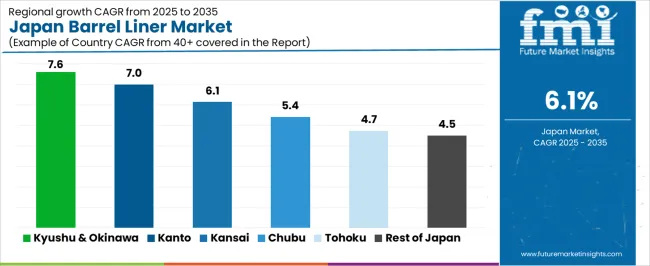
| Region | CAGR (2025-2035) |
|---|---|
| Kyushu & Okinawa | 7.6% |
| Kanto | 7.0% |
| Kansai | 6.1% |
| Chubu | 5.4% |
| Tohoku | 4.7% |
| Rest of Japan | 4.5% |
How is Kyushu & Okinawa driving demand for barrel liners?
Kyushu & Okinawa posts 7.6% CAGR, mainly supported by beverage, food processing, and chemical-handling activities across hubs such as Fukuoka and Kumamoto. Shochu manufacturing drives liner adoption to preserve batch purity and prevent residue accumulation inside storage barrels. Soy-based sauces and seasoning liquid producers integrate liners to simplify sanitation and reduce downtime between filling cycles. Regional seafood-processing plants require corrosion-resistant liners for controlled brine storage. Supply chains in Okinawa benefit from liners that ensure barrel reusability during inter-island shipping, allowing containers to remain in rotation without intensive tank washing. Hazardous-liquid handlers prefer certified liner materials that reduce contamination risks during temporary storage. Procurement teams prioritize liner formats compatible with existing barrel dimensions to avoid new equipment investment.
- Beverage fermentation requiring contamination control
- Liquid food plants preferring fast sanitation cycles
- Inter-island transport supporting liner durability
- Chemical applications prioritizing compartment integrity
How is Kanto shaping barrel liner usage?

Kanto records 7.0% CAGR, driven by beverage distribution, pharmaceutical storage, and chemical logistics centered around Tokyo, Yokohama, and Saitama. Pharmaceutical companies adopt liners to maintain sterility during intermediate handling of liquid formulations. Beverage manufacturers employ liners in fermentation and bulk liquid storage to control cleaning costs in urban production facilities with limited space. E-commerce packaging growth supports demand for liners used in regional consolidation warehouses where liquid materials require temporary storage. Chemical companies handling solvents and cleaning fluids procure liners that provide compatibility with regulated materials. Distribution hubs in Chiba focus on scalable liner procurement tied to shipping schedules.
- Pharma distribution reinforcing sterile container requirements
- Urban food and beverage operations reducing cleaning time
- Chemical handling requiring compliance-approved liners
- Logistics centers supporting predictable procurement cycles
How is Kansai contributing to liner adoption?
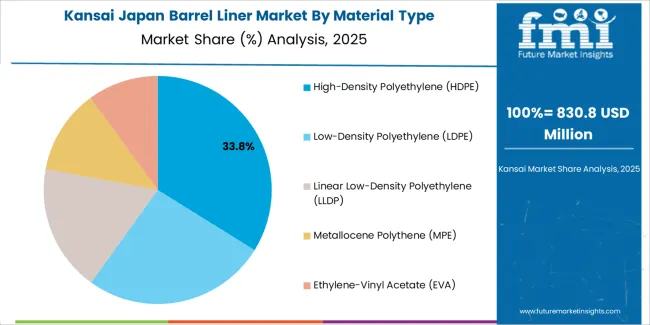
Kansai shows 6.1% CAGR, linked to industrial manufacturing and beverage-processing activity in Osaka, Kyoto, and Kobe. Breweries and craft drink producers rely on liners to maintain flavor separation between limited-run products. Chemical plants in Kansai ports adopt high-strength liner materials suitable for controlled handling and transfer of industrial liquids. Food producers package sauces and liquid additives in lined barrels to sustain storage hygiene across short-haul logistics routes. Packaging decisions emphasize compatibility with existing drum pumps and fast removal. Procurement teams pursue consistent liner thickness to maintain predictable handling characteristics.
- Craft brewing requiring flavor consistency
- Industrial liquids needing chemical resistance
- Short-haul logistics benefiting from hygienic turnover
- Handling compatibility supporting operational continuity
How is Chubu influencing liner requirements?

Chubu posts 5.4% CAGR, supported by large-scale food processing and automotive chemical supply chains in Aichi and Shizuoka. Soy and vinegar production uses liners to control acidity-driven wear in storage surfaces. Export-focused companies evaluate liner formats that ensure compliance with customs inspections and quality checks. Manufacturers value quick replacement processes that extend the lifecycle of steel barrels. Packaging teams integrate liners into scheduled production cycles to support cleaner transitions between formulations.
- Acidic liquid protection driving adoption
- Export logistics requiring condition preservation
- Cleaning reduction extending barrel usability
- Batch-change workflows benefiting from simplified turnover
How is Tohoku shaping liner implementation?
Tohoku achieves 4.7% CAGR, supported by agricultural processing, fishery operations, and health-product distribution. Liquid food producers use liners to safeguard freshness through long-distance transport to national retail centers. Cold-climate handling requires liner materials that maintain flexibility to protect against internal cracking in refrigerated conditions. Seasonal manufacturing peaks drive temporary storage needs that benefit from re-usable barrels equipped with liners.
- Long-haul distribution guiding packaging reliability
- Refrigerated environments requiring flexible materials
- Seasonal activity increasing temporary storage demand
- Re-use goals shaping procurement decisions
How is the Rest of Japan adopting barrel liners?
The Rest of Japan posts 4.5% CAGR, reflecting steady usage in small and mid-sized beverage, local chemical, and food-processing sites. Adoption focuses on operational cost reduction through extended barrel lifespan. Smaller operators choose liners only when compatible with existing closure systems to avoid modification costs. Regional suppliers offer frequent small-batch deliveries to match production timing across distributed facilities.
- Cost efficiencies guiding purchasing behavior
- Compatibility with existing barrels reducing complexity
- Small-batch delivery supporting regional procurement
- Continuous operations requiring sanitation efficiency
What is the competitive landscape of demand for barrel liners in Japan?

Demand for barrel liners in Japan is shaped by industrial-packaging suppliers providing polyethylene and high-barrier liners that ensure contamination control and chemical-resistance performance during filling, storage, and transport. Taiyo Kogyo Co., Ltd. holds an estimated 28.0% share, supported by consistently manufactured liners with reliable weld integrity and thickness uniformity used in chemical and food-grade drum operations across Japan. Maeda Kosen Co., Ltd. maintains strong participation in heavy-duty liners and flexible containment films with stable strength performance under high-viscosity and corrosive-material conditions. Okura Industrial Co., Ltd. contributes product lines that deliver dependable sealing and puncture-resistance for bulk dry-goods and industrial intermediates.
Sekisui Seikei Co., Ltd. supports specialized requirements with high-purity liners used in pharmaceutical and electronic-chemical packaging where trace contamination must remain tightly controlled. Greif Japan provides additional availability for export-compliant drum liners used by global manufacturers operating in Japan. Competition focuses on chemical compatibility, weld-line durability, barrier stability, filling-line reliability, and regulated-industry compliance. Demand remains steady as Japanese producers depend on liner-protected drum systems to preserve material integrity and maintain workplace safety across industrial supply chains.
Key Players in Japan Barrel Liner Demand
- Taiyo Kogyo Co., Ltd.
- Maeda Kosen Co., Ltd.
- Okura Industrial Co., Ltd.
- Sekisui Seikei Co., Ltd.
- Greif
Scope of the Report
| Items | Values |
|---|---|
| Quantitative Units | USD million |
| Material Type | High-Density Polyethylene (HDPE), Low-Density Polyethylene (LDPE), Linear Low-Density Polyethylene (LLDPE), Metallocene Polyethylene (MPE), Ethylene-Vinyl Acetate (EVA) |
| Packaging Type | Flexible Barrel Liner, Rigid Barrel Liner, Semi-Rigid Barrel Liner |
| Capacity | Above 50 Liters, 20–50 Liters, Below 20 Liters |
| Application | Chemicals & Lubricants, Food & Beverages, Flammable Liquids, Grease and Oils, Adhesives |
| Sales Channel | Offline, Online |
| Regions Covered | Kyushu & Okinawa, Kanto, Kansai, Chubu, Tohoku, Rest of Japan |
| Key Companies Profiled | Taiyo Kogyo Co., Ltd., Maeda Kosen Co., Ltd., Okura Industrial Co., Ltd., Sekisui Seikei Co., Ltd., Greif |
| Additional Attributes | Demand driven by hazardous chemical containment and food-grade compliance; liners are adopted for preventing contamination, corrosion, and leak reduction in industrial storage; focus on solvent-resistant and anti-static properties for chemical packaging; increased interest in customized sizes for domestic manufacturing plants and logistics operators; growing online procurement by small-scale industries; regulatory alignment with eco-friendly initiatives encouraging recyclable polymer liners. |
Japan Barrel Liner Demand by Segments
Material Type:
- High-Density Polyethylene (HDPE)
- Low-Density Polyethylene (LDPE)
- Linear Low-Density Polyethylene (LLDP)
- Metallocene Polythene (MPE)
- Ethylene-Vinyl Acetate (EVA)
Packaging Type:
- Flexible Barrel Liner
- Rigid Barrel Liner
- Semi-Rigid Barrel Liner
Capacity:
- Above 50 Liters
- 20-50 Liters
- Below 20 Liters
Application:
- Chemicals & Lubricants
- Food & Beverages
- Flammable Liquids
- Grease and Oils
- Adhesives
Sales Channel:
- Offline
- Online
Region:
- Kyushu & Okinawa
- Kanto
- Kansai
- Chubu
- Tohoku
- Rest of Japan
Bibliography
- Ministry of Health, Labour and Welfare Japan. (2023). Food contact materials and packaging safety regulations including liners and barrier materials. MHLW Food Safety Publications.
- International Safe Transit Association. (2023). Packaging performance testing guidance for liners and protective materials in bulk and container packaging. ISTA Test Procedures and Guidance.
- Japan Industrial Standards Committee. (2023). JIS standards for liner materials, barrier performance, and packaging integrity evaluation. JIS Standards Publications.
- Reusable Packaging Association. (2023). Liner use considerations for bulk packaging, material handling, and protective barrier solutions. RPA Industry Publications.
Frequently Asked Questions
How big is the demand for barrel liner in Japan in 2025?
The demand for barrel liner in Japan is estimated to be valued at USD 4.2 million in 2025.
What will be the size of barrel liner in Japan in 2035?
The market size for the barrel liner in Japan is projected to reach USD 7.6 million by 2035.
How much will be the demand for barrel liner in Japan growth between 2025 and 2035?
The demand for barrel liner in Japan is expected to grow at a 6.1% CAGR between 2025 and 2035.
What are the key product types in the barrel liner in Japan?
The key product types in barrel liner in Japan are high-density polyethylene (hdpe), low-density polyethylene (ldpe), linear low-density polyethylene (lldp), metallocene polythene (mpe) and ethylene-vinyl acetate (eva).
Which packaging type segment is expected to contribute significant share in the barrel liner in Japan in 2025?
In terms of packaging type, flexible barrel liner segment is expected to command 51.0% share in the barrel liner in Japan in 2025.
Preview the report firsthand - request a free sample
Get SampleGet the brochure for pricing and purchase details.
Get PDFTable of Content
- Executive Summary
- Japan Market Outlook
- Demand-side Trends
- Supply-side Trends
- Technology Roadmap Analysis
- Analysis and Recommendations
- Market Overview
- Market Coverage / Taxonomy
- Market Definition / Scope / Limitations
- Market Background
- Market Dynamics
- Drivers
- Restraints
- Opportunity
- Trends
- Scenario Forecast
- Demand in Optimistic Scenario
- Demand in Likely Scenario
- Demand in Conservative Scenario
- Opportunity Map Analysis
- Product Life Cycle Analysis
- Supply Chain Analysis
- Investment Feasibility Matrix
- Value Chain Analysis
- PESTLE and Porter’s Analysis
- Regulatory Landscape
- Regional Parent Market Outlook
- Production and Consumption Statistics
- Import and Export Statistics
- Market Dynamics
- Japan Market Analysis 2020 to 2024 and Forecast, 2025 to 2035
- Historical Market Size Value (USD Million) Analysis, 2020 to 2024
- Current and Future Market Size Value (USD Million) Projections, 2025 to 2035
- Y-o-Y Growth Trend Analysis
- Absolute $ Opportunity Analysis
- Japan Market Pricing Analysis 2020 to 2024 and Forecast 2025 to 2035
- Japan Market Analysis 2020 to 2024 and Forecast 2025 to 2035, By Material Type
- Introduction / Key Findings
- Historical Market Size Value (USD Million) Analysis By Material Type , 2020 to 2024
- Current and Future Market Size Value (USD Million) Analysis and Forecast By Material Type , 2025 to 2035
- High-Density Polyethylene (HDPE)
- Low-Density Polyethylene (LDPE)
- Linear Low-Density Polyethylene (LLDP)
- Metallocene Polythene (MPE)
- Ethylene-Vinyl Acetate (EVA)
- Y-o-Y Growth Trend Analysis By Material Type , 2020 to 2024
- Absolute $ Opportunity Analysis By Material Type , 2025 to 2035
- Japan Market Analysis 2020 to 2024 and Forecast 2025 to 2035, By Packaging Type
- Introduction / Key Findings
- Historical Market Size Value (USD Million) Analysis By Packaging Type, 2020 to 2024
- Current and Future Market Size Value (USD Million) Analysis and Forecast By Packaging Type, 2025 to 2035
- Flexible Barrel Liner
- Rigid Barrel Liner
- Semi-Rigid Barrel Liner
- Y-o-Y Growth Trend Analysis By Packaging Type, 2020 to 2024
- Absolute $ Opportunity Analysis By Packaging Type, 2025 to 2035
- Japan Market Analysis 2020 to 2024 and Forecast 2025 to 2035, By Capacity
- Introduction / Key Findings
- Historical Market Size Value (USD Million) Analysis By Capacity, 2020 to 2024
- Current and Future Market Size Value (USD Million) Analysis and Forecast By Capacity, 2025 to 2035
- Above 50 Liters
- 20-50 Liters
- Below 20 Liters
- Y-o-Y Growth Trend Analysis By Capacity, 2020 to 2024
- Absolute $ Opportunity Analysis By Capacity, 2025 to 2035
- Japan Market Analysis 2020 to 2024 and Forecast 2025 to 2035, By Application
- Introduction / Key Findings
- Historical Market Size Value (USD Million) Analysis By Application, 2020 to 2024
- Current and Future Market Size Value (USD Million) Analysis and Forecast By Application, 2025 to 2035
- Chemicals & Lubricants
- Food & Beverages
- Flammable Liquids
- Grease and Oils
- Adhesives
- Y-o-Y Growth Trend Analysis By Application, 2020 to 2024
- Absolute $ Opportunity Analysis By Application, 2025 to 2035
- Japan Market Analysis 2020 to 2024 and Forecast 2025 to 2035, By Sales Channel
- Introduction / Key Findings
- Historical Market Size Value (USD Million) Analysis By Sales Channel, 2020 to 2024
- Current and Future Market Size Value (USD Million) Analysis and Forecast By Sales Channel, 2025 to 2035
- Offline
- Online
- Y-o-Y Growth Trend Analysis By Sales Channel, 2020 to 2024
- Absolute $ Opportunity Analysis By Sales Channel, 2025 to 2035
- Market Structure Analysis
- Competition Dashboard
- Competition Benchmarking
- Market Share Analysis of Top Players
- By Regional
- By Material Type
- By Packaging Type
- By Capacity
- By Application
- By Sales Channel
- Competition Analysis
- Competition Deep Dive
- Taiyo Kogyo Co., Ltd.
- Overview
- Product Portfolio
- Profitability by Market Segments (Product/Age /Sales Channel/Region)
- Sales Footprint
- Strategy Overview
- Marketing Strategy
- Product Strategy
- Channel Strategy
- Maeda Kosen Co., Ltd.
- Okura Industrial Co., Ltd.
- Sekisui Seikei Co., Ltd.
- Greif
- Taiyo Kogyo Co., Ltd.
- Competition Deep Dive
- Assumptions & Acronyms Used
- Research Methodology


