

- Industry Size (2025)
- USD 29.8 Mn
- Forecast (2035)
- USD 62.6 Mn
- CAGR (2025 to 2035)
- 7.7%
Demand for Barrel Liner in USA Forecast and Outlook 2025 to 2035
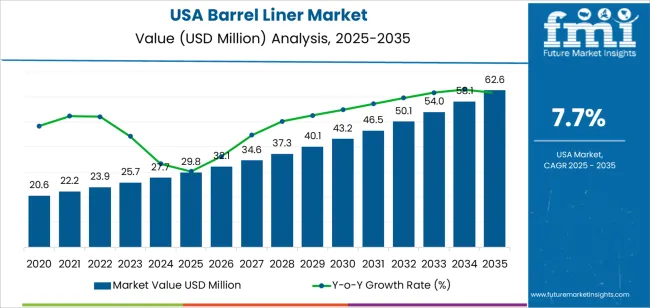
In 2025, barrel liner demand in the USA is valued at USD 29.8 million and is projected to reach USD 62.6 million by 2035 at a CAGR of 7.7%. Early growth reflects rising use across chemical processing, food ingredients, pharmaceutical intermediates, and hazardous material transport. Liners play a central role in contamination control, moisture protection, and safe handling of powders, semi liquids, and corrosive materials. The strongest uptake is seen in specialty chemicals and nutraceutical ingredients where purity and shelf stability are tightly regulated. Polyethylene based liners dominate due to their balance of chemical resistance and cost efficiency. Contract packaging firms and industrial distributors form the core demand channel during this phase.
After 2030, demand expansion in the USA becomes more logistics driven than production driven. Market value rises from about USD 43.2 million in 2030 toward USD 62.6 million by 2035 as bulk handling volumes increase in agrochemicals, resins, and specialty additives. Export oriented manufacturers raise liner USAge to reduce cross batch contamination risk in international shipments. Pharmaceutical and biotechnology sectors also contribute through higher compliance standards for sterile and low extractables packaging. Key suppliers focus on multilayer film construction, anti-static properties, and tighter dimensional consistency for automated drum and barrel filling lines. Growth remains supported by regulatory scrutiny, higher material traceability requirements, and rising outsourcing of bulk packaging operations across the USA.
Quick Stats for Demand for Barrel Liners in USA:
- Demand for Barrel Liners in USA Value (2025): USD 29.8 million
- Demand for Barrel Liners in USA Forecast Value (2035): USD 62.6 million
- Demand for Barrel Liners in USA Forecast CAGR (2025–2035): 7.7%
- Leading Material in Barrel Liners in USA: High-Density Polyethylene (34%)
- Key Growth Regions for Barrel Liners in USA: West, South, Northeast, Midwest
- Top Players in Barrel Liners Industry in USA: Greif, Inc., Berry Global Inc., Protective Lining Corp., CDF Corporation, International Plastics, Inc.
What is the Demand Forecast for Barrel Liner in USA through 2035?
The long-term value accumulation curve for barrel liner demand in USA shows a steady and compounding build-up from USD 29.8 million in 2025 to USD 32.1 million by 2026 and USD 34.6 million by 2027, indicating early-stage accumulation driven by food ingredients, chemicals, and specialty liquid logistics. The market adds USD 2.3 million to USD 2.7 million annually during the first half of the forecast window, reflecting growing adoption of hygienic and contamination-resistant packaging in bulk transport. Value accumulation in this phase is shaped by compliance-driven demand, especially in edible oils, flavor concentrates, and agrochemical intermediates, where barrel liners shift from optional protection to routine safety infrastructure.
From 2030 onward, the accumulation curve steepens in absolute terms as the market expands from USD 40.1 million in 2030 to USD 62.6 million by 2035, generating USD 22.5 million in cumulative value in the second half of the decade alone. Annual additions widen from about USD 3.1 million to more than USD 4.5 million by the final years, reflecting volume scale-up and rising liner specification standards. This back-weighted value build-up is driven by higher use in pharmaceutical liquids, resin transport, and bio-based chemicals, where contamination control and material compatibility elevate both unit demand and pricing.
Barrel Liner Industry in USA Key Takeaways
| Metric | Value |
|---|---|
| Industry Value (2025) | USD 29.8 million |
| Forecast Value (2035) | USD 62.6 million |
| Forecast CAGR (2025 to 2035) | 7.7% |
What Is Driving Demand for Barrel Liners in the USA?
Demand for barrel liners in the USA has grown as industries increasingly rely on bulk transport and storage of liquids, powders, and chemicals that require contamination-free containment. Agricultural producers, food and beverage firms, chemical and pharmaceutical manufacturers often use barrels for transport and storage. Liners help prevent direct contact between the barrel wall and the contents, which reduces risk of contamination, chemical reactions, odors, and flavour transfer. Growth in food-processing, chemicals, and contract manufacturing sectors contributed to rising USAge of plastic-film barrel liners. Tightening hygiene standards and regulatory compliance requirements in regulated sectors enhanced demand for liner solutions over traditional barrel reuse.
Future demand for barrel liners in the USA will depend on expansion of industries dealing with bulk materials, increased regulatory scrutiny over cross-contamination, and growth in contract manufacturing and outsourcing. As companies outsource more production and storage, they will demand single-use or disposable liners to guarantee product integrity throughout the supply-chain. Demand may rise in markets such as food ingredients, fine chemicals, pet foods, and specialty chemicals where traceability and contamination control are critical. However cost pressures, environmental concerns around single-use plastics, and preference for reusable barrels may pose constraints. The market’s growth will depend on balancing contamination risk mitigation against sustainability and cost efficiency.
How Are Material Type and Packaging Type Structuring the Demand for Barrel Liners in USA?
The demand for barrel liners in the USA is structured by material type and packaging type. High density polyethylene accounts for 34% of total demand, followed by low density polyethylene, linear low density polyethylene, metallocene polythene, and ethylene vinyl acetate. By packaging type, flexible barrel liners represent 51.0% of total USAge, followed by rigid and semi rigid barrel liners. Demand behavior is shaped by chemical compatibility, puncture resistance, temperature tolerance, and disposal requirements. These segments reflect how material performance and liner flexibility determine suitability across chemical processing, food ingredients, pharmaceuticals, and hazardous material handling in the USA.
Why Does High Density Polyethylene Lead the Barrel Liner Material Demand in USA?
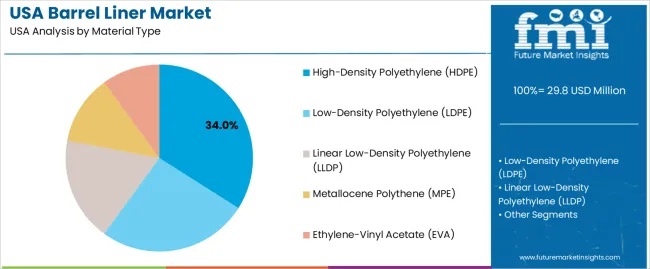
High density polyethylene accounts for 34% of total barrel liner demand in the USA. This leadership reflects its high tensile strength, strong chemical resistance, and low moisture permeability. HDPE performs reliably when used with solvents, acids, powders, and viscous liquids commonly handled in industrial and food grade applications. Its resistance to tearing during drum loading and unloading supports safe material transfer under high weight conditions.
HDPE barrel liners also show strong performance in temperature variable storage environments. Compatibility with both hot fill and cold storage operations expands its application range. Domestic processing capacity for HDPE film extrusion supports stable supply across regional packaging hubs. Replacement demand remains consistent across chemical distributors and contract manufacturers. These performance stability and supply chain advantages sustain HDPE as the leading barrel liner material in the USA.
Why Do Flexible Barrel Liners Dominate Packaging Type Demand in USA?
Flexible barrel liners account for 51.0% of total demand in the USA. Their dominance reflects ease of installation, broad drum compatibility, and reduced storage space requirements when shipped in flat packed form. Flexible liners conform to standard steel, fiber, and plastic drums, which improves sealing efficiency and minimizes product residue during discharge.
Flexible liners also support cost efficient disposal and contamination control between batch changes. Industries handling food ingredients, powders, resins, and agrochemicals rely on flexible liners to simplify sanitation procedures and shorten turnaround times. Their lightweight structure reduces freight costs compared with rigid formats. Inventory management also benefits from compact stacking and rapid deployment. These handling, hygiene, and logistics advantages position flexible barrel liners as the leading packaging type in the USA.
What Forces Are Driving the Demand for Barrel Liners in the USA?
Demand for barrel liners in the USA is driven by strict contamination control requirements across chemicals, food ingredients, pharmaceuticals, and specialty resins. Drum and barrel packaging remains central to bulk handling in domestic manufacturing and export logistics. Liners are used to protect high-value contents from moisture, oxygen exposure, and cross-contamination while extending container reuse cycles. Growth in contract manufacturing and toll processing increases reliance on clean, insert-based packaging rather than dedicated drums. These industrial handling and cross-sector regulatory conditions support steady baseline demand for barrel liners across U.S. supply chains.
How Do Chemical Processing, Food Ingredients, and Pharma Logistics Shape Barrel Liner Demand?
In the USA, chemical producers use barrel liners to isolate corrosive, hygroscopic, and reactive materials from steel or plastic drum walls. Food ingredient processors rely on liners to meet sanitation standards for sugars, starches, powders, oils, and enzymes. Pharmaceutical logistics require ultra-clean liners for APIs, intermediates, and excipients where cross-batch contamination risk cannot be tolerated. Shared drum pools and third-party logistics operators increasingly require liners to prevent trace residue transfer. These application-specific hygiene and material-compatibility needs anchor consistent multi-industry barrel liner consumption.
What Cost, Material, and Handling Constraints Limit Expansion of Barrel Liner Use in the USA?
Barrel liner demand in the USA faces constraints tied to resin pricing volatility, disposal cost, and sustainability scrutiny. Single-use plastic liners attract waste management attention in regulated states with strict packaging waste targets. Heavy-duty multilayer liners raise unit costs for low-margin bulk commodities. Improper liner fitting can cause tearing or product loss, leading some operators to revert to rigid liners or dedicated drums. Heat exposure during filling also limits use in certain applications. These economic, environmental, and handling limitations slow aggressive expansion beyond controlled industrial segments.
How Are Sustainability, Multi-Layer Design, and Reuse Models Reshaping Barrel Liner Demand in the USA?
Barrel liner demand in the USA is shifting toward thinner-gauge, high-strength films engineered to deliver puncture resistance with reduced plastic mass. Recyclable mono-material liners are gaining preference in food and specialty chemical markets. Some logistics operators pair liners with drum refurbishing programs to extend container life and reduce transport emissions. Antistatic and conductive liners see increased use for fine powders and flammable materials. Precision-fit liners with tie-off, form-fit, and gusseted bottoms improve filling efficiency. These trends show barrel liners moving from disposable accessories toward engineered components of sustainable bulk packaging systems.
What is the Demand for Barrel Liner in USA by Region?
| Region | CAGR (%) |
|---|---|
| West | 8.8% |
| South | 7.9% |
| Northeast | 7.1% |
| Midwest | 6.2% |
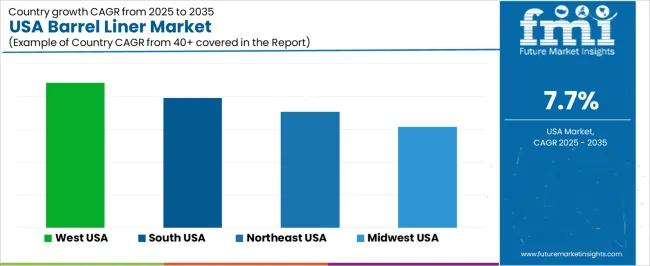
The demand for barrel liners in the USA shows a clear regional gradient with the West leading at 8.8 % CAGR. This region likely benefits from growth in industrial storage, waste-management, chemical processing, and food & beverage packaging requiring durable barrel liners. The South, at 7.9 %, sees strong demand due to its industrial base, agricultural commodities processing, and logistics operations that use liners for safe transport and storage. The Northeast at 7.1 % reflects demand from manufacturing, chemicals, and specialty packaging sectors concentrated in urban and industrial zones. The Midwest’s 6.2 % growth suggests moderate uptake, aligned with stable industrial activity and growing awareness of containment and protection standards for bulk materials.
What is Driving Barrel Liner Demand in the West Region of USA?
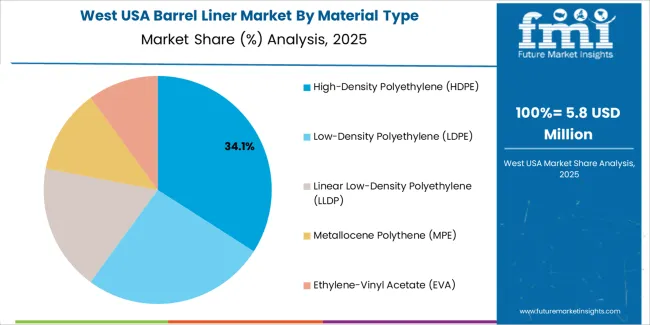
Growth in the West reflects a CAGR of 8.8% through 2035 for barrel liner demand, supported by strong chemical processing, food ingredient handling, and pharmaceutical manufacturing activity. Coastal ports and export oriented industries rely on liners for contamination control and moisture protection during bulk transport. Wine, specialty chemicals, and nutraceuticals generate consistent liner USAge. Hazardous material regulations strengthen adoption for safe material handling. Demand remains strongly compliance driven rather than discretionary, with purchasing tied to bulk storage and shipment volumes across industrial corridors serving domestic processing and international export supply chains.
- Chemical and nutraceutical bulk transport anchors core demand
- Export handling increases moisture and contamination protection needs
- Regulatory compliance strengthens liner adoption
- Port based logistics sustains consistent shipment volumes
How is the South Supporting Barrel Liner Demand in USA?
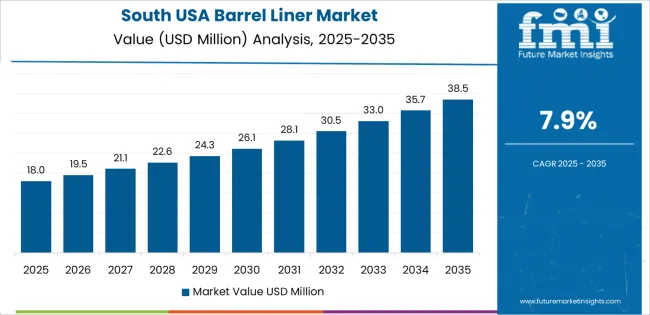
The South advances at a CAGR of 7.9% through 2035 for barrel liner demand, driven by large scale food processing, agricultural chemicals, and resin manufacturing. Poultry, edible oils, and liquid additives require liners to prevent cross contamination during storage. Warm climate conditions increase the need for barrier protection against humidity and microbial growth. Regional chemical distributors supply liners across food, polymer, and agrochemical plants. Demand remains volume oriented, linked closely to continuous production cycles in food manufacturing and industrial material processing zones across southern states.
- Food oils and liquid additives drive steady liner consumption
- Warm climate raises barrier protection requirements
- Agrochemical production adds secondary application volume
- Continuous production cycles guide bulk liner procurement
Why is Barrel Liner Demand Rising Steadily in the Northeast Region of USA?
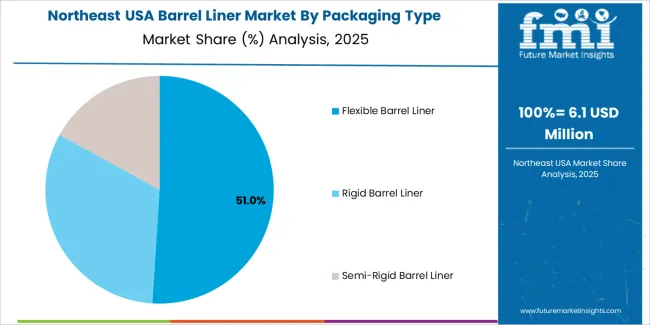
The Northeast records a CAGR of 7.1% through 2035 for barrel liner demand, shaped by pharmaceutical production, specialty chemicals, and institutional food ingredient manufacturing. Urban industrial zones require strict contamination control for sensitive materials. Pharmaceutical excipients and active ingredients depend on high integrity liner systems. Dense regulatory oversight reinforces routine liner replacement. Port proximity supports chemical import and re export activity using lined barrels. Demand remains quality driven rather than scale driven, with high specification liner purchases supporting consistent value growth across regulated manufacturing and distribution environments.
- Pharmaceutical handling requires high integrity liner systems
- Regulatory oversight enforces frequent liner replacement
- Port based chemical movement supports lined barrel USAge
- Specialty ingredient manufacturing drives premium demand
What is Influencing Barrel Liner Demand in the Midwest Region of USA?
The Midwest expands at a CAGR of 6.2% through 2035 for barrel liner demand, supported by agricultural chemicals, food ingredients, and industrial resins production. Grain processing byproducts, flavor extracts, and polymer additives rely on lined barrels for storage stability. Manufacturing led demand outweighs logistics hub driven consumption. Seasonal agricultural output influences liner purchase cycles. Regional packaging distributors supply bulk liner volumes to processing plants. Demand remains operational and predictable, guided by production batch schedules rather than export logistics intensity seen in coastal regions.
- Agricultural chemicals and extracts anchor core demand
- Seasonal production cycles influence liner purchasing
- Industrial resins add stable secondary USAge
- Distributor networks support bulk plant level supply
What Is Driving the Demand for Barrel Liners in the USA and Who Are the Key Players Shaping the Industry?
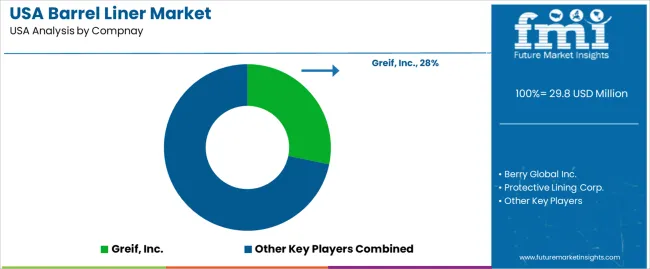
Demand for barrel liners in the USA is rising across several sectors, especially chemicals, food & beverage, pharmaceuticals, and bulk raw material storage. Users rely on barrel liners to prevent contamination between the drum interior and stored contents. Liners help maintain product integrity, reduce cleaning and maintenance costs, and enable reuse of drums. For chemical or hazardous materials storage, liners provide protection against corrosion and leakage. In food, beverage, and pharmaceutical contexts, liners support hygiene standards and regulatory compliance, especially when handling sensitive or reactive substances. Growing regulatory scrutiny and rising volumes of industrial packaging reinforce continued uptake of high performance and barrier type liners.
Key suppliers active in the US barrel liner market include the firms you listed: Greif, Inc., Berry Global Inc., Protective Lining Corp., CDF Corporation, and International Plastics, Inc. Greif and Berry Global leverage large-scale plastic film manufacturing and distribution networks to supply standard and high barrier liners for drums and barrels. Protective Lining Corp. and CDF specialize in linings tailored for chemical, lubricant, and hazardous materials drums, offering heavy duty and corrosion resistant solutions for industrial customers. International Plastics serves more general purpose and food grade liner needs, supplying a range of film types suited for packaging coatings, powders, and liquids. This mix of large-scale producers and specialized liner manufacturers supports a competitive and flexible supply base.
Key Players in the Barrel Liners Industry in the USA
- Greif, Inc.
- Berry Global Inc.
- Protective Lining Corp.
- CDF Corporation
- International Plastics, Inc.
Scope of the Report
| Items | Values |
|---|---|
| Quantitative Units (2025) | USD million |
| Material Type | High-Density Polyethylene (HDPE), Low-Density Polyethylene (LDPE), Linear Low-Density Polyethylene (LLDP), Metallocene Polythene (MPE), Ethylene-Vinyl Acetate (EVA) |
| Packaging Type | Flexible Barrel Liner, Rigid Barrel Liner, Semi-Rigid Barrel Liner |
| Capacity | Above 50 Liters, 20–50 Liters, Below 20 Liters |
| Application | Chemicals & Lubricants, Food & Beverages, Flammable Liquids, Grease and Oils, Adhesives |
| Sales Channel | Offline, Online |
| Regions Covered | West USA, South USA, Northeast USA, Midwest USA |
| Countries Covered | USA |
| Key Companies Profiled | Greif, Inc., Berry Global Inc., Protective Lining Corp., CDF Corporation, International Plastics, Inc. |
| Additional Attributes | Dollar-value distribution by material and packaging type; regional CAGR projections; HDPE leads material demand for chemical resistance and strength; flexible liners dominate packaging type for ease of installation and drum compatibility; early growth 2025–2030 adds USD 13.4 million reflecting food, chemical, and pharmaceutical uptake; 2030–2035 growth adds USD 22.5 million driven by export, compliance, and higher specification liners; adoption in pharmaceutical liquids, resins, and nutraceutical ingredients; demand shaped by regulatory scrutiny, contamination control, moisture protection, and bulk logistics; supply chain anchored in contract packaging and industrial distributors; back-weighted growth with higher unit value and increased technical specifications; multi-industry use drives sustained baseline demand in chemicals, food, beverage, and pharma logistics. |
Barrel Liners Industry in the USA Segmentation
Material Type:
- High-Density Polyethylene (HDPE)
- Low-Density Polyethylene (LDPE)
- Linear Low-Density Polyethylene (LLDP)
- Metallocene Polythene (MPE)
- Ethylene-Vinyl Acetate (EVA)
Packaging Type:
- Flexible Barrel Liner
- Rigid Barrel Liner
- Semi-Rigid Barrel Liner
Capacity:
- Above 50 Liters
- 20-50 Liters
- Below 20 Liters
Application:
- Chemicals & Lubricants
- Food & Beverages
- Flammable Liquids
- Grease and Oils
- Adhesives
Sales Channel:
- Offline
- Online
Region:
- Northeast USA
- West USA
- Midwest USA
- South USA
Frequently Asked Questions
How big is the demand for barrel liner in USA in 2025?
The demand for barrel liner in USA is estimated to be valued at USD 29.8 million in 2025.
What will be the size of barrel liner in USA in 2035?
The market size for the barrel liner in USA is projected to reach USD 62.6 million by 2035.
How much will be the demand for barrel liner in USA growth between 2025 and 2035?
The demand for barrel liner in USA is expected to grow at a 7.7% CAGR between 2025 and 2035.
What are the key product types in the barrel liner in USA?
The key product types in barrel liner in USA are high-density polyethylene (hdpe), low-density polyethylene (ldpe), linear low-density polyethylene (lldp), metallocene polythene (mpe) and ethylene-vinyl acetate (eva).
Which packaging type segment is expected to contribute significant share in the barrel liner in USA in 2025?
In terms of packaging type, flexible barrel liner segment is expected to command 51.0% share in the barrel liner in USA in 2025.
Preview the report firsthand - request a free sample
Get SampleGet the brochure for pricing and purchase details.
Get PDFTable of Content
- Executive Summary
- USA Market Outlook
- Demand-side Trends
- Supply-side Trends
- Technology Roadmap Analysis
- Analysis and Recommendations
- Market Overview
- Market Coverage / Taxonomy
- Market Definition / Scope / Limitations
- Market Background
- Market Dynamics
- Drivers
- Restraints
- Opportunity
- Trends
- Scenario Forecast
- Demand in Optimistic Scenario
- Demand in Likely Scenario
- Demand in Conservative Scenario
- Opportunity Map Analysis
- Product Life Cycle Analysis
- Supply Chain Analysis
- Investment Feasibility Matrix
- Value Chain Analysis
- PESTLE and Porter’s Analysis
- Regulatory Landscape
- Regional Parent Market Outlook
- Production and Consumption Statistics
- Import and Export Statistics
- Market Dynamics
- USA Market Analysis 2020 to 2024 and Forecast, 2025 to 2035
- Historical Market Size Value (USD Million) Analysis, 2020 to 2024
- Current and Future Market Size Value (USD Million) Projections, 2025 to 2035
- Y-o-Y Growth Trend Analysis
- Absolute $ Opportunity Analysis
- USA Market Pricing Analysis 2020 to 2024 and Forecast 2025 to 2035
- USA Market Analysis 2020 to 2024 and Forecast 2025 to 2035, By Material Type
- Introduction / Key Findings
- Historical Market Size Value (USD Million) Analysis By Material Type , 2020 to 2024
- Current and Future Market Size Value (USD Million) Analysis and Forecast By Material Type , 2025 to 2035
- High-Density Polyethylene (HDPE)
- Low-Density Polyethylene (LDPE)
- Linear Low-Density Polyethylene (LLDP)
- Metallocene Polythene (MPE)
- Ethylene-Vinyl Acetate (EVA)
- Y-o-Y Growth Trend Analysis By Material Type , 2020 to 2024
- Absolute $ Opportunity Analysis By Material Type , 2025 to 2035
- USA Market Analysis 2020 to 2024 and Forecast 2025 to 2035, By Packaging Type
- Introduction / Key Findings
- Historical Market Size Value (USD Million) Analysis By Packaging Type, 2020 to 2024
- Current and Future Market Size Value (USD Million) Analysis and Forecast By Packaging Type, 2025 to 2035
- Flexible Barrel Liner
- Rigid Barrel Liner
- Semi-Rigid Barrel Liner
- Y-o-Y Growth Trend Analysis By Packaging Type, 2020 to 2024
- Absolute $ Opportunity Analysis By Packaging Type, 2025 to 2035
- USA Market Analysis 2020 to 2024 and Forecast 2025 to 2035, By Capacity
- Introduction / Key Findings
- Historical Market Size Value (USD Million) Analysis By Capacity, 2020 to 2024
- Current and Future Market Size Value (USD Million) Analysis and Forecast By Capacity, 2025 to 2035
- Above 50 Liters
- 20-50 Liters
- Below 20 Liters
- Y-o-Y Growth Trend Analysis By Capacity, 2020 to 2024
- Absolute $ Opportunity Analysis By Capacity, 2025 to 2035
- USA Market Analysis 2020 to 2024 and Forecast 2025 to 2035, By Application
- Introduction / Key Findings
- Historical Market Size Value (USD Million) Analysis By Application, 2020 to 2024
- Current and Future Market Size Value (USD Million) Analysis and Forecast By Application, 2025 to 2035
- Chemicals & Lubricants
- Food & Beverages
- Flammable Liquids
- Grease and Oils
- Adhesives
- Y-o-Y Growth Trend Analysis By Application, 2020 to 2024
- Absolute $ Opportunity Analysis By Application, 2025 to 2035
- USA Market Analysis 2020 to 2024 and Forecast 2025 to 2035, By Sales Channel
- Introduction / Key Findings
- Historical Market Size Value (USD Million) Analysis By Sales Channel, 2020 to 2024
- Current and Future Market Size Value (USD Million) Analysis and Forecast By Sales Channel, 2025 to 2035
- Offline
- Online
- Y-o-Y Growth Trend Analysis By Sales Channel, 2020 to 2024
- Absolute $ Opportunity Analysis By Sales Channel, 2025 to 2035
- Market Structure Analysis
- Competition Dashboard
- Competition Benchmarking
- Market Share Analysis of Top Players
- By Regional
- By Material Type
- By Packaging Type
- By Capacity
- By Application
- By Sales Channel
- Competition Analysis
- Competition Deep Dive
- Greif, Inc.
- Overview
- Product Portfolio
- Profitability by Market Segments (Product/Age /Sales Channel/Region)
- Sales Footprint
- Strategy Overview
- Marketing Strategy
- Product Strategy
- Channel Strategy
- Berry Global Inc.
- Protective Lining Corp.
- CDF Corporation
- International Plastics, Inc.
- Greif, Inc.
- Competition Deep Dive
- Assumptions & Acronyms Used
- Research Methodology


