

- Industry Size (2025)
- USD 7.1 Mn
- Forecast (2035)
- USD 10.0 Mn
- CAGR (2025 to 2035)
- 3.5%
Demand for Rapid Infuser in Japan Forecast and Outlook 2025 to 2035
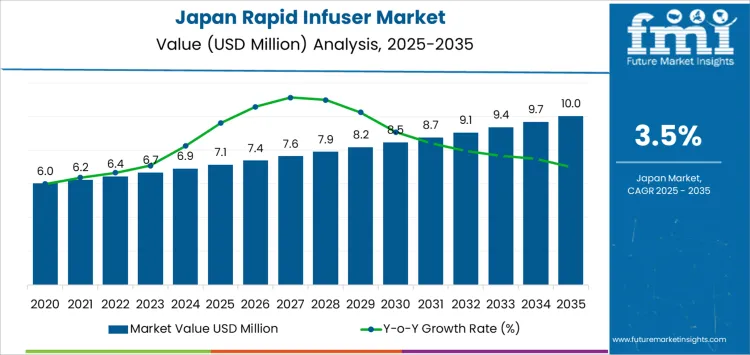
Demand for rapid infuser in Japan is valued at USD 7.1 million in 2025 and is projected to reach USD 10.0 million by 2035 at a CAGR of 3.5%. Utilization is concentrated in hospitals, which account for about 55.0% of end use, followed by military services at 20.0% and emergency medical services at 10.0%. Trolley-mounted devices dominate product demand with a 67% share due to their use in operating rooms and trauma bays, while accessories represent 29% through consumables and flow control components.
Reusable systems account for 65.0% of usability preference, reflecting cost control policies in Japanese hospitals. Regionally, Kyushu and Okinawa and Kanto lead demand, followed by Kinki and Chubu. Key suppliers active in the country include 3M Company, Smiths Medical, ZOLL Medical Corporation, Stryker Corporation, and GE Healthcare.
Quick Stats for Rapid Infuser Industry in Japan
- Demand for Rapid Infuser in Japan Value (2025): USD 7.1 million
- Demand for Rapid Infuser in Japan Forecast Value (2035): USD 10.0 million
- Demand for Rapid Infuser in Japan Forecast CAGR (2025 to 2035): 3.5%
- Demand by Leading Product Type in Japan (2025): Trolley Mounted Devices (67%)
- Demand by Leading Usability Preference in Japan (2025): Reusable Systems (65%)
- Key Growth Regions in Japan: Kyushu & Okinawa, Kanto, Kinki, Chubu
- Top Players in Japan: 3M Company, Smiths Medical, ZOLL Medical Corporation, Stryker Corporation, GE Healthcare
What is the Demand Forecast for Rapid Infuser in Japan through 2035?
Post 2030, growth in the rapid infuser industry in Japan is shaped by trauma caseload management, disaster preparedness protocols, and surgical blood management practices rather than expansion in hospital infrastructure. Emergency response standardization across prefectural health systems sustains baseline equipment replacement cycles, while ambulatory surgical centers maintain limited but stable uptake through controlled procedure volumes.
Military demand remains episodic but capacity-driven under national emergency readiness frameworks. Hospitals continue to favor reusable platforms to manage long-term operating costs, which slows unit turnover but preserves steady service and accessory demand. Competitive positioning increasingly depends on device warming accuracy, flow rate stability, and integration with existing transfusion systems rather than aggressive price competition. The industry retains a clinically anchored growth profile driven by procedural intensity and emergency preparedness rather than broad-based device diffusion.
The demand for rapid infuser in Japan is valued at USD 7.1 million in 2025 and reaches USD 8.2 million by 2030, reflecting a steady increase of USD 1.1 million over the first half of the forecast period. Annual progression from USD 6.0 million in 2020 to USD 7.1 million in 2025 shows a controlled, volume-led expansion pattern rooted in hospital infusion suites, emergency care units, and critical care transport systems. The Japan rapid infuser industry benefits from aging population dynamics, rising surgical throughput, and protocol-driven adoption in trauma and cardiovascular procedures. Growth in this phase is incremental rather than reactionary, supported by planned equipment replacement cycles, budgeted hospital procurement, and standardized infusion speed requirements in acute care environments.
From 2030 to 2035, demand rises from USD 8.2 million to USD 10.0 million, adding USD 1.8 million in the second half of the forecast window. The growth slope becomes slightly steeper as annual increments move from USD 0.3 million to nearly USD 0.3 to 0.4 million toward the end of the period. This expansion is driven by wider penetration into secondary hospitals, disaster-response readiness programs, and mobile emergency units where high-speed fluid delivery is structurally required. Rising case volumes of sepsis, polytrauma, and complex surgeries also reinforce the demand outlook. By 2035, the rapid infuser segment in Japan shifts from selective ICU deployment into broader emergency infrastructure utilization, supporting sustained long-term demand growth.
Rapid Infuser Industry in Japan Key Takeaways
| Metric | Value |
|---|---|
| Industry Value (2025) | USD 7.1 million |
| Forecast Value (2035) | USD 10.0 million |
| Forecast CAGR (2025 to 2035) | 3.5% |
What Is Driving the Demand for Rapid Infuser in Japan?
The demand for rapid infuser in Japan has grown from structural changes in emergency medicine, trauma response, and perioperative care. Historically, fluid resuscitation in emergency rooms and operating theaters relied on gravity driven systems and standard infusion pumps, which limited flow control during acute blood loss and shock. As Japan expanded advanced trauma care centers and regional emergency transport networks, clinical protocols placed greater emphasis on fast, controlled warming and delivery of fluids and blood products.
Rapid infusers became embedded in cardiovascular surgery, transplant procedures, and critical trauma workflows where hypothermia and delayed volume replacement increased complication risks. Aging population trends also reinforced demand, as elderly patients tolerate fluid imbalance poorly and require tighter hemodynamic control during urgent interventions.
Future demand for rapid infuser in Japan will be shaped by expansion of advanced critical care capacity, disaster preparedness priorities, and surgical complexity rather than patient volume alone. High acuity surgeries, mass casualty readiness, and structured hypothermia prevention protocols will keep rapid infusion systems central to hospital preparedness planning. Growth will also be supported by integration into hybrid operating rooms and mobile emergency units.
Barriers include high equipment acquisition cost, maintenance burden, and conservative procurement cycles in smaller regional hospitals. Training requirements and limited standardized usage outside major centers may constrain full penetration. Long term demand will depend on how effectively rapid infusers are embedded into national emergency readiness frameworks and standardized acute care pathways.
What Is the Structural Breakdown of the Demand for Rapid Infuser in Japan by Product and Usability?
The demand for Rapid Infuser in Japan is segmented by product type and usability. By product, adoption is classified into trolley mounted devices, handheld devices, and accessories. By usability, demand is divided into reusable systems and single use systems. These segment divisions reflect how emergency response workflows, hospital infrastructure constraints, and infection control protocols shape equipment selection across Japanese critical care units, trauma centers, and emergency transport services.
Why Do Trolley Mounted Devices Dominate the Demand for Rapid Infuser in Japan by Product?
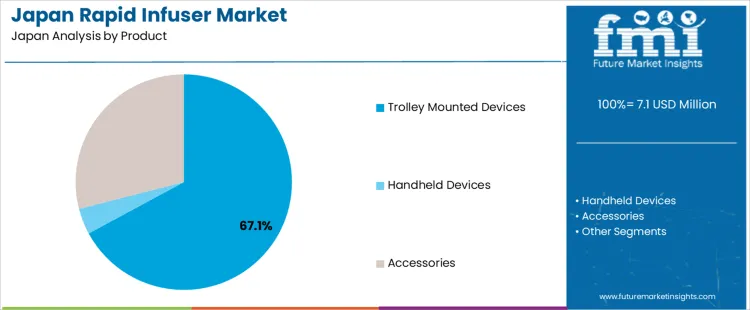
Trolley mounted devices account for 67% of the demand for Rapid Infuser in Japan, reflecting their dominant role in high acuity hospital environments. Consumption is driven by large tertiary hospitals, university medical centers, and advanced emergency departments where bulk fluid resuscitation is routinely performed. Usage intensity remains high due to frequent deployment in trauma surgery, cardiovascular procedures, and intensive care units.
Procurement is largely contract based through hospital tenders with long replacement cycles. Price sensitivity remains moderate because reliability, flow rate stability, and integration with existing monitoring equipment take priority over upfront cost. Specification requirements emphasize pressure control accuracy, alarm systems, and thermal regulation consistency. Import dependence remains high due to limited domestic production. Switching tendency remains low because staff training, maintenance systems, and protocol alignment are tightly linked to installed trolley platforms.
What Factors Are Driving Reusable Systems to Lead the Demand for Rapid Infuser in Japan by Usability?
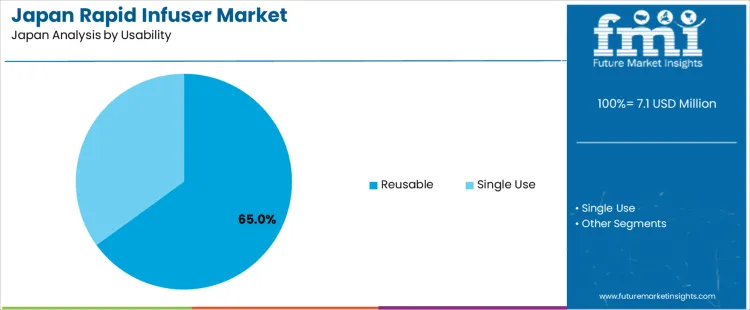
Reusable systems represent 65.0% of the demand for Rapid Infuser in Japan, reflecting procurement strategies centered on long term cost control and standardized hospital workflows. Repeat usage is supported by centralized sterilization infrastructure and strict reprocessing protocols across Japanese healthcare facilities. Consumption per facility remains stable due to predictable emergency case volumes and surgical throughput. Buyers favor reusable systems under multiyear supply agreements that bundle service, maintenance, and component replacement.
Price elasticity remains low because lifecycle cost and durability outweigh disposable convenience. Regulatory exposure is higher due to audit requirements for sterilization validation and component tracking. Inventory risk is managed through controlled spare part stock rather than high volume consumables. Substitution pressure from single use systems remains constrained by waste management costs and hospital sustainability targets. This structure stabilizes recurring demand across national emergency care networks.
What Is Shaping the Demand for Rapid Infuser in Japan Healthcare Infrastructure?
Demand for rapid infusers in Japan is shaped by hospital preparedness for trauma care, emergency surgery, and disaster-response medicine. The country’s high aging burden increases surgical volume, while earthquake and disaster planning drives consistent investment in emergency medical equipment. Rapid infusers are integrated into tertiary hospitals, trauma centers, and emergency transport units where fast fluid and blood warming are critical. Japan emphasis on precision medicine and strict clinical protocols favors systems with controlled temperature, air detection, and flow regulation. Demand is therefore tied to infrastructure reliability, emergency readiness, and procedural efficiency rather than episodic procurement cycles.
How Is Disaster Readiness Influencing Hospital Adoption of Rapid Infusers?
Japan disaster preparedness framework directly supports the demand for rapid infusers in emergency medicine. Earthquake and tsunami planning requires hospitals to maintain high-capacity resuscitation capability under power and infrastructure stress. Rapid infusers enable immediate volume replacement with controlled warming during mass trauma scenarios. Emergency response drills increasingly integrate rapid infusion systems into standardized shock and hemorrhage protocols. This readiness culture extends beyond urban trauma centers into regional emergency networks. Procurement decisions prioritize reliability, portability, and rapid setup under constrained clinical conditions. Demand is therefore driven by civil defense readiness embedded within the healthcare delivery system.
Why Is Surgical Throughput and Blood Conservation Creating Structural Demand?
Japan high surgical density, particularly in cardiovascular, orthopedic, and oncology procedures, drives consistent need for rapid fluid and blood management. Rapid infusers support tighter intraoperative volume control, reducing hypothermia risk and stabilizing hemodynamics during high-blood-loss surgery. Japan emphasis on patient safety and blood conservation aligns with rapid, temperature-regulated transfusion systems. Hospitals prioritize devices that integrate air detection, pressure monitoring, and warming without manual intervention. This demand is not driven by emergency volume alone but by routine surgical efficiency and complication reduction under tightly regulated operating room standards.
How Do Cost Control, Training Burden, and Device Redundancy Restrain Expansion?
Demand for rapid infusers in Japan faces restraint from strict hospital capital equipment budgets and reimbursement controls. Device acquisition competes with imaging, robotic surgery, and ICU monitoring systems for funding priority. Training requirements for nursing and anesthesia staff also slow deployment in smaller hospitals where workforce rotation is high. In addition, redundancy policies in large facilities limit the number of additional units justified per department. Maintenance certification and periodic safety validation add operating cost. These factors do not eliminate demand but restrain rapid multi-unit expansion outside core emergency and surgical departments.
What is the Demand for Rapid Infuser in Japan by Region?
| Region | CAGR (%) |
|---|---|
| Kyushu & Okinawa | 4.3% |
| Kanto | 4.0% |
| Kinki | 3.5% |
| Chubu | 3.1% |
| Tohoku | 2.7% |
| Rest of Japan | 2.6% |
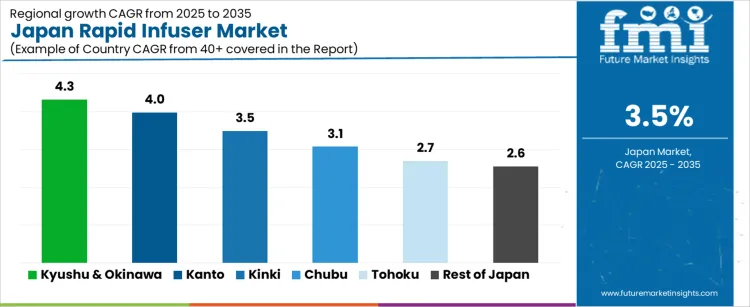
The demand for rapid infusers in Japan is increasing steadily across all regions, led by Kyushu and Okinawa at a 4.3% CAGR. Growth here is supported by expansion of emergency care capacity, rising trauma admissions, and wider installation of high flow warming systems in secondary hospitals. Kanto follows at 4.0%, driven by dense tertiary hospital networks, surgical procedure volumes, and continual upgrades in critical care equipment.
Kinki records 3.5% growth, reflecting balanced demand from emergency departments and perioperative units. Chubu at 3.1% shows moderate uptake linked to regional hospital modernization and procedural growth. Tohoku and the Rest of Japan, at 2.7% and 2.6%, reflect slower but stable adoption shaped by lower population density, fewer high acuity centers, and longer equipment replacement cycles. Demand remains tied closely to emergency care investments.
How Is Emergency Care Infrastructure in Kyushu and Okinawa Supporting Rapid Infuser Demand?
Growth in Kyushu and Okinawa is progressing at a CAGR of 4.3% through 2035 for rapid infuser demand, supported by rising trauma care capacity, expansion of coastal emergency medical services, and increased disaster preparedness investments. Hospital modernization across Fukuoka, Naha, and Kagoshima is strengthening deployment of high flow infusion devices in emergency rooms and surgical suites. Compared with Tohoku, adoption here is driven more by trauma response needs than aging population care. Procurement remains concentrated among tertiary hospitals and air medical support units with critical care specialization.
- Trauma response units anchor core device demand
- Disaster readiness strengthens infusion system upgrades
- Emergency transport services support equipment deployment
- Major hospitals dominate procurement concentration
What Is Driving Rapid Infuser Utilization Across High Intensity Medical Systems in Kanto?
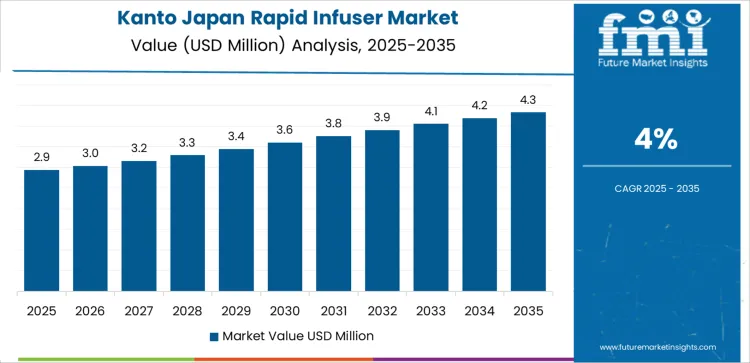
Expansion in Kanto reflects a CAGR of 4.0% through 2035 for rapid infuser usage, led by dense tertiary hospital networks, large emergency departments, and advanced surgical volume across Tokyo and surrounding prefectures. Kanto contrasts with Kyushu and Okinawa through procedure driven utilization rather than disaster response oriented deployment. Rapid infusers are widely used in cardiovascular surgery, transplant procedures, trauma stabilization, and high volume intensive care units. Teaching hospitals and private super specialty centers represent the main procurement hubs with continuous equipment replacement cycles.
- High surgical volumes sustain steady infusion demand
- Teaching hospitals drive technology standardization
- Intensive care wards support continuous device usage
- Private super specialty centers lead equipment upgrades
Why Is Industrial and Regional Healthcare Growth Influencing Rapid Infuser Adoption in Kinki?
Growth in Kinki is advancing at a CAGR of 3.5% through 2035 for rapid infuser demand, supported by balanced development of regional trauma centers, industrial accident care, and cardiovascular surgery programs. Osaka, Kobe, and Kyoto hospitals anchor infusion system deployment across emergency and operating room settings. Kinki contrasts with Kanto through greater focus on regional referral hospitals rather than national scale tertiary clusters. Rapid infusers here are increasingly used for trauma stabilization, vascular surgery, and perioperative fluid resuscitation.
- Regional trauma hospitals sustain baseline demand
- Industrial accident care supports infusion usage
- Cardiovascular surgery expands procedural adoption
- Referral hospitals dominate capital equipment purchasing
How Is Manufacturing Region Healthcare Expansion Shaping Rapid Infuser Demand in Chubu?
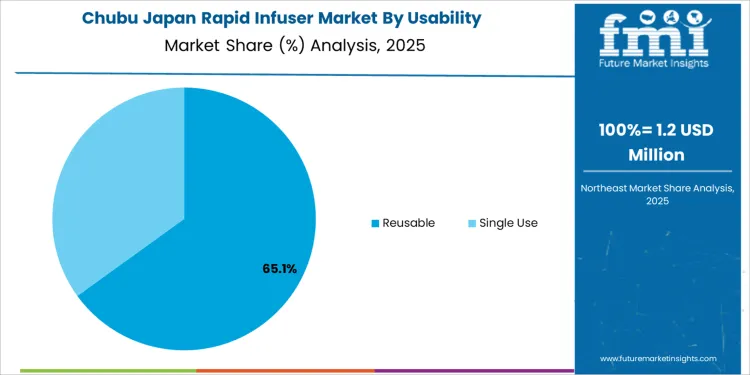
Expansion in Chubu reflects a CAGR of 3.1% through 2035 for rapid infuser adoption, supported by hospital upgrades across Nagoya and surrounding industrial cities and rising road accident trauma management needs. Chubu contrasts with Kinki through a stronger connection between industrial workforce health services and emergency medical infrastructure. Rapid infusers are deployed across emergency units, orthopedic trauma surgery, and general surgical wards requiring fast fluid replacement. Procurement remains tied to prefectural hospitals and regional medical centers serving industrial belts.
- Industrial accident response drives infusion demand
- Regional medical centers support steady device placement
- Emergency orthopedic surgery anchors practical usage
- Prefectural hospitals lead procurement activity
What Is Sustaining Gradual Rapid Infuser Uptake Across Aging Care Networks in Tohoku?
Growth in Tohoku is moving at a CAGR of 2.7% through 2035 for rapid infuser demand, supported by aging population care needs, emergency stabilization in rural hospitals, and regional disaster preparedness planning. Tohoku contrasts with Kanto and Kinki through lower surgical throughput and greater dependence on regional emergency transport systems. Rapid infusers are mainly used for geriatric trauma, internal bleeding management, and emergency stabilization in smaller hospitals. Budget constraints and low patient density continue to limit faster deployment.
- Geriatric trauma care sustains limited device usage
- Rural hospitals lead regional infusion deployment
- Emergency transport supports stabilization procedures
- Budget constraints slow large scale equipment upgrades
How Does Low Density Healthcare Infrastructure Influence Rapid Infuser Demand in the Rest of Japan?
Growth in the Rest of Japan is advancing at a CAGR of 2.6% through 2035 for rapid infuser demand, shaped by smaller hospital networks, limited trauma center density, and lower surgical case volumes. This region contrasts with Kanto and Kyushu and Okinawa through slower equipment replacement cycles and conservative capital allocation. Rapid infusers are primarily placed in district hospitals for emergency stabilization rather than high frequency surgical use. Procurement decisions remain tied to prefectural funding cycles and emergency preparedness programs.
- District hospitals dominate unit level deployment
- Emergency stabilization represents the main use case
- Capital budgets limit faster technology replacement
- Prefectural funding shapes procurement timelines
What Is Driving the Demand for Rapid Infuser in Japan and Which Companies Control Hospital Adoption?
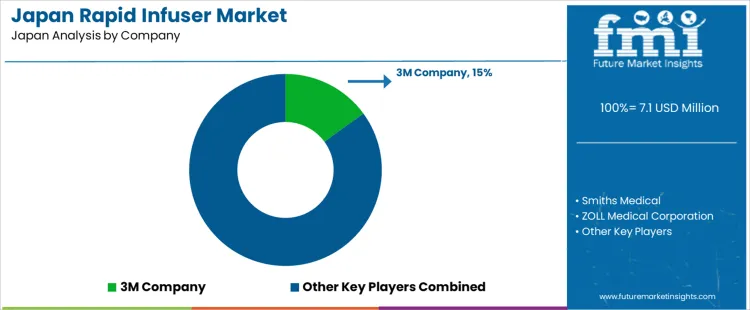
The demand for rapid infuser systems in Japan is shaped by trauma care standards, aging demographics, and procedural volume in emergency surgery and critical care units. Terumo holds a central position in the Japan hospital device ecosystem through established distribution across tertiary care centers and disaster response hospitals. Nipro supports infusion related infrastructure through broad critical care portfolios used in operating rooms and intensive care units.
3M Company participates through fluid management and patient warming system integration used alongside rapid infusion workflows. Smith’s Medical maintains deployment in selected Japanese hospitals through anesthesia and critical care device channels. Adoption is driven by structured trauma protocols, earthquake preparedness planning, and rising cardiovascular and orthopedic surgery volumes.
ZOLL Medical Corporation supports demand through temperature management and resuscitation systems that integrate with high volume fluid delivery environments in emergency care. Stryker Corporation participates through trauma surgery and acute care infrastructure where rapid fluid resuscitation forms part of bundled operating room systems. GE Healthcare contributes through anesthesia delivery and patient monitoring platforms that operate in parallel with infusion workflows in surgical settings.
Procurement in Japan is guided by regulatory clearance under PMDA, compatibility with hospital electrical standards, and long term service coverage. Buyer preference favors suppliers with stable domestic service teams, training support in Japanese language, and long cycle maintenance programs. Adoption patterns reflect public hospital budgeting cycles and disaster medicine preparedness priorities.
Key Players in the Rapid Infuser Industry
- 3M Company
- Smiths Medical
- ZOLL Medical Corporation
- Stryker Corporation
- GE Healthcare
Scope of the report
| Items | Values |
|---|---|
| Quantitative Units (2025) | USD million |
| Product | Trolley Mounted Devices, Handheld Devices, Accessories |
| Usability | Reusable, Single Use |
| End User | Hospitals, Ambulatory Surgical Centers, Specialty Clinics, Emergency Medical Services, Military Services |
| Regions Covered | Kyushu & Okinawa, Kanto, Kansai, Chubu, Tohoku, Rest of Japan |
| Key Companies Profiled | 3M Company, Smiths Medical, ZOLL Medical Corporation, Stryker Corporation, GE Healthcare |
| Additional Attributes | Dollar by sales breakdown by region, end-user, product, and usability; growth projections through 2035; hospital adoption patterns; trauma and emergency preparedness impact; reusable vs single use preference; device integration with monitoring and transfusion systems; procurement and replacement cycles; PMDA regulatory compliance; training and service coverage; accessory and consumables demand |
Rapid Infuser Industry Segmentation
Product:
- Trolley Mounted Devices
- Handheld Devices
- Accessories
Usability:
- Reusable
- Single Use
End User:
- Hospitals
- Ambulatory Surgical Centers
- Speciality Clinics
- Emergency Medical Services
- Military Services
Region
- Kyushu & Okinawa
- Kanto
- Kansai
- Chubu
- Tohoku
- Rest of Japan
Frequently Asked Questions
How big is the demand for rapid infuser in Japan in 2025?
The demand for rapid infuser in Japan is estimated to be valued at USD 7.1 million in 2025.
What will be the size of rapid infuser in Japan in 2035?
The market size for the rapid infuser in Japan is projected to reach USD 10.0 million by 2035.
How much will be the demand for rapid infuser in Japan growth between 2025 and 2035?
The demand for rapid infuser in Japan is expected to grow at a 3.5% CAGR between 2025 and 2035.
What are the key product types in the rapid infuser in Japan?
The key product types in rapid infuser in Japan are trolley mounted devices, handheld devices and accessories.
Which usability segment is expected to contribute significant share in the rapid infuser in Japan in 2025?
In terms of usability, reusable segment is expected to command 65.0% share in the rapid infuser in Japan in 2025.
Preview the report firsthand - request a free sample
Get SampleGet the brochure for pricing and purchase details.
Get PDFTable of Content
- Executive Summary
- Japan Market Outlook
- Demand-side Trends
- Supply-side Trends
- Technology Roadmap Analysis
- Analysis and Recommendations
- Market Overview
- Market Coverage / Taxonomy
- Market Definition / Scope / Limitations
- Market Background
- Market Dynamics
- Drivers
- Restraints
- Opportunity
- Trends
- Scenario Forecast
- Demand in Optimistic Scenario
- Demand in Likely Scenario
- Demand in Conservative Scenario
- Opportunity Map Analysis
- Product Life Cycle Analysis
- Supply Chain Analysis
- Investment Feasibility Matrix
- Value Chain Analysis
- PESTLE and Porter’s Analysis
- Regulatory Landscape
- Regional Parent Market Outlook
- Production and Consumption Statistics
- Import and Export Statistics
- Market Dynamics
- Japan Market Analysis 2020 to 2024 and Forecast, 2025 to 2035
- Historical Market Size Value (USD Million) Analysis, 2020 to 2024
- Current and Future Market Size Value (USD Million) Projections, 2025 to 2035
- Y-o-Y Growth Trend Analysis
- Absolute $ Opportunity Analysis
- Japan Market Pricing Analysis 2020 to 2024 and Forecast 2025 to 2035
- Japan Market Analysis 2020 to 2024 and Forecast 2025 to 2035, By Product
- Introduction / Key Findings
- Historical Market Size Value (USD Million) Analysis By Product , 2020 to 2024
- Current and Future Market Size Value (USD Million) Analysis and Forecast By Product , 2025 to 2035
- Trolley Mounted Devices
- Handheld Devices
- Accessories
- Y-o-Y Growth Trend Analysis By Product , 2020 to 2024
- Absolute $ Opportunity Analysis By Product , 2025 to 2035
- Japan Market Analysis 2020 to 2024 and Forecast 2025 to 2035, By Usability
- Introduction / Key Findings
- Historical Market Size Value (USD Million) Analysis By Usability, 2020 to 2024
- Current and Future Market Size Value (USD Million) Analysis and Forecast By Usability, 2025 to 2035
- Reusable
- Single Use
- Y-o-Y Growth Trend Analysis By Usability, 2020 to 2024
- Absolute $ Opportunity Analysis By Usability, 2025 to 2035
- Japan Market Analysis 2020 to 2024 and Forecast 2025 to 2035, By End User
- Introduction / Key Findings
- Historical Market Size Value (USD Million) Analysis By End User, 2020 to 2024
- Current and Future Market Size Value (USD Million) Analysis and Forecast By End User, 2025 to 2035
- Hospitals
- Ambulatory Surgical Centers
- Speciality Clinics
- Emergency Medical Services
- Military Services
- Y-o-Y Growth Trend Analysis By End User, 2020 to 2024
- Absolute $ Opportunity Analysis By End User, 2025 to 2035
- Market Structure Analysis
- Competition Dashboard
- Competition Benchmarking
- Market Share Analysis of Top Players
- By Regional
- By Product
- By Usability
- By End User
- Competition Analysis
- Competition Deep Dive
- 3M Company
- Overview
- Product Portfolio
- Profitability by Market Segments (Product/Age /Sales Channel/Region)
- Sales Footprint
- Strategy Overview
- Marketing Strategy
- Product Strategy
- Channel Strategy
- Smiths Medical
- ZOLL Medical Corporation
- Stryker Corporation
- GE Healthcare
- 3M Company
- Competition Deep Dive
- Assumptions & Acronyms Used
- Research Methodology


