

- Industry Size (2025)
- USD 4060.0 Mn
- Forecast (2035)
- USD 7171.5 Mn
- CAGR (2025 to 2035)
- 5.9%
Malt Sprouts Market Forecast and Outlook 2025 to 2035
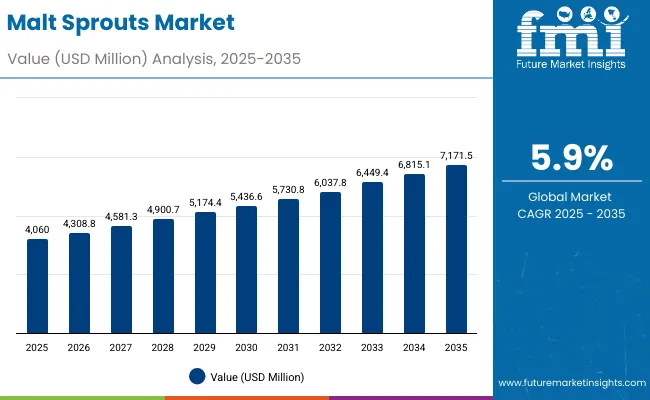
The malt sprouts market is projected to reach USD 7,171.5 million by 2035, recording an absolute increase of USD 3,111.5 million over the forecast period. The market is valued at USD 4,060.0 million in 2025 and is expected to grow at a CAGR of 5.9% over the assessment period. The scale and pace of expansion align with steady agricultural modernization across livestock, feed manufacturing, and food processing sectors, where nutritional supplementation influences animal productivity, feed efficiency, and cost-per-unit outcomes.
Between 2025 and 2030, the market increases to USD 5.44 billion, contributing 44.3% of the decade growth as facilities adopt advanced feed formulations and replace conventional protein sources. The larger 55.7% contribution during 2030 to 2035 reflects deeper integration of specialized processing systems, enhanced nutritional profiles, and automated feed technologies supporting high-performance animal nutrition in livestock operations, food manufacturing, and agricultural applications.
Source segmentation reinforces these performance priorities: barley-based systems hold ~85% share due to superior nutritional profiles and processing compatibility, while wheat at ~8% and rye at ~4% offer specialized applications in targeted feed formulations within complex agricultural environments. By application, animal feed leads with ~70%, followed by the food industry at ~15% and biofuel & industrial use at ~7%, reflecting widespread adoption across livestock nutrition, bakery applications, and fermentation processes.
Quick Stats for Malt Sprouts Market
- Malt Sprouts Market Value (2025): USD 4,060.0 million
- Malt Sprouts Market Forecast Value (2035): USD 7,171.5 million
- Malt Sprouts Market Forecast CAGR: 5.9%
- Leading Source in Malt Sprouts Market: Barley
- Key Growth Regions in Malt Sprouts Market: Europe, South Asia & Pacific, and North America
- Top Players in Malt Sprouts Market: Cargill, MalteuropGroupe, GrainCorp, Viking Malt, Axereal
Malt Sprouts Market Key Takeaways
| Metric | Value |
|---|---|
| Market Value (2025) | USD 4,060.0 million |
| Market Forecast Value (2035) | USD 7,171.5 million |
| Forecast CAGR (2025 to 2035) | 5.9% |
Malt Sprouts Market Year-over-Year Forecast (2025-2035)
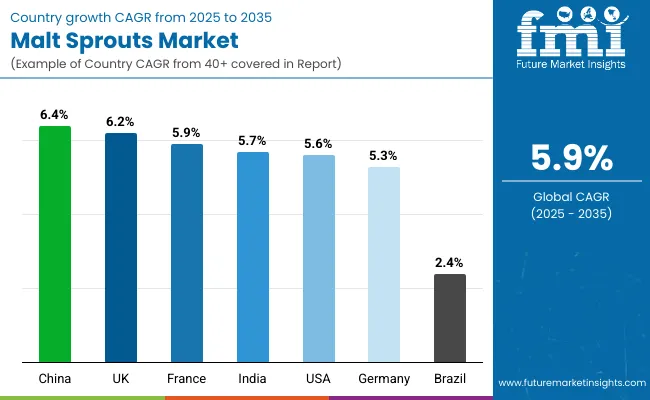
Geographically, the market is led by China (6.4% CAGR) and the UK (6.2% CAGR), supported by livestock expansion, agricultural modernization, and feed industry development. France (5.9%) and India (5.7%) sustain growth through agricultural development and livestock productivity enhancement, while the USA (5.6%), Germany (5.3%), and Brazil (2.4%) grow through incremental modernization rather than capacity expansion. Competitive structure remains moderately consolidated, with Cargill, MalteuropGroupe, and GrainCorp collectively holding a 25-35% share, while regional manufacturers compete through localized processing, faster delivery cycles, and application-specific support near agricultural hubs.
Malt sprouts are dried rootlets and shoots separated from malted barley grains during kilning, and they contain concentrated proteins, vitamins, and bioactive compounds essential for animal nutrition and food industry applications. The sprouting process activates enzymatic systems within cereal grains, transforming starch reserves into fermentable sugars while producing protein-rich rootlets and shoots that accumulate amino acids, B-complex vitamins, and growth factors. These metabolic changes create highly digestible feed supplements with enhanced palatability characteristics compared to unsprouted grain materials.
Traditional malting operations generate malt sprouts as primary by-products during barley processing for brewing and distilling industries. Modern collection systems capture sprouts immediately after kilning to preserve nutritional quality and prevent oxidation of sensitive compounds. Mechanical separation techniques remove sprouts from finished malt through screening, aspiration, and density classification methods that maintain structural integrity while achieving target purity levels for specific applications.
Processing technologies encompass drying, grinding, pelleting, and extraction procedures tailored for different end-use requirements. Controlled drying operations reduce moisture content to stable levels while preserving heat-sensitive vitamins and bioactive molecules. Grinding systems produce uniform particle sizes optimized for feed mixing and digestibility characteristics. Pelleting equipment compresses dried sprouts into dense pellets that improve handling properties and reduce transportation costs for bulk applications.
Animal nutrition applications dominate market demand through incorporation into ruminant, poultry, swine, and pet food formulations. The high protein content ranging from 20-25% provides essential amino acids for livestock growth and productivity enhancement. Fiber components support digestive health in ruminants, while vitamin B-complex content contributes to metabolic function optimization across various animal species. Natural palatability enhancers improve feed acceptance rates compared to synthetic alternatives.
Between 2025 and 2030, the malt sprouts market is projected to expand from USD 4,060.0 million to USD 5,436.6 million, representing a 44.3% increase in value and accounting for 44.3% of the total forecast growth for the decade. This phase of development will be shaped by rising demand for animal feed supplements and functional food ingredients, product innovation in processing technologies and extraction systems, and expanding integration with feed manufacturing and food processing applications. Companies are establishing competitive positions through investment in processing capabilities, advanced extraction technologies, and strategic market expansion across animal feed, food industry, and nutraceutical applications.
From 2030 to 2035, the market is forecast to grow from USD 5,436.6 million to USD 7,171.5 million, adding another USD 1,734.9 million, which constitutes 55.7% of the overall ten-year expansion. This period is expected to be characterized by the expansion of specialized applications, including advanced feed formulations and nutraceutical products tailored for specific nutritional requirements, strategic collaborations between malt sprouts producers and feed companies, and an enhanced focus on standardized quality protocols and automated processing systems.
Why is the Malt Sprouts Market Growing?
The malt sprouts market grows by enabling feed manufacturers and food companies to optimize production processes while accessing specialized nutritional ingredients without substantial in-house processing infrastructure investment. Manufacturing companies and agricultural operators face mounting pressure to develop advanced feed formulations and functional food products while managing complex nutritional requirements, with high-quality malt sprouts typically providing 40-60% performance enhancement compared to conventional alternatives, making advanced powder and pellet formulations essential for competitive market positioning.
The feed industry's need for natural protein sources and application-specific nutritional capabilities creates demand for comprehensive malt sprouts solutions that can provide superior digestibility, maintain consistent quality standards, and ensure reliable operation without compromising nutritional efficacy or regulatory compliance.
Government initiatives promoting animal nutrition improvement and food security drive adoption in feed manufacturing, food processing, and agricultural applications, where ingredient quality has a direct impact on production performance and long-term market effectiveness. Complex processing requirements during large-scale production projects and the expertise requirements for quality optimization may limit accessibility among smaller manufacturing companies and developing regions with limited technical infrastructure for advanced feed processing systems.
Segmental Analysis
The market is segmented by source, application, form, sales channel, end use industry, and region. By source, the market is divided into barley, wheat, rye, and other cereals. Based on application, the market is categorized into animal feed, brewing & distilling, food industry, nutraceuticals, and biofuel & industrial use. By form, the market includes whole sprouts, powder, pellets, and liquid extract. By sales channel, the market is divided into direct sales, distributors/wholesalers, and online bulk platforms. Based on end use industry, the market is categorized into feed industry, food & beverage industry, pharma & nutraceutical, and industrial/biofuel manufacturers. Regionally, the market is divided into North America, Europe, Asia Pacific, Latin America, and Middle East & Africa.
By Source, the Barley Segment Accounts for a Dominant Market Share
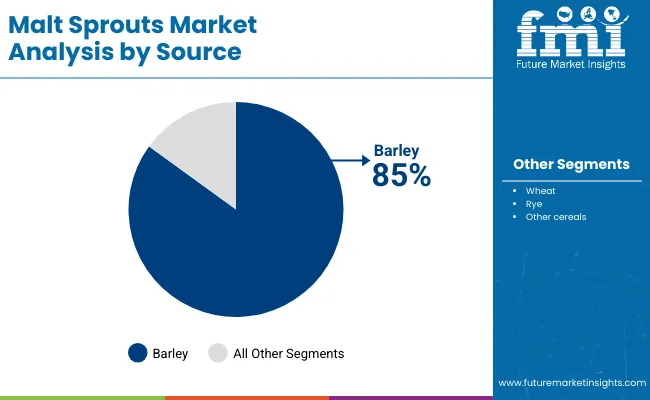
The barley segment represents the dominant force in the malt sprouts market, capturing approximately 85.0% of total market share in 2025. This established source category encompasses solutions featuring advanced nutritional characteristics and specialized feed applications, including high-performance protein profiles and enhanced digestibility characteristics that enable superior animal nutrition benefits and feed outcomes across all agricultural applications. The barley segment's market leadership stems from its proven nutritional capabilities, with solutions capable of addressing diverse feed requirements while maintaining consistent quality standards and processing effectiveness across all production environments.
The wheat segment maintains 8.0% market share, serving specialized applications that require specific nutritional profiles with particular processing characteristics for targeted feed formulations. Rye accounts for 4.0% market share, while other cereals capture 3.0% market share, offering specific nutritional profiles for niche feed applications while providing sufficient protein levels to meet specialized animal nutrition and regulatory demands.
Key source advantages driving the barley segment include:
- Advanced nutritional technology with integrated protein characteristics that enhance feed quality and ensure consistent nutritional performance
- Established processing capabilities allowing streamlined production workflows across different applications without extensive modification requirements
- Enhanced availability enabling diverse product formats while maintaining nutritional integrity and digestibility reliability
- Superior market acceptance providing optimal feed performance for various animal nutrition applications
By Application, the Animal Feed Segment Accounts for the Largest Market Share
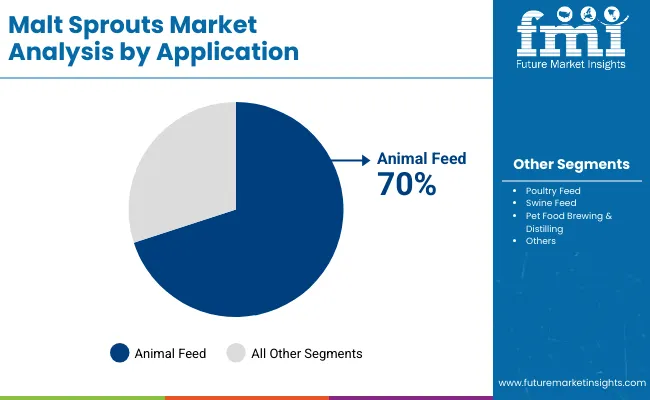
Animal feed applications dominate the malt sprouts market with approximately 70.0% market share in 2025, reflecting the critical role of protein supplements in supporting livestock nutrition requirements and agricultural productivity worldwide. The animal feed segment's market leadership is reinforced by increasing livestock production trends, protein demand growth, and rising needs for natural feed ingredients in agricultural applications across developed and emerging markets.
The food industry segment represents the second-largest application category, capturing 15.0% market share through specialized requirements for bakery products, snacks, and malt extract applications. This segment benefits from growing functional food integration demand that requires specific nutritional requirements, quality standards, and processing optimization protocols in food markets.
The biofuel & industrial use segment accounts for 7.0% market share, serving industrial fermentation, energy production, and specialized manufacturing applications. Brewing & distilling captures 5.0% market share, while nutraceuticals accounts for 3.0% market share across various health sectors.
Key market dynamics supporting application growth include:
- Animal feed expansion driven by livestock production growth and protein demand, requiring specialized nutritional solutions in emerging agricultural markets
- Food industry modernization trends require flexible, integrated ingredient systems for competitive differentiation and product innovation development
- Integration of advanced processing technologies enabling enhanced formulation capabilities and automated production systems
- Growing emphasis on nutritional optimization driving demand for specialized, validated feed solutions without traditional processing limitations
What are the Drivers, Restraints, and Key Trends of the Malt Sprouts Market?
The market is driven by three concrete demand factors tied to agricultural and food processing outcomes. First, animal nutrition enhancement and livestock productivity improvement create increasing demand for malt sprouts supplements, with feed performance enhancement of 15-25% annually in major agricultural markets worldwide, requiring comprehensive processing infrastructure.
Second, government initiatives promoting agricultural modernization and food security drive increased adoption of natural feed ingredients, with many countries implementing livestock nutrition programs and regulatory frameworks for feed quality advancement by 2030. Third, technological advancements in processing systems and extraction methods enable more efficient and effective production solutions that improve nutritional quality while reducing manufacturing costs and processing complexity.
Market restraints include complex processing requirements and validation costs for specialized malt sprouts platforms that can challenge market participants in developing compliant production capabilities, particularly in regions where regulatory pathways for feed additives remain evolving and uncertain. Technical complexity of extraction systems and quality standardization requirements pose another challenge, as malt sprouts demand sophisticated processing methods and nutritional controls, potentially affecting production costs and operational efficiency. Supply variability constraints from malting operations across different regions create additional operational challenges for manufacturers, demanding ongoing investment in sourcing infrastructure and quality assurance programs.
Key trends indicate accelerated adoption in Asia-Pacific markets, particularly China and India, where agricultural expansion and livestock production growth drive comprehensive malt sprouts adoption. Technology integration trends toward specialized powder systems with enhanced nutritional characteristics, advanced extraction applications, and integrated processing solutions enable effective manufacturing approaches that optimize production efficiency and minimize quality risks. The market thesis could face disruption if advances in synthetic feed additives or changes in agricultural practices reduce reliance on traditional malt sprouts applications.
Analysis of the Malt Sprouts Market by Key Country
| Countries | CAGR (%) |
|---|---|
| UK | 6.2 |
| China | 6.4 |
| France | 5.9 |
| India | 5.7 |
| USA | 5.6 |
| Germany | 5.3 |
| Brazil | 2.4 |
The global malt sprouts market is expanding steadily, with China leading at a 6.4% CAGR through 2035, driven by livestock production growth, agricultural modernization, and expanding feed manufacturing platforms. UK follows at 6.2%, supported by advanced animal nutrition programs and feed industry development initiatives. France records 5.9%, reflecting established agricultural markets with growing integration in feed manufacturing and food processing. India advances at 5.7%, anchored by livestock sector expansion and agricultural development programs. USA grows at 5.6%, leveraging feed manufacturing capabilities. Germany posts 5.3%, focusing on feed processing excellence, while Brazil grows at 2.4%, emphasizing agricultural commodity integration.
China Leads Global Market Expansion
China demonstrates the strongest growth potential in the malt sprouts sector, expanding at a CAGR of 6.4% through 2035, driven by rapid livestock production growth, agricultural modernization programs, and government-backed feed manufacturing reforms. The country’s emphasis on sustainable and high-efficiency animal nutrition has positioned malt sprouts as a preferred feed ingredient due to their protein and fiber content. Major agricultural hubs such as Beijing, Shanghai, Guangzhou, and Chengdu are central to feed innovation and large-scale adoption. Agricultural cooperatives and livestock companies are integrating malt sprouts into feed formulations to improve digestion, productivity, and overall animal health.
The Ministry of Agriculture and Rural Affairs continues to promote nutrient-balanced feeding practices through subsidies and technical training programs, supporting national objectives for sustainable livestock expansion. Additionally, the growth of domestic feed manufacturing capacity and export-oriented production enhances China’s competitiveness in the global feed industry. Increasing collaborations between international feed technology providers and Chinese manufacturers are further optimizing processing standards and distribution efficiency. Overall, China’s modernization strategy, regulatory coherence, and focus on high-value livestock nutrition firmly establish it as a global leader in malt sprouts integration across industrial-scale animal feeding operations.
UK Emerges as High-Growth Market
The United Kingdom’s malt sprouts industry is advancing at a CAGR of 6.2% through 2035, reflecting strong momentum in agricultural modernization, feed innovation, and livestock productivity enhancement. The country’s agricultural transformation is driven by sustainability goals, with farmers and feed producers prioritizing natural and protein-rich supplements such as malt sprouts to reduce environmental footprints while improving livestock output. Major regions including East Anglia, Yorkshire, and Scotland are implementing malt sprouts-based feed systems supported by government incentives under agri-innovation programs.
British companies are investing in advanced feed processing technologies and data-driven nutrition management platforms to optimize efficiency across dairy and meat sectors. Furthermore, academic research institutions and agricultural cooperatives are collaborating on R&D initiatives exploring malt sprouts’ role in gut health and feed efficiency. The UK government’s "Sustainable Farming Incentive" supports the use of alternative feed materials that align with carbon reduction goals, further enhancing adoption. The growing integration of technology with agricultural practices positions the UK as one of Europe’s fastest-growing regions for malt sprouts utilization, combining innovation, sustainability, and high-value livestock nutrition strategies.
France Shows Agricultural Leadership
France’s malt sprouts sector is expanding at a CAGR of 5.9% through 2035, driven by its strong livestock industry, advanced agricultural systems, and government-supported feed modernization initiatives. French agricultural regions such as Brittany, Normandy, and Nouvelle-Aquitaine are witnessing increasing integration of malt sprouts into dairy and cattle feed, aimed at improving nutritional profiles and enhancing animal productivity. The country’s focus on sustainable agriculture aligns well with the European Union’s "Farm to Fork" strategy, which promotes efficient resource use and environmentally responsible feed solutions.
French feed manufacturers are exploring high-efficiency processing systems to standardize malt sprouts quality, though challenges persist in scaling and maintaining consistency. Collaborative programs between domestic agricultural cooperatives and international feed technology companies are addressing these challenges by introducing automation and precision nutrition techniques. Moreover, government funding for sustainable livestock practices and R&D on plant-based feed alternatives continues to strengthen the market’s foundation. France’s balanced approach, combining innovation, sustainability, and regulatory oversight, positions it as a key European leader in agricultural modernization, with malt sprouts serving as a vital component in advancing national livestock nutrition programs.
India Demonstrates Agricultural Growth
India’s malt sprouts sector is advancing steadily at a CAGR of 5.7% through 2035, supported by robust agricultural growth, livestock modernization, and increasing awareness of feed quality improvement. The country’s major agricultural hubs, Punjab, Haryana, Maharashtra, and Andhra Pradesh, are embracing malt sprouts as an efficient protein and fiber source to enhance cattle health and dairy productivity. Indian feed manufacturers are deploying automated milling and blending systems to improve nutritional consistency across feed formulations. Government initiatives such as the "National Livestock Mission" and "Rashtriya Gokul Mission" are encouraging the adoption of nutritional feed supplements to increase milk yield and animal resilience.
Agricultural universities and research bodies are further validating the benefits of malt sprouts in balanced livestock diets, driving stronger adoption among dairy cooperatives and private sector producers. Distribution networks through agricultural institutions and local feed cooperatives ensure widespread accessibility, particularly in rural dairy clusters. Moreover, rising private investment in feed manufacturing and cold-chain logistics is expanding capacity and product availability. With growing livestock populations and evolving dietary standards, India is becoming an increasingly influential participant in Asia’s evolving malt sprouts landscape, integrating tradition with advanced agricultural technology.
USA Shows Feed Innovation Leadership
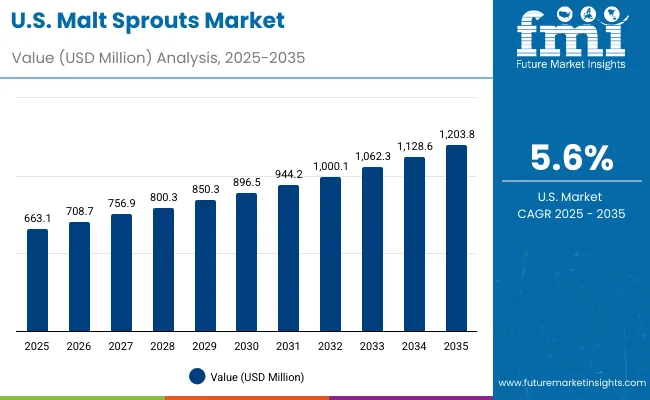
The United States malt sprouts industry maintains a strong innovation trajectory, growing at a CAGR of 5.6% through 2035, driven by advanced feed optimization systems and data-led livestock productivity management. American feed producers are emphasizing malt sprouts’ nutritional advantages, high protein digestibility, fiber content, and enzymatic benefits, to meet rising livestock performance standards. Major agricultural regions, including Iowa, Texas, Wisconsin, and Nebraska, are leading large-scale implementation through vertically integrated feed operations.
Technological advancements in feed formulation, automation, and microbial enhancement are improving feed conversion ratios and sustainability metrics. USA agricultural programs under the USDA encourage sustainable ingredient utilization, aligning malt sprouts use with carbon reduction and animal health improvement goals. Additionally, collaborations between universities and agritech startups are driving innovation in feed science, particularly in optimizing malt sprouts processing and bioavailability. The country’s feed industry is also expanding exports to Latin America and Southeast Asia, leveraging strong R&D and quality assurance frameworks. With consistent investment in performance-driven livestock nutrition, regulatory transparency, and advanced manufacturing capabilities, the USA continues to demonstrate leadership in feed innovation and malt sprouts-based productivity enhancement.
Germany Demonstrates Processing Excellence
Germany’s malt sprouts market is advancing at a CAGR of 5.3% through 2035, powered by its expertise in feed processing technologies and precision agricultural systems. The country’s feed manufacturers are integrating high-efficiency malt sprouts processing units within modern feed plants located in Bavaria, Lower Saxony, and North Rhine-Westphalia. German engineering excellence is enabling the production of standardized, nutrient-rich feed formulations that improve livestock digestion and productivity. Continuous modernization of agricultural equipment and quality assurance systems underpins the market’s stable expansion.
Partnerships between agricultural cooperatives and feed technology developers are fostering innovation in sustainable ingredient sourcing and automated feed blending systems. Furthermore, Germany’s adherence to EU feed safety and sustainability regulations ensures high product traceability and environmental compliance. The nation’s R&D programs focus on optimizing enzymatic breakdown of malt sprouts to enhance nutrient absorption efficiency in livestock. With strong infrastructure, regulatory rigor, and an emphasis on technological superiority, Germany stands out as a benchmark for feed processing excellence, offering precision-oriented solutions for both domestic and European feed manufacturers adopting malt sprouts in advanced nutrition systems.
Brazil Shows Agricultural Integration
Brazil’s malt sprouts sector is expanding steadily at a CAGR of 4.8% through 2035, supported by agricultural integration and the growing demand for efficient feed supplementation across large-scale livestock operations. The country’s vast agricultural landscape, spanning key regions such as São Paulo, Paraná, and Minas Gerais, provides a strong foundation for incorporating malt sprouts into diversified feed systems. Brazilian feed manufacturers are leveraging the nutritional advantages of malt sprouts to enhance protein balance and feed digestibility across poultry, swine, and dairy segments.
Government-led agricultural modernization programs and partnerships with global feed companies are facilitating the transfer of advanced feed technologies and best practices. Moreover, domestic cooperatives are playing a vital role in promoting adoption through knowledge dissemination and cost-sharing initiatives for farmers. The expansion of regional feed processing infrastructure and logistics networks is improving supply chain efficiency and accessibility to malt sprouts supplements. Brazil’s growing focus on animal nutrition, sustainability, and export competitiveness ensures that malt sprouts become integral to future feed innovation. The country’s agricultural integration approach positions it as Latin America’s emerging hub for natural, high-performance livestock feed solutions.
Europe Market Split by Country
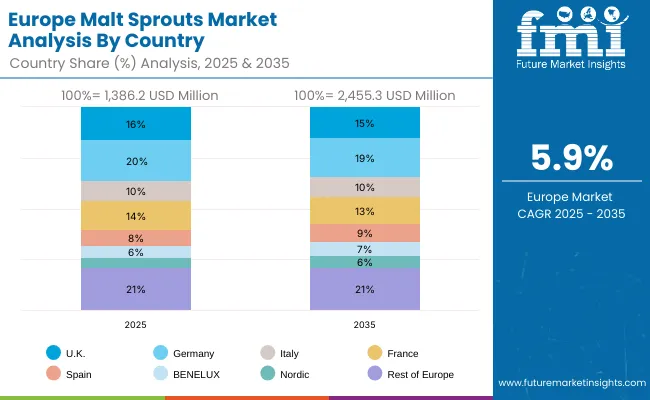
The malt sprouts market in Europe is projected to grow from USD 1,386.2 million in 2025 to USD 2,455.3 million by 2035, registering a CAGR of 5.9% over the forecast period. Germany is expected to maintain its leadership position with a 20.0% market share in 2025, projected to reach 19.0% by 2035, supported by its extensive feed processing infrastructure, advanced manufacturing facilities, and comprehensive distribution networks serving major European markets.
United Kingdom follows with a 16.0% share in 2025, projected to reach 15.0% by 2035, driven by comprehensive animal nutrition programs in major agricultural regions implementing advanced malt sprouts systems. France holds a 14.0% share in 2025, expected to reach 13.0% by 2035 through the ongoing development of feed processing facilities and agricultural networks. Italy commands a 10.0% share, while Spain accounts for 8.0% in 2025, projected to reach 9.0% by 2035. The Rest of Europe region is anticipated to maintain 21.0% market share, attributed to increasing malt sprouts adoption in Nordic countries and emerging Eastern European agricultural facilities implementing feed programs.
Competitive Landscape of the Malt Sprouts Market
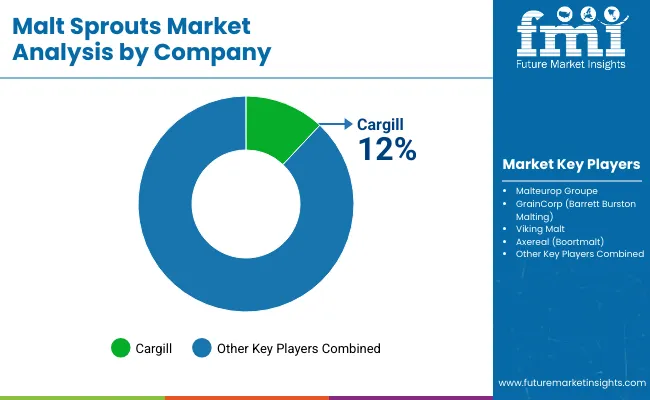
The malt sprouts market is closely tied to the global malting industry, since malt sprouts are generated as a by-product when barley is malted for brewing, distilling, and food applications. Production of malt sprouts is therefore concentrated among a relatively small group of large maltsters, while distribution into compound feed is fragmented across regional feed mills and commodity traders.
At the production level, leading malt ingredient groups such as Boortmalt (Axereal), MalteuropGroupe, GrainCorp’s malt businesses, Soufflet Malt, and Viking Malt have structural advantages: multi-region malting capacity, secure barley sourcing, and established supply contracts with brewers and distillers. Malt sprouts are captured, processed (often pelleted), and then channelled into ruminant, equine, and mixed-feed formulations as a protein- and fibre-rich ingredient, creating a relatively high barrier for new greenfield entrants.
Competitive differentiation is driven more by reliability of supply, consistency of nutrient profile, and integration with broader malt ingredient portfolios than by pure price competition. Large maltsters increasingly position malt sprouts and other malting by-products within broader "circular" or "sustainable feed" narratives, leveraging their malt brands, agronomy programs, and brewery relationships to lock in long-term contracts with feed manufacturers and integrators.
Below this global tier, regional maltsters and feed companies in Europe, North America, and Asia-Pacific capture value by converting locally available malt sprouts into tailored ruminant and equine feed lines, often competing on proximity, logistics, and the ability to tweak formulations for local regulations and farm requirements. In high-growth feed markets such as China and India, local malting capacity expansion and brewery investments gradually increase the availability of malt sprouts, which benefits domestic feed compounders able to integrate this by-product into cost-optimised rations.
Key Players in the Malt Sprouts Market
- Boortmalt (Axereal Group)
- MalteuropGroupe
- GrainCorp / United Malt (Barrett Burston Malting)
- Soufflet Malt (InVivo Group)
- Viking Malt
Scope of the Report
| Items | Values |
|---|---|
| Quantitative Units (2025) | USD 4,060 Million |
| Source | Barley, Wheat, Rye, Other Cereals |
| Application | Animal Feed, Brewing & Distilling, Food Industry, Nutraceuticals, Biofuel & Industrial Use |
| Form | Whole Sprouts, Powder, Pellets, Liquid Extract |
| Sales Channel | Direct Sales (B2B), Distributors/Wholesalers, Online Bulk Platforms |
| End Use Industry | Feed Industry, Food & Beverage Industry, Pharma & Nutraceutical, Industrial/Biofuel Manufacturers |
| Regions Covered | North America, Europe, Asia Pacific, Latin America, Middle East & Africa |
| Countries Covered | China, UK, France, India, USA, Germany, Brazil, and 40+ countries |
| Key Companies Profiled | Cargill, Malteurop Groupe, GrainCorp, Viking Malt, Axereal |
Malt Sprouts Market by Segments
By Source:
- Barley
- Wheat
- Rye
- Other Cereals
By Application:
- Animal Feed
- Ruminant Feed
- Poultry Feed
- Swine Feed
- Pet Food
- Brewing & Distilling
- Food Industry
- Bakery Products
- Snacks
- Malt Extracts
- Nutraceuticals
- Biofuel & Industrial Use
By Form:
- Whole Sprouts
- Powder
- Pellets
- Liquid Extract
By Sales Channel:
- Direct Sales (B2B)
- Distributors/Wholesalers
- Online Bulk Platforms
By End Use Industry:
- Feed Industry
- Food & Beverage Industry
- Pharma & Nutraceutical
- Industrial/Biofuel Manufacturers
By Region:
- North America
- United States
- Canada
- Mexico
- Europe
- Germany
- United Kingdom
- France
- Italy
- Spain
- Nordic
- BENELUX
- Rest of Europe
- Asia Pacific
- China
- Japan
- South Korea
- India
- Australia & New Zealand
- ASEAN
- Rest of Asia Pacific
- Latin America
- Brazil
- Argentina
- Rest of Latin America
- Middle East & Africa
- Kingdom of Saudi Arabia
- Other GCC Countries
- Turkey
- South Africa
- Other African Union
- Rest of Middle East & Africa
Frequently Asked Questions
How big is the malt sprouts market in 2025?
The global malt sprouts market is estimated to be valued at USD 4,060.0 million in 2025.
What will be the size of the malt sprouts market in 2035?
The market size for the malt sprouts market is projected to reach USD 7,171.5 million by 2035.
How much will be the malt sprouts market growth between 2025 and 2035?
The malt sprouts market is expected to grow at a 5.9% CAGR between 2025 and 2035.
What are the key product types in the malt sprouts market?
The key product types in the malt sprouts market are barley-based malt sprouts, wheat-based malt sprouts, rye-based malt sprouts, and other cereal-based malt sprouts.
Which application segment to contribute significant share in the malt sprouts market in 2025?
In terms of application, the animal feed segment is set to command a 70.0% share in the malt sprouts market in 2025.
Preview the report firsthand - request a free sample
Get SampleGet the brochure for pricing and purchase details.
Get PDFTable of Content
- Executive Summary
- Global Market Outlook
- Demand-side Trends
- Supply-side Trends
- Technology Roadmap Analysis
- Analysis and Recommendations
- Market Overview
- Market Coverage / Taxonomy
- Market Definition / Scope / Limitations
- Market Background
- Market Dynamics
- Drivers
- Restraints
- Opportunity
- Trends
- Scenario Forecast
- Demand in Optimistic Scenario
- Demand in Likely Scenario
- Demand in Conservative Scenario
- Opportunity Map Analysis
- Product Life Cycle Analysis
- Supply Chain Analysis
- Investment Feasibility Matrix
- Value Chain Analysis
- PESTLE and Porter’s Analysis
- Regulatory Landscape
- Regional Parent Market Outlook
- Production and Consumption Statistics
- Import and Export Statistics
- Market Dynamics
- Global Market Analysis 2020 to 2024 and Forecast, 2025 to 2035
- Historical Market Size Value (USD Million) Analysis, 2020 to 2024
- Current and Future Market Size Value (USD Million) Projections, 2025 to 2035
- Y-o-Y Growth Trend Analysis
- Absolute $ Opportunity Analysis
- Global Market Pricing Analysis 2020 to 2024 and Forecast 2025 to 2035
- Global Market Analysis 2020 to 2024 and Forecast 2025 to 2035, By Source
- Introduction / Key Findings
- Historical Market Size Value (USD Million) Analysis By Source , 2020 to 2024
- Current and Future Market Size Value (USD Million) Analysis and Forecast By Source , 2025 to 2035
- Barley
- Wheat
- Rye
- Other Cereals
- Y-o-Y Growth Trend Analysis By Source , 2020 to 2024
- Absolute $ Opportunity Analysis By Source , 2025 to 2035
- Global Market Analysis 2020 to 2024 and Forecast 2025 to 2035, By Application
- Introduction / Key Findings
- Historical Market Size Value (USD Million) Analysis By Application, 2020 to 2024
- Current and Future Market Size Value (USD Million) Analysis and Forecast By Application, 2025 to 2035
- Animal Feed
- Ruminant Feed
- Poultry Feed
- Swine Feed
- Pet Food
- Brewing & Distilling
- Food Industry
- Bakery Products
- Snacks
- Malt Extracts
- Nutraceuticals
- Biofuel & Industrial Use
- Animal Feed
- Y-o-Y Growth Trend Analysis By Application, 2020 to 2024
- Absolute $ Opportunity Analysis By Application, 2025 to 2035
- Global Market Analysis 2020 to 2024 and Forecast 2025 to 2035, By Form
- Introduction / Key Findings
- Historical Market Size Value (USD Million) Analysis By Form, 2020 to 2024
- Current and Future Market Size Value (USD Million) Analysis and Forecast By Form, 2025 to 2035
- Whole Sprouts
- Powder
- Pellets
- Liquid Extract
- Y-o-Y Growth Trend Analysis By Form, 2020 to 2024
- Absolute $ Opportunity Analysis By Form, 2025 to 2035
- Global Market Analysis 2020 to 2024 and Forecast 2025 to 2035, By Sales Channel
- Introduction / Key Findings
- Historical Market Size Value (USD Million) Analysis By Sales Channel, 2020 to 2024
- Current and Future Market Size Value (USD Million) Analysis and Forecast By Sales Channel, 2025 to 2035
- Direct Sales (B2B)
- Distributors/Wholesalers
- Online Bulk Platforms
- Y-o-Y Growth Trend Analysis By Sales Channel, 2020 to 2024
- Absolute $ Opportunity Analysis By Sales Channel, 2025 to 2035
- Global Market Analysis 2020 to 2024 and Forecast 2025 to 2035, By End Use Industry
- Introduction / Key Findings
- Historical Market Size Value (USD Million) Analysis By End Use Industry, 2020 to 2024
- Current and Future Market Size Value (USD Million) Analysis and Forecast By End Use Industry, 2025 to 2035
- Feed Industry
- Food & Beverage Industry
- Pharma & Nutraceutical
- Industrial/Biofuel Manufacturers
- Y-o-Y Growth Trend Analysis By End Use Industry, 2020 to 2024
- Absolute $ Opportunity Analysis By End Use Industry, 2025 to 2035
- Global Market Analysis 2020 to 2024 and Forecast 2025 to 2035, By Region
- Introduction
- Historical Market Size Value (USD Million) Analysis By Region, 2020 to 2024
- Current Market Size Value (USD Million) Analysis and Forecast By Region, 2025 to 2035
- North America
- Latin America
- Western Europe
- Eastern Europe
- East Asia
- South Asia and Pacific
- Middle East & Africa
- Market Attractiveness Analysis By Region
- North America Market Analysis 2020 to 2024 and Forecast 2025 to 2035, By Country
- Historical Market Size Value (USD Million) Trend Analysis By Market Taxonomy, 2020 to 2024
- Market Size Value (USD Million) Forecast By Market Taxonomy, 2025 to 2035
- By Country
- USA
- Canada
- Mexico
- By Source
- By Application
- By Form
- By Sales Channel
- By End Use Industry
- By Country
- Market Attractiveness Analysis
- By Country
- By Source
- By Application
- By Form
- By Sales Channel
- By End Use Industry
- Key Takeaways
- Latin America Market Analysis 2020 to 2024 and Forecast 2025 to 2035, By Country
- Historical Market Size Value (USD Million) Trend Analysis By Market Taxonomy, 2020 to 2024
- Market Size Value (USD Million) Forecast By Market Taxonomy, 2025 to 2035
- By Country
- Brazil
- Argentina
- Chile
- Rest of Latin America
- By Source
- By Application
- By Form
- By Sales Channel
- By End Use Industry
- By Country
- Market Attractiveness Analysis
- By Country
- By Source
- By Application
- By Form
- By Sales Channel
- By End Use Industry
- Key Takeaways
- Western Europe Market Analysis 2020 to 2024 and Forecast 2025 to 2035, By Country
- Historical Market Size Value (USD Million) Trend Analysis By Market Taxonomy, 2020 to 2024
- Market Size Value (USD Million) Forecast By Market Taxonomy, 2025 to 2035
- By Country
- Germany
- UK
- Italy
- Spain
- France
- Nordic
- BENELUX
- Rest of Western Europe
- By Source
- By Application
- By Form
- By Sales Channel
- By End Use Industry
- By Country
- Market Attractiveness Analysis
- By Country
- By Source
- By Application
- By Form
- By Sales Channel
- By End Use Industry
- Key Takeaways
- Eastern Europe Market Analysis 2020 to 2024 and Forecast 2025 to 2035, By Country
- Historical Market Size Value (USD Million) Trend Analysis By Market Taxonomy, 2020 to 2024
- Market Size Value (USD Million) Forecast By Market Taxonomy, 2025 to 2035
- By Country
- Russia
- Poland
- Hungary
- Balkan & Baltic
- Rest of Eastern Europe
- By Source
- By Application
- By Form
- By Sales Channel
- By End Use Industry
- By Country
- Market Attractiveness Analysis
- By Country
- By Source
- By Application
- By Form
- By Sales Channel
- By End Use Industry
- Key Takeaways
- East Asia Market Analysis 2020 to 2024 and Forecast 2025 to 2035, By Country
- Historical Market Size Value (USD Million) Trend Analysis By Market Taxonomy, 2020 to 2024
- Market Size Value (USD Million) Forecast By Market Taxonomy, 2025 to 2035
- By Country
- China
- Japan
- South Korea
- By Source
- By Application
- By Form
- By Sales Channel
- By End Use Industry
- By Country
- Market Attractiveness Analysis
- By Country
- By Source
- By Application
- By Form
- By Sales Channel
- By End Use Industry
- Key Takeaways
- South Asia and Pacific Market Analysis 2020 to 2024 and Forecast 2025 to 2035, By Country
- Historical Market Size Value (USD Million) Trend Analysis By Market Taxonomy, 2020 to 2024
- Market Size Value (USD Million) Forecast By Market Taxonomy, 2025 to 2035
- By Country
- India
- ASEAN
- Australia & New Zealand
- Rest of South Asia and Pacific
- By Source
- By Application
- By Form
- By Sales Channel
- By End Use Industry
- By Country
- Market Attractiveness Analysis
- By Country
- By Source
- By Application
- By Form
- By Sales Channel
- By End Use Industry
- Key Takeaways
- Middle East & Africa Market Analysis 2020 to 2024 and Forecast 2025 to 2035, By Country
- Historical Market Size Value (USD Million) Trend Analysis By Market Taxonomy, 2020 to 2024
- Market Size Value (USD Million) Forecast By Market Taxonomy, 2025 to 2035
- By Country
- Kingdom of Saudi Arabia
- Other GCC Countries
- Turkiye
- South Africa
- Other African Union
- Rest of Middle East & Africa
- By Source
- By Application
- By Form
- By Sales Channel
- By End Use Industry
- By Country
- Market Attractiveness Analysis
- By Country
- By Source
- By Application
- By Form
- By Sales Channel
- By End Use Industry
- Key Takeaways
- Key Countries Market Analysis
- USA
- Pricing Analysis
- Market Share Analysis, 2024
- By Source
- By Application
- By Form
- By Sales Channel
- By End Use Industry
- Canada
- Pricing Analysis
- Market Share Analysis, 2024
- By Source
- By Application
- By Form
- By Sales Channel
- By End Use Industry
- Mexico
- Pricing Analysis
- Market Share Analysis, 2024
- By Source
- By Application
- By Form
- By Sales Channel
- By End Use Industry
- Brazil
- Pricing Analysis
- Market Share Analysis, 2024
- By Source
- By Application
- By Form
- By Sales Channel
- By End Use Industry
- Argentina
- Pricing Analysis
- Market Share Analysis, 2024
- By Source
- By Application
- By Form
- By Sales Channel
- By End Use Industry
- Chile
- Pricing Analysis
- Market Share Analysis, 2024
- By Source
- By Application
- By Form
- By Sales Channel
- By End Use Industry
- Germany
- Pricing Analysis
- Market Share Analysis, 2024
- By Source
- By Application
- By Form
- By Sales Channel
- By End Use Industry
- UK
- Pricing Analysis
- Market Share Analysis, 2024
- By Source
- By Application
- By Form
- By Sales Channel
- By End Use Industry
- Italy
- Pricing Analysis
- Market Share Analysis, 2024
- By Source
- By Application
- By Form
- By Sales Channel
- By End Use Industry
- Spain
- Pricing Analysis
- Market Share Analysis, 2024
- By Source
- By Application
- By Form
- By Sales Channel
- By End Use Industry
- France
- Pricing Analysis
- Market Share Analysis, 2024
- By Source
- By Application
- By Form
- By Sales Channel
- By End Use Industry
- India
- Pricing Analysis
- Market Share Analysis, 2024
- By Source
- By Application
- By Form
- By Sales Channel
- By End Use Industry
- ASEAN
- Pricing Analysis
- Market Share Analysis, 2024
- By Source
- By Application
- By Form
- By Sales Channel
- By End Use Industry
- Australia & New Zealand
- Pricing Analysis
- Market Share Analysis, 2024
- By Source
- By Application
- By Form
- By Sales Channel
- By End Use Industry
- China
- Pricing Analysis
- Market Share Analysis, 2024
- By Source
- By Application
- By Form
- By Sales Channel
- By End Use Industry
- Japan
- Pricing Analysis
- Market Share Analysis, 2024
- By Source
- By Application
- By Form
- By Sales Channel
- By End Use Industry
- South Korea
- Pricing Analysis
- Market Share Analysis, 2024
- By Source
- By Application
- By Form
- By Sales Channel
- By End Use Industry
- Russia
- Pricing Analysis
- Market Share Analysis, 2024
- By Source
- By Application
- By Form
- By Sales Channel
- By End Use Industry
- Poland
- Pricing Analysis
- Market Share Analysis, 2024
- By Source
- By Application
- By Form
- By Sales Channel
- By End Use Industry
- Hungary
- Pricing Analysis
- Market Share Analysis, 2024
- By Source
- By Application
- By Form
- By Sales Channel
- By End Use Industry
- Kingdom of Saudi Arabia
- Pricing Analysis
- Market Share Analysis, 2024
- By Source
- By Application
- By Form
- By Sales Channel
- By End Use Industry
- Turkiye
- Pricing Analysis
- Market Share Analysis, 2024
- By Source
- By Application
- By Form
- By Sales Channel
- By End Use Industry
- South Africa
- Pricing Analysis
- Market Share Analysis, 2024
- By Source
- By Application
- By Form
- By Sales Channel
- By End Use Industry
- USA
- Market Structure Analysis
- Competition Dashboard
- Competition Benchmarking
- Market Share Analysis of Top Players
- By Regional
- By Source
- By Application
- By Form
- By Sales Channel
- By End Use Industry
- Competition Analysis
- Competition Deep Dive
- Cargill
- Overview
- Product Portfolio
- Profitability by Market Segments (Product/Age /Sales Channel/Region)
- Sales Footprint
- Strategy Overview
- Marketing Strategy
- Product Strategy
- Channel Strategy
- Malteurop Groupe
- GrainCorp (Barrett Burston Malting)
- Viking Malt
- Axereal (Boortmalt)
- Cargill
- Competition Deep Dive
- Assumptions & Acronyms Used
- Research Methodology


