

- Industry Size (2026)
- USD 6.9 Bn
- Forecast (2036)
- USD 10.4 Bn
- CAGR (2026 to 2036)
- 4.2%
Multi-Trip Woven PP FIBC Jumbo Bags Market Size, Market Forecast and Outlook By FMI
The multi-trip woven PP FIBC jumbo bags market was valued at USD 6.6 billion in 2025. Industry is poised to reach USD 6.9 billion in 2026 at a CAGR of 4.2% during the forecast. Demand outlook carries the valuation to USD 10.4 billion through 2036 as circular economy economics reach mid-market chemical and agricultural tiers that previously deferred packaging upgrades.
The transition from single-use disposable packaging to formalized multi-trip reverse logistics frameworks defines the current growth cycle. Facility managers operating continuous production lines now reject disposable bulk formats that introduce unmanageable waste streams and volatility into packaging procurement budgets. This architectural pivot forces incumbent resin suppliers to integrate robust recycled intermediate bulk containers into every new extrusion sequence. Shippers entering long-term export contracts without certified reconditioning and tracking mechanisms face a disqualification window they cannot close after tender evaluations begin.
Summary of Multi-Trip Woven PP FIBC Jumbo Bags Market
- Multi-Trip Woven PP FIBC Jumbo Bags Market Definition
- Multi-trip woven PP FIBC jumbo bags encompass specialized high-tenacity flexible containers built to a 6:1 safety ratio to guarantee structural integrity across multiple transport cycles. The structural boundary is defined by the physical capability to undergo professional reconditioning and inspection without catastrophic loss of load-bearing strength.
- Demand Drivers in the Market
- Strict extended producer responsibility frameworks force industrial shippers to replace single-use bulk formats with formalized reusable asset pools.
- Plant safety managers operating hazardous chemical lines mandate anti-static woven architectures to prevent catastrophic ignition events during high-speed powder discharge.
- Supply chain directors confronting volatile virgin resin costs deploy multi-trip container models to decouple packaging procurement budgets from global petrochemical price fluctuations.
- Key Segments Analyzed in the FMI Report
- Type A: 44.0% share in 2026, reflecting the massive baseline reliance on standard heavy-duty containers for non-combustible material transport.
- Chemicals & Fertilizers: 30.0% share in 2026, as agrochemical exporters standardize on durable heavy-duty bags to eliminate moisture contamination.
- India: 5.8% CAGR driven by export-oriented polymer processors deploying vertically integrated container manufacturing facilities.
- Analyst Opinion at FMI
- Ismail Sutaria, Lead Consultant in Packaging, opines, "In my analysis, I have observed that the true bottleneck in bulk logistics modernization is not the physical durability of the bags, but the fragmented reverse-logistics infrastructure required for multi-trip validation. Facilities attempting to run closed-loop chemical transport without standardized decontamination protocols face unavoidable compliance failures that trigger automated safety audits. Supply chain directors who continue patching ad-hoc return networks will find themselves unable to meet the UN certification renewal times required for next-generation hazardous material transport."
- Strategic Implications / Executive Takeaways
- Polymer extrusion facility managers must secure third-party reconditioning certifications to qualify for impending chemical export handling contracts.
- Reverse logistics directors should phase out manual visual inspections and mandate automated structural integrity testing in all depot screening workflows.
- Asset pool operators must develop specialized digital tracing competencies to prove lifecycle chain-of-custody during regulatory audits.
- Research Methodology
- Primary Research: FMI conducted detailed technical interviews with packaging engineers, logistics network operators, and material handling directors across 40 countries to validate lifecycle adoption timelines.
- Desk Research: Analysts aggregated public standards of documentation from EFIBCA, ISO compliance registries, corporate sustainability reports, and national circular economy grant programs.
- Market-Sizing and Forecasting: The model applies a bottom-up methodology starting with global installed base metrics for reusable industrial containers and projecting the conversion rate to multi-trip standards.
- Data Validation and Update Cycle: Segment forecasts undergo cross-validation against quarterly polypropylene resin consumption volumes for heavy-duty technical textiles.
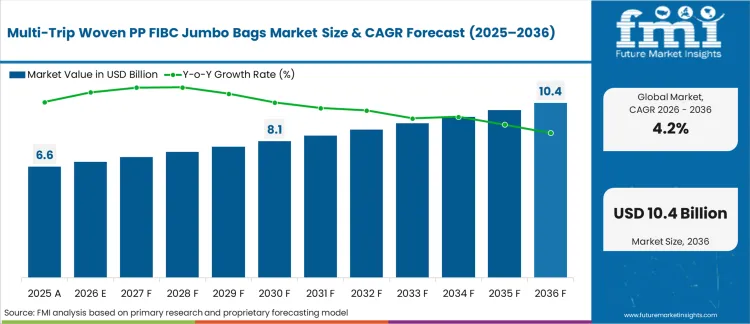
The definitive inflection point emerges when chemical exporters realize the lifecycle cost of reconditioning a 6:1 safety-factor container falls permanently below the escalating European plastic packaging taxes levied on single-use equivalents. Logistics directors must secure verified third-party depot decontamination contracts within the next procurement cycle before stringent cross-border extended producer responsibility audits disqualify their baseline packaging formats. This transition ultimately replaces linear purchasing habits with highly optimized, closed-loop asset pooling networks.
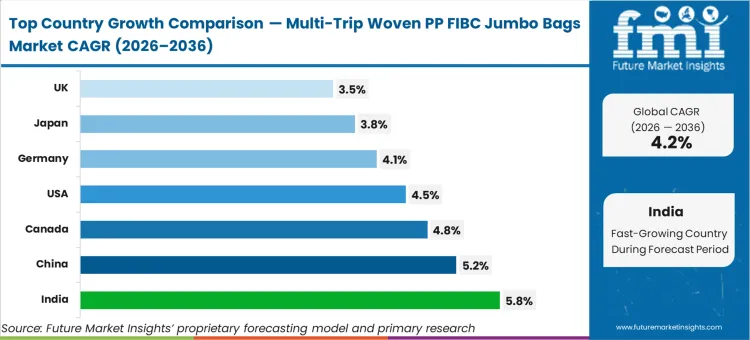
India advances at a 5.8% CAGR value across the forecast decade as export-focused agrochemical hubs bypass legacy single-trip models in favor of pooled assets. China tracks at a 5.2% trajectory anchored by its aggressive manufacturing modernization mandates. Canada expands at 4.8% supported by its robust mining and resource extraction sector. The United States follows at 4.5% as discrete manufacturers unify their logical supply chain topologies. Germany posts a 4.1% CAGR, while Japan records a 3.8% pace and the UK grows at 3.5%. The geographic distribution of this lifecycle migration reveals distinct adoption velocities tied directly to national extended producer responsibility policies.
Multi-Trip Woven PP FIBC Jumbo Bags Market Definition
Multi-trip woven PP FIBC jumbo bags represent heavy-duty flexible industrial containers engineered specifically for repeated use in the storage and transportation of dry flowable products. The core construction relies on high-tenacity polypropylene woven fabrics capable of withstanding rigorous physical stresses across multiple filling and discharge cycles. The defined scope includes bags certified with a 6:1 or higher safety factor.
Multi-Trip Woven PP FIBC Jumbo Bags Market Inclusions
The market scope includes heavy-duty bulk bags featuring reinforced lifting loops, integrated discharge spouts, and internal baffles designed for multi-trip lifecycles. Specialized industrial packaging formats equipped with polyethylene liners, anti-static grounding mechanisms, and document pouches fall within the boundaries. Products explicitly manufactured and tested to meet multi-use safety factors for non-hazardous and hazardous material containment are fully incorporated.
Multi-Trip Woven PP FIBC Jumbo Bags Market Exclusions
Single-trip bulk containers rated at a 5:1 safety factors are excluded. Standard rigid plastic intermediate bulk containers, steel drums, and corrugated octabins fall outside the defined parameters. Standard consumer-grade woven sacks designed for capacities under 100 kilograms are explicitly omitted from the valuation.
Multi-Trip Woven PP FIBC Jumbo Bags Market Research Methodology
- Primary Research: Analysts engaged with packaging procurement directors, third-party logistics operators, and resin extrusion facility managers to map the specific decision gates triggering multi-trip upgrades.
- Desk Research: The data collection phase aggregated compliance roadmaps from the UN Model Regulations, structural testing criteria from the Flexible Intermediate Bulk Container Association, and the baseline woven packaging framework.
- Market-Sizing and Forecasting: The baseline value derives from a bottom-up aggregation of high-safety-factor bag shipments, applying region-specific sustainability mandates to project the future adoption velocity.
- Data Validation and Update Cycle: Projections are rigorously tested against publicly reported capital expenditure guidance from leading polymer converters and industrial packaging conglomerates.
Segmental Analysis
Multi-Trip Woven PP FIBC Jumbo Bags Market Analysis by Product Type
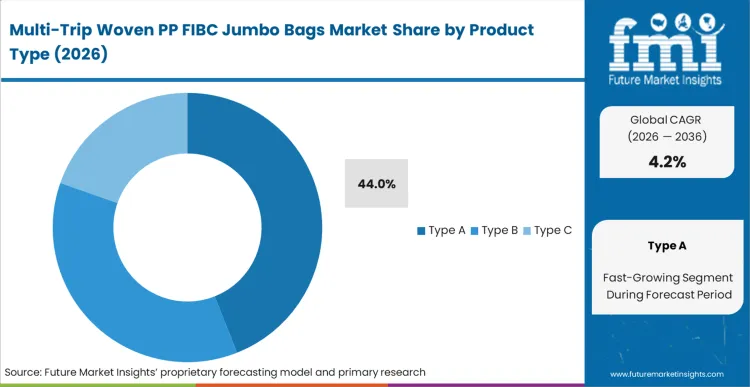
Extrusion vendors unable to supply certified high-durability Type A fabric risk immediate exclusion from the next wave of bulk agricultural tenders. Safety compliance officers mandating 6:1 tear resistance ratio eliminates catastrophic rupture events during heavy port handling. With standard dry goods comprising the vast majority of global bulk tonnage, logistics network operators execute massive procurement contracts for foundational multi-use formats. Type A commands a dominant 44.0% share in 2026, reflecting the absolute requirement for cost-effective physical containment before specialized electrostatic protection becomes necessary. Facility managers deploying these basic polypropylene packaging solutions establish the structural backbone for non-hazardous agricultural and mineral transit. This broad applicability eliminates the need for complex fleet segregation in general commodity networks. According to FMI's estimates, operators standardizing these foundational bags streamline their depot inventory and significantly reduce overall sorting overhead.
- Electrostatic Isolation: Highly specialized fabric weaving techniques integrate continuous conductive yarns, shifting the safety burden away from manual grounding clips during sensitive powder handling.
- Brush discharge Prevention: Engineered low-voltage breakdown coatings safely dissipate static accumulation without requiring complex facility ground linkages.
- Commodity Standardization: Relying on fundamental high-strength woven structures shrinks the unit cost for non-combustible agricultural transport in constrained logistics environments.
Multi-Trip Woven PP FIBC Jumbo Bags Market Analysis by Design Type
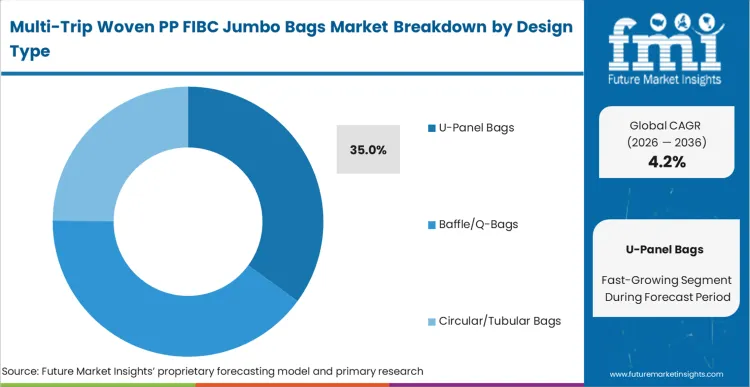
U-Panel Bags capture 35.0% share in 2026 as their superior weight-bearing architecture directly enables maximum payload capacity without sacrificing vertical stability. Plant automation leads must validate lifting loop stress distribution during site acceptance testing to authorize automated filling line integration. The structural integration of a single continuous fabric piece forming the bottom and opposite sides forces bag engineers to rethink traditional seam placement. FMI analysts optimizing this stress profile directly extend the viable trip lifecycle of the asset. Maintaining consistent geometric shapes under maximum load allows warehouse managers to stack product higher. Manufacturers deploy these rigid-form flexible containers to maximize shipping container utilization. Transport directors specifying these reinforced panels secure measurable freight savings through dense vehicle packing.
- Corner Stabilization: Internal fabric baffles receive guaranteed tension, preserving the exact cubic footprint required for standard pallet automation interfaces.
- Seam Reduction: Minimizing base stitching lines accelerates the extraction of residual material during high-pressure depot washing cycles.
- Tubular Weaving: Eliminating vertical seams entirely reduces the engineering hours previously required to test multiple stress points along the bag body.
Multi-Trip Woven PP FIBC Jumbo Bags Market Analysis by Capacity
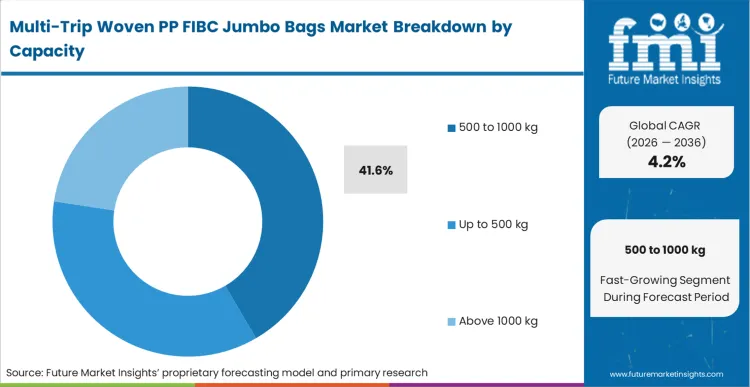
As per FMI's projection, continuous integration with automated bagging lines compensates for inherent manual labor shortages across connected port facilities. Standardizing this mid-tier volume allows depot operators to reconstruct exact storage grids across geographically distributed storage locations. Port authority directors executing bulk transfer operations to accelerate vessel loading sequences. The 500 to 1000 kg capacity segment captures 41.6% of the market share in 2026 by establishing a universal weight standard perfectly aligned with standard forklift operational limits. Warehouse architects utilizing this volume specification coordinate complex multi-tier racking layouts with unprecedented reliability. Precise alignment with standard chemical batch sizes enables advanced inventory control when formulation systems require exact input quantities. Facilities operating outside this foundational sizing envelope face systemic logistics delays as specialized handling equipment becomes necessary.
- Micro-Batch Scaling: Limited volume configurations ensure exact powder additions bypass standard weighing bottlenecks, delivering precise input control for high-value pharmaceutical precursors.
- Maximum Tonnage: Reinforced lifting architectures permit high-density mineral shipments to utilize full crane capabilities without risking structural fabric failure.
- Universal Alignment: Aligning filled dimensions with standard pallet geometry empowers facility owners to source automated guided vehicles without worrying about custom dimensional constraints.
Multi-Trip Woven PP FIBC Jumbo Bags Market Analysis by End Use
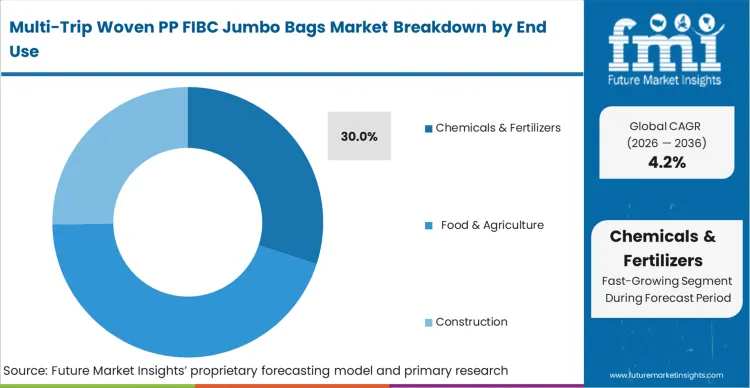
Chemicals & Fertilizers account for a leading 30.0% segment share in 2026, driven by the absolute necessity to protect highly reactive compounds from atmospheric degradation across extended marine transit. Process engineers operating continuous fertilizer blending facilities reject packaging designs introducing variable moisture ingress into the chemical matrix. Incorporating certified impermeable liners guarantees that high-value hygroscopic agricultural inputs arrive exactly in their intended physical state. Based on FMI's assessment, the convergence of strict dangerous goods transport regulations with core chemical packaging safety amplifies the demand for multi-trip UN-rated models. Suppliers failing to demonstrate seamless decontamination compatibility with established commercial washing solvents to lose priority status in critical infrastructure upgrade cycles. Agrochemical procurement leads to mandating these heavy-duty assets to eradicate moisture caking failures during final field applications.
- Hygienic Isolation: Cleanroom manufacturing protocols ensure food-grade liners bypass standard industrial weaving floors, delivering zero-contamination surfaces for consumable powder transport.
- Abrasive Resistance: Heavy denier fabric extrusion guarantees aggregate containment modules withstand severe frictional wear against concrete surfaces during active construction staging.
- Toxic Containment: Multi-layer barrier films execute complete vapor locks, preventing hazardous pharmaceutical dust from escaping into active warehouse breathing zones.
Multi-Trip Woven PP FIBC Jumbo Bags Market Drivers, Restraints, and Opportunities
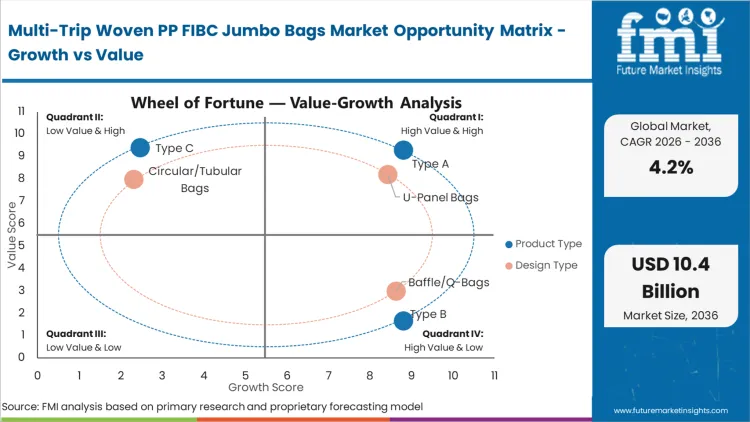
The transition toward circular economic policies forces corporate sustainability officers to extract maximum utility from heavy industrial plastics. This regulatory requirement renders single-use, low-durability packaging formats obsolete. Plant managers upgrading brownfield logistics networks face a strict binary choice between paying escalating plastic disposal taxes or overhauling their base procurement model. Transitioning to a unified multi-trip ecosystem simplifies inventory management and enables direct alignment with corporate zero-waste mandates. Exporters that fail to modernize their core agricultural packaging layers risk operational bottlenecks and reduced access to heavily regulated European destination ports.
The intricate tracking parameters required to monitor trip lifecycles create steep learning curves for traditional warehouse personnel. Executing conflict-free asset recovery across multi-national trade routes demands specialized reverse logistics expertise that most manufacturing facilities lack internally. To mitigate this skill gap, supply chain directors increasingly rely on third-party pool operators who automate the recovery process and validate bag integrity before returning them to the active filling queue.
Opportunities in the Multi-Trip Woven PP FIBC Jumbo Bags Market
- RFID-Enabled Tracing: Next-generation smart labels enable pool operators to run automated scan-in events directly on the receiving dock. This capability eliminates manual tally sheets and drastically simplifies individual unit lifecycle tracking.
- Food-Grade Circularity: Upgraded thermal decontamination permits quality assurance teams to deploy food-grade FIBC units across multiple high-hygiene trips without risking cross-contamination. This capability prevents massive virgin plastic consumption in the food ingredient sector.
- Automated Inspection Rigging: Depot engineers integrating AI vision systems require high-resolution imagery to detect micro-tears. Robotic inspection provides the micro-millimeter accuracy necessary to balance safety compliance with rapid depot turnaround times.
Regional Analysis
Based on the regional analysis, the Multi-Trip Woven PP FIBC Jumbo Bags market is segmented into North America, Latin America, Europe, East Asia, South Asia, Oceania, and Middle East & Africa across 40 plus countries.
.webp "Top Country Growth Comparison Multi Trip Woven Pp Fibc Jumbo Bags Market Cagr (2026 2036)")
| Country | CAGR (2026 to 2036) |
|---|---|
| India | 5.8% |
| China | 5.2% |
| Canada | 4.8% |
| USA | 4.5% |
| Germany | 4.1% |
| Japan | 3.8% |
| UK | 3.5% |
Source: Future Market Insights (FMI) analysis, based on proprietary forecasting model and primary research
Asia Pacific Multi-Trip Woven PP FIBC Jumbo Bags Market Analysis
FMI's analysis indicates that this proactive approach eliminates the costly and time-consuming landfill management phase that plagues older industrial centers. By building reverse-logistics capabilities into the foundation, regional shippers establish highly resilient transport environments capable of navigating volatile plastic pricing. Export operations directors constructing new high-volume chemical and pharmaceutical facilities specify unified reusable industrial packaging in their initial logistics of blueprints. Aggressive manufacturing expansion across the Asia Pacific region accelerates the bypass of legacy single-use packaging constraints.
- India: Anchoring a 5.8% CAGR value through to 2036, the national push toward higher value chemical processing triggers a wave of logistics upgrades prioritizing durable, multi-trip infrastructure. India's export-driven specialty chemical sector operates under stringent international buyer mandates requiring verifiable carbon footprint reductions for all inbound raw materials. Extrusion facility owners failing to provide bags with built-in UV resistance and 6:1 safety factor face disqualification from major chemical handling tenders. Plant safety engineers must deploy high-strength anti-static FIBC configurations capable of surviving the rigorous marine transit to European and North American ports.
- China: Transport network planners mandate tear-resistant architectures to ensure heavy bulk solids survive multi-modal transfers without localized material loss. High-volume mineral processors in China navigate massive internal distance challenges requiring robust transport assets. Advancing at a 5.2% rate across the forecast decade, China sees discrete manufacturers unify their bulk distribution models. Polymer weaving vendors lacking verified UN certified FIBC capabilities forfeit access to the next generation of government-backed hazardous material transport contracts. The sheer scale of domestic agricultural and chemical movement necessitates continuous investment in high-durability woven backbones to maximize transport yield rates.
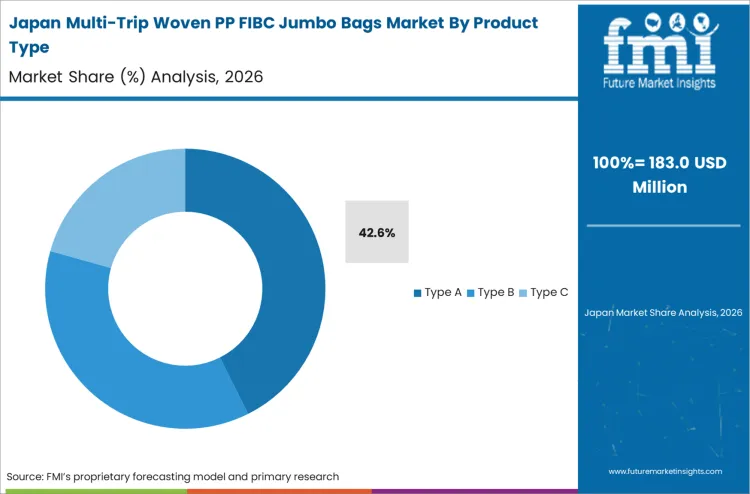
- Japan: Logistics service operators targeting domestic food processors must guarantee absolute microbial clearance prior to the finalization of service procurement budgets. Japan's highly automated food ingredient supply chain dictates stringent validation criteria for hygienic container reuse. The domestic rigid focus on contamination prevention creates a recurring compliance cycle that accelerates demand for easily cleanable inner-lined configurations. Quality assurance engineers must demonstrate flawless execution of sterilization protocols before receiving authorization to reintroduce a bag into the active food matrix. This systemic qualification pressure drives Japan's 3.8% CAGR for certified reusable bulk bags.
FMI's report includes extensive coverage of the broader Asia Pacific bulk logistics landscape. It incorporates detailed analysis of Vietnam, Thailand, Australia, and the wider ASEAN trading bloc. A primary trend shaping these nations is the rapid localization of polymer weaving capacity, forcing domestic producers to adopt advanced multi-trip testing standards to satisfy stringent global buyer traceability requirements.
North America Multi-Trip Woven PP FIBC Jumbo Bags Market Analysis
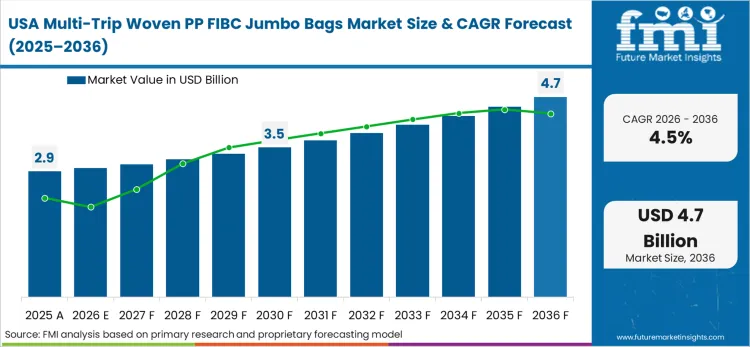
Implementing a standardized, multi-trip container pool enables facilities to deploy advanced batch tracking algorithms without compromising physical handling stability. In FMI's view, the agricultural and chemical processing sectors actively drive this consolidation to secure their material handling economics against volatile virgin resin pricing. Industrial sustainability mandates across North America target the systematic eradication of single-use operational waste streams. Supply chain directors leading corporate environmental overhauls face strict directives to unify disparate bulk packaging systems under a single manageable reusable architecture.
- USA: Tracking at a 4.5% CAGR trajectory to 2036, the United States market grows as agricultural cooperatives unify their returnable asset networks. Terminal specification leads replacing aging rigid containers must deploy flexible architectures capable of supporting both maximum payload density and rapid collapse for empty return legs. Hardware vendors lacking documented compliance with rigorous FIBCA structural standards face immediate exclusion from massive national agribusiness modernization contracts. The United States agricultural processing sector enforces strict handling efficiency mandates across its entire multi-state distribution ecosystem. Corporate zero-waste modernization initiatives actively fund the replacement of vulnerable single-use sacks with standardized, heavy-duty jumbo bags.
- Canada: The concentration of remote extraction sites necessitates continuous investment in ultra-durable containment to prevent catastrophic spillage in pristine environments. Mining operations in Canada operate to tear-resistance tolerances that exceed standard industrial packaging specifications by orders of magnitude. Canada's multi-trip bag demand is rising at a 4.8% CAGR as this zero-tolerance standard becomes the universal procurement baseline. Container suppliers targeting the next mining expansion cycle must prove sub-zero impact resistance before entering the approved vendor list. Extractive industry logistics leads to mandate multi-layer baffle bags to ensure heavy mineral concentrates perform flawlessly during severe cold-weather multi-modal transfers.
FMI's report includes comprehensive evaluation of the North American industrial bulk packaging sector. It features specific analysis of the Mexican cross-border logistics market. A defining dynamic in this region involves the integration of cross-border automotive and chemical supply chains, which requires standardized multi-trip container protocols to coordinate just-in-time powder delivery sequences.
Europe Multi-Trip Woven PP FIBC Jumbo Bags Market Analysis
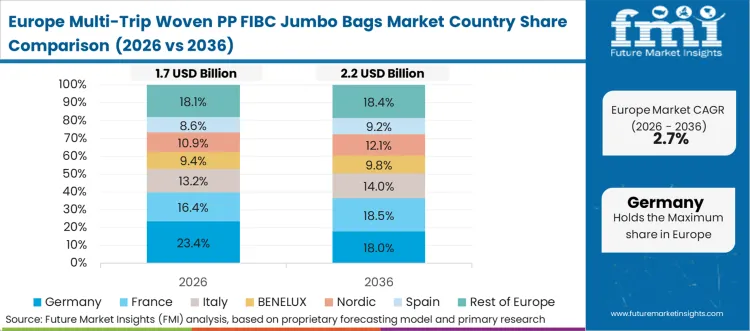
Upgrading the core bulk transport infrastructure provides the necessary physical durability to support advanced circular manufacturing practices. This dual-purpose network requirement forces the rapid adoption of RFID-embedded smart bags to guarantee a chain of custody while transmitting heavy diagnostic lifecycle payloads. European environmental policy actively penalizes the continued operation of highly consumptive, linear packaging models. The transition requires a complete overhaul of existing procurement topologies, shifting from constant virgin bag purchasing to service-oriented pooling architectures. Sustainability architects redesigning legacy distribution lines must integrate continuous asset tracking data alongside critical chemical transport requirements.
- Germany: Chemical plant managers must demonstrate flawless execution of static dissipation protocols before receiving authorization to utilize a container for volatile powder loading. Asset pool suppliers lacking verified automated testing records to forfeit access to the next generation of full-line chemical distribution contracts. Germany's advanced chemical manufacturing complex operates under rigorous functional safety certifications that mandate unified hazardous transport layers. The national push toward aggressive plastic recycling targets creates a recurring compliance cycle that accelerates the adoption of circular FIBC frameworks. This systemic qualification pressure as a result, sustains a 4.1% CAGR for precision-engineered multi-trip bags in Germany's chemical corridor.
- UK: Positioned at a 3.5% CAGR, the UK market expands as feed providers systematically upgrade their operational logistics during a critical agricultural transition. Mill network planners deploying advanced automated filling systems mandate breathable architectures capable of sub-millimeter ventilated FIBC performance across distributed geographic farms. Weaving contractors unable to demonstrate absolute seam integrity under severe load conditions forfeit qualification for national feed mill expansion projects. The shift toward traceable animal nutrition forces feed operators to abandon legacy single-use sacks in favor of highly resilient, trackable woven networks. The United Kingdom's agricultural feed modernization programs require precise nutritional batch segregation to balance increasingly volatile grain supply chains.
FMI's report includes thorough investigation of the European industrial packaging framework. The analysis encompasses Italy, France, Spain, the Nordics, and the Benelux region. A prevailing structural condition across these nations is the mandatory compliance with strict plastic packaging tax directives, forcing asset owners to specify highly durable multi-trip networks that can reliably transport goods while amortizing the tax burden across numerous operational cycles.
Competitive Aligners for Market Players
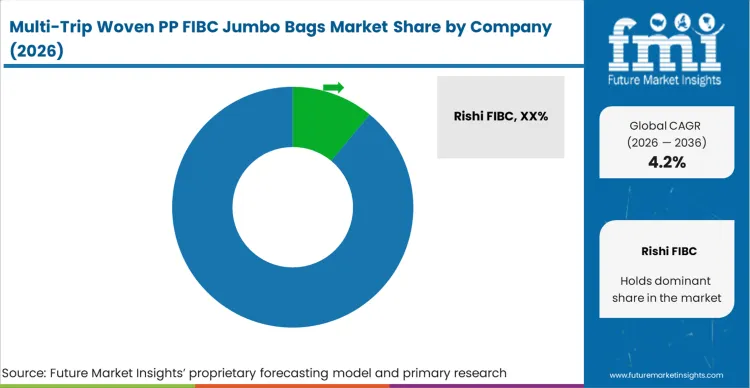
The multi-trip woven PP FIBC jumbo bags market operates as a moderately consolidated ecosystem where the sheer capital requirements for automated depot networks create formidable barriers to entry. This structure exists because transitioning from single-use extrusion to full-lifecycle asset management demands deep certification capabilities and a massive installed base of standardized tracking infrastructure. Global heavyweights such as Greif Inc., Berry Global, and LC Packaging leverage their established international footprints to dominate Tier-1 chemical and agricultural supply contracts. For industrial buyers navigating complex extended producer responsibility mandates, the primary competitive variable is no longer the per-unit cost of the bag, but the supplier's proven ability to execute localized, certified reconditioning and decontamination services. Vendors are unable to provide verifiable chain-of-custody tracking alongside their physical woven products to find themselves structurally locked out of major corporate procurement cycles.
Dominant players secure their market positions through specialized material science and integrated recycling architectures that smaller regional extruders simply cannot replicate. Companies like Packem Umasree and Rishi FIBC maintain a structural advantage by embedding closed-loop, recycled PET capabilities directly into their high-tenacity weaving processes, fulfilling strict European sustainability thresholds before the product even leaves the facility. Similarly, Bulk Corp International and Global-Pak differentiate themselves by engineering proprietary solvent-based purification networks that guarantee absolute hygienic safety for consecutive multi-trip lifecycles. This specialized capability ensures heavy-duty reusable industrial packaging assets survive rigorous industrial washing without catastrophic loss of load-bearing strength. For challengers attempting to penetrate this tier, the requirement to build overlapping physical washing depots and digital tracing software creates an immense capital barrier, effectively forcing them to either partner with established asset poolers or remain confined to low-margin, single-trip commodity sectors.
Despite the concentrated power of integrated lifecycle providers, sophisticated procurement directors actively deploy multi-vendor qualification frameworks to prevent catastrophic operational lock-in. By mandating open RFID tracking standards and conducting in-house structural integrity testing, large agricultural and chemical conglomerates force competing container suppliers to ensure seamless interoperability across shared depot infrastructure. This behavior structurally limits vendor pricing power, as facility managers can seamlessly shift their reusable asset volume between qualified suppliers without fundamentally altering their internal warehouse automation grids.
Key Players in Multi-Trip Woven PP FIBC Jumbo Bags Market
- Rishi FIBC
- Packem Umasree
- Bulk Corp International
- Global-Pak
- Berry Global
- Greif Inc.
- LC Packaging
Scope of the Report
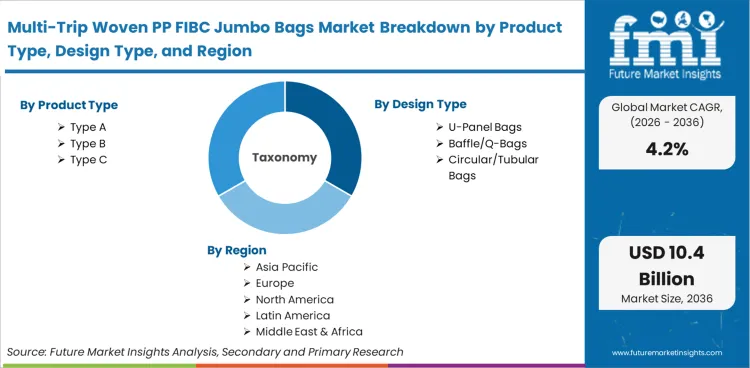
| Metric | Value |
|---|---|
| Quantitative Units | USD 6.9 billion to USD 10.4 billion, at a CAGR of 4.2% |
| Market Definition | Multi-trip woven PP FIBC jumbo bags represent heavy-duty flexible industrial containers engineered specifically for repeated use in the storage and transportation of dry flowable products, utilizing high-tenacity polypropylene woven fabrics capable of withstanding rigorous physical stresses. |
| Product Type Segmentation | Type A, Type B, Type C, Type D |
| Design Type Segmentation | U-Panel Bags, Baffle/Q-Bags, Circular/Tubular Bags, Four Side Panel Bags |
| Capacity Segmentation | Up to 500 kg, 500 to 1000 kg, Above 1000 kg |
| End Use Segmentation | Chemicals & Fertilizers, Food & Agriculture, Construction, Pharmaceuticals |
| Regions Covered | North America, Latin America, Europe, East Asia, South Asia, Oceania, Middle East & Africa |
| Countries Covered | India, China, Canada, USA, Germany, Japan, UK, and 40 plus countries |
| Key Companies Profiled | Rishi FIBC, Packem Umasree, Bulk Corp International, Global-Pak, Berry Global, Greif Inc., LC Packaging |
| Forecast Period | 2026 to 2036 |
| Approach | The baseline value derives from a bottom-up aggregation of high-safety-factor bag shipments, applying region-specific sustainability mandates to project the future adoption velocity. Segment forecasts undergo cross-validation against quarterly polypropylene resin consumption volumes. |
Source: Future Market Insights (FMI) analysis, based on proprietary forecasting model and primary research
Multi-Trip Woven PP FIBC Jumbo Bags Market by Segments
Product Type:
- Type A
- Type B
- Type C
- Type D
Design Type:
- U-Panel Bags
- Baffle/Q-Bags
- Circular/Tubular Bags
- Four Side Panel Bags
Capacity:
- Up to 500 kg
- 500 to 1000 kg
- Above 1000 kg
End Use:
- Chemicals & Fertilizers
- Food & Agriculture
- Construction
- Pharmaceuticals
Regions:
- North America
- USA
- Canada
- Mexico
- Latin America
- Brazil
- Argentina
- Rest of Latin America
- Europe
- Germany
- UK
- France
- Italy
- Spain
- Rest of Europe
- East Asia
- China
- Japan
- South Korea
- South Asia
- India
- Thailand
- Vietnam
- Rest of South Asia
- Oceania
- Australia
- New Zealand
- Middle East & Africa
- GCC
- South Africa
- Rest of Middle East & Africa
Bibliography
- Flexible Intermediate Bulk Container Association. (2025, February). Safe handling guidelines for multi-trip industrial containers. FIBCA Publications.
- United Nations Economic Commission for Europe. (2025, May). UN recommendations on the transport of dangerous goods: Model regulations. UNECE.
- International Organization for Standardization. (2024, November). ISO 21898: Packaging - Flexible intermediate bulk containers for non-dangerous goods. ISO Standards.
- USA Environmental Protection Agency. (2024, August). National recycling strategy and circular economy framework for industrial packaging. EPA.
- European Commission. (2025, January). Packaging and packaging waste directive revisions for heavy industrial transit. EU Publications.
- Ministry of Environment, Forest and Climate Change (India). (2025, April). Extended producer responsibility guidelines for industrial plastic packaging. Government of India.
This bibliography is provided for reader reference. The full FMI report contains the complete reference list with primary research documentation.
This Report Addresses
- Market sizing for the organized multi‑trip woven PP FIBC jumbo bags sector, enabling strategic decision‑making across global industrial bulk‑packaging ecosystems
- Forecast estimation and 10‑year demand outlook for certified 6:1 safety‑factor FIBC containers from 2026 to 2036, supported by compliance‑aligned lifecycle validation and industry interviews
- Growth opportunity mapping across Product Types (Type A, B, C, D) with emphasis on safety performance, electrostatic protection, and high‑tenacity polypropylene engineering
- Segment and regional adoption forecasts covering U‑Panel Bags, Baffle/Q‑Bags, and related design architectures across chemical, agricultural, construction, and pharmaceutical supply chains
- Competitive strategy assessment including reverse‑logistics efficiency, reconditioning infrastructure depth, traceability capabilities, and multi‑trip asset‑pooling service differentiation
- Technology and lifecycle‑management advancements including RFID‑enabled tracking, automated inspection systems, and high‑durability fabric enhancements that support multi‑cycle reuse
- Market access and operational integration analysis covering export‑driven procurement programs, regulatory compliance frameworks, sustainability mandates, and cross‑sector industrial logistics networks
- Delivery of market insights in PDF, Excel, PPT, and dashboard formats for executive planning, procurement strategy, and operational benchmarking requirements.
Frequently Asked Questions
How large is the Multi-Trip Woven PP FIBC Jumbo Bags Market in 2026?
The market is valued at USD 6.9 billion in 2026. This massive scale reflects the immediate requirement for high-durability transit assets as corporate zero-waste mandates force the retirement of single-use bulk formats.
What will the Multi-Trip Woven PP FIBC Jumbo Bags Market be valued at by 2036?
The valuation is projected to reach USD 10.4 billion by 2036. This expansion is structurally driven by the integration of digital tracking and specialized automated depot networks that validate asset safety for highly regulated chemical transport.
What CAGR is projected for Multi-Trip Woven PP FIBC Jumbo Bags Market from 2026 to 2036?
The market will expand at a 4.2% CAGR across the forecast period. Strict enforcement of extended producer responsibility taxes continuously forces industrial shippers to upgrade to formal, multi-trip container pools.
Which Product Type leads the Multi-Trip Woven PP FIBC Jumbo Bags Market?
Type A secures a 44.0% share in 2026. This dominance stems from the massive global baseline requirement for cost-effective structural containment in non-combustible agricultural and mineral logistics networks.
Which Design Type dominates the Multi-Trip Woven PP FIBC Jumbo Bags Market?
U-Panel Bags lead the design category with a 35.0% share in 2026. Their continuous fabric base minimizes load-bearing seam failure, ensuring bags survive the repeated high-stress lifting required in multi-trip lifecycles.
Which Capacity segment drives the most volume?
The 500 to 1000 kg capacity range holds a 41.6% share in 2026. Aligning perfectly with standard forklift limitations and automated racking grids ensures maximum operational efficiency inside modernized warehouses.
Which End Use application holds the highest share?
Chemicals & Fertilizers captures a 30.0% share in 2026. The absolute necessity to prevent moisture degradation and guarantee hazardous material containment forces this sector to aggressively procure certified multi-trip UN bags.
Which region leads the Multi-Trip Woven PP FIBC Jumbo Bags Market?
Asia Pacific establishes overwhelming dominance in this space. The massive concentration of export-focused polymer extrusion facilities and chemical processors creates unparalleled demand for durable global shipping assets.
What forces chemical shippers to abandon single-use jumbo bags?
Volatile virgin resin pricing and incoming plastic disposal penalties make single-use models financially unsustainable. Transitioning to leased, multi-trip containers stabilizes packaging budgets while satisfying corporate sustainability directives.
What creates the primary operational bottleneck for multi-trip adoption?
The lack of standardized, high-speed reverse logistics networks prevents rapid bag turnaround. Exporters struggle to orchestrate the retrieval, decontamination, and safety recertification of bags across complex multi-national supply chains.
How does India achieve its 5.8% compound growth?
Export-driven specialty chemical manufacturers in India must meet the strict carbon footprint mandates set by European buyers. This compliance pressure forces domestic facilities to integrate formal multi-trip bag networks to secure long-term supply contracts.
Why does China track at a 5.2% expansion rate?
Heavy domestic mineral processing requires transport assets capable of surviving severe multi-modal transfers across vast internal distances. The government's push for industrial modernization accelerates the deployment of highly durable woven backbones.
What policy framework has accelerated Europe's circular bag adoption?
Aggressive packaging and packaging waste directives financially penalize linear plastic consumption. This regulatory pressure forces chemical plant managers to deploy traceable, reusable assets to amortize compliance costs over numerous trips.
How does the United States market structure differ from Canada's approach?
The USA at a 4.5% CAGR relies on agribusiness cooperatives unifying logistics networks to maximize freight density, whereas Canada at a 4.8% CAGR focuses almost entirely on extreme-duty applications within remote mineral extraction zones.
Why do U-Panel structures outcompete traditional circular designs?
U-Panel bags offer superior shape retention and stackability under maximum payload weight. Maintaining a rigid square footprint allows logistics directors to completely fill standard marine shipping containers without wasted dead space.
What is the function of Type C and Type D bags in this ecosystem?
These specialized configurations dissipate electrostatic charge buildup during the rapid discharge of fine powders. They prevent catastrophic dust ignitions in volatile chemical and pharmaceutical manufacturing environments.
How is RFID technology altering the bulk bag competitive landscape?
Embedding digital tracking chips transforms passive plastic containers into trackable logistics assets. Pool operators utilize this data to prove chain-of-custody and automate safety inspection schedules, creating a powerful service differentiator.
What specifically defines a multi-trip FIBC versus a standard bag?
Multi-trip bags must be constructed and certified to a 6:1 safety factor, meaning they can withstand their rated working load six times. This structural over-engineering ensures they survive repeated mechanical handling and depot washing.
What prevents facility managers from reusing standard 5:1 bags?
International transport regulations and workplace safety standards strictly prohibit the reuse of single-trip (5:1) containers. Attempting to reload these bags risks catastrophic rupture, facility shutdowns, and massive liability during hazardous transport.
What does the Multi-Trip Woven PP FIBC Jumbo Bags Market encompass?
The market scope covers heavy-duty, reusable woven polypropylene containers, specifically designed and certified with 6:1 safety factors for the multi-cycle transport of dry bulk industrial materials.
What bulk packaging formats are excluded from this analysis?
Standard single-trip FIBCs, rigid plastic intermediate bulk containers, metal drums, corrugated octabins, and consumer-grade woven sacks under 100 kilograms are entirely excluded.
How did FMI analysts build the forecast for this market?
The projection relies on a bottom-up model aggregating high-safety-factor bag shipments, cross-referenced against the compliance timelines of major chemical exporters and quarterly polypropylene resin consumption for technical textiles.
What is the strategic takeaway for extrusion facility owners?
Incumbent manufacturers must pivot from selling commodity bags to providing integrated lifecycle services. Developing localized reconditioning depots and automated testing capabilities is essential to secure Tier-1 corporate supply contracts.
Preview the report firsthand - request a free sample
Get SampleGet the brochure for pricing and purchase details.
Get PDFTable of Content
- Key Takeaways
- Market Size and CAGR
- Top Growth Driver
- Fastest Growing Segment
- Leading Region
- Key Companies
- Emerging Opportunities
- Executive Summary
- Global Market Outlook
- Demand-side Trends
- Supply-side Trends
- Technology Roadmap Analysis
- Analysis and Recommendations
- Analyst Perspective (What is happening? Why now? What should investors know?)
- Key Questions Answered
- How large is the market?
- What is the CAGR?
- What are key trends?
- Which region dominates?
- Who are the leaders?
- Market Overview
- Market Coverage / Taxonomy
- Market Definition / Scope / Limitations
- Research Methodology
- Chapter Orientation
- Analytical Lens and Working Hypotheses
- Market Structure, Signals, and Trend Drivers
- Benchmarking and Cross-market Comparability
- Market Sizing, Forecasting, and Opportunity Mapping
- Research Design and Evidence Framework
- Desk Research Programme (Secondary Evidence)
- Expert Input and Fieldwork (Primary Evidence)
- Tooling, Models, and Reference Databases
- Data Engineering and Model Build
- Quality Assurance and Audit Trail
- Market Background
- Market Dynamics (Drivers, Restraints, Opportunity, Trends)
- Scenario Forecast (Optimistic, Likely, Conservative)
- Impact Analysis
- AI Impact
- Sustainability Impact
- Regulatory Impact
- Technology Impact
- Consumer / Buyer Analysis
- Purchase Drivers
- Adoption Barriers
- Buyer Journey
- Opportunity Map Analysis
- Product Life Cycle Analysis
- Supply Chain Analysis
- Investment Feasibility Matrix
- Value Chain Analysis
- PESTLE and Porter's Analysis
- Regulatory Landscape
- Regional Parent Market Outlook
- Production and Consumption Statistics
- Import and Export Statistics
- Global Market Analysis and Forecast, 2021 to 2036
- Historical Market Size Value (USD Billion) Analysis, 2021 to 2025
- Current and Future Market Size Value (USD Billion) Projections, 2026 to 2036
- Y-o-Y Growth Trend Analysis
- Absolute $ Opportunity Analysis
- Global Market Pricing Analysis, 2021 to 2036
- Global Market Analysis and Forecast, By Product Type, 2021 to 2036
- Introduction / Key Findings
- Historical Market Size Value (USD Billion) Analysis By Product Type, 2021 to 2025
- Current and Future Market Size Value (USD Billion) Analysis and Forecast By Product Type, 2026 to 2036
- Type A
- Type B
- Type C
- Type D
- Type A
- Y-o-Y Growth Trend Analysis By Product Type, 2021 to 2025
- Absolute $ Opportunity Analysis By Product Type, 2026 to 2036
- Global Market Analysis and Forecast, By Design Type, 2021 to 2036
- Introduction / Key Findings
- Historical Market Size Value (USD Billion) Analysis By Design Type, 2021 to 2025
- Current and Future Market Size Value (USD Billion) Analysis and Forecast By Design Type, 2026 to 2036
- U-Panel Bags
- Baffle/Q-Bags
- Circular/Tubular Bags
- Four Side Panel Bags
- U-Panel Bags
- Y-o-Y Growth Trend Analysis By Design Type, 2021 to 2025
- Absolute $ Opportunity Analysis By Design Type, 2026 to 2036
- Global Market Analysis and Forecast, By Capacity, 2021 to 2036
- Introduction / Key Findings
- Historical Market Size Value (USD Billion) Analysis By Capacity, 2021 to 2025
- Current and Future Market Size Value (USD Billion) Analysis and Forecast By Capacity, 2026 to 2036
- 500 to 1000 kg
- Up to 500 kg
- Above 1000 kg
- 500 to 1000 kg
- Y-o-Y Growth Trend Analysis By Capacity, 2021 to 2025
- Absolute $ Opportunity Analysis By Capacity, 2026 to 2036
- Global Market Analysis and Forecast, By End Use, 2021 to 2036
- Introduction / Key Findings
- Historical Market Size Value (USD Billion) Analysis By End Use, 2021 to 2025
- Current and Future Market Size Value (USD Billion) Analysis and Forecast By End Use, 2026 to 2036
- Chemicals & Fertilizers
- Food & Agriculture
- Construction
- Pharmaceuticals
- Chemicals & Fertilizers
- Y-o-Y Growth Trend Analysis By End Use, 2021 to 2025
- Absolute $ Opportunity Analysis By End Use, 2026 to 2036
- Global Market Analysis and Forecast, By Region, 2021 to 2036
- Introduction
- Historical Market Size Value (USD Billion) Analysis By Region, 2021 to 2025
- Current Market Size Value (USD Billion) Analysis and Forecast By Region, 2026 to 2036
- North America
- Latin America
- Western Europe
- Eastern Europe
- East Asia
- South Asia and Pacific
- Middle East & Africa
- Market Attractiveness Analysis By Region
- North America Market Analysis and Forecast, By Country, 2021 to 2036
- Historical Market Size Value (USD Billion) Trend Analysis By Market Taxonomy, 2021 to 2025
- Market Size Value (USD Billion) Forecast By Market Taxonomy, 2026 to 2036
- By Country
- USA
- Canada
- By Product Type
- By Design Type
- By Capacity
- By End Use
- By Country
- Market Attractiveness Analysis
- By Country
- By Product Type
- By Design Type
- By Capacity
- By End Use
- Key Takeaways
- Latin America Market Analysis and Forecast, By Country
- Historical Market Size Value (USD Billion) Trend Analysis By Market Taxonomy, 2021 to 2025
- Market Size Value (USD Billion) Forecast By Market Taxonomy, 2026 to 2036
- By Country
- Brazil
- Mexico
- Chile
- Rest of Latin America
- By Product Type
- By Design Type
- By Capacity
- By End Use
- By Country
- Market Attractiveness Analysis
- By Country
- By Product Type
- By Design Type
- By Capacity
- By End Use
- Key Takeaways
- Western Europe Market Analysis and Forecast, By Country
- Historical Market Size Value (USD Billion) Trend Analysis By Market Taxonomy, 2021 to 2025
- Market Size Value (USD Billion) Forecast By Market Taxonomy, 2026 to 2036
- By Country
- Germany
- UK
- Italy
- Spain
- France
- Nordic
- BENELUX
- Rest of Western Europe
- By Product Type
- By Design Type
- By Capacity
- By End Use
- By Country
- Market Attractiveness Analysis
- By Country
- By Product Type
- By Design Type
- By Capacity
- By End Use
- Key Takeaways
- Eastern Europe Market Analysis and Forecast, By Country
- Historical Market Size Value (USD Billion) Trend Analysis By Market Taxonomy, 2021 to 2025
- Market Size Value (USD Billion) Forecast By Market Taxonomy, 2026 to 2036
- By Country
- Russia
- Poland
- Hungary
- Balkan & Baltic
- Rest of Eastern Europe
- By Product Type
- By Design Type
- By Capacity
- By End Use
- By Country
- Market Attractiveness Analysis
- By Country
- By Product Type
- By Design Type
- By Capacity
- By End Use
- Key Takeaways
- East Asia Market Analysis and Forecast, By Country
- Historical Market Size Value (USD Billion) Trend Analysis By Market Taxonomy, 2021 to 2025
- Market Size Value (USD Billion) Forecast By Market Taxonomy, 2026 to 2036
- By Country
- China
- Japan
- South Korea
- By Product Type
- By Design Type
- By Capacity
- By End Use
- By Country
- Market Attractiveness Analysis
- By Country
- By Product Type
- By Design Type
- By Capacity
- By End Use
- Key Takeaways
- South Asia and Pacific Market Analysis and Forecast, By Country
- Historical Market Size Value (USD Billion) Trend Analysis By Market Taxonomy, 2021 to 2025
- Market Size Value (USD Billion) Forecast By Market Taxonomy, 2026 to 2036
- By Country
- India
- ASEAN
- Australia & New Zealand
- Rest of South Asia and Pacific
- By Product Type
- By Design Type
- By Capacity
- By End Use
- By Country
- Market Attractiveness Analysis
- By Country
- By Product Type
- By Design Type
- By Capacity
- By End Use
- Key Takeaways
- Middle East & Africa Market Analysis and Forecast, By Country
- Historical Market Size Value (USD Billion) Trend Analysis By Market Taxonomy, 2021 to 2025
- Market Size Value (USD Billion) Forecast By Market Taxonomy, 2026 to 2036
- By Country
- Kingdom of Saudi Arabia
- Other GCC Countries
- Türkiye
- South Africa
- Other African Union
- Rest of Middle East & Africa
- By Product Type
- By Design Type
- By Capacity
- By End Use
- By Country
- Market Attractiveness Analysis
- By Country
- By Product Type
- By Design Type
- By Capacity
- By End Use
- Key Takeaways
- Key Countries Market Analysis
- USA
- Pricing Analysis
- Market Share Analysis, 2025
- By Product Type
- By Design Type
- By Capacity
- By End Use
- Canada
- Pricing Analysis
- Market Share Analysis, 2025
- By Product Type
- By Design Type
- By Capacity
- By End Use
- Mexico
- Pricing Analysis
- Market Share Analysis, 2025
- By Product Type
- By Design Type
- By Capacity
- By End Use
- Brazil
- Pricing Analysis
- Market Share Analysis, 2025
- By Product Type
- By Design Type
- By Capacity
- By End Use
- Chile
- Pricing Analysis
- Market Share Analysis, 2025
- By Product Type
- By Design Type
- By Capacity
- By End Use
- Germany
- Pricing Analysis
- Market Share Analysis, 2025
- By Product Type
- By Design Type
- By Capacity
- By End Use
- UK
- Pricing Analysis
- Market Share Analysis, 2025
- By Product Type
- By Design Type
- By Capacity
- By End Use
- Italy
- Pricing Analysis
- Market Share Analysis, 2025
- By Product Type
- By Design Type
- By Capacity
- By End Use
- Spain
- Pricing Analysis
- Market Share Analysis, 2025
- By Product Type
- By Design Type
- By Capacity
- By End Use
- France
- Pricing Analysis
- Market Share Analysis, 2025
- By Product Type
- By Design Type
- By Capacity
- By End Use
- India
- Pricing Analysis
- Market Share Analysis, 2025
- By Product Type
- By Design Type
- By Capacity
- By End Use
- ASEAN
- Pricing Analysis
- Market Share Analysis, 2025
- By Product Type
- By Design Type
- By Capacity
- By End Use
- Australia & New Zealand
- Pricing Analysis
- Market Share Analysis, 2025
- By Product Type
- By Design Type
- By Capacity
- By End Use
- China
- Pricing Analysis
- Market Share Analysis, 2025
- By Product Type
- By Design Type
- By Capacity
- By End Use
- Japan
- Pricing Analysis
- Market Share Analysis, 2025
- By Product Type
- By Design Type
- By Capacity
- By End Use
- South Korea
- Pricing Analysis
- Market Share Analysis, 2025
- By Product Type
- By Design Type
- By Capacity
- By End Use
- Russia
- Pricing Analysis
- Market Share Analysis, 2025
- By Product Type
- By Design Type
- By Capacity
- By End Use
- Poland
- Pricing Analysis
- Market Share Analysis, 2025
- By Product Type
- By Design Type
- By Capacity
- By End Use
- Hungary
- Pricing Analysis
- Market Share Analysis, 2025
- By Product Type
- By Design Type
- By Capacity
- By End Use
- Kingdom of Saudi Arabia
- Pricing Analysis
- Market Share Analysis, 2025
- By Product Type
- By Design Type
- By Capacity
- By End Use
- Türkiye
- Pricing Analysis
- Market Share Analysis, 2025
- By Product Type
- By Design Type
- By Capacity
- By End Use
- South Africa
- Pricing Analysis
- Market Share Analysis, 2025
- By Product Type
- By Design Type
- By Capacity
- By End Use
- USA
- Market Structure Analysis
- Competition Dashboard
- Competition Benchmarking
- Market Share Analysis of Top Players
- By Regional
- By Product Type
- By Design Type
- By Capacity
- By End Use
- Emerging Startups
- Innovation Benchmarking
- Competition Analysis
- Competition Deep Dive
- Berry Global
- Overview
- Product Portfolio
- Profitability by Market Segments
- Sales Footprint
- Strategy Overview
- Marketing Strategy
- Product Strategy
- Channel Strategy
- Greif Inc.
- LC Packaging
- Rishi FIBC
- Packem Umasree
- Bulk Corp International
- Global-Pak
- Berry Global
- Case Studies
- Success Stories
- Recent Developments
- Competition Deep Dive
- Assumptions & Acronyms Used


