

- Industry Size (2026)
- USD 198 Mn
- Forecast (2036)
- USD 518.2 Mn
- CAGR (2026 to 2036)
- 10.1%
Non-Staining Sealants for Natural Stone and Luxury Surfaces Market Forecast and Outlook 2026 to 2036
The non-staining sealants for natural stone and luxury surfaces market is valued at USD 198 million in 2026 and is projected to reach USD 518.2 million by 2036, reflecting a CAGR of 10.1%. Growth over this period is driven by surface preservation requirements, aesthetic risk management, and installation accountability in high value projects. Sealant selection depends on chemical neutrality, long term color stability, and resistance to edge darkening. Cost structures reflect formulation purity, pigment interaction testing, and slower production runs. Suppliers meeting stringent appearance tolerances secure specification preference. Performance expectations emphasize prevention of irreversible surface damage rather than adhesive strength alone.
Between 2026 and 2036, competitive positioning is shaped by trust, installer confidence, and project level approval processes. Architects and fabricators prioritize sealants with proven compatibility across marble, granite, limestone, and engineered stone. Once approved, materials remain specified due to replacement risk and reputational exposure. Entry barriers persist through extensive surface testing and limited tolerance for failure. Strategic tradeoffs emerge between expanding product ranges and maintaining consistent non-reactive performance. Firms supporting installers with application guidance and testing data strengthen long term adoption. Profitability favors suppliers embedded in premium construction workflows where material reliability outweighs cost sensitivity.
Quick Stats for Non-Staining Sealants for Natural Stone and Luxury Surfaces Market
- Non-Staining Sealants for Natural Stone and Luxury Surfaces Market Value (2026): USD 198 million
- Non-Staining Sealants for Natural Stone and Luxury Surfaces Market Forecast Value (2036): USD 518.2 million
- Non-Staining Sealants for Natural Stone and Luxury Surfaces Market Forecast CAGR (2026 to 2036): 10.1%
- Leading Sealant Chemistry in Non-Staining Sealants for Natural Stone and Luxury Surfaces Market: Neutral cure silicone sealants
- Leading Surface Material in Non-Staining Sealants for Natural Stone and Luxury Surfaces Market: Marble
- Key Growth Regions in Non-Staining Sealants for Natural Stone and Luxury Surfaces Market: North America, Asia Pacific, Europe
- Top Players in Non-Staining Sealants for Natural Stone and Luxury Surfaces Market: Sika AG, Dow (DOWSIL), Tremco CPG, Mapei S.p.A., Bostik (Arkema Group)
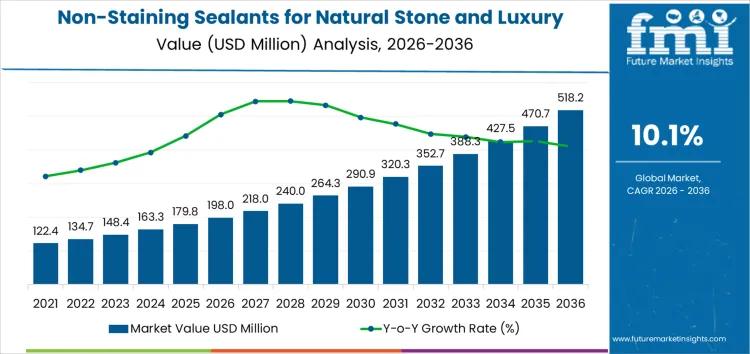
What Is the Growth Forecast for Non-Staining Sealants for Natural Stone and Luxury Surfaces Market through 2036?
Surface integrity preservation and aesthetic durability requirements shape the early growth phase of the non-staining sealants for natural stone and luxury surfaces market between 2026 and 2031. During this period, the market expands from USD 198 million to USD 288 million, adding USD 90 million in value. Annual progression from USD 109 million to USD 198 million reflects rising use of marble, granite, engineered stone, and premium composite surfaces in residential and commercial interiors. Historical growth was limited by discoloration risks and incompatibility of conventional sealants with porous substrates. Forward expansion in this phase is supported by improved formulation stability, wider acceptance among installers, and growing specification in kitchens, bathrooms, and high visibility architectural finishes.
Design consistency requirements and premium interior construction activity drive growth from 2031 to 2036. Over this period, the market increases from USD 288 million to USD 518.2 million, adding USD 235 million and representing the stronger expansion window. Annual values rise from USD 316 million to USD 518.2 million, indicating accelerating year over year momentum. Earlier demand focused on high end residential projects, while future growth reflects broader adoption across hospitality, retail, and institutional developments. Larger surface areas, tighter aesthetic tolerances, and higher replacement costs support sustained expansion as non-staining sealants become standard materials for protecting luxury stone and surface installations.
Non-Staining Sealants for Natural Stone and Luxury Surfaces Market Key Takeaways
| Metric | Value |
|---|---|
| Market Value (2026) | USD 198 million |
| Forecast Value (2036) | USD 518.2 million |
| Forecast CAGR (2026 to 2036) | 10.1% |
What Is Driving Growth in the Non-Staining Sealants for Natural Stone and Luxury Surfaces Market?
Demand for non-staining sealants for natural stone and luxury surfaces originates from functional limitations observed in traditional sealant chemistries when applied to high-value materials rather than from general sealing needs alone. Natural stone surfaces such as marble, travertine, limestone, and certain granites are porous and sensitive to staining from resins, oils, and colorants present in conventional sealants. Installation contractors and designers observed blotches, discoloration, and uneven appearance after sealant application, leading to costly refinishing and dissatisfied clients.
Luxury surface specifications began to call for sealants that provided water and soil resistance without altering surface appearance, reflecting aesthetic quality criteria more than basic protection needs. Early demand was concentrated in high-end residential and premium commercial projects where visual integrity directly affected project acceptance and brand reputation rather than across all construction segments.
Future growth in this market is being shaped by formalised quality standards, designer and brand expectations, and documented performance outcomes in specification documents rather than by incremental material substitution alone. Architects, consultants, and facility owners are increasingly specifying non-staining performance metrics in tender documents and contract clauses for projects involving premium natural materials.
Regulatory and sustainability frameworks that recognise material longevity and surface preservation are also influencing specification, encouraging products that reduce maintenance cycles and material replacement over time. Advances in polymer and silane chemistries are improving compatibility with diverse stone mineralogies, controlling hydrophobicity and oleophobicity without leaving residues that affect finish. Demand will align with benchmarked performance criteria such as resistance to coffee, wine, oil, and other staining agents under defined test protocols rather than subjective preferences, integrating sealant selection into early design stages for premium surface applications.
What Factors Are Affecting the Demand for Non-Staining Sealants for Natural Stone and Luxury Surfaces Market in Terms of Sealant Chemistry and Surface Material?
The non-staining sealants market for natural stone and luxury surfaces is driven by premium construction growth, stricter aesthetic standards, and sensitivity of porous materials to oil migration. Demand focuses on sealants that prevent discoloration while maintaining adhesion and long term durability. Adoption depends on stone porosity, finish type, and exposure conditions. Market leadership reflects proven non-staining performance, installer confidence, and compatibility with high value architectural surfaces rather than bond strength alone.
What Is Driving Leadership by Sealant Chemistry in the Non-Staining Sealants Market?
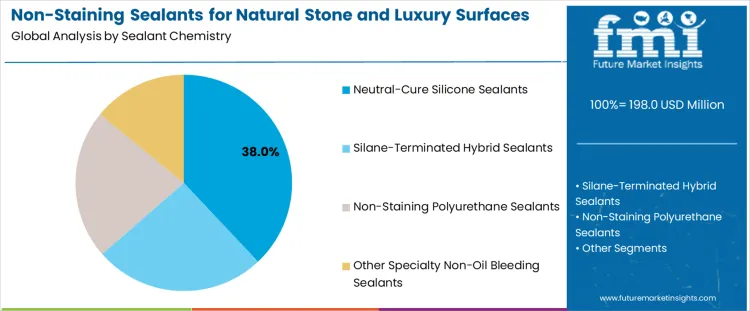
Neutral cure silicone sealants account for about 38% of demand because they offer reliable non-staining performance on porous and polished stone surfaces. These sealants cure without releasing acidic or oily byproducts that can migrate into stone, reducing the risk of edge darkening and halo effects. Architects and installers favor neutral cure silicones for marble, granite, and limestone because long term color stability is well documented. Their flexibility supports movement accommodation without cracking, which is critical in stone installations. Resistance to UV exposure and moisture further reinforces suitability for both interior and exterior luxury applications. Predictable curing behavior and wide availability support specification across residential, hospitality, and commercial projects where visual integrity is critical.
Silane terminated hybrid sealants, non-staining polyurethanes, and specialty formulations expand available options but remain secondary. Hybrid systems offer paintability and balanced adhesion yet may show limited track record on sensitive stones. Non-staining polyurethane sealants provide strength but require careful formulation control. Specialty sealants address niche finishes. These alternatives complement silicone dominance rather than replace it. Chemistry leadership therefore reflects aesthetic safety, long term color stability, and installer familiarity rather than maximum adhesion or rapid curing performance.
Neutral cure silicones also reduce remediation risk. Their dominance is reinforced by liability avoidance in high value stone installations globally today.
What Is Driving Leadership by Surface Material in the Non-Staining Sealants Market?
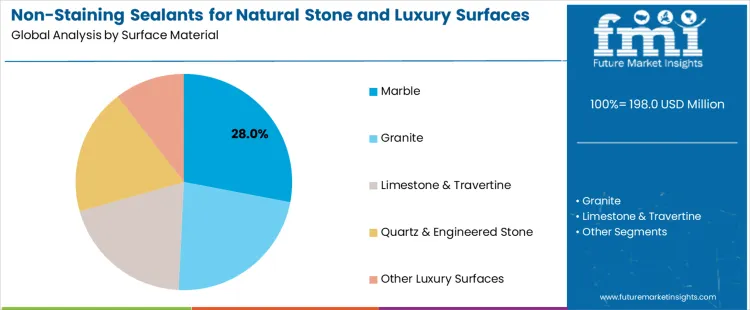
Marble represents about 28% of demand because it is widely used in luxury interiors and is highly sensitive to staining and oil migration. Its porous structure and light coloration make even minor discoloration visible, increasing reliance on certified non-staining sealants. Marble is commonly applied in bathrooms, kitchens, lobbies, and façades where joint sealing is extensive. Designers and contractors specify premium sealants for marble installations to protect aesthetic value and avoid costly replacement. High use in hospitality and residential developments reinforces consistent demand. The need to preserve surface appearance under moisture and cleaning exposure further anchors marble as the leading surface category.
Granite, limestone, travertine, quartz, and engineered stone contribute significant secondary demand. Granite offers greater stain resistance but still requires protection at joints. Limestone and travertine share porosity concerns but are used less extensively. Quartz and engineered stone are less absorbent yet demand clean aesthetics. Other luxury surfaces are applied selectively. Surface material leadership therefore reflects sensitivity to discoloration, volume of use, and replacement cost risk rather than sheer surface hardness or structural role within architectural projects.
How Are Non-Staining Sealants Being Applied Across Natural Stone and Luxury Surface Installations?
Use appears in residential, commercial, and hospitality projects where marble, granite, limestone, and engineered stone surfaces require protection without altering appearance. Manufacturers adopt non-staining sealants to prevent oil, water, or chemical penetration while preserving color, texture, and gloss. Installers integrate these sealants in countertops, flooring, cladding, and decorative elements to maintain surface aesthetics and durability. These applications reflect operational and quality priorities rather than purely protective purposes, with adoption driven by surface integrity, stain resistance, and customer satisfaction.
What Operational and Material Conditions Support Adoption of Non-Staining Sealants for Luxury Surfaces?
Selection aligns with porous and sensitive substrates requiring deep penetration, long-term adhesion, and chemical compatibility. Formulations are optimized for clarity, curing time, and resistance to household or industrial chemicals. Installation workflows monitor surface preparation, sealant application, and curing conditions to ensure uniform coverage and prevent residue. Quality control evaluates stain resistance, surface sheen, and adhesion longevity to meet aesthetic and functional performance standards. These conditions emerge from operational efficiency, material protection, and aesthetic preservation priorities in structured surface treatment workflows.
Which Practical Considerations Limit Wider Use of Non-Staining Sealants for Luxury Surfaces?
Higher material cost and precise application requirements may restrict adoption to premium projects. Surface porosity, moisture content, and temperature can affect penetration and efficacy. Compatibility with polish, coating, or cleaning protocols must be verified. Long-term performance and periodic maintenance are necessary to sustain protection. These factors lead to selective deployment where stain prevention, surface aesthetics, and durability justify incremental cost and careful application management.
What is the Demand for Non-Staining Sealants for Natural Stone and Luxury Surfaces by Country?
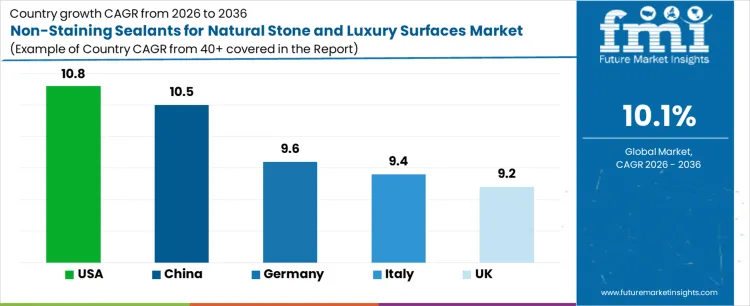
| Country | CAGR (%) |
|---|---|
| USA | 10.8% |
| China | 10.5% |
| Germany | 9.6% |
| Italy | 9.4% |
| UK | 9.2% |
The demand for non-staining sealants for natural stone and luxury surfaces varies across countries, driven by high end construction, interior design trends, and preservation of premium materials. The USA leads with a 10.8% CAGR, supported by rising luxury construction, interior renovation projects, and adoption of protective sealants. China follows at 10.5%, driven by growing real estate development, premium property construction, and high demand for stone and marble finishes. Germany records 9.6%, shaped by mature construction markets and strict quality standards. Italy posts 9.4%, supported by luxury architecture and historic building preservation. The UK grows at 9.2%, reflecting adoption in high end residential and commercial projects.
How Are Non-Staining Sealants Expanding Applications in Natural Stone and Luxury Surfaces in the United States?
In the United States, the Non-Staining Sealants for Natural Stone and Luxury Surfaces Market is growing at a CAGR of 10.8% through 2036, driven by increasing residential and commercial construction of high-end interiors and decorative surfaces. Contractors and surface treatment specialists are adopting non-staining sealants to protect marble, granite, and engineered stone, maintain aesthetic quality, and improve durability. Demand is concentrated in luxury residential projects, commercial office developments, and interior design-focused construction hubs. Compared to China, adoption in the USA emphasizes both performance and aesthetic standards. Domestic suppliers provide high-performance, chemically compatible sealants suitable for recurring surface application and maintenance cycles.
- Luxury residential projects, commercial developments, and interior design hubs drive adoption
- Sealants protect natural stone and maintain surface aesthetics
- Domestic suppliers provide high-performance, chemically compatible solutions
- Recurring surface application and maintenance cycles sustain adoption
How Are Construction and Luxury Design Driving Growth in China?
In China, revenue is growing at a CAGR of 10.5% through 2036, supported by rapid growth in luxury residential, commercial, and hospitality projects. Contractors and interior specialists are integrating non-staining sealants to prevent discoloration, enhance durability, and meet aesthetic requirements for natural stone and engineered surfaces. Demand is concentrated in urban construction hubs, high-end residential zones, and commercial developments. Compared to the USA, China emphasizes high-volume application and large-scale construction adoption. Domestic suppliers provide high-performance, cost-effective sealants suitable for recurring surface application and finishing operations.
- Urban construction hubs, high-end residential zones, and commercial developments drive adoption
- Sealants prevent discoloration and enhance durability
- Domestic suppliers provide high-performance, cost-effective solutions
- Recurring surface application and finishing operations sustain adoption
How Are Environmental Standards and Luxury Construction Driving Adoption in Germany?
In Germany, the market is expanding at a CAGR of 9.6% through 2036, driven by increasing use of natural stone and engineered surfaces in high-end residential and commercial buildings, combined with strict environmental and VOC regulations. Contractors and surface treatment firms are adopting non-staining sealants to maintain surface integrity, ensure chemical compliance, and enhance aesthetic quality. Demand is concentrated in urban construction hubs, industrial stone processing centers, and commercial development projects. Compared to China, adoption is more compliance- and quality-driven than volume-focused. Domestic suppliers provide EU-certified, high-performance sealants suitable for recurring surface application and inspection cycles.
- Urban construction hubs, stone processing centers, and commercial projects drive adoption
- Sealants maintain surface integrity and ensure regulatory compliance
- Domestic suppliers provide EU-certified, high-performance solutions
- Recurring surface application and inspection cycles sustain adoption
How Are Luxury Construction and Historic Preservation Driving Growth in Italy?
In Italy, revenue is growing at a CAGR of 9.4% through 2036, supported by use of natural stone in luxury residential, commercial, and heritage restoration projects. Contractors and specialized interior firms are adopting non-staining sealants to prevent discoloration, enhance durability, and protect aesthetic quality of marble, granite, and other natural surfaces. Demand is concentrated in historic urban centers, luxury residential developments, and commercial construction zones. Compared to the USA, adoption emphasizes quality, aesthetics, and preservation rather than high-volume industrial deployment. Domestic suppliers provide high-performance sealants suitable for recurring application and restoration maintenance.
- Historic urban centers, luxury residential developments, and commercial zones drive adoption
- Sealants prevent discoloration and enhance durability
- Domestic suppliers provide high-performance, restoration-compatible solutions
- Recurring application and maintenance cycles sustain adoption
How Are Premium Construction Projects Driving Market Growth in the United Kingdom?
In the United Kingdom, the market is expanding at a CAGR of 9.2% through 2036, driven by high-end residential, commercial, and hospitality construction projects. Contractors and surface treatment specialists are integrating non-staining sealants to protect natural and engineered stone surfaces, preserve aesthetic quality, and ensure long-term durability. Demand is concentrated in luxury urban developments, commercial projects, and renovation of heritage buildings. Compared to Germany, adoption emphasizes a balance between performance, aesthetics, and operational efficiency. Domestic suppliers provide high-performance sealants suitable for recurring surface application and maintenance cycles.
- Luxury urban developments, commercial projects, and heritage renovations drive adoption
- Sealants protect surfaces, preserve aesthetics, and enhance durability
- Domestic suppliers provide high-performance, application-compatible solutions
- Recurring surface application and maintenance cycles sustain adoption
Which Strategic Approaches Define Competition in the Non-Staining Sealants for Natural Stone and Luxury Surfaces Market?
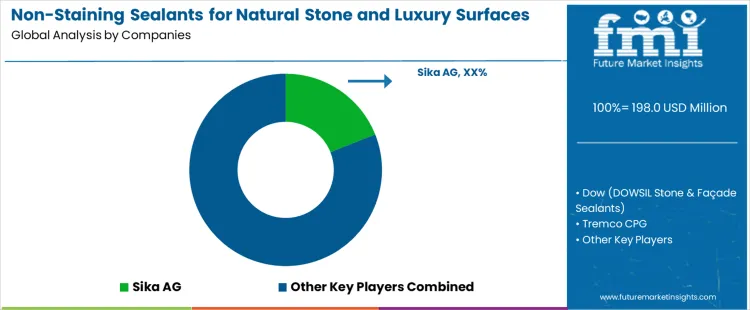
Competition in non-staining sealants for natural stone and luxury surfaces is shaped by risk avoidance rather than by general sealing performance. Discoloration, edge darkening, and migration of plasticizers carry irreversible consequences for high value materials such as marble, limestone, quartzite, and engineered stone. Sika AG and Dow, through DOWSIL stone and façade sealants, position their products around chemical inertness and controlled interaction with porous substrates. Their strategies emphasize neutral cure systems, low extractables, and extensive compatibility testing across stone types and finishes. Specification decisions are often driven by architects and façade consultants who prioritize long term visual stability over ease of application or cure speed. Proven field history and mock up validation strongly influence material selection.
System alignment and application discipline define secondary competitive strategies. Tremco CPG competes by embedding non-staining sealants within façade and envelope systems, aligning joint performance with membranes, coatings, and drainage details used in premium construction. Mapei S.p.A. emphasizes formulation balance and installer guidance, targeting consistency across interior and exterior luxury applications. Bostik, part of Arkema Group, focuses on sealants tailored for sensitive substrates, supported by technical advisories to reduce installer error. Across the market, competitive advantage depends on demonstrated non-staining performance over time, documentation quality, and confidence among designers and installers. Success is determined by preservation of appearance and reputational risk management rather than by volume, speed of cure, or portfolio breadth.
Key Players in the Non-Staining Sealants for Natural Stone and Luxury Surfaces Market
- Sika AG
- Dow (DOWSIL Stone & Façade Sealants)
- Tremco CPG
- Mapei S.p.A.
- Bostik (Arkema Group)
Scope of the Report
| Items | Values |
|---|---|
| Quantitative Units (2026) | USD million |
| Type | Neutral-Cure Silicone Sealants, Silane-Terminated Hybrid Sealants, Non-Staining Polyurethane Sealants, Other Specialty Non-Oil-Bleeding Sealants |
| Application | Façades and Exterior Cladding, Luxury Interior Surfaces including Kitchens and Baths, Flooring and Staircases, Decorative and Architectural Elements, Other Specialized Installations |
| End Users | Luxury Residential Developers, Commercial and Hospitality Developers, Stone Fabricators and Installers, Façade and Interior Fit-Out Contractors |
| Regions Covered | Asia Pacific, Europe, North America, Latin America, Middle East and Africa |
| Countries Covered | United States, China, Germany, Italy, United Kingdom, France, Spain, Japan, South Korea, India, Canada, Australia, ASEAN countries, GCC countries, and other global regions |
| Key Companies Profiled | Sika AG, Dow DOWSIL Stone and Façade Sealants, Tremco CPG, Mapei S.p.A., Bostik part of Arkema Group |
| Additional Attributes | Dollar by sales across sealant chemistry surface material and application type, non-staining and non-migration performance benchmarks, compatibility testing with porous and polished stone substrates, resistance to edge darkening and discoloration, installer approval and mock-up validation requirements, regional adoption trends linked to luxury residential hospitality and premium commercial construction |
Non-Staining Sealants for Natural Stone and Luxury Surfaces Market Segmentation
Sealant Chemistry:
- Neutral-Cure Silicone Sealants
- Silane-Terminated Hybrid Sealants
- Non-Staining Polyurethane Sealants
- Other Specialty Non-Oil Bleeding Sealants
Surface Material:
- Marble
- Granite
- Limestone & Travertine
- Quartz & Engineered Stone
- Other Luxury Surfaces
Application Type:
- Façades & Exterior Cladding
- Luxury Interior Surfaces (Kitchens, Baths)
- Flooring & Staircases
- Decorative & Architectural Elements
- Other Specialized Installations
Region
- Asia Pacific
- China
- Japan
- South Korea
- India
- Australia & New Zealand
- ASEAN
- Rest of Asia Pacific
- Europe
- Germany
- United Kingdom
- France
- Italy
- Spain
- Nordic
- BENELUX
- Rest of Europe
- North America
- United States
- Canada
- Mexico
- Latin America
- Brazil
- Chile
- Rest of Latin America
- Middle East & Africa
- Kingdom of Saudi Arabia
- Other GCC Countries
- Turkey
- South Africa
- Other African Union
- Rest of Middle East & Africa
Frequently Asked Questions
How big is the non-staining sealants for natural stone and luxury surfaces market in 2026?
The global non-staining sealants for natural stone and luxury surfaces market is estimated to be valued at USD 198.0 million in 2026.
What will be the size of non-staining sealants for natural stone and luxury surfaces market in 2036?
The market size for the non-staining sealants for natural stone and luxury surfaces market is projected to reach USD 518.2 million by 2036.
How much will be the non-staining sealants for natural stone and luxury surfaces market growth between 2026 and 2036?
The non-staining sealants for natural stone and luxury surfaces market is expected to grow at a 10.1% CAGR between 2026 and 2036.
What are the key product types in the non-staining sealants for natural stone and luxury surfaces market?
The key product types in non-staining sealants for natural stone and luxury surfaces market are neutral-cure silicone sealants, silane-terminated hybrid sealants, non-staining polyurethane sealants and other specialty non-oil bleeding sealants.
Which surface material segment to contribute significant share in the non-staining sealants for natural stone and luxury surfaces market in 2026?
In terms of surface material, marble segment to command 28.0% share in the non-staining sealants for natural stone and luxury surfaces market in 2026.
Preview the report firsthand - request a free sample
Get SampleGet the brochure for pricing and purchase details.
Get PDFTable of Content
- Executive Summary
- Global Market Outlook
- Demand-side Trends
- Supply-side Trends
- Technology Roadmap Analysis
- Analysis and Recommendations
- Market Overview
- Market Coverage / Taxonomy
- Market Definition / Scope / Limitations
- Market Background
- Market Dynamics
- Drivers
- Restraints
- Opportunity
- Trends
- Scenario Forecast
- Demand in Optimistic Scenario
- Demand in Likely Scenario
- Demand in Conservative Scenario
- Opportunity Map Analysis
- Product Life Cycle Analysis
- Supply Chain Analysis
- Investment Feasibility Matrix
- Value Chain Analysis
- PESTLE and Porter’s Analysis
- Regulatory Landscape
- Regional Parent Market Outlook
- Production and Consumption Statistics
- Import and Export Statistics
- Market Dynamics
- Global Market Analysis 2021 to 2025 and Forecast, 2026 to 2036
- Historical Market Size Value (USD Million) Analysis, 2021 to 2025
- Current and Future Market Size Value (USD Million) Projections, 2026 to 2036
- Y-o-Y Growth Trend Analysis
- Absolute $ Opportunity Analysis
- Global Market Pricing Analysis 2021 to 2025 and Forecast 2026 to 2036
- Global Market Analysis 2021 to 2025 and Forecast 2026 to 2036, By Sealant Chemistry
- Introduction / Key Findings
- Historical Market Size Value (USD Million) Analysis By Sealant Chemistry , 2021 to 2025
- Current and Future Market Size Value (USD Million) Analysis and Forecast By Sealant Chemistry , 2026 to 2036
- Neutral-Cure Silicone Sealants
- Silane-Terminated Hybrid Sealants
- Non-Staining Polyurethane Sealants
- Other Specialty Non-Oil Bleeding Sealants
- Neutral-Cure Silicone Sealants
- Y-o-Y Growth Trend Analysis By Sealant Chemistry , 2021 to 2025
- Absolute $ Opportunity Analysis By Sealant Chemistry , 2026 to 2036
- Global Market Analysis 2021 to 2025 and Forecast 2026 to 2036, By Surface Material
- Introduction / Key Findings
- Historical Market Size Value (USD Million) Analysis By Surface Material, 2021 to 2025
- Current and Future Market Size Value (USD Million) Analysis and Forecast By Surface Material, 2026 to 2036
- Marble
- Granite
- Limestone & Travertine
- Quartz & Engineered Stone
- Other Luxury Surfaces
- Marble
- Y-o-Y Growth Trend Analysis By Surface Material, 2021 to 2025
- Absolute $ Opportunity Analysis By Surface Material, 2026 to 2036
- Global Market Analysis 2021 to 2025 and Forecast 2026 to 2036, By Application Type
- Introduction / Key Findings
- Historical Market Size Value (USD Million) Analysis By Application Type, 2021 to 2025
- Current and Future Market Size Value (USD Million) Analysis and Forecast By Application Type, 2026 to 2036
- Façades & Exterior Cladding
- Luxury Interior Surfaces (Kitchens, Baths)
- Flooring & Staircases
- Decorative & Architectural Elements
- Other Specialized Installations
- Façades & Exterior Cladding
- Y-o-Y Growth Trend Analysis By Application Type, 2021 to 2025
- Absolute $ Opportunity Analysis By Application Type, 2026 to 2036
- Global Market Analysis 2021 to 2025 and Forecast 2026 to 2036, By Region
- Introduction
- Historical Market Size Value (USD Million) Analysis By Region, 2021 to 2025
- Current Market Size Value (USD Million) Analysis and Forecast By Region, 2026 to 2036
- North America
- Latin America
- Western Europe
- Eastern Europe
- East Asia
- South Asia and Pacific
- Middle East & Africa
- Market Attractiveness Analysis By Region
- North America Market Analysis 2021 to 2025 and Forecast 2026 to 2036, By Country
- Historical Market Size Value (USD Million) Trend Analysis By Market Taxonomy, 2021 to 2025
- Market Size Value (USD Million) Forecast By Market Taxonomy, 2026 to 2036
- By Country
- USA
- Canada
- Mexico
- By Sealant Chemistry
- By Surface Material
- By Application Type
- By Country
- Market Attractiveness Analysis
- By Country
- By Sealant Chemistry
- By Surface Material
- By Application Type
- Key Takeaways
- Latin America Market Analysis 2021 to 2025 and Forecast 2026 to 2036, By Country
- Historical Market Size Value (USD Million) Trend Analysis By Market Taxonomy, 2021 to 2025
- Market Size Value (USD Million) Forecast By Market Taxonomy, 2026 to 2036
- By Country
- Brazil
- Chile
- Rest of Latin America
- By Sealant Chemistry
- By Surface Material
- By Application Type
- By Country
- Market Attractiveness Analysis
- By Country
- By Sealant Chemistry
- By Surface Material
- By Application Type
- Key Takeaways
- Western Europe Market Analysis 2021 to 2025 and Forecast 2026 to 2036, By Country
- Historical Market Size Value (USD Million) Trend Analysis By Market Taxonomy, 2021 to 2025
- Market Size Value (USD Million) Forecast By Market Taxonomy, 2026 to 2036
- By Country
- Germany
- UK
- Italy
- Spain
- France
- Nordic
- BENELUX
- Rest of Western Europe
- By Sealant Chemistry
- By Surface Material
- By Application Type
- By Country
- Market Attractiveness Analysis
- By Country
- By Sealant Chemistry
- By Surface Material
- By Application Type
- Key Takeaways
- Eastern Europe Market Analysis 2021 to 2025 and Forecast 2026 to 2036, By Country
- Historical Market Size Value (USD Million) Trend Analysis By Market Taxonomy, 2021 to 2025
- Market Size Value (USD Million) Forecast By Market Taxonomy, 2026 to 2036
- By Country
- Russia
- Poland
- Hungary
- Balkan & Baltic
- Rest of Eastern Europe
- By Sealant Chemistry
- By Surface Material
- By Application Type
- By Country
- Market Attractiveness Analysis
- By Country
- By Sealant Chemistry
- By Surface Material
- By Application Type
- Key Takeaways
- East Asia Market Analysis 2021 to 2025 and Forecast 2026 to 2036, By Country
- Historical Market Size Value (USD Million) Trend Analysis By Market Taxonomy, 2021 to 2025
- Market Size Value (USD Million) Forecast By Market Taxonomy, 2026 to 2036
- By Country
- China
- Japan
- South Korea
- By Sealant Chemistry
- By Surface Material
- By Application Type
- By Country
- Market Attractiveness Analysis
- By Country
- By Sealant Chemistry
- By Surface Material
- By Application Type
- Key Takeaways
- South Asia and Pacific Market Analysis 2021 to 2025 and Forecast 2026 to 2036, By Country
- Historical Market Size Value (USD Million) Trend Analysis By Market Taxonomy, 2021 to 2025
- Market Size Value (USD Million) Forecast By Market Taxonomy, 2026 to 2036
- By Country
- India
- ASEAN
- Australia & New Zealand
- Rest of South Asia and Pacific
- By Sealant Chemistry
- By Surface Material
- By Application Type
- By Country
- Market Attractiveness Analysis
- By Country
- By Sealant Chemistry
- By Surface Material
- By Application Type
- Key Takeaways
- Middle East & Africa Market Analysis 2021 to 2025 and Forecast 2026 to 2036, By Country
- Historical Market Size Value (USD Million) Trend Analysis By Market Taxonomy, 2021 to 2025
- Market Size Value (USD Million) Forecast By Market Taxonomy, 2026 to 2036
- By Country
- Kingdom of Saudi Arabia
- Other GCC Countries
- Turkiye
- South Africa
- Other African Union
- Rest of Middle East & Africa
- By Sealant Chemistry
- By Surface Material
- By Application Type
- By Country
- Market Attractiveness Analysis
- By Country
- By Sealant Chemistry
- By Surface Material
- By Application Type
- Key Takeaways
- Key Countries Market Analysis
- USA
- Pricing Analysis
- Market Share Analysis, 2025
- By Sealant Chemistry
- By Surface Material
- By Application Type
- Canada
- Pricing Analysis
- Market Share Analysis, 2025
- By Sealant Chemistry
- By Surface Material
- By Application Type
- Mexico
- Pricing Analysis
- Market Share Analysis, 2025
- By Sealant Chemistry
- By Surface Material
- By Application Type
- Brazil
- Pricing Analysis
- Market Share Analysis, 2025
- By Sealant Chemistry
- By Surface Material
- By Application Type
- Chile
- Pricing Analysis
- Market Share Analysis, 2025
- By Sealant Chemistry
- By Surface Material
- By Application Type
- Germany
- Pricing Analysis
- Market Share Analysis, 2025
- By Sealant Chemistry
- By Surface Material
- By Application Type
- UK
- Pricing Analysis
- Market Share Analysis, 2025
- By Sealant Chemistry
- By Surface Material
- By Application Type
- Italy
- Pricing Analysis
- Market Share Analysis, 2025
- By Sealant Chemistry
- By Surface Material
- By Application Type
- Spain
- Pricing Analysis
- Market Share Analysis, 2025
- By Sealant Chemistry
- By Surface Material
- By Application Type
- France
- Pricing Analysis
- Market Share Analysis, 2025
- By Sealant Chemistry
- By Surface Material
- By Application Type
- India
- Pricing Analysis
- Market Share Analysis, 2025
- By Sealant Chemistry
- By Surface Material
- By Application Type
- ASEAN
- Pricing Analysis
- Market Share Analysis, 2025
- By Sealant Chemistry
- By Surface Material
- By Application Type
- Australia & New Zealand
- Pricing Analysis
- Market Share Analysis, 2025
- By Sealant Chemistry
- By Surface Material
- By Application Type
- China
- Pricing Analysis
- Market Share Analysis, 2025
- By Sealant Chemistry
- By Surface Material
- By Application Type
- Japan
- Pricing Analysis
- Market Share Analysis, 2025
- By Sealant Chemistry
- By Surface Material
- By Application Type
- South Korea
- Pricing Analysis
- Market Share Analysis, 2025
- By Sealant Chemistry
- By Surface Material
- By Application Type
- Russia
- Pricing Analysis
- Market Share Analysis, 2025
- By Sealant Chemistry
- By Surface Material
- By Application Type
- Poland
- Pricing Analysis
- Market Share Analysis, 2025
- By Sealant Chemistry
- By Surface Material
- By Application Type
- Hungary
- Pricing Analysis
- Market Share Analysis, 2025
- By Sealant Chemistry
- By Surface Material
- By Application Type
- Kingdom of Saudi Arabia
- Pricing Analysis
- Market Share Analysis, 2025
- By Sealant Chemistry
- By Surface Material
- By Application Type
- Turkiye
- Pricing Analysis
- Market Share Analysis, 2025
- By Sealant Chemistry
- By Surface Material
- By Application Type
- South Africa
- Pricing Analysis
- Market Share Analysis, 2025
- By Sealant Chemistry
- By Surface Material
- By Application Type
- USA
- Market Structure Analysis
- Competition Dashboard
- Competition Benchmarking
- Market Share Analysis of Top Players
- By Regional
- By Sealant Chemistry
- By Surface Material
- By Application Type
- Competition Analysis
- Competition Deep Dive
- Sika AG
- Overview
- Product Portfolio
- Profitability by Market Segments (Product/Age /Sales Channel/Region)
- Sales Footprint
- Strategy Overview
- Marketing Strategy
- Product Strategy
- Channel Strategy
- Dow (DOWSIL Stone & Façade Sealants)
- Tremco CPG
- Mapei S.p.A.
- Bostik (Arkema Group)
- Sika AG
- Competition Deep Dive
- Assumptions & Acronyms Used
- Research Methodology


