

- Industry Size (2026)
- USD 53.0 Mn
- Forecast (2036)
- USD 140.0 Mn
- CAGR (2026 to 2036)
- 10.2%
Plant-Based Tzatziki and Labneh Ferment Bases Market Size, Market Forecast and Outlook By FMI
Plant-based tzatziki and labneh ferment bases market was valued at USD 48.1 million in 2025. Industry is expected to reach USD 53.0 million in 2026 at a 10.2% CAGR during the forecast period. Demand is projected to lift total valuation to USD 140.0 million by 2036 as commercial formulators reduce dependence on multi-ingredient hydrocolloid systems and move toward targeted lactic acid bacteria strains that can build viscosity more naturally in non-dairy matrices.
Summary of Plant-Based Tzatziki and Labneh Ferment Bases Market
- The market is forecast to reach USD 140.0 million by 2036.
- The market is expected to grow at a CAGR of 10.2% from 2026 to 2036.
- The market was estimated at USD 48.1 million in 2025.
- The forecast period represents an incremental opportunity of USD 87.0 million.
- The market focuses on plant-based fermented bases designed to replicate traditional dairy dips like tzatziki and labneh.
- Demand is driven by rising adoption of plant-based yogurt and cultured dairy alternatives across retail and foodservice.
- Labneh bases lead the product segment with a 52.0% share due to thicker texture and premium positioning.
- Oat-based formulations dominate with a 30.0% share, supported by neutral taste and clean-label compatibility.
- Complete formulation systems account for 46.0% share as brands prefer integrated solutions that reduce development time.
- Retail brands lead end use with a 57.0% share, acting as the primary channel for product validation and scale.
- UAE, Turkey, and Spain are the fastest-growing markets, while Germany and the United States remain key demand bases.
- Market growth is constrained by challenges in taste, texture consistency, and price competitiveness.
- Competition is shifting toward integrated ingredient systems combining cultures, proteins, and stabilizers for faster commercialization.
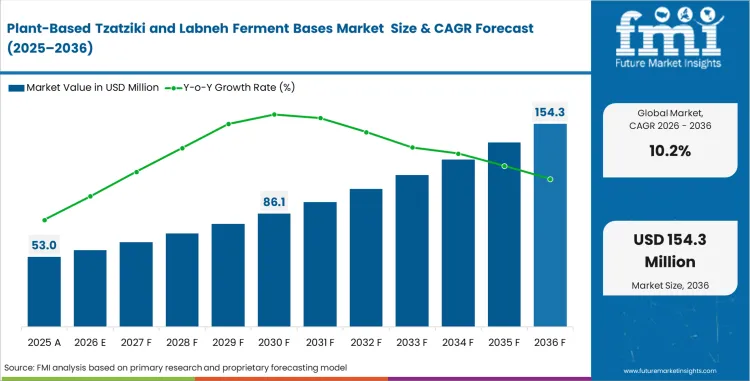
Clean-label pressure now sits at the center of formulation decisions. Long ingredient decks built around modified starches and heavy stabilizer systems are harder to defend in refrigerated dips, especially when brands are trying to match strained-dairy mouthfeel in products linked to plant based yogurt equivalents. Texture density is only part of the issue. Product teams also need cultures that can hold consistency when cucumber, garlic, salt, and herbs start changing water activity inside the finished dip.
Factory performance becomes easier once modular ferment blends can separate texturization from acid-development speed in high-protein oat, soy, or pulse systems. Standard incubation cycles have limited scale because dense plant bases do not behave like dairy proteins under fermentation. Better strain selection narrows that gap. Shelf-life consistency improves at the same time, which matters more in chilled dips than early pilot performance usually suggests.
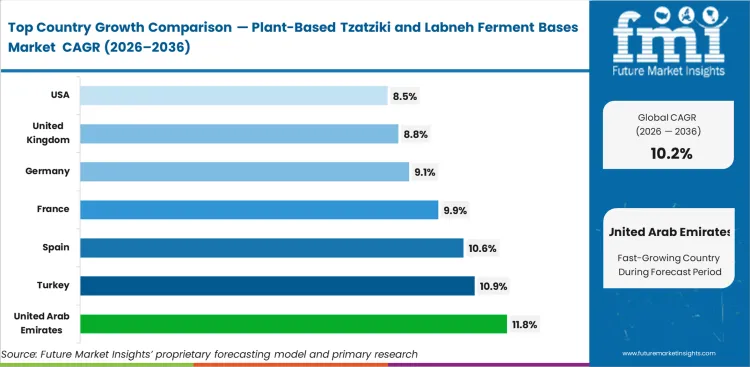
United Arab Emirates leads outlook with demand projected to rise at a 11.8% CAGR through 2036 as premium foodservice channels require dairy-free versions of established mezze formats. Turkey follows at 10.9%, supported by export-oriented production serving European retail. Spain is forecast at 10.6%, while France is expected to expand at 9.9% as Mediterranean flavor profiles move deeper into mainstream vegan assortments. Germany posts 9.1%, the United Kingdom reaches 8.8%, and the United States is projected at 8.5% through 2036. Differences across this range come down to one clear divide, some countries require authentic regional flavor and texture replication, while others use these bases more as practical savory spread systems.
Plant-Based Tzatziki and Labneh Ferment Bases Market Key Takeaways
| Metric | Details |
|---|---|
| Industry Size (2026) | USD 53.0 million |
| Industry Value (2036) | USD 140.0 million |
| CAGR (2026 to 2036) | 10.2% |
Source: Future Market Insights (FMI) analysis, based on proprietary forecasting model and primary research
Segmental Analysis
Plant-Based Tzatziki and Labneh Ferment Bases Market Analysis by Product Type
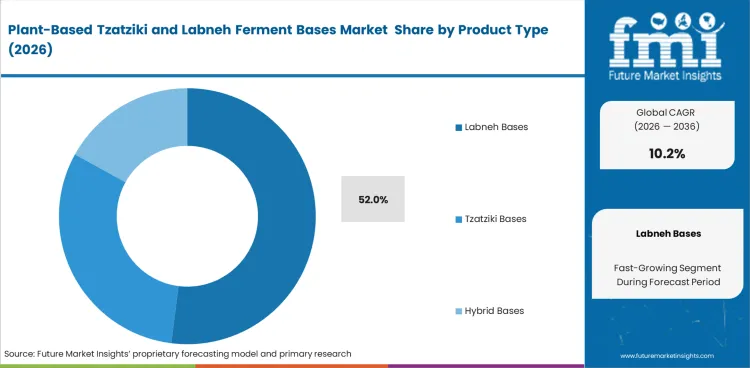
Texture density sits at the center of product-type competition because labneh-style applications ask more from fermentation systems than standard cultured dips. Labneh Bases are expected to account for 52.0% share in 2026, reflecting how often manufacturers pursue thicker formats for premium chilled spreads and foodservice use. Development teams do not treat these systems as a simple extension of yogurt-style fermentation. Mechanical concentration alone rarely delivers a stable result in plant matrices because fragile protein gels break under stress well before a reliable strained texture is achieved. Density has to be developed during fermentation rather than corrected later. Filling-line performance carries as much weight as spoon feel once production moves beyond pilot scale. Facilities that underestimate pumping load, herb inclusion stress, or post-fermentation handling often find that a base performing well at bench scale loses stability when batch size rises and line pressure increases.
- Fermentation density: Targeted bacterial strains build viscosity early in incubation, allowing formulation teams to reach thicker labneh-style textures without relying too heavily on late-stage functional correction.
- Acid profile control: Mild but sufficient acid development helps quality teams protect shelf life while keeping savory flavor systems from drifting into harsh or astringent territory.
- Shear resistance: Stronger gel tolerance matters when operations teams blend herbs, cucumber, and oil after fermentation, because weak bases fracture quickly under industrial mixing.
Plant-Based Tzatziki and Labneh Ferment Bases Market Analysis by Base Material
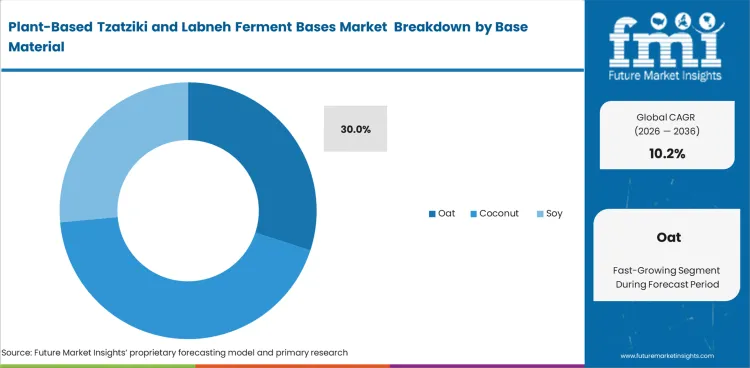
Substrate choice changes both formulation burden and finished-product credibility. Oat is expected to represent 30.0% share in 2026, though leadership here is not just a matter of consumer familiarity. Oat gains ground because starch behavior during cooling adds a second layer of viscosity support alongside microbial texturization, which reduces dependence on external structuring aids. Formulation teams value that advantage in savory applications where clean-label constraints are tighter and ingredient statements are watched closely. Taste still creates limits. Fermented oat can move toward a cereal note quickly when paired with garlic, dill, or cucumber unless bitterness control and acidity balance are managed carefully. Commercial success depends less on oat alone than on how well the full base system handles flavor masking, water binding, and chilled stability. Products that miss that balance tend to look technically acceptable in early trials yet fall short once retail sampling and repeat purchase begin.
- Cooling-set viscosity: Oat carbohydrates firm predictably after pasteurization, which helps process teams manage tub fill consistency and shortens adjustment time on packaging lines.
- Flavor masking burden: Fermented cereal notes need tighter control in savory formats, so formulation scientists must match oat with cultures and modulators that keep garlic and herb profiles clean.
- Alternative substrate trade-off: Soy and pulse systems can build stronger protein networks, but application teams often accept higher flavor-correction work when moving away from oat.
Plant-Based Tzatziki and Labneh Ferment Bases Market Analysis by Formulation Type
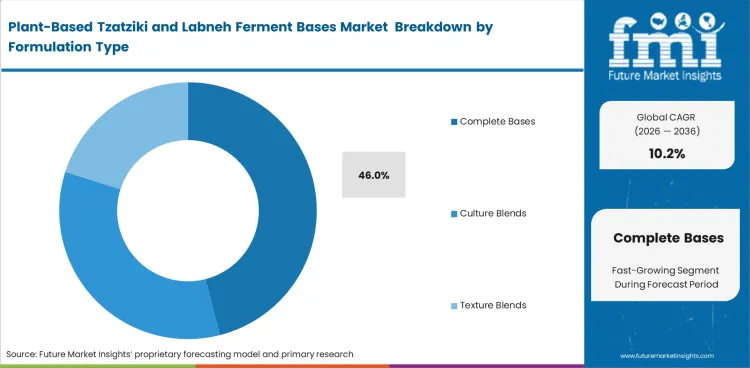
Factory capability influences formulation-type demand more than product ambition usually does. Complete Bases are forecast to contribute 46.0% share in 2026 because many mid-scale producers want a stable route into savory cultured spreads without building in-house expertise across proteins, starches, and live microbial food cultures. Modular systems offer flexibility, but flexibility only pays off when teams can manage batch variation, hydration behavior, and fermentation timing with confidence. Complete bases reduce that burden by arriving with a pre-balanced architecture that is easier to execute on the plant floor. Customization narrows once a manufacturer commits to one of these systems. Retailer-specific acidity targets, seasonal flavor changes, and texture adjustments become harder to manage when the supplier fixes core product behavior too early in the formulation process. That trade-off explains why complete bases lead, but it also explains why some larger processors continue to protect partial control over culture and texture inputs.
- Execution simplification: Integrated powder systems lower formulation error rates, which helps plant managers reduce rework and keep production planning tighter.
- Consistency control: Pre-balanced compositions support steadier fermentation performance, giving quality leads fewer batch-to-batch texture deviations to correct.
- Customization limit: Supplier-defined architecture can restrict later adjustment, so technical teams often give up some flexibility in exchange for easier plant execution.
Plant-Based Tzatziki and Labneh Ferment Bases Market Analysis by End Use
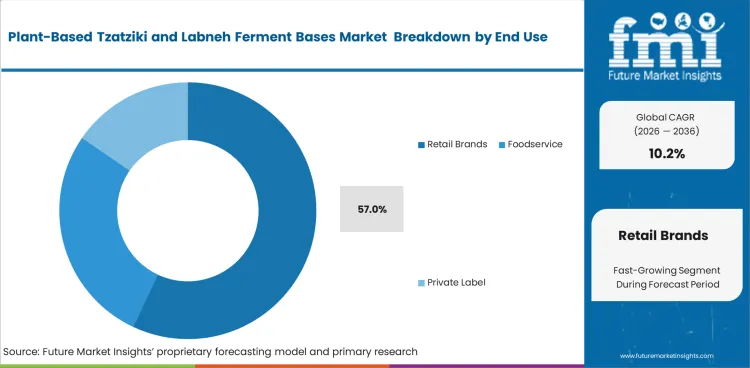
Commercial success in this segment is often decided on shelf before it is judged on palate. Retail Brands are expected to make up 57.0% share in 2026 because refrigerated supermarket channels remain the main launch platform for vegan dips and spreads. Visual stability matters immediately in that setting. Water pooling, oil separation, or texture collapse can undermine trial before flavor has a chance to compensate. Retail-led demand keeps more development spending focused on syneresis control than many adjacent cultured categories require. Shelf survival, though, can distort formulation choices. Bases engineered too aggressively for cold-chain variation often become dense in the wrong way and lose the creamy spreadability consumers associate with labneh or tzatziki. Local fresh-service formats sometimes outperform national retail packs on eating quality for that reason, even when national brands execute better on distribution. Balance, not maximum stability, is what ultimately separates a durable retail formula from a technically safe but disappointing one plant based spreads.
- Shelf appearance: Strong syneresis control helps category teams avoid visible separation in clear packs, protecting first impression during early listing periods.
- Foodservice adaptation: Heat exposure and plate application push culinary developers toward bases that can hold body without breaking on warm dishes.
- Private-label economics: Leaner systems appeal to own-label programs because product teams can hit texture and acidity targets with tighter ingredient cost discipline.
Plant-Based Tzatziki and Labneh Ferment Bases Market Drivers, Restraints, and Opportunities
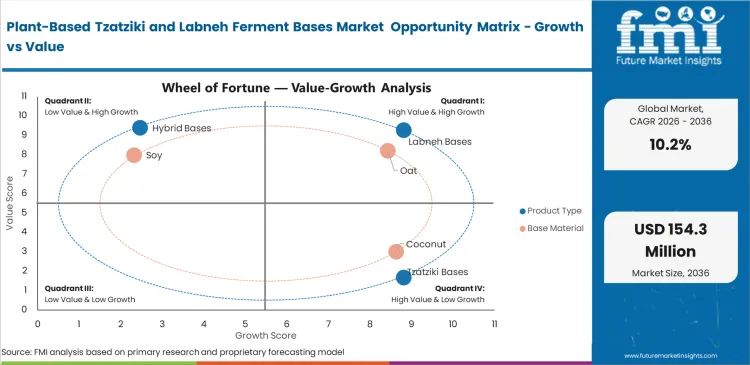
Clean-label rules continue to push formulators away from heavy stabilizer systems and toward fermentation-led viscosity development. Retailers in Europe and North America have made ingredient scrutiny stricter in savory chilled foods, which limits how far brands can rely on modified starches and synthetic texturizers. Standard probiotic ingredients do not solve that problem on their own because live-culture positioning is different from texture architecture. Product developers need base systems that build density, manage water, and hold flavor in one formulation path. Commercial relevance comes from execution. Brands that cannot make that transition cleanly face a higher risk of listing pressure when ingredient decks and visual stability are reviewed together.
Adoption remains slower where savory inclusions disturb fermentation control after a base appears technically sound on its own. Fresh cucumber, garlic paste, salt load, and herb systems can alter osmotic conditions quickly, and poorly adapted cultures may lose viscosity before chilled stability is fully secured. Premium strains designed for those conditions exist, but plant teams still need tighter temperature control and more disciplined incubation management to use them effectively. Scheduling strain shows up fast when fermentation windows lengthen or become less predictable.
Opportunities in the Plant-Based Tzatziki and Labneh Ferment Bases Market
- Protective culture integration: Application teams that combine bioprotective strains with vegan sauces can improve refrigerated shelf stability without leaning on controversial preservative systems.
- High-protein pulse systems: Ingredient suppliers that reduce off-notes in pea or fava bases are better placed to support front-of-pack protein claims in savory chilled formats.
- Fast-acidifying texturizers: Biotechnology developers that shorten time to target pH can help co-manufacturers improve tank utilization without expanding fermentation capacity.
Regional Analysis
Regional segmentation for Plant-Based Tzatziki and Labneh Ferment Bases Market covers North America, Latin America, Europe, Asia Pacific, and Middle East and Africa across more than 40 countries.
.webp "Top Country Growth Comparison Plant Based Tzatziki And Labneh Ferment Bases Market Cagr (2026 2036)")
| Country | CAGR (2026 to 2036) |
|---|---|
| United Arab Emirates | 11.8% |
| Turkey | 10.9% |
| Spain | 10.6% |
| France | 9.9% |
| Germany | 9.1% |
| United Kingdom | 8.8% |
| United States | 8.5% |
Source: Future Market Insights (FMI) analysis, based on proprietary forecasting model and primary research
Middle East Plant-Based Tzatziki and Labneh Ferment Bases Market Analysis
Authenticity remains a commercial requirement across premium Middle East foodservice channels, especially in formats linked to established mezze consumption. Dairy-free adaptation works here only when flavor, tartness, and density feel regionally credible. Formulation standards are less forgiving for watery bases or generic yogurt-like textures. Richer substrate systems and careful fermentation tuning matter because final products still need to interact well with oil, herbs, and plated service. plant based cheese analog thinking sometimes influences richness targets, but spread behavior remains a separate technical challenge.
- United Arab Emirates: Premium hospitality keeps the United Arab Emirates at the front of regional expansion, with demand projected to rise at a 11.8% CAGR through 2036. Product expectations remain high across hotel dining, upscale casual formats, and premium prepared foods, so developers continue to favor ferment bases that can reproduce tartness, body, and chilled stability in formats close to traditional mezze service. Commercial traction also depends on reliable holding performance, since plated presentation and consistency matter as much as flavor in this environment.
- Turkey: Export-oriented production supports a 10.9% CAGR through 2036. Local manufacturing strength in cucumber, dill, savory cultured applications, and broader Mediterranean flavor systems gives processors a practical base for dairy-free tzatziki formats designed for European shipment. Turkey also benefits from a production logic that balances flavor familiarity with industrial adaptability, which makes it an important bridge between regional authenticity and export-scale formulation.
FMI’s report includes Saudi Arabia, Qatar, and Kuwait. Alternative protein investment across GCC markets supports wider local interest in fermentation systems suited to hot-climate distribution and premium prepared foods.
Europe Plant-Based Tzatziki and Labneh Ferment Bases Market Analysis
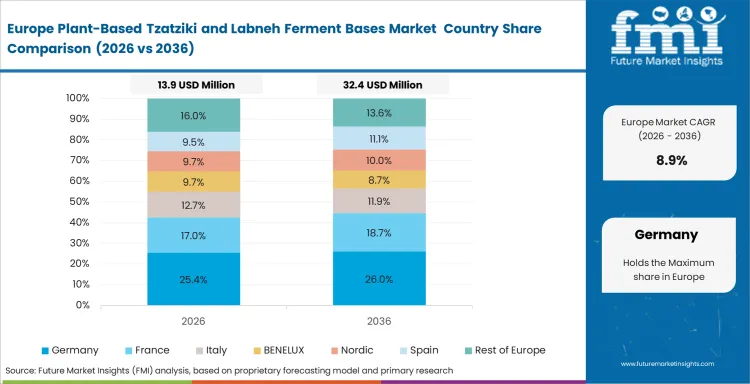
Clean-label discipline shapes adoption across Europe more directly than in most other regions. Ingredient declarations are watched closely, and plant-based savory products face less tolerance for visible separation or heavy texturizer use. Oat-based systems remain attractive because supply chains are relatively resilient and consumer familiarity is already established, yet flavor control stays harder in garlic- and herb-led formulations. Development work across Europe is therefore less about launching a dairy-free version quickly and more about getting shape, taste, and ingredient simplicity into commercial balance. demand for dairy alternatives in the eu continues to support that direction.
- Spain: Mainstream vegan portfolios in Spain are absorbing more Mediterranean-style products, and plant-based tzatziki and labneh ferment bases are projected to expand at a 10.6% CAGR through 2036. Local familiarity with the flavor profile lowers the burden of consumer education, which gives product developers more room to focus on quality and execution rather than on category explanation. Spain also benefits from a stronger culinary fit for savory cultured formats, which supports both domestic uptake and wider relevance for export-oriented chilled lines.
- France: Culinary acceptance remains more selective, but France is expected to post 9.9% CAGR through 2036. Foodservice and premium chilled retail continue to require tighter texture parity before dairy-free options can scale, so formulation discipline matters more here than broad trend appeal. Better body, cleaner acidity, and controlled herb integration are central to adoption because finished products still need to sit comfortably within established eating expectations.
- Germany: Established clean-label snacking habits support a steady industry outlook, with demand in Germany forecast to advance at 9.1% CAGR through 2036. Manufacturers continue to replace artificial stabilizers with fermentation-led texturization in savory dip systems, but product performance still has to remain highly consistent. German acceptance depends on repeatable sensory delivery, which makes separation control and spoonable texture just as important as ingredient simplicity.
- United Kingdom: Private-label intensity keeps cost and execution under close review, and the United Kingdom is anticipated to record 8.8% CAGR through 2036. Turnkey powder systems suit this environment because grocers often want rapid portfolio extension without major formulation complexity or long redevelopment cycles. Commercial viability in this country depends on whether suppliers can support quick rollout while still keeping chilled texture, acidity, and shelf-life behavior under control.
FMI’s report includes Italy, Netherlands, and Sweden. Familiarity with cultured dairy formats across Europe gives suppliers room to launch savory dairy-free variants without rebuilding category understanding from scratch.
North America Plant-Based Tzatziki and Labneh Ferment Bases Market Analysis
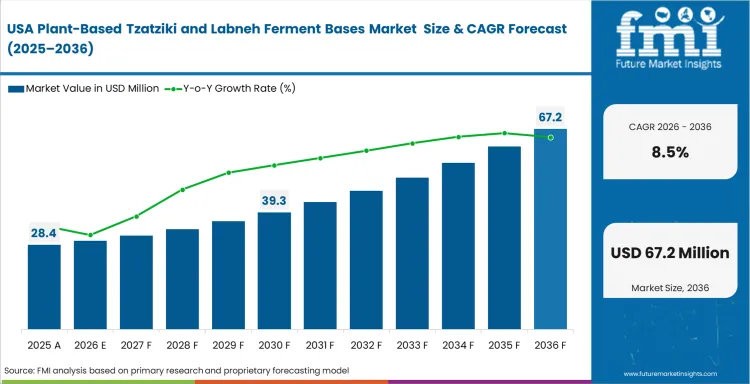
Protein-led positioning shapes North American demand more strongly than culinary authenticity alone. Savory cultured dips are often evaluated through a nutrition lens, which pulls attention toward pea and fava systems as much as toward classic Mediterranean flavor replication. Acidification becomes harder under that model because dense pulse proteins resist rapid pH movement and can keep off-notes more visible. Technical performance therefore depends on culture strength and flavor management at the same time. yogurt dips provide a useful adjacent reference, but plant-based savory formats carry a narrower margin for texture failure.
- United States: Industry expansion in the United States is expected at a 8.5% CAGR through 2036. High-protein savory snacking keeps development interest active, but product teams need custom culture systems that can handle pulse-heavy matrices without leaving grassy notes, weak acidification, or unstable texture. Commercial uptake depends on keeping nutrition claims credible while still delivering an eating experience close enough to familiar cultured-dip expectations.
FMI’s report includes Canada and Mexico. Cross-border manufacturing networks continue to favor complete base powders because they simplify quality control across separate packaging and filling locations.
Competitive Aligners for Market Players
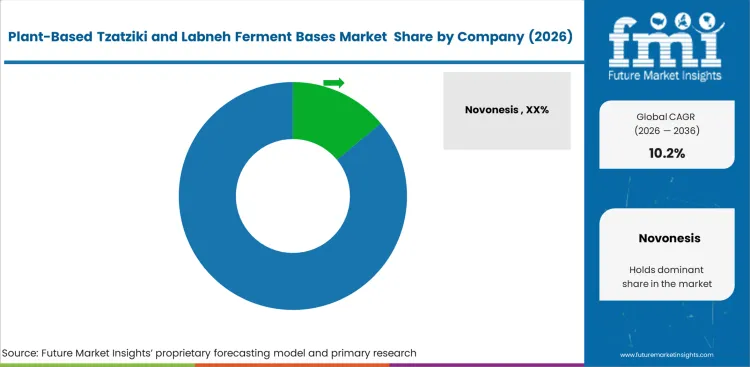
Competition in this sector depends less on broad plant-based capability and more on whether a supplier can support a narrow savory cultured application with reliable plant-level results. Generic fermentation systems are easier to place in sweet dairy alternatives than in labneh or tzatziki-style bases, where salt load, herb inclusion, and water release expose weaknesses quickly. Suppliers that can demonstrate stability in those conditions are in a different competitive tier from those offering standard dairy-alternative toolkits.
Novonesis and dsm-firmenich benefit from deeper fermentation know-how and wider commercial reach, while IFF, Kerry Group, Ingredion, ADM, and Cargill remain relevant where customers want broader formulation support around proteins, textures, and chilled-food execution. Capability depth matters here. Access to characterized strain libraries and application support linked to food and beverage protective cultures gives larger suppliers an advantage that smaller entrants cannot recreate quickly.
Large food manufacturers still try to avoid full dependency on one supplier architecture. Culture systems, protein inputs, and texture components are often separated where internal technical teams have enough experience to manage integration themselves. Mid-tier producers usually take a different route because turnkey bases reduce plant variation and shorten development time. Supplier power is real, but lock-in is rarely accepted without a clear gain in consistency, shelf performance, or speed to launch.
Key Players in Plant-Based Tzatziki and Labneh Ferment Bases Market
- Novonesis
- dsm-firmenich
- IFF
- Kerry Group
- Ingredion
- ADM
- Cargill
Scope of the Report
| Metric | Value |
|---|---|
| Quantitative Units | USD 53.0 million to USD 140.0 million, at a CAGR of 10.2% |
| Market Definition | Commercial ingredient systems integrating microbial cultures and plant substrates to produce thick, savory Mediterranean-style spreads without dairy proteins. These B2B solutions control viscosity and acidification in industrial manufacturing. |
| Segmentation | By Product Type, Base Material, Formulation Type, End Use, and Region |
| Regions Covered | North America, Latin America, Europe, Asia Pacific, Middle East and Africa |
| Countries Covered | United Arab Emirates, Turkey, Spain, France, Germany, United Kingdom, United States, and others |
| Key Companies Profiled | Novonesis, dsm-firmenich, IFF, Kerry Group, Ingredion, ADM, Cargill |
| Forecast Period | 2026 to 2036 |
| Approach | Wholesale ingredient volumes tracking specialized lactic acid bacteria shipments into savory dairy-alternative processing facilities. |
Source: Future Market Insights (FMI) analysis, based on proprietary forecasting model and primary research
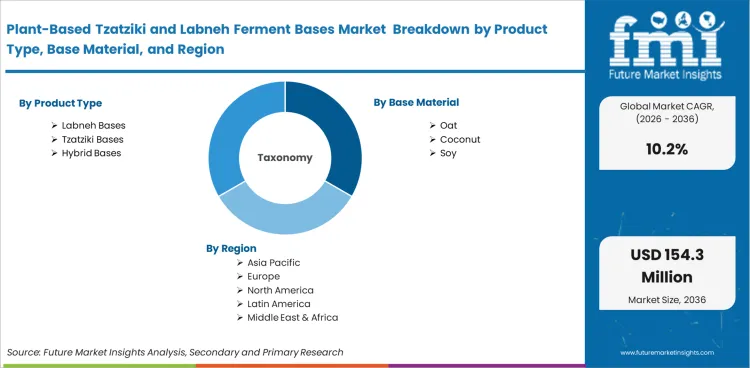
Plant-Based Tzatziki and Labneh Ferment Bases Market Analysis by Segments
Product Type
- Labneh Bases
- Tzatziki Bases
- Hybrid Bases
Base Material
- Oat
- Coconut
- Soy
- Pulse
- Almond
Formulation Type
- Complete Bases
- Culture Blends
- Texture Blends
- Flavor Modules
End Use
- Retail Brands
- Foodservice
- Private Label
- Deli Counter
Region
- North America
- Latin America
- Europe
- Asia Pacific
- Middle East and Africa
Bibliography
- Agriculture and Agri-Food Canada. (2025, July 02). Sector Trend Analysis - Plant-based protein trends in the United Arab Emirates. Government of Canada.
- Bhaskaracharya, R. K., Alnuaimi, F. S. R., Aldarmaki, S. R. J., Abdulazeez, A., & Ayyash, M. (2024, October 29). Labneh: A retail market analysis and selected product characterization. Foods, 13(21), 3461.
- Darnay, L., Téglás, F., Süth, M., Friedrich, L., Boros, A., & Varga-Tóth, A. (2025, December 15). Texture improvement possibilities for plant-based yogurt alternatives. LWT, 238, 118775.
- Hanley, L., Dobson, S., & Marangoni, A. G. (2024, May). Legume milk-based yogurt mimetics structured using glucono-δ-lactone. Food Research International, 184, 114259.
- Liu, Q., Wang, K., Shen, Y., & Yu, X. (2025, August 20). Nutritional value and sensory attributes of plant-based fermented milk: A comprehensive review. Food Science and Technology International. Advance online publication.
This bibliography is provided for reader reference. The full FMI report contains the complete reference list with primary source documentation.
This Report Addresses
- Identification of fermentation systems needed for dense labneh-style texturization.
- Assessment of syneresis-control challenges in cucumber-based tzatziki production.
- Evaluation of complete base powders versus modular culture blends for mid-scale co-manufacturers.
- Analysis of oat starch behavior in savory non-dairy fermentation environments.
- Impact of clean-label formulation limits on hydrocolloid replacement strategies.
- Regional review of Mediterranean flavor adoption across European retail channels.
- Supplier capability assessment for cultures that can tolerate high-salt savory conditions.
- Quantification of premium foodservice demand for dairy-free mezze ingredients in GCC markets.
Frequently Asked Questions
What is the plant-based tzatziki and labneh ferment bases market?
Plant-based tzatziki and labneh ferment bases are B2B ingredient systems combining microbial cultures, texturizers, and plant substrates to produce thick, savory cultured spreads without dairy proteins.
How big is the plant-based tzatziki and labneh ferment bases market?
Plant-Based Tzatziki and Labneh Ferment Bases Market is valued at USD 53.0 million in 2026 and is projected to reach USD 140.0 million by 2036.
Which ingredients are used in plant-based tzatziki bases?
Commercial tzatziki bases commonly use specific lactic acid bacteria, exopolysaccharide-producing strains, and plant substrates such as oat, soy, pulse, coconut, or almond.
Why are oat bases used in dairy-free labneh?
Oat substrates support viscosity development during cooling and fermentation, which helps formulation teams build dense textures with fewer external texturizers.
What cultures are used in plant-based fermented dips?
Plant-based fermented dips typically use specialized lactic acid bacteria selected to control acidification, build viscosity, and manage water behavior in non-dairy savory systems.
How do manufacturers control syneresis in plant-based labneh?
Manufacturers reduce syneresis by using fermentation systems that improve water retention during incubation, usually supported by well-matched texturizers and protein systems.
Which countries are driving plant-based tzatziki and labneh ferment bases demand?
United Arab Emirates leads forecast expansion at a 11.8% CAGR, followed by Turkey at 10.9%, Spain at 10.6%, and France at 9.9% through 2036.
Who are the key suppliers in plant-based fermented dip bases?
Key participants include Novonesis, dsm-firmenich, IFF, Kerry Group, Ingredion, ADM, and Cargill.
What is included in a complete plant-based ferment base system?
Complete systems usually combine plant proteins, texture-support ingredients, and dormant bacterial cultures into one ready-to-process formulation base.
What base materials work best for vegan labneh texture?
Oat and soy remain widely used because they support denser body and better gel formation, though final suitability still depends on flavor control, culture selection, and process design.
How does the United Arab Emirates market compare with France?
United Arab Emirates is forecast at a 11.8% CAGR through 2036, while France is projected at 9.9%. GCC hospitality demand lifts UAE faster.
Why do retail brands dominate end-use demand?
Retail Brands are expected to represent 57.0% share in 2026 because supermarket refrigeration remains the main launch route for vegan dips and spreads.
What causes gel weakness in standard vegan yogurt bases?
Gel weakness usually comes from plant proteins that do not handle mixing stress, water release, or savory inclusions as well as culture systems developed specifically for labneh-style applications.
How do protective cultures extend shelf life?
Protective cultures can limit spoilage pressure during chilled storage by improving microbiological stability inside refrigerated savory applications.
Why is pea protein difficult to formulate in savory dips?
Pea-heavy systems can buffer acidification and leave noticeable grassy notes, which raises the workload on both culture design and flavor correction.
What distinguishes labneh bases from sweet yogurt cultures?
Labneh bases are designed for thicker body, slower water movement, and better spread stability in savory applications, rather than for tartness alone.
How do private label manufacturers optimize production costs?
Private-label programs often favor leaner complete bases that simplify plant execution and reduce the number of separate ingredients held in inventory.
Why is syneresis a specific problem for tzatziki?
Cucumber introduces free water into the fermented base, which can reduce viscosity and cause visible separation when water-binding capacity is insufficient.
What role do flavor modules play in formulation?
Flavor modules help shape tartness, dairy-style perception, and herb compatibility so the finished dip feels closer to an authentic Mediterranean profile.
How does starch retrogradation support production performance?
Cooling-set starch behavior can improve fill consistency and texture build, which helps plant teams keep line output more stable.
Why do mid-tier brands prefer complete bases?
Complete bases reduce formulation risk for producers that do not want to manage culture balance, protein interaction, and texturizer control from scratch.
What limits adoption for dense labneh equivalents?
Dense bases can create handling issues on industrial lines, especially where pumping systems and mixing equipment were designed for lighter cultured products.
Preview the report firsthand - request a free sample
Get SampleGet the brochure for pricing and purchase details.
Get PDFTable of Content
- Executive Summary
- Global Market Outlook
- Demand-side Trends
- Supply-side Trends
- Technology Roadmap Analysis
- Analysis and Recommendations
- Market Overview
- Market Coverage / Taxonomy
- Market Definition / Scope / Limitations
- Research Methodology
- Chapter Orientation
- Analytical Lens and Working Hypotheses
- Market Sizing, Forecasting, and Opportunity Mapping
- Research Design and Evidence Framework
- Desk Research Programme (Secondary Evidence)
- Company Annual and Sustainability Reports
- Peer-reviewed Journals and Academic Literature
- Corporate Websites, Product Literature, and Technical Notes
- Earnings Decks and Investor Briefings
- Statutory Filings and Regulatory Disclosures
- Technical White Papers and Standards Notes
- Trade Journals, Industry Magazines, and Analyst Briefs
- Conference Proceedings, Webinars, and Seminar Materials
- Government Statistics Portals and Public Data Releases
- Press Releases and Reputable Media Coverage
- Specialist Newsletters and Curated Briefings
- Sector Databases and Reference Repositories
- FMI Internal Proprietary Databases and Historical Market Datasets
- Subscription Datasets and Paid Sources
- Social Channels, Communities, and Digital Listening Inputs
- Additional Desk Sources
- Expert Input and Fieldwork (Primary Evidence)
- Primary Modes
- Qualitative Interviews and Expert Elicitation
- Quantitative Surveys and Structured Data Capture
- Blended Approach
- Why Primary Evidence is Used
- Observational and In-context Research
- Social and Community Interactions
- Primary Modes
- Stakeholder Universe Engaged
- C-suite Leaders
- Board Members
- Presidents and Vice Presidents
- R&D and Innovation Heads
- Technical Specialists
- Domain Subject-matter Experts
- Scientists
- Physicians and Other Healthcare Professionals
- Governance, Ethics, and Data Stewardship
- Research Ethics
- Data Integrity and Handling
- Desk Research Programme (Secondary Evidence)
- Tooling, Models, and Reference Databases
- Data Engineering and Model Build
- Data Acquisition and Ingestion
- Cleaning, Normalisation, and Verification
- Synthesis, Triangulation, and Analysis
- Quality Assurance and Audit Trail
- Market Background
- Market Dynamics
- Drivers
- Restraints
- Opportunity
- Trends
- Scenario Forecast
- Demand in Optimistic Scenario
- Demand in Likely Scenario
- Demand in Conservative Scenario
- Opportunity Map Analysis
- Product Life Cycle Analysis
- Supply Chain Analysis
- Investment Feasibility Matrix
- Value Chain Analysis
- PESTLE and Porter’s Analysis
- Regulatory Landscape
- Regional Parent Market Outlook
- Production and Consumption Statistics
- Import and Export Statistics
- Market Dynamics
- Global Market Analysis 2021 to 2025 and Forecast, 2026 to 2036
- Historical Market Size Value (USD Million) Analysis, 2021 to 2025
- Current and Future Market Size Value (USD Million) Projections, 2026 to 2036
- Y-o-Y Growth Trend Analysis
- Absolute $ Opportunity Analysis
- Global Market Pricing Analysis 2021 to 2025 and Forecast 2026 to 2036
- Global Market Analysis 2021 to 2025 and Forecast 2026 to 2036, By Product Type
- Introduction / Key Findings
- Historical Market Size Value (USD Million) Analysis By Product Type , 2021 to 2025
- Current and Future Market Size Value (USD Million) Analysis and Forecast By Product Type , 2026 to 2036
- Labneh Bases
- Tzatziki Bases
- Hybrid Bases
- Labneh Bases
- Y-o-Y Growth Trend Analysis By Product Type , 2021 to 2025
- Absolute $ Opportunity Analysis By Product Type , 2026 to 2036
- Global Market Analysis 2021 to 2025 and Forecast 2026 to 2036, By Base Material
- Introduction / Key Findings
- Historical Market Size Value (USD Million) Analysis By Base Material, 2021 to 2025
- Current and Future Market Size Value (USD Million) Analysis and Forecast By Base Material, 2026 to 2036
- Oat
- Coconut
- Soy
- Oat
- Y-o-Y Growth Trend Analysis By Base Material, 2021 to 2025
- Absolute $ Opportunity Analysis By Base Material, 2026 to 2036
- Global Market Analysis 2021 to 2025 and Forecast 2026 to 2036, By Formulation Type
- Introduction / Key Findings
- Historical Market Size Value (USD Million) Analysis By Formulation Type, 2021 to 2025
- Current and Future Market Size Value (USD Million) Analysis and Forecast By Formulation Type, 2026 to 2036
- Complete Bases
- Culture Blends
- Texture Blends
- Complete Bases
- Y-o-Y Growth Trend Analysis By Formulation Type, 2021 to 2025
- Absolute $ Opportunity Analysis By Formulation Type, 2026 to 2036
- Global Market Analysis 2021 to 2025 and Forecast 2026 to 2036, By End Use
- Introduction / Key Findings
- Historical Market Size Value (USD Million) Analysis By End Use, 2021 to 2025
- Current and Future Market Size Value (USD Million) Analysis and Forecast By End Use, 2026 to 2036
- Retail Brands
- Foodservice
- Private Label
- Retail Brands
- Y-o-Y Growth Trend Analysis By End Use, 2021 to 2025
- Absolute $ Opportunity Analysis By End Use, 2026 to 2036
- Global Market Analysis 2021 to 2025 and Forecast 2026 to 2036, By Region
- Introduction
- Historical Market Size Value (USD Million) Analysis By Region, 2021 to 2025
- Current Market Size Value (USD Million) Analysis and Forecast By Region, 2026 to 2036
- North America
- Latin America
- Western Europe
- Eastern Europe
- East Asia
- South Asia and Pacific
- Middle East & Africa
- Market Attractiveness Analysis By Region
- North America Market Analysis 2021 to 2025 and Forecast 2026 to 2036, By Country
- Historical Market Size Value (USD Million) Trend Analysis By Market Taxonomy, 2021 to 2025
- Market Size Value (USD Million) Forecast By Market Taxonomy, 2026 to 2036
- By Country
- USA
- Canada
- Mexico
- By Product Type
- By Base Material
- By Formulation Type
- By End Use
- By Country
- Market Attractiveness Analysis
- By Country
- By Product Type
- By Base Material
- By Formulation Type
- By End Use
- Key Takeaways
- Latin America Market Analysis 2021 to 2025 and Forecast 2026 to 2036, By Country
- Historical Market Size Value (USD Million) Trend Analysis By Market Taxonomy, 2021 to 2025
- Market Size Value (USD Million) Forecast By Market Taxonomy, 2026 to 2036
- By Country
- Brazil
- Chile
- Rest of Latin America
- By Product Type
- By Base Material
- By Formulation Type
- By End Use
- By Country
- Market Attractiveness Analysis
- By Country
- By Product Type
- By Base Material
- By Formulation Type
- By End Use
- Key Takeaways
- Western Europe Market Analysis 2021 to 2025 and Forecast 2026 to 2036, By Country
- Historical Market Size Value (USD Million) Trend Analysis By Market Taxonomy, 2021 to 2025
- Market Size Value (USD Million) Forecast By Market Taxonomy, 2026 to 2036
- By Country
- Germany
- UK
- Italy
- Spain
- France
- Nordic
- BENELUX
- Rest of Western Europe
- By Product Type
- By Base Material
- By Formulation Type
- By End Use
- By Country
- Market Attractiveness Analysis
- By Country
- By Product Type
- By Base Material
- By Formulation Type
- By End Use
- Key Takeaways
- Eastern Europe Market Analysis 2021 to 2025 and Forecast 2026 to 2036, By Country
- Historical Market Size Value (USD Million) Trend Analysis By Market Taxonomy, 2021 to 2025
- Market Size Value (USD Million) Forecast By Market Taxonomy, 2026 to 2036
- By Country
- Russia
- Poland
- Hungary
- Balkan & Baltic
- Rest of Eastern Europe
- By Product Type
- By Base Material
- By Formulation Type
- By End Use
- By Country
- Market Attractiveness Analysis
- By Country
- By Product Type
- By Base Material
- By Formulation Type
- By End Use
- Key Takeaways
- East Asia Market Analysis 2021 to 2025 and Forecast 2026 to 2036, By Country
- Historical Market Size Value (USD Million) Trend Analysis By Market Taxonomy, 2021 to 2025
- Market Size Value (USD Million) Forecast By Market Taxonomy, 2026 to 2036
- By Country
- China
- Japan
- South Korea
- By Product Type
- By Base Material
- By Formulation Type
- By End Use
- By Country
- Market Attractiveness Analysis
- By Country
- By Product Type
- By Base Material
- By Formulation Type
- By End Use
- Key Takeaways
- South Asia and Pacific Market Analysis 2021 to 2025 and Forecast 2026 to 2036, By Country
- Historical Market Size Value (USD Million) Trend Analysis By Market Taxonomy, 2021 to 2025
- Market Size Value (USD Million) Forecast By Market Taxonomy, 2026 to 2036
- By Country
- India
- ASEAN
- Australia & New Zealand
- Rest of South Asia and Pacific
- By Product Type
- By Base Material
- By Formulation Type
- By End Use
- By Country
- Market Attractiveness Analysis
- By Country
- By Product Type
- By Base Material
- By Formulation Type
- By End Use
- Key Takeaways
- Middle East & Africa Market Analysis 2021 to 2025 and Forecast 2026 to 2036, By Country
- Historical Market Size Value (USD Million) Trend Analysis By Market Taxonomy, 2021 to 2025
- Market Size Value (USD Million) Forecast By Market Taxonomy, 2026 to 2036
- By Country
- Kingdom of Saudi Arabia
- Other GCC Countries
- Turkiye
- South Africa
- Other African Union
- Rest of Middle East & Africa
- By Product Type
- By Base Material
- By Formulation Type
- By End Use
- By Country
- Market Attractiveness Analysis
- By Country
- By Product Type
- By Base Material
- By Formulation Type
- By End Use
- Key Takeaways
- Key Countries Market Analysis
- USA
- Pricing Analysis
- Market Share Analysis, 2025
- By Product Type
- By Base Material
- By Formulation Type
- By End Use
- Canada
- Pricing Analysis
- Market Share Analysis, 2025
- By Product Type
- By Base Material
- By Formulation Type
- By End Use
- Mexico
- Pricing Analysis
- Market Share Analysis, 2025
- By Product Type
- By Base Material
- By Formulation Type
- By End Use
- Brazil
- Pricing Analysis
- Market Share Analysis, 2025
- By Product Type
- By Base Material
- By Formulation Type
- By End Use
- Chile
- Pricing Analysis
- Market Share Analysis, 2025
- By Product Type
- By Base Material
- By Formulation Type
- By End Use
- Germany
- Pricing Analysis
- Market Share Analysis, 2025
- By Product Type
- By Base Material
- By Formulation Type
- By End Use
- UK
- Pricing Analysis
- Market Share Analysis, 2025
- By Product Type
- By Base Material
- By Formulation Type
- By End Use
- Italy
- Pricing Analysis
- Market Share Analysis, 2025
- By Product Type
- By Base Material
- By Formulation Type
- By End Use
- Spain
- Pricing Analysis
- Market Share Analysis, 2025
- By Product Type
- By Base Material
- By Formulation Type
- By End Use
- France
- Pricing Analysis
- Market Share Analysis, 2025
- By Product Type
- By Base Material
- By Formulation Type
- By End Use
- India
- Pricing Analysis
- Market Share Analysis, 2025
- By Product Type
- By Base Material
- By Formulation Type
- By End Use
- ASEAN
- Pricing Analysis
- Market Share Analysis, 2025
- By Product Type
- By Base Material
- By Formulation Type
- By End Use
- Australia & New Zealand
- Pricing Analysis
- Market Share Analysis, 2025
- By Product Type
- By Base Material
- By Formulation Type
- By End Use
- China
- Pricing Analysis
- Market Share Analysis, 2025
- By Product Type
- By Base Material
- By Formulation Type
- By End Use
- Japan
- Pricing Analysis
- Market Share Analysis, 2025
- By Product Type
- By Base Material
- By Formulation Type
- By End Use
- South Korea
- Pricing Analysis
- Market Share Analysis, 2025
- By Product Type
- By Base Material
- By Formulation Type
- By End Use
- Russia
- Pricing Analysis
- Market Share Analysis, 2025
- By Product Type
- By Base Material
- By Formulation Type
- By End Use
- Poland
- Pricing Analysis
- Market Share Analysis, 2025
- By Product Type
- By Base Material
- By Formulation Type
- By End Use
- Hungary
- Pricing Analysis
- Market Share Analysis, 2025
- By Product Type
- By Base Material
- By Formulation Type
- By End Use
- Kingdom of Saudi Arabia
- Pricing Analysis
- Market Share Analysis, 2025
- By Product Type
- By Base Material
- By Formulation Type
- By End Use
- Turkiye
- Pricing Analysis
- Market Share Analysis, 2025
- By Product Type
- By Base Material
- By Formulation Type
- By End Use
- South Africa
- Pricing Analysis
- Market Share Analysis, 2025
- By Product Type
- By Base Material
- By Formulation Type
- By End Use
- USA
- Market Structure Analysis
- Competition Dashboard
- Competition Benchmarking
- Market Share Analysis of Top Players
- By Regional
- By Product Type
- By Base Material
- By Formulation Type
- By End Use
- Competition Analysis
- Competition Deep Dive
- Novonesis
- Overview
- Product Portfolio
- Profitability by Market Segments (Product/Age /Sales Channel/Region)
- Sales Footprint
- Strategy Overview
- Marketing Strategy
- Product Strategy
- Channel Strategy
- dsm-firmenich
- IFF
- Kerry Group
- Ingredion
- ADM
- Cargill
- Novonesis
- Competition Deep Dive
- Assumptions & Acronyms Used


