

- Industry Size (2026)
- USD 425 Mn
- Forecast (2036)
- USD 1734 Mn
- CAGR (2026 to 2036)
- 15.1%
Smart UV-Activated Field Fungicide Market Forecast and Outlook 2026 to 2036
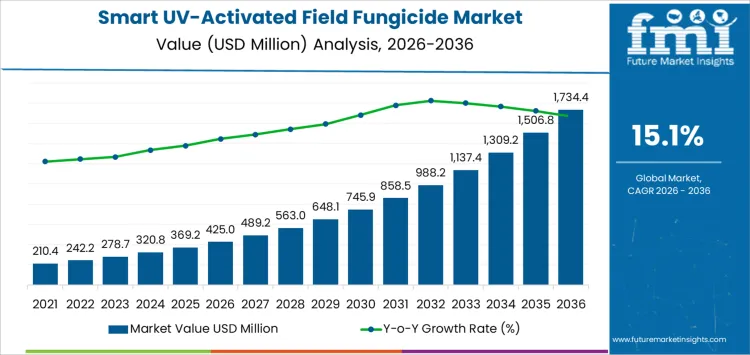
The smart UV-activated field fungicide market is projected to grow from USD 425 million in 2026 to USD 1,734 million by 2036, reflecting a compound annual growth rate (CAGR) of 15.1%. These innovative fungicides, activated by UV light, offer enhanced efficacy in protecting crops from fungal diseases while reducing environmental impact. As the agricultural sector increasingly shifts towards sustainable and precision farming practices, the demand for smart UV-activated fungicides is expected to rise. This growth is fueled by the need for more efficient, eco-friendly solutions to combat crop diseases and improve agricultural yield, without the excessive use of chemical pesticides that can harm ecosystems and human health.
The market growth is also driven by advancements in agricultural technology, including innovations in UV-activated chemicals that offer targeted, fast-acting solutions for fungal control. As more farmers adopt sustainable farming practices and integrate technological advancements into their operations, the use of smart UV-activated field fungicides is expected to grow significantly, with increased adoption across both large-scale commercial farms and smaller operations seeking environmentally friendly pest and disease management solutions.
Quick Stats of the Smart UV-Activated Field Fungicide Market
- Smart UV-Activated Field Fungicide Market Value (2026): USD 425 million
- Smart UV-Activated Field Fungicide Market Forecast Value (2036): USD 1,734 million
- Smart UV-Activated Field Fungicide Market Global Forecast CAGR (2026 to 2035): 15.1%
- Smart UV-Activated Field Fungicide Market Leading Segment: Fungicide Type (Systemic Fungicides) 44%
- Key Growth Regions in Smart UV-Activated Field Fungicide Market: United States
- Top Players in Smart UV-Activated Field Fungicide Market: ADAMA Agricultural Solutions, Valent BioSciences, Sumitomo Chemical (AgroSolutions), Belchim Crop Protection, Isagro S.p.A., Others
What is the Growth Forecast for the Smart UV-Activated Field Fungicide Market through 2036?
The long-term value accumulation curve for the smart UV-activated field fungicide market shows consistent and accelerating growth, reflecting the increasing adoption of advanced fungicide solutions. Starting at USD 425 million in 2026, the market grows to USD 489.7 million in 2027 and USD 564.1 million in 2028, indicating steady early-stage growth. These initial years reflect the growing awareness and initial adoption of UV-activated fungicide solutions as more farmers adopt sustainable agricultural practices.
From 2028 to 2030, the market continues to expand, reaching USD 650.6 million in 2029 and USD 751.8 million in 2030. During this phase, the market sees an acceleration as the benefits of UV-activated fungicides become more apparent in reducing the need for chemical pesticides and improving crop protection in an environmentally responsible manner. Between 2030 and 2035, the growth trajectory continues to accelerate, with the market reaching USD 870.7 million in 2031, USD 1,010.4 million in 2032, and USD 1,173.5 million in 2033.
By 2035, the market is projected to reach USD 1,363.8 million, with the final market value of USD 1,734 million expected in 2036. The long-term value accumulation curve shows that as the technology becomes more widely adopted, the market will experience substantial growth driven by technological advancements, regulatory support, and a growing focus on sustainable farming practices. This trend reflects the increasing value placed on smart agricultural solutions, where eco-friendly and effective pest control is a priority.
Smart UV-Activated Field Fungicide Market Key Takeaways
| Metric | Value |
|---|---|
| Industry Sales Value (2026) | USD 425 million |
| Industry Forecast Value (2036) | USD 1,734 million |
| Industry Forecast CAGR (2026 to 2036) | 15.1% |
What Is Driving the Demand for the Smart UV-Activated Field Fungicide Market Globally?
The global demand for smart UV activated field fungicides is being driven by the need for more precise, environmentally responsible disease control in agriculture and horticulture. Traditional fungicide programs rely on scheduled or reactive applications that can lead to overuse of active ingredients, resistance development in pathogens, and non target impacts on soil and beneficial organisms. Smart UV activated formulations are designed to remain dormant until triggered by specific wavelengths of ultraviolet light, which often correspond to environmental conditions that favour pathogen development, such as high humidity and disease pressure periods.
This targeted activation improves timing of fungicide action, increases efficacy against fungal diseases like powdery mildew, rusts, and blights, and reduces the volume of chemicals applied across a field. Growers deploying these products can align disease control with crop phenology and microclimate conditions, which helps manage costs, limit unnecessary exposure, and support integrated pest management (IPM) frameworks. Rising concerns about fungicide resistance and tighter regulatory scrutiny of broad spectrum chemistries are encouraging adoption of technologies that improve precision and reduce total active use without compromising crop protection.
Future demand for smart UV activated field fungicides is expected to grow as agriculture continues to emphasize sustainability, digital agriculture, and data driven crop protection strategies. Advances in formulation science and photoreactive chemistry will enhance activation specificity and persistence, making these products increasingly reliable under diverse climatic conditions. Integration with precision application technologies - including GPS guided sprayers, automated weather stations, and decision support platforms - will help growers apply fungicides only where and when needed, improving resource efficiency and reducing environmental loading.
Expansion of global horticulture, specialty crops, and high value row crops will further support uptake, as growers in these segments seek tools that balance yield protection with stewardship objectives. Regulatory frameworks that encourage reduced chemical inputs, coupled with retailer and consumer demand for sustainably produced food, will reinforce interest in smart, stimulus responsive crop protection. As resistance management and sustainability targets become more central to agricultural procurement and certification schemes, the market for UV activated, condition responsive fungicides is poised for steady expansion across regions.
What is the Segment Analysis for the Smart UV-Activated Field Fungicide Market?
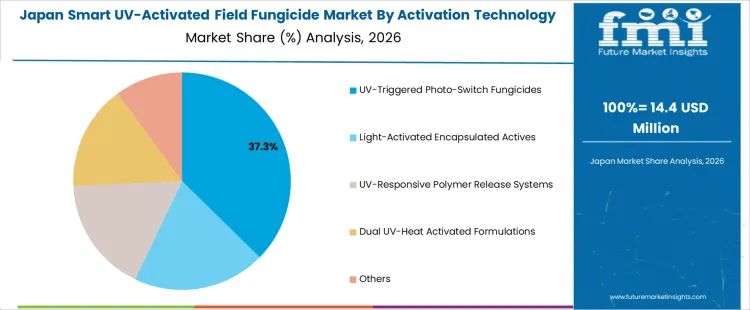
The smart UV-activated field fungicide market is driven by activation technologies and fungicide types. Among activation technologies, UV-triggered photo-switch fungicides lead the market, accounting for 39% of the market share, followed by light-activated encapsulated actives, UV-responsive polymer release systems, and dual UV-heat activated formulations. In terms of fungicide types, systemic fungicides dominate, comprising 44% of the market share, with contact fungicides, biological/bio-hybrid fungicides, and multi-site protectants also contributing.
These smart fungicides are designed to release their active ingredients when exposed to UV light, providing targeted, efficient pest control. The market is expanding as demand for environmentally friendly, precise, and effective agricultural solutions rises. The growing interest in sustainable farming practices and reduced chemical use is driving the adoption of UV-activated field fungicides, making them increasingly popular in crop protection.
What is Driving Growth in the UV-Triggered Photo-Switch Fungicides Segment of the Fungicide Activation Technology Market?
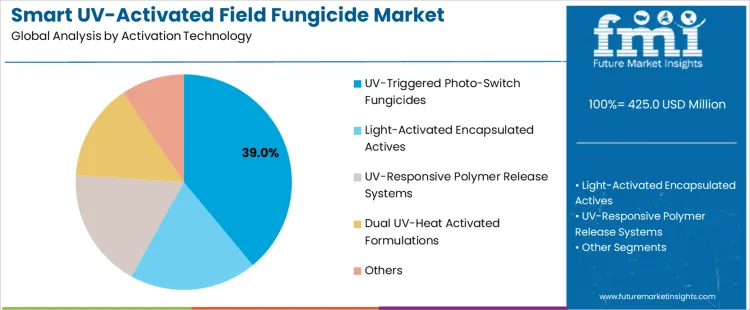
UV-triggered photo-switch fungicides represent the largest activation technology segment in the smart UV-activated field fungicide market, holding 39% of the market share. This growth is driven by the unique ability of photo-switch fungicides to activate their fungicidal properties when exposed to UV light, allowing for precise, on-demand control of fungal infections.
These fungicides offer enhanced efficacy, as they are only activated when needed, reducing the environmental impact associated with traditional chemical fungicides. As agriculture moves toward more sustainable practices, photo-switch fungicides are increasingly being adopted for their ability to minimize pesticide use while providing targeted protection for crops. This innovative approach to fungicide activation is expected to continue to grow as it aligns with both regulatory trends and consumer demand for environmentally responsible farming solutions.
What is Contributing to the Growth of Systemic Fungicides in the Fungicide Type Segment?
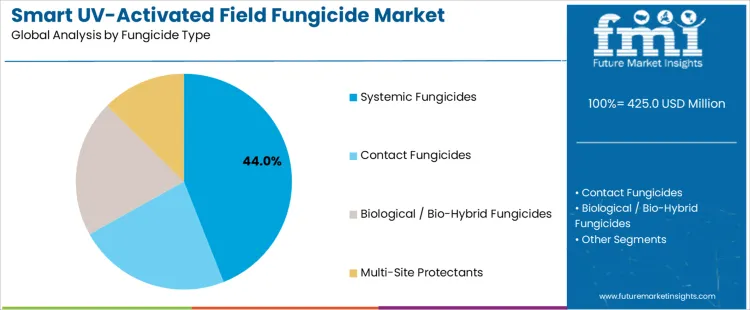
Systemic fungicides are the leading fungicide type in the smart UV-activated field fungicide market, comprising 44% of the market share. Systemic fungicides are widely used in agriculture because they are absorbed by the plant and provide long-lasting protection by moving through the plant’s vascular system. This makes them effective against a wide range of fungal pathogens that affect various crops. The growth of this segment is fueled by the demand for more effective, preventive fungicide treatments that offer extended protection, especially in high-risk environments.
The incorporation of UV-activated technology into systemic fungicides enhances their performance by providing controlled release, which increases efficacy while reducing the frequency of applications. As sustainable agriculture practices and reduced chemical usage become increasingly important, the demand for systemic fungicides, particularly those with UV-activated properties, is expected to continue rising.
What is the Key Dynamics of the Global Smart UV-Activated Field Fungicide Market?
The global smart UV activated field fungicide market is developing as growers and crop protection companies adopt responsive chemistries that activate when exposed to ultraviolet light in field conditions. These formulations remain stable until UV triggers release of fungicidal activity, reducing unnecessary exposure and enhancing precision against fungal pathogens. Demand is influenced by increased fungal pressure due to shifting weather patterns, emphasis on sustainable practices, and integration with digital agriculture tools. Adoption spans cereals, fruits and vegetables where protection timing and environmental impact influence productivity and product choice globally.
What are the Key Drivers for the Global Smart UV-Activated Field Fungicide Market?
Rising incidence of crop diseases caused by fungi encourages investment in advanced fungicide technologies that improve timing of active release. Farmers seek products that reduce off target effects and align protection with periods of high pathogen risk, reducing waste and costs associated with repeated sprays. Expansion of precision agriculture supports adoption of smart inputs that integrate with crop monitoring systems and environmental sensors. Regulatory focus on reducing overall chemical usage and minimizing environmental residues boosts interest in targeted activation approaches. Growth of high value crops with sensitivity to disease pressure supports demand for responsive fungicide solutions that can adapt to field conditions.
What are the Restraints for the Global Smart UV-Activated Field Fungicide Market?
Challenges include complexity and cost of developing UV-responsive formulations that meet stringent performance and regulatory criteria. Research and validation of activation mechanisms require investment in material science and field trials to demonstrate consistency under variable sunlight and crop canopies. Some growers and advisors remain cautious about new activation based products until regional data supports reliability across climates and pathogens. Pricing premiums relative to conventional fungicides may limit uptake in price sensitive markets. Variation in regulatory frameworks for novel fungicide technologies across countries can affect timing of product availability and adoption.
What is the Key Trends in the Global Smart UV-Activated Field Fungicide Market?
A trend is integration of smart fungicide formulations with decision support systems that use weather, crop stage and disease models to recommend application timing and product choice. Developers are refining UV activated chemistries to ensure activation thresholds align with canopy light conditions and crop schedules. Combination products that pair UV responsive components with broader mode of action strategies are emerging to address resistance management. Collaboration between formulation chemists and agronomists is increasing to tailor solutions for specific crop systems. Emphasis on environmental stewardship and reduced chemical footprints in sustainable farming programs influences product positioning and adoption strategies by growers and crop protection suppliers.
What is the Country-Wise Analysis of the Smart UV-Activated Field Fungicide Market?
The smart UV-activated field fungicide market is expected to grow at a strong pace across several regions, driven by increasing demand for efficient, sustainable, and technologically advanced agricultural solutions. UV-activated fungicides are designed to activate upon exposure to UV light, providing a targeted and controlled application that reduces waste and environmental impact.
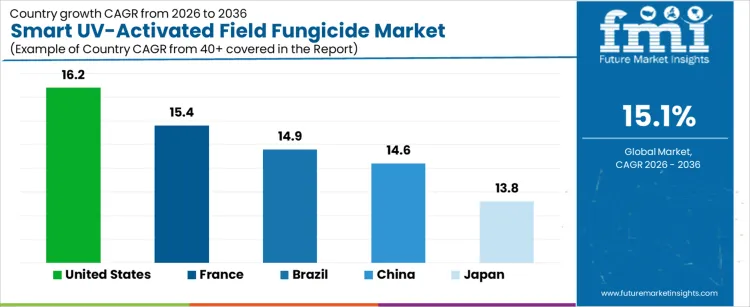
The market growth is largely attributed to the need for better crop protection methods, the increasing adoption of precision agriculture, and the rising awareness of sustainable farming practices. High-growth markets like the United States, France, and Brazil are seeing strong demand due to their established agricultural sectors, while China and Japan are also experiencing growth driven by their efforts to modernize agriculture and reduce the impact of chemicals.
| Country | CAGR (2026 to 2036) |
|---|---|
| United States | 16.2% |
| France | 15.4% |
| China | 14.6% |
| Brazil | 14.9% |
| Japan | 13.8% |
What is the Growth Outlook for the Smart UV-Activated Field Fungicide Market in the United States?
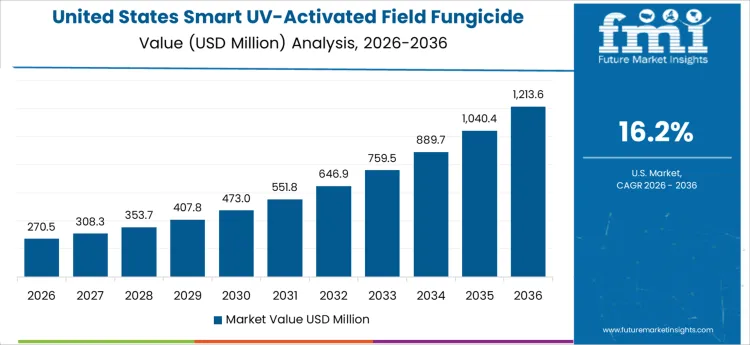
The smart UV-activated field fungicide market in the United States is expected to grow at a rapid pace, with a projected CAGR of 16.2%. The USA market benefits from a well-established agricultural industry, especially in crop production, where the need for advanced fungicide solutions is increasing. With a strong focus on precision agriculture and sustainable farming practices, USA farmers are increasingly adopting UV-activated fungicides to improve crop protection while minimizing chemical usage. The growing demand for efficient pest and disease management solutions, coupled with advancements in agricultural technology, is expected to drive significant market growth in the USA The trend toward more environmentally friendly and cost-effective solutions in agriculture further supports this growth.
What is the Market Outlook for the Smart UV-Activated Field Fungicide Market in France?
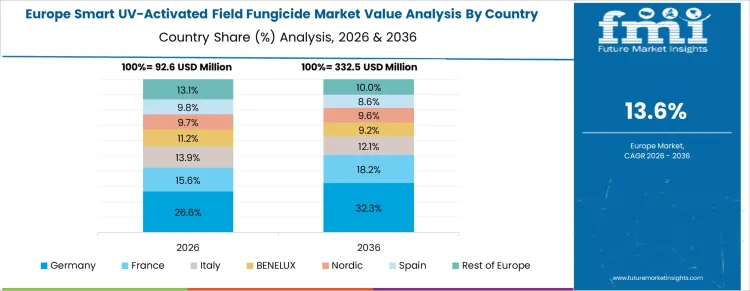
The smart UV-activated field fungicide market in France is projected to grow at a strong pace, with a projected CAGR of 15.4%. France, being one of the largest agricultural producers in Europe, is witnessing increasing demand for innovative and sustainable solutions in crop protection. The French agricultural sector is increasingly adopting precision farming technologies that use less pesticide and reduce environmental impact, driving the adoption of UV-activated fungicides. Additionally, France’s strict regulations around chemical use in farming are pushing farmers to seek alternatives that provide effective disease control while aligning with sustainability goals. As demand for eco-friendly and efficient crop protection solutions rises, the French market for UV-activated fungicides is expected to grow steadily.
What is the Growth Forecast for the Smart UV-Activated Field Fungicide Market in China?
The smart UV-activated field fungicide market in China is expected to grow at a steady pace, with a projected CAGR of 14.6%. China’s rapidly expanding agricultural sector, coupled with a growing demand for sustainable farming practices, is driving the adoption of advanced crop protection solutions. With the country focusing on reducing the environmental impact of traditional chemicals and enhancing agricultural productivity, the market for UV-activated fungicides is gaining traction. Furthermore, China’s commitment to improving food security and modernizing its agricultural practices supports the use of technology-driven solutions, such as UV-activated fungicides, which offer more targeted and eco-friendly pest management. As China continues to adopt more sustainable farming methods, the market for these fungicides is expected to grow.
What is the Market Outlook for the Smart UV-Activated Field Fungicide Market in Brazil?
The smart UV-activated field fungicide market in Brazil is projected to grow at a strong rate, with a projected CAGR of 14.9%. Brazil’s large agricultural industry, particularly in soybeans, corn, and sugarcane, is experiencing increased adoption of advanced pest and disease management solutions. As the demand for sustainable agricultural practices rises, Brazilian farmers are increasingly turning to UV-activated fungicides to reduce their reliance on traditional chemicals and improve crop protection. The adoption of these fungicides is also supported by Brazil’s focus on reducing the environmental impact of its agricultural sector and meeting global sustainability standards. As Brazil continues to innovate and modernize its farming techniques, the market for UV-activated field fungicides is expected to grow significantly.
What are the Growth Prospects for the Smart UV-Activated Field Fungicide Market in Japan?
The smart UV-activated field fungicide market in Japan is expected to grow steadily, with a projected CAGR of 13.8%. Japan’s highly advanced agricultural sector is increasingly adopting precision farming technologies to enhance crop protection and improve sustainability. As environmental regulations become more stringent, Japanese farmers are seeking alternatives to traditional chemical pesticides. UV-activated fungicides, which offer a more targeted and eco-friendly solution, are becoming increasingly popular in the country’s efforts to reduce pesticide usage and protect crops more efficiently. With Japan’s strong focus on food safety, sustainability, and technological innovation in agriculture, the market for UV-activated field fungicides is expected to grow steadily in the coming years.
What is the Competitive Landscape for the Smart UV-Activated Field Fungicide Market?
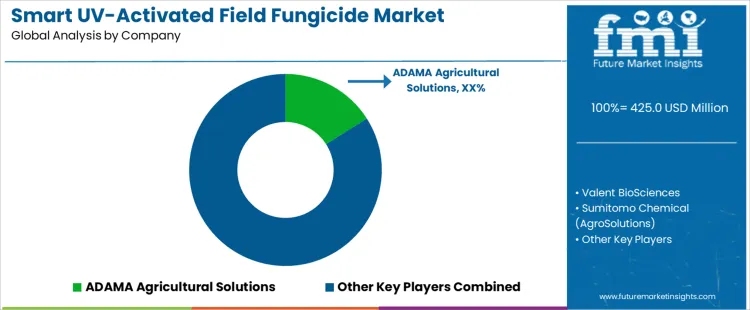
The smart UV-activated field fungicide market is expanding, driven by the increasing need for innovative solutions that enhance crop protection while being environmentally friendly. ADAMA Agricultural Solutions leads the market with its advanced UV-activated fungicides, designed to activate upon exposure to sunlight, ensuring targeted and efficient control of field fungi.
Their focus on sustainability and innovative formulations has positioned them as a key player in the market. Valent BioSciences, Sumitomo Chemical (AgroSolutions), and Belchim Crop Protection are strong competitors, each offering smart fungicide solutions that optimize application and effectiveness. Valent BioSciences focuses on bio-based solutions, while Sumitomo Chemical and Belchim Crop Protection bring advanced chemical formulations to the market, emphasizing long-lasting protection and efficiency.
Isagro S.p.A. and Others further contribute to the competitive landscape by offering their own innovative UV-activated fungicide products. Isagro S.p.A. specializes in developing environmentally friendly fungicides that target a range of crop diseases.
Other companies in this market compete by focusing on developing formulations that improve the efficacy of fungicides, reduce environmental impact, and provide better cost efficiency for farmers. The competition is driven by the ability to offer solutions that meet the growing demand for sustainable agricultural practices and more precise, targeted crop protection.
Key Players of the Smart UV-Activated Field Fungicide Market
- ADAMA Agricultural Solutions
- Valent BioSciences
- Sumitomo Chemical (AgroSolutions)
- Belchim Crop Protection
- Isagro S.p.A.
- Others
Scope of the Report
| Items | Values |
|---|---|
| Quantitative Units (2026) | USD Million |
| Activation Technology | UV-Triggered Photo-Switch Fungicides, Light-Activated Encapsulated Actives, UV-Responsive Polymer Release Systems, Dual UV-Heat Activated Formulations, Others |
| Fungicide Type | Systemic Fungicides, Contact Fungicides, Biological / Bio-Hybrid Fungicides, Multi-Site Protectants, Others |
| Crop Type | Cereals & Grains, Fruits & Vegetables, Vineyards, Plantation & Specialty Crops, Others |
| Companies | ADAMA Agricultural Solutions, Valent BioSciences, Sumitomo Chemical (AgroSolutions), Belchim Crop Protection, Isagro S.p.A., Others |
| Regions Covered | North America, Latin America, Western Europe, Eastern Europe, South Asia and Pacific, East Asia, Middle East & Africa |
| Countries Covered | United States, Canada, Mexico, Brazil, Argentina, Germany, France, United Kingdom, Italy, Spain, Netherlands, China, India, Japan, South Korea, ANZ, GCC Countries, South Africa |
| Additional Attributes | Dollar by sales by activation technology, fungicide type, crop type, and region. Includes market trends in smart UV-activated field fungicides, focusing on UV-triggered photo-switch fungicides, light-activated encapsulated actives, and biological/bio-hybrid fungicides. Highlights the role of UV-responsive polymer release systems and dual UV-heat activated formulations in improving crop protection. Focus on cost-effectiveness, sustainability, regulatory compliance, market share, and competitive positioning of key companies in the fungicide sector. |
Smart UV-Activated Field Fungicide Market Segmentation
By Activation Technology:
- UV-Triggered Photo-Switch Fungicides
- Light-Activated Encapsulated Actives
- UV-Responsive Polymer Release Systems
- Dual UV-Heat Activated Formulations
- Others
By Fungicide Type:
- Systemic Fungicides
- Contact Fungicides
- Biological / Bio-Hybrid Fungicides
- Multi-Site Protectants
- Others
By Crop Type:
- Cereals & Grains
- Fruits & Vegetables
- Vineyards
- Plantation & Specialty Crops
- Others
By Region:
- Asia Pacific
- China
- Japan
- South Korea
- India
- Australia & New Zealand
- ASEAN
- Rest of Asia Pacific
- Europe
- Germany
- United Kingdom
- France
- Italy
- Spain
- Nordic
- BENELUX
- Rest of Europe
- North America
- United States
- Canada
- Mexico
- Latin America
- Brazil
- Chile
- Rest of Latin America
- Middle East & Africa
- Kingdom of Saudi Arabia
- Other GCC Countries
- Turkey
- South Africa
- Other African Union
- Rest of Middle East & Africa
Frequently Asked Questions
How big is the smart UV-activated field fungicide market in 2026?
The global smart UV-activated field fungicide market is estimated to be valued at USD 425.0 million in 2026.
What will be the size of smart UV-activated field fungicide market in 2036?
The market size for the smart UV-activated field fungicide market is projected to reach USD 1,734.4 million by 2036.
How much will be the smart UV-activated field fungicide market growth between 2026 and 2036?
The smart UV-activated field fungicide market is expected to grow at a 15.1% CAGR between 2026 and 2036.
What are the key product types in the smart UV-activated field fungicide market?
The key product types in smart UV-activated field fungicide market are UV-triggered photo-switch fungicides, light-activated encapsulated actives, UV-responsive polymer release systems, dual UV-heat activated formulations and others.
Which fungicide type segment to contribute significant share in the smart UV-activated field fungicide market in 2026?
In terms of fungicide type, systemic fungicides segment to command 44.0% share in the smart UV-activated field fungicide market in 2026.
Preview the report firsthand - request a free sample
Get SampleGet the brochure for pricing and purchase details.
Get PDFTable of Content
- Executive Summary
- Global Market Outlook
- Demand-side Trends
- Supply-side Trends
- Technology Roadmap Analysis
- Analysis and Recommendations
- Market Overview
- Market Coverage / Taxonomy
- Market Definition / Scope / Limitations
- Market Background
- Market Dynamics
- Drivers
- Restraints
- Opportunity
- Trends
- Scenario Forecast
- Demand in Optimistic Scenario
- Demand in Likely Scenario
- Demand in Conservative Scenario
- Opportunity Map Analysis
- Product Life Cycle Analysis
- Supply Chain Analysis
- Investment Feasibility Matrix
- Value Chain Analysis
- PESTLE and Porter’s Analysis
- Regulatory Landscape
- Regional Parent Market Outlook
- Production and Consumption Statistics
- Import and Export Statistics
- Market Dynamics
- Global Market Analysis 2021 to 2025 and Forecast, 2026 to 2036
- Historical Market Size Value (USD Million) Analysis, 2021 to 2025
- Current and Future Market Size Value (USD Million) Projections, 2026 to 2036
- Y-o-Y Growth Trend Analysis
- Absolute $ Opportunity Analysis
- Global Market Pricing Analysis 2021 to 2025 and Forecast 2026 to 2036
- Global Market Analysis 2021 to 2025 and Forecast 2026 to 2036, By Activation Technology
- Introduction / Key Findings
- Historical Market Size Value (USD Million) Analysis By Activation Technology , 2021 to 2025
- Current and Future Market Size Value (USD Million) Analysis and Forecast By Activation Technology , 2026 to 2036
- UV-Triggered Photo-Switch Fungicides
- Light-Activated Encapsulated Actives
- UV-Responsive Polymer Release Systems
- Dual UV-Heat Activated Formulations
- Others
- Y-o-Y Growth Trend Analysis By Activation Technology , 2021 to 2025
- Absolute $ Opportunity Analysis By Activation Technology , 2026 to 2036
- Global Market Analysis 2021 to 2025 and Forecast 2026 to 2036, By Fungicide Type
- Introduction / Key Findings
- Historical Market Size Value (USD Million) Analysis By Fungicide Type, 2021 to 2025
- Current and Future Market Size Value (USD Million) Analysis and Forecast By Fungicide Type, 2026 to 2036
- Systemic Fungicides
- Contact Fungicides
- Biological / Bio-Hybrid Fungicides
- Multi-Site Protectants
- Y-o-Y Growth Trend Analysis By Fungicide Type, 2021 to 2025
- Absolute $ Opportunity Analysis By Fungicide Type, 2026 to 2036
- Global Market Analysis 2021 to 2025 and Forecast 2026 to 2036, By Crop Type
- Introduction / Key Findings
- Historical Market Size Value (USD Million) Analysis By Crop Type, 2021 to 2025
- Current and Future Market Size Value (USD Million) Analysis and Forecast By Crop Type, 2026 to 2036
- Cereals & Grains
- Fruits & Vegetables
- Vineyards
- Plantation & Specialty Crops
- Others
- Y-o-Y Growth Trend Analysis By Crop Type, 2021 to 2025
- Absolute $ Opportunity Analysis By Crop Type, 2026 to 2036
- Global Market Analysis 2021 to 2025 and Forecast 2026 to 2036, By Region
- Introduction
- Historical Market Size Value (USD Million) Analysis By Region, 2021 to 2025
- Current Market Size Value (USD Million) Analysis and Forecast By Region, 2026 to 2036
- North America
- Latin America
- Western Europe
- Eastern Europe
- East Asia
- South Asia and Pacific
- Middle East & Africa
- Market Attractiveness Analysis By Region
- North America Market Analysis 2021 to 2025 and Forecast 2026 to 2036, By Country
- Historical Market Size Value (USD Million) Trend Analysis By Market Taxonomy, 2021 to 2025
- Market Size Value (USD Million) Forecast By Market Taxonomy, 2026 to 2036
- By Country
- USA
- Canada
- Mexico
- By Activation Technology
- By Fungicide Type
- By Crop Type
- By Country
- Market Attractiveness Analysis
- By Country
- By Activation Technology
- By Fungicide Type
- By Crop Type
- Key Takeaways
- Latin America Market Analysis 2021 to 2025 and Forecast 2026 to 2036, By Country
- Historical Market Size Value (USD Million) Trend Analysis By Market Taxonomy, 2021 to 2025
- Market Size Value (USD Million) Forecast By Market Taxonomy, 2026 to 2036
- By Country
- Brazil
- Chile
- Rest of Latin America
- By Activation Technology
- By Fungicide Type
- By Crop Type
- By Country
- Market Attractiveness Analysis
- By Country
- By Activation Technology
- By Fungicide Type
- By Crop Type
- Key Takeaways
- Western Europe Market Analysis 2021 to 2025 and Forecast 2026 to 2036, By Country
- Historical Market Size Value (USD Million) Trend Analysis By Market Taxonomy, 2021 to 2025
- Market Size Value (USD Million) Forecast By Market Taxonomy, 2026 to 2036
- By Country
- Germany
- UK
- Italy
- Spain
- France
- Nordic
- BENELUX
- Rest of Western Europe
- By Activation Technology
- By Fungicide Type
- By Crop Type
- By Country
- Market Attractiveness Analysis
- By Country
- By Activation Technology
- By Fungicide Type
- By Crop Type
- Key Takeaways
- Eastern Europe Market Analysis 2021 to 2025 and Forecast 2026 to 2036, By Country
- Historical Market Size Value (USD Million) Trend Analysis By Market Taxonomy, 2021 to 2025
- Market Size Value (USD Million) Forecast By Market Taxonomy, 2026 to 2036
- By Country
- Russia
- Poland
- Hungary
- Balkan & Baltic
- Rest of Eastern Europe
- By Activation Technology
- By Fungicide Type
- By Crop Type
- By Country
- Market Attractiveness Analysis
- By Country
- By Activation Technology
- By Fungicide Type
- By Crop Type
- Key Takeaways
- East Asia Market Analysis 2021 to 2025 and Forecast 2026 to 2036, By Country
- Historical Market Size Value (USD Million) Trend Analysis By Market Taxonomy, 2021 to 2025
- Market Size Value (USD Million) Forecast By Market Taxonomy, 2026 to 2036
- By Country
- China
- Japan
- South Korea
- By Activation Technology
- By Fungicide Type
- By Crop Type
- By Country
- Market Attractiveness Analysis
- By Country
- By Activation Technology
- By Fungicide Type
- By Crop Type
- Key Takeaways
- South Asia and Pacific Market Analysis 2021 to 2025 and Forecast 2026 to 2036, By Country
- Historical Market Size Value (USD Million) Trend Analysis By Market Taxonomy, 2021 to 2025
- Market Size Value (USD Million) Forecast By Market Taxonomy, 2026 to 2036
- By Country
- India
- ASEAN
- Australia & New Zealand
- Rest of South Asia and Pacific
- By Activation Technology
- By Fungicide Type
- By Crop Type
- By Country
- Market Attractiveness Analysis
- By Country
- By Activation Technology
- By Fungicide Type
- By Crop Type
- Key Takeaways
- Middle East & Africa Market Analysis 2021 to 2025 and Forecast 2026 to 2036, By Country
- Historical Market Size Value (USD Million) Trend Analysis By Market Taxonomy, 2021 to 2025
- Market Size Value (USD Million) Forecast By Market Taxonomy, 2026 to 2036
- By Country
- Kingdom of Saudi Arabia
- Other GCC Countries
- Turkiye
- South Africa
- Other African Union
- Rest of Middle East & Africa
- By Activation Technology
- By Fungicide Type
- By Crop Type
- By Country
- Market Attractiveness Analysis
- By Country
- By Activation Technology
- By Fungicide Type
- By Crop Type
- Key Takeaways
- Key Countries Market Analysis
- USA
- Pricing Analysis
- Market Share Analysis, 2025
- By Activation Technology
- By Fungicide Type
- By Crop Type
- Canada
- Pricing Analysis
- Market Share Analysis, 2025
- By Activation Technology
- By Fungicide Type
- By Crop Type
- Mexico
- Pricing Analysis
- Market Share Analysis, 2025
- By Activation Technology
- By Fungicide Type
- By Crop Type
- Brazil
- Pricing Analysis
- Market Share Analysis, 2025
- By Activation Technology
- By Fungicide Type
- By Crop Type
- Chile
- Pricing Analysis
- Market Share Analysis, 2025
- By Activation Technology
- By Fungicide Type
- By Crop Type
- Germany
- Pricing Analysis
- Market Share Analysis, 2025
- By Activation Technology
- By Fungicide Type
- By Crop Type
- UK
- Pricing Analysis
- Market Share Analysis, 2025
- By Activation Technology
- By Fungicide Type
- By Crop Type
- Italy
- Pricing Analysis
- Market Share Analysis, 2025
- By Activation Technology
- By Fungicide Type
- By Crop Type
- Spain
- Pricing Analysis
- Market Share Analysis, 2025
- By Activation Technology
- By Fungicide Type
- By Crop Type
- France
- Pricing Analysis
- Market Share Analysis, 2025
- By Activation Technology
- By Fungicide Type
- By Crop Type
- India
- Pricing Analysis
- Market Share Analysis, 2025
- By Activation Technology
- By Fungicide Type
- By Crop Type
- ASEAN
- Pricing Analysis
- Market Share Analysis, 2025
- By Activation Technology
- By Fungicide Type
- By Crop Type
- Australia & New Zealand
- Pricing Analysis
- Market Share Analysis, 2025
- By Activation Technology
- By Fungicide Type
- By Crop Type
- China
- Pricing Analysis
- Market Share Analysis, 2025
- By Activation Technology
- By Fungicide Type
- By Crop Type
- Japan
- Pricing Analysis
- Market Share Analysis, 2025
- By Activation Technology
- By Fungicide Type
- By Crop Type
- South Korea
- Pricing Analysis
- Market Share Analysis, 2025
- By Activation Technology
- By Fungicide Type
- By Crop Type
- Russia
- Pricing Analysis
- Market Share Analysis, 2025
- By Activation Technology
- By Fungicide Type
- By Crop Type
- Poland
- Pricing Analysis
- Market Share Analysis, 2025
- By Activation Technology
- By Fungicide Type
- By Crop Type
- Hungary
- Pricing Analysis
- Market Share Analysis, 2025
- By Activation Technology
- By Fungicide Type
- By Crop Type
- Kingdom of Saudi Arabia
- Pricing Analysis
- Market Share Analysis, 2025
- By Activation Technology
- By Fungicide Type
- By Crop Type
- Turkiye
- Pricing Analysis
- Market Share Analysis, 2025
- By Activation Technology
- By Fungicide Type
- By Crop Type
- South Africa
- Pricing Analysis
- Market Share Analysis, 2025
- By Activation Technology
- By Fungicide Type
- By Crop Type
- USA
- Market Structure Analysis
- Competition Dashboard
- Competition Benchmarking
- Market Share Analysis of Top Players
- By Regional
- By Activation Technology
- By Fungicide Type
- By Crop Type
- Competition Analysis
- Competition Deep Dive
- ADAMA Agricultural Solutions
- Overview
- Product Portfolio
- Profitability by Market Segments (Product/Age /Sales Channel/Region)
- Sales Footprint
- Strategy Overview
- Marketing Strategy
- Product Strategy
- Channel Strategy
- Valent BioSciences
- Sumitomo Chemical (AgroSolutions)
- Belchim Crop Protection
- Isagro S.p.A.
- Others
- ADAMA Agricultural Solutions
- Competition Deep Dive
- Assumptions & Acronyms Used
- Research Methodology


