

- Industry Size (2026)
- USD 67.0 Mn
- Forecast (2036)
- USD 110.5 Mn
- CAGR (2026 to 2036)
- 5.1%
Demand for Tracheal Tubes and Airway Products in South Korea Forecast and Outlook 2026 to 2036
Demand for tracheal tubes and airway management solutions in South Korea is anticipated to reach USD 67.0 million by 2026. The sector is poised to ascend to USD 110.5 million by 2036, progressing at a compound annual growth rate of 5.1%. South Korea faces an accelerating demographic shift towards an aged society, which directly correlates with higher incidences of respiratory failure and chronic obstructive pulmonary diseases. Elderly patients often require assisted ventilation during hospitalization, necessitating reliable intubation devices. Rising surgical volumes, particularly for cardiovascular and orthopedic procedures among seniors, further drive consumption of anesthesia-related disposables. Clinicians prioritize patient safety, leading to increased adoption of single-use devices to minimize cross-contamination risks in critical care settings.
National health insurance policies are expanding coverage for essential medical supplies, reducing out-of-pocket expenses for prolonged hospitalizations. Regulatory bodies actively enforce strict quality standards for medical devices, compelling hospitals to procure high-grade consumables from reputable suppliers. Infrastructure investments in trauma centers and emergency departments across metropolitan areas ensure that advanced airway management tools are readily available for critical cases. Public awareness regarding infection control has heightened post-pandemic, influencing procurement strategies towards sterile, individually packaged products. Medical institutions are also investing in training programs for anesthesiologists and paramedics, ensuring optimal utilization of these life-saving tools during emergencies.
Quick Stats for Demand for Tracheal Tubes and Airway Products in South Korea
- Demand for Tracheal Tubes and Airway Products in South Korea Value (2026): USD 67.0 million
- Demand for Tracheal Tubes and Airway Products in South Korea Forecast Value (2036): USD 110.5 million
- Demand for Tracheal Tubes and Airway Products in South Korea Forecast CAGR: 5.1%
- Leading Product Type Segment for Tracheal Tubes and Airway Products Industry in South Korea: Products (84.0%)
- Leading Material Segment for Tracheal Tubes and Airway Products Industry in South Korea: Polyvinyl Chloride (PVC) (48.6%)
- Leading End User Segment for Tracheal Tubes and Airway Products Industry in South Korea: Hospitals (71.3%)
- Key Growth Regions for Tracheal Tubes and Airway Products Industry in South Korea: Jeju, South Gyeongsang, South Jeolla, North Jeolla
- Tracheal Tubes and Airway Products Industry in South Korea Key Players: Medtronic plc, Smith’s Medical (ICU Medical, Inc.), Teleflex Incorporated, Ambu A/S, Vyaire Medical, Inc.
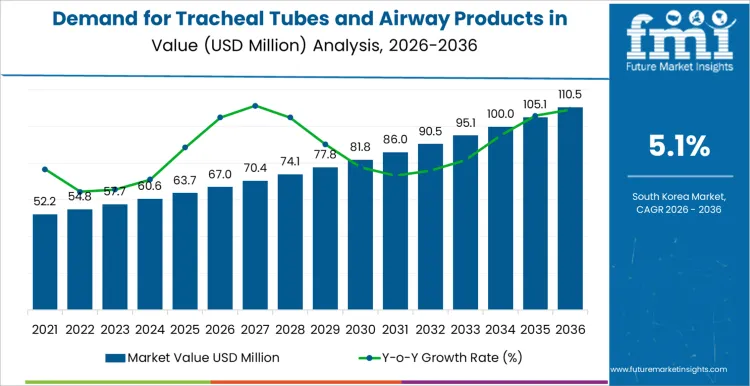
Innovation in material science is reshaping product offerings, with a focus on patient comfort and safety. Manufacturers are introducing endotracheal tube solutions featuring biocompatible materials that reduce tracheal trauma during prolonged intubation. Adoption of airway management devices trends includes integration of subglottic secretion drainage ports to prevent ventilator-associated pneumonia. Shifts towards safer materials are evident, yet cost-effective intubation tube options remain vital for general ward settings. Advancements in laryngeal mask designs offer alternatives to traditional intubation, providing rapid airway access during difficult scenarios. These technological strides ensure that healthcare providers have diverse options tailored to specific patient needs.
Demand for Tracheal Tubes and Airway Products in South Korea Key Takeaways
South Korea's airway management domain is characterized by a strong reliance on hospital-based care and high-quality consumables. Polyvinyl Chloride remains the dominant material due to its balance of flexibility and cost-effectiveness, although silicone and safer polymers are gaining traction. Hospitals represent the primary consumption channel, driven by routine surgeries and emergency admissions. Regional growth patterns indicate a decentralization of medical services, with provincial areas expanding critical care capabilities. Competitive dynamics favor global medtech giants who offer comprehensive portfolios, while local distributors play a crucial role in last-mile delivery. Sustainability concerns are emerging, pushing manufacturers to explore eco-friendly disposal methods for massive volumes of plastic waste generated daily.
| Metric | Value |
|---|---|
| Industry Size (2026) | USD 67.0 million |
| Industry Value (2036) | USD 110.5 million |
| CAGR (2026 to 2036) | 5.1% |
What Clinical Factors Are Fueling Airway Product Adoption?
Increasing prevalence of chronic respiratory ailments acts as a primary catalyst for sector expansion. Air pollution and smoking habits contribute to high rates of lung disease, necessitating frequent interventions involving therapeutic respiratory devices solutions. Complex surgeries requiring general anesthesia are becoming more common as medical technology advances, ensuring steady demand for airway catheters supplies. Emergency medical services are upgrading their capabilities, stocking advanced airway tools in ambulances to improve pre-hospital survival rates. Focus on reducing hospital-acquired infections drives the replacement of reusable items with single-use disposables, creating a consistent revenue stream for manufacturers supplying sterile tubing and masks.
How is the Sector Structured Across Key Segments?
Structure of this domain is categorized by product type, material composition, and end-user facility. Product segmentation distinguishes between core tubes and supplementary accessories, with core devices driving volume. Material classification highlights the dominance of PVC alongside premium alternatives like silicone and TPU. End-user data underscores the critical role of tertiary hospitals compared to homecare or ambulatory settings. Understanding this segmentation helps suppliers optimize inventory, focusing on high-volume PVC products for general use while stocking specialized silicone variants for sensitive pediatric or long-term care cases.
Why Do Core Products Maintain Dominance?
Core Products command an 84.0% share of total revenue. Essential nature of endotracheal and tracheostomy tubes in critical care ensures their dominant position. Every general anesthesia procedure requires a primary airway device, guaranteeing baseline consumption volumes. Accessories, while important, are supplementary and often have lower unit costs. Innovation is heavily focused on improving the core tube design, such as adding cuffs that prevent aspiration or reinforced walls that resist kinking. Hospitals allocate the majority of their airway management budgets to these fundamental tools, prioritizing reliability and ease of insertion over peripheral add-ons.
Why is Polyvinyl Chloride (PVC) the Preferred Material?
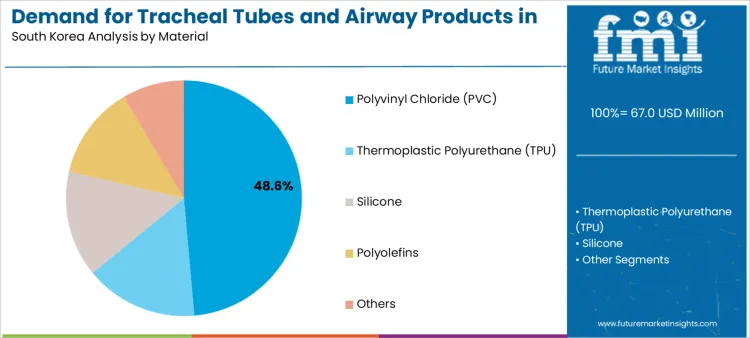
Polyvinyl Chloride (PVC) captures a 48.6% share of usage. Medical-grade PVC offers an optimal balance of rigidity for insertion and flexibility at body temperature to conform to patient anatomy. Cost-effectiveness is a major factor, as PVC allows for mass production of affordable single-use devices, essential for cost-conscious healthcare systems. Transparency of PVC allows clinicians to visualize condensation or blockages within the tube easily. Despite concerns regarding phthalates, advanced formulations are addressing safety issues, ensuring PVC remains the material of choice for standard short-term intubation requirements in adult patients.
Why Do Hospitals Lead Consumption?
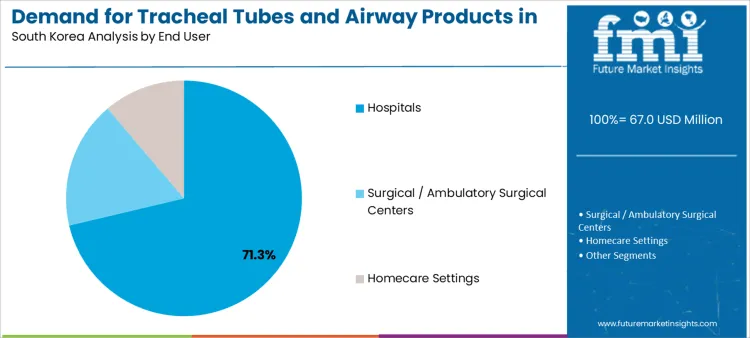
Hospitals account for 71.3% of sector demand. Complex airway management procedures, including intubation and mechanical ventilation, are predominantly performed in hospital operating rooms and intensive care units. positive air pressure devices utilization is highest in these settings for treating acute respiratory failure. Specialized staff and monitoring equipment available in hospitals are prerequisites for safe airway control. Emergency departments within hospitals serve as the primary entry point for trauma cases requiring immediate airway security. Consequently, procurement volume from hospital networks vastly outstrips demand from smaller clinics or homecare environments.
Will Homecare Settings Expand Future Sales?
Usage of respiratory inhaler devices and tracheostomy care products in home settings is steadily rising. Aging patients with chronic conditions prefer home-based management to prolonged hospital stays. This trend drives demand for user-friendly, durable airway products designed for non-professional caregivers. nebuliser expansion in homecare supports the need for compatible airway interfaces. Reimbursement reforms covering home mechanical ventilation are encouraging this shift. Manufacturers are responding by developing simplified care kits and educational materials, empowering families to manage stable tracheostomy patients at home, thereby opening a growing niche outside traditional hospital walls.
How Do Material Innovations Impact Safety?
Concerns regarding plasticizers in PVC are prompting a shift towards safer alternatives like Thermoplastic Polyurethane (TPU) and Silicone. TPU offers superior biocompatibility and softens significantly upon insertion, reducing mucosal injury. Veterinary endotracheal tubes trends often mirror human medicine, where silicone is preferred for reusability and comfort; in human care, silicone is gained ground in long-term tracheostomy applications. Development of antimicrobial coatings for tubes is another safety innovation aimed at preventing bacterial colonization.7 These material advancements provide clinicians with options to reduce complications, driving the adoption of premium, safer airway solutions.
Is the Trend Towards Minimally Invasive Care Affecting Demand?
Rise of less invasive ventilation strategies impacts tube consumption patterns. Non-invasive ventilation (NIV) utilizing masks instead of invasive tubes is gaining popularity for certain patient cohorts. This shifts demand towards high-performance face masks and nasal interfaces rather than traditional endotracheal tubes. However, dry powder inhaler and metered dose inhalers growth suggests a broader focus on managing respiratory health before intubation becomes necessary. Nevertheless, for surgical procedures and severe trauma, invasive airway management remains indispensable, ensuring that core tube demand remains stable despite the growth of non-invasive alternatives.
How is the Landscape Evolving Across South Korea's Regions?
Regional consumption reflects the distribution of advanced medical infrastructure and aging populations. Metropolitan areas drive innovation and high-volume procurement, while provincial regions focus on expanding access to critical care. Government efforts to equalize healthcare quality across regions are boosting demand in southern provinces.
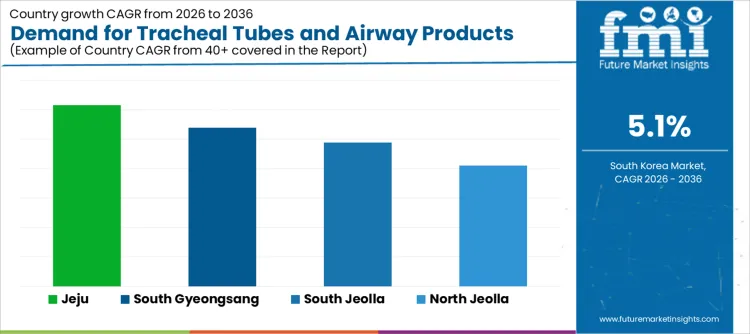
| Region | CAGR (2026 to 2036) |
|---|---|
| Jeju | 6.2% |
| South Gyeongsang | 5.4% |
| South Jeolla | 4.9% |
| North Jeolla | 4.1% |
Why is Medical Infrastructure in Jeju Driving Rapid Growth?
Adoption of airway products in Jeju is projected to expand at a CAGR of 6.2%. Jeju Island's expanding medical capabilities, driven by tourism and a growing resident population, require robust emergency care infrastructure. Local hospitals are upgrading their intensive care units to handle complex cases independently from the mainland. Investments in trauma centers on the island necessitate a steady supply of intubation devices. High volume of tourists increases the probability of accidents and medical emergencies, ensuring consistent demand for airway management tools in local emergency departments.
How is Industrial Activity in South Gyeongsang Influencing Sales?
Sales of respiratory consumables in South Gyeongsang are likely to reach a CAGR of 5.4%. Heavy industry presence in this region leads to occupational health risks, including respiratory injuries and chemical exposures requiring immediate airway intervention. Regional hospitals are equipped to handle industrial accidents, driving procurement of specialized trauma airway kits. An aging workforce in these industrial zones also contributes to higher rates of chronic lung disease, sustaining demand for long-term airway management solutions. Economic stability in the region supports continuous healthcare investment and facility modernization.
What Specific Factors Drive Demand in South Jeolla?
Expansion in South Jeolla is anticipated to rise at a CAGR of 4.9%. This province has a significantly high elderly demographic, creating a natural demand for respiratory care products. Geriatric patients frequently require airway support due to pneumonia or surgery. Public health initiatives in the region prioritize improving elderly care facilities, leading to increased stocking of essential medical supplies. Expansion of nursing homes and long-term care hospitals in South Jeolla creates a secondary market for tracheostomy care products and suction catheters.
Why is North Jeolla Modernizing its Critical Care Services?
Deployment of medical devices in North Jeolla is expected to increase at a CAGR of 4.1%. University hospitals in Jeonju are serving as regional hubs, adopting the latest airway management protocols. Focus on patient safety standards is driving the shift from reusable to single-use devices in these institutions. Educational partnerships with medical device companies are enhancing the skills of local clinicians, promoting the use of advanced video laryngoscopes and specialized tubes. Steady modernization of healthcare facilities ensures a reliable growth trajectory for airway product consumption.
What Strategic Initiatives Define Market Leadership?
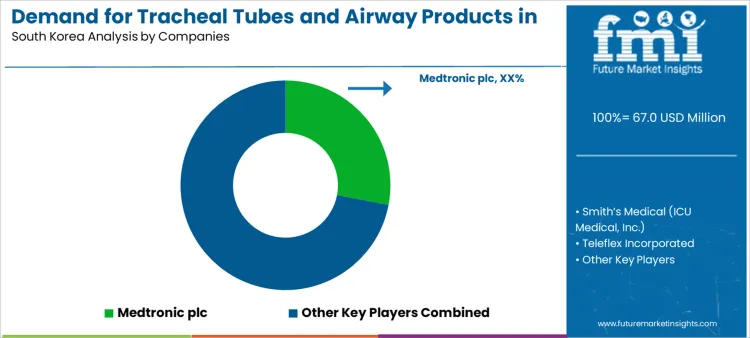
Medtronic plc commands a dominant position with a 28.0% share, leveraging its extensive portfolio of Shiley and McGrath products. Strategy focuses on offering a complete ecosystem of airway solutions, from intubation to monitoring. Medtronic invests heavily in physician training and clinical education to ensure brand loyalty. Competitors like Smith’s Medical and Teleflex differentiate through specialized niche products and strong relationships with anesthesiologists. Supply chain reliability and competitive pricing are critical factors for maintaining share in the cost-sensitive hospital tender process.
How Are Global Players Adapting to Local Needs?
International firms are customizing their offerings to suit Korean clinical preferences. Providing smaller tube sizes appropriate for Asian anatomical features is a key product adaptation. Companies establish local distribution centers to ensure rapid delivery to hospitals, minimizing inventory gaps. Collaborating with key opinion leaders in South Korean academic hospitals helps global brands introduce new technologies like video-assisted intubation. Marketing efforts often highlight safety features and compliance with local regulatory standards to build trust with hospital purchasing committees.
Key Companies
- Medtronic plc
- Smith’s Medical (ICU Medical, Inc.)
- Teleflex Incorporated
- Ambu A/S
- Vyaire Medical, Inc.
Scope of Report
| Items | Values |
|---|---|
| Quantitative Units | USD Million |
| Product Type | Products, Accessories |
| Material | Polyvinyl Chloride (PVC), Thermoplastic Polyurethane (TPU), Silicone, Polyolefins |
| End User | Hospitals, Surgical / Ambulatory Surgical Centers, Homecare Settings |
| Regions Covered | Jeju, South Gyeongsang, South Jeolla, North Jeolla |
| Key Companies Profiled | Medtronic, Smith’s Medical, Teleflex, Ambu, Vyaire Medical |
Demand for Tracheal Tubes and Airway Products in South Korea by Segments
By Product Type
- Products
- Accessories
By Material
- Polyvinyl Chloride (PVC)
- Thermoplastic Polyurethane (TPU)
- Silicone
- Polyolefins
By End User
- Hospitals
- Surgical / Ambulatory Surgical Centers
- Homecare Settings
Bibliography
- Ministry of Food and Drug Safety. (2024, December 6). Partial revision of medical device standards and specifications (Medical Device Standards and Specifications) (MFDS Notice No. 2024-78). Ministry of Food and Drug Safety, Republic of Korea.
- Ministry of Food and Drug Safety. (2024, December 18). Partial revision of medical device standards and specifications (Medical Device Standards and Specifications) (MFDS Notice No. 2024-80). Ministry of Food and Drug Safety, Republic of Korea.
- Statistics Korea. (2024, October 4). Approval notice for changes to “Major surgeries covered by national health insurance” statistics (KOSTAT Notice No. 2024-638). Statistics Korea, Republic of Korea.
- Health Insurance Review and Assessment Service. (2024, February 29). MOHW Notice No. 2024-34: Reimbursed and non-reimbursed medical materials list and maximum reimbursement prices table (treatment materials list). Health Insurance Review and Assessment Service, Republic of Korea.
- Korea Health Industry Development Institute. (2024, May 2). First survey on the medical device industry. Korea Health Industry Development Institute, Republic of Korea.
Frequently Asked Questions
How big is the demand for Tracheal Tubes and Airway Products in South Korea in 2026?
The demand for Tracheal Tubes and Airway Products in South Korea is estimated to be valued at USD 67.0 million in 2026.
What will be the size of Tracheal Tubes and Airway Products in South Korea in 2036?
The industry size for the Tracheal Tubes and Airway Products in South Korea is projected to reach USD 110.5 million by 2036.
How much will be the demand for Tracheal Tubes and Airway Products in South Korea growth between 2026 and 2036?
The demand for Tracheal Tubes and Airway Products in South Korea is expected to grow at a 5.1% CAGR between 2026 and 2036.
What are the key product types in the Tracheal Tubes and Airway Products in South Korea?
The key product types in Tracheal Tubes and Airway Products in South Korea are Products and Accessories.
Which end user segment is expected to contribute significant share in the Tracheal Tubes and Airway Products in South Korea in 2026?
By end user, Hospitals segment is expected to command 71.3% share in the Tracheal Tubes and Airway Products in South Korea in 2026.
Preview the report firsthand - request a free sample
Get SampleGet the brochure for pricing and purchase details.
Get PDFTable of Content
- Executive Summary
- South Korea Market Outlook
- Demand-side Trends
- Supply-side Trends
- Technology Roadmap Analysis
- Analysis and Recommendations
- Market Overview
- Market Coverage / Taxonomy
- Market Definition / Scope / Limitations
- Market Background
- Market Dynamics
- Drivers
- Restraints
- Opportunity
- Trends
- Scenario Forecast
- Demand in Optimistic Scenario
- Demand in Likely Scenario
- Demand in Conservative Scenario
- Opportunity Map Analysis
- Product Life Cycle Analysis
- Supply Chain Analysis
- Investment Feasibility Matrix
- Value Chain Analysis
- PESTLE and Porter’s Analysis
- Regulatory Landscape
- Regional Parent Market Outlook
- Production and Consumption Statistics
- Import and Export Statistics
- Market Dynamics
- South Korea Market Analysis 2021 to 2025 and Forecast, 2026 to 2036
- Historical Market Size Value (USD Million) Analysis, 2021 to 2025
- Current and Future Market Size Value (USD Million) Projections, 2026 to 2036
- Y-o-Y Growth Trend Analysis
- Absolute $ Opportunity Analysis
- South Korea Market Pricing Analysis 2021 to 2025 and Forecast 2026 to 2036
- South Korea Market Analysis 2021 to 2025 and Forecast 2026 to 2036, By Product Type
- Introduction / Key Findings
- Historical Market Size Value (USD Million) Analysis By Product Type , 2021 to 2025
- Current and Future Market Size Value (USD Million) Analysis and Forecast By Product Type , 2026 to 2036
- Products
- Accessories
- Vacuums
- Products
- Y-o-Y Growth Trend Analysis By Product Type , 2021 to 2025
- Absolute $ Opportunity Analysis By Product Type , 2026 to 2036
- South Korea Market Analysis 2021 to 2025 and Forecast 2026 to 2036, By Material
- Introduction / Key Findings
- Historical Market Size Value (USD Million) Analysis By Material, 2021 to 2025
- Current and Future Market Size Value (USD Million) Analysis and Forecast By Material, 2026 to 2036
- Polyvinyl Chloride (PVC)
- Thermoplastic Polyurethane (TPU)
- Silicone
- Polyolefins
- Others
- Polyvinyl Chloride (PVC)
- Y-o-Y Growth Trend Analysis By Material, 2021 to 2025
- Absolute $ Opportunity Analysis By Material, 2026 to 2036
- South Korea Market Analysis 2021 to 2025 and Forecast 2026 to 2036, By End User
- Introduction / Key Findings
- Historical Market Size Value (USD Million) Analysis By End User, 2021 to 2025
- Current and Future Market Size Value (USD Million) Analysis and Forecast By End User, 2026 to 2036
- Hospitals
- Surgical / Ambulatory Surgical Centers
- Homecare Settings
- Hospitals
- Y-o-Y Growth Trend Analysis By End User, 2021 to 2025
- Absolute $ Opportunity Analysis By End User, 2026 to 2036
- Market Structure Analysis
- Competition Dashboard
- Competition Benchmarking
- Market Share Analysis of Top Players
- By Regional
- By Product Type
- By Material
- By End User
- Competition Analysis
- Competition Deep Dive
- Medtronic plc
- Overview
- Product Portfolio
- Profitability by Market Segments (Product/Age /Sales Channel/Region)
- Sales Footprint
- Strategy Overview
- Marketing Strategy
- Product Strategy
- Channel Strategy
- Smith’s Medical (ICU Medical, Inc.)
- Teleflex Incorporated
- Ambu A/S
- Vyaire Medical, Inc.
- Medtronic plc
- Competition Deep Dive
- Assumptions & Acronyms Used
- Research Methodology


