

- Industry Size (2026)
- USD 220.0 Mn
- Forecast (2036)
- USD 335.2 Mn
- CAGR (2026 to 2036)
- 4.3%
Tow Hitch Lock and Storage Accessories Market Forecast and Outlook (2026-2036)
The tow hitch lock and storage accessories market is likely to be valued at USD 220.0 million in 2026, and reach USD 335.2 million by 2036, at 4.3% CAGR. Value formation is anchored in aftermarket replacement and incremental add-on purchases rather than factory-installed hardware. Demand concentrates where towing equipment remains attached for extended periods, increasing exposure to theft, corrosion, and mechanical wear. Purchasing behavior reflects preference for accessories that balance fit accuracy, material hardness, and ease of removal without specialized tools. Product pricing remains secondary to perceived security effectiveness because replacement cost of stolen towing components exceeds accessory expenditure in most use cases.
Volume progression reflects stability of the installed towing base rather than expansion in towing participation. Receiver class fragmentation limits universal product standardization and constrains scale efficiencies in manufacturing and inventory management. Seasonal towing activity creates uneven demand distribution across retail channels, affecting stocking strategies and turnover rates. Material cost variability influences margin management due to reliance on hardened steel and corrosion-resistant finishes. Competitive intensity remains high due to low certification barriers and frequent design imitation. Replacement cycles, vehicle changeovers, and wear-related upgrades sustain baseline demand without supporting rapid structural acceleration across mature and emerging towing-focused vehicle populations.
Quick Stats for Tow Hitch Lock and Storage Accessories Market
- Tow Hitch Lock and Storage Accessories Market Value (2026): USD 220.0 million
- Tow Hitch Lock and Storage Accessories Market Forecast Value (2036): USD 335.2 million
- Tow Hitch Lock and Storage Accessories Market Forecast CAGR 2026 to 2036: 4.3%
- Leading Product Type by Demand Share: Locking Hitch Pins & Receiver Locks
- Fastest-Growing Countries: India, Mexico, USA, Canada, Australia
- Top Players in Global Demand: Master Lock, CURT Manufacturing (Lippert), Reese Towpower, Trimax Locks, Proven Industries
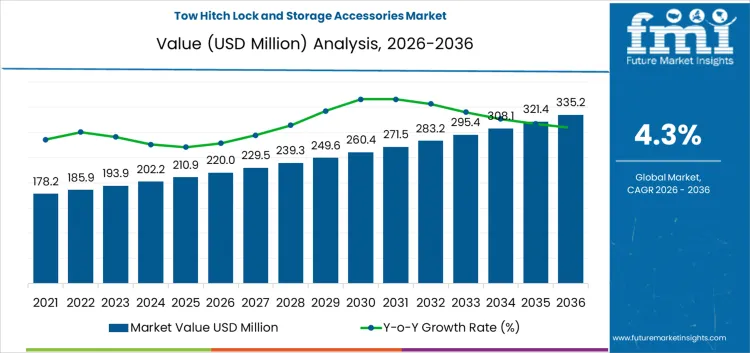
Tow Hitch Lock and Storage Accessories Market Key Takeaways
| Metric | Value |
|---|---|
| Market Value (2026) | USD 220.0 million |
| Market Forecast Value (2036) | USD 335.2 million |
| Forecast CAGR (2026-2036) | 4.3% |
Why is the Demand for Tow Hitch Lock and Storage Accessories Growing?
Demand for tow hitch lock and storage accessories is rising as vehicle owners and fleet managers seek solutions that protect towing equipment and cargo against theft and misuse. Tow hitches are frequently targeted due to their resale value and ease of removal, and locks engineered with robust materials and precision keying reduce unauthorized detachment while preserving hitch integrity. Procurement decisions emphasize corrosion resistance, fit accuracy with diverse receiver classes, and ease of operation under varied weather conditions because outdoor exposure and road vibration influence component longevity. Storage accessories such as hitch-mounted carriers and lockable boxes are specified to organize tools, recovery gear, and recreational equipment in a secure, accessible manner during travel. Transport and logistics operators also integrate lock systems with overall fleet security protocols to maintain accountability for trailing assets and minimize costly equipment loss in high utilization environments.
Growth in recreational vehicle use, off highway towing activities, and commercial hauling tasks reinforces uptake of tow hitch locks and storage accessories that align with user expectations for convenience and asset protection. Aftermarket demand remains strong because customization, seasonal accessory swaps, and expanding payload requirements drive iterative purchases of lock variants, storage modules, and compatibility kits. Mechanical engineers and end users evaluate accessory designs for ease of installation and removal without specialized tools, which supports flexible use across multiple vehicles and hitch types. Retailers and service networks maintain inventories that match prevalent receiver standards to support rapid fulfillment and minimize downtime for end users. These operational and security specific requirements are contributing to sustained demand growth in the tow hitch lock and storage accessories market.
How Are the Segments Classified in the Tow Hitch Lock and Storage Accessories Market?
Demand for tow hitch lock and storage accessories is shaped by vehicle security concerns, trailer theft prevention, and increasing recreational towing activity. Owners seek solutions that protect hitch assemblies during parking, storage, and unattended trailer attachment. Adoption aligns with growth in pickup trucks, SUVs, and recreational vehicle usage for towing and hauling. Product selection prioritizes locking strength, corrosion resistance, and ease of installation. Segment classification reflects differentiation by accessory function, vehicle compatibility, and material composition influencing durability, security effectiveness, and deployment frequency across towing applications.
Which Product Type Represents the Largest Share of Demand?
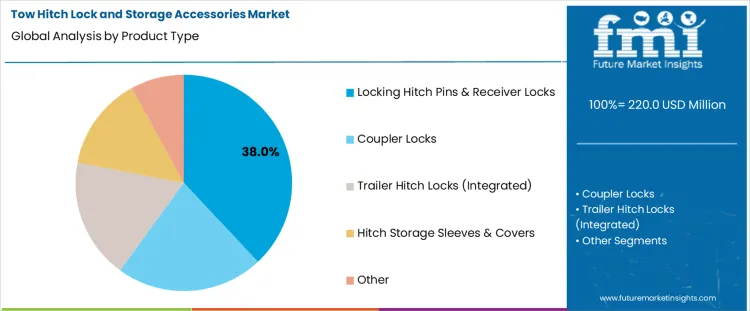
Locking hitch pins and receiver locks hold 38.0%, representing the largest share among product types due to direct theft deterrence function. These accessories secure the hitch receiver connection, preventing unauthorized removal of ball mounts and towing hardware. Simple installation supports frequent use across multiple vehicle types. Universal sizing enables compatibility with common receiver standards. Coupler locks secure trailer connections with lower usage frequency when vehicles are detached. Integrated trailer hitch locks combine functions with higher cost. Storage sleeves and covers focus on protection rather than security. Product type segmentation reflects preference for primary locking solutions addressing immediate theft risk.
Key Points
- Hitch pins secure receiver-mounted towing components.
- Universal fit supports widespread vehicle compatibility.
- Other products address coupler security or storage protection.
Which Vehicle Type Accounts for the Highest Share of Demand?
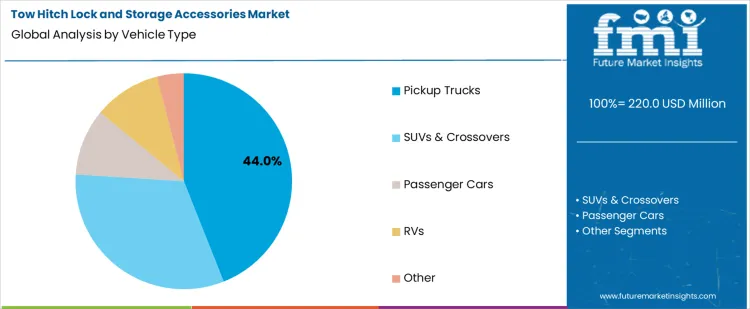
Pickup trucks hold 44.0%, representing the largest share among vehicle types due to frequent towing usage. Owners regularly tow trailers, equipment, and recreational loads requiring secure hitch protection. Higher payload and towing ratings increase accessory attachment frequency. Usage across work and leisure contexts raises theft exposure risk. SUVs and crossovers apply hitch accessories for recreational towing with moderate frequency. Passenger cars and RVs contribute lower aggregate volume. Vehicle type segmentation reflects concentration where towing intensity, accessory attachment duration, and exposure risk remain highest.
Key Points
- Pickups perform frequent work and recreational towing.
- Higher hitch usage increases security accessory demand.
- Other vehicles tow less frequently or seasonally.
Which Material Accounts for the Highest Share of Demand?
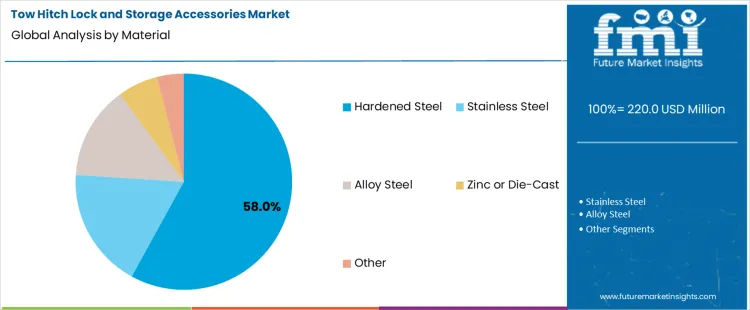
Hardened steel holds 58.0%, representing the largest share among materials due to strength and tamper resistance. High hardness resists cutting, drilling, and forced removal attempts. Structural integrity remains stable under outdoor exposure and repeated locking cycles. Material density reinforces user perception of security effectiveness. Stainless steel offers corrosion resistance with lower hardness. Alloy steel balances strength and weight. Zinc or die-cast materials support lightweight designs with reduced security performance. Material segmentation reflects preference for robust metals where theft deterrence and durability remain critical.
Key Points
- Hardened steel resists cutting and forced entry.
- Strength supports long-term outdoor durability.
- Other materials balance corrosion resistance or weight.
What are the Key Dynamics in the Tow Hitch Lock and Storage Accessories Market?
Demand for tow hitch lock and storage accessories reflects security, organization, and equipment protection needs associated with trailer hitch usage. Adoption concentrates in light trucks, SUVs, recreational towing, and commercial fleet vehicles. Global scope aligns with rising trailer attachment frequency and theft prevention requirements. Usage centers on hitch pin locks, coupler locks, receiver tube covers, and dedicated storage mounts designed to secure, store, and preserve hitch components during active and idle use.
How do theft prevention need and towing usage patterns shape adoption?
Tow hitch components remain exposed and easily removable, increasing theft risk in public parking and storage environments. Demand increases as users transport trailers, bike racks, cargo carriers, and towing accessories with high replacement cost. Locking devices prevent unauthorized removal of ball mounts and hitch pins during vehicle downtime. Commercial fleets rely on locks to avoid asset loss and operational disruption. Recreational users adopt storage accessories to organize hitch components when not towing, reducing corrosion and misplacement. Compatibility with multiple receiver sizes influences purchasing decisions. Weather-resistant materials support outdoor use across varied climates. Adoption reflects practical security and equipment management requirements tied directly to towing frequency.
How do product standardization limits and cost sensitivity influence market scalability?
Hitch receivers vary by class and size, limiting universal fit across vehicle platforms. Demand sensitivity rises where users prioritize low-cost accessories due to perceived simplicity. Material durability affects performance under exposure to road salt, moisture, and debris. Lock mechanisms face wear and jamming risk without proper sealing. Aftermarket competition introduces quality variability and pricing pressure. Storage solutions require vehicle-specific mounting space, constraining applicability. Limited regulatory oversight reduces enforced quality benchmarks. Replacement demand fluctuates with towing seasonality, constraining predictable volume scaling across global user segments.
How Is Demand for Tow Hitch Lock and Storage Accessories Evolving Globally?
Demand for tow hitch lock and storage accessories is expanding globally due to growth in recreational towing, vehicle accessory adoption, and theft prevention requirements. Pickup trucks, SUVs, and utility vehicles increasingly use towing equipment for recreational, commercial, and lifestyle purposes. Owners prioritize security, organized storage, and compliance with road safety norms. Replacement demand emerges from wear, corrosion, and vehicle changeovers. Growth rates in India at 6.2%, Mexico at 5.1%, USA at 4.6%, Canada at 4.3%, and Australia at 4.1% indicate steady expansion driven by rising vehicle utility usage, outdoor activity participation, and accessory-led aftermarket spending.
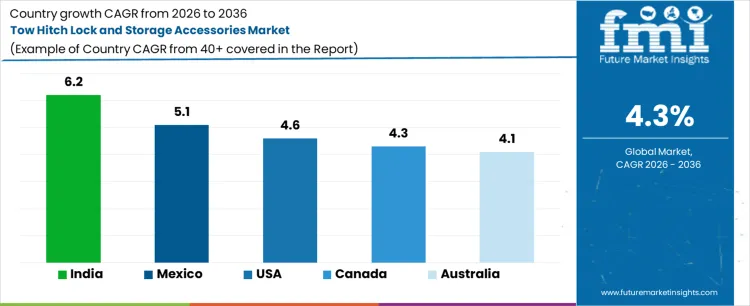
| Country | CAGR (%) |
|---|---|
| India | 6.2% |
| Mexico | 5.1% |
| USA | 4.6% |
| Canada | 4.3% |
| Australia | 4.1% |
What Is Driving Growth of Tow Hitch Lock and Storage Accessory Demand in India?
Demand for tow hitch lock and storage accessories in India is growing at a CAGR of 6.2%, supported by rising adoption of SUVs and lifestyle utility vehicles. Recreational towing for boats, trailers, and utility carriers increases need for hitch security. Urban theft risk encourages use of locking mechanisms for detachable hitches. Aftermarket customization culture expands accessory installation beyond commercial fleets. Growth of organized accessory retail improves availability and standardization. Demand growth reflects vehicle mix evolution and security awareness rather than widespread commercial towing penetration.
- Rising SUV and lifestyle vehicle ownership
- Increased recreational and utility towing usage
- Theft prevention needs for detachable hitches
- Expansion of organized aftermarket accessory retail
Why Is Mexico Seeing Steady Expansion in Tow Hitch Accessory Sales?
Tow hitch lock and storage accessory sales in Mexico are expanding at a CAGR of 5.1%, driven by pickup truck usage and cross-border vehicle compatibility. Commercial and recreational towing supports consistent accessory demand. Theft deterrence remains a key purchase driver in urban and semi-urban areas. Fleet operators adopt standardized locking solutions for asset control. Integration with North American vehicle platforms sustains product compatibility. Growth reflects stable pickup utilization and security-driven accessory adoption rather than rapid increase in towing intensity.
- High pickup truck penetration
- Security concerns driving lock adoption
- Fleet standardization of towing accessories
- Compatibility with North American vehicle platforms
How Is the United States Supporting Demand for Tow Hitch Lock Accessories?
Tow hitch lock and storage accessory demand in the United States is growing at a CAGR of 4.6%, supported by mature towing culture and recreational vehicle usage. Pickup trucks and SUVs routinely tow trailers, campers, and equipment. Theft prevention influences widespread use of hitch locks. Organized storage accessories support convenience and safety compliance. Large installed base drives replacement demand due to wear and corrosion. Growth reflects replacement cycles and accessory upgrades rather than expansion of towing participation.
- Mature recreational and utility towing culture
- Theft prevention for high-value towing equipment
- Demand for organized hitch storage solutions
- Replacement of worn or corroded accessories
What Factors Are Sustaining Tow Hitch Accessory Demand in Canada?
Tow hitch lock and storage accessory demand in Canada is expanding at a CAGR of 4.3%, shaped by outdoor recreation and seasonal towing. Utility trailers, boats, and campers sustain consistent accessory usage. Climate exposure increases wear, supporting replacement demand. Safety compliance influences secure hitch usage. Pickup truck ownership remains high across regions. Growth reflects seasonal towing activity and replacement needs rather than expansion of vehicle ownership.
- Seasonal recreational towing activity
- Climate-driven wear and corrosion replacement
- Safety compliance influencing secure hitch usage
- High pickup truck ownership
Why Is Australia Experiencing Measured Growth in Tow Hitch Accessories?
Demand for tow hitch lock and storage accessories in Australia is growing at a CAGR of 4.1%, supported by utility vehicle dominance and outdoor lifestyle usage. Utes and SUVs tow caravans, trailers, and equipment across long distances. Theft prevention and vibration control influence accessory selection. Rural usage increases need for durable storage solutions. Replacement demand arises from harsh operating conditions. Growth remains measured, reflecting established towing practices and maintenance-led purchases rather than rapid expansion in towing adoption.
- Utility vehicle dominance in vehicle fleet
- Long-distance recreational and rural towing
- Harsh conditions driving durability requirements
- Maintenance-led replacement demand
What is the competitive landscape of demand for the tow hitch lock and storage accessories market globally?
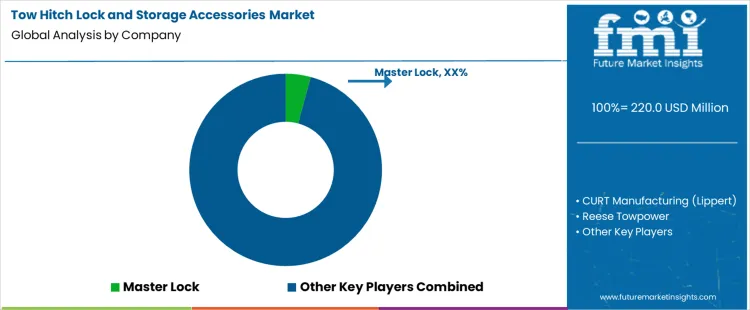
Demand for tow hitch lock and storage accessories is driven by the growing popularity of recreational vehicle (RV) use, towing needs, and the increasing concern for vehicle security. Buyers evaluate lock security, ease of installation, durability under various weather conditions, and compatibility with different towing systems. Procurement behavior emphasizes product effectiveness in preventing theft, long-lasting construction, and the ability to secure not only hitches but also trailers and storage equipment. Purchasing decisions prioritize reliable brands offering corrosion-resistant materials, high security, and practical design for everyday use. Trend in the market reflects rising consumer awareness of theft prevention and a growing interest in multipurpose storage solutions for towing accessories.
Master Lock leads competitive positioning with a strong brand reputation for reliable, durable lock solutions and a broad range of security products for towing systems. CURT Manufacturing (Lippert) competes with a comprehensive lineup of towing accessories, focusing on high-quality, easy-to-use locks and storage solutions for various vehicle types. Reese Towpower is recognized for its high-performance towing accessories, offering secure hitch locks and convenient storage solutions for both light and heavy-duty users. Trimax Locks participates by providing high-security locking systems, emphasizing strength and weather resistance for outdoor storage. Proven Industries offers innovative tow hitch storage solutions that combine security with design for recreational and commercial users.
Key Players in the Tow Hitch Lock and Storage Accessories Market
- Master Lock
- CURT Manufacturing (Lippert)
- Reese Towpower
- Trimax Locks
- Proven Industries
- BOLT Lock
- Bulldog (towing accessories)
- Fastway (Progress Mfg.)
Scope of the Report
| Items | Values |
|---|---|
| Quantitative Units | USD million |
| Product Type | Locking Hitch Pins & Receiver Locks; Coupler Locks; Trailer Hitch Locks (Integrated); Hitch Storage Sleeves & Covers; Other |
| Vehicle Type | Pickup Trucks; SUVs & Crossovers; Passenger Cars; RVs; Other |
| Material | Hardened Steel; Stainless Steel; Alloy Steel; Zinc or Die-Cast; Other |
| Sales Channel | Online Retail; Auto Parts Retail; Towing or Trailer Dealers; OEM or Dealer Accessories; Other |
| Regions Covered | Asia Pacific, Europe, North America, Latin America, Middle East & Africa |
| Countries Covered | India, Mexico, USA, Canada, Australia, and 40+ countries |
| Key Companies Profiled | Master Lock; CURT Manufacturing (Lippert); Reese Towpower; Trimax Locks; Proven Industries; BOLT Lock; Bulldog (towing accessories); Fastway (Progress Mfg.) |
| Additional Attributes | Dollar sales by product type, vehicle type, material, and sales channel; locking strength, corrosion resistance, and material durability across hardened steel, stainless steel, alloy steel, and zinc or die-cast products; market segmentation driven by pickup trucks, SUVs, RVs, and towing needs; procurement trends influenced by online retail growth, auto parts retail expansion, and OEM/dealer accessory integrations. |
Tow Hitch Lock and Storage Accessories Market by Segment
Product Type:
- Locking Hitch Pins & Receiver Locks
- Coupler Locks
- Trailer Hitch Locks (Integrated)
- Hitch Storage Sleeves & Covers
- Other
Vehicle Type:
- Pickup Trucks
- SUVs & Crossovers
- Passenger Cars
- RVs
- Other
Material:
- Hardened Steel
- Stainless Steel
- Alloy Steel
- Zinc or Die-Cast
- Other
Sales Channel:
- Online Retail
- Auto Parts Retail
- Towing or Trailer Dealers
- OEM or Dealer Accessories
- Other
Region:
- Asia Pacific
- China
- Japan
- South Korea
- India
- Australia & New Zealand
- ASEAN
- Rest of Asia Pacific
- Europe
- Germany
- United Kingdom
- France
- Italy
- Spain
- Nordic
- BENELUX
- Rest of Europe
- North America
- United States
- Canada
- Mexico
- Latin America
- Brazil
- Chile
- Rest of Latin America
- Middle East & Africa
- Kingdom of Saudi Arabia
- Other GCC Countries
- Turkey
- South Africa
- Other African Union
- Rest of Middle East & Africa
Bibliography
- International Organization for Standardization. (2024). Corrosion protection of steel components for automotive exterior accessories (ISO 12944-9:2024). ISO.
- United Nations Economic Commission for Europe. (2023). UN Regulation No. 55—Mechanical coupling components of vehicle combinations: Amendments impacting towing devices and security hardware. United Nations.
- European Commission. (2023). Regulation (EU) 2019/2144—General safety requirements for motor vehicles: Phased implementation affecting towing devices, coupling integrity, and accessory safety. Official Journal of the European Union.
Frequently Asked Questions
How big is the tow hitch lock and storage accessories market in 2026?
The global tow hitch lock and storage accessories market is estimated to be valued at USD 220.0 million in 2026.
What will be the size of tow hitch lock and storage accessories market in 2036?
The market size for the tow hitch lock and storage accessories market is projected to reach USD 335.2 million by 2036.
How much will be the tow hitch lock and storage accessories market growth between 2026 and 2036?
The tow hitch lock and storage accessories market is expected to grow at a 4.3% CAGR between 2026 and 2036.
What are the key product types in the tow hitch lock and storage accessories market?
The key product types in tow hitch lock and storage accessories market are locking hitch pins & receiver locks, coupler locks, trailer hitch locks (integrated), hitch storage sleeves & covers and other.
Which vehicle type segment to contribute significant share in the tow hitch lock and storage accessories market in 2026?
In terms of vehicle type, pickup trucks segment to command 44.0% share in the tow hitch lock and storage accessories market in 2026.
Preview the report firsthand - request a free sample
Get SampleGet the brochure for pricing and purchase details.
Get PDFTable of Content
- Executive Summary
- Global Market Outlook
- Demand-side Trends
- Supply-side Trends
- Technology Roadmap Analysis
- Analysis and Recommendations
- Market Overview
- Market Coverage / Taxonomy
- Market Definition / Scope / Limitations
- Market Background
- Market Dynamics
- Drivers
- Restraints
- Opportunity
- Trends
- Scenario Forecast
- Demand in Optimistic Scenario
- Demand in Likely Scenario
- Demand in Conservative Scenario
- Opportunity Map Analysis
- Product Life Cycle Analysis
- Supply Chain Analysis
- Investment Feasibility Matrix
- Value Chain Analysis
- PESTLE and Porter’s Analysis
- Regulatory Landscape
- Regional Parent Market Outlook
- Production and Consumption Statistics
- Import and Export Statistics
- Market Dynamics
- Global Market Analysis 2021 to 2025 and Forecast, 2026 to 2036
- Historical Market Size Value (USD Million) Analysis, 2021 to 2025
- Current and Future Market Size Value (USD Million) Projections, 2026 to 2036
- Y-o-Y Growth Trend Analysis
- Absolute $ Opportunity Analysis
- Global Market Pricing Analysis 2021 to 2025 and Forecast 2026 to 2036
- Global Market Analysis 2021 to 2025 and Forecast 2026 to 2036, By Product Type
- Introduction / Key Findings
- Historical Market Size Value (USD Million) Analysis By Product Type , 2021 to 2025
- Current and Future Market Size Value (USD Million) Analysis and Forecast By Product Type , 2026 to 2036
- Locking Hitch Pins & Receiver Locks
- Coupler Locks
- Trailer Hitch Locks (Integrated)
- Hitch Storage Sleeves & Covers
- Other
- Locking Hitch Pins & Receiver Locks
- Y-o-Y Growth Trend Analysis By Product Type , 2021 to 2025
- Absolute $ Opportunity Analysis By Product Type , 2026 to 2036
- Global Market Analysis 2021 to 2025 and Forecast 2026 to 2036, By Vehicle Type
- Introduction / Key Findings
- Historical Market Size Value (USD Million) Analysis By Vehicle Type, 2021 to 2025
- Current and Future Market Size Value (USD Million) Analysis and Forecast By Vehicle Type, 2026 to 2036
- Pickup Trucks
- SUVs & Crossovers
- Passenger Cars
- RVs
- Other
- Pickup Trucks
- Y-o-Y Growth Trend Analysis By Vehicle Type, 2021 to 2025
- Absolute $ Opportunity Analysis By Vehicle Type, 2026 to 2036
- Global Market Analysis 2021 to 2025 and Forecast 2026 to 2036, By Material
- Introduction / Key Findings
- Historical Market Size Value (USD Million) Analysis By Material, 2021 to 2025
- Current and Future Market Size Value (USD Million) Analysis and Forecast By Material, 2026 to 2036
- Hardened Steel
- Stainless Steel
- Alloy Steel
- Zinc or Die-Cast
- Other
- Hardened Steel
- Y-o-Y Growth Trend Analysis By Material, 2021 to 2025
- Absolute $ Opportunity Analysis By Material, 2026 to 2036
- Global Market Analysis 2021 to 2025 and Forecast 2026 to 2036, By Sales Channel
- Introduction / Key Findings
- Historical Market Size Value (USD Million) Analysis By Sales Channel, 2021 to 2025
- Current and Future Market Size Value (USD Million) Analysis and Forecast By Sales Channel, 2026 to 2036
- Online Retail
- Auto Parts Retail
- Towing or Trailer Dealers
- OEM or Dealer Accessories
- Other
- Online Retail
- Y-o-Y Growth Trend Analysis By Sales Channel, 2021 to 2025
- Absolute $ Opportunity Analysis By Sales Channel, 2026 to 2036
- Global Market Analysis 2021 to 2025 and Forecast 2026 to 2036, By Region
- Introduction
- Historical Market Size Value (USD Million) Analysis By Region, 2021 to 2025
- Current Market Size Value (USD Million) Analysis and Forecast By Region, 2026 to 2036
- North America
- Latin America
- Western Europe
- Eastern Europe
- East Asia
- South Asia and Pacific
- Middle East & Africa
- Market Attractiveness Analysis By Region
- North America Market Analysis 2021 to 2025 and Forecast 2026 to 2036, By Country
- Historical Market Size Value (USD Million) Trend Analysis By Market Taxonomy, 2021 to 2025
- Market Size Value (USD Million) Forecast By Market Taxonomy, 2026 to 2036
- By Country
- USA
- Canada
- Mexico
- By Product Type
- By Vehicle Type
- By Material
- By Sales Channel
- By Country
- Market Attractiveness Analysis
- By Country
- By Product Type
- By Vehicle Type
- By Material
- By Sales Channel
- Key Takeaways
- Latin America Market Analysis 2021 to 2025 and Forecast 2026 to 2036, By Country
- Historical Market Size Value (USD Million) Trend Analysis By Market Taxonomy, 2021 to 2025
- Market Size Value (USD Million) Forecast By Market Taxonomy, 2026 to 2036
- By Country
- Brazil
- Chile
- Rest of Latin America
- By Product Type
- By Vehicle Type
- By Material
- By Sales Channel
- By Country
- Market Attractiveness Analysis
- By Country
- By Product Type
- By Vehicle Type
- By Material
- By Sales Channel
- Key Takeaways
- Western Europe Market Analysis 2021 to 2025 and Forecast 2026 to 2036, By Country
- Historical Market Size Value (USD Million) Trend Analysis By Market Taxonomy, 2021 to 2025
- Market Size Value (USD Million) Forecast By Market Taxonomy, 2026 to 2036
- By Country
- Germany
- UK
- Italy
- Spain
- France
- Nordic
- BENELUX
- Rest of Western Europe
- By Product Type
- By Vehicle Type
- By Material
- By Sales Channel
- By Country
- Market Attractiveness Analysis
- By Country
- By Product Type
- By Vehicle Type
- By Material
- By Sales Channel
- Key Takeaways
- Eastern Europe Market Analysis 2021 to 2025 and Forecast 2026 to 2036, By Country
- Historical Market Size Value (USD Million) Trend Analysis By Market Taxonomy, 2021 to 2025
- Market Size Value (USD Million) Forecast By Market Taxonomy, 2026 to 2036
- By Country
- Russia
- Poland
- Hungary
- Balkan & Baltic
- Rest of Eastern Europe
- By Product Type
- By Vehicle Type
- By Material
- By Sales Channel
- By Country
- Market Attractiveness Analysis
- By Country
- By Product Type
- By Vehicle Type
- By Material
- By Sales Channel
- Key Takeaways
- East Asia Market Analysis 2021 to 2025 and Forecast 2026 to 2036, By Country
- Historical Market Size Value (USD Million) Trend Analysis By Market Taxonomy, 2021 to 2025
- Market Size Value (USD Million) Forecast By Market Taxonomy, 2026 to 2036
- By Country
- China
- Japan
- South Korea
- By Product Type
- By Vehicle Type
- By Material
- By Sales Channel
- By Country
- Market Attractiveness Analysis
- By Country
- By Product Type
- By Vehicle Type
- By Material
- By Sales Channel
- Key Takeaways
- South Asia and Pacific Market Analysis 2021 to 2025 and Forecast 2026 to 2036, By Country
- Historical Market Size Value (USD Million) Trend Analysis By Market Taxonomy, 2021 to 2025
- Market Size Value (USD Million) Forecast By Market Taxonomy, 2026 to 2036
- By Country
- India
- ASEAN
- Australia & New Zealand
- Rest of South Asia and Pacific
- By Product Type
- By Vehicle Type
- By Material
- By Sales Channel
- By Country
- Market Attractiveness Analysis
- By Country
- By Product Type
- By Vehicle Type
- By Material
- By Sales Channel
- Key Takeaways
- Middle East & Africa Market Analysis 2021 to 2025 and Forecast 2026 to 2036, By Country
- Historical Market Size Value (USD Million) Trend Analysis By Market Taxonomy, 2021 to 2025
- Market Size Value (USD Million) Forecast By Market Taxonomy, 2026 to 2036
- By Country
- Kingdom of Saudi Arabia
- Other GCC Countries
- Turkiye
- South Africa
- Other African Union
- Rest of Middle East & Africa
- By Product Type
- By Vehicle Type
- By Material
- By Sales Channel
- By Country
- Market Attractiveness Analysis
- By Country
- By Product Type
- By Vehicle Type
- By Material
- By Sales Channel
- Key Takeaways
- Key Countries Market Analysis
- USA
- Pricing Analysis
- Market Share Analysis, 2025
- By Product Type
- By Vehicle Type
- By Material
- By Sales Channel
- Canada
- Pricing Analysis
- Market Share Analysis, 2025
- By Product Type
- By Vehicle Type
- By Material
- By Sales Channel
- Mexico
- Pricing Analysis
- Market Share Analysis, 2025
- By Product Type
- By Vehicle Type
- By Material
- By Sales Channel
- Brazil
- Pricing Analysis
- Market Share Analysis, 2025
- By Product Type
- By Vehicle Type
- By Material
- By Sales Channel
- Chile
- Pricing Analysis
- Market Share Analysis, 2025
- By Product Type
- By Vehicle Type
- By Material
- By Sales Channel
- Germany
- Pricing Analysis
- Market Share Analysis, 2025
- By Product Type
- By Vehicle Type
- By Material
- By Sales Channel
- UK
- Pricing Analysis
- Market Share Analysis, 2025
- By Product Type
- By Vehicle Type
- By Material
- By Sales Channel
- Italy
- Pricing Analysis
- Market Share Analysis, 2025
- By Product Type
- By Vehicle Type
- By Material
- By Sales Channel
- Spain
- Pricing Analysis
- Market Share Analysis, 2025
- By Product Type
- By Vehicle Type
- By Material
- By Sales Channel
- France
- Pricing Analysis
- Market Share Analysis, 2025
- By Product Type
- By Vehicle Type
- By Material
- By Sales Channel
- India
- Pricing Analysis
- Market Share Analysis, 2025
- By Product Type
- By Vehicle Type
- By Material
- By Sales Channel
- ASEAN
- Pricing Analysis
- Market Share Analysis, 2025
- By Product Type
- By Vehicle Type
- By Material
- By Sales Channel
- Australia & New Zealand
- Pricing Analysis
- Market Share Analysis, 2025
- By Product Type
- By Vehicle Type
- By Material
- By Sales Channel
- China
- Pricing Analysis
- Market Share Analysis, 2025
- By Product Type
- By Vehicle Type
- By Material
- By Sales Channel
- Japan
- Pricing Analysis
- Market Share Analysis, 2025
- By Product Type
- By Vehicle Type
- By Material
- By Sales Channel
- South Korea
- Pricing Analysis
- Market Share Analysis, 2025
- By Product Type
- By Vehicle Type
- By Material
- By Sales Channel
- Russia
- Pricing Analysis
- Market Share Analysis, 2025
- By Product Type
- By Vehicle Type
- By Material
- By Sales Channel
- Poland
- Pricing Analysis
- Market Share Analysis, 2025
- By Product Type
- By Vehicle Type
- By Material
- By Sales Channel
- Hungary
- Pricing Analysis
- Market Share Analysis, 2025
- By Product Type
- By Vehicle Type
- By Material
- By Sales Channel
- Kingdom of Saudi Arabia
- Pricing Analysis
- Market Share Analysis, 2025
- By Product Type
- By Vehicle Type
- By Material
- By Sales Channel
- Turkiye
- Pricing Analysis
- Market Share Analysis, 2025
- By Product Type
- By Vehicle Type
- By Material
- By Sales Channel
- South Africa
- Pricing Analysis
- Market Share Analysis, 2025
- By Product Type
- By Vehicle Type
- By Material
- By Sales Channel
- USA
- Market Structure Analysis
- Competition Dashboard
- Competition Benchmarking
- Market Share Analysis of Top Players
- By Regional
- By Product Type
- By Vehicle Type
- By Material
- By Sales Channel
- Competition Analysis
- Competition Deep Dive
- Master Lock
- Overview
- Product Portfolio
- Profitability by Market Segments (Product/Age /Sales Channel/Region)
- Sales Footprint
- Strategy Overview
- Marketing Strategy
- Product Strategy
- Channel Strategy
- CURT Manufacturing (Lippert)
- Reese Towpower
- Trimax Locks
- Proven Industries
- BOLT Lock
- Bulldog (towing accessories)
- Fastway (Progress Mfg.)
- Master Lock
- Competition Deep Dive
- Assumptions & Acronyms Used
- Research Methodology


