

- Industry Size (2025)
- USD 13.8 Bn
- Forecast (2035)
- USD 27.2 Bn
- CAGR (2025 to 2035)
- 7.0%
Demand for Call Centre in USA 2025 to 2035
The USA call centre demand is valued at USD 13.8 billion in 2025 and is forecasted to reach USD 27.2 billion by 2035, recording a CAGR of 7.0%. Demand is supported by rising customer service volumes, expanded use of structured support operations across banking, retail, healthcare, and technology, and continued reliance on human-assisted interaction for complex inquiries. Call centres remain central to service delivery for organisations seeking consistent handling of customer issues, regulatory compliance, and structured workflow management. Growth in omnichannel communication and steady interaction volumes across voice and digital channels reinforce long-term service requirements.
On-premises solutions represent the leading deployment mode, driven by their suitability for organisations that prioritise data governance, strict compliance controls, and integration with existing enterprise systems. These deployments provide stable performance, customisable routing capabilities, and consistent control over communication infrastructure. Improvements in workforce management tools, call analytics software, and interoperability with CRM platforms continue to support replacement cycles within established call centre networks.
Demand is strongest in the West, South, and Northeast, where large customer service hubs, enterprise headquarters, and regional service centres are concentrated. Key companies include Teleperformance, Concentrix, TTEC, Foundever, and Alorica. Their focus is on operational consistency, technology integration, and structured service delivery across varied client sectors.
Quick Stats for USA Call Centre Demand
- USA Call Centre Sales Value (2025): USD 13.8 billion
- USA Call Centre Forecast Value (2035): USD 27.2 billion
- USA Call Centre Forecast CAGR (2025 to 2035): 7.0%
- Leading Deployment Mode in USA Call Centre Demand: On-premises solutions
- Key Growth Regions in USA Call Centre Demand: West, South, Northeast
- Top Players in USA Call Centre Demand: Teleperformance, Concentrix, TTEC, Foundever, Alorica
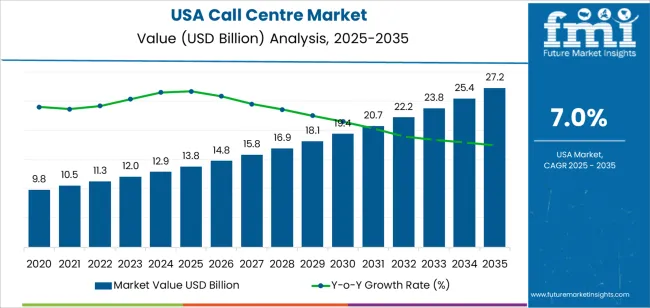
What is the Growth Forecast for Call Centre Industry in USA through 2035?
Peak-to-trough analysis shows a cyclic yet resilient pattern shaped by enterprise outsourcing needs, customer-experience investments, and labour-industry conditions. Between 2025 and 2028, the segment is expected to reach an early peak as organisations expand omnichannel support, integrate AI-driven assistance tools, and strengthen service capacity to manage growing digital-transaction volumes. Increased adoption of hybrid cloud contact-centre platforms will reinforce this upward phase.
A mild trough is likely between 2029 and 2031 as cost controls, operational consolidation, and fluctuations in domestic hiring cycles moderate short-term spending. This period may also reflect adjustment to automation deployments, with firms recalibrating the balance between human agents and AI-enabled self-service workflows. After 2031, the segment is expected to regain momentum as companies’ upgrade legacy systems, integrate advanced analytics, and expand multilingual support capabilities. Replacement and optimisation cycles will drive the recovery rather than rapid capacity expansion. The peak-to-trough pattern reflects a stable service segment influenced by enterprise budget cycles, technology integration phases, and continuing reliance on structured customer-support operations across USA industries.
USA Call Centre Key Takeaways
| Metric | Value |
|---|---|
| USA Call Centre Sales Value (2025) | USD 13.8 billion |
| USA Call Centre Forecast Value (2035) | USD 27.2 billion |
| USA Call Centre Forecast CAGR (2025-2035) | 7.0% |
Why is the Demand for Call Centre Services in the USA Growing?
Demand for call centre services in the USA is increasing because organisations across retail, financial services, healthcare and technology sectors require scalable, high-quality support operations that handle large volumes of customer interactions. The shift toward digital commerce and omnichannel customer engagement means companies need platforms that integrate voice, chat, email and social media communications seamlessly. Automation, analytics and AI-enabled tools contribute to efficiency gains, which drives investment in professional call centre services. Outsourcing and onshore-managed service models are growing as firms prioritise cost reduction, service level optimisation and 24-hour support capabilities.
Regulation, data security requirements and the need for multilingual customer support elevate the value of established call centre providers with compliance credentials and skilled agent pools in the USA. Constraints include increasing wage and labour costs in the USA, competition from offshore and automated service models, and the challenge of talent retention in high-turnover environments. Organisations must also invest in technology upgrades and training to handle evolving customer expectations and complex workflows.
Which Deployment Mode, Vertical, and Component Segments Lead Demand for Call Centres in the USA?
Demand for call-centre solutions in the United States is shaped by deployment preferences, sector-specific service requirements, and adoption of technology platforms. Distribution across deployment mode, end-use verticals, and system components reflects operational scale, regulatory considerations, and the need for reliable communication systems in high-volume environments.
By Deployment Mode, On-Premises Solutions Account for the Largest Share of Demand
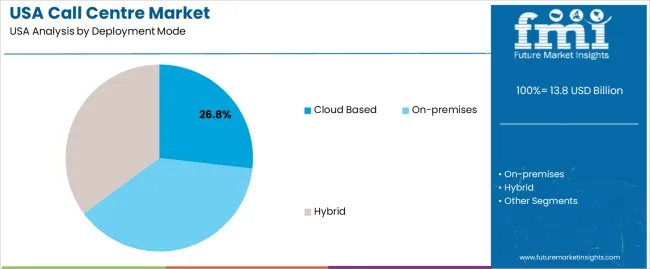
On-premises systems hold 38.1% of USA demand and represent the largest deployment mode. They remain widely used across sectors requiring controlled data environments, customised integration, and locally managed infrastructure. Organisations with established IT environments often maintain on-premises systems to retain full oversight of security protocols and performance management. Hybrid deployments account for 35.1%, reflecting a shift toward blended architectures that combine cloud scalability with local control. Cloud-based systems hold 26.8%, driven by subscription affordability, remote-work compatibility, and faster deployment cycles. Deployment preferences reflect organisational policy, infrastructure maturity, and compliance requirements across regulated industries.
Key drivers and attributes:
- On-premises systems provide controlled data governance.
- Hybrid solutions support gradual migration strategies.
- Cloud deployments align with flexible workforce models.
- Deployment type depends on security posture and operational scale.
By Vertical, the BFSI and Government Segment Accounts for the Largest Share of Demand
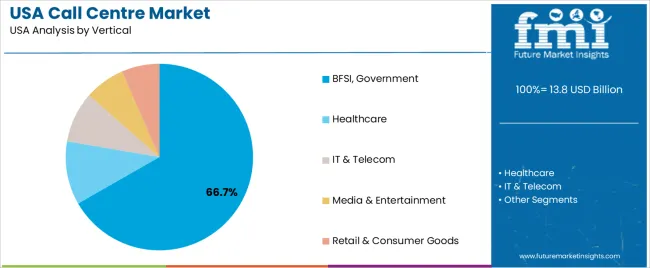
BFSI and government together hold 66.7% of USA demand, making them the dominant vertical group. These sectors require high-volume citizen and customer interactions, strict compliance frameworks, and resilient communication infrastructure. Call-centre platforms in these sectors support authentication, issue resolution, claims management, and service-related communication. Healthcare represents 11.0%, supported by scheduling, claims support, and remote-care coordination. IT and telecom hold 8.8%, driven by technical support and service-provision requirements. Media and entertainment represent 7.0%, while retail and consumer goods account for 6.5%, reflecting demand for order support, inquiry handling, and customer service.
Key drivers and attributes:
- BFSI and government operations require controlled communication systems.
- Healthcare relies on appointment and service-management workflows.
- IT and telecom support technical-issue handling.
- Retail and media depend on high-volume customer interactions.
By Component, Software Represents the Largest Share of Demand
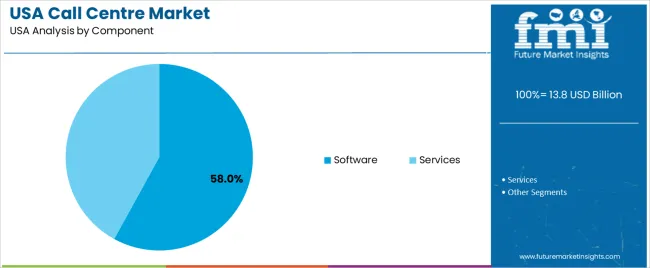
Software platforms hold an estimated 58.0% share of USA demand. Call-centre software supports routing, analytics, workforce management, voice systems, compliance monitoring, and omnichannel integration. Organisations prioritise software capable of handling high call volumes, integrating with CRM systems, and enabling automated workflows. Services account for 42.0%, spanning installation, training, system optimisation, and managed support. Service demand remains steady due to frequent upgrades, configuration needs, and ongoing operational assistance. Component distribution reflects the reliance on scalable software capabilities and the need for technical and operational support across industries.
Key drivers and attributes:
- Software enables routing, automation, and data integration.
- Service components support implementation and operational continuity.
- Component patterns align with technology adoption cycles.
- Organisations select components based on system complexity and workforce scale.
What are the Drivers, Restraints, and Key Trends of the Demand for Call Centres in the USA?
Increasing focus on customer experience, growth in digital commerce, and multi-channel service needs are driving demand.
Organisations in the USA are expanding call-centre operations to support higher customer expectations for 24/7 access, faster response times and personalised service across phone, chat and social-media channels. Growth in e-commerce, subscription services and digital platforms multiplies contact-volume and complexity, which fuels demand for both in-house and outsourced call-centre units. Industries such as financial services, healthcare, telecommunications and retail are investing in call centres to manage customer onboarding, technical support, billing inquiries and retention activities. Enhanced cloud infrastructure, remote-agent capability and analytics-driven call-routing strengthen call-centre value and support greater deployment.
Cost pressures, automation/AI substitution and labour-industry challenges are restraining growth.
Running call centres involves significant expense for staffing, training, real-time supervision and infrastructure upgrades; some businesses are delaying expansions due to cost concerns. Advances in automation, artificial-intelligence chatbots and digital self-service reduce the volume of traditional voice interactions, which may lessen the rate of growth for human-agent call-centre demand. Recruiting, retaining and training highly skilled agents, especially for specialised support roles, remains challenging in the USA, which can slow scaling of new call-centre operations.
Expansion of remote-agent and hybrid-model centres, integration of AI-analytics and growth in on-shore outsourcing are shaping industry trends.
Many US organisations now deploy call centres with remote or hybrid agent work-forces to access broader talent pools, reduce real-estate costs and support flexible staffing. Call-centre systems increasingly incorporate AI analytics, sentiment detection, real-time coaching and workforce-management tools to improve agent productivity and customer-experience metrics. There is also a rising preference for on-shore or near-shore call-centre outsourcing that maintains cultural alignment and security control, rather than solely offshore models. These trends support evolving call-centre demand across the USA, even as automation transforms some service functions.
Analysis of the Demand for Call Centres in the United States by Region
Demand for call centres in the United States is rising through 2035, driven by expanding service outsourcing, higher customer-support volumes across digital commerce, and broader adoption of omnichannel communication platforms. Companies rely on call centres for technical support, sales coordination, retention services, and inbound query management. Growth also reflects increased integration of analytics, automated routing, and cloud-based contact-centre solutions. Regional differences align with labor availability, operational costs, and the concentration of service-oriented industries. The West leads with an 8.1% CAGR, followed by the South (7.2%), the Northeast (6.5%), and the Midwest (5.6%). Demand remains strong across finance, healthcare, telecom, and technology-driven customer-service environments.
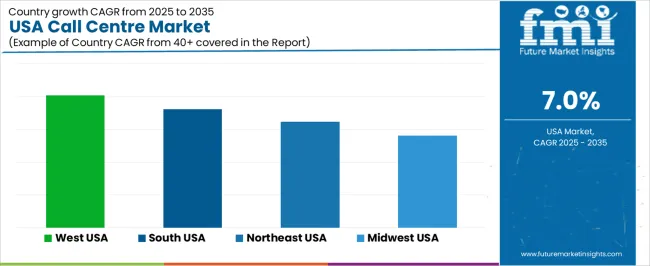
| Region | CAGR (2025-2035) |
|---|---|
| West | 8.1% |
| South | 7.2% |
| Northeast | 6.5% |
| Midwest | 5.6% |
How is the West driving demand for call centres?
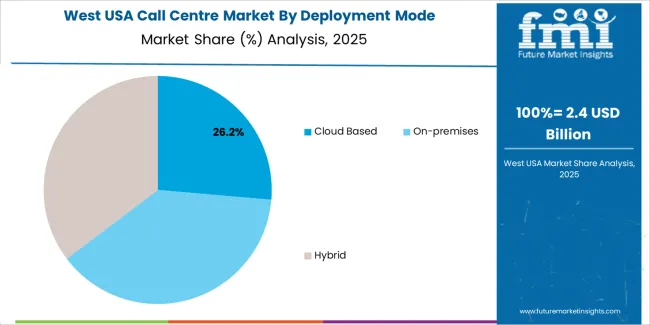
The West grows at 8.1% CAGR, supported by extensive adoption of cloud-based customer-service platforms, strong demand from technology firms, and high service volumes across e-commerce and telecommunications operations. States such as California, Washington, Colorado, and Arizona maintain large workforces involved in inbound and outbound support functions. Companies rely on call centres to manage multi-channel communication, including voice, chat, and email support. Startups and software firms generate strong demand for technical-assistance operations, while insurance and healthcare providers depend on call centres for claims support and appointment coordination. Regional focus on digital services increases usage of workforce-management systems and quality-monitoring tools, reinforcing steady expansion of call-centre infrastructure.
- High demand from technology, e-commerce, and telecom firms
- Strong adoption of cloud-based contact-centre platforms
- Large workforce supporting multi-channel communication tasks
- Stable activity across healthcare, insurance, and financial services
How is the South advancing demand for call centres?
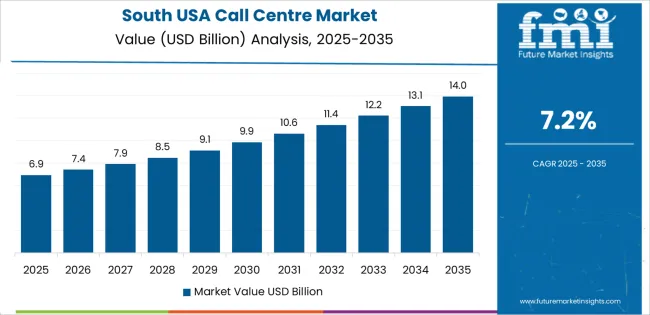
The South grows at 7.2% CAGR, supported by competitive labor industries, large service-sector activity, and strong adoption of outsourced customer-support operations. States such as Texas, Florida, Georgia, and North Carolina attract call-centre deployments due to favorable operating costs and established business-services ecosystems. Regional companies operate large facilities handling sales inquiries, billing support, and technical-service workflows. Healthcare, telecom, and retail sectors rely heavily on call-centre partners to manage high-volume customer interactions. The South’s growing population increases inbound support needs across utilities, service subscriptions, and consumer-product companies. Expansion of remote-work models also broadens regional recruitment capacity for distributed call-centre teams.
- Competitive labor conditions drawing large call-centre facilities
- Strong activity across healthcare, telecom, and retail support
- Increased outsourcing for billing, sales, and service inquiries
- Expanded hiring due to remote-work call-centre models
How is the Northeast shaping demand for call centres?
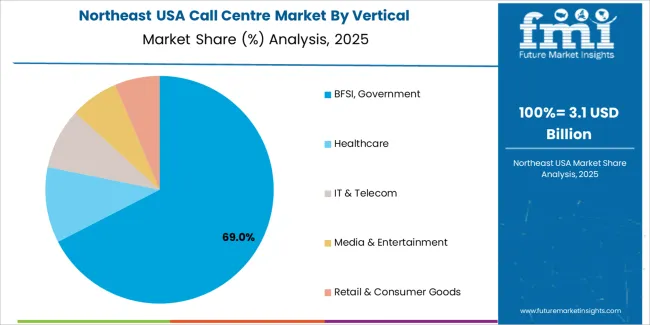
The Northeast grows at 6.5% CAGR, supported by dense service industries, strong financial-services presence, and extensive demand for technical and administrative support functions. States including New York, New Jersey, Massachusetts, and Pennsylvania maintain call-centre operations that manage banking inquiries, insurance claims, healthcare administration, and public-service hotlines. Financial institutions rely on call centres for compliance-related communication, authentication tasks, and account-assistance workflows. Technology and telecom providers also contribute steady demand for specialized support teams. High population density generates consistent customer-service volume, while corporate headquarters in the region maintain in-house and outsourced call-centre operations.
- Strong demand from finance, insurance, and healthcare sectors
- High service-volume requirements in metropolitan regions
- Steady adoption of call-centre teams for compliance support
- Use of specialized technical-support units across telecom and IT
How is the Midwest influencing demand for call centres?
The Midwest grows at 5.6% CAGR, supported by established customer-support operations, strong activity in insurance and manufacturing-service sectors, and stable inbound-service volumes across utilities, banking, and logistics companies. States such as Illinois, Ohio, Michigan, and Wisconsin operate call-centre networks that manage scheduling, product-service inquiries, claims assistance, and technical troubleshooting. Regional cost structures favor medium-sized call-centre setups serving national service networks. Manufacturing firms rely on call centres for distributor support, warranty coordination, and equipment-service communication. Although growth is moderate due to stable population trends, recurring service needs and consistent commercial activity maintain reliable regional demand.
- Strong usage across insurance, utilities, and logistics
- Support operations for manufacturing and equipment services
- Medium-sized centres serving national customer networks
- Moderate but steady growth tied to stable service demand
What is the competitive landscape of the demand for call-centre services in the USA?
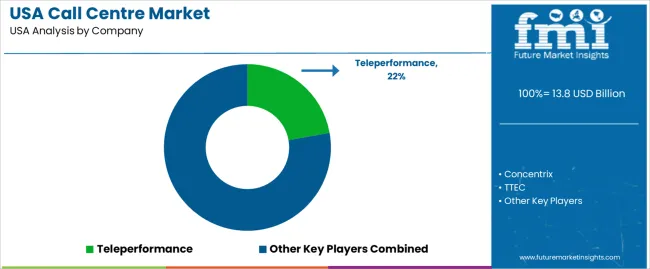
Demand for call-centre services in the USA is shaped by a concentrated group of global business-process providers supporting customer service, technical assistance, sales engagement, and outsourced contact-centre operations. Teleperformance holds the leading position with an estimated 22.2% share, supported by its extensive USA delivery network, multilingual staffing capacity, and established operational frameworks for large enterprise clients. Its position is reinforced by consistent service-level performance and broad experience across telecom, banking, healthcare, and retail accounts.
Concentrix and TTEC follow as major participants, offering structured omnichannel support, analytics-driven workflow management, and scalable operations suited to complex customer engagement programmes. Their strengths include documented quality processes, integration with automation tools, and strong relationships with USA technology and service brands. Foundever maintains a significant role through diversified service centres and long-term partnerships with consumer electronics, travel, and financial-services clients. Alorica contributes additional depth with widespread USA and nearshore operations, supporting high-volume voice and digital interactions. Its position is supported by stable workforce management, flexible staffing models, and consistent performance across seasonal demand cycles.
Competition across this segment centers on service reliability, peak-demand scalability, training quality, cost structure, digital-channel integration, and compliance with USA data-security requirements. Demand remains strong due to continuous outsourcing of customer-support functions, rising interaction volumes across digital and voice channels, and growing reliance on providers capable of delivering predictable response quality, efficient issue resolution, and integrated human-plus-automation support for enterprise clients.
Key Players in USA Call Centre Demand
- Teleperformance
- Concentrix
- TTEC
- Foundever
- Alorica
Scope of the Report
| Items | Values |
|---|---|
| Quantitative Units | USD billion |
| Deployment Mode | Cloud Based, On-premises, Hybrid |
| Vertical | BFSI, Government, Healthcare, IT & Telecom, Media & Entertainment, Retail & Consumer Goods |
| Component | Software, Services |
| Regions Covered | West, Midwest, South, Northeast |
| Key Companies Profiled | Teleperformance, Concentrix, TTEC, Foundever, Alorica |
| Additional Attributes | Dollar sales by deployment mode, vertical, and component categories; regional adoption trends across West, Midwest, South, and Northeast; competitive landscape of call centre service providers and CX technology vendors; advancements in cloud contact centre platforms, AI-driven automation, and omnichannel support; integration with large enterprises, public sector operations, and digital customer experience transformation initiatives in the USA. |
USA Call Centre Demand by Segments
Deployment Mode:
- Cloud Based
- On-premises
- Hybrid
Vertical:
- BFSI, Government
- Healthcare
- IT & Telecom
- Media & Entertainment
- Retail & Consumer Goods
Component:
- Software
- Services
Region:
- West
- South
- Northeast
- Midwest
Frequently Asked Questions
How big is the demand for call centre in USA in 2025?
The global demand for call centre in USA is estimated to be valued at USD 13.8 billion in 2025.
What will be the size of demand for call centre in USA in 2035?
The market size for the demand for call centre in USA is projected to reach USD 27.2 billion by 2035.
How much will be the demand for call centre in USA growth between 2025 and 2035?
The demand for call centre in USA is expected to grow at a 7.0% CAGR between 2025 and 2035.
What are the key product types in the demand for call centre in usa?
The key product types in demand for call centre in USA are cloud based, on-premises and hybrid.
Which vertical segment to contribute significant share in the demand for call centre in USA in 2025?
In terms of vertical, bfsi, government segment to command 66.7% share in the demand for call centre in USA in 2025.
Preview the report firsthand - request a free sample
Get SampleGet the brochure for pricing and purchase details.
Get PDFTable of Content
- Executive Summary
- USA Market Outlook
- Demand-side Trends
- Supply-side Trends
- Technology Roadmap Analysis
- Analysis and Recommendations
- Market Overview
- Market Coverage / Taxonomy
- Market Definition / Scope / Limitations
- Market Background
- Market Dynamics
- Drivers
- Restraints
- Opportunity
- Trends
- Scenario Forecast
- Demand in Optimistic Scenario
- Demand in Likely Scenario
- Demand in Conservative Scenario
- Opportunity Map Analysis
- Product Life Cycle Analysis
- Supply Chain Analysis
- Investment Feasibility Matrix
- Value Chain Analysis
- PESTLE and Porter’s Analysis
- Regulatory Landscape
- Regional Parent Market Outlook
- Production and Consumption Statistics
- Import and Export Statistics
- Market Dynamics
- USA Market Analysis 2020 to 2024 and Forecast, 2025 to 2035
- Historical Market Size Value (USD Million) Analysis, 2020 to 2024
- Current and Future Market Size Value (USD Million) Projections, 2025 to 2035
- Y-o-Y Growth Trend Analysis
- Absolute $ Opportunity Analysis
- USA Market Pricing Analysis 2020 to 2024 and Forecast 2025 to 2035
- USA Market Analysis 2020 to 2024 and Forecast 2025 to 2035, By Deployment Mode
- Introduction / Key Findings
- Historical Market Size Value (USD Million) Analysis By Deployment Mode , 2020 to 2024
- Current and Future Market Size Value (USD Million) Analysis and Forecast By Deployment Mode , 2025 to 2035
- Cloud Based
- On-premises
- Hybrid
- Y-o-Y Growth Trend Analysis By Deployment Mode , 2020 to 2024
- Absolute $ Opportunity Analysis By Deployment Mode , 2025 to 2035
- USA Market Analysis 2020 to 2024 and Forecast 2025 to 2035, By Vertical
- Introduction / Key Findings
- Historical Market Size Value (USD Million) Analysis By Vertical, 2020 to 2024
- Current and Future Market Size Value (USD Million) Analysis and Forecast By Vertical, 2025 to 2035
- BFSI, Government
- Healthcare
- IT & Telecom
- Media & Entertainment
- Retail & Consumer Goods
- Y-o-Y Growth Trend Analysis By Vertical, 2020 to 2024
- Absolute $ Opportunity Analysis By Vertical, 2025 to 2035
- USA Market Analysis 2020 to 2024 and Forecast 2025 to 2035, By Component
- Introduction / Key Findings
- Historical Market Size Value (USD Million) Analysis By Component, 2020 to 2024
- Current and Future Market Size Value (USD Million) Analysis and Forecast By Component, 2025 to 2035
- Software
- Services
- Y-o-Y Growth Trend Analysis By Component, 2020 to 2024
- Absolute $ Opportunity Analysis By Component, 2025 to 2035
- Market Structure Analysis
- Competition Dashboard
- Competition Benchmarking
- Market Share Analysis of Top Players
- By Regional
- By Deployment Mode
- By Vertical
- By Component
- Competition Analysis
- Competition Deep Dive
- Teleperformance
- Overview
- Product Portfolio
- Profitability by Market Segments (Product/Age /Sales Channel/Region)
- Sales Footprint
- Strategy Overview
- Marketing Strategy
- Product Strategy
- Channel Strategy
- Concentrix
- TTEC
- Foundever
- Alorica
- Teleperformance
- Competition Deep Dive
- Assumptions & Acronyms Used
- Research Methodology


