

- Industry Size (2026)
- USD 8.99 Bn
- Forecast (2036)
- USD 17.68 Bn
- CAGR (2026 to 2036)
- 7.0%
Demand for Cereal Bars in USA Market Size, Market Forecast and Outlook By FMI
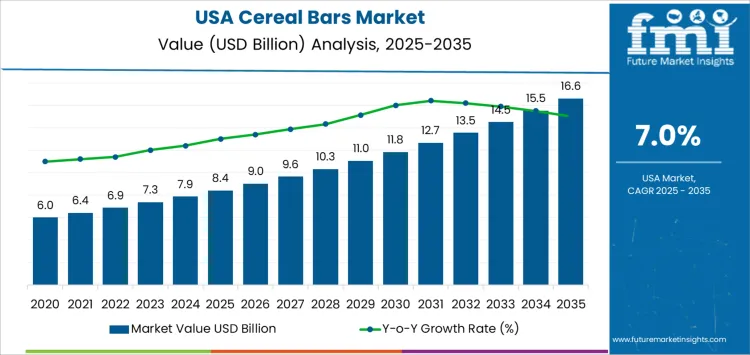
The demand for cereal bars in USA market was valued at USD 8.40 billion in 2025, projected to reach USD 8.99 billion in 2026, and is forecast to expand to USD 17.68 billion by 2036 at a 7.0% CAGR. Accelerating demand for portable, nutritionally fortified snack formats across the United States is expanding the cereal bar category beyond traditional breakfast occasions into all-day consumption patterns. The intersection of convenience-driven lifestyles, health-conscious ingredient scrutiny, and on-the-go meal replacement behavior is creating sustained purchasing volume across multiple retail channels. Cereal bar manufacturers are responding to retail buyer mandates for clean-label, high-protein formulations that meet evolving consumer expectations without sacrificing taste performance or shelf stability requirements.
Summary of Demand for Cereal Bars in USA Market
- Market Overview
- The market is valued at USD 8.40 billion in 2025 and is projected to reach USD 17.68 billion by 2036.
- The industry is expected to grow at a 7.0% CAGR from 2026 to 2036, creating an incremental opportunity of USD 8.69 billion.
- The market is a portable nutrition category where clean-label formulation, protein fortification, and retail shelf space competition define competitive positioning across the United States.
- Demand and Growth Drivers
- Traditional sit-down breakfast occasions in the USA are declining as consumers adopt on-the-go snacking patterns that favor portable, individually wrapped cereal bar formats, creating sustained category growth that is structural rather than cyclical in nature.
- Retail buyers across major US grocery chains are implementing clean-label ingredient requirements for shelf placement, forcing cereal bar manufacturers to reformulate products by removing artificial preservatives, synthetic colors, and high-fructose corn syrup from existing product lines.
- Consumer willingness to pay 30% to 50% premiums for protein-fortified cereal bars is creating a value-accretive product tier that outpaces volume growth in standard granola bars, rewarding manufacturers who invest in high-quality protein ingredient sourcing and sensory optimization.
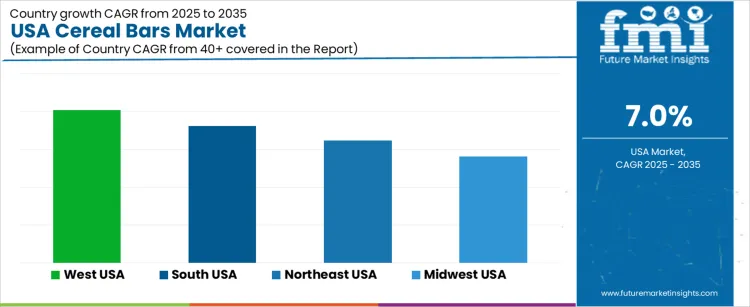
- Among key regions, West USA at 8.1%, South USA at 7.2%, Northeast USA at 6.5%, Midwest USA at 5.6%.
- Product and Segment View
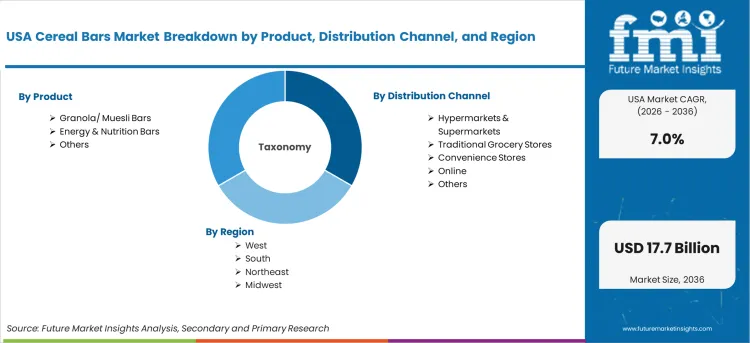
- The market includes products segmented by Product, Distribution Channel, covering Granola/ Muesli Bars, Energy & Nutrition Bars, Others under Product and Hypermarkets & Supermarkets, Traditional Grocery Stores, Convenience Stores, Online, Others under Distribution Channel.
- Granola/ Muesli Bars leads Product segmentation with 50.0% share in 2026.
- Hypermarkets & Supermarkets leads Distribution Channel segmentation with 39.0% share in 2026.
- Geography and Competitive Outlook
- West USA is the fastest-growing area at 8.1% CAGR, while Midwest USA registers steady but lower expansion.
- Competition is shaped by product diversification, distribution reach, and pricing discipline, with key players including General Mills, Inc., Naturell India Pvt. Ltd., Mars Incorporation and its Affiliates, BELLRING BRANDS, INC., Nestlé S.A..
- Analyst Opinion at FMI
- Nandini Roy Choudhury, Principal Consultant at FMI, opines: 'In my analysis, I have observed that the cereal bar category in the USA is entering a margin compression phase where formulation cost and retail shelf access become the primary competitive variables. Manufacturers who build proprietary ingredient sourcing networks for clean-label protein and fiber inputs will sustain margin positions that competitors relying on commodity suppliers cannot match.'
- Strategic Implications / Executive Takeaways
- Manufacturers must build proprietary clean-label ingredient supply chains for protein and fiber inputs to sustain margin positions against private label competition.
- Brand managers should invest in functional positioning around specific health outcomes rather than generic nutrition claims to differentiate in crowded retail categories.
- Retail account teams must present measurable category growth data to merchandising decision-makers to defend and expand shelf space allocations.
FMI analysts note that the USA cereal bar market is undergoing formulation diversification as manufacturers compete to meet clean-label, high-protein, and low-sugar consumer requirements simultaneously. Granola and muesli bars maintain volume leadership, but the fastest category acceleration is in protein-fortified and functional ingredient variants targeting fitness-conscious buyers. Private label competition is intensifying across major grocery chains, compressing branded margins and forcing innovation in packaging format and ingredient sourcing. Retail consolidation is placing added pressure on shelf space allocation, rewarding brands that deliver measurable category growth metrics to merchandising teams. The USDA dietary guidelines framework continues to support whole grain and fiber consumption messaging, providing a regulatory communication tailwind for cereal bar products that meet established nutritional thresholds.
Regional demand trajectories reflect distinct structural conditions within the United States. West USA leads with a 8.1% CAGR, followed by South USA at 7.2%, Northeast USA at 6.5%, Midwest USA at 5.6%. As per FMI, these regional variations are tied to local health food retail penetration, fitness culture adoption, and the concentration of health-conscious consumer demographics in each region. West USA leads with the highest growth rate, driven by California and Pacific Northwest consumer preference for natural, organic, and clean-label snack products. South USA registers the second-highest growth rate, benefiting from population growth and expanding suburban retail infrastructure. Northeast USA maintains steady demand anchored by urban convenience channel density and commuter snacking behavior. Midwest USA registers the lowest growth rate as conventional snack categories maintain competitive pricing advantages in markets where clean-label premiums face consumer resistance.
Demand for Cereal Bars in USA Market Key Takeaways
| Metric | Details |
|---|---|
| Industry Size (2026) | USD 8.99 Billion |
| Industry Value (2036) | USD 17.68 Billion |
| CAGR (2026-2036) | 7.0% |
Source: Future Market Insights, 2026
Demand for Cereal Bars in USA Market Drivers, Restraints, and Opportunities
Future Market Insights analysis indicates the cereal bar market in the USA has matured beyond a single-occasion breakfast product into a multi-occasion portable nutrition category. The structural shift is driven by fragmentation of traditional meal patterns, with consumers replacing sit-down breakfasts and scheduled lunch breaks with on-the-go snacking occasions that occur throughout the day. Category value is migrating from standard granola bars toward premium protein-fortified and functional ingredient variants that command higher per-unit pricing. Retail shelf space competition is intensifying as both branded manufacturers and private label operators expand their cereal bar assortments to capture the growing share of consumer snack expenditure flowing into the bar format.
The margin architecture of the USA cereal bar market is under pressure from two directions: rising ingredient costs for clean-label and high-protein formulations, and intensifying private label competition that compresses retail pricing. FMI is of the opinion that branded manufacturers must differentiate through ingredient sourcing transparency, functional benefit specificity, and packaging innovation rather than competing on price against retailer private label programs that benefit from guaranteed shelf placement. The cost of protein ingredients, including whey isolate, plant-based protein concentrates, and collagen peptides, has increased as demand from multiple food categories competes for the same supply base. Brands that build proprietary ingredient sourcing relationships will sustain margins that commodity-dependent competitors cannot match.
- Meal Pattern Fragmentation: Traditional sit-down breakfast occasions in the USA are declining as consumers adopt on-the-go snacking patterns that favor portable, individually wrapped cereal bar formats, creating sustained category growth that is structural rather than cyclical in nature.
- Clean-Label Formulation Mandates: Retail buyers across major US grocery chains are implementing clean-label ingredient requirements for shelf placement, forcing cereal bar manufacturers to reformulate products by removing artificial preservatives, synthetic colors, and high-fructose corn syrup from existing product lines.
- Protein Fortification Premium: Consumer willingness to pay 30% to 50% premiums for protein-fortified cereal bars is creating a value-accretive product tier that outpaces volume growth in standard granola bars, rewarding manufacturers who invest in high-quality protein ingredient sourcing and sensory optimization.
Demand for Cereal Bars in USA Market Definition
Cereal bars are ready-to-eat, individually packaged snack products manufactured by compressing or binding cereal grains, oats, nuts, dried fruits, and other nutritional ingredients into a portable bar format. Product categories include granola and muesli bars, energy and nutrition bars, and specialty bars fortified with protein, fiber, vitamins, or functional ingredients. These products serve as convenient meal replacements, on-the-go snacks, and pre- or post-exercise nutrition options distributed through organized retail channels across the United States.
Demand for Cereal Bars in USA Market Inclusions
Market scope includes granola and muesli bars, energy and nutrition bars, and other cereal-based bar formats sold as packaged consumer products. Distribution channel coverage spans hypermarkets and supermarkets, traditional grocery stores, convenience stores, online retail, and other channels. Regional coverage spans West, South, Northeast, and Midwest USA with forecast projections from 2026 to 2036.
Demand for Cereal Bars in USA Market Exclusions
Loose granola, muesli, and breakfast cereal products sold in bags or boxes are excluded. Unpackaged bakery items, fresh baked goods, confectionery bars without cereal grain content, and protein bars manufactured without cereal-based ingredients fall outside the scope.
Demand for Cereal Bars in USA Market Research Methodology
- Primary Research: Analysts conducted structured interviews with supply chain managers, product procurement leads, and distribution network operators to map decision triggers that shape purchasing volumes and vendor selection criteria.
- Desk Research: Data collection phases aggregated regulatory filings, trade body publications, national consumption surveys, and public procurement records from government statistical agencies.
- Market-Sizing and Forecasting: Baseline values derive from a bottom-up aggregation of category-level consumption volumes, applying region-specific penetration curves and pricing benchmarks to project future demand trajectories.
- Data Validation and Update Cycle: Projections are cross-checked against publicly reported trade statistics, manufacturer shipment disclosures, and import-export databases maintained by customs authorities.
Why is the Demand for Cereal Bars in USA Growing?
The demand for cereal bars in the USA is growing due to their increasing popularity as a convenient, on-the-go snack that offers both nutrition and portability. As busy lifestyles continue to drive the need for quick meal replacements, cereal bars have become a favored option for consumers seeking a balance of convenience and health. These bars, often packed with grains, fiber, protein, and vitamins, cater to consumers seeking healthier snack alternatives to traditional junk food. As awareness of healthy eating increases, people are more inclined to choose cereal bars as part of their balanced diet, contributing to a steady rise in demand.
The expanding variety of cereal bars, including options targeting specific dietary needs such as gluten-free, low-sugar, high-protein, and organic formulations, is another key driver of this growth. As consumers become more health-conscious, they are seeking snacks that align with their specific preferences and nutritional requirements. The increasing demand for plant-based and natural ingredients also fuels innovation in the cereal bar sector, with more brands incorporating whole foods and clean ingredients to appeal to a broader consumer base.
The rise in consumer interest for functional foods, such as those that boost energy, improve digestion, or support immunity, has contributed to the growth of cereal bars with added health benefits. Despite the growing demand, challenges such as price competition from other snack categories, continued innovation and the expanding health-focused consumer base are expected to sustain the demand for cereal bars in the USA.
What is the Segment-Wise Analysis of Demand for Cereal Bars in USA?
Demand for cereal bars in the USA is segmented by product, distribution channel, and region. By product type, granola/muesli bars lead at 50%, followed by energy & nutrition bars and other varieties. In terms of distribution channel, hypermarkets & supermarkets dominate with 39%, while traditional grocery stores, convenience stores, online platforms, and other channels also contribute to the demand. Regionally, demand spans across West USA, South USA, Northeast USA, and Midwest USA, with varying preferences based on local consumer habits and lifestyle trends.
How Do Granola/Muesli Bars Lead the Demand for Cereal Bars in USA?
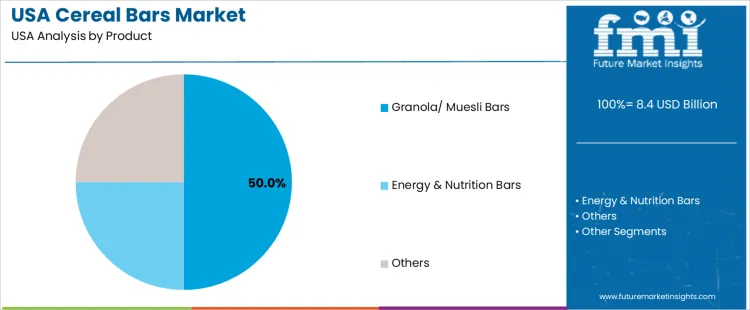
Granola/muesli bars account for 50% of the demand for cereal bars in the USA, driven by their popularity as a healthy, convenient snack option. These bars are rich in fiber, grains, and natural ingredients, making them a preferred choice for health-conscious consumers looking for a quick, nutritious snack. The demand for granola/muesli bars is especially strong in regions like the West and Northeast USA, where consumers prioritize wellness and balanced diets. The rising trend of on-the-go eating, combined with the growing awareness of the benefits of whole grains and natural foods, further fuels the demand for these bars. Granola/muesli bars are seen as an ideal solution for busy lifestyles, providing sustained energy and satisfaction. Their versatility and the increasing focus on health and wellness make granola/muesli bars the leading product in the cereal bar market.
Why Do Hypermarkets & Supermarkets Lead the Demand for Cereal Bars in USA?
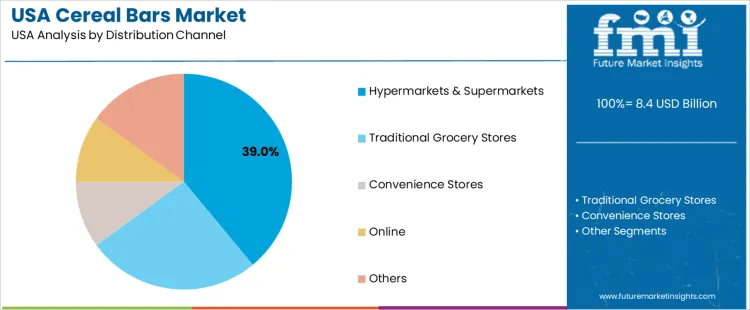
Hypermarkets & supermarkets account for 39% of the demand for cereal bars in the USA, reflecting their role as the primary retail channel for snack foods. These large retail outlets offer a wide variety of cereal bars, providing consumers with easy access to their preferred brands and flavors. Supermarkets and hypermarkets are the go-to destinations for families and individuals who regularly purchase cereal bars as a snack or breakfast option. The convenience of finding these products in large, well-stocked stores contributes to their high demand. Regions like the West and Midwest USA, where grocery shopping is often done in large retail chains, show the highest adoption of this sales channel. The growing preference for healthy, on-the-go snacks, coupled with the convenience of shopping at supermarkets and hypermarkets, ensures that these stores remain the leading distribution channel for cereal bars in the USA.
What are the Key Trends, Drivers, and Restraints in Demand for Cereal Bars in USA?
Demand for cereal bars in the USA is expected to continue growing as more consumers prioritize health-conscious, convenient snack options. As busy lifestyles become more common, the demand for quick, portable meals is expected to rise. The increased popularity of fitness, wellness trends, and clean-label ingredients also supports this demand. Expanding product varieties and the convenience of availability through both physical stores and online channels will likely fuel long-term growth. Cereal bars will remain a favored snack option, especially with innovations in health-focused ingredients, catering to different dietary needs and preferences.
What is Driving Demand for Cereal Bars in USA?
Demand for cereal bars in the USA is rising as more consumers seek convenient, ready-to-eat snacks that fit busy, on-the-go lifestyles. Growing health consciousness and interest in nutrition spur demand for bars that offer energy, protein, fiber, or clean-label ingredients. Cereal bars appeal as quick breakfast alternatives, mid-day snacks, or meal replacements for busy individuals. Increasing awareness about healthy eating and dietary preferences encourages people to choose cereal bars over more processed snacks. Wider availability through supermarkets, convenience stores, and online retail makes cereal bars easy to access. Product variety from granola and fruit-nut bars to protein and energy-focused bars ensures appeal across different age groups and dietary needs. These factors combine to drive sustained growth in cereal bar consumption and sales in the USA.
How Are Trends in Lifestyle, Convenience, and Retail Channels Influencing Cereal Bar Demand in USA?
Urbanization, busy daily schedules, and changing meal patterns have increased the need for quick and portable food options cereal bars satisfy this demand. For many Americans, cereal bars serve as practical substitutes for breakfast or lunch when time is limited. The expanding variety of cereal bars from classic granola to high-protein and functional bars makes them suitable for different occasions like work-day snacks, gym snacks, or travel. Retail channels play a key role: supermarkets and hypermarkets continue to carry wide assortments of cereal bars while online platforms allow consumers to shop from home, increasing accessibility even in regions with limited store coverage. As bars become normalized in regular diet and snacking habits, demand grows through consistent repeat purchases and a widening consumer base.
What Are the Key Challenges and Restraints Limiting Cereal Bar Demand in USA?
Despite strong growth, cereal-bar demand faces some restraints. Competition from other snack formats (e.g., fresh fruit, yogurt, protein shakes) can reduce cereal-bar consumption, especially among health-conscious buyers concerned about sugar content or processed ingredients. Consumer scrutiny over nutritional claims pushes manufacturers to reformulate bars adding cost pressure and possibly affecting taste or appeal. Industry saturation and heavy competition among many brands may limit growth or force price competition. Supply-chain disruptions, rising ingredient costs, or regulatory changes around health labeling might also affect availability and pricing. Shifting dietary trends (e.g., preference for whole foods over processed snacks) could dampen long-term demand if consumers move away from packaged bars.
What is the Regional Demand Outlook for Cereal Bars in the USA?
| Region | CAGR (%) |
|---|---|
| West USA | 8.1% |
| South USA | 7.2% |
| Northeast USA | 6.5% |
| Midwest USA | 5.6% |
Demand for cereal bars in the USA is growing steadily across all regions, with West USA leading at an 8.1% CAGR, driven by the region's focus on health-conscious and on-the-go snacks. South USA follows with a 7.2% CAGR, supported by the increasing preference for convenient, nutritious options for busy lifestyles. Northeast USA shows a 6.5% CAGR, fueled by the demand for healthy, energy-boosting snacks in urban environments. Midwest USA experiences a 5.6% CAGR, with rising interest in convenient, portable snack options as consumer habits evolve. As more consumers embrace cereal bars as part of their daily routines for health, convenience, and energy, demand for these snacks is expected to continue growing across the country.
How is Demand for Cereal Bars Growing in West USA?
West USA leads the demand for cereal bars, growing at an 8.1% CAGR. The region’s active, health-conscious population is a major driver of this trend. As more consumers focus on wellness and fitness, cereal bars have become a popular choice for on-the-go, nutritious snacks. Cities like Los Angeles and San Francisco are hubs for health and wellness, where consumers seek convenient and high-protein options. The variety of cereal bar flavors catering to different dietary needs, such as gluten-free, organic, and high-fiber, has further boosted their popularity. With consumers increasingly seeking snacks that combine convenience and health benefits, cereal bars are becoming a staple in many households. The region’s growing interest in sustainable and eco-friendly products aligns with the rising demand for healthier snack options. As demand for nutritious, quick snacks continues to grow, cereal bars are expected to remain a top choice in West USA.
Why is Demand for Cereal Bars Rising in South USA?
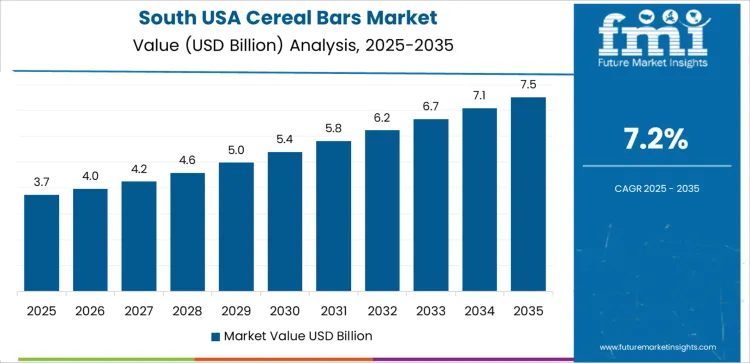
In South USA, demand for cereal bars is rising at a 7.2% CAGR. The region’s busy lifestyle and increasing preference for convenient, healthy snacks have driven the growth of cereal bars. South USA, with its growing population of health-conscious consumers, especially in cities like Texas and Florida, is experiencing a shift toward healthier, portable snack options. The demand for convenient yet nutritious snacks has led to a rise in cereal bars, which offer a mix of protein, fiber, and energy-boosting ingredients. The popularity of fitness and wellness trends is contributing to this demand, as more consumers prioritize balanced diets and on-the-go snacks. Cereal bars are being embraced by a wide range of consumers, including those seeking organic and gluten-free options. As convenience and health remain top priorities, demand for cereal bars in South USA is expected to continue growing, driven by both consumer preferences and lifestyle changes.
How is Demand for Cereal Bars Expanding in Northeast USA?
Northeast USA shows steady demand for cereal bars, growing at a 6.5% CAGR. The region’s fast-paced urban lifestyle, particularly in cities like New York and Boston, has led to the increasing popularity of on-the-go snacks. Cereal bars are a preferred choice for busy professionals and commuters, providing a convenient, nutritious option during hectic workdays. The growing focus on health and wellness in Northeast USA has fueled this trend, as consumers seek snacks that align with their fitness goals and dietary preferences. With a rise in demand for protein-rich, low-sugar, and high-fiber bars, cereal bars are being incorporated into more daily routines. The region’s focus on sustainability and healthy eating has also contributed to the popularity of organic and natural cereal bar options. As convenience, nutrition, and taste continue to be top priorities, demand for cereal bars in Northeast USA will keep growing steadily, catering to the region’s evolving eating habits.
Why is Demand for Cereal Bars Growing in Midwest USA?
Midwest USA is experiencing steady demand for cereal bars, growing at a 5.6% CAGR. The region’s evolving consumer habits, particularly in cities like Chicago and Detroit, have driven increased interest in convenient and nutritious snacks. As more consumers seek healthier alternatives to traditional snacks, cereal bars are becoming a go-to option for their portability and nutritional benefits. The rise in fitness and wellness trends in Midwest USA, along with the region’s focus on health-conscious eating, has led to a higher demand for protein-rich, fiber-filled cereal bars. The growing availability of cereal bars with dietary options such as gluten-free and low-sugar choices has expanded their appeal to a wider range of consumers. As more people prioritize convenience, nutrition, and taste, demand for cereal bars is expected to keep rising. The Midwest’s growing interest in personalized, healthier snacking options further contributes to the steady growth in this industry segment.
Competitive Aligners for Market Players
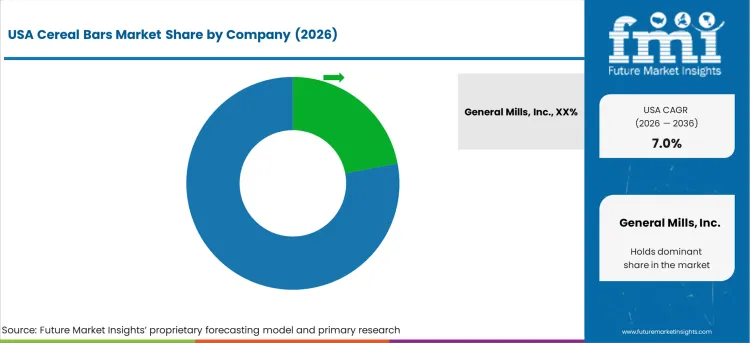
The competitive structure of the cereal bar market in the USA is moderately concentrated, with the top five manufacturers holding a combined retail value share exceeding 55%. General Mills, Inc., Naturell India Pvt. Ltd., Mars Incorporation and its Affiliates, BELLRING BRANDS, INC., and Nestle S.A. compete through brand portfolio breadth, distribution reach, and formulation innovation. Competitive differentiation is driven by the ability to deliver clean-label, high-protein products at price points that maintain margin while meeting retailer shelf performance benchmarks.
Scale advantages in ingredient procurement, manufacturing throughput, and retail relationship management provide structural moats for established players. Companies with multi-brand portfolios spanning standard granola, premium protein, and functional ingredient categories can offer retailers comprehensive category management solutions that single-brand competitors cannot match. Private label programs operated by major retailers represent the fastest-growing competitive threat, leveraging guaranteed shelf placement and consumer price sensitivity to capture market share from mid-tier branded products.
New entrant activity is concentrated in the premium and functional segments, where direct-to-consumer distribution channels reduce dependence on traditional retail shelf access. Startup brands with differentiated ingredient platforms, such as keto-compatible, collagen-enriched, or adaptogen-infused formulations, are building consumer loyalty through subscription models and social media marketing before pursuing retail distribution expansion.
Key Players in Demand for Cereal Bars in USA Market
- General Mills, Inc.
- Naturell India Pvt. Ltd.
- Mars Incorporation and its Affiliates
- BELLRING BRANDS, INC.
- Nestlé S.A.
Scope of the Report
| Metric | Value |
|---|---|
| Quantitative Units | USD 8.99 Billion to USD 17.68 Billion, at a CAGR of 7.0% |
| Market Definition | Cereal bars are ready-to-eat, individually packaged snack products manufactured by compressing or binding cereal grains, oats, nuts, dried fruits, and other nutritional ingredients into a portable bar format. Product categories include granola and muesli bars, energy and nutrition bars, and specialty bars fortified with protein, fiber, vitamins, or functional ingredients. |
| Product Segmentation | Granola/ Muesli Bars, Energy & Nutrition Bars, Others |
| Distribution Channel Segmentation | Hypermarkets & Supermarkets, Traditional Grocery Stores, Convenience Stores, Online, Others |
| Regions Covered | West USA, South USA, Northeast USA, Midwest USA |
| Key Companies Profiled | General Mills, Inc., Naturell India Pvt. Ltd., Mars Incorporation and its Affiliates, BELLRING BRANDS, INC., Nestlé S.A. |
| Forecast Period | 2026 to 2036 |
| Approach | Bottom-up methodology starting with category-level consumption data and applying regional penetration assumptions. |
Demand for Cereal Bars in USA Market Analysis by Segments
By Product:
Granola/ Muesli Bars, Energy & Nutrition Bars, Others
By Distribution Channel:
Hypermarkets & Supermarkets, Traditional Grocery Stores, Convenience Stores, Online, Others
By Region:
West USA, South USA, Northeast USA, Midwest USA
Bibliography
- 1. United States Department of Agriculture. (2024). Economic Research Service: Snack Food Market Trends and Consumer Data. USDA ERS.
- 2. Food and Drug Administration. (2024). Nutrition Labeling and Health Claims Guidance for Packaged Foods. FDA.
- 3. American Institute for Cancer Research. (2024). Dietary Guidelines and Whole Grain Consumption Statistics. AICR.
- 4. International Food Information Council. (2024). Food and Health Survey: Consumer Snacking Behavior. IFIC.
- 5. Grain Foods Foundation. (2024). Annual Cereal and Grain Product Consumption Report. GFF.
This bibliography is provided for reader reference. The full Future Market Insights report contains the complete reference list with primary research documentation.
Frequently Asked Questions
How large is the Demand for Cereal Bars in USA Market in 2026?
The Demand for Cereal Bars in USA market is estimated to be valued at USD 8.99 billion in 2026.
What will be the market size of Demand for Cereal Bars in USA by 2036?
The Demand for Cereal Bars in USA market is projected to reach USD 17.68 billion by 2036.
What is the expected CAGR for Demand for Cereal Bars in USA between 2026 and 2036?
The Demand for Cereal Bars in USA market is expected to grow at a CAGR of 7.0% between 2026 and 2036.
Which Product is poised to lead in 2026?
Granola/ Muesli Bars accounts for 50.0% share in 2026, maintaining its position as the leading product segment.
Which region is projected to grow the fastest?
West USA is projected to grow at a CAGR of 8.1% during 2026 to 2036, the fastest among all covered regions.
What does Demand for Cereal Bars in USA mean in this report?
Cereal bars are ready-to-eat, individually packaged snack products manufactured by compressing or binding cereal grains, oats, nuts, dried fruits, and other nutritional ingredients into a portable bar format. Product categories include granola and muesli bars, energy and nutrition bars, and specialty bars fortified with protein, fiber, vitamins, or functional ingredients.
What is included in the scope of this report?
Market scope includes granola and muesli bars, energy and nutrition bars, and other cereal-based bar formats sold as packaged consumer products. Distribution channel coverage spans hypermarkets and supermarkets, traditional grocery stores, convenience stores, online retail, and other channels.
How does FMI build and validate the Demand for Cereal Bars in USA forecast?
Forecasting models apply a bottom-up methodology starting with category-level consumption data and cross-validate projections against trade statistics, manufacturer shipment disclosures, and regulatory filings.
Preview the report firsthand - request a free sample
Get SampleGet the brochure for pricing and purchase details.
Get PDFTable of Content
- Executive Summary
- USA Market Outlook
- Demand-side Trends
- Supply-side Trends
- Technology Roadmap Analysis
- Analysis and Recommendations
- Market Overview
- Market Coverage / Taxonomy
- Market Definition / Scope / Limitations
- Research Methodology
- Chapter Orientation
- Analytical Lens and Working Hypotheses
- Market Structure, Signals, and Trend Drivers
- Benchmarking and Cross-market Comparability
- Market Sizing, Forecasting, and Opportunity Mapping
- Research Design and Evidence Framework
- Desk Research Programme (Secondary Evidence)
- Company Annual and Sustainability Reports
- Peer-reviewed Journals and Academic Literature
- Corporate Websites, Product Literature, and Technical Notes
- Earnings Decks and Investor Briefings
- Statutory Filings and Regulatory Disclosures
- Technical White Papers and Standards Notes
- Trade Journals, Industry Magazines, and Analyst Briefs
- Conference Proceedings, Webinars, and Seminar Materials
- Government Statistics Portals and Public Data Releases
- Press Releases and Reputable Media Coverage
- Specialist Newsletters and Curated Briefings
- Sector Databases and Reference Repositories
- FMI Internal Proprietary Databases and Historical Market Datasets
- Subscription Datasets and Paid Sources
- Social Channels, Communities, and Digital Listening Inputs
- Additional Desk Sources
- Expert Input and Fieldwork (Primary Evidence)
- Primary Modes
- Qualitative Interviews and Expert Elicitation
- Quantitative Surveys and Structured Data Capture
- Blended Approach
- Why Primary Evidence is Used
- Field Techniques
- Interviews
- Surveys
- Focus Groups
- Observational and In-context Research
- Social and Community Interactions
- Stakeholder Universe Engaged
- C-suite Leaders
- Board Members
- Presidents and Vice Presidents
- R&D and Innovation Heads
- Technical Specialists
- Domain Subject-matter Experts
- Scientists
- Physicians and Other Healthcare Professionals
- Governance, Ethics, and Data Stewardship
- Research Ethics
- Data Integrity and Handling
- Primary Modes
- Tooling, Models, and Reference Databases
- Desk Research Programme (Secondary Evidence)
- Data Engineering and Model Build
- Data Acquisition and Ingestion
- Cleaning, Normalisation, and Verification
- Synthesis, Triangulation, and Analysis
- Quality Assurance and Audit Trail
- Market Background
- Market Dynamics
- Drivers
- Restraints
- Opportunity
- Trends
- Scenario Forecast
- Demand in Optimistic Scenario
- Demand in Likely Scenario
- Demand in Conservative Scenario
- Opportunity Map Analysis
- Product Life Cycle Analysis
- Supply Chain Analysis
- Investment Feasibility Matrix
- Value Chain Analysis
- PESTLE and Porter’s Analysis
- Regulatory Landscape
- Regional Parent Market Outlook
- Production and Consumption Statistics
- Import and Export Statistics
- Market Dynamics
- USA Market Analysis 2021 to 2025 and Forecast, 2026 to 2036
- Historical Market Size Value (USD Million) Analysis, 2021 to 2025
- Current and Future Market Size Value (USD Million) Projections, 2026 to 2036
- Y-o-Y Growth Trend Analysis
- Absolute $ Opportunity Analysis
- USA Market Pricing Analysis 2021 to 2025 and Forecast 2026 to 2036
- USA Market Analysis 2021 to 2025 and Forecast 2026 to 2036, By Product
- Introduction / Key Findings
- Historical Market Size Value (USD Million) Analysis By Product , 2021 to 2025
- Current and Future Market Size Value (USD Million) Analysis and Forecast By Product , 2026 to 2036
- Granola/ Muesli Bars
- Energy & Nutrition Bars
- Others
- Granola/ Muesli Bars
- Y-o-Y Growth Trend Analysis By Product , 2021 to 2025
- Absolute $ Opportunity Analysis By Product , 2026 to 2036
- USA Market Analysis 2021 to 2025 and Forecast 2026 to 2036, By Distribution Channel
- Introduction / Key Findings
- Historical Market Size Value (USD Million) Analysis By Distribution Channel, 2021 to 2025
- Current and Future Market Size Value (USD Million) Analysis and Forecast By Distribution Channel, 2026 to 2036
- Hypermarkets & Supermarkets
- Traditional Grocery Stores
- Convenience Stores
- Online
- Others
- Hypermarkets & Supermarkets
- Y-o-Y Growth Trend Analysis By Distribution Channel, 2021 to 2025
- Absolute $ Opportunity Analysis By Distribution Channel, 2026 to 2036
- USA Market Analysis 2021 to 2025 and Forecast 2026 to 2036, By Region
- Introduction
- Historical Market Size Value (USD Million) Analysis By Region, 2021 to 2025
- Current Market Size Value (USD Million) Analysis and Forecast By Region, 2026 to 2036
- West
- South
- Northeast
- Midwest
- Market Attractiveness Analysis By Region
- West Market Analysis 2021 to 2025 and Forecast 2026 to 2036, By Country
- Historical Market Size Value (USD Million) Trend Analysis By Market Taxonomy, 2021 to 2025
- Market Size Value (USD Million) Forecast By Market Taxonomy, 2026 to 2036
- By Country
- By Product
- By Distribution Channel
- By Country
- Market Attractiveness Analysis
- By Country
- By Product
- By Distribution Channel
- Key Takeaways
- South Market Analysis 2021 to 2025 and Forecast 2026 to 2036, By Country
- Historical Market Size Value (USD Million) Trend Analysis By Market Taxonomy, 2021 to 2025
- Market Size Value (USD Million) Forecast By Market Taxonomy, 2026 to 2036
- By Country
- By Product
- By Distribution Channel
- By Country
- Market Attractiveness Analysis
- By Country
- By Product
- By Distribution Channel
- Key Takeaways
- Northeast Market Analysis 2021 to 2025 and Forecast 2026 to 2036, By Country
- Historical Market Size Value (USD Million) Trend Analysis By Market Taxonomy, 2021 to 2025
- Market Size Value (USD Million) Forecast By Market Taxonomy, 2026 to 2036
- By Country
- By Product
- By Distribution Channel
- By Country
- Market Attractiveness Analysis
- By Country
- By Product
- By Distribution Channel
- Key Takeaways
- Midwest Market Analysis 2021 to 2025 and Forecast 2026 to 2036, By Country
- Historical Market Size Value (USD Million) Trend Analysis By Market Taxonomy, 2021 to 2025
- Market Size Value (USD Million) Forecast By Market Taxonomy, 2026 to 2036
- By Country
- By Product
- By Distribution Channel
- By Country
- Market Attractiveness Analysis
- By Country
- By Product
- By Distribution Channel
- Key Takeaways
- Key Countries Market Analysis
- West
- Pricing Analysis
- Market Share Analysis, 2025
- By Product
- By Distribution Channel
- South
- Pricing Analysis
- Market Share Analysis, 2025
- By Product
- By Distribution Channel
- Northeast
- Pricing Analysis
- Market Share Analysis, 2025
- By Product
- By Distribution Channel
- Midwest
- Pricing Analysis
- Market Share Analysis, 2025
- By Product
- By Distribution Channel
- West
- Market Structure Analysis
- Competition Dashboard
- Competition Benchmarking
- Market Share Analysis of Top Players
- By Regional
- By Product
- By Distribution Channel
- Competition Analysis
- Competition Deep Dive
- General Mills, Inc.
- Overview
- Product Portfolio
- Profitability by Market Segments (Product/Age /Sales Channel/Region)
- Sales Footprint
- Strategy Overview
- Marketing Strategy
- Product Strategy
- Channel Strategy
- Naturell India Pvt. Ltd.
- Mars Incorporation and its Affiliates
- BELLRING BRANDS, INC.
- Nestlé S.A.
- General Mills, Inc.
- Competition Deep Dive
- Assumptions & Acronyms Used


