

- Industry Size (2026)
- USD 528.1 Mn
- Forecast (2036)
- USD 860.7 Mn
- CAGR (2026 to 2036)
- 5.0%
Demand for Positron Emission Tomography Scanners in USA 2026 to 2036
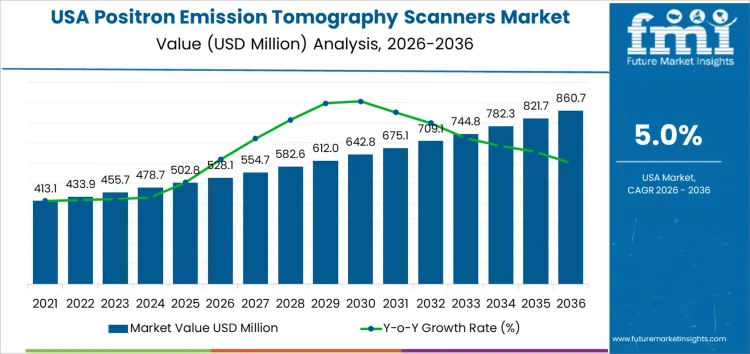
Demand for positron emission tomography scanners in USA is valued at USD 528.1 million in 2026 and is projected to reach USD 860.7 million by 2036, reflecting a CAGR of 5.0%. Demand expands through rising oncology and neurology imaging volumes, wider adoption of precision diagnostics, and replacement cycles for aging imaging infrastructure. Growth in outpatient imaging centers and integration of PET with advanced radiotracer programs support sustained equipment uptake.
Quick Stats for Demand for Positron Emission Tomography Scanners in USA
- USA Positron Emission Tomography Scanners Sales Value (2026): USD 528.1 million
- USA Positron Emission Tomography Scanners Forecast Value (2036): USD 860.7 million
- USA Positron Emission Tomography Scanners Forecast CAGR (2026 to 2036): 5.0%
- Leading Product Type in USA: Full-ring PET Scanners
- Key Growth Regions in USA: West USA, South USA, Northeast USA, Midwest USA
- Top Players in USA: Siemens Healthineers, GE HealthCare, Canon Medical Systems, Philips Healthcare, United Imaging Healthcare
Full-ring PET scanners lead product-type usage because complete detector coverage delivers higher sensitivity, improved image quality, and faster acquisition times. Providers prefer full-ring systems for oncology staging, treatment response assessment, and neurodegenerative disease evaluation. Advances in detector materials, time-of-flight capability, and AI-assisted reconstruction enhance diagnostic accuracy and workflow efficiency.
West USA, South USA, Northeast USA, and Midwest USA represent key growth regions supported by dense hospital networks, academic medical centers, and imaging service providers. Siemens Healthineers, GE HealthCare, Canon Medical Systems, Philips Healthcare, and United Imaging Healthcare anchor competitive activity through technology innovation, service coverage, and platforms aligned with evolving clinical protocols and reimbursement frameworks across USA diagnostic imaging environments.
USA Positron Emission Tomography Scanners Key Takeaways
| Metric | Value |
|---|---|
| USA Positron Emission Tomography Scanners Sales Value (2026) | USD 528.1 million |
| USA Positron Emission Tomography Scanners Forecast Value (2036) | USD 860.7 million |
| USA Positron Emission Tomography Scanners Forecast CAGR (2026-2036) | 5.0% |
Why is the Demand for Positron Emission Tomography (PET) Scanners in USA Growing?
Demand for positron emission tomography scanners in the United States grows due to expanding use of advanced diagnostic imaging across oncology, cardiology, and neurology care pathways. Cancer management relies on PET imaging for tumor detection, staging, treatment planning, and therapy response assessment, which increases scanner utilization. Rising cancer incidence and longer survival increase repeat imaging needs during disease monitoring. Neurology applications expand due to higher diagnosis rates of Alzheimer’s disease, epilepsy, and neurodegenerative disorders that require metabolic imaging for accurate evaluation. Cardiology practices apply PET scans to assess myocardial perfusion and viability in patients with complex coronary artery disease.
Growth in precision medicine increases reliance on molecular imaging to guide personalized treatment decisions. Hospitals and imaging centers invest in hybrid PET CT and PET MR systems to improve diagnostic accuracy and workflow efficiency. Expansion of radiotracer development supports broader clinical indications and research activity. Favorable reimbursement for approved indications sustains adoption across outpatient imaging facilities. Academic medical centers expand PET capacity to support clinical trials and translational research. Technological advancements improve image resolution, scanning speed, and dose efficiency, which supports replacement of older systems. Increased emphasis on early diagnosis and outcome monitoring reinforces continued demand across the healthcare system.
How Are the Segments Classified in the Demand for Positron Emission Tomography (PET) Scanners in USA?
Demand for positron emission tomography scanners in USA is shaped by cancer diagnostic volumes, expansion of molecular imaging protocols, and integration of PET within clinical decision workflows. Healthcare providers evaluate image resolution, detector sensitivity, scan efficiency, and compatibility with hybrid imaging systems. Adoption patterns reflect strong concentration in tertiary hospitals and diagnostic centers supporting oncology, neurology, and cardiology imaging under regulated reimbursement and clinical guideline frameworks.
Which PET Scanner Product Configuration Dominates Demand in USA?
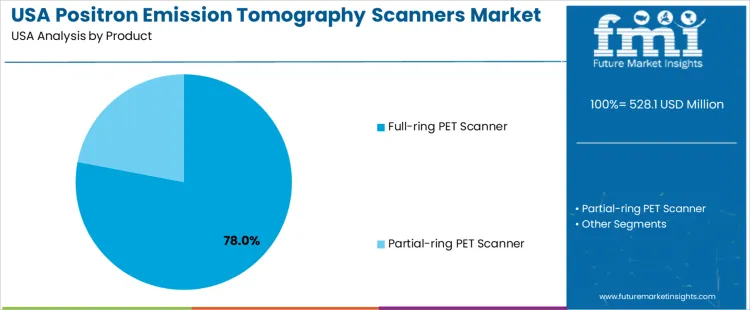
Full-ring PET scanners hold 78.0%, dominating product configuration demand in USA. These systems provide complete detector coverage, enabling higher image resolution, improved sensitivity, and reduced scan times. Full-ring designs support high-throughput clinical environments managing complex diagnostic workloads. Partial-ring PET scanners hold 22.0%, used in cost-sensitive settings or specialized research applications where reduced coverage remains acceptable. Product distribution reflects preference for full-ring systems due to diagnostic accuracy requirements and alignment with advanced imaging protocols across USA healthcare facilities.
Key Points
- Full-ring scanners lead due to superior image quality.
- Complete detector coverage improves diagnostic confidence.
- Partial-ring systems serve selective and budget-driven use.
Which Clinical Application Drives the Majority of PET Scanner Utilization in USA?
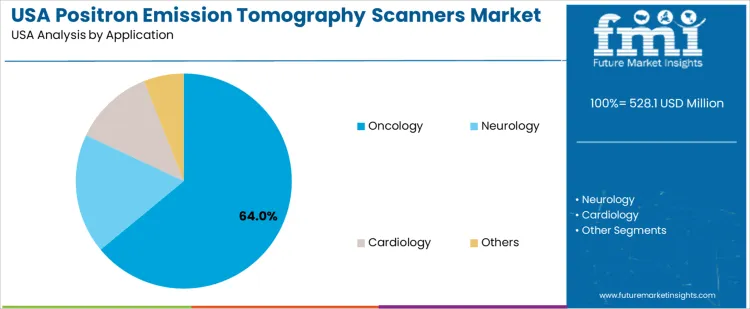
Oncology holds 64.0%, driving the majority of PET scanner utilization in USA. PET imaging supports tumor detection, staging, therapy response assessment, and recurrence monitoring across multiple cancer types. Neurology accounts for 18.0%, supporting evaluation of neurodegenerative disorders and epilepsy. Cardiology holds 12.0%, applied in myocardial viability and perfusion assessment. Other applications account for 6.0%, including infection and inflammation imaging. Application distribution reflects dominant role of PET imaging within oncology-focused diagnostic pathways.
Key Points
- Oncology dominates due to broad cancer imaging use.
- Neurology supports functional brain assessment.
- Cardiology applications remain specialized.
Which Detector Material Is Most Widely Used in PET Scanners in USA?
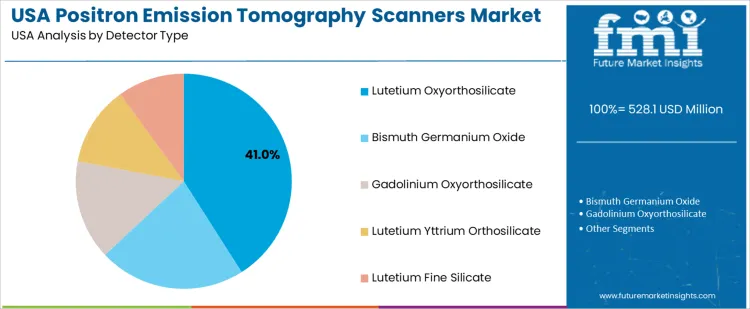
Lutetium oxyorthosilicate detectors hold 41.0%, representing the most widely used detector material in USA PET scanners. These detectors provide high light output, fast decay time, and strong energy resolution, supporting precise imaging. Bismuth germanium oxide holds 22.0%, offering stability and cost advantages in established systems. Gadolinium oxyorthosilicate accounts for 15.0%, supporting balanced performance characteristics. Lutetium yttrium orthosilicate holds 12.0%, while lutetium fine silicate holds 10.0%, serving specialized performance requirements. Detector distribution reflects emphasis on sensitivity and timing performance.
Key Points
- LYSO leads due to sensitivity and timing efficiency.
- BGO supports established and cost-focused systems.
- Other detectors address specialized imaging needs.
What are the Key Dynamics in the Positron Emission Tomography Scanners Industry?
Demand rises as hospitals, cancer centers, and imaging networks in USA adopt PET scanners to support early disease detection, oncology staging, and therapeutic monitoring. Usage aligns with high prevalence of cancer, neurological disorders, and cardiovascular diseases requiring functional imaging. Adoption reflects advanced clinical infrastructure, structured diagnostic pathways, and reimbursement coverage across Medicare, Medicaid, and private insurers. Deployment concentrates in metropolitan healthcare hubs and specialized outpatient imaging centers.
How do disease burden and clinical diagnostic standards drive demand in USA?
USA experiences significant incidence of malignancies where PET imaging informs staging, treatment planning, and response assessment. Oncologists rely on PET’s metabolic imaging to distinguish viable tumor tissue from post-treatment changes. Neurology practices use PET to evaluate cognitive disorders, movement disorders, and dementia subtyping. Cardiology applications include evaluation of myocardial viability and perfusion. Integrated PET/CT and PET/MR platforms enhance anatomical correlation and diagnostic accuracy. High referral rates from multidisciplinary care teams sustain procedural volumes. Early detection and personalized therapy strategies reinforce repeated use throughout treatment cycles. Demand concentrates where care networks emphasize evidence-based imaging protocols.
How do reimbursement policies, capital costs, and operational requirements influence demand stability in USA?
PET scanners involve substantial capital expenditure and require skilled personnel, including nuclear medicine technologists and radiochemists. Medicare and private payer reimbursement affects procedural volume and financial justification for acquisition. Regulatory oversight of radiotracer use, facility licensing, and radiation safety adds compliance complexity. PET imaging requires access to cyclotron-produced tracers or reliable delivery logistics, influencing site selection. Integration with electronic health records and referral patterns shapes utilization. Competition from alternative imaging modalities exists in specific indications. Demand remains strong where diagnostic value is demonstrable, while broader adoption depends on reimbursement clarity, cost management, and sustained clinical guideline endorsement within USA healthcare practice.
How Is Demand for Positron Emission Tomography (PET) Scanners in the USA Evolving by Region?
Demand for positron emission tomography scanners in the USA is expanding due to oncology imaging needs, neurological disorder diagnosis, and growth in precision medicine. West USA leads with a 5.8% CAGR, supported by cancer centers and early adoption of advanced imaging technologies. South USA follows at 5.2%, driven by expanding hospital networks and rising chronic disease burden. Northeast USA records a 4.6% CAGR, shaped by academic medical centers and research-driven imaging utilization. Midwest USA posts 4.0%, reflecting system-wide replacement cycles and cost-managed capital planning. Regional differences reflect imaging infrastructure density, reimbursement discipline, and pace of diagnostic technology upgrades across the USA.
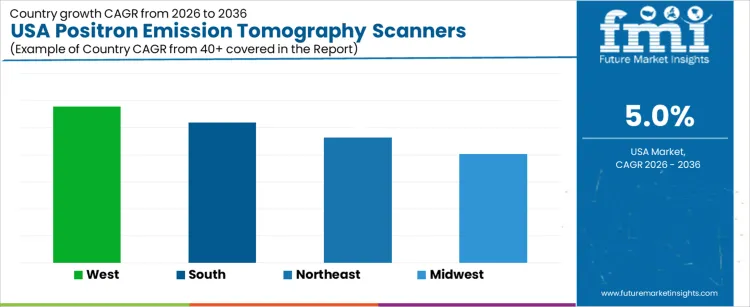
| Region | CAGR (2026-2036) |
|---|---|
| West USA | 5.8% |
| South USA | 5.2% |
| Northeast USA | 4.6% |
| Midwest USA | 4.0% |
What clinical and investment factors are driving PET scanner adoption in West USA?
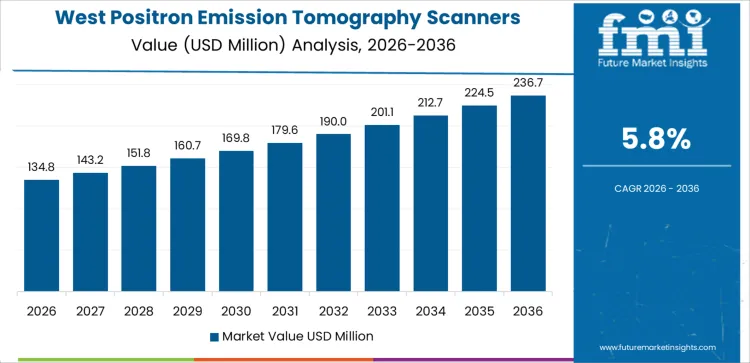
West USA drives demand through high concentration of comprehensive cancer centers, academic hospitals, and specialty imaging providers. Region’s CAGR of 5.8% reflects strong utilization of PET scanners for oncology staging, therapy monitoring, and neurological imaging. Providers invest in digital PET systems offering higher resolution and lower radiation dose. Research activity supports adoption of advanced tracers and hybrid PET CT platforms. Capital investment aligns with competitive positioning and clinical differentiation. Demand favors scanners supporting high throughput and integration with AI-enabled image analysis. Growth remains innovation-led, aligned with precision diagnostics and strong reimbursement capture in high-acuity care settings.
- High density of comprehensive cancer centers
- Adoption of digital and hybrid PET systems
- Use of advanced radiotracers
- Investment in high-throughput imaging platforms
Why is PET scanner demand growing steadily across South USA healthcare systems?
South USA demand is shaped by hospital expansion, population growth, and rising cancer incidence. Region’s CAGR of 5.2% reflects increased installation of PET scanners in regional hospitals and outpatient imaging centers. Health systems prioritize expanding diagnostic capacity to reduce referral delays. Oncology and cardiology imaging represent primary use cases. Cost efficiency and service availability influence procurement decisions. Facilities favor reliable systems with strong service support and predictable operating costs. Growth remains capacity-led and access-focused, aligned with broadening diagnostic coverage across urban and suburban healthcare markets.
- Expansion of regional hospital networks
- Oncology-driven diagnostic imaging demand
- Focus on access and reduced referral times
- Emphasis on service reliability and cost control
How do research intensity and care standards influence PET scanner demand in Northeast USA?
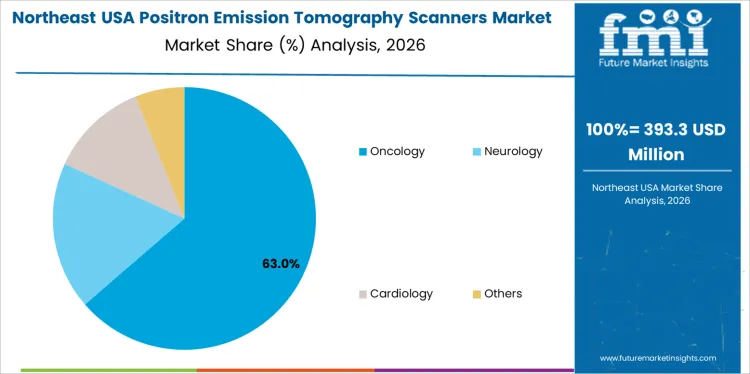
Northeast USA demand reflects academic medicine leadership, research-driven imaging protocols, and standardized diagnostic pathways. Region’s CAGR of 4.6% is supported by use of PET scanners in oncology trials, neurology research, and precision diagnostics. Teaching hospitals emphasize image accuracy, protocol consistency, and integration with research databases. Capital purchases align with grant funding and institutional investment cycles. Demand favors systems supporting multiple tracers and advanced reconstruction software. Growth remains disciplined and evidence-focused, aligned with research output and guideline-driven clinical practice rather than rapid capacity expansion.
- Academic hospital and research-led utilization
- Clinical trial and protocol-driven imaging
- Multi-tracer and advanced software capability
- Funding-aligned capital investment cycles
What explains measured PET scanner adoption across Midwest USA facilities?
Midwest USA demand is anchored in integrated health systems, mature imaging infrastructure, and conservative capital planning. Region’s CAGR of 4.0% reflects replacement of aging PET scanners and selective capacity expansion. Providers prioritize operational reliability, uptime, and reimbursement alignment. Oncology imaging remains primary application, with limited expansion into advanced research use. Procurement decisions emphasize total cost of ownership and long-term service agreements. Growth remains steady and replacement-led, aligned with maintaining diagnostic standards and managing capital expenditure across large regional healthcare networks.
- Replacement-driven imaging equipment upgrades
- Integrated health system procurement models
- Focus on reliability and reimbursement alignment
- Conservative and planned capital investment
What is the competitive landscape of demand for positron emission tomography scanners in the USA?
Demand for positron emission tomography scanners in the USA is driven by diagnostic oncology, cardiology, neurology, and research applications requiring high-resolution functional imaging. PET systems support cancer staging, therapy response assessment, Alzheimer’s and Parkinson’s disease evaluation, and cardiovascular perfusion studies. Buyers evaluate spatial resolution, sensitivity, time-of-flight performance, integrated PET/CT or PET/MRI platforms, and software analytics that enhance diagnostic confidence. Procurement teams prioritize suppliers with robust clinical support networks, rapid service response, compliance with FDA imaging device regulations, and integration with hospital information and radiology PACS systems. Trend in the USA market reflects investment in advanced digital detectors, hybrid imaging solutions, and AI-enhanced reconstruction algorithms that improve throughput and diagnostic accuracy.
Siemens Healthineers USA holds a leading position in the PET scanner market with a broad portfolio of PET/CT and integrated imaging solutions adopted by USA cancer centers, academic hospitals, and large imaging networks. GE HealthCare participates with advanced PET/CT systems featuring digital detector technology and comprehensive clinical workflow integration. Canon Medical Systems USA maintains visibility with PET/CT platforms emphasizing image quality and dose efficiency tailored to multimodality imaging needs. Philips Healthcare USA contributes PET/CT and PET/MRI hybrid systems supported by strong clinical partnerships and service infrastructure. United Imaging Healthcare USA supports demand with PET/CT and digital imaging solutions gaining adoption through competitive performance and service support. Competitive positioning in the USA reflects imaging performance, service reliability, regulatory alignment, and ability to meet diverse clinical application requirements across oncology, cardiology, and neurology.
Key Players in USA Positron Emission Tomography Scanners Demand
- Siemens Healthineers
- GE HealthCare
- Canon Medical Systems
- Philips Healthcare
- United Imaging Healthcare
Scope of the Report
| Items | Details |
|---|---|
| Quantitative Units | USD million |
| Product | Full-ring PET Scanner; Partial-ring PET Scanner |
| Application | Oncology; Neurology; Cardiology; Others |
| Detector Type | Lutetium Oxyorthosilicate; Bismuth Germanium Oxide; Gadolinium Oxyorthosilicate; Lutetium Yttrium Orthosilicate; Lutetium Fine Silicate |
| End User | Hospitals; Diagnostic Centers; PET Centers; Research Institute |
| Regions Covered | West USA; South USA; Northeast USA; Midwest USA |
| Key Companies Profiled | Siemens Healthineers; GE HealthCare; Canon Medical Systems; Philips Healthcare; United Imaging Healthcare |
| Additional Attributes | Demand is supported by rising cancer incidence, expansion of advanced diagnostic imaging infrastructure, and replacement of legacy systems. Adoption is strongest in oncology-focused hospitals and diagnostic centers, with detector innovation and image resolution improvements influencing procurement decisions across major US regions. |
USA Positron Emission Tomography Scanners Demand by Segments
Product:
- Full-ring PET Scanner
- Partial-ring PET Scanner
Application:
- Oncology
- Neurology
- Cardiology
- Others
Detector Type:
- Lutetium Oxyorthosilicate
- Bismuth Germanium Oxide
- Gadolinium Oxyorthosilicate
- Lutetium Yttrium Orthosilicate
- Lutetium Fine Silicate
End User:
- Hospitals
- Diagnostic Centers
- PET Centers
- Research Institute
Region:
- West USA
- South USA
- Northeast USA
- Midwest USA
Frequently Asked Questions
How big is the demand for positron emission tomography scanners in USA in 2026?
The demand for positron emission tomography scanners in USA is estimated to be valued at USD 528.1 million in 2026.
What will be the size of positron emission tomography scanners in USA in 2036?
The market size for the positron emission tomography scanners in USA is projected to reach USD 860.7 million by 2036.
How much will be the demand for positron emission tomography scanners in USA growth between 2026 and 2036?
The demand for positron emission tomography scanners in USA is expected to grow at a 5.0% CAGR between 2026 and 2036.
What are the key product types in the positron emission tomography scanners in USA?
The key product types in positron emission tomography scanners in USA are full-ring pet scanner and partial-ring pet scanner.
Which application segment is expected to contribute significant share in the positron emission tomography scanners in USA in 2026?
In terms of application, oncology segment is expected to command 64.0% share in the positron emission tomography scanners in USA in 2026.
Preview the report firsthand - request a free sample
Get SampleGet the brochure for pricing and purchase details.
Get PDFTable of Content
- Executive Summary
- USA Market Outlook
- Demand-side Trends
- Supply-side Trends
- Technology Roadmap Analysis
- Analysis and Recommendations
- Market Overview
- Market Coverage / Taxonomy
- Market Definition / Scope / Limitations
- Market Background
- Market Dynamics
- Drivers
- Restraints
- Opportunity
- Trends
- Scenario Forecast
- Demand in Optimistic Scenario
- Demand in Likely Scenario
- Demand in Conservative Scenario
- Opportunity Map Analysis
- Product Life Cycle Analysis
- Supply Chain Analysis
- Investment Feasibility Matrix
- Value Chain Analysis
- PESTLE and Porter’s Analysis
- Regulatory Landscape
- Regional Parent Market Outlook
- Production and Consumption Statistics
- Import and Export Statistics
- Market Dynamics
- USA Market Analysis 2021 to 2025 and Forecast, 2026 to 2036
- Historical Market Size Value (USD Million) Analysis, 2021 to 2025
- Current and Future Market Size Value (USD Million) Projections, 2026 to 2036
- Y-o-Y Growth Trend Analysis
- Absolute $ Opportunity Analysis
- USA Market Pricing Analysis 2021 to 2025 and Forecast 2026 to 2036
- USA Market Analysis 2021 to 2025 and Forecast 2026 to 2036, By Product
- Introduction / Key Findings
- Historical Market Size Value (USD Million) Analysis By Product , 2021 to 2025
- Current and Future Market Size Value (USD Million) Analysis and Forecast By Product , 2026 to 2036
- Full-ring PET Scanner
- Partial-ring PET Scanner
- Full-ring PET Scanner
- Y-o-Y Growth Trend Analysis By Product , 2021 to 2025
- Absolute $ Opportunity Analysis By Product , 2026 to 2036
- USA Market Analysis 2021 to 2025 and Forecast 2026 to 2036, By Application
- Introduction / Key Findings
- Historical Market Size Value (USD Million) Analysis By Application, 2021 to 2025
- Current and Future Market Size Value (USD Million) Analysis and Forecast By Application, 2026 to 2036
- Oncology
- Neurology
- Cardiology
- Others
- Oncology
- Y-o-Y Growth Trend Analysis By Application, 2021 to 2025
- Absolute $ Opportunity Analysis By Application, 2026 to 2036
- USA Market Analysis 2021 to 2025 and Forecast 2026 to 2036, By Detector Type
- Introduction / Key Findings
- Historical Market Size Value (USD Million) Analysis By Detector Type, 2021 to 2025
- Current and Future Market Size Value (USD Million) Analysis and Forecast By Detector Type, 2026 to 2036
- Lutetium Oxyorthosilicate
- Bismuth Germanium Oxide
- Gadolinium Oxyorthosilicate
- Lutetium Yttrium Orthosilicate
- Lutetium Fine Silicate
- Lutetium Oxyorthosilicate
- Y-o-Y Growth Trend Analysis By Detector Type, 2021 to 2025
- Absolute $ Opportunity Analysis By Detector Type, 2026 to 2036
- USA Market Analysis 2021 to 2025 and Forecast 2026 to 2036, By End User
- Introduction / Key Findings
- Historical Market Size Value (USD Million) Analysis By End User, 2021 to 2025
- Current and Future Market Size Value (USD Million) Analysis and Forecast By End User, 2026 to 2036
- Hospitals
- Diagnostic Centers
- PET Centers
- Research Institute
- Hospitals
- Y-o-Y Growth Trend Analysis By End User, 2021 to 2025
- Absolute $ Opportunity Analysis By End User, 2026 to 2036
- Market Structure Analysis
- Competition Dashboard
- Competition Benchmarking
- Market Share Analysis of Top Players
- By Regional
- By Product
- By Application
- By Detector Type
- By End User
- Competition Analysis
- Competition Deep Dive
- Siemens Healthineers
- Overview
- Product Portfolio
- Profitability by Market Segments (Product/Age /Sales Channel/Region)
- Sales Footprint
- Strategy Overview
- Marketing Strategy
- Product Strategy
- Channel Strategy
- GE HealthCare
- Canon Medical Systems
- Philips Healthcare
- Value (USD Million)ed Imaging Healthcare
- Siemens Healthineers
- Competition Deep Dive
- Assumptions & Acronyms Used
- Research Methodology


