

- Industry Size (2026)
- USD 1.54 Bn
- Forecast (2036)
- USD 3.96 Bn
- CAGR (2026 to 2036)
- 10.0%
Aromatic Ketone Polymers Market Size, Market Forecast and Outlook By FMI
In 2025, the aromatic ketone polymers market was valued at USD 1.4 billion. Based on Future Market Insights' analysis, demand for aromatic ketone polymers is estimated to grow to USD 1.54 billion in 2026 and USD 3.96 billion by 2036. FMI projects a CAGR of 10.0% during the forecast period. This expansion is transformational rather than incremental, as the market is set to nearly triple from its 2025 base. Growth remains supported by rising adoption of high-performance polymers in aerospace, electronics, and medical devices, while feedstock price volatility for specialty intermediates, high processing costs, and substitution pressure from advanced polyimides and PPS grades moderate the pace of expansion.
Rising OEM qualification cycles in aerospace and electrification programs are pushing specialty polymer suppliers to streamline portfolios and focus on higher-margin performance grades, including aromatic ketone polymers used in lightweight structural and insulation components. This strategic repositioning is reflected in corporate restructuring across the specialty materials space.
Summary of Aromatic Ketone Polymers Market
- Market Definition
- Aromatic ketone polymers are high-temperature, chemically resistant engineering thermoplastics supplied as resins and semi-finished forms for conversion into load-bearing industrial components across aerospace, automotive, electronics, and medical sectors.
- Demand Drivers
- Aerospace OEMs are specifying metal replacement materials to reduce aircraft weight and improve fuel efficiency, directly increasing demand for high-performance aromatic ketone grades.
- Electric vehicle manufacturers are adopting thermally stable polymers for motor insulation and structural housings to manage higher operating temperatures.
- Medical device producers are shifting toward implantable and sterilizable polymers that can withstand repeated autoclaving without mechanical degradation.
- Key Segments Analyzed
- By Type: Polyacrylic Ketone accounts for 27.2% share in 2026, driven by its balance of processability and mechanical strength.
- By End-User Industry: Aerospace and automotive lightweighting applications represent the dominant consumption base due to high certification barriers and long-term contracts.
- By Geography: Asia Pacific leads volume growth, supported by manufacturing expansion and domestic aerospace programs.
- Analyst Opinion at FMI
- Nikhil Kaitwade, principal consultant for Chemicals & Materials at Future Market Insights, opines, “long‑term industry leadership in aromatic ketone polymers will be defined not by price negotiations but by the depth of qualification, performance assurance, and the ability to meet mission‑critical specifications that govern supplier positioning in high‑stakes markets.”
- Strategic Implications/Executive Takeaways
- Invest in application-specific grades aligned with aerospace and EV certification cycles to secure multi-year supply agreements.
- Diversify feedstock sourcing to mitigate exposure to aromatic intermediate price volatility.
- Strengthen downstream technical service capabilities to support OEM material substitution programs.
- Methodology
- Market sizing integrates bottom-up capacity assessments with top-down validation against engineering plastics demand benchmarks.
- Primary interviews with OEM procurement and polymer producers were used to validate pricing and adoption assumptions.
- Trade data and company financial disclosures were triangulated to confirm regional growth projections.
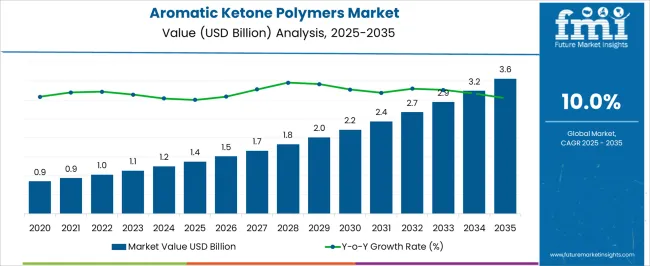
| Metric | Value |
|---|---|
| Expected Value (2026E) | USD 1.54 billion |
| Projected Value (2036F) | USD 3.96 billion |
| CAGR (2026-2036) | 10.0% |
Source: Future Market Insights-analysis driven by proprietary forecasting models and primary research
As Ilham Kadri, Chief Executive Officer of Syensqo SA, noted regarding the company’s transformation strategy, “The actions taken to build and strengthen Syensqo’s foundation support future profitable growth and value creation. In times like these, it has been more important than ever to accelerate change, become leaner and more agile, sharpen our value proposition with existing customers, find incremental growth opportunities with new customers, and continue transforming into a purer-play specialty company that will outgrow our markets for years to come.” [1]
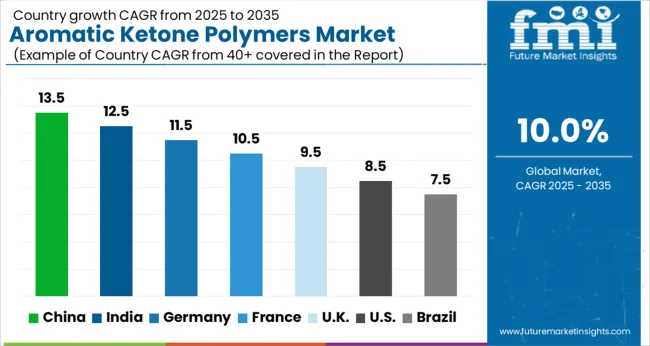
China is projected to record the fastest expansion at a CAGR of 11.8%, supported by domestic aerospace programs and scaling EV drivetrain manufacturing that increasingly substitutes metal components with high-performance polymers. India follows at 11.2% CAGR, driven by capacity additions in specialty chemicals and policy support for domestic electronics and defense manufacturing.
South Korea is expected to grow at 10.9% CAGR, underpinned by semiconductor equipment demand and battery component innovation requiring high thermal stability materials. Germany is forecasted to expand at 9.8% CAGR, sustained by automotive lightweighting mandates and precision industrial engineering applications. USA is projected to grow at 9.4% CAGR, supported by aerospace retrofits and medical device material upgrades, though moderated by regulatory qualification cycles.
Segmental Analysis
Aromatic Ketone Polymers Market Analysis by Product Type
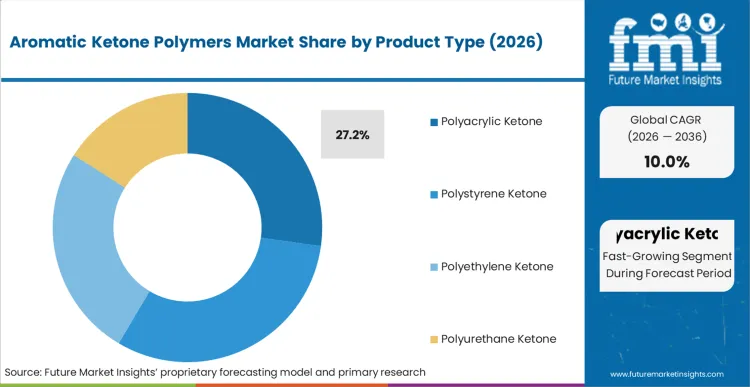
Polyether ether ketone (PEEK) and polyether ketone ketone (PEKK) are witnessing accelerated adoption as primary extrusion and injection molding grades. These high-performance polymers deliver unmatched mechanical toughness and chemical inertness under extreme operating temperatures, allowing manufacturers to bypass the weight penalties of traditional aluminum or titanium housings while retaining structural integrity in high-load environments.
- Capacity Investment: Victrex plc confirmed continued investment in PEEK capacity and downstream processing capabilities to support aerospace and energy demand, reinforcing supply reliability for aromatic ketone polymer grades [2].
- Product Development: Syensqo, following its specialty portfolio transition, expanded its high-performance polymer offerings to support electrification and advanced mobility applications requiring heat-resistant materials [3].
- Regional Compounding Expansion: SABIC expanded engineering thermoplastics compounding capacity in Asia to reduce supply lead times and strengthen regional delivery for high-performance automotive and electronics customers [4].
Aromatic Ketone Polymers Market Analysis by End-Use Industry
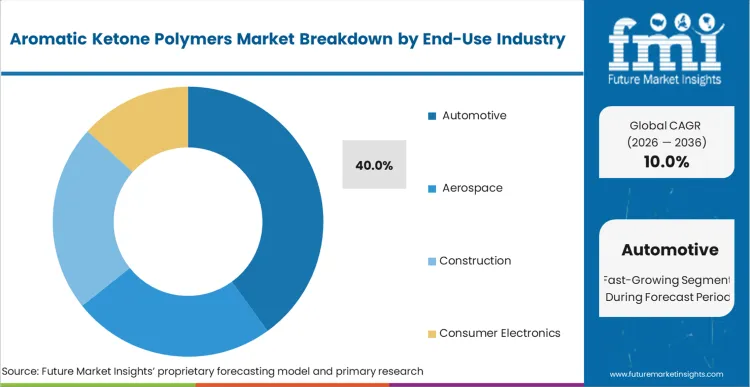
Mobility and transportation applications represent a primary growth engine for high-performance thermoplastics. As engineers grapple with the thermal management challenges of next-generation powertrains, aromatic ketone polymers provide the necessary dielectric strength and flame retardancy to secure critical high-voltage battery modules and e-motor insulations without compromising on payload efficiency or safety.
- Electrification Programs: Major global OEMs have accelerated EV platform rollouts, increasing demand for high-temperature polymer insulation and structural housings in e-motors and battery modules, as disclosed in multiple 2023-2024 automotive earnings releases [5].
- Lightweighting Mandates: Regulatory fleet emission standards in the European Union continue to pressure automakers to substitute metal parts with advanced thermoplastics to reduce mass and meet CO₂ targets.
- Tier-1 Integration: Tier-1 automotive suppliers have expanded in-house polymer component manufacturing to secure material supply continuity for high-performance thermoplastics used in powertrain systems.
Aromatic Ketone Polymers Market Drivers, Restraints and Opportunities
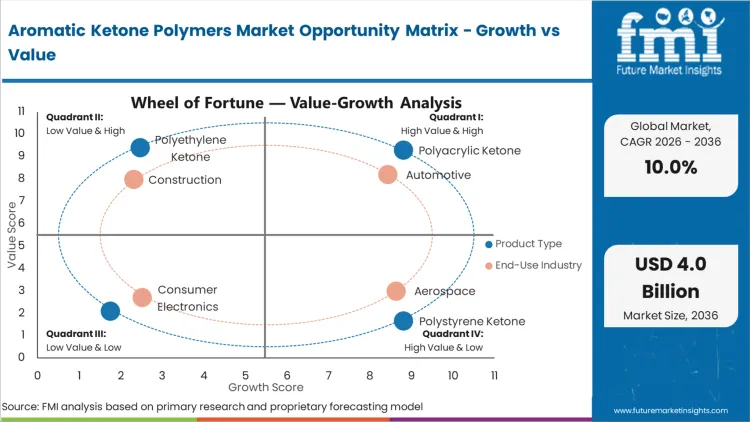
Aromatic ketone polymers market has historically been qualification-driven rather than volume-driven. The market's current baseline is sustained by non-negotiable performance mandates in highly regulated sectors where material failure carries catastrophic risks. Procurement is characterized by long-term supply agreements and stringent multi-year qualification processes, erecting high barriers to entry that shield established polymer producers from rapid commoditization.
While some legacy oil and gas sealing applications are experiencing slower procurement cycles due to capital expenditure discipline, demand is expanding in electric vehicle motor insulation and battery-adjacent components. Higher-performance grades command premium pricing, even when volumes are modest, which sustains revenue growth. As a result, revenue expansion reflects value-per-kilogram gains rather than sheer tonnage acceleration.
- Fleet Emission Mandates: The European Union’s Regulation (EU) 2019/631 on CO₂ emission performance standards continues to push automakers to reduce fleet emissions, encouraging substitution of metal parts with high-temperature thermoplastics to reduce vehicle weight. This policy-driven lightweighting dynamic directly supports automotive consumption of aromatic ketone polymers.
- Asia Manufacturing Shift: China and South Korea are expanding domestic aerospace and EV component production, increasing local demand for engineering polymers. Regional supply chain localization reduces dependency on European imports and strengthens Asia Pacific’s share of incremental capacity additions.
- Medical Sterilization Standards: Increasing reliance on repeated sterilization protocols in medical devices, aligned with ISO 17665 standards for moist heat sterilization, is encouraging adoption of polymers that can withstand autoclave cycles without mechanical degradation. This creates a steady niche demand independent of automotive cyclicality.
Regional Analysis
The regional analysis covers China, India, South Korea, Germany, the United States, Japan, France, and the United Kingdom, representing high-growth manufacturing hubs and mature engineering markets. The market is segmented across Asia Pacific, North America, and Europe based on production capacity, end-use concentration, and regulatory intensity. The full report provides country-level benchmarking and market attractiveness analysis for each geography.
.webp "Top Country Growth Comparison Aromatic Ketone Polymers Market Cagr (2026 2036)")
| Countries | Value CAGR (2026 to 2036) |
|---|---|
| China | 11.8% |
| India | 11.2% |
| South Korea | 10.9% |
| Germany | 9.8% |
| France | 8.2% |
| UK | 7.8% |
| Japan | 8.5% |
| USA | 9.4% |
Source: Future Market Insights analysis, supported by a proprietary forecasting model and primary research
Asia Pacific Aromatic Ketone Polymers Market Analysis
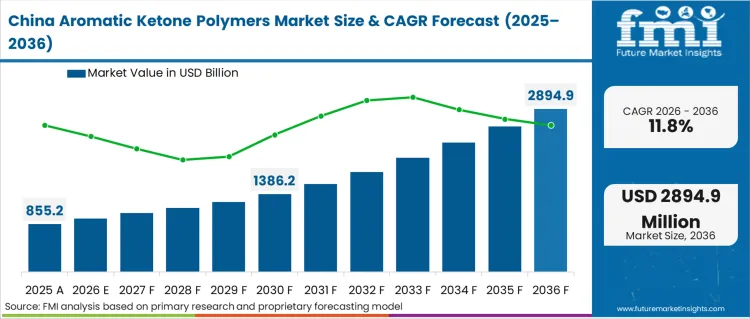
Asia Pacific is the production epicenter for aromatic ketone polymers demand growth, driven by expanding EV manufacturing and domestic aerospace ambitions. Vertically integrated manufacturers and global suppliers such as SABIC support regional momentum, which maintains compounding operations in the region, and Syensqo SA, which serves Asian mobility platforms through specialty polymer supply agreements. The region combines cost-competitive processing with fast-growing end-use industries.
- China: Demand for aromatic ketone polymers in China is projected to rise at an 11.8% CAGR through 2036. Domestic aerospace procurement structures favor localized material sourcing, which reduces reliance on imported high-performance polymers and encourages regional capacity development.
- India: India is expected to see its aromatic ketone polymers sector grow at a compound annual rate of 11.2% through 2036. Such growth reflects a policy-driven import substitution framework combined with expanding private sector EV assembly.
- South Korea: South Korea's aromatic ketone polymers industry is projected to witness growth at a CAGR of 10.9% through 2036. Hyundai Motor Group’s electrification roadmap updates in 2023-2024 confirmed scaling of EV platform production, supporting demand for high-temperature drivetrain polymers. South Korea’s growth mechanism is export-oriented manufacturing expansion rather than domestic fleet replacement.
- Japan: The market for aromatic ketone polymers in Japan is forecast to register a CAGR of 8.5% through 2036. Japan’s Green Growth Strategy revisions in 2023 continue to prioritize EV and advanced material innovation. Mature automotive production volumes and slower domestic EV penetration rates, resulting in steady but measured polymer adoption in precision engineering and electronics, moderate Japan’s growth.
The comprehensive FMI report provides an in-depth analysis of the broader Asia Pacific ecosystem, extending beyond these major manufacturing hubs to identify highly lucrative opportunities in Taiwan and Southeast Asia. Taiwan's massive semiconductor industry is driving intense demand for ultra-pure, high-temperature aromatic ketone polymers used in wafer processing equipment. Simultaneously, countries like Vietnam and Thailand are rapidly emerging as electronics and automotive assembly hubs, drawing regional compounding investments to support shifting global supply chains.
Europe Aromatic Ketone Polymers Market Analysis
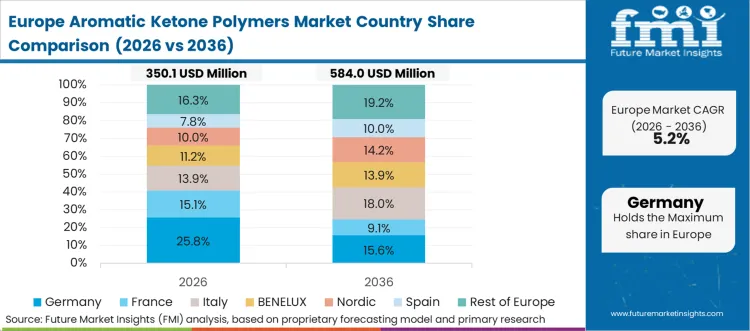
Europe functions as the global regulatory laboratory for lightweighting and emission standards. Demand patterns are influenced by EU fleet emission mandates and aerospace certification frameworks. Regional players such as Syensqo SA and Evonik Industries AG maintain strong positions in specialty materials supply, while Victrex plc serves aerospace and energy markets from its UK base. The region is characterized by mature qualification cycles and premium-grade demand.
- Germany: The aromatic ketone polymers segment in Germany is projected to grow at an average annual rate of 9.8% through 2036. Germany’s implementation of EU Regulation 2019/631 on CO₂ emission standards continues to push automotive OEMs toward lightweight substitution strategies. Germany’s procurement model centers on Tier-1 supplier integration, requiring long qualification cycles but providing stable demand once approved.
- France: Over the forecast period, aromatic ketone polymers in France are set for a CAGR of 8.2% through 2036. Unlike Germany’s automotive-heavy exposure, France’s growth leans toward aerospace modernization and medical device sterilization compliance standards adopted through national health regulatory frameworks.
- United Kingdom: The UK aromatic ketone polymers landscape is set to achieve a CAGR of 7.8% through 2036. Industry reflects replacement-driven aerospace procurement and advanced manufacturing policy support rather than large-scale EV fleet expansion.
FMI’s report gets in-depth on the wider European landscape by analyzing additional high-potential markets outside the big three. Italy is a critical hub experiencing a rise in demand fueled by its luxury automotive sector and specialized medical device manufacturing, both of which require premium-grade heat-resistant polymers. Switzerland's precision engineering and world-class healthcare manufacturing industries create a highly lucrative, niche market for repeatedly sterilizable polymer components.
North America Aromatic Ketone Polymers Market Analysis
North America represents the advanced application and certification hub for aromatic ketone polymers, with demand rooted in aerospace, medical devices, and premium automotive engineering. Major suppliers such as SABIC and Syensqo SA maintain distribution and technical service networks, while US-based OEM ecosystems drive application-specific material approvals. The region emphasizes performance validation and long-term contracting.
- United States: Sales of aromatic ketone products in the USA are on track to record a CAGR of 9.4% through 2036. The Inflation Reduction Act implementation milestones in 2023-2024 expanded domestic EV manufacturing incentives, indirectly stimulating demand for high-temperature polymer components in battery and drivetrain systems. Boeing’s 2024 production outlook updates reaffirmed sustained single-aisle aircraft output planning, supporting aerospace-grade polymer procurement. The US market differs from Asia through its reliance on long-term supply contracts and federal incentive structures rather than centralized industrial policy.
FMI’s extensive report goes in-depth to evaluate the broader North American ecosystem, highlighting that while the US is the anchor, Canada and Mexico are highly lucrative supporting hubs. Canada is witnessing steady demand tied to its robust commercial aerospace clusters in Quebec, where lightweighting for fuel efficiency remains a top priority. Concurrently, Mexico continues to rise as an essential nearshoring hub for Tier-1 automotive suppliers, drawing significant high-performance polymer imports for localized EV component assembly.
Competitive Aligners for Market Players
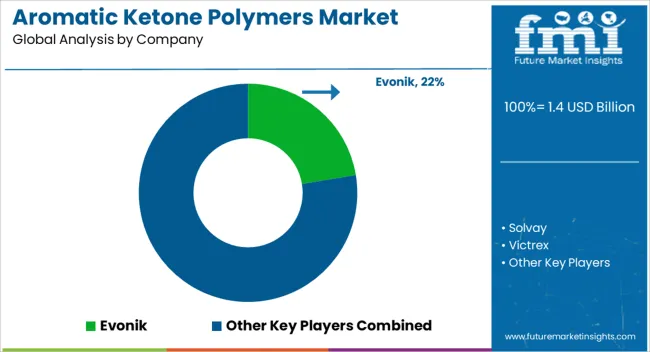
The competitive structure in aromatic ketone polymers is concentrated, shaped by a small set of high-performance polymer specialists and engineered shapes processors rather than a long tail of commodity resin suppliers. Across most end uses, the primary competitive variable is not spot price, it is qualification depth, lot-to-lot consistency, and the ability to support application engineering during OEM validation. As a result, share is anchored with a handful of suppliers that can meet aerospace, medical, and under-the-hood automotive requirements at scale.
Structural advantage sits with companies that control critical know-how across resin chemistry, compounding, and conversion into semi-finished forms. Players with integrated technical service teams and long-running customer programs are better positioned to win platform approvals because buyers often require joint testing, documentation, and repeatable processing windows before locking material into a bill of materials. Those with established regulatory and certification track records also shorten adoption timelines for new grades.
Buyer behaviour is disciplined and risk-managed. Large OEMs and Tier-1 suppliers typically dual-source where possible, qualify second sources early, and negotiate multi-year supply frameworks to secure continuity for certified parts. This reduces supplier dependency but also limits sudden volume swings, since switching costs are high once a grade is specified. Pricing power is strongest for approved, application-specific grades, while more standardized industrial uses face tougher negotiation and periodic re-tendering.
In this market, execution is often decided by how well suppliers manage contracting discipline, technical documentation, and lead-time reliability, especially when feedstock costs move faster than OEM price reset cycles. Suppliers that can offer stable delivery, validated change control, and credible roadmaps for performance upgrades tend to sustain premium pricing even when downstream markets soften.
Recent Developments
- Ensinger, June 2024: Ensinger announced an expansion of production capacity for thermoplastic composites, adding equipment to support continuous processing of fibre-reinforced composites for high-temperature applications.
- Evonik, October 2024: Evonik published life cycle assessment data in its online High Performance Polymers Plastics Database, expanding openly available LCA data for customers evaluating material selection and footprint reporting.
- Syensqo, November 2024: Syensqo announced an expansion of polymer production capacity for life-saving and life-supporting applications, targeting advanced polymer demand tied to healthcare and water-related uses.
Key Players Profiled
- Victrex plc
- Syensqo SA
- Solvay SA
- Evonik Industries AG
- SABIC
- Ensinger GmbH
- GEHR GmbH
- Quadrant AG
- Arkema SA
- Celanese Corporation
Scope of the Report
| Metric | Value |
|---|---|
| Quantitative Units | USD 1.54 Billion (2026); USD 3.96 Billion (2036); CAGR 10.0% (2026 to 2036) |
| Market Definition | High-performance engineering thermoplastics containing aromatic ring structures linked by ketone groups, designed for high-temperature, chemically resistant, and load-bearing industrial applications. |
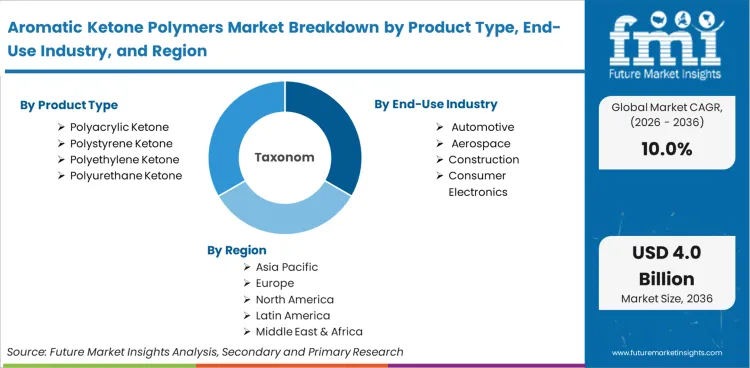
| Type Segmentation | Polyacrylic Ketone; Polyether Ether Ketone (PEEK); Polyether Ketone (PEK); Polyether Ketone Ketone (PEKK); Others |
| Application Segmentation | Structural Components; Electrical & Electronic Components; Sealing Systems; Medical Implants & Devices; Industrial Machinery Parts |
| End-User Industry Segmentation | Automotive (41%); Aerospace; Electronics & Semiconductor; Medical; Industrial Equipment |
| Form Segmentation | Granules/Pellets; Powder; Sheets; Rods & Tubes; Composites |
| Properties Segmentation | High Thermal Resistance; Chemical Resistance; Flame Retardancy; Mechanical Strength; Dimensional Stability |
| Regions Covered | Asia Pacific; Europe; North America; Latin America; Middle East & Africa |
| Countries Covered | China; India; South Korea; Germany; France; United Kingdom; United States; Japan |
| Key Companies Profiled | Victrex plc; Syensqo SA; Solvay SA; Evonik Industries AG; SABIC; Ensinger GmbH; GEHR GmbH; Arkema SA; Celanese Corporation |
| Forecast Period | 2026 to 2036 |
| Approach | Hybrid market-sizing model combining bottom-up capacity analysis with top-down validation using engineering plastics demand benchmarks, supported by primary interviews and trade data triangulation. |
Aromatic Ketone Polymers Market Analysis by Segments
Type
- Polyacrylic Ketone
- Polystyrene Ketone
- Polyethylene Ketone
- Polyurethane Ketone
- Other Types
Application
- Plastics & Composites
- Adhesives & Sealants
- Coatings
- Textiles & Fibers
- Medical Devices
- Other Applications
End-User Industry
- Automotive
- Aerospace
- Construction
- Consumer Electronics
- Healthcare
- Other Industries
Form
- Solid Form
- Liquid Form
- Powdered Form
- Film Form
- Other Forms
Properties
- Chemical Resistance
- Thermal Stability
- Mechanical Strength
- Optical Clarity
- Other Properties
Region
- North America
- Latin America
- Europe
- Asia Pacific
- Middle East & Africa
Bibliography
- [1] Ilham Kadri. Syensqo SA. (2024). Annual report 2024. Syensqo SA.
- [2] Victrex plc. (2023). Full Year Results Announcement. Victrex Investor Relations.
- [3] Syensqo SA. (2024). Annual Report 2024. Syensqo Investor Relations.
- [4] SABIC. (2023). Engineering Thermoplastics Expansion Announcement. SABIC Newsroom.
- [5] Volkswagen AG. (2024). Annual Report 2023. Volkswagen Investor Relations.
- [6] European Commission. (2023). Regulation (EU) 2019/631 on CO₂ emission performance standards for passenger cars and light commercial vehicles-implementation update.
- [7] Bosch Group. (2024). Annual Report 2023. Bosch Corporate Publications.
This Report Addresses
- Market intelligence to enable structured strategic decision-making across mature and emerging aromatic ketone polymers markets.
- Market size estimation and 10-year revenue forecasts from 2026 to 2036, supported by validated automotive production and medical device manufacturing benchmarks.
- Growth opportunity mapping across polymer types, applications, and end-user industries with emphasis on additive manufacturing and electric vehicle applications.
- Segment and regional revenue forecasts covering automotive, aerospace, medical, and electronics applications.
- Competition strategy assessment including polymerization technology, compounding capability, and regulatory compliance benchmarking.
- Regulatory impact analysis covering medical device standards, aerospace flammability requirements, and food contact approvals.
- Market report delivery in PDF, Excel, PPT, and interactive dashboard formats for executive and operational use.
Frequently Asked Questions
How large is the aromatic ketone polymers market today?
In 2025, the aromatic ketone polymers market was valued at USD 1.4 billion.
What will the market size be in 2026?
Based on Future Market Insights' analysis, demand for aromatic ketone polymers is estimated to reach USD 1.54 billion in 2026.
What is the projected market value by 2036?
The market is forecast to reach USD 3.96 billion by 2036.
What is the expected CAGR for the market?
FMI projects a CAGR of 10.0% during the 2026 to 2036 forecast period.
How much absolute dollar growth is expected over the forecast period?
The market is expected to expand from USD 1.54 billion in 2026 to USD 3.96 billion by 2036, reflecting substantial incremental revenue generation over the decade.
Which product type is poised to lead the market?
Polyacrylic Ketone is expected to lead, holding 27.2% share in 2025.
How significant is the automotive segment in this market?
The automotive segment accounts for 41% share in 2025, making it the dominant end-use industry.
What is driving the market’s expansion at a 10.0% CAGR?
Growth from USD 1.54 billion in 2026 to USD 3.96 billion by 2036 reflects rising adoption in automotive electrification, aerospace lightweighting, and medical-grade applications.
Is this market considered high growth compared to specialty polymers?
Yes, a 10.0% CAGR from 2026 to 2036 positions aromatic ketone polymers among the faster-growing high-performance polymer segments.
How does the 2036 valuation compare to 2025 levels?
The market grows from USD 1.4 billion in 2025 to USD 3.96 billion by 2036, nearly tripling over the long term.
What is the base year considered in this analysis?
The base year valuation is USD 1.4 billion in 2025.
What revenue level marks the start of the forecast period?
The forecast period begins at USD 1.54 billion in 2026.
Which regions are expected to contribute to growth during 2026 to 2036?
Asia Pacific, North America, and Europe contribute to the market’s expansion from USD 1.54 billion in 2026 to USD 3.96 billion by 2036.
Does the market show steady or volatile growth?
The projected increase from USD 1.54 billion in 2026 to USD 3.96 billion by 2036 at a 10.0% CAGR indicates sustained and structured expansion rather than short-term spikes.
How large will the incremental opportunity be by 2036?
By 2036, the market is expected to reach USD 3.96 billion, up from USD 1.54 billion in 2026, representing strong long-term revenue potential.
How important is product qualification in sustaining this 10.0% CAGR?
Qualification-driven demand supports the projected rise from USD 1.54 billion in 2026 to USD 3.96 billion by 2036, ensuring long-term contract stability.
Preview the report firsthand - request a free sample
Get SampleGet the brochure for pricing and purchase details.
Get PDFTable of Content
- Executive Summary
- Global Market Outlook
- Demand-side Trends
- Supply-side Trends
- Technology Roadmap Analysis
- Analysis and Recommendations
- Market Overview
- Market Coverage / Taxonomy
- Market Definition / Scope / Limitations
- Research Methodology
- Chapter Orientation
- Analytical Lens and Working Hypotheses
- Market Structure, Signals, and Trend Drivers
- Benchmarking and Cross-market Comparability
- Market Sizing, Forecasting, and Opportunity Mapping
- Research Design and Evidence Framework
- Desk Research Programme (Secondary Evidence)
- Company Annual and Sustainability Reports
- Peer-reviewed Journals and Academic Literature
- Corporate Websites, Product Literature, and Technical Notes
- Earnings Decks and Investor Briefings
- Statutory Filings and Regulatory Disclosures
- Technical White Papers and Standards Notes
- Trade Journals, Industry Magazines, and Analyst Briefs
- Conference Proceedings, Webinars, and Seminar Materials
- Government Statistics Portals and Public Data Releases
- Press Releases and Reputable Media Coverage
- Specialist Newsletters and Curated Briefings
- Sector Databases and Reference Repositories
- FMI Internal Proprietary Databases and Historical Market Datasets
- Subscription Datasets and Paid Sources
- Social Channels, Communities, and Digital Listening Inputs
- Additional Desk Sources
- Expert Input and Fieldwork (Primary Evidence)
- Primary Modes
- Qualitative Interviews and Expert Elicitation
- Quantitative Surveys and Structured Data Capture
- Blended Approach
- Why Primary Evidence is Used
- Field Techniques
- Interviews
- Surveys
- Focus Groups
- Observational and In-context Research
- Social and Community Interactions
- Stakeholder Universe Engaged
- C-suite Leaders
- Board Members
- Presidents and Vice Presidents
- R&D and Innovation Heads
- Technical Specialists
- Domain Subject-matter Experts
- Scientists
- Physicians and Other Healthcare Professionals
- Governance, Ethics, and Data Stewardship
- Research Ethics
- Data Integrity and Handling
- Primary Modes
- Tooling, Models, and Reference Databases
- Desk Research Programme (Secondary Evidence)
- Data Engineering and Model Build
- Data Acquisition and Ingestion
- Cleaning, Normalisation, and Verification
- Synthesis, Triangulation, and Analysis
- Quality Assurance and Audit Trail
- Market Background
- Market Dynamics
- Drivers
- Restraints
- Opportunity
- Trends
- Scenario Forecast
- Demand in Optimistic Scenario
- Demand in Likely Scenario
- Demand in Conservative Scenario
- Opportunity Map Analysis
- Product Life Cycle Analysis
- Supply Chain Analysis
- Investment Feasibility Matrix
- Value Chain Analysis
- PESTLE and Porter’s Analysis
- Regulatory Landscape
- Regional Parent Market Outlook
- Production and Consumption Statistics
- Import and Export Statistics
- Market Dynamics
- Global Market Analysis 2021 to 2025 and Forecast, 2026 to 2036
- Historical Market Size Value (USD Million) Analysis, 2021 to 2025
- Current and Future Market Size Value (USD Million) Projections, 2026 to 2036
- Y-o-Y Growth Trend Analysis
- Absolute $ Opportunity Analysis
- Global Market Pricing Analysis 2021 to 2025 and Forecast 2026 to 2036
- Global Market Analysis 2021 to 2025 and Forecast 2026 to 2036, By Product Type
- Introduction / Key Findings
- Historical Market Size Value (USD Million) Analysis By Product Type , 2021 to 2025
- Current and Future Market Size Value (USD Million) Analysis and Forecast By Product Type , 2026 to 2036
- Polyacrylic Ketone
- Polystyrene Ketone
- Polyethylene Ketone
- Polyurethane Ketone
- Polyacrylic Ketone
- Y-o-Y Growth Trend Analysis By Product Type , 2021 to 2025
- Absolute $ Opportunity Analysis By Product Type , 2026 to 2036
- Global Market Analysis 2021 to 2025 and Forecast 2026 to 2036, By End-Use Industry
- Introduction / Key Findings
- Historical Market Size Value (USD Million) Analysis By End-Use Industry, 2021 to 2025
- Current and Future Market Size Value (USD Million) Analysis and Forecast By End-Use Industry, 2026 to 2036
- Automotive
- Aerospace
- Construction
- Consumer Electronics
- Automotive
- Y-o-Y Growth Trend Analysis By End-Use Industry, 2021 to 2025
- Absolute $ Opportunity Analysis By End-Use Industry, 2026 to 2036
- Global Market Analysis 2021 to 2025 and Forecast 2026 to 2036, By Region
- Introduction
- Historical Market Size Value (USD Million) Analysis By Region, 2021 to 2025
- Current Market Size Value (USD Million) Analysis and Forecast By Region, 2026 to 2036
- North America
- Latin America
- Western Europe
- Eastern Europe
- East Asia
- South Asia and Pacific
- Middle East & Africa
- Market Attractiveness Analysis By Region
- North America Market Analysis 2021 to 2025 and Forecast 2026 to 2036, By Country
- Historical Market Size Value (USD Million) Trend Analysis By Market Taxonomy, 2021 to 2025
- Market Size Value (USD Million) Forecast By Market Taxonomy, 2026 to 2036
- By Country
- USA
- Canada
- Mexico
- By Product Type
- By End-Use Industry
- By Country
- Market Attractiveness Analysis
- By Country
- By Product Type
- By End-Use Industry
- Key Takeaways
- Latin America Market Analysis 2021 to 2025 and Forecast 2026 to 2036, By Country
- Historical Market Size Value (USD Million) Trend Analysis By Market Taxonomy, 2021 to 2025
- Market Size Value (USD Million) Forecast By Market Taxonomy, 2026 to 2036
- By Country
- Brazil
- Chile
- Rest of Latin America
- By Product Type
- By End-Use Industry
- By Country
- Market Attractiveness Analysis
- By Country
- By Product Type
- By End-Use Industry
- Key Takeaways
- Western Europe Market Analysis 2021 to 2025 and Forecast 2026 to 2036, By Country
- Historical Market Size Value (USD Million) Trend Analysis By Market Taxonomy, 2021 to 2025
- Market Size Value (USD Million) Forecast By Market Taxonomy, 2026 to 2036
- By Country
- Germany
- UK
- Italy
- Spain
- France
- Nordic
- BENELUX
- Rest of Western Europe
- By Product Type
- By End-Use Industry
- By Country
- Market Attractiveness Analysis
- By Country
- By Product Type
- By End-Use Industry
- Key Takeaways
- Eastern Europe Market Analysis 2021 to 2025 and Forecast 2026 to 2036, By Country
- Historical Market Size Value (USD Million) Trend Analysis By Market Taxonomy, 2021 to 2025
- Market Size Value (USD Million) Forecast By Market Taxonomy, 2026 to 2036
- By Country
- Russia
- Poland
- Hungary
- Balkan & Baltic
- Rest of Eastern Europe
- By Product Type
- By End-Use Industry
- By Country
- Market Attractiveness Analysis
- By Country
- By Product Type
- By End-Use Industry
- Key Takeaways
- East Asia Market Analysis 2021 to 2025 and Forecast 2026 to 2036, By Country
- Historical Market Size Value (USD Million) Trend Analysis By Market Taxonomy, 2021 to 2025
- Market Size Value (USD Million) Forecast By Market Taxonomy, 2026 to 2036
- By Country
- China
- Japan
- South Korea
- By Product Type
- By End-Use Industry
- By Country
- Market Attractiveness Analysis
- By Country
- By Product Type
- By End-Use Industry
- Key Takeaways
- South Asia and Pacific Market Analysis 2021 to 2025 and Forecast 2026 to 2036, By Country
- Historical Market Size Value (USD Million) Trend Analysis By Market Taxonomy, 2021 to 2025
- Market Size Value (USD Million) Forecast By Market Taxonomy, 2026 to 2036
- By Country
- India
- ASEAN
- Australia & New Zealand
- Rest of South Asia and Pacific
- By Product Type
- By End-Use Industry
- By Country
- Market Attractiveness Analysis
- By Country
- By Product Type
- By End-Use Industry
- Key Takeaways
- Middle East & Africa Market Analysis 2021 to 2025 and Forecast 2026 to 2036, By Country
- Historical Market Size Value (USD Million) Trend Analysis By Market Taxonomy, 2021 to 2025
- Market Size Value (USD Million) Forecast By Market Taxonomy, 2026 to 2036
- By Country
- Kingdom of Saudi Arabia
- Other GCC Countries
- Turkiye
- South Africa
- Other African Union
- Rest of Middle East & Africa
- By Product Type
- By End-Use Industry
- By Country
- Market Attractiveness Analysis
- By Country
- By Product Type
- By End-Use Industry
- Key Takeaways
- Key Countries Market Analysis
- USA
- Pricing Analysis
- Market Share Analysis, 2025
- By Product Type
- By End-Use Industry
- Canada
- Pricing Analysis
- Market Share Analysis, 2025
- By Product Type
- By End-Use Industry
- Mexico
- Pricing Analysis
- Market Share Analysis, 2025
- By Product Type
- By End-Use Industry
- Brazil
- Pricing Analysis
- Market Share Analysis, 2025
- By Product Type
- By End-Use Industry
- Chile
- Pricing Analysis
- Market Share Analysis, 2025
- By Product Type
- By End-Use Industry
- Germany
- Pricing Analysis
- Market Share Analysis, 2025
- By Product Type
- By End-Use Industry
- UK
- Pricing Analysis
- Market Share Analysis, 2025
- By Product Type
- By End-Use Industry
- Italy
- Pricing Analysis
- Market Share Analysis, 2025
- By Product Type
- By End-Use Industry
- Spain
- Pricing Analysis
- Market Share Analysis, 2025
- By Product Type
- By End-Use Industry
- France
- Pricing Analysis
- Market Share Analysis, 2025
- By Product Type
- By End-Use Industry
- India
- Pricing Analysis
- Market Share Analysis, 2025
- By Product Type
- By End-Use Industry
- ASEAN
- Pricing Analysis
- Market Share Analysis, 2025
- By Product Type
- By End-Use Industry
- Australia & New Zealand
- Pricing Analysis
- Market Share Analysis, 2025
- By Product Type
- By End-Use Industry
- China
- Pricing Analysis
- Market Share Analysis, 2025
- By Product Type
- By End-Use Industry
- Japan
- Pricing Analysis
- Market Share Analysis, 2025
- By Product Type
- By End-Use Industry
- South Korea
- Pricing Analysis
- Market Share Analysis, 2025
- By Product Type
- By End-Use Industry
- Russia
- Pricing Analysis
- Market Share Analysis, 2025
- By Product Type
- By End-Use Industry
- Poland
- Pricing Analysis
- Market Share Analysis, 2025
- By Product Type
- By End-Use Industry
- Hungary
- Pricing Analysis
- Market Share Analysis, 2025
- By Product Type
- By End-Use Industry
- Kingdom of Saudi Arabia
- Pricing Analysis
- Market Share Analysis, 2025
- By Product Type
- By End-Use Industry
- Turkiye
- Pricing Analysis
- Market Share Analysis, 2025
- By Product Type
- By End-Use Industry
- South Africa
- Pricing Analysis
- Market Share Analysis, 2025
- By Product Type
- By End-Use Industry
- USA
- Market Structure Analysis
- Competition Dashboard
- Competition Benchmarking
- Market Share Analysis of Top Players
- By Regional
- By Product Type
- By End-Use Industry
- Competition Analysis
- Competition Deep Dive
- Victrex plc
- Overview
- Product Portfolio
- Profitability by Market Segments (Product/Age /Sales Channel/Region)
- Sales Footprint
- Strategy Overview
- Marketing Strategy
- Product Strategy
- Channel Strategy
- Syensqo SA
- Solvay SA
- Evonik Industries AG
- ABIC
- Ensinger GmbH
- GEHR GmbH
- Victrex plc
- Competition Deep Dive
- Assumptions & Acronyms Used


