

- Industry Size (2026)
- USD 134.0 Mn
- Forecast (2036)
- USD 364.0 Mn
- CAGR (2026 to 2036)
- 10.5%
AR-Enabled Retail Sleeves Market Forecast and Outlook 2026 to 2036
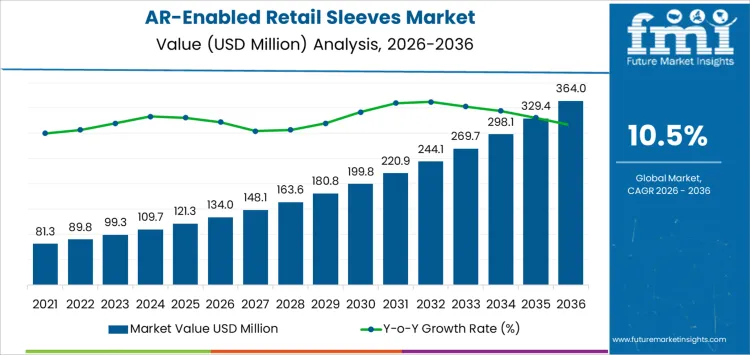
The AR-enabled retail sleeves market is valued at USD 134 million in 2026 and is projected to reach USD 364 million by 2036, growing at a CAGR of 10.5%. Between 2026 and 2031, the market exhibits rapid acceleration, with yearly absolute additions rising from roughly USD 11 million to USD 33 million. Early growth is driven by adoption in premium consumer goods, electronics, and fashion retail, where augmented reality sleeves enhance consumer engagement, provide interactive content, and enable gamified experiences. Initial deployment focuses on pilot campaigns and high-visibility products to gauge consumer response.
From 2031 to 2036, the market continues its upward trajectory, increasing from approximately USD 243 million to USD 364 million. Annual absolute gains remain substantial, reflecting broader deployment across mainstream retail categories and repeat usage in established product lines. Growth is reinforced by improved production efficiency, standardization of AR-enabled sleeve formats, and integration with digital marketing strategies. Relative acceleration moderates slightly as the market matures, indicating a transition from adoption-led expansion to stable, high-volume growth supported by recurring orders and widespread retailer implementation.
Quick Stats of the AR-Enabled Retail Sleeves Market:
- AR-Enabled Retail Sleeves Market Value (2026): USD 134.0 million
- AR-Enabled Retail Sleeves Market Forecast Value (2036): USD 364.0 million
- AR-Enabled Retail Sleeves Market Forecast CAGR (2026 to 2036): 10.5%
- AR-Enabled Retail Sleeves Market Leading End Use: Retail promotions & product storytelling (40%)
- AR-Enabled Retail Sleeves Market Leading Packaging Format: Removable Retail Sleeves (55%)
- AR-Enabled Retail Sleeves Market Key Growth Regions: India, China, USA, Brazil, Germany, Japan
- AR-Enabled Retail Sleeves Market Top Players: Toppan / Zappar partners, DS Smith, Amcor, UFlex, Klabin, Miyako Paper
What is the Growth Forecast for the AR-Enabled Retail Sleeves Market through 2036?
From 2026 to 2031, the AR-enabled retail sleeves market grows from USD 134 million to approximately USD 221 million, reflecting an early adoption phase driven by premium and experiential product launches. Growth during this period is shaped by brand experimentation with augmented reality overlays, interactive product experiences, and consumer engagement campaigns. Uptake is concentrated among high-visibility SKUs in cosmetics, beverages, and limited-edition retail promotions. YeAR-on-year value additions expand steadily as sleeve print quality, AR recognition accuracy, and packaging integration improve, allowing incremental scaling across additional product lines.
Between 2031 and 2036, the market expands from roughly USD 221 million to USD 364 million, indicating a stronger acceleration in value creation. This phase reflects wider deployment across mass-market categories, subscription packaging, and promotional campaigns, where AR features are increasingly embedded in standard retail packaging. Growth is reinforced by higher per-unit usage, multi-region rollout, and repeat adoption. Earlier growth relied on selective pilot projects, while later expansion is driven by portfolio-wide integration, standardized AR deployment, and greater consumer engagement across global retail channels.
AR Enabled Retail Sleeves Market Key Takeaways
| Metric | Value |
|---|---|
| Market Value (2026) | USD 134.0 million |
| Forecast Value (2036) | USD 364.0 million |
| Forecast CAGR (2026–2036) | 10.5% |
How Are Immersive Shopping Experiences Driving the AR-Enabled Retail Sleeves Market from 2026 to 2036?
AR-enabled retail sleeves gained adoption as brands sought to enhance consumer interaction with physical packaging through augmented reality experiences. Beverage, confectionery, electronics, and cosmetics products used sleeves that, when scanned with smartphones or AR devices, revealed promotional content, tutorials, or gamified engagement. Historical demand reflected pilot campaigns in high-traffic retail environments and brand activations targeting tech-savvy consumers. Buyers prioritized sleeve print quality, AR marker accuracy, and durability during shelf handling. Adoption aligned with marketing strategies that integrated physical products with digital content to boost engagement metrics and brand recall.
From 2026 to 2036 demand is expected to expand with wider rollout of AR campaigns and integration into omnichannel retail strategies. Growth aligns with adoption in seasonal promotions, limited editions, and interactive packaging programs that link in-store experiences to online platforms. Manufacturers refine print and material properties to ensure AR recognition while maintaining aesthetic appeal. Buyers assess digital platform compatibility, ease of scanning, and consumer adoption rates. Demand reflects experiential marketing priorities, technological adoption in packaging, and the desire to create measurable engagement through interactive physical-digital touchpoints across retail sectors.
What Is the Demand for the AR-Enabled Retail Sleeves Market by End Use and Packaging Format from 2026 to 2036?
From 2026 to 2036, the AR-enabled retail sleeves market grows as brands leverage augmented reality to enhance product storytelling, consumer engagement, and in-store experience. Retail promotions and product storytelling account for 40% of end-use demand as AR sleeves provide interactive content that drives trial, awareness, and repeat purchases. Adoption is concentrated in categories where visual appeal and digital interactivity influence buying decisions. Demand reflects the integration of AR functionality without altering core packaging performance, ensuring sleeves remain compatible with existing shelf space, retail displays, and handling processes. Brands also prioritize scalability and durability of AR components over multiple handling cycles.
Why do retail promotions and product storytelling account for 40% of demand in the AR-enabled retail sleeves market from 2026 to 2036?
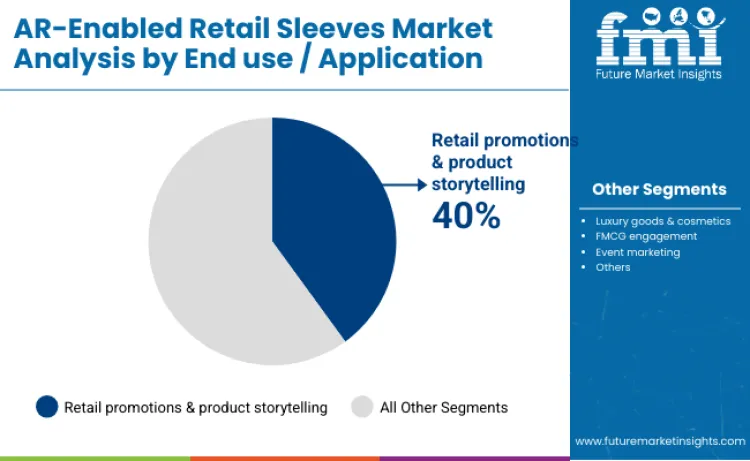
Retail promotions and product storytelling account for 40% of demand because AR sleeves enable immersive experiences directly on packaging, strengthening brand recall and engagement. Consumption intensity is high in sectors such as FMCG, confectionery, and beverages where trial and impulse purchases are common. Usage remains steady as interactive sleeves support limited-edition campaigns, seasonal offerings, and targeted marketing activations. Procurement decisions focus on material compatibility with AR printing, durability under transport, and alignment with existing display systems. Buyers favor sleeves that deliver high-quality visual and digital interaction without compromising core package protection. Price sensitivity remains moderate since AR functionality adds marketing value. Demand remains stable through 2036 as retailers increasingly adopt augmented reality to differentiate products on crowded shelves.
AR-enabled sleeves continue to support event-based activations and digital content integration. Usage patterns align with promotional cycles and product refreshes. Specification control emphasizes sleeve flatness, print fidelity, and AR readability. Demand persists through 2036 as brands expand interactive storytelling into multiple product categories.
Why do removable retail sleeves represent 55% of demand in the AR-enabled retail sleeves market by packaging format from 2026 to 2036?
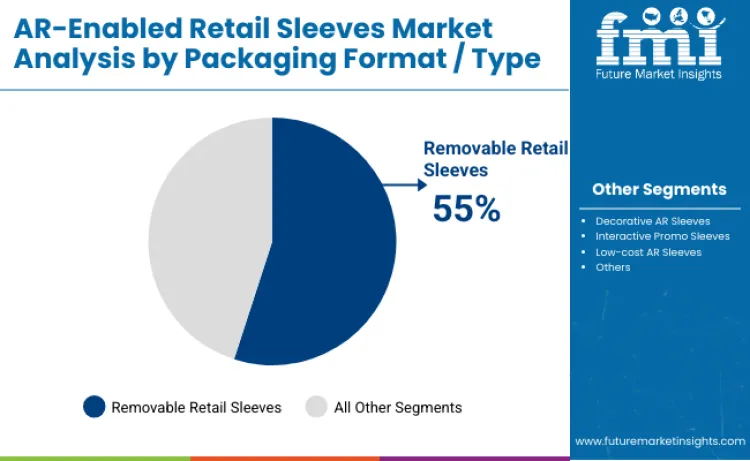
Removable retail sleeves represent 55% of demand because they allow consumers to interact with packaging without altering the primary container. Consumption is strong across retail promotions, seasonal campaigns, and limited-edition product launches where sleeves can be replaced or repositioned. Usage remains steady as removable sleeves provide consistent AR engagement while protecting the underlying packaging. Procurement favors designs that integrate AR content with minimal disruption to core packaging operations. Buyers prioritize ease of application, durability during handling, and consistent visual alignment. Price sensitivity remains moderate since removable sleeves support marketing effectiveness and operational efficiency. Demand remains firm through 2036 as removable formats continue to dominate AR-enabled sleeve adoption.
Removable sleeves also simplify inventory management and post-purchase handling. Specification control focuses on material resilience, adhesion balance, and repeat removability. Demand remains resilient through 2036 as removable AR sleeves become a preferred format for interactive retail packaging.
What are the Key Dynamics of the AR-Enabled Retail Sleeves Market?
How Are AR Enabled Retail Sleeves Being Applied Across Product Packaging and Consumer Engagement?
Use appears in retail environments where augmented reality enhances interaction and storytelling on packaged products. Beverage and confectionery brands apply AR enabled sleeves to display 3D animations, recipe instructions, or promotional content when scanned with smartphones. Cosmetic companies use them on multipacks to demonstrate product benefits or application techniques. Retailers include AR sleeves in limited edition or seasonal campaigns to increase shelf engagement. These applications reflect marketing and experiential priorities integrated with physical packaging rather than purely functional protection or structural support.
What Operational and Marketing Conditions Support Adoption of AR Enabled Retail Sleeves?
Selection aligns with environments where interactive experiences drive brand differentiation and engagement metrics. Brands choose sleeves compatible with existing carton or bottle formats without altering filling or display processes. Digital content teams create AR experiences tailored to campaign objectives, ensuring mobile device compatibility. Retailers favor sleeves that encourage scanning in store, promoting repeat visits or online interaction. Packaging engineers integrate AR printing and alignment into standard workflows to maintain production efficiency. These conditions arise from combining marketing impact, user experience, and packaging feasibility in structured retail operations.
Which Practical Considerations Limit Wider Use of AR Enabled Retail Sleeves?
Cost per unit is higher than standard sleeves, influencing adoption in high volume, low margin categories. Smartphone compatibility and user familiarity affect engagement levels. Alignment of AR markers with packaging must be precise to ensure functionality. Content creation and update cycles add operational complexity. Sleeve materials must balance print quality with durability during handling. These factors lead to selective deployment where marketing benefit, digital readiness, and production capability justify incremental cost and complexity.
What is the Demand for AR Enabled Retail Sleeves by Country?
| Country | CAGR (%) |
|---|---|
| USA | 9.5% |
| Germany | 6.8% |
| China | 11.5% |
| India | 12.0% |
| Brazil | 7.5% |
| Japan | 4.6% |
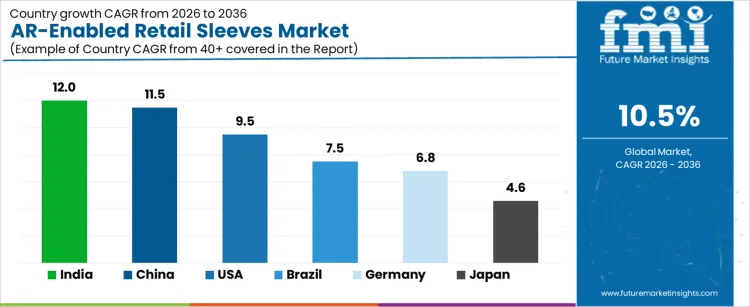
The demand for AR enabled retail sleeves shows varied growth across countries, influenced by immersive marketing adoption, consumer engagement, and retail packaging innovation. India leads with a 12.0% CAGR, supported by rising e commerce penetration, increasing use of AR campaigns, and premium packaging adoption. China follows at 11.5%, driven by large scale FMCG production and integration of AR features in retail displays. The USA grows at 9.5%, reflecting adoption by lifestyle and food brands for interactive consumer experiences. Brazil records 7.5%, shaped by organized retail expansion and promotional packaging use. Germany posts 6.8%, supported by structured retail standards, while Japan grows at 4.6%, reflecting mature markets and steady adoption of AR enabled packaging.
How Is Augmented Reality Packaging Adoption Driving Growth in the United States?
In the United States, revenue from the AR-Enabled Retail Sleeves Market is expanding at a CAGR of 9.5% through 2035, driven by adoption of augmented reality technology to enhance consumer engagement and brand interaction in retail packaging. Brands are using AR-enabled sleeves to deliver interactive experiences, promotional content, and product information across beverages, cosmetics, and personal care products. Demand is concentrated in premium and experiential product lines distributed through retail and online channels. Domestic sleeve converters are integrating AR technology while ensuring compatibility with existing carton and shrink wrap lines. High consumer interaction and repeat purchases are sustaining predictable procurement across packaging users nationwide.
- Beverage, cosmetics, and personal care brands are adopting AR-enabled sleeves to improve consumer engagement and interactive experiences
- Augmented reality features provide promotional content and product information directly on the packaging
- Domestic converters integrate AR technology compatible with existing carton and shrink packaging lines
- Repeat consumer interactions sustain predictable procurement volumes
How Do Regulatory and Quality Standards Shape Demand in Germany?
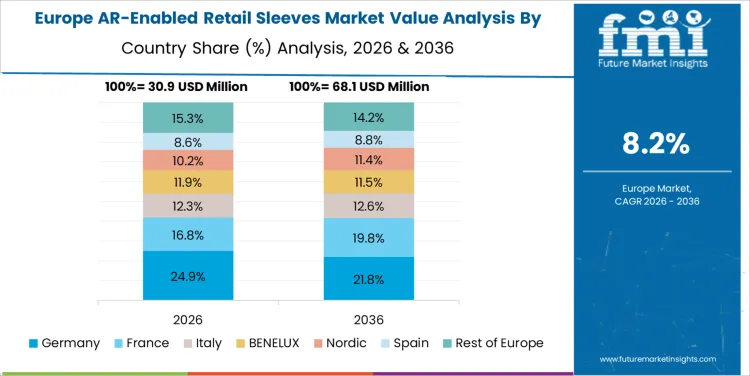
Germany continues to record steady growth in the AR-Enabled Retail Sleeves Market at a CAGR of 6.8% through 2035, supported by quality and regulatory standards in packaging design. Manufacturers are integrating AR-enabled sleeves for promotional campaigns, interactive content, and traceability in beverages, food, and personal care products. Demand remains focused on premium retail lines and marketing-driven packaging formats. Technical expertise in print and digital integration ensures reliable AR activation and durability. Stable production volumes and compliance-driven procurement practices are sustaining measured adoption across domestic packaging operations nationwide.
- Regulatory and quality standards encourage AR-enabled packaging adoption for interactive content
- Premium beverages and personal care products anchor demand
- Technical expertise ensures reliable AR activation and material durability
- Compliance-driven procurement sustains steady adoption levels
How Is Retail Expansion Accelerating Adoption in China?
In China, revenue from the AR-Enabled Retail Sleeves Market is growing at a CAGR of 11.5% through 2035, driven by rapid retail expansion and digital marketing integration. Brands are using AR-enabled sleeves to engage consumers with interactive content, gamification, and promotional offers. Demand is strong across beverages, cosmetics, and functional foods distributed through modern retail and e-commerce channels. Domestic converters are scaling AR sleeve production using advanced printing and digital embedding technologies. High retail volume, structured procurement, and marketing campaigns are sustaining rapid adoption nationwide.
- Retail expansion and digital marketing integration support AR-enabled sleeve adoption
- Beverages, cosmetics, and functional foods drive high volume usage
- Domestic converters scale production with advanced printing and AR embedding
- Marketing campaigns and consumer engagement sustain consistent procurement
How Is Organized Manufacturing Supporting Growth in India?
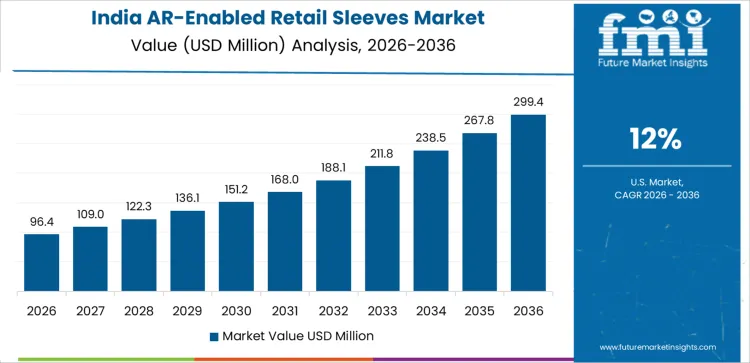
India is witnessing strong expansion in the AR-Enabled Retail Sleeves Market at a CAGR of 12% through 2035, supported by growth in organized manufacturing and branded retail consumption. Manufacturers are adopting AR-enabled sleeves for beverages, personal care, and packaged food products. Demand is rising across urban retail, online platforms, and subscription channels. Domestic sleeve producers are providing cost-aligned AR integration solutions suitable for high volume production. Expanding retail networks and experiential marketing campaigns are sustaining robust procurement across packaging operations nationwide.
- Organized manufacturing increases demand for AR-enabled retail sleeves
- Urban retail and e-commerce channels drive high volume adoption
- Domestic producers provide cost-aligned AR integration solutions
- Experiential marketing campaigns sustain procurement growth
How Are Consumer Goods Shipments Supporting Adoption in Brazil?
Brazil is seeing steady growth in the AR-Enabled Retail Sleeves Market at a CAGR of 7.5% through 2035, supported by rising distribution of packaged beverages, personal care, and food products. Manufacturers are using AR-enabled sleeves to enhance brand experience, provide interactive promotions, and support digital engagement. Demand is concentrated in organized retail and regional distribution networks. Imports supply some AR components, while domestic converters expand production capacity for integrated sleeves. Growth in retail distribution is sustaining recurring procurement across packaging operations nationwide.
- Packaged beverages and personal care products drive AR-enabled sleeve adoption
- Interactive promotions and digital engagement enhance consumer experience
- Domestic converters expand production capacity for integrated AR sleeves
- Retail distribution growth sustains recurring procurement volumes
How Does Mature Retail Packaging Demand Influence Stability in Japan?
Japan is maintaining measured growth in the AR-Enabled Retail Sleeves Market at a CAGR of 4.6% through 2035, supported by mature retail markets and selective adoption of augmented reality packaging. Brands apply AR-enabled sleeves for beverages, cosmetics, and specialty products. Demand remains focused on reliability, consistent AR activation, and material quality. Domestic suppliers emphasize precision in sleeve production and digital integration. Stable consumption patterns and replacement-driven purchasing are sustaining predictable procurement across established packaging operations nationwide.
- Mature retail markets favor selective adoption of AR-enabled sleeves
- Beverages, cosmetics, and specialty products anchor baseline demand
- Domestic suppliers ensure reliable AR activation and production quality
- Replacement-driven purchasing sustains procurement continuity
What Is Driving the Demand for AR Enabled Retail Sleeves and Which Companies Shape Smart Packaging Integration?
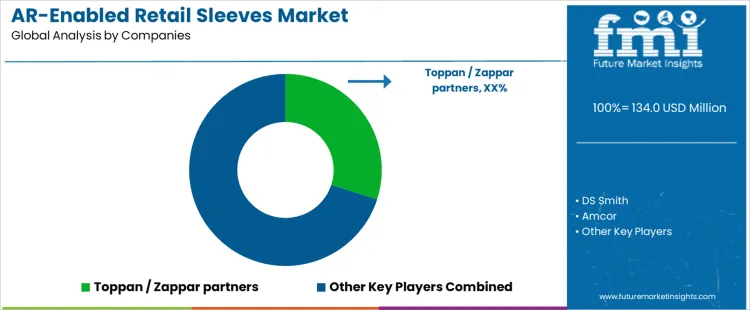
AR enabled retail sleeves are gaining traction as brands explore augmented reality experiences to enhance consumer engagement and product storytelling at the point of sale. Beverage, snack, and premium consumer goods brands use these sleeves to deliver interactive visuals, promotions, and gamified experiences without altering the primary packaging. Toppan, in collaboration with Zappar, supports adoption through printed sleeves integrated with AR markers that trigger digital content on smartphones. DS Smith contributes through fiber based sleeve production that combines structural integrity with print precision. Amcor and UFlex participate through flexible and laminated sleeve formats compatible with high volume packaging lines. Klabin and Miyako Paper provide paper based solutions for retail ready designs.
Selection of AR sleeves is guided by print fidelity, digital trigger reliability, material compatibility, and shelf appeal. Brand owners focus on visual impact, ease of application over primary packs, and integration with existing production workflows. Usage spans seasonal promotions, limited edition products, gift packs, and beverage multipacks where interactive experiences drive differentiation. Buyers prioritize sleeves that maintain structural stability, support high quality AR graphics, and comply with environmental and recycling standards. Demand visibility tracks growth in experiential marketing, adoption of smart packaging, and continued investment in retail innovation to enhance consumer engagement and brand recall.
Key Players in the AR Enabled Retail Sleeves Market
- Toppan / Zappar partners
- DS Smith
- Amcor
- UFlex
- Klabin
- Miyako Paper
Scope of the Report
| Items | Values |
|---|---|
| Quantitative Units (2026) | USD million |
| End-use / Application | Retail promotions & product storytelling; Luxury goods & cosmetics; FMCG engagement; Event marketing; Others |
| Packaging Format / Type | Removable Retail Sleeves; Decorative AR Sleeves; Interactive Promo Sleeves; Low-cost AR Sleeves; Others |
| Material | Coated Paperboard; Virgin/Recycled Board; Coated Kraft; Recycled Paper; Others |
| Technology | AR Marker Printing & App Integration; Image-recognition AR; WeChat-integrated AR; Scan-to-AR; Others |
| Regions Covered | Asia Pacific; Europe; North America; Latin America; Middle East & Africa |
| Countries Covered | China; Japan; South Korea; India; Australia & New Zealand; ASEAN; Germany; United Kingdom; France; Italy; Spain; Nordic; BENELUX; United States; Canada; Mexico; Brazil; Chile; Kingdom of Saudi Arabia; Other GCC Countries; Turkey; South Africa; Other African Union; plus remaining countries across each region |
| Key Companies Profiled | Toppan / Zappar partners; DS Smith; Amcor; UFlex; Klabin; Miyako Paper |
| Additional Attributes | Dollar by sales across end-use applications and sleeve formats; adoption of AR-enabled sleeves in FMCG, cosmetics, and luxury retail; integration of AR markers, image recognition, and app-based interactivity; use of coated and recycled boards with high print fidelity; alignment with experiential marketing and product storytelling initiatives; specification control on sleeve durability, AR readability, and material compatibility; compatibility with automated packing lines and shelf-ready designs; adoption tracking across retail, e-commerce, and promotional campaigns; visual branding integration and digital engagement metrics; deployment across multi-region promotional and product launch activities |
AR Enabled Retail Sleeves Market Segmentation
End-use / Application
- Retail promotions & product storytelling
- Luxury goods & cosmetics
- FMCG engagement
- Event marketing
- Others
Packaging Format / Type
- Removable Retail Sleeves
- Decorative AR Sleeves
- Interactive Promo Sleeves
- Low-cost AR Sleeves
- Others
Material
- Coated Paperboard
- Virgin/Recycled Board
- Coated Kraft
- Recycled Paper
- Others
Technology
- AR Marker Printing & App Integration
- Image-recognition AR
- WeChat-integrated AR
- Scan-to-AR
- Others
Region
- Asia Pacific
- China
- Japan
- South Korea
- India
- Australia & New Zealand
- ASEAN
- Rest of Asia Pacific
- Europe
- Germany
- United Kingdom
- France
- Italy
- Spain
- Nordic
- BENELUX
- Rest of Europe
- North America
- United States
- Canada
- Mexico
- Latin America
- Brazil
- Chile
- Rest of Latin America
- Middle East & Africa
- Kingdom of Saudi Arabia
- Other GCC Countries
- Turkey
- South Africa
- Other African Union
- Rest of Middle East & Africa
Frequently Asked Questions
How big is the AR-enabled retail sleeves market in 2026?
The global AR-enabled retail sleeves market is estimated to be valued at USD 134.0 million in 2026.
What will be the size of AR-enabled retail sleeves market in 2036?
The market size for the AR-enabled retail sleeves market is projected to reach USD 364.0 million by 2036.
How much will be the AR-enabled retail sleeves market growth between 2026 and 2036?
The AR-enabled retail sleeves market is expected to grow at a 10.5% CAGR between 2026 and 2036.
What are the key product types in the AR-enabled retail sleeves market?
The key product types in AR-enabled retail sleeves market are retail promotions & product storytelling, luxury goods & cosmetics, fmcg engagement, event marketing and others.
Which packaging format / type segment to contribute significant share in the AR-enabled retail sleeves market in 2026?
In terms of packaging format / type, removable retail sleeves segment to command 55.0% share in the AR-enabled retail sleeves market in 2026.
Preview the report firsthand - request a free sample
Get SampleGet the brochure for pricing and purchase details.
Get PDFTable of Content
- Executive Summary
- Global Market Outlook
- Demand-side Trends
- Supply-side Trends
- Technology Roadmap Analysis
- Analysis and Recommendations
- Market Overview
- Market Coverage / Taxonomy
- Market Definition / Scope / Limitations
- Market Background
- Market Dynamics
- Drivers
- Restraints
- Opportunity
- Trends
- Scenario Forecast
- Demand in Optimistic Scenario
- Demand in Likely Scenario
- Demand in Conservative Scenario
- Opportunity Map Analysis
- Product Life Cycle Analysis
- Supply Chain Analysis
- Investment Feasibility Matrix
- Value Chain Analysis
- PESTLE and Porter’s Analysis
- Regulatory Landscape
- Regional Parent Market Outlook
- Production and Consumption Statistics
- Import and Export Statistics
- Market Dynamics
- Global Market Analysis 2021 to 2025 and Forecast, 2026 to 2036
- Historical Market Size Value (USD Million) Analysis, 2021 to 2025
- Current and Future Market Size Value (USD Million) Projections, 2026 to 2036
- Y-o-Y Growth Trend Analysis
- Absolute $ Opportunity Analysis
- Global Market Pricing Analysis 2021 to 2025 and Forecast 2026 to 2036
- Global Market Analysis 2021 to 2025 and Forecast 2026 to 2036, By End-use / Application
- Introduction / Key Findings
- Historical Market Size Value (USD Million) Analysis By End-use / Application , 2021 to 2025
- Current and Future Market Size Value (USD Million) Analysis and Forecast By End-use / Application , 2026 to 2036
- Retail promotions & product storytelling
- Luxury goods & cosmetics
- FMCG engagement
- Event marketing
- Others
- Y-o-Y Growth Trend Analysis By End-use / Application , 2021 to 2025
- Absolute $ Opportunity Analysis By End-use / Application , 2026 to 2036
- Global Market Analysis 2021 to 2025 and Forecast 2026 to 2036, By Packaging Format / Type
- Introduction / Key Findings
- Historical Market Size Value (USD Million) Analysis By Packaging Format / Type, 2021 to 2025
- Current and Future Market Size Value (USD Million) Analysis and Forecast By Packaging Format / Type, 2026 to 2036
- Removable Retail Sleeves
- Decorative AR Sleeves
- Interactive Promo Sleeves
- Low-cost AR Sleeves
- Others
- Y-o-Y Growth Trend Analysis By Packaging Format / Type, 2021 to 2025
- Absolute $ Opportunity Analysis By Packaging Format / Type, 2026 to 2036
- Global Market Analysis 2021 to 2025 and Forecast 2026 to 2036, By Material
- Introduction / Key Findings
- Historical Market Size Value (USD Million) Analysis By Material, 2021 to 2025
- Current and Future Market Size Value (USD Million) Analysis and Forecast By Material, 2026 to 2036
- Coated Paperboard
- Virgin/Recycled Board
- Coated Kraft
- Recycled Paper
- Others
- Others
- Y-o-Y Growth Trend Analysis By Material, 2021 to 2025
- Absolute $ Opportunity Analysis By Material, 2026 to 2036
- Global Market Analysis 2021 to 2025 and Forecast 2026 to 2036, By Technology
- Introduction / Key Findings
- Historical Market Size Value (USD Million) Analysis By Technology, 2021 to 2025
- Current and Future Market Size Value (USD Million) Analysis and Forecast By Technology, 2026 to 2036
- AR Marker Printing & App Integration
- Image-recognition AR
- WeChat-integrated AR
- Scan-to-AR
- Others
- Others
- Y-o-Y Growth Trend Analysis By Technology, 2021 to 2025
- Absolute $ Opportunity Analysis By Technology, 2026 to 2036
- Global Market Analysis 2021 to 2025 and Forecast 2026 to 2036, By Region
- Introduction
- Historical Market Size Value (USD Million) Analysis By Region, 2021 to 2025
- Current Market Size Value (USD Million) Analysis and Forecast By Region, 2026 to 2036
- North America
- Latin America
- Western Europe
- Eastern Europe
- East Asia
- South Asia and Pacific
- Middle East & Africa
- Market Attractiveness Analysis By Region
- North America Market Analysis 2021 to 2025 and Forecast 2026 to 2036, By Country
- Historical Market Size Value (USD Million) Trend Analysis By Market Taxonomy, 2021 to 2025
- Market Size Value (USD Million) Forecast By Market Taxonomy, 2026 to 2036
- By Country
- USA
- Canada
- Mexico
- By End-use / Application
- By Packaging Format / Type
- By Material
- By Technology
- By Country
- Market Attractiveness Analysis
- By Country
- By End-use / Application
- By Packaging Format / Type
- By Material
- By Technology
- Key Takeaways
- Latin America Market Analysis 2021 to 2025 and Forecast 2026 to 2036, By Country
- Historical Market Size Value (USD Million) Trend Analysis By Market Taxonomy, 2021 to 2025
- Market Size Value (USD Million) Forecast By Market Taxonomy, 2026 to 2036
- By Country
- Brazil
- Chile
- Rest of Latin America
- By End-use / Application
- By Packaging Format / Type
- By Material
- By Technology
- By Country
- Market Attractiveness Analysis
- By Country
- By End-use / Application
- By Packaging Format / Type
- By Material
- By Technology
- Key Takeaways
- Western Europe Market Analysis 2021 to 2025 and Forecast 2026 to 2036, By Country
- Historical Market Size Value (USD Million) Trend Analysis By Market Taxonomy, 2021 to 2025
- Market Size Value (USD Million) Forecast By Market Taxonomy, 2026 to 2036
- By Country
- Germany
- UK
- Italy
- Spain
- France
- Nordic
- BENELUX
- Rest of Western Europe
- By End-use / Application
- By Packaging Format / Type
- By Material
- By Technology
- By Country
- Market Attractiveness Analysis
- By Country
- By End-use / Application
- By Packaging Format / Type
- By Material
- By Technology
- Key Takeaways
- Eastern Europe Market Analysis 2021 to 2025 and Forecast 2026 to 2036, By Country
- Historical Market Size Value (USD Million) Trend Analysis By Market Taxonomy, 2021 to 2025
- Market Size Value (USD Million) Forecast By Market Taxonomy, 2026 to 2036
- By Country
- Russia
- Poland
- Hungary
- Balkan & Baltic
- Rest of Eastern Europe
- By End-use / Application
- By Packaging Format / Type
- By Material
- By Technology
- By Country
- Market Attractiveness Analysis
- By Country
- By End-use / Application
- By Packaging Format / Type
- By Material
- By Technology
- Key Takeaways
- East Asia Market Analysis 2021 to 2025 and Forecast 2026 to 2036, By Country
- Historical Market Size Value (USD Million) Trend Analysis By Market Taxonomy, 2021 to 2025
- Market Size Value (USD Million) Forecast By Market Taxonomy, 2026 to 2036
- By Country
- China
- Japan
- South Korea
- By End-use / Application
- By Packaging Format / Type
- By Material
- By Technology
- By Country
- Market Attractiveness Analysis
- By Country
- By End-use / Application
- By Packaging Format / Type
- By Material
- By Technology
- Key Takeaways
- South Asia and Pacific Market Analysis 2021 to 2025 and Forecast 2026 to 2036, By Country
- Historical Market Size Value (USD Million) Trend Analysis By Market Taxonomy, 2021 to 2025
- Market Size Value (USD Million) Forecast By Market Taxonomy, 2026 to 2036
- By Country
- India
- ASEAN
- Australia & New Zealand
- Rest of South Asia and Pacific
- By End-use / Application
- By Packaging Format / Type
- By Material
- By Technology
- By Country
- Market Attractiveness Analysis
- By Country
- By End-use / Application
- By Packaging Format / Type
- By Material
- By Technology
- Key Takeaways
- Middle East & Africa Market Analysis 2021 to 2025 and Forecast 2026 to 2036, By Country
- Historical Market Size Value (USD Million) Trend Analysis By Market Taxonomy, 2021 to 2025
- Market Size Value (USD Million) Forecast By Market Taxonomy, 2026 to 2036
- By Country
- Kingdom of Saudi Arabia
- Other GCC Countries
- Turkiye
- South Africa
- Other African Union
- Rest of Middle East & Africa
- By End-use / Application
- By Packaging Format / Type
- By Material
- By Technology
- By Country
- Market Attractiveness Analysis
- By Country
- By End-use / Application
- By Packaging Format / Type
- By Material
- By Technology
- Key Takeaways
- Key Countries Market Analysis
- USA
- Pricing Analysis
- Market Share Analysis, 2025
- By End-use / Application
- By Packaging Format / Type
- By Material
- By Technology
- Canada
- Pricing Analysis
- Market Share Analysis, 2025
- By End-use / Application
- By Packaging Format / Type
- By Material
- By Technology
- Mexico
- Pricing Analysis
- Market Share Analysis, 2025
- By End-use / Application
- By Packaging Format / Type
- By Material
- By Technology
- Brazil
- Pricing Analysis
- Market Share Analysis, 2025
- By End-use / Application
- By Packaging Format / Type
- By Material
- By Technology
- Chile
- Pricing Analysis
- Market Share Analysis, 2025
- By End-use / Application
- By Packaging Format / Type
- By Material
- By Technology
- Germany
- Pricing Analysis
- Market Share Analysis, 2025
- By End-use / Application
- By Packaging Format / Type
- By Material
- By Technology
- UK
- Pricing Analysis
- Market Share Analysis, 2025
- By End-use / Application
- By Packaging Format / Type
- By Material
- By Technology
- Italy
- Pricing Analysis
- Market Share Analysis, 2025
- By End-use / Application
- By Packaging Format / Type
- By Material
- By Technology
- Spain
- Pricing Analysis
- Market Share Analysis, 2025
- By End-use / Application
- By Packaging Format / Type
- By Material
- By Technology
- France
- Pricing Analysis
- Market Share Analysis, 2025
- By End-use / Application
- By Packaging Format / Type
- By Material
- By Technology
- India
- Pricing Analysis
- Market Share Analysis, 2025
- By End-use / Application
- By Packaging Format / Type
- By Material
- By Technology
- ASEAN
- Pricing Analysis
- Market Share Analysis, 2025
- By End-use / Application
- By Packaging Format / Type
- By Material
- By Technology
- Australia & New Zealand
- Pricing Analysis
- Market Share Analysis, 2025
- By End-use / Application
- By Packaging Format / Type
- By Material
- By Technology
- China
- Pricing Analysis
- Market Share Analysis, 2025
- By End-use / Application
- By Packaging Format / Type
- By Material
- By Technology
- Japan
- Pricing Analysis
- Market Share Analysis, 2025
- By End-use / Application
- By Packaging Format / Type
- By Material
- By Technology
- South Korea
- Pricing Analysis
- Market Share Analysis, 2025
- By End-use / Application
- By Packaging Format / Type
- By Material
- By Technology
- Russia
- Pricing Analysis
- Market Share Analysis, 2025
- By End-use / Application
- By Packaging Format / Type
- By Material
- By Technology
- Poland
- Pricing Analysis
- Market Share Analysis, 2025
- By End-use / Application
- By Packaging Format / Type
- By Material
- By Technology
- Hungary
- Pricing Analysis
- Market Share Analysis, 2025
- By End-use / Application
- By Packaging Format / Type
- By Material
- By Technology
- Kingdom of Saudi Arabia
- Pricing Analysis
- Market Share Analysis, 2025
- By End-use / Application
- By Packaging Format / Type
- By Material
- By Technology
- Turkiye
- Pricing Analysis
- Market Share Analysis, 2025
- By End-use / Application
- By Packaging Format / Type
- By Material
- By Technology
- South Africa
- Pricing Analysis
- Market Share Analysis, 2025
- By End-use / Application
- By Packaging Format / Type
- By Material
- By Technology
- USA
- Market Structure Analysis
- Competition Dashboard
- Competition Benchmarking
- Market Share Analysis of Top Players
- By Regional
- By End-use / Application
- By Packaging Format / Type
- By Material
- By Technology
- Competition Analysis
- Competition Deep Dive
- Toppan / Zappar partners
- Overview
- Product Portfolio
- Profitability by Market Segments (Product/Age /Sales Channel/Region)
- Sales Footprint
- Strategy Overview
- Marketing Strategy
- Product Strategy
- Channel Strategy
- DS Smith
- Amcor
- UFlex
- Klabin
- Miyako Paper
- Toppan / Zappar partners
- Competition Deep Dive
- Assumptions & Acronyms Used
- Research Methodology


