- Market Size (2026)
- USD 548.6 Mn
- Forecast (2036)
- USD 982.5 Mn
- CAGR (2026 to 2036)
- 6.0%
How Big Is the Arbitrary Waveform Generator Market in 2026?
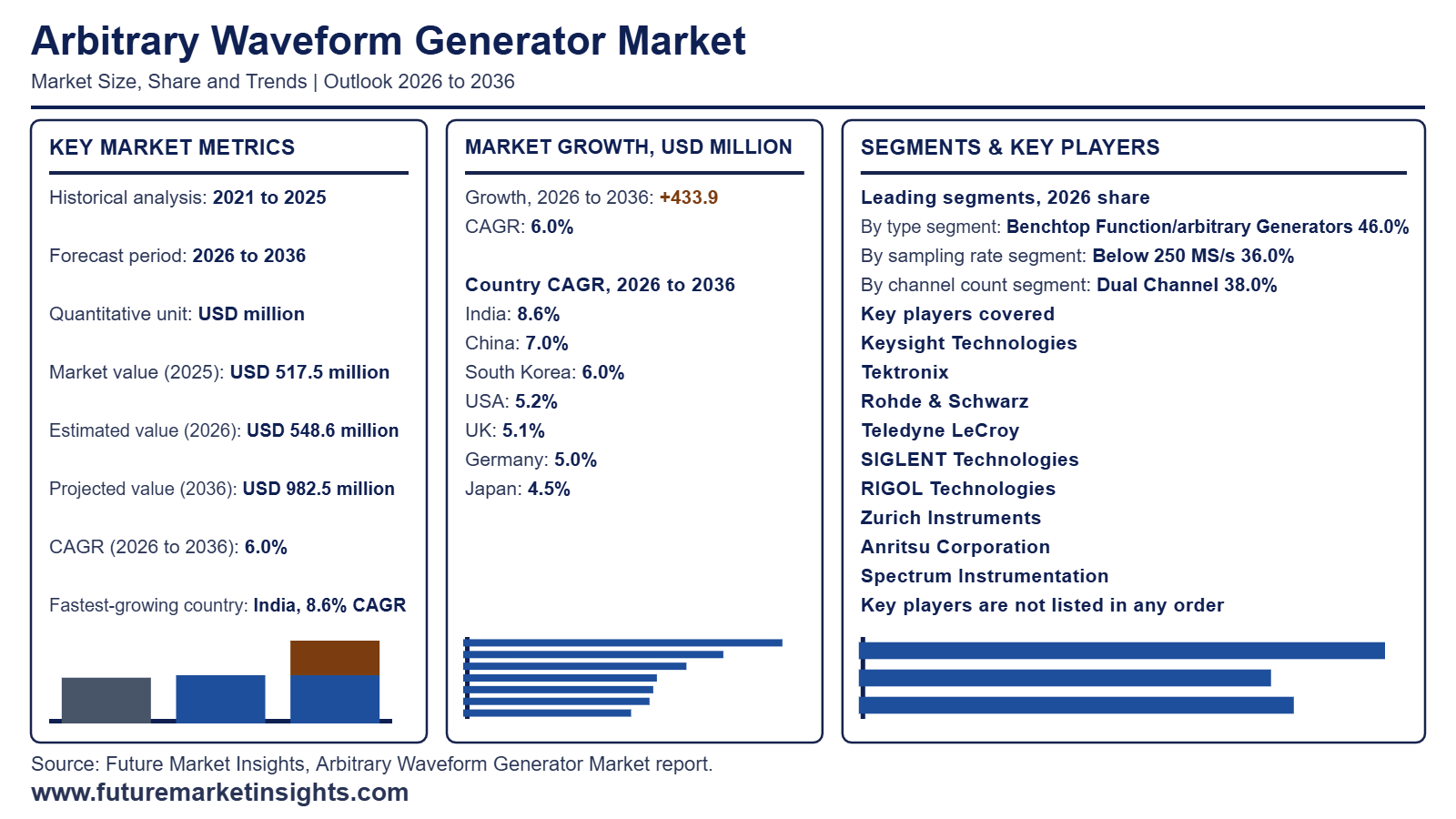
With a valuation of USD 517.5 million in 2025 and moving to USD 548.6 million in 2026, the global arbitrary waveform generator market is positioned to attain USD 982.5 million by 2036, exhibiting a CAGR of 6.0% as per FMI analysis. Steady instrument adoption across semiconductor validation and RF test benches creates an incremental dollar opportunity of USD 433.9 million over the decade due to rising buyer preference for reproducible fault stimulus.
| Market Metric | Valuation / Share / Forecast Benchmark |
|---|---|
| 2025 Market Size (Historical) | USD 517.5 million |
| 2026 Market Size (Estimated) | USD 548.6 million |
| 2036 Market Size (Projected) | USD 982.5 million |
| Compound Annual Growth Rate (2026 to 2036) | 6.0% CAGR |
| Incremental Dollar Opportunity (2026 to 2036) | USD 433.9 million |
| Dominant Type Segment (2026 Share) | Benchtop Function/arbitrary Generators (46.0% share in 2026) | Other Segment Combined (54.0%) |
| Leading Sampling Rate Segment (2026 Share) | Below 250 MS/s (36.0% share in 2026) | Other Segment Combined (64.0%) |
| Leading Channel Count Segment (2026 Share) | Dual Channel (38.0% share in 2026) | Other Segment Combined (62.0%) |
| Leading Application Segment (2026 Share) | Electronics Design and Validation (30.0% share in 2026) | Other Segment Combined (70.0%) |
| Fastest-Growing Country Markets (2026 to 2036) | India (8.6% CAGR), China (7.0% CAGR), South Korea (6.0% CAGR) |
| Leading Tier-1 Companies | Keysight Technologies, Tektronix, Rohde & Schwarz, Teledyne LeCroy, SIGLENT Technologies, RIGOL Technologies, Zurich Instruments, Anritsu Corporation, Spectrum Instrumentation, Berkeley Nucleonics Corporation |
Source: Future Market Insights analysis of the arbitrary waveform generator market, 2026.
Executive Market Overview
Demand for arbitrary waveform generators is rising across electronics validation laboratories and semiconductor characterization benches owing to the shift from fixed-function sources to programmable stimulus that reproduces timing jitter and modulation impairments on demand. Custom analog stimulus boards take weeks to rebuild for every prototype revision, and FMI survey reflects that hardware validation managers prefer multi-channel instruments capable of replaying captured fault profiles across general-purpose electronic test and measurement instruments. Official records from the Press Information Bureau, Government of India (September 2026) confirm 12 approved semiconductor manufacturing units with cumulative investments exceeding INR 1.6 lakh crore. Country-wise growth is therefore led by India at an 8.6% CAGR and China at 7.0% due to greenfield wafer fab construction and 5G-Advanced radio verification, outpacing mature replacement markets such as the USA (5.2%) and Japan (4.5%) through 2036.
Laboratory procurement teams face strict qualification restraints when fixture attenuation and license incompatibilities delay multi-vendor rack integration. Instrument suppliers protect commercial margins by bundling precompensation software and deeper waveform memory, as demonstrated when Tektronix (October 2025) released AWG5200 Series Software V8.3 with closed-loop precompensation and Keysight Technologies (May 2026) updated its M8199B 256 GSa/s platform firmware to version 2.5.50.0 for 160 GBaud optical validation. FMI projects bit error rate testers to expand at a 7.5% CAGR and power semiconductor wafer-level reliability test equipment to grow at 10.8% through 2036, whereas arbitrary waveform generators advance at a steadier 6.0% CAGR because general laboratory benches reuse existing signal generators across multiple product cycles. Market sizing includes standalone benchtop, modular PXI and AXIe, and USB-controlled arbitrary waveform generators, while excluding standalone oscilloscopes, general-purpose RF sources without dedicated arbitrary options, and third-party calibration services.
This Report Answers
- How large the arbitrary waveform generator market is in 2026 and what valuation it reaches by 2036
- Which type, sampling rate, channel count, and application segments lead in 2026
- What commercial factors drive laboratory demand and what qualification hurdles restrain rapid procurement
- Which countries expand fastest between 2026 and 2036 across semiconductor and quantum test programs
- What Keysight Technologies, Tektronix, SIGLENT Technologies, and Spectrum Instrumentation have launched
- How the arbitrary waveform generator market is defined, segmented, and measured across regions
Analyst Perspective
"Arbitrary waveform generator vendors will expand revenue faster than unit shipments by monetizing multi-channel phase synchronization, precompensation software licenses, and high-memory modular cards for quantum and 800G optical validation. The primary commercial risk is prolonged bench qualification when delivered signal fidelity at the device test fixture diverges from datasheet sample-rate claims."
- Nikhil Kaitwade, Principal Consultant, Future Market Insights.
Key Market Trends & Insights
- Multi-Channel Ethernet and Modular Synchronization Reshapes Automated Test Cells: Engineering laboratories are shifting from isolated single-box sources toward network-controlled multi-channel generators that distribute phase-coherent pulses across automated test racks. Phase synchronization across eight or more channels without manual cable deskewing reduces setup hours across phased-array radar and modular instrumentation platforms. Hardware releases confirm this commercial direction; Spectrum Instrumentation (December 2025) launched its DN6.63x NETBOX arbitrary waveform generators providing up to 6 channels at 10 GS/s or 12 channels at 5 GS/s over Ethernet, while Spectrum Instrumentation (May 2025) expanded remote LXI rack integration for automated validation lines. Standardized network control increases multi-unit fleet orders through 2036.
- High-Density Baseband and I/Q Interpolation Widens Mid-Range Bench Adoption: Semiconductor and wireless equipment designers increasingly demand benchtop generators that combine arbitrary waveform playback with wideband I/Q modulation to validate transceiver margins without buying separate microwave sources. Single-box consolidation of baseband and RF stimulus lowers capital expenditure across RF test equipment and signal analyzers, which FMI believes is accelerating mid-tier bench adoption. Product launches validate this buyer preference; SIGLENT Technologies (May 2026) introduced the SDG8000A series featuring 12 GSa/s interpolated I/Q sample rates and 5 GSa/s direct digital output, while SIGLENT Technologies (September 2025) rolled out the SDG3000X series with 1.2 GSa/s sampling and 40 Mpts memory per channel. Integrated modulation capability sustains mid-range instrument sales growth through 2036.
- Quantum Qubit Control and Sub-Nanosecond Skew Alignment Drive Precision Orders: Quantum computing laboratories and advanced packaging fabs require deterministic pulse sequencing and sub-500-picosecond inter-channel skew to manipulate superconducting qubits and test high-speed interconnects. Standard function generators lack real-time feedback and low-jitter clock distribution needed across integrated photonics test and reliability systems. Supplier engineering reflects this requirement; RIGOL Technologies (July 2025) launched its 8-channel DG5000 Pro series with 2.5 GSa/s sampling, 16-bit resolution, and sub-500 ps channel skew, while Berkeley Nucleonics Corporation (May 2026) highlighted the Model 686 arbitrary waveform generator delivering 20 GS/s real-time sampling across 14-bit channels. Precision timing alignment anchors high-margin research procurement through 2036.
What Are the Main Drivers, Restraints, and Opportunities?
Higher semiconductor design complexity and national quantum funding drive programmable stimulus procurement, whereas fixture-level signal calibration and software switching costs restrain rapid vendor replacement, leaving network-controlled modular test bays as the primary expansion opportunity.
Driver: Complex Semiconductor Interconnect and Quantum Pulse Validation Requirements
Semiconductor design houses and national metrology laboratories procure arbitrary waveform generators because multi-level serdes links and quantum processors require repeatable, impaired signal injection that fixed-function generators cannot synthesize. Direct bench emulation of crosstalk and thermal noise on the validation bench shortens silicon bring-up cycles and complements automated test equipment across wafer-sort and package-test floors. Public research programs confirm expanding validation budgets; the National Institute of Standards and Technology (September 2026) advanced next-generation AI-assisted semiconductor overlay metrology programs, while the Press Information Bureau, Government of India (August 2026) documented National Quantum Mission infrastructure deployments across premier engineering institutes. Multi-node chip complexity sustains multi-year demand for high-resolution stimulus instruments through 2036.
Restraint: Fixture Calibration Friction and Proprietary Waveform Software Lock-In
Laboratory upgrades of arbitrary waveform generators across established engineering departments require extensive fixture de-embedding, reference-clock alignment, and test-script migration. High headline sampling rates lose commercial value when cable losses distort fast pulse edges, and FMI observes that rewriting waveform libraries across incompatible control environments used with in-circuit testers slows procurement approvals. Technical documentation from Keysight Technologies (May 2026) on its M8199A module driver package and Rohde & Schwarz (2026) on its RTP and RTO2000 oscilloscope arbitrary waveform options illustrates how clocking and trigger architectures differ substantially across vendors. Extended acceptance testing and software re-qualification lengthen procurement cycles and restrain rapid vendor switching across cost-conscious electronics manufacturers through 2036.
Opportunity: Direct Digital Synthesis Upgrades and Optical Co-Packaged Test Integration
Instrument manufacturers can access incremental revenue by offering firmware-upgradeable direct digital synthesis modes and high-baud optical stimulus modules for co-packaged optics validation. Firmware licensing allows laboratories to convert general-purpose arbitrary cards into multi-tone pulse arrays without purchasing separate hardware racks for silicon photonics and optical I/O test systems. Recent supplier deployments prove this commercial pathway; Spectrum Instrumentation (March 2026) introduced a Direct Digital Synthesis option for its 65xx series AWGs enabling 64 phase-continuous sine cores per card, while Anritsu Corporation (March 2025) extended its MG3710E vector and arbitrary baseband generator coverage up to 44 GHz using frequency converters. Modular firmware and optical-baud extensions will generate recurring upgrade sales through 2036.
How Is the Arbitrary Waveform Generator Market Segmented?
Arbitrary Waveform Generator Market is segmented by Type, Sampling Rate, Channel Count, Application, and Region. Forecast period from 2026 to 2036.
| Segmentation Axis | Sub-Segments Covered | 2026 Leading Segment & Share | Other Segment Combined & Total |
|---|---|---|---|
| Type | Benchtop Function/arbitrary Generators, High-Speed (above 1 GS/s) Generators, Modular (PXI and AXIe) Generators, Software-Defined and USB Generators | Benchtop Function/arbitrary Generators (46.0% share in 2026) | Other Segment Combined (54.0%) | Total (100.0%) |
| Sampling Rate | Below 250 MS/s, 250 MS/s to 2 GS/s, 2 GS/s to 10 GS/s, Above 10 GS/s | Below 250 MS/s (36.0% share in 2026) | Other Segment Combined (64.0%) | Total (100.0%) |
| Channel Count | Dual Channel, Single Channel, Four to Eight Channels, More Than Eight Channels | Dual Channel (38.0% share in 2026) | Other Segment Combined (62.0%) | Total (100.0%) |
| Application | Electronics Design and Validation, Communications and 5G/6G, Aerospace and Defense, Radar, Semiconductor and Quantum Research, Education and General Lab | Electronics Design and Validation (30.0% share in 2026) | Other Segment Combined (70.0%) | Total (100.0%) |
| Region | North America, Latin America, Western Europe, Eastern Europe, East Asia, South Asia and Pacific, Middle East and Africa | East Asia & North America (India fastest at 8.6% CAGR) | Global Coverage Across 7 Core Countries (100.0%) |
Source: Future Market Insights analysis of the arbitrary waveform generator market, 2026.
Why Do Benchtop Function/arbitrary Generators Lead by Type?
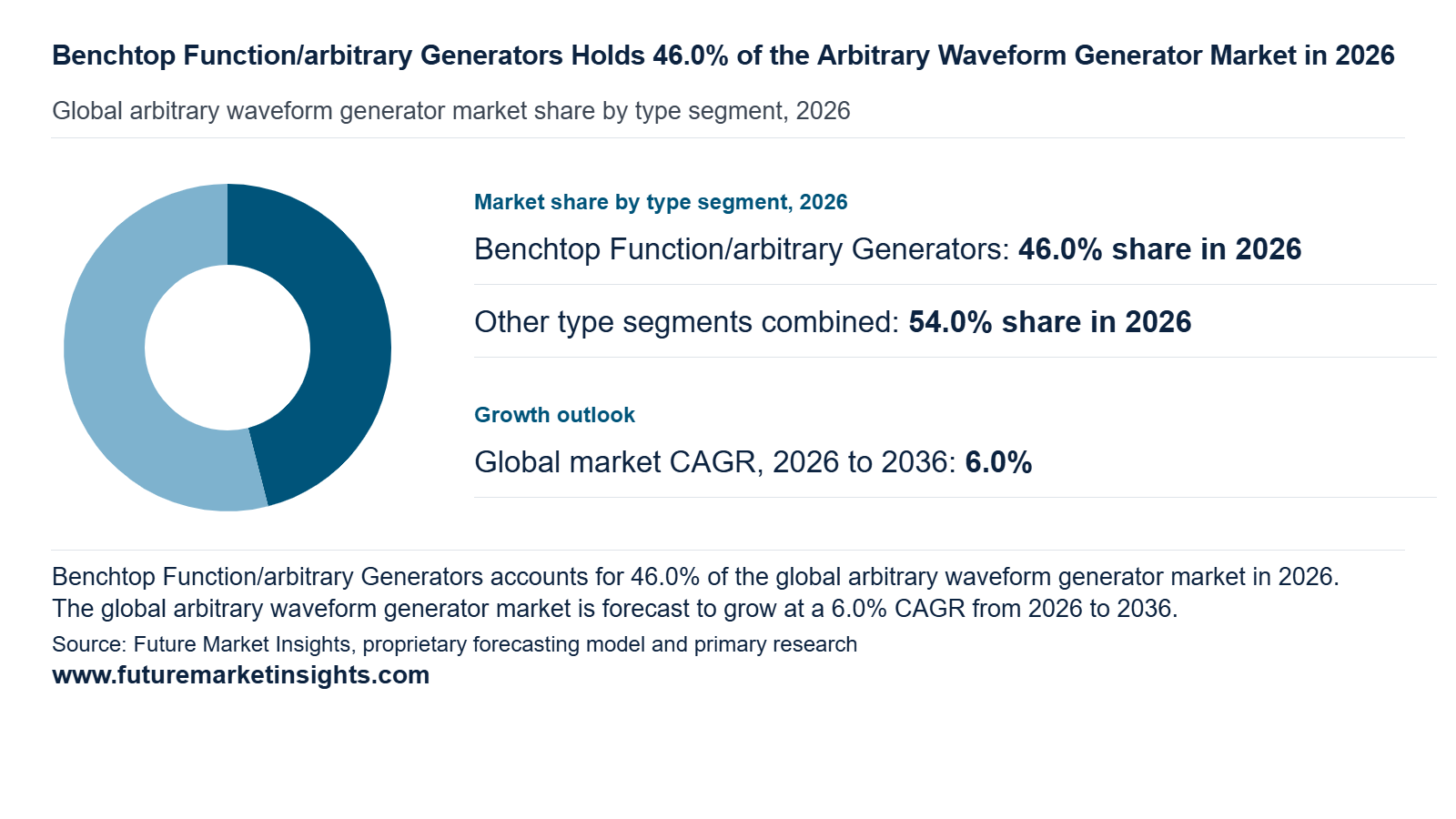
In 2026, benchtop function/arbitrary generators account for a leading 46.0% share of type demand owing to hardware verification engineers prioritizing self-contained instruments with integrated displays and front-panel controls that move easily between prototype debug benches. Modular AXIe or PXI cards require a host chassis and custom driver setup, whereas benchtop function/arbitrary generators allow immediate fault reproduction beside spectrum analyzers. Supplier product expansions reinforce this segment's commercial position; Teledyne LeCroy (2026) markets its T3AWG3K and T3AWG2K 16-bit benchtop series with 128 Mpts/ch waveform memory, while SIGLENT Technologies (May 2026) launched the SDG8000A benchtop platform for RF and arbitrary signal generation. FMI predicts that shared laboratory utility and plug-and-play deployment will keep benchtop function/arbitrary generators at the forefront of type sales through 2036.
What Sustains the Below 250 MS/s Segment Within Sampling Rate?
Demand for below 250 MS/s instruments represents 36.0% of the sampling rate segment in 2026, attributed to widespread adoption in automotive sensor simulation, power-electronics gate testing, and university teaching laboratories that rarely require gigasample clock rates. Procurement managers avoid steep price premiums for microwave DAC architectures when 14-bit or 16-bit vertical resolution below 250 MS/s satisfies controller test specifications, as FMI analysts note across industrial accounts. Recent engineering updates confirm steady supplier investment in this rate band; Spectrum Instrumentation (March 2026) introduced Direct Digital Synthesis firmware for its 65xx series operating between 40 MS/s and 125 MS/s, while Rohde & Schwarz (2026) supplies 250 MS/s 14-bit arbitrary function generators. Favorable per-seat economics and mixed-signal compatibility will sustain below 250 MS/s leadership through 2036.
Why Is Dual Channel the Preferred Channel Count Configuration?
Dual channel configurations hold 38.0% of channel count sales in 2026 due to engineering preference for two phase-locked outputs that stimulate differential signaling paths or inject an interfering tone beside a clean reference signal. Single channel units cannot run simultaneous I/Q baseband pairs, whereas four-to-eight channel systems require specialized skew calibration reserved for phased-array or multi-qubit racks. Product specifications from Zurich Instruments (2026) on its dual-channel 1.8 GHz GHF-AWG and Tektronix (November 2025) on its AWG5200 series demonstrate how two synchronized outputs cover most differential validation tasks. FMI believes that balanced hardware pricing and straightforward two-port synchronization will preserve dual channel leadership across commercial test laboratories through 2036.
How Does Electronics Design and Validation Anchor Application Revenue?
Within the application category, electronics design and validation commands 30.0% of 2026 revenue on account of mandatory margin verification across printed circuit boards, power management ICs, and embedded controllers prior to manufacturing release. Design engineers rely on arbitrary waveform playback to stress-test components against voltage dropouts and clock glitches without building custom analog test fixtures beside optical spectrum analyzers. Recent product launches target this exact workflow; SIGLENT Technologies (September 2025) introduced the SDG3000X series with 40 Mpts per-channel memory for electronics and semiconductor validation, while RIGOL Technologies (July 2025) expanded its DG5000 Pro series for multi-rail board verification. According to FMI's assessment, compressed hardware release cycles will keep electronics design and validation as the largest application segment through 2036.
Regional & Country Outlook
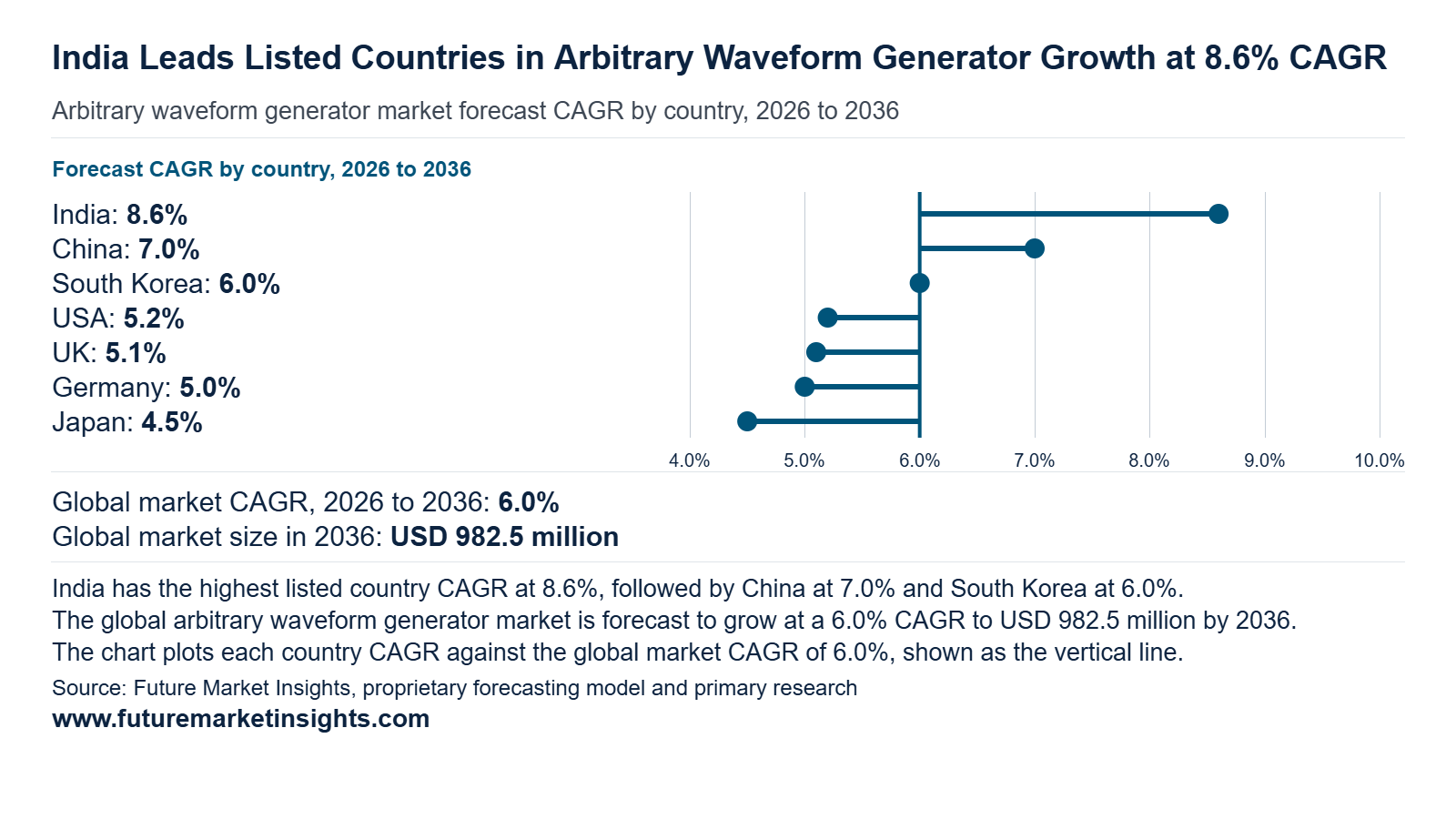
North America and East Asia anchor global arbitrary waveform generator revenue through dense semiconductor design and telecommunications equipment ecosystems, while South Asia posts the fastest percentage gains as greenfield fabrication and quantum laboratories come online. FMI projects India to lead national growth at an 8.6% CAGR from 2026 to 2036, followed by China at 7.0% and South Korea at 6.0%. Mature markets expand at a steadier pace, with the USA at 5.2%, the UK at 5.1%, Germany at 5.0%, and Japan at 4.5%, creating a 4.1 percentage-point spread across the seven profiled countries as equipment vendors align local calibration and application engineering support with national chip and quantum funding programs.
| Country | 2026 Revenue | 2036 Revenue | 10-Year Addition | 2026 to 2036 CAGR | Global Share (2026 -> 2036) |
|---|---|---|---|---|---|
| India | USD 38.4 million | USD 87.6 million | +USD 49.2 million | 8.6% | 7.0% -> 8.9% |
| China | USD 120.7 million | USD 237.4 million | +USD 116.7 million | 7.0% | 22.0% -> 24.2% |
| South Korea | USD 43.9 million | USD 78.6 million | +USD 34.7 million | 6.0% | 8.0% -> 8.0% |
| USA | USD 153.6 million | USD 255.0 million | +USD 101.4 million | 5.2% | 28.0% -> 26.0% |
| UK | USD 27.4 million | USD 45.1 million | +USD 17.7 million | 5.1% | 5.0% -> 4.6% |
| Germany | USD 49.4 million | USD 80.5 million | +USD 31.1 million | 5.0% | 9.0% -> 8.2% |
| Japan | USD 60.3 million | USD 93.6 million | +USD 33.3 million | 4.5% | 11.0% -> 9.5% |
Source: Future Market Insights analysis of the arbitrary waveform generator market, 2026.
India
Demand for arbitrary waveform generators across India is projected to climb from USD 38.4 million in 2026 to USD 87.6 million by 2036, advancing at an 8.6% CAGR and generating USD 49.2 million in incremental revenue. FMI's analysis indicates that India's rapid growth stems from first-time test bench installations across newly commissioned semiconductor assembly plants and academic chip-design hubs rather than replacement orders. Official figures from the Press Information Bureau, Government of India (September 2026) document 12 approved semiconductor manufacturing facilities with cumulative investments exceeding INR 1.6 lakh crore and design tool access across 300 universities. Domestic wafer characterization and quantum laboratory buildouts will sustain strong multi-channel generator procurement across India through 2036.
China
Sales of arbitrary waveform generators throughout China are forecast to rise from USD 120.7 million in 2026 to USD 237.4 million by 2036, progressing at a 7.0% CAGR and adding USD 116.7 million in new market value. In FMI's assessment, China's purchasing momentum is anchored by high-volume 5G-Advanced base-station manufacturing and domestic 6G waveform research requiring wideband I/Q stimulus. Official statistics from the State Council of the People's Republic of China (January 2026) confirm that national 5G base stations exceeded 4.8 million at the end of 2025 with 5G-Advanced deployed across more than 330 cities. Domestic instrument makers including SIGLENT Technologies and RIGOL Technologies will capture expanding bench and production test orders across Chinese electronics hubs through 2036.
South Korea
Buyer adoption of arbitrary waveform generators in South Korea is estimated to expand from USD 43.9 million in 2026 to USD 78.6 million by 2036, registering a 6.0% CAGR that contributes USD 34.7 million in ten-year revenue addition. FMI observes that South Korean demand is tightly linked to high-bandwidth memory interface verification and state-backed quantum research clusters. Budget disclosures from the Ministry of Science and ICT of South Korea (March 2025) detail a KRW 6.8 trillion cross-ministry investment plan prioritizing semiconductor packaging, next-generation communications, and quantum computing hardware. Sustained capital spending by memory foundries and national research institutes will support steady high-speed waveform generator upgrades across South Korea through 2036.
USA
Revenue generated by arbitrary waveform generator suppliers across the USA is projected to grow from USD 153.6 million in 2026 to USD 255.0 million by 2036, exhibiting a 5.2% CAGR and creating USD 101.4 million in incremental opportunity. Based on FMI's evaluation, the USA remains the largest single national market because aerospace defense primes, hyperscale optical transceiver labs, and leading-edge logic fabs demand ultra-high-speed 256 GSa/s modular systems in parallel with United States automated test equipment. Research updates from the National Institute of Standards and Technology (September 2026) highlight ongoing federal investments in atomic-scale semiconductor metrology and AI hardware verification. Continuous upgrades to 1.6T optical and radar validation benches will anchor high-value U.S. instrument shipments through 2036.
UK
Consumption of arbitrary waveform generators within the UK is forecast to advance from USD 27.4 million in 2026 to USD 45.1 million by 2036, reflecting a 5.1% CAGR that adds USD 17.7 million in category revenue. FMI believes UK procurement is distinctively shaped by national quantum computing testbeds and defense electronics laboratories requiring phase-coherent pulse sequencers beside United Kingdom automated test equipment. Policy announcements from the UK Department for Science, Innovation and Technology (March 2026) committed up to GBP 2.0 billion toward national quantum computing and sensing procurement pathways. Dedicated funding for quantum hardware validation and optical communications research will drive specialized multi-channel AWG orders across the UK through 2036.
Germany
Procurement of arbitrary waveform generators across Germany is tracking from USD 49.4 million in 2026 to USD 80.5 million by 2036, advancing at a 5.0% CAGR and adding USD 31.1 million to national market size. FMI notes that German demand is concentrated in automotive power-semiconductor validation and industrial metrology laboratories where traceable calibration is mandatory. Regulatory approvals from the European Commission (June 2026) cleared EUR 76.0 million in German state aid for first-of-a-kind semiconductor testing equipment manufacturing under the European Chips Act framework. Automotive silicon carbide testing and industrial automation validation will sustain German instrument demand through 2036.
Japan
Arbitrary waveform generator sales across Japan are estimated to increase from USD 60.3 million in 2026 to USD 93.6 million by 2036, progressing at a 4.5% CAGR and generating USD 33.3 million in ten-year expansion value. In FMI's view, Japan's mature installed base of precision electronics test equipment moderates percentage growth while supporting high-specification replacements for next-generation foundry nodes. Official statements from the Ministry of Economy, Trade and Industry of Japan (November 2025) confirmed government investment through the Information-technology Promotion Agency to advance Rapidus 2-nanometer semiconductor prototype lines. Foundry qualification and optical component testing will maintain dependable Japanese instrument orders through 2036.
Competitive Environment and Notable Companies
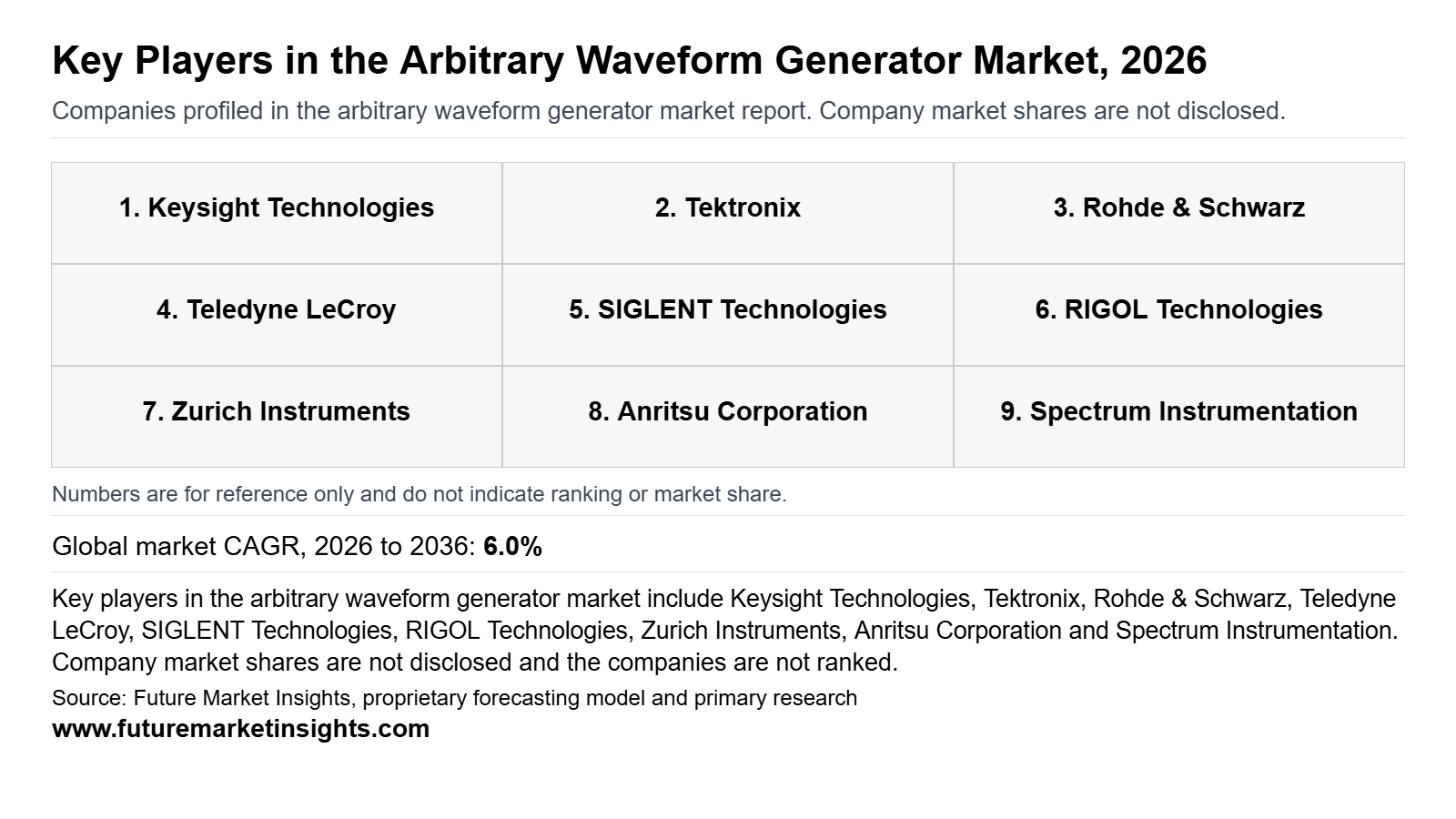
Notable companies operating in the global arbitrary waveform generator market include Keysight Technologies, Tektronix, Rohde & Schwarz, Teledyne LeCroy, SIGLENT Technologies, RIGOL Technologies, Zurich Instruments, Anritsu Corporation, Spectrum Instrumentation, and Berkeley Nucleonics Corporation. Competition spans three commercial tiers: ultra-high-speed standalone and modular AXIe/PXI platform leaders, versatile benchtop function/arbitrary instrument manufacturers, and specialized quantum-control, PCIe/Ethernet modular, and RF-integrated signal generation providers.
How Are Companies Positioned in the Arbitrary Waveform Generator Market?
Keysight Technologies and Tektronix anchor the ultra-high-speed standalone and modular tier, supplying 65 GSa/s to 256 GSa/s platforms for optical and semiconductor research. SIGLENT Technologies, RIGOL Technologies, Teledyne LeCroy, and Berkeley Nucleonics Corporation compete across mid-range and high-voltage benchtop validation, while Spectrum Instrumentation and Zurich Instruments specialize in multi-channel PCIe/Ethernet and quantum pulse sequencing, and Rohde & Schwarz and Anritsu Corporation integrate arbitrary baseband generators into vector signal platforms.
What Matters When a Buyer Selects an Arbitrary Waveform Generator Supplier?
Laboratory procurement teams evaluate suppliers on effective number of bits across the target bandwidth, inter-channel phase skew below 500 picoseconds, waveform memory depth, and driver compatibility with Python, LabVIEW, and MATLAB automation scripts. High-speed optical and quantum laboratories prioritize closed-loop precompensation from Tektronix (October 2025) and M8199B calibration workflows from Keysight Technologies (May 2026) to guarantee clean signals at the device test fixture.
Which Capabilities Distinguish Product Offers?
Product differentiation centers on native DAC sampling speed, channel synchronization density, and firmware-defined pulse sequencing. Keysight Technologies (May 2026) delivers 256 GSa/s across 8 synchronized channels with 80 GHz bandwidth on its M8199B, whereas Spectrum Instrumentation (December 2025) provides 12 Ethernet-controlled channels in a single NETBOX chassis and SIGLENT Technologies (May 2026) combines 12 GSa/s interpolated I/Q modulation with dual-channel benchtop operation.
How Does Geographic Reach Affect Competition?
Vendors with localized calibration laboratories and application engineering teams win higher repeat orders from semiconductor foundries and defense contractors that require rapid turnaround on ISO-traceable calibration. Keysight Technologies, Tektronix, Rohde & Schwarz, and Anritsu Corporation maintain direct calibration and support centers across North America, Europe, and Asia-Pacific, while Spectrum Instrumentation and Berkeley Nucleonics Corporation use regional distribution partners.
| Verified Company Evidence (2025 to 2026) | Commercial Effect | Buyer Action |
|---|---|---|
| May 2026: SIGLENT Technologies launched the SDG8000A series with 5 GSa/s direct output and 12 GSa/s interpolated I/Q modulation (SIGLENT Technologies, May 2026). | Extends benchtop arbitrary waveform generators into wideband RF and I/Q modulation testing. | Evaluate dual-mode I/Q benchtop AWGs to consolidate baseband and RF test stations. |
| March 2026: Spectrum Instrumentation introduced a Direct Digital Synthesis firmware option for its 65xx AWG series adding 64 sine cores per card (Spectrum Instrumentation, March 2026). | Enables multi-tone quantum and transducer stimulus on sub-250 MS/s modular cards via firmware. | Specify DDS-enabled PCIe or NETBOX cards for multi-frequency trap and sensor arrays. |
| December 2025: Spectrum Instrumentation released the DN6.63x NETBOX multichannel AWG supporting 6 channels at 10 GS/s or 12 channels at 5 GS/s (Spectrum Instrumentation, December 2025). | Simplifies multi-channel phase-aligned stimulus over standard Ethernet without PXI chassis overhead. | Adopt network-controlled multichannel AWGs for automated production and radar test cells. |
Source: Verified corporate disclosures and Future Market Insights analysis, 2026.
| Company | Core Positioning | Verified Activity & Source Attribution |
|---|---|---|
| Keysight Technologies | Ultra-high-speed AXIe modular and benchtop AWGs up to 256 GSa/s | Updated M8199A driver package and M8199B 256 GSa/s firmware v2.5.50.0 in May 2026 for 160 GBaud optical validation (Keysight Technologies, May 2026). |
| Tektronix | High-speed standalone AWG5200 and AWG70000B series with SourceXpress | Released AWG5200 Series Software V8.3 in October 2025 adding closed-loop precompensation support (Tektronix, October 2025). |
| Rohde & Schwarz | Integrated oscilloscope AWG options and HMF arbitrary function generators | Supplies 500 MS/s 14-bit RTP/RTO2000 AWG options and 250 MS/s HMF2550 bench generators (Rohde & Schwarz, 2026). |
| Teledyne LeCroy | High-definition 16-bit T3AWG2K and T3AWG3K benchtop waveform generators | Markets T3AWG3252 1.2 GS/s 16-bit dual-channel AWGs with 128 Mpts/ch memory and +/-24V output window (Teledyne LeCroy, 2026). |
| SIGLENT Technologies | Benchtop SDG3000X and high-speed SDG8000A arbitrary waveform generators | Launched SDG8000A series in May 2026 and SDG3000X 1.2 GSa/s series in September 2025 (SIGLENT Technologies, May 2026). |
| RIGOL Technologies | Multi-channel DG5000 Pro and compact benchtop arbitrary/function generators | Introduced 8-channel 2.5 GSa/s DG5000 Pro series with sub-500 ps skew in July 2025 (RIGOL Technologies, July 2025). |
| Zurich Instruments | Quantum-focused HDAWG, GHF-AWG, and SHFSG synchronized pulse sequencers | Supplies 750 MHz HDAWG and dual-channel 1.8 GHz 6 GSa/s GHF-AWG platforms with LabOne control (Zurich Instruments, 2026). |
| Anritsu Corporation | Vector signal generators with integrated wideband arbitrary baseband memory | Extended MG3710E vector and arbitrary waveform signal generator coverage to 44 GHz in March 2025 (Anritsu Corporation, March 2025). |
| Spectrum Instrumentation | Modular PCIe, PXIe, and Ethernet NETBOX arbitrary waveform generators | Launched DN6.63x 10 GS/s multichannel NETBOX AWGs in December 2025 and DDS firmware in March 2026 (Spectrum Instrumentation, December 2025). |
| Berkeley Nucleonics Corporation | High-speed standalone Model 686 and pulse-arbitrary test instruments | Highlighted the Model 686 20 GS/s 14-bit arbitrary waveform generator in May 2026 for radar and quantum test (Berkeley Nucleonics Corporation, May 2026). |
Source: Verified corporate disclosures and Future Market Insights analysis, 2026.
Key takeaways from the Arbitrary Waveform Generator Market Report
- The market stands at USD 548.6 million in 2026, anticipated to hit USD 982.5 million by 2036.
- Industry expansion is anticipated to add USD 433.9 million at a 6.0% CAGR over the decade.
- Benchtop function/arbitrary generators lead the type segment at 46.0% share in 2026.
- Dual channel models capture 38.0% of channel count demand in 2026.
- India projected to expand at a notable 8.6% CAGR, outpacing China at 7.0% and South Korea at 6.0%.
Arbitrary Waveform Generator Market Report Scope and Research Methodology
FMI analysts size the global arbitrary waveform generator market through primary interviews with electronic test instrument manufacturers, modular PXI and AXIe system integrators, semiconductor validation managers, and national metrology procurement officers, combined with desk research across government semiconductor mission disclosures, federal metrology publications, and corporate product filings. Base 2025 and 2026 valuations reconcile standalone benchtop, modular card, and network-controlled arbitrary waveform generator shipments across all seven profiled countries and regional clusters. Segment shares across type, sampling rate, channel count, and application axes are reconciled against verified instrument catalogs, while excluding standalone oscilloscopes, unbundled general-purpose RF signal sources, and third-party calibration services to prevent double counting.
| Coverage Field | Report Scope |
|---|---|
| Market Definition | Revenue from dedicated standalone benchtop, modular (PXI, AXIe, PCIe), and software-defined/networked arbitrary waveform generators. |
| Type Segments | Benchtop Function/arbitrary Generators, High-Speed (above 1 GS/s) Generators, Modular (PXI and AXIe) Generators, and Software-Defined and USB Generators. |
| Sampling Rate Segments | Below 250 MS/s, 250 MS/s to 2 GS/s, 2 GS/s to 10 GS/s, and Above 10 GS/s. |
| Channel Count Segments | Dual Channel, Single Channel, Four to Eight Channels, and More Than Eight Channels. |
| Application Segments | Electronics Design and Validation, Communications and 5G/6G, Aerospace and Defense, Radar, Semiconductor and Quantum Research, and Education and General Lab. |
| Exclusions | Finished downstream electronics, standalone oscilloscopes, general-purpose RF generators except separately identifiable AWG options, and aftermarket calibration services. |
| Quantitative Units | USD Million for global and country-level market sizing; CAGR % for growth rates. |
| Historical & Base Years | 2025 (Historical) and 2026 (Estimated Base Year). |
| Forecast Period | 2026 to 2036 (10-Year Projection Window). |
| Regions Covered | North America (United States, Canada), Latin America (Brazil, Mexico, Argentina, Chile), Western Europe (Germany, France, United Kingdom, Italy, Spain, Benelux, Nordics), Eastern Europe (Poland, Czech Republic, Romania, Hungary), East Asia (China, Japan, South Korea), South Asia and Pacific (India, ASEAN, Australia and New Zealand), and Middle East and Africa (GCC Countries, South Africa, Turkiye, Israel). |
| Countries Profiled | India, China, South Korea, USA, UK, Germany, and Japan. |
| Companies Covered | Keysight Technologies, Tektronix, Rohde & Schwarz, Teledyne LeCroy, SIGLENT Technologies, RIGOL Technologies, Zurich Instruments, Anritsu Corporation, Spectrum Instrumentation, and Berkeley Nucleonics Corporation. |
| Research Approach | Primary laboratory buyer and instrument manufacturer interviews combined with secondary government semiconductor, quantum, and corporate disclosure triangulation. |
Source: Future Market Insights analysis of the arbitrary waveform generator market, 2026.
Research Sources and Bibliography
- Anritsu Corporation. (2025, March 11). Anritsu Extends Signal Generator Frequency to 44 GHz with TMYTEK Frequency Converters for MG3710E. https://www.anritsu.com/en-au/test-measurement/news/news-releases/2025/2025-03-11-au01
- Berkeley Nucleonics Corporation. (2026, May 25). Berkeley Nucleonics Highlights the Model 686 Arbitrary Waveform Generator. https://www.berkeleynucleonics.com/docs/bnc-awg-686-press-release.html
- European Commission. (2026, June 22). Commission Approves EUR 76 Million German State Aid for First-of-a-Kind Semiconductor Testing Equipment Facility. https://digital-strategy.ec.europa.eu/it/news/commission-approves-eu76-million-german-state-aid-first-kind-semiconductor-testing-equipment
- Keysight Technologies. (2026, May 5). M8199A Module Driver, M8008A Module Driver and M8070B System Software Package. https://www.keysight.com/in/en/lib/software-detail/instrument-firmware-software/m8199a-module-driver-m8008a-module-driver-and-m8070b-system-software-3135650.html
- Keysight Technologies. (2026, May 6). Technical Support and Firmware Release 2.5.50.0: M8199B 256 GSa/s Arbitrary Waveform Generator. https://www.keysight.com/us/en/support/M8199B/m8199b-256-gsa-s-arbitrary-waveform-generator.html
- Ministry of Economy, Trade and Industry of Japan. (2025, November 21). Press Conference by Minister Akazawa on Next-Generation Semiconductor Investment and Rapidus Support. https://www.meti.go.jp/english/speeches/press_conferences/2025/1121001.html
- Ministry of Science and ICT of South Korea. (2025, March 12). KRW 6.8 Trillion Investment in 2025 to Advance Critical and Emerging Technologies and Secure Leadership in Global Tech Race. https://www.msit.go.kr/eng/bbs/view.do?bbsSeqNo=42&mId=4&mPid=2&nttSeqNo=1105&sCode=eng
- National Institute of Standards and Technology. (2026, September 3). Overlay Metrology Using Physics and AI-Based Scanning Electron Microscopy for Semiconductor Manufacturing. https://www.nist.gov/programs-projects/overlay-metrology-using-physics-and-ai-based-scanning-electron-microscopy
- Press Information Bureau, Government of India. (2026, September 17). India Building Semiconductor Future: Emerging Capabilities Across Design, Manufacturing, Packaging, Materials and Talent. https://www.pib.gov.in/PressNoteDetails.aspx?ModuleId=3&NoteId=160020&lang=1®=46
- Press Information Bureau, Government of India. (2026, August 12). Parliament Question: National Quantum Mission Infrastructure and Research Hubs. https://www.pib.gov.in/PressReleasePage.aspx?PRID=2298218&lang=2®=48
- RIGOL Technologies. (2025, July 8). access New Possibilities: The Next-Generation DG5000 Pro Series Function/Arbitrary Waveform Generator. https://www.rigolna.com/news/2025/9092/
- Rohde & Schwarz. (2026). Arbitrary Waveform Generator Options for R&S RTP, RTO2000 and RTE Oscilloscopes. https://www.rohde-schwarz.com/us/products/test-and-measurement/oscilloscopes-options/arbitrary-waveform-generator-oscilloscopes_63493-502031.html
- SIGLENT Technologies. (2026, May 22). SIGLENT Introduces the SDG8000A Series: A New Platform for High-Performance RF and Arbitrary Signal Generation. https://siglentna.com/news-article/siglent-introduces-the-sdg8000a-series-a-new-platform-for-high-performance-rf-and-arbitrary-signal-generation/
- SIGLENT Technologies. (2025, September 25). SIGLENT Launches SDG3000X Arbitrary Waveform Generator for Advanced Semiconductor Testing. https://siglentna.com/news-article/siglent-launches-sdg3000x-arbitrary-waveform-generator-for-advanced-semiconductor-testing/
- Spectrum Instrumentation. (2026, March 11). DDS Option Boosts Flexibility of General-Purpose AWGs. https://spectrum-instrumentation.com/news/202603_New_DDS_option_boosts_general-purpose_AWGs.php
- Spectrum Instrumentation. (2025, December 3). New Multichannel AWGs for GHz Signal Generation: DN6.63x NETBOX Series. https://spectrum-instrumentation.com/news/202512_New_multichannel_AWGs_for_GHz_signal_generation.php
- Spectrum Instrumentation. (2025, May 14). Ultrafast AWGs with Ethernet Control for Wideband Signal Generation. https://spectrum-instrumentation.com/news/202505_Ultrafast_AWGs_with_Ethernet_control.php
- State Council of the People's Republic of China. (2026, January 28). China's 5G Base Stations Top 4.8 Million by End of 2025 With 6G Verification Progress. https://english.www.gov.cn/archive/statistics/202601/28/content_WS6979f123c6d00ca5f9a08ce7.html
- Tektronix. (2025, November 7). AWG5200 Arbitrary Waveform Generator Series Product Specifications and SourceXpress Control. https://www.tek.com/en/products/arbitrary-waveform-generators/awg5200
- Tektronix. (2025, October 2). AWG5200 Series Software V8.3 Firmware and Precompensation Release. https://www.tek.com/en/support/software/firmware/awg5200-series-software-v83
- Teledyne LeCroy. (2026). T3AWG3K Series High Performance 16-Bit Arbitrary Waveform Generator Specifications. https://www.teledynelecroy.com/waveform-function-generators/waveform.aspx?mseries=582
- UK Department for Science, Innovation and Technology. (2026, March 17). UK's Quantum Leap to Help Beat Disease, Deliver High-Paid Jobs, and Strengthen National Security. https://www.gov.uk/government/news/uks-quantum-leap-tohelp-beat-diseasedeliver-high-paid-jobs-and-strengthen-national-security-as-first-country-in-the-world-to-roll-out-quantum
- Zurich Instruments. (2026). GHF-AWG 1.8 GHz 6 GSa/s Arbitrary Waveform Generator and HDAWG Synchronized Control. https://www.zhinst.com/en/products/ghf-awg-arbitrary-waveform-generator/
Table of Content
- Key Takeaways
- Market Size and CAGR
- Top Growth Driver
- Fastest Growing Segment
- Leading Region
- Key Companies
- Emerging Opportunities
- Executive Summary
- Global Market Outlook
- Demand-side Trends
- Supply-side Trends
- Technology Roadmap Analysis
- Analysis and Recommendations
- Analyst Perspective (What is happening? Why now? What should investors know?)
- Key Questions Answered
- How large is the market?
- What is the CAGR?
- What are key trends?
- Which region dominates?
- Who are the leaders?
Read More...
- Market Overview
- Market Coverage / Taxonomy
- Market Definition / Scope / Limitations
- Research Methodology
- Chapter Orientation
- Analytical Lens and Working Hypotheses
- Market Structure, Signals, and Trend Drivers
- Benchmarking and Cross-market Comparability
- Market Sizing, Forecasting, and Opportunity Mapping
- Research Design and Evidence Framework
- Desk Research Programme (Secondary Evidence)
- Expert Input and Fieldwork (Primary Evidence)
- Tooling, Models, and Reference Databases
- Data Engineering and Model Build
- Quality Assurance and Audit Trail
- Market Background
- Market Dynamics (Drivers, Restraints, Opportunity, Trends)
- Scenario Forecast (Optimistic, Likely, Conservative)
- Impact Analysis
- AI Impact
- Sustainability Impact
- Regulatory Impact
- Technology Impact
- Consumer / Buyer Analysis
- Purchase Drivers
- Adoption Barriers
- Buyer Journey
- Opportunity Map Analysis
- Product Life Cycle Analysis
- Supply Chain Analysis
- Investment Feasibility Matrix
- Value Chain Analysis
- PESTLE and Porter's Analysis
- Regulatory Landscape
- Regional Parent Market Outlook
- Production and Consumption Statistics
- Import and Export Statistics
- Global Market Analysis and Forecast, 2021 to 2036
- Historical Market Size Value (USD Million) Analysis, 2021 to 2025
- Current and Future Market Size Value (USD Million) Projections, 2026 to 2036
- Y-o-Y Growth Trend Analysis
- Absolute $ Opportunity Analysis
- Global Market Pricing Analysis, 2021 to 2036
- Global Market Analysis and Forecast, By Type, 2021 to 2036
- Introduction / Key Findings
- Historical Market Size Value (USD Million) Analysis By Type, 2021 to 2025
- Current and Future Market Size Value (USD Million) Analysis and Forecast By Type, 2026 to 2036
- Benchtop Function/arbitrary Generators
- High-Speed (above 1 GS/s) Generators
- Modular (PXI and AXIe) Generators
- Software-Defined and USB Generators
- Y-o-Y Growth Trend Analysis By Type, 2021 to 2025
- Absolute $ Opportunity Analysis By Type, 2026 to 2036
- Global Market Analysis and Forecast, By Sampling Rate, 2021 to 2036
- Introduction / Key Findings
- Historical Market Size Value (USD Million) Analysis By Sampling Rate, 2021 to 2025
- Current and Future Market Size Value (USD Million) Analysis and Forecast By Sampling Rate, 2026 to 2036
- Below 250 MS/s
- 250 MS/s to 2 GS/s
- 2 GS/s to 10 GS/s
- Above 10 GS/s
- Y-o-Y Growth Trend Analysis By Sampling Rate, 2021 to 2025
- Absolute $ Opportunity Analysis By Sampling Rate, 2026 to 2036
- Global Market Analysis and Forecast, By Channel Count, 2021 to 2036
- Introduction / Key Findings
- Historical Market Size Value (USD Million) Analysis By Channel Count, 2021 to 2025
- Current and Future Market Size Value (USD Million) Analysis and Forecast By Channel Count, 2026 to 2036
- Dual Channel
- Single Channel
- Four to Eight Channels
- More Than Eight Channels
- Y-o-Y Growth Trend Analysis By Channel Count, 2021 to 2025
- Absolute $ Opportunity Analysis By Channel Count, 2026 to 2036
- Global Market Analysis and Forecast, By Application, 2021 to 2036
- Introduction / Key Findings
- Historical Market Size Value (USD Million) Analysis By Application, 2021 to 2025
- Current and Future Market Size Value (USD Million) Analysis and Forecast By Application, 2026 to 2036
- Electronics Design and Validation
- Communications and 5G/6G
- Aerospace and Defense
- Radar
- Semiconductor and Quantum Research
- Education and General Lab
- Y-o-Y Growth Trend Analysis By Application, 2021 to 2025
- Absolute $ Opportunity Analysis By Application, 2026 to 2036
- Global Market Analysis and Forecast, By Region, 2021 to 2036
- Introduction
- Historical Market Size Value (USD Million) Analysis By Region, 2021 to 2025
- Current Market Size Value (USD Million) Analysis and Forecast By Region, 2026 to 2036
- North America
- Western Europe
- East Asia
- South Asia and Pacific
- Market Attractiveness Analysis By Region
- North America Market Analysis and Forecast, By Country, 2021 to 2036
- Historical Market Size Value (USD Million) Trend Analysis By Market Taxonomy, 2021 to 2025
- Market Size Value (USD Million) Forecast By Market Taxonomy, 2026 to 2036
- By Country
- United States
- Canada
- By Type
- By Sampling Rate
- By Channel Count
- By Application
- By Country
- Market Attractiveness Analysis
- By Country
- By Type
- By Sampling Rate
- By Channel Count
- By Application
- Key Takeaways
- Western Europe Market Analysis and Forecast, By Country
- Historical Market Size Value (USD Million) Trend Analysis By Market Taxonomy, 2021 to 2025
- Market Size Value (USD Million) Forecast By Market Taxonomy, 2026 to 2036
- By Country
- United Kingdom
- Germany
- France
- By Type
- By Sampling Rate
- By Channel Count
- By Application
- By Country
- Market Attractiveness Analysis
- By Country
- By Type
- By Sampling Rate
- By Channel Count
- By Application
- Key Takeaways
- East Asia Market Analysis and Forecast, By Country
- Historical Market Size Value (USD Million) Trend Analysis By Market Taxonomy, 2021 to 2025
- Market Size Value (USD Million) Forecast By Market Taxonomy, 2026 to 2036
- By Country
- China
- Japan
- South Korea
- By Type
- By Sampling Rate
- By Channel Count
- By Application
- By Country
- Market Attractiveness Analysis
- By Country
- By Type
- By Sampling Rate
- By Channel Count
- By Application
- Key Takeaways
- South Asia and Pacific Market Analysis and Forecast, By Country
- Historical Market Size Value (USD Million) Trend Analysis By Market Taxonomy, 2021 to 2025
- Market Size Value (USD Million) Forecast By Market Taxonomy, 2026 to 2036
- By Country
- India
- Australia
- Rest of world aggregate
- By Type
- By Sampling Rate
- By Channel Count
- By Application
- By Country
- Market Attractiveness Analysis
- By Country
- By Type
- By Sampling Rate
- By Channel Count
- By Application
- Key Takeaways
- Key Countries Market Analysis
- United States
- Pricing Analysis
- Market Share Analysis, 2025
- By Type
- By Sampling Rate
- By Channel Count
- By Application
- Canada
- Pricing Analysis
- Market Share Analysis, 2025
- By Type
- By Sampling Rate
- By Channel Count
- By Application
- Germany
- Pricing Analysis
- Market Share Analysis, 2025
- By Type
- By Sampling Rate
- By Channel Count
- By Application
- United Kingdom
- Pricing Analysis
- Market Share Analysis, 2025
- By Type
- By Sampling Rate
- By Channel Count
- By Application
- France
- Pricing Analysis
- Market Share Analysis, 2025
- By Type
- By Sampling Rate
- By Channel Count
- By Application
- India
- Pricing Analysis
- Market Share Analysis, 2025
- By Type
- By Sampling Rate
- By Channel Count
- By Application
- China
- Pricing Analysis
- Market Share Analysis, 2025
- By Type
- By Sampling Rate
- By Channel Count
- By Application
- Japan
- Pricing Analysis
- Market Share Analysis, 2025
- By Type
- By Sampling Rate
- By Channel Count
- By Application
- South Korea
- Pricing Analysis
- Market Share Analysis, 2025
- By Type
- By Sampling Rate
- By Channel Count
- By Application
- Australia
- Pricing Analysis
- Market Share Analysis, 2025
- By Type
- By Sampling Rate
- By Channel Count
- By Application
- United States
- Market Structure Analysis
- Competition Dashboard
- Competition Benchmarking
- Market Share Analysis of Top Players
- By Regional
- By Type
- By Sampling Rate
- By Channel Count
- By Application
- Emerging Startups
- Innovation Benchmarking
- Competition Analysis
- Competition Deep Dive
- Keysight Technologies
- Overview
- Product Portfolio
- Profitability by Market Segments
- Sales Footprint
- Strategy Overview
- Marketing Strategy
- Product Strategy
- Channel Strategy
- Tektronix
- Rohde & Schwarz
- Teledyne LeCroy
- SIGLENT Technologies
- RIGOL Technologies
- Zurich Instruments
- Anritsu Corporation
- Spectrum Instrumentation
- Berkeley Nucleonics Corporation
- Keysight Technologies
- Case Studies
- Success Stories
- Recent Developments
- Competition Deep Dive
- Assumptions & Acronyms Used
List of Tables
- Table 1: Global Market Value (USD Million) Forecast by Region, 2021 to 2036
- Table 2: Global Market Value (USD Million) Forecast by Type, 2021 to 2036
- Table 3: Global Market Value (USD Million) Forecast by Sampling Rate, 2021 to 2036
- Table 4: Global Market Value (USD Million) Forecast by Channel Count, 2021 to 2036
- Table 5: Global Market Value (USD Million) Forecast by Application, 2021 to 2036
- Table 6: North America Market Value (USD Million) Forecast by Country, 2021 to 2036
- Table 7: North America Market Value (USD Million) Forecast by Type, 2021 to 2036
- Table 8: North America Market Value (USD Million) Forecast by Sampling Rate, 2021 to 2036
- Table 9: North America Market Value (USD Million) Forecast by Channel Count, 2021 to 2036
- Table 10: North America Market Value (USD Million) Forecast by Application, 2021 to 2036
- Table 11: Western Europe Market Value (USD Million) Forecast by Country, 2021 to 2036
- Table 12: Western Europe Market Value (USD Million) Forecast by Type, 2021 to 2036
- Table 13: Western Europe Market Value (USD Million) Forecast by Sampling Rate, 2021 to 2036
- Table 14: Western Europe Market Value (USD Million) Forecast by Channel Count, 2021 to 2036
- Table 15: Western Europe Market Value (USD Million) Forecast by Application, 2021 to 2036
- Table 16: East Asia Market Value (USD Million) Forecast by Country, 2021 to 2036
- Table 17: East Asia Market Value (USD Million) Forecast by Type, 2021 to 2036
- Table 18: East Asia Market Value (USD Million) Forecast by Sampling Rate, 2021 to 2036
- Table 19: East Asia Market Value (USD Million) Forecast by Channel Count, 2021 to 2036
- Table 20: East Asia Market Value (USD Million) Forecast by Application, 2021 to 2036
- Table 21: South Asia and Pacific Market Value (USD Million) Forecast by Country, 2021 to 2036
- Table 22: South Asia and Pacific Market Value (USD Million) Forecast by Type, 2021 to 2036
- Table 23: South Asia and Pacific Market Value (USD Million) Forecast by Sampling Rate, 2021 to 2036
- Table 24: South Asia and Pacific Market Value (USD Million) Forecast by Channel Count, 2021 to 2036
- Table 25: South Asia and Pacific Market Value (USD Million) Forecast by Application, 2021 to 2036
List of Figures
- Figure 1: Global Market Pricing Analysis
- Figure 2: Global Market Value (USD Million) Forecast 2021-2036
- Figure 3: Global Market Value Share and BPS Analysis by Type, 2026 and 2036
- Figure 4: Global Market Y-o-Y Growth Comparison by Type, 2026-2036
- Figure 5: Global Market Attractiveness Analysis by Type
- Figure 6: Global Market Value Share and BPS Analysis by Sampling Rate, 2026 and 2036
- Figure 7: Global Market Y-o-Y Growth Comparison by Sampling Rate, 2026-2036
- Figure 8: Global Market Attractiveness Analysis by Sampling Rate
- Figure 9: Global Market Value Share and BPS Analysis by Channel Count, 2026 and 2036
- Figure 10: Global Market Y-o-Y Growth Comparison by Channel Count, 2026-2036
- Figure 11: Global Market Attractiveness Analysis by Channel Count
- Figure 12: Global Market Value Share and BPS Analysis by Application, 2026 and 2036
- Figure 13: Global Market Y-o-Y Growth Comparison by Application, 2026-2036
- Figure 14: Global Market Attractiveness Analysis by Application
- Figure 15: Global Market Value (USD Million) Share and BPS Analysis by Region, 2026 and 2036
- Figure 16: Global Market Y-o-Y Growth Comparison by Region, 2026-2036
- Figure 17: Global Market Attractiveness Analysis by Region
- Figure 18: North America Market Incremental Dollar Opportunity, 2026-2036
- Figure 19: Western Europe Market Incremental Dollar Opportunity, 2026-2036
- Figure 20: East Asia Market Incremental Dollar Opportunity, 2026-2036
- Figure 21: South Asia and Pacific Market Incremental Dollar Opportunity, 2026-2036
- Figure 22: North America Market Value Share and BPS Analysis by Country, 2026 and 2036
- Figure 23: North America Market Value Share and BPS Analysis by Type, 2026 and 2036
- Figure 24: North America Market Y-o-Y Growth Comparison by Type, 2026-2036
- Figure 25: North America Market Attractiveness Analysis by Type
- Figure 26: North America Market Value Share and BPS Analysis by Sampling Rate, 2026 and 2036
- Figure 27: North America Market Y-o-Y Growth Comparison by Sampling Rate, 2026-2036
- Figure 28: North America Market Attractiveness Analysis by Sampling Rate
- Figure 29: North America Market Value Share and BPS Analysis by Channel Count, 2026 and 2036
- Figure 30: North America Market Y-o-Y Growth Comparison by Channel Count, 2026-2036
- Figure 31: North America Market Attractiveness Analysis by Channel Count
- Figure 32: North America Market Value Share and BPS Analysis by Application, 2026 and 2036
- Figure 33: North America Market Y-o-Y Growth Comparison by Application, 2026-2036
- Figure 34: North America Market Attractiveness Analysis by Application
- Figure 35: Western Europe Market Value Share and BPS Analysis by Country, 2026 and 2036
- Figure 36: Western Europe Market Value Share and BPS Analysis by Type, 2026 and 2036
- Figure 37: Western Europe Market Y-o-Y Growth Comparison by Type, 2026-2036
- Figure 38: Western Europe Market Attractiveness Analysis by Type
- Figure 39: Western Europe Market Value Share and BPS Analysis by Sampling Rate, 2026 and 2036
- Figure 40: Western Europe Market Y-o-Y Growth Comparison by Sampling Rate, 2026-2036
- Figure 41: Western Europe Market Attractiveness Analysis by Sampling Rate
- Figure 42: Western Europe Market Value Share and BPS Analysis by Channel Count, 2026 and 2036
- Figure 43: Western Europe Market Y-o-Y Growth Comparison by Channel Count, 2026-2036
- Figure 44: Western Europe Market Attractiveness Analysis by Channel Count
- Figure 45: Western Europe Market Value Share and BPS Analysis by Application, 2026 and 2036
- Figure 46: Western Europe Market Y-o-Y Growth Comparison by Application, 2026-2036
- Figure 47: Western Europe Market Attractiveness Analysis by Application
- Figure 48: East Asia Market Value Share and BPS Analysis by Country, 2026 and 2036
- Figure 49: East Asia Market Value Share and BPS Analysis by Type, 2026 and 2036
- Figure 50: East Asia Market Y-o-Y Growth Comparison by Type, 2026-2036
- Figure 51: East Asia Market Attractiveness Analysis by Type
- Figure 52: East Asia Market Value Share and BPS Analysis by Sampling Rate, 2026 and 2036
- Figure 53: East Asia Market Y-o-Y Growth Comparison by Sampling Rate, 2026-2036
- Figure 54: East Asia Market Attractiveness Analysis by Sampling Rate
- Figure 55: East Asia Market Value Share and BPS Analysis by Channel Count, 2026 and 2036
- Figure 56: East Asia Market Y-o-Y Growth Comparison by Channel Count, 2026-2036
- Figure 57: East Asia Market Attractiveness Analysis by Channel Count
- Figure 58: East Asia Market Value Share and BPS Analysis by Application, 2026 and 2036
- Figure 59: East Asia Market Y-o-Y Growth Comparison by Application, 2026-2036
- Figure 60: East Asia Market Attractiveness Analysis by Application
- Figure 61: South Asia and Pacific Market Value Share and BPS Analysis by Country, 2026 and 2036
- Figure 62: South Asia and Pacific Market Value Share and BPS Analysis by Type, 2026 and 2036
- Figure 63: South Asia and Pacific Market Y-o-Y Growth Comparison by Type, 2026-2036
- Figure 64: South Asia and Pacific Market Attractiveness Analysis by Type
- Figure 65: South Asia and Pacific Market Value Share and BPS Analysis by Sampling Rate, 2026 and 2036
- Figure 66: South Asia and Pacific Market Y-o-Y Growth Comparison by Sampling Rate, 2026-2036
- Figure 67: South Asia and Pacific Market Attractiveness Analysis by Sampling Rate
- Figure 68: South Asia and Pacific Market Value Share and BPS Analysis by Channel Count, 2026 and 2036
- Figure 69: South Asia and Pacific Market Y-o-Y Growth Comparison by Channel Count, 2026-2036
- Figure 70: South Asia and Pacific Market Attractiveness Analysis by Channel Count
- Figure 71: South Asia and Pacific Market Value Share and BPS Analysis by Application, 2026 and 2036
- Figure 72: South Asia and Pacific Market Y-o-Y Growth Comparison by Application, 2026-2036
- Figure 73: South Asia and Pacific Market Attractiveness Analysis by Application
- Figure 74: Global Market - Tier Structure Analysis
- Figure 75: Global Market - Company Share Analysis
Frequently Asked Questions
How big is the arbitrary waveform generator market in 2026?
Future Market Insights estimates the global arbitrary waveform generator market valuation at USD 548.6 million in 2026, advancing from USD 517.5 million in 2025 as semiconductor and RF validation expands.
What is the projected size and CAGR of the arbitrary waveform generator market through 2036?
Global arbitrary waveform generator revenue is projected to reach USD 982.5 million by 2036, expanding at a 6.0% CAGR from 2026 to 2036 and generating USD 433.9 million in incremental opportunity.
Which Type segment leads the arbitrary waveform generator market in 2026?
Benchtop function/arbitrary generators lead the type axis with a 46.0% revenue share in 2026 due to standalone operation and shared debug utility across engineering laboratories.
Which Sampling Rate segment captures the largest share of arbitrary waveform generator sales?
Below 250 MS/s equipment holds 36.0% of sampling rate revenue in 2026 because automotive sensor emulation, power control, and educational laboratories prioritize vertical resolution over microwave clock rates.
How much share does Dual Channel hold in the arbitrary waveform generator market?
Dual channel configurations account for 38.0% of channel count demand in 2026, enabling differential interface stimulation and reference-versus-impairment testing in one instrument.
Why does Electronics Design and Validation lead arbitrary waveform generator applications?
Electronics design and validation captures 30.0% of 2026 application revenue because design engineers use programmable fault replay across prototype circuit boards prior to production release.
Which countries are projected to grow fastest in the arbitrary waveform generator market?
India leads national growth at an 8.6% CAGR from 2026 to 2036, followed by China at 7.0% and South Korea at 6.0% as domestic fab and quantum investments scale.
Which companies are profiled as key players in the arbitrary waveform generator market?
Key profiled companies include Keysight Technologies, Tektronix, Rohde & Schwarz, Teledyne LeCroy, SIGLENT Technologies, RIGOL Technologies, Zurich Instruments, Anritsu Corporation, Spectrum Instrumentation, and Berkeley Nucleonics Corporation.
Preview the report firsthand - request a free sample
Get SampleGet the brochure for pricing and purchase details.
Get PDF