

- Market Size (2026)
- USD 3.1 Bn
- Forecast (2036)
- USD 4.8 Bn
- CAGR (2026 to 2036)
- 4.5%
Crankshaft and Connecting Rod Engine Bearings Market Size, Forecast, and Outlook By FMI
Summary of the Crankshaft and Connecting Rod Engine Bearings Market
- Demand and Growth Drivers
- ICE engine rebuild work supports bearing demand as workshops replace worn main and rod bearings during crankshaft repair.
- Hybrid powertrains keep demand active because repeated start-stop cycles increase stress at the crankshaft interface.
- Commercial vehicle maintenance adds higher-value replacement demand as commercial vehicle engines need bearing checks before unplanned downtime.
- Product and Segment View
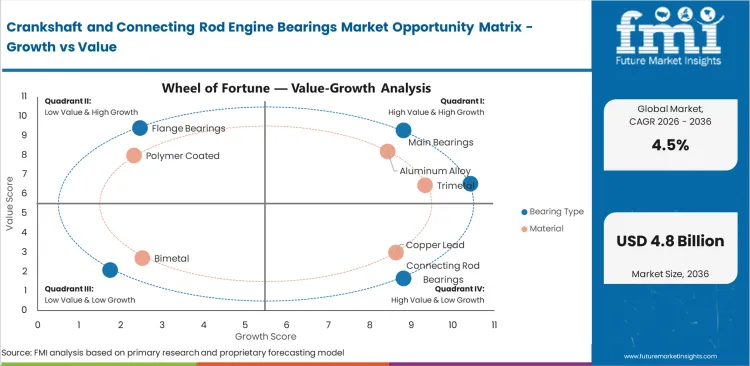
- Main bearings are expected to lead as crankshaft support remains the first fitment point in engine assembly and rebuild work.
- Aluminum alloy bearings hold a wide material base as light-duty engine programs need cost-controlled bearing sets.
- Connecting rod bearings keep steady aftermarket movement through rebuild kits and undersize replacement demand.
- Geography and Competitive Outlook
- China continues to show stronger demand due to large engine production and a deep replacement parts network.
- India records higher demand as two-wheeler and commercial vehicle service volumes widen the bearing replacement base.
- Suppliers with OE approval depth and aftermarket catalog coverage are expected to gain share during the forecast period.
- Analyst Opinion
- Nikhil Kaitwade, Principal Consultant for Automotive at FMI says, “I view this market as being driven by durability and service preparedness, not basic component sales. Crankshaft and connecting rod bearings will continue to retain value as long as ICE and hybrid engines rely on consistent oil‑film stability under heavy operating loads and during rebuild cycles. Suppliers that can prove coating strength, clearance accuracy and fast aftermarket coverage will have the stronger adoption advantage.”
- Crankshaft and Connecting Rod Engine Bearings Market Value Analysis
- Engine bearing value comes from precision load support inside ICE engines and from repeat replacement during engine overhaul work.
- Main bearings create the leading value pool as crankshaft journals need stable oil-film control and accurate clearance.
- Engine rebuilders spend on matched bearing sets to reduce repeat teardown risk after crankshaft grinding or oil starvation damage.
- OEM supply remains important as engine plants need approved bearing geometry and repeatable material batches.
- Supplier advantage comes from catalog depth and fast availability of standard and undersize bearing sets.
Key Takeaways, Market Size, and Forecast
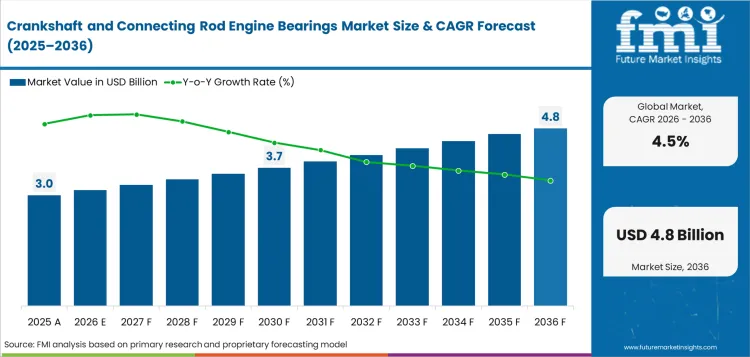
- The crankshaft and connecting rod engine bearings market was valued at USD 3.0 billion in 2025.
- By 2036, the crankshaft and connecting rod engine bearings market is expected to be worth USD 4.8 billion.
- Demand is projected to expand at a CAGR of 4.5% during the assessment period.
- The market is forecast to create an incremental opportunity of USD 1.7 billion between 2026 and 2036.
- In 2026, main bearings are expected to account for 38.0% of the bearing type segment due to their role in crankshaft load support.
- Aluminum alloy bearings are projected to represent 42.5% of material demand in 2026 as light-duty engine programs favor cost-controlled bearing sets.
- China (5.4% CAGR) and India (5.2% CAGR) are the two higher-growth country markets in the forecast set.
Engine bearing selection starts with oil-film protection and the condition of the crankshaft. In 2026, MAHLE Aftermarket in Stuttgart, Germany, stated that CLEVITE engine bearings are offered in H, HC, F and V series. That shows why rebuilders need application-specific bearing grades instead of one replacement type. MAHLE also stated that HC coated bearings use a low-friction polymer base for protection and lubricity in extreme conditions. That matters when engines face higher load or lubrication stress. Heavy-duty rebuilds require another material logic because many CLEVITE rod and main bearings use TriMetal CL-112 construction. Kolbenschmidt in Neuenstadt, Germany, keeps the repair case practical through a wide range of oversize bearings. Suppliers with coated, tri-metal and oversize options are better placed across fleet rebuilds and performance engine work.
Crankshaft and Connecting Rod Engine Bearings Market Definition
The crankshaft and connecting rod engine bearings market includes precision plain bearings used to support crankshaft rotation and connecting rod movement inside internal combustion engines.
Crankshaft and Connecting Rod Engine Bearings Market Inclusions
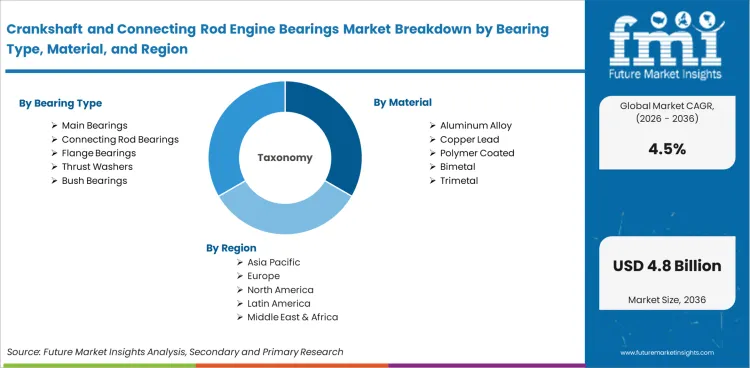
Market scope includes main bearings, connecting rod bearings, flange bearings, thrust washers, bush bearings, aluminum alloy materials, copper lead materials, polymer-coated variants, bimetal products, trimetal products, OEM supply, aftermarket supply, engine rebuilders, distributor supply, online retail, and global regional demand. Participants include automotive OEMs, engine manufacturers, engine bearing manufacturers, engine component suppliers, engine rebuild workshops, aftermarket distributors, fleet maintenance operators, commercial vehicle service centers, performance engine builders, and regional parts suppliers.
Crankshaft and Connecting Rod Engine Bearings Market Exclusions
Market scope excludes ball bearings, roller bearings, wheel hub bearings, clutch bearings, transmission bearings, electric motor bearings, crankshaft position sensors, connecting rods, pistons, and complete engine assemblies.
Crankshaft and Connecting Rod Engine Bearings Market Research Methodology
- Primary Research: FMI analysts reviewed input from engine rebuilders, OE powertrain suppliers, bearing distributors, and aftermarket catalog managers. Interviews focused on bearing fitment coverage, service failure modes, order frequency, and price movement across ICE engine families.
- Desk Research: The study used public vehicle production data, transport activity indicators, regulatory documents, and official company product information. Product scope was checked against bearing catalog structures and public supplier pages for main bearing and rod bearing coverage.
- Market Sizing and Forecasting: The model combined engine production volumes, bearing set pricing, replacement intervals, and vehicle type mix. Country-level estimates were adjusted for vehicle production scale, fleet age, repair intensity, and commercial engine use.
- Data Validation: Forecasts were cross-checked against automotive production patterns, aftermarket service activity, and supplier portfolio coverage. Segment shares were validated through fitment breadth, OE approval depth, and rebuild channel demand.
Why is the Crankshaft and Connecting Rod Engine Bearings Market Growing?
- ICE rebuild demand supports bearing replacement as worn journals and oil film failure require matched bearing sets.
- Hybrid engines keep bearing loads active since repeated start-stop operation raises stress at the crankshaft interface.
- Commercial vehicle uptime programs increase replacement demand when high-mileage engines enter scheduled overhaul cycles.
- Emission rules support tighter engine design, which raises the value of stable bearing clearance and material control.
Global engine bearing demand depends on ICE vehicle production and the age of vehicles already in use. OICA reported that global vehicle production rose from 92.7 million units in 2024 to 96.4 million units in 2025. The production base keeps bearing suppliers active across gasoline, diesel, and hybrid engines before aftermarket replacement is counted. Each engine needs matched bearing sets around the crankshaft and connecting rods. Suppliers with broad engine coverage can protect volume as powertrain mixes change.
Aftermarket demand becomes more important as high-mileage fleets need engine repair instead of full vehicle replacement. FHWA’s Spring 2025 forecast projects total USA vehicle miles traveled to grow at 0.6% per year through 2053. Single-unit truck VMT is projected to rise at 2.0% per year over the same period. Higher truck use raises crankshaft and rod bearing wear risk in commercial service. Workshops often replace bearing sets during overhaul to reduce repeat teardown cost. Suppliers that support fast lookup by engine code and undersize specification benefit from automotive bearing and clutch component aftermarket demand.
Market Segmentation Analysis
- Main bearings are projected to lead with 38.0% share at the start of the forecast period as crankshaft support sets the core bearing requirement.
- A 42.5% share is expected for aluminum alloy bearings by 2026, supported by cost and weight advantages in light-duty engines.
- Passenger cars are forecast to hold 46.0% as the leading automotive vehicle group in the opening forecast year due to wide service volumes.
- OEM supply is projected to hold 55.0% during the first forecast year since engine programs require approved line-fit bearing sets.
- By 2026, crankshaft support is anticipated to represent 40.5% as main bearing replacement is central to rebuild work.
Segmentation in this market follows how engine builders specify bearing sets and how workshops diagnose service failures. Bearing type decides fitment, oil-film load, and crankshaft alignment. Material selection reflects engine load, cost target, and expected service life. Passenger cars lead volume because they create high annual replacement flow, although heavy commercial vehicles carry higher unit value. OEM supply leads value as approved bearing programs move through engine assembly contracts. Aftermarket demand remains important because crankshaft grinding, undersize bearings, and rebuild kits create repeat orders.
Insights into Crankshaft and Connecting Rod Engine Bearings Market by Bearing Type
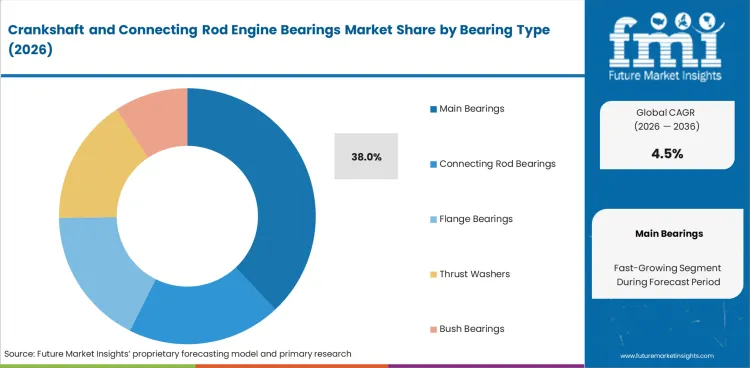
- Main bearings are projected to hold 38.0% at the start of the forecast period as crankshaft journal support controls shaft alignment and oil-film stability.
- Connecting rod bearings are used more often in performance rebuilds when engine builders adjust clearance targets for high-RPM use and crankshaft condition.
Insights into Crankshaft and Connecting Rod Engine Bearings Market by Material
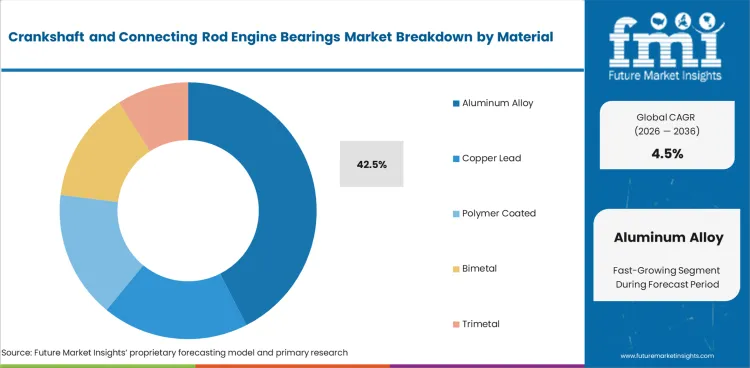
- Aluminum alloy bearings are expected to represent 42.5% by 2026 as light-duty engine programs value lower cost and steady wear behavior.
- Copper lead and trimetal designs serve heavy-duty engines since higher load density requires stronger overlay performance during rebuild work.
Insights into Crankshaft and Connecting Rod Engine Bearings Market by Vehicle Type
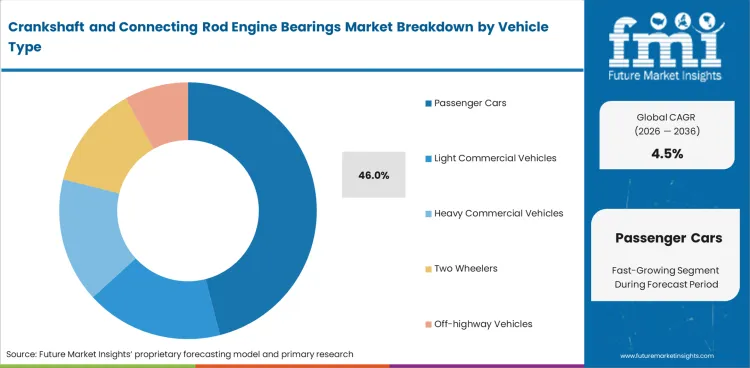
- Passenger cars are anticipated to account for 46.0% in the opening forecast year as wide engine parc volume creates steady workshop replacement orders.
- Heavy commercial vehicles carry higher bearing value per repair because long-duty engines need tighter clearance control and deeper rebuild support.
Insights into Crankshaft and Connecting Rod Engine Bearings Market by Sales Channel
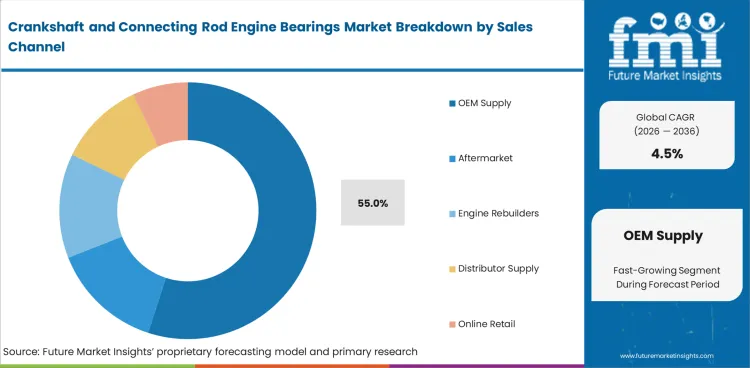
- OEM supply is projected to represent 55.0% during the first forecast year as engine assembly contracts require approved bearing geometry and repeatable material batches.
- Aftermarket channels depend on catalog accuracy because service shops often order standard and undersize bearing sets after crankshaft inspection.
Insights into Crankshaft and Connecting Rod Engine Bearings Market by Application
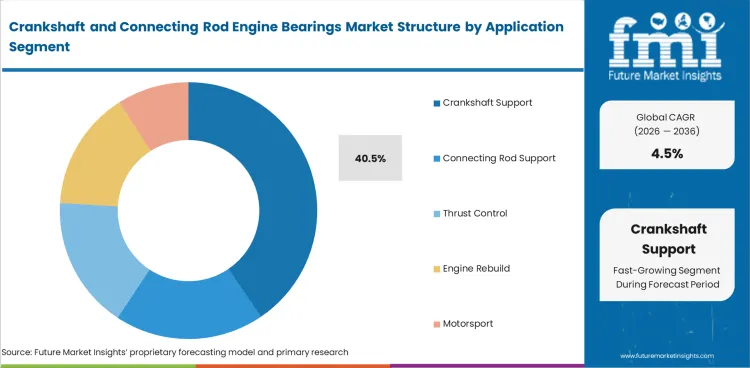
- Crankshaft support is estimated to hold 40.5% by 2026 as main bearings control rotational stability inside every ICE engine platform.
- Motorsport applications carry higher specification needs through coating choice and clearance options even though unit volume remains limited.
Crankshaft and Connecting Rod Engine Bearings Market Drivers, Restraints, and Opportunities
- Engine rebuild cycles raise bearing replacement demand when crank journals show wear or oil-film damage.
- Hybrid ICE duty cycles create added stress through repeated start-stop operation and thermal cycling.
- Battery electric vehicle penetration limits long-term demand for light-duty engine bearing sets.
- Heavy-duty engine service creates value for bearing sets with stronger overlay control and coating performance.
Crankshaft Journal Wear Control
Bearing demand is shaped by what workshops find during crankshaft inspection. Crankshaft journals and connecting rod big ends often need matched bearing replacement after oil starvation or high-mileage wear. Daido Metal Co., Ltd. states that engine bearings and thrust washers are used in automobiles and building machinery. Daido’s product coverage supports demand beyond passenger car engines. Bearing suppliers need to cover different load ranges and fitment standards across vehicle classes. Distributors gain repeat orders when they offer catalog depth and undersize bearing availability.
Emission-Tight Engine Design
Engine design is becoming more exact as vehicle regulations keep pressure on combustion efficiency and pollutant control. The Council of the European Union adopted the Euro 7 regulation in April 2024, covering emission limits for cars and trucks. Engine programs must keep friction low and combustion behavior stable under tighter approval requirements. Crankshaft and connecting rod bearings help control oil-film behavior inside hotter and more compact engine packages. Suppliers with reliable coating control and dimensional accuracy can protect qualification access as engine platforms change.
Analysis of Crankshaft and Connecting Rod Engine Bearings Market by Key Countries
.webp "Top Country Growth Comparison Crankshaft And Connecting Rod Engine Bearings Market Cagr (2026 2036)")
| Country | CAGR |
|---|---|
| China | 5.4% |
| India | 5.2% |
| Brazil | 4.8% |
| United States | 4.2% |
| Germany | 3.9% |
| South Korea | 3.8% |
| Japan | 3.6% |
Source: FMI analysis based on primary research and proprietary forecasting model.
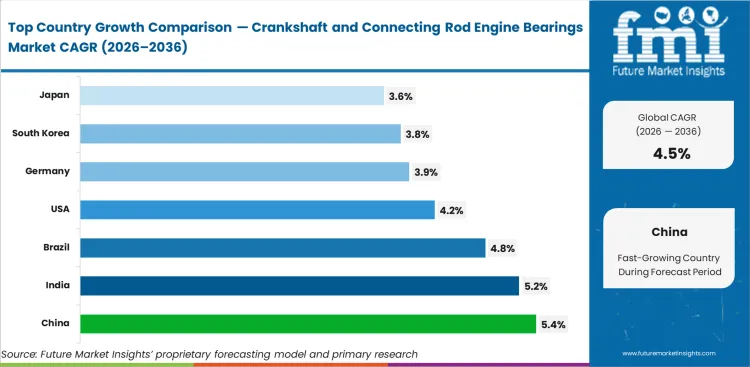
Crankshaft and Connecting Rod Engine Bearings Market CAGR Analysis by Country
- The engine output and aftermarket scale in China support its 5.4% CAGR by 2036.
- India is expected to expand during the forecast period at 5.2% CAGR as two-wheeler and passenger car production widen service demand.
- Brazil records 4.8% CAGR between 2026 and 2036 as flex-fuel engine use and freight repair sustain bearing replacement.
- High vehicle miles and a deep rebuild channel support the United States at 4.2% CAGR in the assessment period.
- Germany is projected to advance through the forecast timeframe at 3.9% CAGR as precision engine manufacturing supports value demand.
- Domestic engine programs and export-focused suppliers keep South Korea at 3.8% CAGR by 2036.
- Japan’s hybrid engine maturity supports bearing use across the forecast period with 3.6% CAGR.
- The global crankshaft and connecting rod engine bearings market is projected to grow at 4.5% CAGR between 2026 and 2036.
Demand Outlook for Crankshaft and Connecting Rod Engine Bearings Market in China
China crankshaft and connecting rod engine bearings market is projected to grow at 5.4% CAGR by 2036, underpinned by scale large engine output and a well-developed replacement parts network. OEM production and an active repair ecosystem keep demand steady for both main and rod bearing sets across combustion and hybrid platforms. Supplier performance is shaped less by single contracts and more by how quickly approved parts can be routed from manufacturing hubs to workshops that need standard and undersize options.
- Guangdong engine parts clusters support bearing distribution into South China repair networks and export channels.
- Chongqing vehicle manufacturing supports demand for passenger car and commercial engine components.
- Local aftermarket depth gives suppliers a larger base for standard and undersize bearing sets.
Sales Analysis of Crankshaft and Connecting Rod Engine Bearings Market in India
The India crankshaft and connecting rod engine bearings market is expected to expand at 5.2% CAGR over the forecast period, with volume momentum anchored in two-wheeler output and a steadily intensifying commercial-vehicle service cycle. Small-displacement engines keep the aftermarket moving consistently, whereas diesel overhaul work in fleets lifts unit value because workshops typically reset clearances and replace bearing sets as part of reliability-focused rebuilds.
- Maharashtra and Tamil Nadu vehicle clusters support bearing supply into OEM and component manufacturing belts.
- Delhi NCR workshops support replacement demand for high-mileage taxi fleets and light commercial vehicles.
- Local distributor coverage helps workshops source standard and undersize bearing sets faster.
Demand Analysis of Crankshaft and Connecting Rod Engine Bearings Market in Brazil
Brazil is forecast to record 4.8% CAGR between 2026 and 2036 for crankshaft and connecting rod engine bearings, where the demand profile is strongly shaped by flex-fuel service patterns and long-haul freight repair needs. Domestic production maintains baseline OEM pull-through, but it is the older fleet mix and repair economics that sustain a steady stream of rod and main bearing replacement in the aftermarket.
- São Paulo automotive activity supports OEM and aftermarket bearing supply through local component networks.
- Minas Gerais and Paraná freight routes create service demand for diesel engines in transport vehicles.
- Flex-fuel engine use supports replacement demand across gasoline and ethanol-capable engine families.
Opportunity Analysis of Crankshaft and Connecting Rod Engine Bearings Market in the United States
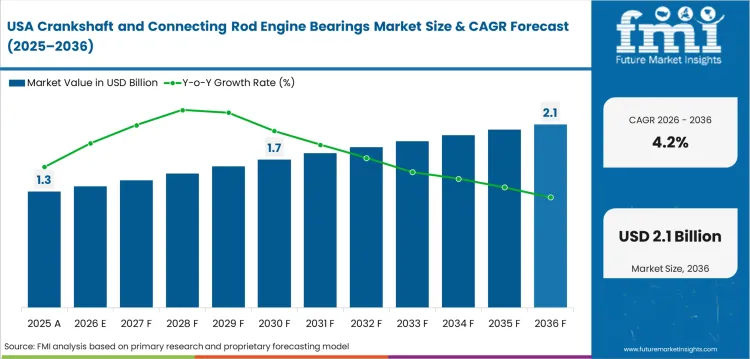
The United States crankshaft and connecting rod engine bearings market is expected to advance at 4.2% CAGR in the assessment period. What differentiates the USA market is the combination of high road usage and a mature engine-rebuild infrastructure that routinely replaces bearing sets during planned overhauls. Pickup trucks and commercial fleets remain key demand anchors, and suppliers that pair warehouse reach with fast, engine-code accurate cataloging are best positioned to win repeat, time-sensitive orders.
- Texas and California support large light truck repair volume through dense fleet activity.
- Midwest engine rebuilders support demand for crankshaft grinding and undersize bearing sets.
- Warehouse networks help distributors serve workshops that need faster engine-code based part matching.
Future Outlook for Crankshaft and Connecting Rod Engine Bearings Market in Germany
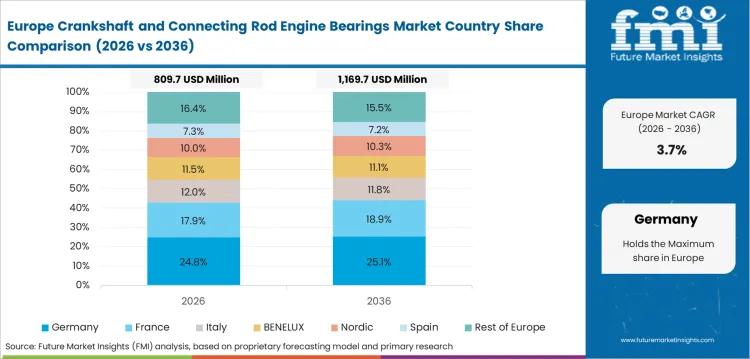
The Germany crankshaft and connecting rod engine bearings market is projected to rise at 3.9% CAGR through the forecast timeframe, supported by precision powertrain manufacturing and structured commercial-vehicle maintenance practices. Bearing demand here is more specification-led than volume-led: tight clearance requirements and approved repair procedures elevate the importance of material traceability and OE-aligned fitment. As a result, suppliers with strong engineering support and certification depth tend to capture the higher-value share of rebuild and production programs.
- Baden-Württemberg supports engine component demand through Stuttgart-area automotive production and supplier activity.
- Bavaria powertrain activity keeps demand active for high-precision bearing sets in premium engines.
- Euro 7 compliance pressure supports better bearing coating and friction-control material choices.
Demand Outlook for Crankshaft and Connecting Rod Engine Bearings Market in South Korea
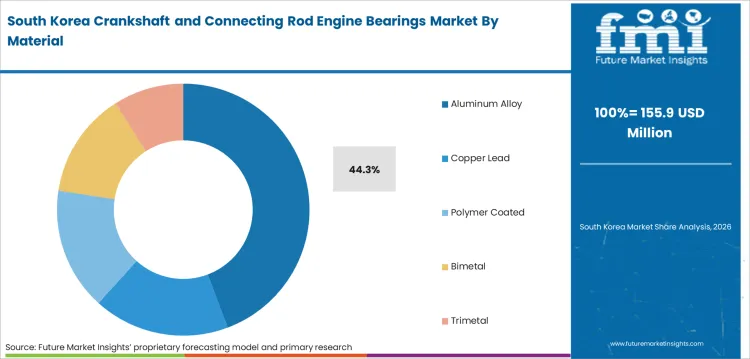
South Korea is forecast to grow at 3.8% CAGR by 2036 for crankshaft and connecting rod engine bearings, with demand closely linked to domestic engine programs and export-oriented vehicle platforms. Ongoing gasoline and hybrid production continues to require OE-qualified bearing sets, while platform refresh cycles place a premium on suppliers that can validate designs quickly and keep line-fit availability stable. Competitive advantage therefore leans toward flexibility in qualification and consistent delivery to both plants and service channels.
- Ulsan automotive activity supports engine component flow into domestic assembly and export programs.
- Gyeonggi supplier networks support precision machining and bearing distribution near major component plants.
- Export-focused vehicle production supports bearing demand tied to global engine platform coverage.
In-depth Analysis of Crankshaft and Connecting Rod Engine Bearings Market in Japan
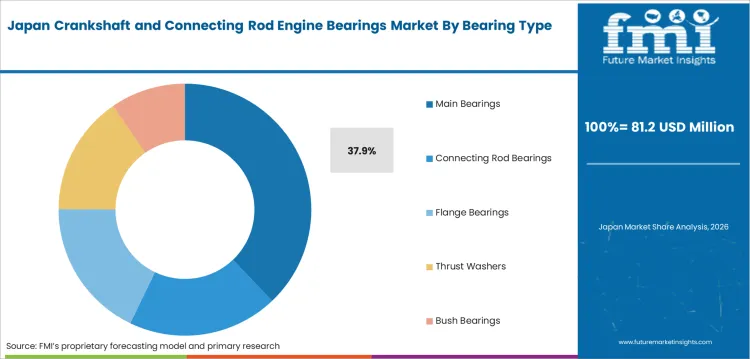
Japan is expected to post 3.6% CAGR during the forecast period for crankshaft and connecting rod engine bearings, but growth is defined by technical rigor more than rapid volume expansion. Hybrid-heavy powertrain mixes and disciplined supplier qualification keep specifications tight, so bearing demand tends to favor consistent overlay performance, dimensional accuracy, and long-term program support. Suppliers with established OE relationships and close engineering engagement are better able to defend value even as overall volume growth remains measured.
- Aichi Prefecture supports engine bearing demand through Toyota-linked supplier networks and hybrid powertrain production.
- Shizuoka and Hamamatsu support motorcycle and small-engine bearing demand through established mobility clusters.
- Hybrid engine maturity supports tolerance-sensitive bearings during line fitment and rebuild work.
Competitive Landscape and Strategic Positioning
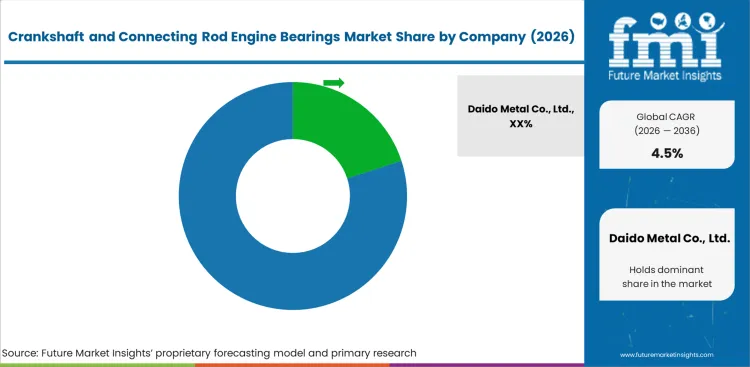
- Competition is moderately concentrated as OE-approved suppliers control high-volume engine programs.
- Leading suppliers compete on overlay strength, bearing geometry and engine platform coverage.
- Specialist brands serve performance rebuild demand through clearance options and coated bearing sets.
- Entry barriers remain high because engine bearings need dimensional control, material validation and catalog depth.
Aftermarket competition depends on coverage and availability. MAHLE Aftermarket lists CLEVITE engine bearings across high-performance and competition race engine applications. CLEVITE coverage supports repair channels that need standard replacement options and higher-load bearing choices. Catalog depth matters because rebuilders often need standard and undersize sets for the same engine family. Suppliers with faster part lookup can secure repeat orders in time-sensitive rebuild work.
Specialist brands serve automotive performance parts demand through clearance options and coated bearing sets. King Engine Bearings lists engine bearings for automobiles, light and heavy duty trucks, marine engines, aviation engines and standby power engines. ACL Race Series focuses on rod and main bearings for motorsport use. Performance brands capture value in rebuild channels that need tighter clearance control and bearing choices for higher engine loads.
Key Companies in the Crankshaft and Connecting Rod Engine Bearings Market
- Global Leaders: MAHLE GmbH, Daido Metal Co., Ltd., Tenneco Inc., Taiho Kogyo Co., Ltd., and Miba AG compete through engine program access and production scale.
- Performance Specialists: King Engine Bearings and ACL Bearing Company compete through performance bearing lines and detailed engine coverage.
- Regional and Application Players: Smaller suppliers compete through localized fitment catalogs, distributor relationships and coverage for older engine platforms.
Competitive Benchmarking: Crankshaft and Connecting Rod Engine Bearings Market
| Company | Engine Platform Coverage | Coating and Overlay Depth | OE Approval Access | Geographic Footprint |
|---|---|---|---|---|
| Daido Metal Co., Ltd. | High | Strong | Strong | Global |
| MAHLE GmbH | High | Strong | Strong | Global |
| Tenneco Inc. | High | Strong | Strong | Global |
| Taiho Kogyo Co., Ltd. | High | Medium | Strong | Asia and Global |
| Miba AG | Medium | Strong | Moderate | Europe and Global |
| King Engine Bearings | Medium | Strong | Moderate | North America and Global |
| ACL Bearing Company | Medium | Strong | Moderate | Australia and Global |
| Kolbenschmidt | Medium | Medium | Moderate | Europe and Global |
Source: Future Market Insights competitive analysis, 2026.
Key Developments in Crankshaft and Connecting Rod Engine Bearings Market
- In February 2025, King Engine Bearings released its 2025-26 Racing Application Guide with Powersports connecting rod bearings and main bearings designed with tight graded tolerances.
- In February 2026, ACL Race Series announced Duraglide conrod general replacement engine bearings for 2014-on GM 6.2L V8 LT1, LT4, L83, and L86 engines.
Key Players in the Crankshaft and Connecting Rod Engine Bearings Market
Global Leaders
- MAHLE GmbH
- Daido Metal Co., Ltd.
- Tenneco Inc.
- Taiho Kogyo Co., Ltd.
- Miba AG
Performance Specialists
- King Engine Bearings
- ACL Bearing Company
Regional and Application Players
- Kolbenschmidt
- Local engine bearing distributors
- Regional rebuild kit suppliers
Report Scope and Coverage
| Parameter | Details |
|---|---|
| Quantitative Units | USD 3.1 billion to USD 4.8 billion, at a CAGR of 4.5% |
| Market Definition | Precision plain bearings used to support crankshaft rotation and connecting rod movement inside internal combustion engines |
| Regions Covered | North America, Latin America, Europe, East Asia, South Asia and Pacific, Middle East and Africa |
| Countries Covered | China, India, Brazil, United States, Germany, South Korea, Japan, 30+ countries |
| Key Companies Profiled | MAHLE GmbH, Daido Metal Co., Ltd., Tenneco Inc., Taiho Kogyo Co., Ltd., Miba AG, King Engine Bearings, ACL Bearing Company |
| Forecast Period | 2026 to 2036 |
| Approach | Hybrid bottom-up and top-down methodology starting with verified transaction data and projecting adoption velocity across segments and regions |
Crankshaft and Connecting Rod Engine Bearings Market by Segments
Crankshaft and Connecting Rod Engine Bearings Market Segmented by Bearing Type:
- Main Bearings
- Connecting Rod Bearings
- Flange Bearings
- Thrust Washers
- Bush Bearings
Crankshaft and Connecting Rod Engine Bearings Market Segmented by Material:
- Aluminum Alloy
- Copper Lead
- Polymer Coated
- Bimetal
- Trimetal
Crankshaft and Connecting Rod Engine Bearings Market Segmented by Vehicle Type:
- Passenger Cars
- Light Commercial Vehicles
- Heavy Commercial Vehicles
- Two Wheelers
- Off-highway Vehicles
Crankshaft and Connecting Rod Engine Bearings Market Segmented by Sales Channel:
- OEM Supply
- Aftermarket
- Engine Rebuilders
- Distributor Supply
- Online Retail
Crankshaft and Connecting Rod Engine Bearings Market Segmented by Application:
- Crankshaft Support
- Connecting Rod Support
- Thrust Control
- Engine Rebuild
- Motorsport
Crankshaft and Connecting Rod Engine Bearings Market by Region:
- North America
- United States
- Canada
- Mexico
- Latin America
- Brazil
- Chile
- Rest of Latin America
- Western Europe
- Germany
- UK
- Italy
- Spain
- France
- Nordic
- BENELUX
- Rest of Western Europe
- Eastern Europe
- Russia
- Poland
- Hungary
- Balkan & Baltic
- Rest of Eastern Europe
- East Asia
- China
- Japan
- South Korea
- South Asia and Pacific
- India
- ASEAN
- Australia & New Zealand
- Rest of South Asia and Pacific
- Middle East & Africa
- Kingdom of Saudi Arabia
- Other GCC Countries
- Turkiye
- South Africa
- Other African Union
- Rest of Middle East & Africa
Research Sources and Bibliography
- Daido Metal Co., Ltd. (2025, May 13). Announcement regarding formulation of New Midterm Plan 2025-2030 “Bridge to Daido 2030”. Daido Metal Co., Ltd.
- MAHLE Aftermarket Inc. (2024, May 15). MAHLE appoints Brent Fletcher as Head of North America Aftermarket Regional Sales. MAHLE Aftermarket.
- King Engine Bearings. (2024, October 24). PRI Show 2024. King Engine Bearings.
- ACL Bearing Company (Australia) Pty Ltd. (2025, December 22). Chevrolet LS doweled narrowed conrod bearings. ACL Race Series.
- Council of the European Union. (2024, April 12). Euro 7: Council adopts new rules on emission limits for cars, vans and trucks. Council of the European Union.
- International Organization of Motor Vehicle Manufacturers. (2026, April 23). Auto industry growth shifted east in 2025 amid global repositioning. OICA.
- Federal Highway Administration. (2025, September). 2025 FHWA forecasts of vehicle miles traveled (VMT). USA Department of Transportation.
- King Engine Bearings. (2025, February 13). Racing application guide 2025-26. King Engine Bearings.
- ACL Race Series. (2026, February). GM V8 Gen V 6.2L LT engine details: Product information bulletin PIB/US004/2026. ACL Race Series.
This Report Answers
- What is the current and future size of the crankshaft and connecting rod engine bearings market?
- How fast is the crankshaft and connecting rod engine bearings market projected to grow during the forecast period?
- Which bearing type is expected to lead demand in 2026?
- Which material type is projected to hold the leading share in 2026?
- How do engine rebuild cycles support crankshaft and connecting rod bearing demand?
- How do emission rules and hybrid engines influence bearing material choices?
- Which countries are forecast to grow fastest through 2036?
- Which companies shape the competitive structure in engine bearing supply?
- What product types are included within the market definition?
- How does FMI estimate and validate the crankshaft and connecting rod engine bearings forecast?
Frequently Asked Questions
What is the global market demand for crankshaft and connecting rod engine bearings in 2026?
In 2026, the global crankshaft and connecting rod engine bearings market is expected to be worth USD 3.1 billion.
How large will the crankshaft and connecting rod engine bearings market be by 2036?
By 2036, the market is forecast to reach USD 4.8 billion as rebuild and OEM demand continue.
What is the projected CAGR for crankshaft and connecting rod engine bearings demand?
Demand is projected to grow at 4.5% CAGR in the forecast timeframe due to ICE service needs.
Which bearing type is expected to lead the market in 2026?
Main bearings are projected to account for 38.0% of bearing type demand due to crankshaft load support.
Which material segment is expected to lead the market in 2026?
Aluminum alloy bearings are expected to represent 42.5% of material demand due to light-duty engine use.
What is driving demand growth in China?
China is forecast at 5.4% CAGR through 2036 due to large vehicle output and aftermarket scale.
What does the market definition include?
The market includes main bearings, connecting rod bearings, thrust washers, and related plain bearings for ICE engines.
How does FMI estimate the market forecast?
FMI uses bottom-up bearing demand, engine production, replacement rates, vehicle type mix, and supplier portfolio checks.
Preview the report firsthand - request a free sample
Get SampleGet the brochure for pricing and purchase details.
Get PDFTable of Content
- Key Takeaways
- Market Size and CAGR
- Top Growth Driver
- Fastest Growing Segment
- Leading Region
- Key Companies
- Emerging Opportunities
- Executive Summary
- Global Market Outlook
- Demand-side Trends
- Supply-side Trends
- Technology Roadmap Analysis
- Analysis and Recommendations
- Analyst Perspective (What is happening? Why now? What should investors know?)
- Key Questions Answered
- How large is the market?
- What is the CAGR?
- What are key trends?
- Which region dominates?
- Who are the leaders?
- Market Overview
- Market Coverage / Taxonomy
- Market Definition / Scope / Limitations
- Research Methodology
- Chapter Orientation
- Analytical Lens and Working Hypotheses
- Market Structure, Signals, and Trend Drivers
- Benchmarking and Cross-market Comparability
- Market Sizing, Forecasting, and Opportunity Mapping
- Research Design and Evidence Framework
- Desk Research Programme (Secondary Evidence)
- Expert Input and Fieldwork (Primary Evidence)
- Tooling, Models, and Reference Databases
- Data Engineering and Model Build
- Quality Assurance and Audit Trail
- Market Background
- Market Dynamics (Drivers, Restraints, Opportunity, Trends)
- Scenario Forecast (Optimistic, Likely, Conservative)
- Impact Analysis
- AI Impact
- Sustainability Impact
- Regulatory Impact
- Technology Impact
- Consumer / Buyer Analysis
- Purchase Drivers
- Adoption Barriers
- Buyer Journey
- Opportunity Map Analysis
- Product Life Cycle Analysis
- Supply Chain Analysis
- Investment Feasibility Matrix
- Value Chain Analysis
- PESTLE and Porter's Analysis
- Regulatory Landscape
- Regional Parent Market Outlook
- Production and Consumption Statistics
- Import and Export Statistics
- Global Market Analysis and Forecast, 2021 to 2036
- Historical Market Size Value (USD Billion) & Volume (Unit) Analysis, 2021 to 2025
- Current and Future Market Size Value (USD Billion) & Volume (Unit) Projections, 2026 to 2036
- Y-o-Y Growth Trend Analysis
- Absolute $ Opportunity Analysis
- Global Market Pricing Analysis, 2021 to 2036
- Global Market Analysis and Forecast, By Bearing Type, 2021 to 2036
- Introduction / Key Findings
- Historical Market Size Value (USD Billion) & Volume (Unit) Analysis By Bearing Type, 2021 to 2025
- Current and Future Market Size Value (USD Billion) & Volume (Unit) Analysis and Forecast By Bearing Type, 2026 to 2036
- Main Bearings
- Connecting Rod Bearings
- Flange Bearings
- Thrust Washers
- Bush Bearings
- Main Bearings
- Y-o-Y Growth Trend Analysis By Bearing Type, 2021 to 2025
- Absolute $ Opportunity Analysis By Bearing Type, 2026 to 2036
- Global Market Analysis and Forecast, By Material, 2021 to 2036
- Introduction / Key Findings
- Historical Market Size Value (USD Billion) & Volume (Unit) Analysis By Material, 2021 to 2025
- Current and Future Market Size Value (USD Billion) & Volume (Unit) Analysis and Forecast By Material, 2026 to 2036
- Aluminum Alloy
- Copper Lead
- Polymer Coated
- Bimetal
- Trimetal
- Aluminum Alloy
- Y-o-Y Growth Trend Analysis By Material, 2021 to 2025
- Absolute $ Opportunity Analysis By Material, 2026 to 2036
- Global Market Analysis and Forecast, By Vehicle Type, 2021 to 2036
- Introduction / Key Findings
- Historical Market Size Value (USD Billion) & Volume (Unit) Analysis By Vehicle Type, 2021 to 2025
- Current and Future Market Size Value (USD Billion) & Volume (Unit) Analysis and Forecast By Vehicle Type, 2026 to 2036
- Passenger Cars
- Light Commercial Vehicles
- Heavy Commercial Vehicles
- Two Wheelers
- Off-highway Vehicles
- Passenger Cars
- Y-o-Y Growth Trend Analysis By Vehicle Type, 2021 to 2025
- Absolute $ Opportunity Analysis By Vehicle Type, 2026 to 2036
- Global Market Analysis and Forecast, By Sales Channel, 2021 to 2036
- Introduction / Key Findings
- Historical Market Size Value (USD Billion) & Volume (Unit) Analysis By Sales Channel, 2021 to 2025
- Current and Future Market Size Value (USD Billion) & Volume (Unit) Analysis and Forecast By Sales Channel, 2026 to 2036
- OEM Supply
- Aftermarket
- Engine Rebuilders
- Distributor Supply
- Online Retail
- OEM Supply
- Y-o-Y Growth Trend Analysis By Sales Channel, 2021 to 2025
- Absolute $ Opportunity Analysis By Sales Channel, 2026 to 2036
- Global Market Analysis and Forecast, By Application, 2021 to 2036
- Introduction / Key Findings
- Historical Market Size Value (USD Billion) & Volume (Unit) Analysis By Application, 2021 to 2025
- Current and Future Market Size Value (USD Billion) & Volume (Unit) Analysis and Forecast By Application, 2026 to 2036
- Crankshaft Support
- Connecting Rod Support
- Thrust Control
- Engine Rebuild
- Motorsport
- Crankshaft Support
- Y-o-Y Growth Trend Analysis By Application, 2021 to 2025
- Absolute $ Opportunity Analysis By Application, 2026 to 2036
- Global Market Analysis and Forecast, By Region, 2021 to 2036
- Introduction
- Historical Market Size Value (USD Billion) & Volume (Unit) Analysis By Region, 2021 to 2025
- Current Market Size Value (USD Billion) & Volume (Unit) Analysis and Forecast By Region, 2026 to 2036
- North America
- Latin America
- Western Europe
- Eastern Europe
- East Asia
- South Asia and Pacific
- Middle East & Africa
- Market Attractiveness Analysis By Region
- North America Market Analysis and Forecast, By Country, 2021 to 2036
- Historical Market Size Value (USD Billion) & Volume (Unit) Trend Analysis By Market Taxonomy, 2021 to 2025
- Market Size Value (USD Billion) & Volume (Unit) Forecast By Market Taxonomy, 2026 to 2036
- By Country
- USA
- Canada
- Mexico
- By Bearing Type
- By Material
- By Vehicle Type
- By Sales Channel
- By Application
- By Country
- Market Attractiveness Analysis
- By Country
- By Bearing Type
- By Material
- By Vehicle Type
- By Sales Channel
- By Application
- Key Takeaways
- Latin America Market Analysis and Forecast, By Country
- Historical Market Size Value (USD Billion) & Volume (Unit) Trend Analysis By Market Taxonomy, 2021 to 2025
- Market Size Value (USD Billion) & Volume (Unit) Forecast By Market Taxonomy, 2026 to 2036
- By Country
- Brazil
- Chile
- Rest of Latin America
- By Bearing Type
- By Material
- By Vehicle Type
- By Sales Channel
- By Application
- By Country
- Market Attractiveness Analysis
- By Country
- By Bearing Type
- By Material
- By Vehicle Type
- By Sales Channel
- By Application
- Key Takeaways
- Western Europe Market Analysis and Forecast, By Country
- Historical Market Size Value (USD Billion) & Volume (Unit) Trend Analysis By Market Taxonomy, 2021 to 2025
- Market Size Value (USD Billion) & Volume (Unit) Forecast By Market Taxonomy, 2026 to 2036
- By Country
- Germany
- UK
- Italy
- Spain
- France
- Nordic
- BENELUX
- Rest of Western Europe
- By Bearing Type
- By Material
- By Vehicle Type
- By Sales Channel
- By Application
- By Country
- Market Attractiveness Analysis
- By Country
- By Bearing Type
- By Material
- By Vehicle Type
- By Sales Channel
- By Application
- Key Takeaways
- Eastern Europe Market Analysis and Forecast, By Country
- Historical Market Size Value (USD Billion) & Volume (Unit) Trend Analysis By Market Taxonomy, 2021 to 2025
- Market Size Value (USD Billion) & Volume (Unit) Forecast By Market Taxonomy, 2026 to 2036
- By Country
- Russia
- Poland
- Hungary
- Balkan & Baltic
- Rest of Eastern Europe
- By Bearing Type
- By Material
- By Vehicle Type
- By Sales Channel
- By Application
- By Country
- Market Attractiveness Analysis
- By Country
- By Bearing Type
- By Material
- By Vehicle Type
- By Sales Channel
- By Application
- Key Takeaways
- East Asia Market Analysis and Forecast, By Country
- Historical Market Size Value (USD Billion) & Volume (Unit) Trend Analysis By Market Taxonomy, 2021 to 2025
- Market Size Value (USD Billion) & Volume (Unit) Forecast By Market Taxonomy, 2026 to 2036
- By Country
- China
- Japan
- South Korea
- By Bearing Type
- By Material
- By Vehicle Type
- By Sales Channel
- By Application
- By Country
- Market Attractiveness Analysis
- By Country
- By Bearing Type
- By Material
- By Vehicle Type
- By Sales Channel
- By Application
- Key Takeaways
- South Asia and Pacific Market Analysis and Forecast, By Country
- Historical Market Size Value (USD Billion) & Volume (Unit) Trend Analysis By Market Taxonomy, 2021 to 2025
- Market Size Value (USD Billion) & Volume (Unit) Forecast By Market Taxonomy, 2026 to 2036
- By Country
- India
- ASEAN
- Australia & New Zealand
- Rest of South Asia and Pacific
- By Bearing Type
- By Material
- By Vehicle Type
- By Sales Channel
- By Application
- By Country
- Market Attractiveness Analysis
- By Country
- By Bearing Type
- By Material
- By Vehicle Type
- By Sales Channel
- By Application
- Key Takeaways
- Middle East & Africa Market Analysis and Forecast, By Country
- Historical Market Size Value (USD Billion) & Volume (Unit) Trend Analysis By Market Taxonomy, 2021 to 2025
- Market Size Value (USD Billion) & Volume (Unit) Forecast By Market Taxonomy, 2026 to 2036
- By Country
- Kingdom of Saudi Arabia
- Other GCC Countries
- Türkiye
- South Africa
- Other African Union
- Rest of Middle East & Africa
- By Bearing Type
- By Material
- By Vehicle Type
- By Sales Channel
- By Application
- By Country
- Market Attractiveness Analysis
- By Country
- By Bearing Type
- By Material
- By Vehicle Type
- By Sales Channel
- By Application
- Key Takeaways
- Key Countries Market Analysis
- USA
- Pricing Analysis
- Market Share Analysis, 2025
- By Bearing Type
- By Material
- By Vehicle Type
- By Sales Channel
- By Application
- Canada
- Pricing Analysis
- Market Share Analysis, 2025
- By Bearing Type
- By Material
- By Vehicle Type
- By Sales Channel
- By Application
- Mexico
- Pricing Analysis
- Market Share Analysis, 2025
- By Bearing Type
- By Material
- By Vehicle Type
- By Sales Channel
- By Application
- Brazil
- Pricing Analysis
- Market Share Analysis, 2025
- By Bearing Type
- By Material
- By Vehicle Type
- By Sales Channel
- By Application
- Chile
- Pricing Analysis
- Market Share Analysis, 2025
- By Bearing Type
- By Material
- By Vehicle Type
- By Sales Channel
- By Application
- Germany
- Pricing Analysis
- Market Share Analysis, 2025
- By Bearing Type
- By Material
- By Vehicle Type
- By Sales Channel
- By Application
- UK
- Pricing Analysis
- Market Share Analysis, 2025
- By Bearing Type
- By Material
- By Vehicle Type
- By Sales Channel
- By Application
- Italy
- Pricing Analysis
- Market Share Analysis, 2025
- By Bearing Type
- By Material
- By Vehicle Type
- By Sales Channel
- By Application
- Spain
- Pricing Analysis
- Market Share Analysis, 2025
- By Bearing Type
- By Material
- By Vehicle Type
- By Sales Channel
- By Application
- France
- Pricing Analysis
- Market Share Analysis, 2025
- By Bearing Type
- By Material
- By Vehicle Type
- By Sales Channel
- By Application
- India
- Pricing Analysis
- Market Share Analysis, 2025
- By Bearing Type
- By Material
- By Vehicle Type
- By Sales Channel
- By Application
- ASEAN
- Pricing Analysis
- Market Share Analysis, 2025
- By Bearing Type
- By Material
- By Vehicle Type
- By Sales Channel
- By Application
- Australia & New Zealand
- Pricing Analysis
- Market Share Analysis, 2025
- By Bearing Type
- By Material
- By Vehicle Type
- By Sales Channel
- By Application
- China
- Pricing Analysis
- Market Share Analysis, 2025
- By Bearing Type
- By Material
- By Vehicle Type
- By Sales Channel
- By Application
- Japan
- Pricing Analysis
- Market Share Analysis, 2025
- By Bearing Type
- By Material
- By Vehicle Type
- By Sales Channel
- By Application
- South Korea
- Pricing Analysis
- Market Share Analysis, 2025
- By Bearing Type
- By Material
- By Vehicle Type
- By Sales Channel
- By Application
- Russia
- Pricing Analysis
- Market Share Analysis, 2025
- By Bearing Type
- By Material
- By Vehicle Type
- By Sales Channel
- By Application
- Poland
- Pricing Analysis
- Market Share Analysis, 2025
- By Bearing Type
- By Material
- By Vehicle Type
- By Sales Channel
- By Application
- Hungary
- Pricing Analysis
- Market Share Analysis, 2025
- By Bearing Type
- By Material
- By Vehicle Type
- By Sales Channel
- By Application
- Kingdom of Saudi Arabia
- Pricing Analysis
- Market Share Analysis, 2025
- By Bearing Type
- By Material
- By Vehicle Type
- By Sales Channel
- By Application
- Türkiye
- Pricing Analysis
- Market Share Analysis, 2025
- By Bearing Type
- By Material
- By Vehicle Type
- By Sales Channel
- By Application
- South Africa
- Pricing Analysis
- Market Share Analysis, 2025
- By Bearing Type
- By Material
- By Vehicle Type
- By Sales Channel
- By Application
- USA
- Market Structure Analysis
- Competition Dashboard
- Competition Benchmarking
- Market Share Analysis of Top Players
- By Regional
- By Bearing Type
- By Material
- By Vehicle Type
- By Sales Channel
- By Application
- Emerging Startups
- Innovation Benchmarking
- Competition Analysis
- Competition Deep Dive
- MAHLE GmbH
- Overview
- Product Portfolio
- Profitability by Market Segments (Product/Region/Sales Channel)
- Sales Footprint
- Strategy Overview
- Marketing Strategy
- Product Strategy
- Channel Strategy
- Daido Metal Co., Ltd.
- Tenneco Inc.
- Taiho Kogyo Co., Ltd.
- Miba AG
- King Engine Bearings
- ACL Bearing Company
- Kolbenschmidt
- Local engine bearing distributors
- Regional rebuild kit suppliers
- MAHLE GmbH
- Case Studies
- Success Stories
- Recent Developments
- Competition Deep Dive
- Assumptions & Acronyms Used


