

- Industry Size (2026)
- USD 0.7 Bn
- Forecast (2036)
- USD 1.3 Bn
- CAGR (2026 to 2036)
- 6.5%
Milk Protein Outlook in France 2026 to 2036
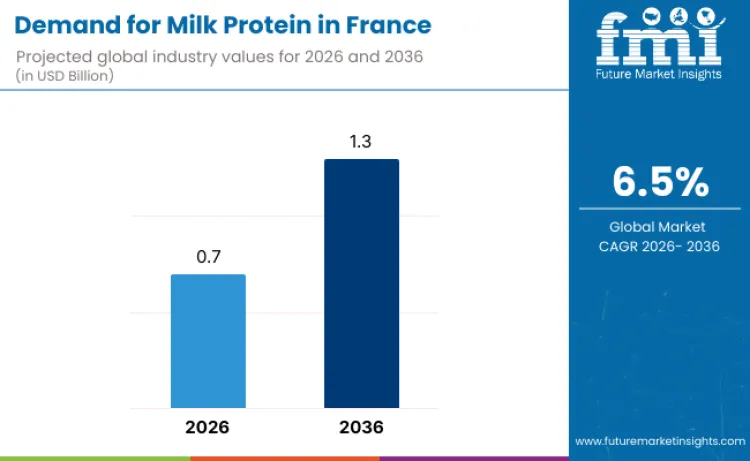
Demand for milk protein in France is projected at USD 0.7 billion in 2026 and is expected to reach USD 1.3 billion by 2036, expanding at a 6.5% CAGR. Consumption is shaped by how French and pan-European brand owners treat dairy proteins as performance inputs for formulation discipline, portfolio renovation, and plant-scale repeatability. Procurement decisions typically sit inside longer qualification cycles because protein specifications are tightly connected to texture, heat stability, dispersibility, sensory targets, and finished-product cost structures.
As per FMI, volume expansion is linked to three practical realities in France. Protein fortification programs that are designed to scale across SKUs rather than remain niche, continued use of dairy proteins in infant nutrition pipelines where compositional compliance and documentation readiness are non-negotiable and wider utilization of optimized powders in industrial environments where dosing accuracy and line efficiency determine plant KPIs.
FMI thinks supplier selection is increasingly driven by batch consistency, documentation responsiveness, and the ability to support troubleshooting during ramp-ups. Teams also prioritize supplier capacity planning that reduces service risk during seasonal spikes tied to sports nutrition cycles and back-to-school consumption patterns. FMI is of the opinion that growth is supported less by frequent supplier churn and more by incremental penetration into new product lines under the same approved vendor lists.
Quick Stats for Milk Protein Demand in France
- Milk Protein Valuation in France (2026): USD 0.7 billion
- Milk Protein Forecast Valuation in France (2036): USD 1.3 billion
- Milk Protein Forecast CAGR (2026-2036): 6.5%
- Leading Regional Growth: Northern (6.8%)
- Leading Product: Milk Protein Concentrates (68.3% share)
- Leading Application: Food & Beverage (39.3% share)
- Leading Form: Powder (75.0% share)
- Key Companies Profiled: Armor Protéines; Euroserum; Lactalis Ingredients; Eurial I&N; EPI Ingredients
Macro-level Food and Beverage Trends influencing Milk Protein Demand in France
| Trend | What it Entails for Milk Protein Demand in France |
|---|---|
| Protein-forward renovation of mainstream SKUs | Raises demand for concentrates and isolates that can hit protein targets without destabilizing texture or raising scrap rates |
| Premiumization in sports and active nutrition | Supports higher-spec isolates and selected hydrolysates where solubility and digestibility claims must be backed by robust supplier documentation |
| Tightened cost discipline in private label and value tiers | Keeps concentrates in the lead where buyers need dependable protein economics and stable functional performance |
| Reformulation pressure on sugar and fat | Increases use of dairy proteins as structural tools in beverages, yogurts, desserts, and bakery where mouthfeel must be protected |
| Industrial risk management in ingredient sourcing | Elevates supplier qualification, multi-site approvals, and traceability expectations for repeat supply |
| Growth of convenient nutrition formats | Lifts powder-led demand for RTM mixes, high-protein snacks, and fortified beverages where dry handling advantages matter |
Source: Future Market Insights (FMI) analysis, based on proprietary forecasting model and primary research
Milk Protein Industry in France Key Takeaways
| Metric | Value |
|---|---|
| Industry Value (2026) | USD 0.7 billion |
| Industry Forecast Value (2036) | USD 1.3 billion |
| Forecast CAGR (2026 to 2036) | 6.5% |
Source: FMI’s proprietary forecasting model and primary research
FMI thinks the strongest upside remains tied to portfolio-wide protein strategies that also lift adjacent dairy ingredient sourcing, which is frequently evaluated alongside dairy ingredients demand outlook in strategic procurement planning.
Why is France Building Steady Demand for Milk Protein?
France combines mature dairy processing depth with ongoing product renovation across beverages, cultured dairy, desserts, clinical-adjacent nutrition, and performance-focused foods. Protein claims are not treated as a short-cycle novelty in many categories; they are embedded into long-term brand architecture and range segmentation.
As per FMI, this supports stable recurring demand because once protein specs are approved, changing them triggers downstream revalidation across sensory, process, and shelf-life checks. Regulatory alignment also influences how buyers behave. Label governance and claim discipline shape what product developers can communicate, which increases the value of suppliers that provide strong composition data, allergen documentation, and quality records.
Supplier differentiation increasingly shows up in audit readiness, responsiveness during deviations, and the ability to support multi-site rollouts. Product teams often align milk-protein choices with broader protein ingredients sourcing strategies, especially in portfolios that span both dairy and non-dairy systems under shared specification governance.
How is the Milk Protein Landscape in France Segmented?
Why do Milk Protein Concentrates remain the dominant product choice for high-volume programs?
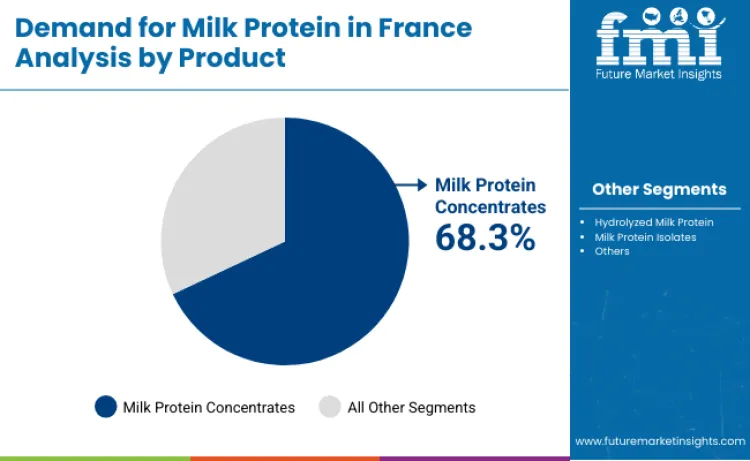
Milk protein concentrates hold a 68.3% share, keeping them in the lead for standardized protein fortification where economics, functionality, and handling practicality must balance. FMI anticipates that concentrates remain preferred when manufacturers need dependable protein contribution while maintaining texture control and minimizing reformulation friction across multiple SKUs. Concentrates also fit well into supplier consolidation strategies where procurement teams aim to reduce vendor complexity without sacrificing quality consistency.
Where do Hydrolyzed Milk Protein and Isolates fit in Purchase Decisions?
Hydrolyzed options are typically selected when digestibility positioning, rapid dispersion, or specific performance needs justify a tighter specification and higher validation attention. Isolates are pulled in when higher protein density is required and brands want to keep formulation constraints under control. These decisions are often benchmarked against related dairy protein systems, including whey protein ingredients frameworks, especially in performance nutrition and fortified beverage programs.
Why does food & beverage remain the leading application center?
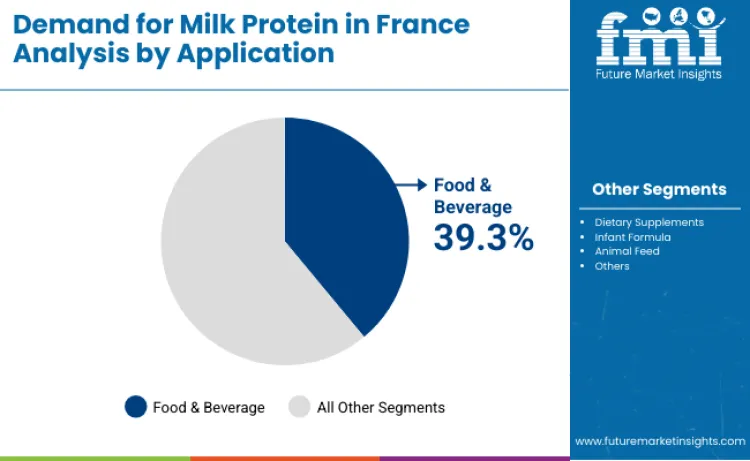
Food & beverage accounts for a 39.3% share, reflecting the scale of protein renovation across everyday consumption occasions. FMI is of the opinion that demand is driven by repeatable use in beverages, cultured products, desserts, and high-protein snack formats where manufacturers need reliable solubility behavior, stable viscosity outcomes, and predictable sensory profiles at scale.
Why is Powdered Milk Protein the Preferred Choice of Consumers?
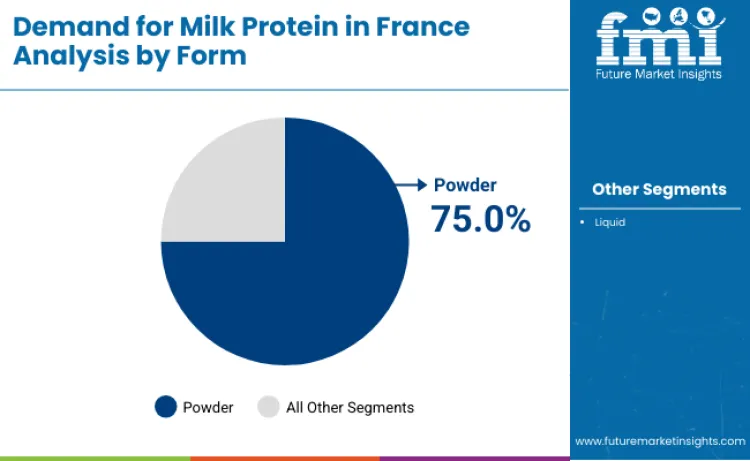
Powder represents a 75.0% share, supported by dosing control, storage discipline, transport efficiency, and compatibility with dry blending and automated feeding systems. As per FMI, powder-led formats reduce plant variability, simplify troubleshooting, and support multi-facility standardization where operational consistency is a core KPI.
What are the Dynamics, Restraints, Opportunities, and Threats Shaping this Space?
What dynamics are strengthening demand across procurement and formulation environments?
Ongoing protein-forward renovation across mainstream foods sustains demand, especially where manufacturers aim to raise protein content while protecting texture and cost position. FMI thinks this also lifts demand for suppliers that can support application guidance and consistency controls at industrial scale.
What Restraints Slow Faster Expansion or Create Qualification Friction?
Qualification timelines remain a key constraint. Switching protein sources can affect viscosity, heat stability, flavor release, and finished-product appearance, which forces structured validation. FMI is of the opinion that supply risk management also matters; any inconsistency in composition or availability can trigger delisting risk in tightly governed programs.
Where do the strongest opportunities sit for suppliers operating in France?
Infant nutrition compliance-driven programs remain a durable opportunity where performance and documentation must both be strong. This is frequently evaluated alongside infant formula ingredients when manufacturers plan long-cycle product pipelines. There is also opportunity in premium performance nutrition, where isolates and selected hydrolysates can scale when suppliers provide stable specs and fast technical support.
What threats could disrupt demand expectations?
Competitive pressure from alternative protein systems can constrain pricing power in selected applications. Another threat comes from stricter scrutiny on claim substantiation and label language, which can slow rollout velocity if documentation is weak.
How is Milk Protein Demand Evolving across Key Regions in France?
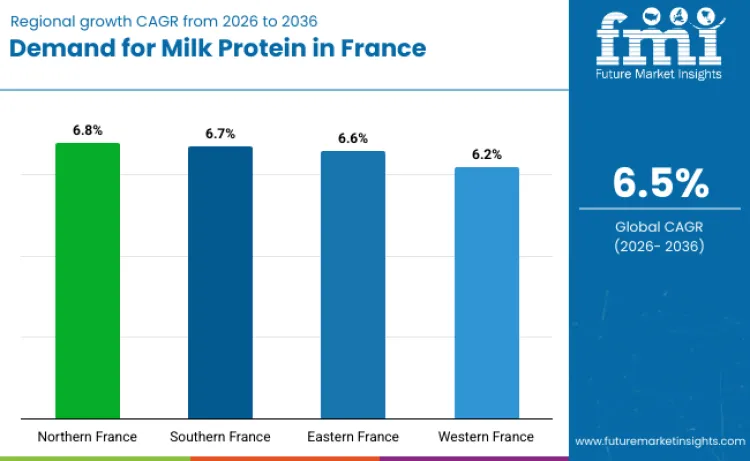
| Region | CAGR (2026-2036) |
|---|---|
| Northern France | 6.8% |
| Western France | 6.2% |
| Eastern France | 6.6% |
| Southern France | 6.7% |
Source: Future Market Insights’ proprietary forecasting model and primary research
Why is Northern leading expansion through manufacturing concentration and procurement scale?
Milk protein sales in Northern France are slated to expand at a CAGR of 6.8% supported by higher concentration of processing assets and structured procurement practices that favor standardized powders and long-cycle supplier relationships. FMI thinks expansion follows broader volume programs rather than short-term buying spikes.
What supports Southern France’s growth through Diversified Consumption Formats?
Milk protein demand in Southern France is projected to advance at a 6.7% CAGR, helped by steady use across food manufacturing and nutrition-led formats where protein positioning supports premium mix. Regional demand often tracks consumption patterns tied to lifestyle and convenience nutrition adoption.
How is Eastern France progressing through stable industrial programs?
Demand for milk protein in Eastern France is slated to expand at a 6.6% CAGR, reflecting consistent demand from plants that value supplier performance, audit readiness, and process stability for repeated runs. Decision cycles here tend to reward vendors with low deviation rates.
Why is Western France showing measured progress tied to disciplined sourcing?
Western France advances at 6.2%, shaped by careful qualification cycles and a stronger emphasis on cost discipline in high-volume formats. Many buyers also evaluate these choices alongside broader dairy input strategies prevalent in milk ingredients portfolios when consolidating vendor lists.
What Defines the Competitive Landscape for Milk Protein in France?
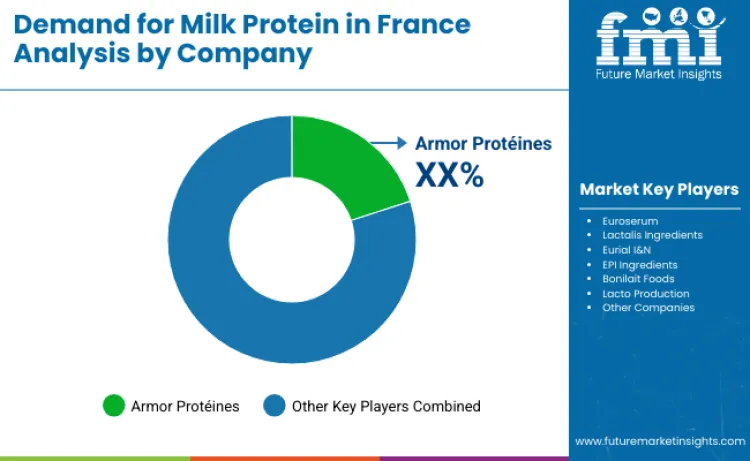
Competition is shaped by specification consistency, responsiveness during technical issues, and the ability to support large-scale manufacturers with stable supply and documentation. FMI is of the opinion that suppliers that can serve both high-volume food & beverage programs and higher-spec nutrition applications without compromising reliability hold the strongest positions.
Armor Protéines and Euroserum compete through established dairy ingredient capabilities and application fit across multiple protein formats. Lactalis Ingredients benefits from integrated dairy processing depth and broad customer access across industrial users.
Eurial I&N and EPI Ingredients contribute through targeted portfolio coverage and specification alignment in selected applications. Buyers increasingly value partners that can support dispersion troubleshooting, stability optimization, and fast corrective action pathways when deviations occur.
Key Industry Participants
- Armor Protéines
- Euroserum
- Lactalis Ingredients
- Eurial I&N
- EPI Ingredients
- Bonilait Foods
- Lacto Production
- Other Companies
Scope of Report
| Items | Values |
|---|---|
| Quantitative Units | USD Billion |
| Product | Milk Protein Concentrates; Hydrolyzed Milk Protein; Milk Protein Isolates; Others |
| Application | Food & Beverage; Dietary Supplements; Infant Formula; Animal Feed; Others |
| Form | Powder; Liquid |
| Regions Covered | Northern France; Western France; Eastern France; Southern France |
| Key Companies Profiled | Armor Protéines; Euroserum; Lactalis Ingredients; Eurial I&N; EPI Ingredients |
Source: Future Market Insights - analysis driven by proprietary forecasting models and primary research
Milk Protein Demand in France by Segments
By Product
- Milk Protein Concentrates
- Hydrolyzed Milk Protein
- Milk Protein Isolates
- Others
By Application
- Food & Beverage
- Dietary Supplements
- Infant Formula
- Animal Feed
- Others
By Form
- Powder
- Liquid
By Region
- Northern France
- Western France
- Eastern France
- Southern France
Frequently Asked Questions
What is the outlook for milk protein demand in France for 2026?
In 2026, milk protein demand in France is likely to total USD 0.7 billion.
What is the expected valuation for milk protein demand in France for 2036?
Milk protein demand in France is forecasted to reach USD 1.3 billion by 2036.
At what rate will milk protein demand expand in France from 2026 to 2036?
Milk protein demand in France is expected to progress at a 6.5% CAGR from 2026 to 2036.
Which product segment leads milk protein consumption in France?
Milk protein concentrates are most widely consumed in France, capturing 68.3% of total demand.
Which application leads milk protein consumption in France?
Food & beverage constitutes the leading application area in France, accounting for 39.3% of total demand.
Preview the report firsthand - request a free sample
Get SampleGet the brochure for pricing and purchase details.
Get PDFTable of Content
- Executive Summary
- Industry Introduction, including Taxonomy and Market Definition
- Trends and Success Factors, including Macro-economic Factors, Market Dynamics, and Recent Industry Developments
- France Demand Analysis 2021 to 2025 and Forecast 2026 to 2036, including Historical Analysis and Future Projections
- Pricing Analysis
- France Analysis 2021 to 2025 and Forecast 2026 to 2036
- Product
- Application
- Form
- Region
- By Product
- Milk Protein Concentrates
- Hydrolyzed Milk Protein
- Milk Protein Isolates
- Others
- By Application
- Food & Beverage
- Dietary Supplements
- Infant Formula
- Animal Feed
- Others
- By Form
- Powder
- Liquid
- By Region
- Northern France
- Western France
- Eastern France
- Southern France
- Northern France Sales Analysis 2021 to 2025 and Forecast 2026 to 2036, by Key Segments
- Western France Sales Analysis 2021 to 2025 and Forecast 2026 to 2036, by Key Segments
- Eastern France Sales Analysis 2021 to 2025 and Forecast 2026 to 2036, by Key Segments
- Southern France Sales Analysis 2021 to 2025 and Forecast 2026 to 2036, by Key Segments
- Sales Forecast to 2036 by Product, Application, Form, and Region
- Competitive Assessment, Company Share Analysis by Key Players, and Competition Dashboard
- Company Profile
- Armor Protéines
- Euroserum
- Lactalis Ingredients
- Eurial I&N
- EPI Ingredients
- Bonilait Foods
- Lacto Production
- Other Companies


