

- Market Size (2026)
- USD 186.6 Mn
- Forecast (2036)
- USD 365.1 Mn
- CAGR (2026 to 2036)
- 7.4%
Gemini Surfactants for Enhanced Oil Recovery Market Size, Market Forecast and Outlook By FMI
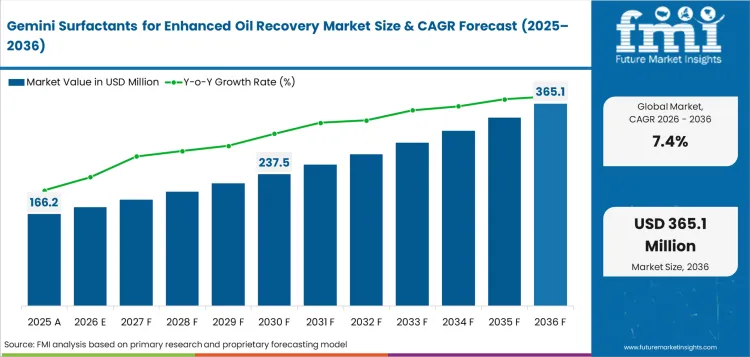
The Gemini surfactants for enhanced oil recovery market held a valuation of USD 166.2 million in 2025. Industry is anticipated to reach USD 178.5 million in 2026 and rise to USD 365.1 million by 2036 at 7.4% CAGR. By end user, national oil companies are projected to account for 48.0% share in 2026. By application, surfactant flooding is expected to hold 45.0% share in 2026.
Harsh carbonate reservoirs make chemical EOR buying difficult because a low interfacial tension result alone does not prove field fit. Fuel’s July 2024 GS8 work used a 2,500 ppm cationic gemini surfactant at 100 °C and showed about 37% additional oil recovery with 1 wt% DTPA. This guides formulators toward additive-assisted packages that reduce operator risk before pilot expansion. Reservoir contrast then changes the specification. Geoenergy Science and Engineering’s May 2024 carbonate tests used 57,745 ppm seawater and 213,768 ppm formation water under pressure above 3,000 psi. Incremental recovery ranged from 31% to 19% across permeability classes. Service providers need core-specific screening over one surfactant recipe. Patent activity is moving in the same practical dir
ection. China Daily Chemical Research Institute’s May 2024 CN115975619B patent specifies 0.1–0.3% use concentration and medium-phase volume above 15%. Buyers gain when lower-dose systems form microemulsions without alcohol or added salt. Field handling becomes simpler and dosage economics are easier to defend.
Summary of the Gemini Surfactants for Enhanced Oil Recovery Market
- Demand and Growth Drivers
- Mature oilfields are raising chemical screening budgets as conventional waterflooding leaves recoverable crude behind in complex rock.
- High-salinity and high-temperature reservoirs create a fit for cationic gemini surfactants with lower critical micelle concentration.
- Carbonate fields support longer qualification cycles due to national oil companies comparing surfactant flooding against gas and polymer options.
- Product and Segment View
- Surfactant flooding is forecast to account for 45.0% share in 2026 since operators can test interfacial tension response before wider blends.
- High-salinity reservoirs are projected to capture 41.0% share in 2026 as brine tolerance becomes the first screening hurdle.
- Quaternary ammonium routes are expected to hold 42.0% share in 2026 due to proven synthesis routes and cationic headgroup performance.
- Geography and Competitive Outlook
- Saudi Arabia and China are forecast above the global pace as mature reservoirs and local research capacity support chemical EOR trials.
- United States is expected to grow at 7.9% CAGR by 2036 as mature onshore wells support selective chemical treatment programs.
- Companies such as BASF and Dow hold strong positions through oilfield chemistry portfolios and global field support networks.
- Analyst Opinion
- Nikhil Kaitwade, Principal Consultant for Chemicals and Materials at FMI, says, "Gemini surfactants are winning in harsh reservoirs that can penalize conventional surfactants through salt load and temperature. Buyers will pay a premium only if suppliers prove stable interfacial tension reduction at field brine strength. By 2036, stronger suppliers will be those combining molecule design with coreflood evidence and field logistics."
- Gemini Surfactants for Enhanced Oil Recovery Market Value Analysis
- Gemini surfactants are moving from academic chemistry into reservoir-specific screening for mature oilfields with tougher brine conditions.
- Operator spending depends on incremental recovery economics as chemical cost must stay below the value of added crude output.
- Formulators are linking surfactant architecture with wettability change as carbonate and sandstone reservoirs respond differently to charge balance.
- Oilfield teams support demand for lower-dosage products able to maintain performance under heat and high dissolved salts.
Key Takeaways
- The gemini surfactants for enhanced oil recovery market was valued at USD 166.2 million in 2025.
- By 2036, the gemini surfactants for enhanced oil recovery market is expected to reach USD 365.1 million.
- From 2026 to 2036, the market is projected to expand at 7.4% CAGR.
- The market is projected to create an incremental opportunity of USD 186.6 million between 2026 and 2036.
- National oil companies are projected to account for 48.0% share of end-user demand in 2026.
- Surfactant flooding is expected to account for 45.0% share of application demand in 2026.
- Saudi Arabia at 8.8% CAGR and China at 8.5% CAGR are the faster-expanding country markets.
Gemini Surfactants for Enhanced Oil Recovery Market Definition
Gemini surfactants for enhanced oil recovery are specialty surfactants with two hydrophilic head groups and two hydrophobic chains joined by a spacer. Revenue scope covers surfactants sold for chemical EOR pilots and field programs. Counted uses include surfactant flooding, ASP flooding and foam EOR support. Related oilfield surfactants are included only if sold as gemini formulations. Related oilfield chemicals are counted only if they support oil recovery service.
Gemini Surfactants for Enhanced Oil Recovery Market Inclusions
Market scope covers gemini surfactants sold for chemical enhanced oil recovery formulations. Product type includes cationic gemini surfactants and anionic gemini surfactants. Nonionic gemini surfactants complete the product scope. Application includes surfactant flooding and wettability alteration. Interfacial tension reduction and heavy-oil viscosity reduction complete the application view. Reservoir type includes sandstone reservoirs and carbonate reservoirs. Heavy-oil reservoirs and high-salinity reservoirs complete the reservoir scope. End user includes national oil companies and independent oil producers. Oilfield service companies and specialty chemical formulators complete the buyer scope.
Gemini Surfactants for Enhanced Oil Recovery Market Exclusions
Study scope excludes commodity surfactants sold into detergents and household cleaning. Personal care surfactants are outside scope unless the same molecule moves into an oilfield route. Agricultural surfactants are excluded unless supplied through an EOR qualification route. Polymer-only EOR products are excluded if no gemini surfactant component is present.
Gemini Surfactants for Enhanced Oil Recovery Market Research Methodology
- Primary Research: FMI analysts reviewed oilfield chemical suppliers, reservoir engineers and EOR formulation specialists. Interviews focused on brine tolerance and field trial economics.
- Desk Research: Desk review used official energy statistics and petroleum ministry releases. Peer-reviewed surfactant studies and company oilfield chemistry portfolios from 2024 onward completed the evidence file.
- Market Sizing and Forecasting: Forecast work combined mature-field production exposure, chemical EOR penetration and estimated surfactant dosage per pilot or field program.
- Data Validation: Segment shares were checked against chemistry fit and reservoir harshness. Oilfield buying routes and public supplier activity completed the validation step.
Why is the Gemini Surfactants for Enhanced Oil Recovery Market Growing?
- Mature oilfields are moving operators toward chemical EOR as waterflooding leaves a large share of original crude in place.
- Harsh brine and carbonate reservoir chemistry support gemini surfactants since lower critical micelle concentration can reduce dosage pressure during pilot design.
- National oil companies provide a steadier qualification route as recovery gains are tested across long-life reservoirs and phased field programs.
Chemical EOR buying is becoming more selective as operators compare molecule cost with added crude recovery. The United States Department of Energystates that secondary recovery generally produces 20.0% to 40.0% of original oil in place. It reports that enhanced oil recovery can raise recovery prospects to 30.0% to 60.0% or more. These recovery limits make surfactants for enhanced oil recovery important only if formulations work under the actual brine and rock setting. Gemini surfactants gain attention as lower dosage can improve pilot economics before field expansion.
Carbonate reservoirs create a sharper need for tailored surfactant architecture. SPE Journal of Petroleum Technologyreported in November 2024 that Saudi Aramco and King Fahd University of Petroleum and Minerals worked on sustainable surfactants for high-temperature and high-salinity carbonate reservoirs. These reservoir conditions define the technical center of GCC chemical EOR activity. Suppliers able to combine lab performance with field handling support can protect value better than commodity oilfield chemicals distributors.
Market Segmentation Analysis
- Cationic gemini surfactants are expected to represent 38.0% share in 2026 since charged headgroups support wettability shift in carbonate rocks.
- Surfactant flooding is projected to capture 45.0% share in 2026 as operators can isolate chemical impact before moving into larger blends.
- High-salinity reservoirs are forecast to hold 41.0% share in 2026 as brine tolerance is the first screening test for harsh fields.
- Quaternary ammonium routes are expected to account for 42.0% share in 2026 due to established synthesis control and cationic performance.
- National oil companies are projected to represent 48.0% share in 2026, led by state-backed operators funding longer pilot cycles across mature fields.
The market is segmented by product type and application. Reservoir type and synthesis route complete the core scope. End user completes the buyer view. Product type covers cationic and anionic chemistries. Nonionic and zwitterionic chemistries complete the product view. Application scope includes surfactant flooding and ASP flooding. Foam EOR and stimulation aid complete the application view. Reservoir type includes carbonate and sandstone systems. High-salinity and high-temperature reservoirs complete the reservoir view.
Insights into Gemini Surfactants for Enhanced Oil Recovery Market by Product Type
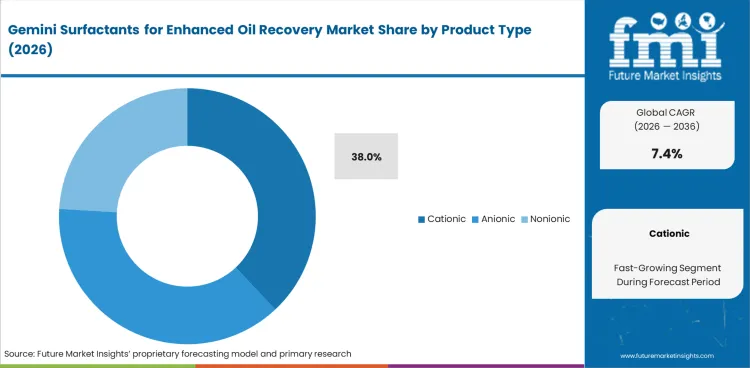
- Cationic gemini surfactants are projected to account for 38.0% share in 2026, supported by charge-driven adsorption behavior able to alter carbonate wettability while keeping dosage lower than many single-chain alternatives.
- Anionic surfactants hold a practical role in sandstone floods as formulators use them for brine compatibility and blend economics across lower-risk pilots.
Insights into Gemini Surfactants for Enhanced Oil Recovery Market by Application
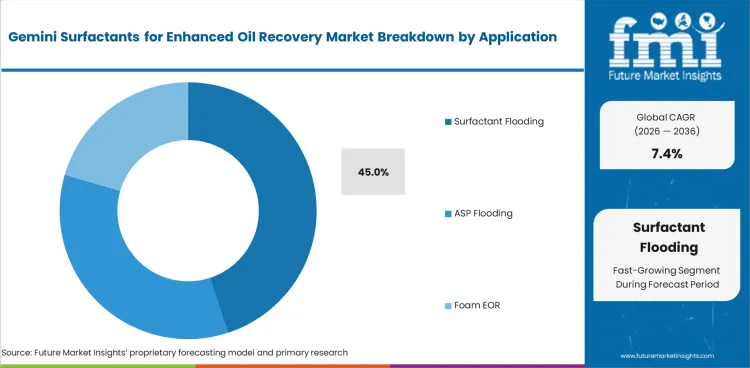
- Surfactant flooding is expected to hold 45.0% share in 2026, as operators can test interfacial tension response and adsorption loss before committing to alkaline-polymer handling complexity.
- ASP flooding gains attention in fields with existing polymer knowledge as oilfield teams combine mobility control with stronger oil-water separation chemistry.
Insights into Gemini Surfactants for Enhanced Oil Recovery Market by Reservoir Type
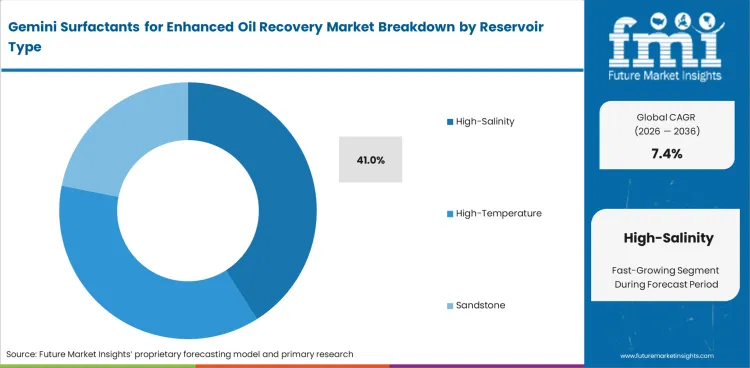
- High-salinity reservoirs are forecast to capture 41.0% share in 2026, since brine tolerance decides whether a gemini molecule can pass screening before coreflood testing.
- Low-foaming surfactants are used carefully in offshore reservoirs as topside separation risk can outweigh small gains in displacement efficiency.
Insights into Gemini Surfactants for Enhanced Oil Recovery Market by Synthesis Route
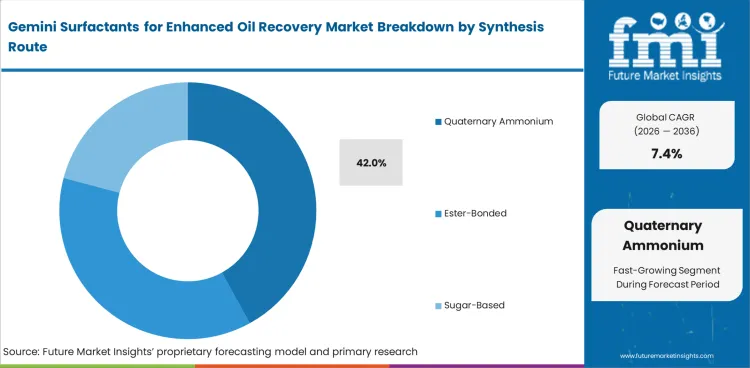
- Quaternary ammonium routes are projected to account for 42.0% share in 2026, led by established cationic synthesis control and stronger surface activity at low concentration.
- Natural surfactants are being screened as buyers ask for lower environmental load in sensitive offshore basins. Bio-based nonionic surfactants provide a second route for formulations with lower aquatic concern.
Insights into Gemini Surfactants for Enhanced Oil Recovery Market by End User
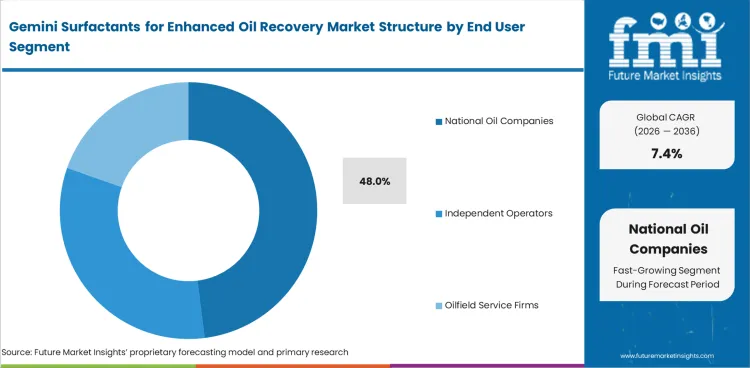
- National oil companies are expected to represent 48.0% share in 2026, since mature national fields justify longer qualification cycles and full-field recovery planning.
- Sulfosuccinate blend knowledge supports independent operators seeking a lower-risk formulation route for small pilots before using more tailored gemini systems.
Gemini Surfactants for Enhanced Oil Recovery Market Drivers, Restraints and Opportunities
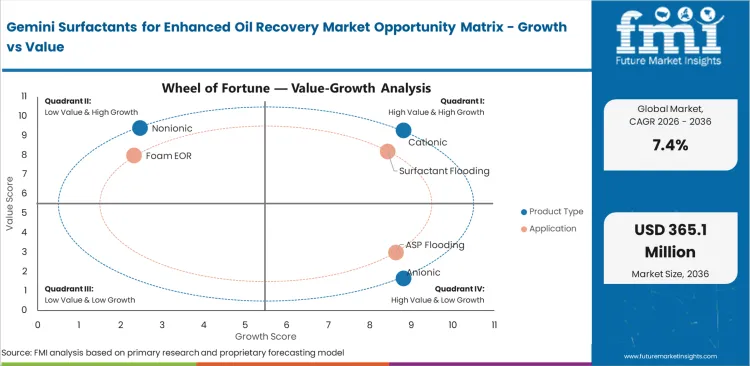
- Mature reservoir recovery pressure is raising chemical pilot interest as operators seek added barrels without new exploration risk.
- Adsorption loss and produced-water handling are likely to slow adoption if reservoir mineralogy consumes too much surfactant.
- Field-ready blend design opens a supplier route for firms able to pair gemini molecules with polymers and scale control.
EOR surfactant buying is shaped by field economics instead of chemistry novelty alone. Operators compare surfactant loss and brine stability before moving from lab screening into pilot design. United States Energy Information Administrationreported in March 2026 that United States crude oil production reached 13.6 million b/d in 2025 despite 5% lower active rigs in the Lower 48. This productivity pressure supports chemical screening in mature assets as operators seek more barrels from existing fields. Suppliers of surfactants for enhanced oil recovery(EOR) gain when recovery response is measurable after coreflood testing.
Produced-water chemistry creates a significant barrier for field adoption. Surfactant floods can lose efficiency through rock adsorption and poor brine compatibility.Royal Society of Chemistry research in 2026 stated that high retention reduces effective surfactant concentration during flooding. Such loss raises dose cost and weakens pilot economics. Oilfield scale inhibitor products and corrosion inhibitors are evaluated beside surfactants during package design. Reservoir response decides the buying outcome.
Surfactant Attribute and Claim Preference Analysis
Buyer preference is moving from general recovery claims toward field-specific proof. Operators ask whether a gemini surfactant keeps ultra-low interfacial tension under actual brine and temperature. ACS Energy & Fuels research published in September 2025 reported that cationic-anionic gemini surfactant mixtures showed salt resistance and reduced oil-water interfacial tension to ultra-low levels. Practical selection depends on coreflood response and adsorption control. Produced-fluid separation quality decides whether a lab result can move into field trials.
Oilfield Recovery Demand Analysis
Recovery chemistry depends on oilfield maturity and production pressure. United States Energy Information Administrationreported in March 2026 that crude production grew by 3% in 2025 and reached a record 13.6 million b/d. Lower 48 output accounted for 83% of total United States crude production. Mature-field teams use this productivity pressure to justify better reservoir contact and chemical screening. Gemini surfactants benefit if oil prices support pilot spending and reservoir teams can quantify added barrels
Regional Analysis
.webp "Top Country Growth Comparison Gemini Surfactants For Enhanced Oil Recovery Market Cagr (2026 2036)")
| Country | CAGR 2026 to 2036 |
|---|---|
| Saudi Arabia | 8.8% |
| China | 8.5% |
| United States | 7.9% |
| Oman | 7.7% |
| Brazil | 7.3% |
| United Arab Emirates | 7.1% |
| Norway | 6.5% |
Source: Future Market Insights analysis, 2026.
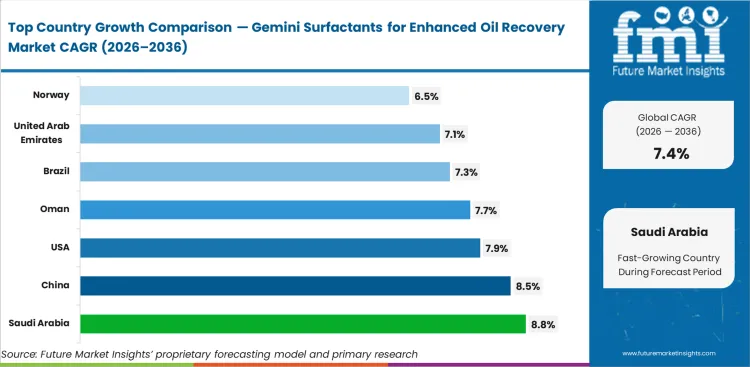
Analysis of Gemini Surfactants for Enhanced Oil Recovery Market by Key Countries
- Saudi Arabia is projected to record 8.8% CAGR by 2036 due to carbonate reservoir research supporting harsh-brine surfactant screening.
- China is expected to expand at 8.5% CAGR by 2036 as mature oilfield output creates room for selective chemical EOR.
- United States is forecast to grow at 7.9% CAGR by 2036 due to mature onshore wells and Gulf projects needing recovery support.
- Oman is expected to advance at 7.7% CAGR by 2036 since EOR stays central to national crude production planning.
- Brazil is projected to rise at 7.3% CAGR by 2036 through offshore recovery pressure and pre-salt field maturity. United Arab Emirates is forecast at 7.1% CAGR by 2036 as Abu Dhabi screens recovery chemicals beside gas and CO2 options. Norway is expected to post 6.5% CAGR by 2036 as offshore environmental screening slows chemical qualification cycles.
Country performance differs by reservoir type and operator structure. Saudi Arabia and China track above the global pace due to state-backed oilfield research and mature-field recovery pressure. United States and Oman stay near the global line as recovery chemistry fits selective fields. Brazil, United Arab Emirates and Norway show measured growth due to offshore qualification cost and tighter chemical approval requirements.
Demand Outlook for Gemini Surfactants for Enhanced Oil Recovery in Saudi Arabia
Demand in Saudi Arabia is projected to record an 8.8% CAGR by 2036 due to carbonate reservoirs creating a harsh-brine testing need. Saudi government statistics reported that oil activities grew 5.7% in 2025, keeping recovery efficiency part of national output planning. Aramco research with King Fahd University gives local operators a technical route for sustainable surfactant screening. Suppliers must prove temperature stability before wider field use.
- High-carbonate formations make salinity and heat tolerance the first filter before surfactant qualification moves forward.
- Reservoir labs are expected to compare adsorption loss against incremental oil response before wider chemical screening decisions.
- Long-life producing assets support gemini surfactants able to protect recovery efficiency without raising treatment complexity.
Demand Analysis of Gemini Surfactants for Enhanced Oil Recovery in China
Sector in China is expected to expand at 8.5% CAGR by 2036, led by mature oilfields needing stronger chemical recovery tools. National Bureau of Statistics data showed crude oil production reached 35.73 million tons during January to February 2026. Daqing and Shengli field systems have long used chemical recovery techniques, supporting buyer familiarity with surfactant screening. Local synthesis depth reduces sampling time for tailored gemini molecules.
- Chemical EOR familiarity gives buyers the opportunity to evaluate gemini surfactants against polymer-heavy recovery systems.
- Reservoir teams are expected to test salinity tolerance and adsorption behavior before advancing new surfactants into pilots.
- Local synthesis capability can shorten sample development cycles for cationic and zwitterionic gemini systems.
Sales Analysis of Gemini Surfactants for Enhanced Oil Recovery in United States
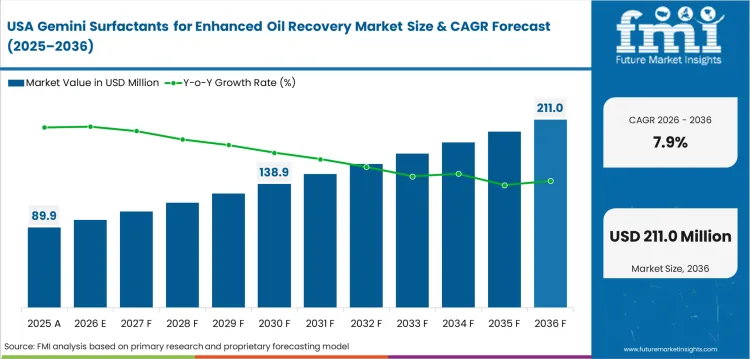
Sales in the United States are forecast to grow at 7.9% CAGR by 2036as mature onshore basins seek output from drilled acreage. Energy Information Administration data published in March 2026 showed crude oil production reached 13.6 million b/d in 2025. Permian and Gulf operators judge surfactants against water handling cost and field uptime. Commercial use will favor chemistries that integrate with existing injection and production systems.
- Mature onshore production keeps surfactant pilots focused on incremental recovery and field operating cost.
- Operators are expected to compare chemical recovery with drilling economics before funding broader surfactant use.
- Commercial uptake favors molecules that integrate with existing injection systems and reduce uncertainty during produced-water handling.
Opportunity Analysis of Gemini Surfactants for Enhanced Oil Recovery in Oman
The industry in Oman is expected to advance at 7.7% CAGR by 2036 as national production planning continues to rely on EOR. Ministry data released in 2025 provided oil and gas production and field performance statistics through a public open-data route. Petroleum Development Oman has used thermal and chemical recovery thinking across mature assets. Gemini products must compete with established polymer and steam-based recovery choices.
- EOR experience gives buyers a stronger base for comparing surfactants with polymer and thermal recovery options.
- Production planning keeps recovery chemistry relevant as operators look for higher output from existing reservoirs.
- Gemini surfactants need clear handling proof to compete with recovery methods already accepted in field operations.
Future Outlook for Gemini Surfactants for Enhanced Oil Recovery in Brazil
Demand in Brazil is projected to rise at 7.3% CAGR by 2036 since offshore output growth raises recovery and flow assurance pressure. Agência Brasil reported in April 2026 that oil production reached 4.061 million b/d in February 2026. Pre-salt assets create high-value barrels. Offshore logistics raise qualification cost for specialty surfactants. Suppliers need strong separation data before operators accept new chemical risk.
- Offshore recovery programs make separation quality and topside compatibility central to surfactant qualification.
- High-value crude streams support specialty chemicals only after operators see clear recovery and handling proof.
- Suppliers must reduce trial risk with stronger data on emulsion behavior and produced-water treatment impact.
Demand Outlook for Gemini Surfactants for Enhanced Oil Recovery in United Arab Emirates
The sector in the United Arab Emirates is forecast at 7.1% CAGR by 2036 as Abu Dhabi production goals keep reservoir recovery in focus. United States trade guidance published in August 2025 stated that ADNOC expects to reach 5.0 million b/d sustainable capacity by 2027. Carbonate reservoirs and high salinity give surfactant suppliers a clear technical test. Chemical EOR competes with gas and CO2 recovery routes in operator planning.
- Carbonate reservoir conditions create a clear test case for cationic gemini surfactant behavior under harsh brine.
- Capacity planning keeps recovery chemistry relevant if the formulation protects output from mature producing assets.
- Local blending and storage routes can support oilfield chemical packages once surfactant stability is proven.
In-depth Analysis of Gemini Surfactants for Enhanced Oil Recovery in Norway
Norwegian demand is expected to post 6.5% CAGR by 2036, influenced by mature offshore assets needing recovery gains under strict environmental review. Norwegian petroleum authorities reported that production reached 239.2 million standard cubic meters of oil equivalent in 2025. North Sea operators evaluate surfactants against discharge rules and offshore logistics.
- Mature offshore assets favor surfactants with strong documentation on handling and discharge behavior.
- Environmental review keeps chemical selection focused on separation quality and measurable reservoir response.
- Offshore logistics raise packaging and transport standards for specialty surfactant blends used in recovery programs.
Competitive Landscape and Strategic Positioning
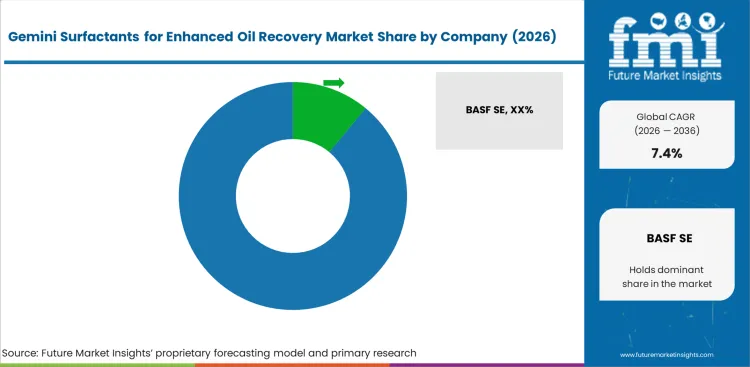
- Competition is centered on integrated oilfield chemical suppliers and specialty surfactant formulators able to support reservoir testing.
- BASF, Dow and Clariant hold strong positions based on oilfield chemistry portfolios and established field service relationships.
- Formulators compete on brine-stable molecule design and field-ready blend handling instead of price per kilogram alone.
Competition in the gemini surfactants for enhanced oil recovery market is shaped by evidence of field compatibility. Large oilfield chemical suppliers compete depending on product breadth and existing relationships with operators. Specialty formulators compete based on sharper chemistry design and faster adjustment to reservoir conditions. Buyers compare suppliers on brine stability and adsorption behavior before moving from lab screening to field injection.
Supplier selection favors packages that combine molecule design with field evidence. BASF lists surfactants and polymers designed to support enhanced oil recovery within its Performance Chemicals portfolio, showing a portfolio route beyond single-product selling. Alkyl polyglucosides and other mild surfactant chemistries are less central to harsh EOR use. These platforms show how suppliers can transfer chemistry knowledge across oilfield applications. Buyers are expected to favor vendors documenting brine stability and adsorption behavior before field injection.
Specialty formulators continue to have room to compete if they understand field constraints better than volume-focused suppliers. Stepan’s oilfield portfolio includes PETROSTEP PE-1 for mature wells and PETROSTEP ME-2 for flowback support. Sasol Chemicals and Nouryon add surfactant synthesis depth across broader specialty chemicals platforms. Advantage is expected to stay with suppliers able to tailor molecule structure and blend format for each reservoir type.
Key Companies in the Gemini Surfactants for Enhanced Oil Recovery Market
Competition spans integrated oilfield chemical suppliers and specialty surfactant formulators. Service-based chemical suppliers complete the field.
- Integrated Oilfield Chemical Suppliers: BASF, Dow and Clariant compete based on oilfield formulation breadth and global field support. Their position is stronger in programs needing lab-to-field continuity.
- Specialty Surfactant Formulators: Stepan Company, Sasol Chemicals and Nouryon compete depending on surfactant synthesis depth and product blending experience. Their value rises if buyers need tailored chemistry for difficult brines.
- Field Chemistry Specialists: Syensqo strengthens the competitive group through specialty chemical know-how and application development. Its opportunity depends on proof in EOR-specific formulations.
Competitive Benchmarking by Gemini Surfactant Capability
| Company | Brine Tolerance Chemistry | EOR Formulation Support | Surfactant Synthesis Depth | Footprint |
|---|---|---|---|---|
| BASF SE | High | Strong | Strong | Global |
| Dow | Strong | High | Strong | United States and global |
| Clariant | Strong | Strong | Moderate | Europe and Middle East |
| Stepan Company | High | Medium | Strong | United States and Middle East |
| Sasol Chemicals | Strong | Medium | High | South Africa and global |
| Nouryon | Moderate | Medium | High | Europe and North America |
| Syensqo | Moderate | Strong | Medium | Europe and global |
Source: Future Market Insights competitive analysis based on public product portfolios and company activity in 2026.
Key Developments in Gemini Surfactants for Enhanced Oil Recovery Market
- In November 2024, Saudi Aramco research teams and King Fahd University of Petroleum and Minerals advanced sustainable surfactants for high-temperature and high-salinity carbonate reservoirs.
- In June 2025, BASF listed surfactants and polymers designed to support enhanced oil recovery within its Performance Chemicals portfolio.
- In March 2026, the United States Energy Information Administration reported that United States crude oil production reached a record 13.6 million b/d in 2025.
Key Players in the Gemini Surfactants for Enhanced Oil Recovery Market
- BASF SE
- Dow
- Clariant
- Stepan Company
- Sasol Chemicals
- Nouryon
- Syensqo
Report Scope and Coverage
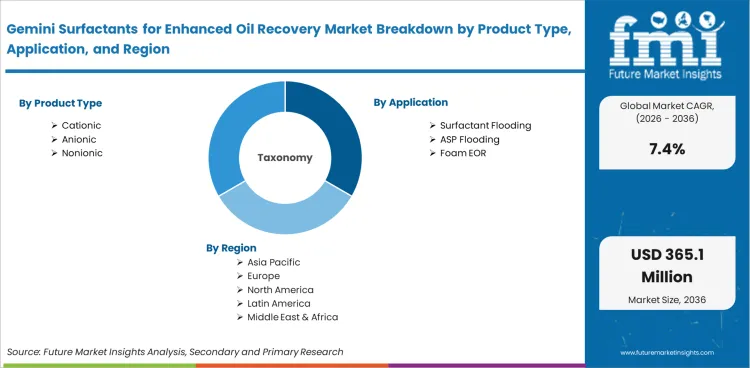
Gemini Surfactants for Enhanced Oil Recovery Market Breakdown by Product Type, Application, Reservoir Type, Synthesis Route, End User, and Region
| Parameter | Details |
|---|---|
| Quantitative Units | USD 178.5 million in 2026 to USD 365.1 million in 2036 at a CAGR of 7.4% |
| Market Definition | Specialty gemini surfactants sold for chemical enhanced oil recovery applications across mature oilfields. |
| By Product Type | Cationic, anionic, nonionic and zwitterionic |
| By Application | Surfactant flooding, ASP flooding, foam EOR and stimulation aid |
| By Reservoir Type | Carbonate, sandstone, high-salinity and high-temperature |
| By Synthesis Route | Quaternary ammonium, ester-linked, sugar-based and sulfonate |
| By End User | National oil companies, independent operators, oilfield service firms and research institutes |
| Regions Covered | North America, Latin America, Western Europe, Eastern Europe, East Asia, South Asia and Pacific, Middle East and Africa |
| Countries Covered | Saudi Arabia, China, United States, Oman, Brazil, United Arab Emirates and Norway |
| Key Companies Profiled | BASF, Dow, Clariant, Stepan Company, Sasol Chemicals, Nouryon and Syensqo |
| Forecast Period | 2026 to 2036 |
| Approach | Hybrid top-down and bottom-up analysis using EOR activity, reservoir conditions and supplier chemistry portfolios |
Source: Future Market Insights, 2026.
Gemini Surfactants for Enhanced Oil Recovery Market by Segments
Gemini Surfactants for Enhanced Oil Recovery Market Segmented by Product Type:
- Cationic
- Anionic
- Nonionic
- Zwitterionic
Gemini Surfactants for Enhanced Oil Recovery Market Segmented by Application:
- Surfactant Flooding
- ASP Flooding
- Foam EOR
- Stimulation Aid
Gemini Surfactants for Enhanced Oil Recovery Market Segmented by Reservoir Type:
- Carbonate
- Sandstone
- High-Salinity
- High-Temperature
Gemini Surfactants for Enhanced Oil Recovery Market Segmented by Synthesis Route:
- Quaternary Ammonium
- Ester-Bonded
- Sugar-Based
- Sulfonate
Gemini Surfactants for Enhanced Oil Recovery Market Segmented by End User:
- National Oil Companies
- Independent Operators
- Oilfield Service Firms
- Research Institutes
Gemini Surfactants for Enhanced Oil Recovery Market by Region:
- North America
- United States
- Canada
- Mexico
- Latin America
- Brazil
- Argentina
- Rest of Latin America
- Western Europe
- Norway
- United Kingdom
- Germany
- France
- BENELUX
- Rest of Western Europe
- Eastern Europe
- Poland
- Romania
- Rest of Eastern Europe
- East Asia
- China
- Japan
- South Korea
- South Asia and Pacific
- India
- ASEAN
- Australia and New Zealand
- Rest of South Asia and Pacific
- Middle East and Africa
- Saudi Arabia
- United Arab Emirates
- Oman
- Kuwait
- South Africa
- Rest of Middle East and Africa
Research Sources and Bibliography
- USA Energy Information Administration. (2026, March 31). USA crude oil production rose in 2025, setting new record.
- National Bureau of Statistics of China. (2026, March 17). Energy production from January to February 2026.
- Agência Brasil. (2026, April 2). Brazil’s oil, natural gas production hits record high in February.
- International Trade Administration. (2025, August 25). United Arab Emirates - Oil and gas.
- General Authority for Statistics. (2026, March 9). GASTAT: Saudi economy records 4.5% growth in 2025.
- Norwegianpetroleum.no. (2026, March 3). Historical production.
- Society of Petroleum Engineers. (2024, November 1). EOR operations-2024.
- BASF. (2025, June 2). Performance Chemicals.
- ADNOC. (2025, May 21). ADNOC signs AED6 billion framework agreements to manufacture critical industrial equipment in the UAE.
- Clariant. (2026, February 26). Fourth quarter and full year results 2025.
- Saien, J., Eghtenaei, A., & Kharazi, M. (2024). Qualifying interfacial properties of crude oil-water system with the synergistic action of a nano Gemini ionic liquid and conventional surfactants. Scientific Reports, 14, 19833.
- Asadabadi, S., Kharazi, M., & Saien, J. (2025). Salinity and alkalinity impacts on the interfacial activity of crude oil-water systems using individual and mixtures of a surface-active ionic liquid and conventional surfactant. RSC Advances, 15, 36050–36064.
- Liu, P., Li, X., Li, H., Liu, S., Wang, J., & Zhang, P. (2025). Application and synthesis of Gemini surfactant in heavy oil development. ACS Omega, 10, 8832–8842.
- Yarahmadi, A., Zargar, G., Ashoori, S., & Khaksar Manshad, A. (2025). Molecular design and thermodynamic insights into TnSm-type gemini surfactants for advanced interfacial applications. Scientific Reports, 15, 37097.
- Kowalczyk, I., Szulc, A., & Brycki, B. (2025). Gemini surfactants: Advances in applications and prospects for the future. Molecules, 30(23), 4599.
- Brycki, B., Szulc, A., Brycka, J., & Kowalczyk, I. (2026). Cationic Gemini surfactants in the oil industry: Applications in extraction, transportation and refinery products. Molecules, 31(1), 108.
Bibliography is provided for reader reference. Sources include government, peer-reviewed, trade body and official company publications.=
This Report Answers
- What is the forecast value of the gemini surfactants for enhanced oil recovery market by 2036?
- Which end user is expected to hold a strong share in 2026?
- Which countries are forecast to grow faster than the global pace by 2036?
- Which application is projected to account for a leading share in 2026?
- Which suppliers are active in gemini surfactants for enhanced oil recovery?
- How do high-salinity reservoirs influence gemini surfactant selection?
- What role does brine tolerance play in chemical EOR screening?
Frequently Asked Questions
How big is the gemini surfactants for enhanced oil recovery market in 2026?
Industry revenue is expected to reach USD 178.5 million in 2026 and advance to USD 365.1 million by 2036.
What is the projected CAGR for the gemini surfactants for enhanced oil recovery market?
The sector is forecast to expand at 7.4% CAGR from 2026 to 2036 as mature reservoirs add selective chemical recovery trials.
Which segment holds a strong share in the gemini surfactants for enhanced oil recovery market?
National oil companies are projected to hold 48.0% share in 2026 due to longer field testing and recovery planning cycles.
Which application shows broader adoption in the gemini surfactants for enhanced oil recovery market?
Surfactant flooding is expected to account for 45.0% share in 2026 as operators test chemistry impact before larger blends.
Which country shows stronger readiness in the gemini surfactants for enhanced oil recovery market?
Saudi Arabia is projected to record 8.8% CAGR by 2036 as carbonate reservoir research supports harsh-brine chemical screening.
Which companies compete in the gemini surfactants for enhanced oil recovery market?
BASF and Dow are active suppliers. Clariant and Stepan compete with Sasol Chemicals, Nouryon and Syensqo across specialist chemistry routes.
How do gemini surfactants work in enhanced oil recovery?
Gemini surfactants lower oil-water interfacial tension and can shift rock wettability so trapped crude moves more easily through reservoir pores.
Why can gemini surfactants cost more than conventional surfactants?
Higher molecule complexity raises production cost. Lower dosage and better brine tolerance can support payback in harsh reservoirs.
How long does qualification take for gemini surfactants in enhanced oil recovery?
Qualification can run from months to multi-year periods as operators move from bottle tests to corefloods and then pilot injection.
Which product comparison matters most for buyers?
Buyers compare gemini surfactants against conventional surfactants on brine tolerance, adsorption loss and oil recovery response under field temperature.
Preview the report firsthand - request a free sample
Get SampleGet the brochure for pricing and purchase details.
Get PDFTable of Content
- Key Takeaways
- Market Size and CAGR
- Top Growth Driver
- Fastest Growing Segment
- Leading Region
- Key Companies
- Emerging Opportunities
- Executive Summary
- Global Market Outlook
- Demand-side Trends
- Supply-side Trends
- Technology Roadmap Analysis
- Analysis and Recommendations
- Analyst Perspective (What is happening? Why now? What should investors know?)
- Key Questions Answered
- How large is the market?
- What is the CAGR?
- What are key trends?
- Which region dominates?
- Who are the leaders?
- Market Overview
- Market Coverage / Taxonomy
- Market Definition / Scope / Limitations
- Research Methodology
- Chapter Orientation
- Analytical Lens and Working Hypotheses
- Market Structure, Signals, and Trend Drivers
- Benchmarking and Cross-market Comparability
- Market Sizing, Forecasting, and Opportunity Mapping
- Research Design and Evidence Framework
- Desk Research Programme (Secondary Evidence)
- Expert Input and Fieldwork (Primary Evidence)
- Tooling, Models, and Reference Databases
- Data Engineering and Model Build
- Quality Assurance and Audit Trail
- Market Background
- Market Dynamics (Drivers, Restraints, Opportunity, Trends)
- Scenario Forecast (Optimistic, Likely, Conservative)
- Impact Analysis
- AI Impact
- Sustainability Impact
- Regulatory Impact
- Technology Impact
- Consumer / Buyer Analysis
- Purchase Drivers
- Adoption Barriers
- Buyer Journey
- Opportunity Map Analysis
- Product Life Cycle Analysis
- Supply Chain Analysis
- Investment Feasibility Matrix
- Value Chain Analysis
- PESTLE and Porter's Analysis
- Regulatory Landscape
- Regional Parent Market Outlook
- Production and Consumption Statistics
- Import and Export Statistics
- Global Market Analysis and Forecast, 2021 to 2036
- Historical Market Size Value (USD Million) & Volume (Unit) Analysis, 2021 to 2025
- Current and Future Market Size Value (USD Million) & Volume (Unit) Projections, 2026 to 2036
- Y-o-Y Growth Trend Analysis
- Absolute $ Opportunity Analysis
- Global Market Pricing Analysis, 2021 to 2036
- Global Market Analysis and Forecast, By Product Type, 2021 to 2036
- Introduction / Key Findings
- Historical Market Size Value (USD Million) & Volume (Unit) Analysis By Product Type, 2021 to 2025
- Current and Future Market Size Value (USD Million) & Volume (Unit) Analysis and Forecast By Product Type, 2026 to 2036
- Cationic
- Anionic
- Nonionic
- Zwitterionic
- Cationic
- Y-o-Y Growth Trend Analysis By Product Type, 2021 to 2025
- Absolute $ Opportunity Analysis By Product Type, 2026 to 2036
- Global Market Analysis and Forecast, By Application, 2021 to 2036
- Introduction / Key Findings
- Historical Market Size Value (USD Million) & Volume (Unit) Analysis By Application, 2021 to 2025
- Current and Future Market Size Value (USD Million) & Volume (Unit) Analysis and Forecast By Application, 2026 to 2036
- Surfactant Flooding
- ASP Flooding
- Foam EOR
- Stimulation Aid
- Surfactant Flooding
- Y-o-Y Growth Trend Analysis By Application, 2021 to 2025
- Absolute $ Opportunity Analysis By Application, 2026 to 2036
- Global Market Analysis and Forecast, By Reservoir Type, 2021 to 2036
- Introduction / Key Findings
- Historical Market Size Value (USD Million) & Volume (Unit) Analysis By Reservoir Type, 2021 to 2025
- Current and Future Market Size Value (USD Million) & Volume (Unit) Analysis and Forecast By Reservoir Type, 2026 to 2036
- High-Salinity
- Carbonate
- Sandstone
- High-Temperature
- High-Salinity
- Y-o-Y Growth Trend Analysis By Reservoir Type, 2021 to 2025
- Absolute $ Opportunity Analysis By Reservoir Type, 2026 to 2036
- Global Market Analysis and Forecast, By Synthesis Route, 2021 to 2036
- Introduction / Key Findings
- Historical Market Size Value (USD Million) & Volume (Unit) Analysis By Synthesis Route, 2021 to 2025
- Current and Future Market Size Value (USD Million) & Volume (Unit) Analysis and Forecast By Synthesis Route, 2026 to 2036
- Quaternary Ammonium
- Ester-Bonded
- Sugar-Based
- Sulfonate
- Quaternary Ammonium
- Y-o-Y Growth Trend Analysis By Synthesis Route, 2021 to 2025
- Absolute $ Opportunity Analysis By Synthesis Route, 2026 to 2036
- Global Market Analysis and Forecast, By End User, 2021 to 2036
- Introduction / Key Findings
- Historical Market Size Value (USD Million) & Volume (Unit) Analysis By End User, 2021 to 2025
- Current and Future Market Size Value (USD Million) & Volume (Unit) Analysis and Forecast By End User, 2026 to 2036
- National Oil Companies
- Independent Operators
- Oilfield Service Firms
- Research Institutes
- National Oil Companies
- Y-o-Y Growth Trend Analysis By End User, 2021 to 2025
- Absolute $ Opportunity Analysis By End User, 2026 to 2036
- Global Market Analysis and Forecast, By Region, 2021 to 2036
- Introduction
- Historical Market Size Value (USD Million) & Volume (Unit) Analysis By Region, 2021 to 2025
- Current Market Size Value (USD Million) & Volume (Unit) Analysis and Forecast By Region, 2026 to 2036
- North America
- Latin America
- Western Europe
- Eastern Europe
- East Asia
- South Asia and Pacific
- Middle East & Africa
- Market Attractiveness Analysis By Region
- North America Market Analysis and Forecast, By Country, 2021 to 2036
- Historical Market Size Value (USD Million) & Volume (Unit) Trend Analysis By Market Taxonomy, 2021 to 2025
- Market Size Value (USD Million) & Volume (Unit) Forecast By Market Taxonomy, 2026 to 2036
- By Country
- USA
- Canada
- Mexico
- By Product Type
- By Application
- By Reservoir Type
- By Synthesis Route
- By End User
- By Country
- Market Attractiveness Analysis
- By Country
- By Product Type
- By Application
- By Reservoir Type
- By Synthesis Route
- By End User
- Key Takeaways
- Latin America Market Analysis and Forecast, By Country
- Historical Market Size Value (USD Million) & Volume (Unit) Trend Analysis By Market Taxonomy, 2021 to 2025
- Market Size Value (USD Million) & Volume (Unit) Forecast By Market Taxonomy, 2026 to 2036
- By Country
- Brazil
- Chile
- Rest of Latin America
- By Product Type
- By Application
- By Reservoir Type
- By Synthesis Route
- By End User
- By Country
- Market Attractiveness Analysis
- By Country
- By Product Type
- By Application
- By Reservoir Type
- By Synthesis Route
- By End User
- Key Takeaways
- Western Europe Market Analysis and Forecast, By Country
- Historical Market Size Value (USD Million) & Volume (Unit) Trend Analysis By Market Taxonomy, 2021 to 2025
- Market Size Value (USD Million) & Volume (Unit) Forecast By Market Taxonomy, 2026 to 2036
- By Country
- Germany
- UK
- Italy
- Spain
- France
- Nordic
- BENELUX
- Rest of Western Europe
- By Product Type
- By Application
- By Reservoir Type
- By Synthesis Route
- By End User
- By Country
- Market Attractiveness Analysis
- By Country
- By Product Type
- By Application
- By Reservoir Type
- By Synthesis Route
- By End User
- Key Takeaways
- Eastern Europe Market Analysis and Forecast, By Country
- Historical Market Size Value (USD Million) & Volume (Unit) Trend Analysis By Market Taxonomy, 2021 to 2025
- Market Size Value (USD Million) & Volume (Unit) Forecast By Market Taxonomy, 2026 to 2036
- By Country
- Russia
- Poland
- Hungary
- Balkan & Baltic
- Rest of Eastern Europe
- By Product Type
- By Application
- By Reservoir Type
- By Synthesis Route
- By End User
- By Country
- Market Attractiveness Analysis
- By Country
- By Product Type
- By Application
- By Reservoir Type
- By Synthesis Route
- By End User
- Key Takeaways
- East Asia Market Analysis and Forecast, By Country
- Historical Market Size Value (USD Million) & Volume (Unit) Trend Analysis By Market Taxonomy, 2021 to 2025
- Market Size Value (USD Million) & Volume (Unit) Forecast By Market Taxonomy, 2026 to 2036
- By Country
- China
- Japan
- South Korea
- By Product Type
- By Application
- By Reservoir Type
- By Synthesis Route
- By End User
- By Country
- Market Attractiveness Analysis
- By Country
- By Product Type
- By Application
- By Reservoir Type
- By Synthesis Route
- By End User
- Key Takeaways
- South Asia and Pacific Market Analysis and Forecast, By Country
- Historical Market Size Value (USD Million) & Volume (Unit) Trend Analysis By Market Taxonomy, 2021 to 2025
- Market Size Value (USD Million) & Volume (Unit) Forecast By Market Taxonomy, 2026 to 2036
- By Country
- India
- ASEAN
- Australia & New Zealand
- Rest of South Asia and Pacific
- By Product Type
- By Application
- By Reservoir Type
- By Synthesis Route
- By End User
- By Country
- Market Attractiveness Analysis
- By Country
- By Product Type
- By Application
- By Reservoir Type
- By Synthesis Route
- By End User
- Key Takeaways
- Middle East & Africa Market Analysis and Forecast, By Country
- Historical Market Size Value (USD Million) & Volume (Unit) Trend Analysis By Market Taxonomy, 2021 to 2025
- Market Size Value (USD Million) & Volume (Unit) Forecast By Market Taxonomy, 2026 to 2036
- By Country
- Kingdom of Saudi Arabia
- Other GCC Countries
- Türkiye
- South Africa
- Other African Union
- Rest of Middle East & Africa
- By Product Type
- By Application
- By Reservoir Type
- By Synthesis Route
- By End User
- By Country
- Market Attractiveness Analysis
- By Country
- By Product Type
- By Application
- By Reservoir Type
- By Synthesis Route
- By End User
- Key Takeaways
- Key Countries Market Analysis
- USA
- Pricing Analysis
- Market Share Analysis, 2025
- By Product Type
- By Application
- By Reservoir Type
- By Synthesis Route
- By End User
- Canada
- Pricing Analysis
- Market Share Analysis, 2025
- By Product Type
- By Application
- By Reservoir Type
- By Synthesis Route
- By End User
- Mexico
- Pricing Analysis
- Market Share Analysis, 2025
- By Product Type
- By Application
- By Reservoir Type
- By Synthesis Route
- By End User
- Brazil
- Pricing Analysis
- Market Share Analysis, 2025
- By Product Type
- By Application
- By Reservoir Type
- By Synthesis Route
- By End User
- Chile
- Pricing Analysis
- Market Share Analysis, 2025
- By Product Type
- By Application
- By Reservoir Type
- By Synthesis Route
- By End User
- Germany
- Pricing Analysis
- Market Share Analysis, 2025
- By Product Type
- By Application
- By Reservoir Type
- By Synthesis Route
- By End User
- UK
- Pricing Analysis
- Market Share Analysis, 2025
- By Product Type
- By Application
- By Reservoir Type
- By Synthesis Route
- By End User
- Italy
- Pricing Analysis
- Market Share Analysis, 2025
- By Product Type
- By Application
- By Reservoir Type
- By Synthesis Route
- By End User
- Spain
- Pricing Analysis
- Market Share Analysis, 2025
- By Product Type
- By Application
- By Reservoir Type
- By Synthesis Route
- By End User
- France
- Pricing Analysis
- Market Share Analysis, 2025
- By Product Type
- By Application
- By Reservoir Type
- By Synthesis Route
- By End User
- India
- Pricing Analysis
- Market Share Analysis, 2025
- By Product Type
- By Application
- By Reservoir Type
- By Synthesis Route
- By End User
- ASEAN
- Pricing Analysis
- Market Share Analysis, 2025
- By Product Type
- By Application
- By Reservoir Type
- By Synthesis Route
- By End User
- Australia & New Zealand
- Pricing Analysis
- Market Share Analysis, 2025
- By Product Type
- By Application
- By Reservoir Type
- By Synthesis Route
- By End User
- China
- Pricing Analysis
- Market Share Analysis, 2025
- By Product Type
- By Application
- By Reservoir Type
- By Synthesis Route
- By End User
- Japan
- Pricing Analysis
- Market Share Analysis, 2025
- By Product Type
- By Application
- By Reservoir Type
- By Synthesis Route
- By End User
- South Korea
- Pricing Analysis
- Market Share Analysis, 2025
- By Product Type
- By Application
- By Reservoir Type
- By Synthesis Route
- By End User
- Russia
- Pricing Analysis
- Market Share Analysis, 2025
- By Product Type
- By Application
- By Reservoir Type
- By Synthesis Route
- By End User
- Poland
- Pricing Analysis
- Market Share Analysis, 2025
- By Product Type
- By Application
- By Reservoir Type
- By Synthesis Route
- By End User
- Hungary
- Pricing Analysis
- Market Share Analysis, 2025
- By Product Type
- By Application
- By Reservoir Type
- By Synthesis Route
- By End User
- Kingdom of Saudi Arabia
- Pricing Analysis
- Market Share Analysis, 2025
- By Product Type
- By Application
- By Reservoir Type
- By Synthesis Route
- By End User
- Türkiye
- Pricing Analysis
- Market Share Analysis, 2025
- By Product Type
- By Application
- By Reservoir Type
- By Synthesis Route
- By End User
- South Africa
- Pricing Analysis
- Market Share Analysis, 2025
- By Product Type
- By Application
- By Reservoir Type
- By Synthesis Route
- By End User
- USA
- Market Structure Analysis
- Competition Dashboard
- Competition Benchmarking
- Market Share Analysis of Top Players
- By Regional
- By Product Type
- By Application
- By Reservoir Type
- By Synthesis Route
- By End User
- Emerging Startups
- Innovation Benchmarking
- Competition Analysis
- Competition Deep Dive
- BASF SE
- Overview
- Product Portfolio
- Profitability by Market Segments (Product/Region/Sales Channel)
- Sales Footprint
- Strategy Overview
- Marketing Strategy
- Product Strategy
- Channel Strategy
- Dow
- Clariant
- Stepan Company
- Sasol Chemicals
- Nouryon
- Syensqo
- BASF SE
- Case Studies
- Success Stories
- Recent Developments
- Competition Deep Dive
- Assumptions & Acronyms Used


