

- Industry Size (2026)
- USD 1.9 Bn
- Forecast (2036)
- USD 7.2 Bn
- CAGR (2026 to 2036)
- 14.2%
Gene Repair Creams Market Forecast and Outlook 2026 to 2036
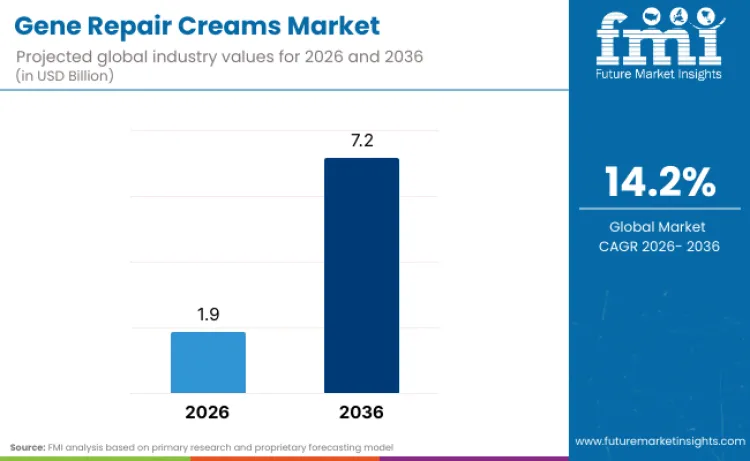
The global Gene Repair Creams market is projected to reach a valuation of USD 1.9 billion in 2026 and accelerate to USD 7.2 billion by 2036, expanding at a robust 14.2% CAGR. Demand for gene repair creams, as per Future Market Insights, is being driven by a growing understanding that visible skin ageing is influenced more by environmental and lifestyle factors than genetics alone. This shift is supported by advances in epigenetic science, where skincare formulations are designed to influence how skin cells respond to external stressors such as UV exposure, pollution, climate, diet, and sleep.
Dr. Nadine Pernodet emphasized this paradigm by stating: “Genes are responsible for just 25 per cent of the signs of ageing. The other 75 per cent? It’s all down to environment - UV exposure, climate, lifestyle choices such as diet and sleep or, as scientists like to describe it, epigenetics.” This perspective highlights how the industry is moving beyond traditional anti-ageing chemistry toward epigenetic skincare that aims to influence cellular behavior rather than merely treating surface symptoms.
Enhanced research into environmental stress response and cellular repair mechanisms is enabling manufacturers to position gene repair creams as biologically informed solutions rather than cosmetic products. Brands are responding to this scientific direction by integrating epigenetic principles into formulation strategies, aligning skincare with measurable cellular resilience and long-term skin health outcomes.
Summary of Gene Repair Creams Market
What Is Growth Outlook for Gene Repair Creams Market as per Future Market Insights Projection?
Future Market Insights projects the gene repair creams market to expand at a CAGR of 14.2% from 2026 to 2036, increasing from USD 1.9 Billion in 2026 to USD 7.2 Billion by 2036.
FMI Research Approach: FMI forecasting model based on clinical trial data, dermatology procedure growth, and enzyme-based skincare adoption.
How Do FMI Analysts Perceive Gene Repair Creams Market to Evolve?
FMI analysts view the market evolving toward epigenetic skincare and molecular repair, where creams correct UV-induced damage via DNA repair enzymes and active cellular signaling.
FMI Research Approach: Epigenetics and enzyme efficacy modeled through NIH studies and clinical dermatology trials.
Which Country Holds Largest Share in Global Gene Repair Creams Market?
China holds the largest market share, supported by post-procedure skincare integration within the booming light medical aesthetics segment.
FMI Research Approach: Country-level CAGR modeling aligned with light medical aesthetics growth and skincare clinic density.
How Large Will Gene Repair Creams Market Be by 2036?
The global gene repair creams market is projected to reach USD 7.2 Billion by 2036.
FMI Research Approach: Long-term revenue forecast based on photodamage incidence, dermatology channel expansion, and gene-targeted innovation pipelines.
What Is Definition of Gene Repair Creams Market?
The gene repair creams market includes topical formulations that repair DNA damage using enzymes like photolyase and T4 endonuclease V, peptides, or liposomal carriers to restore skin at the molecular level.
FMI Research Approach: Inclusion/exclusion framework built around clinical relevance, DNA repair validation, and dermatologist-recommended applications.
What Are Globally Unique Trends Shaping Gene Repair Creams Market?
Unique trends include CRISPR-based topical applications, enzyme-infused post-procedure skincare, and precision peptide delivery for photodamage reversal.
FMI Research Approach: Literature review across NIH, AAD, and peer-reviewed dermatology journals validating DNA repair and molecular skincare therapies.
Gene Repair Creams Market Key Takeaways
| Metric | Details |
|---|---|
| Industry Size (2026) | USD 1.9 Billion |
| Industry Value (2036) | USD 7.2 Billion |
| CAGR (2026-2036) | 14.2% |
Source: Future Market Insights (FMI) analysis, based on proprietary forecasting model and primary research
Which Factors Drive Gene Repair Creams Adoption?
Dermatology clinics are currently facing a critical surge in photodamage and skin cancer cases, creating an urgent clinical need for active therapies that move beyond passive sun protection. Research published by the National Institutes of Health highlights this transition, stating: “Topical application of these enzymes serves to supplement intrinsic DNA repair mechanisms. The direct repair of DNA damage by endogenous repair enzymes lessens rates of mutagenesis and strengthens the immune response to tumor cells.” This capability allows gene repair creams to function as therapeutic interventions rather than protective cosmetics.
A Phase III clinical trial further validated this direction by demonstrating that “use of a topically applied DNA repair enzyme (T4N5 liposome lotion) for 1 year reduced the incidence of basal cell carcinoma by 30% and actinic keratoses by 68%, compared with placebo.” Researchers at the University of British Columbia extended this innovation in January 2026 by proving that “it is possible to correct disease-causing mutations in human skin using a topical treatment that is safe, scalable and easy-to-use.” The integration of lipid nanoparticles to deliver CRISPR technology allows restoration of up to 30% of normal skin function, ensuring that specialist care can shift from prevention toward measurable molecular repair.
How is the Gene Repair Creams Market Segmented?
The gene repair creams market is segmented by product type, formulation, skin type, distribution channel, end user, and region to reflect the diverse pathways through which epigenetic and DNA repair skincare is adopted. By product type, the market includes anti aging gene repair creams, DNA repair moisturizers, skin regeneration creams, UV damage repair creams, and related formats that serve as the primary functional interface for molecular skin repair. By formulation, products include peptide based, stem cell based, enzyme based, botanical extract based, and other advanced compositions designed to support DNA repair and cellular recovery.
By skin type, demand spans sensitive skin, normal skin, dry skin, oily skin, and combination skin. By distribution channel, adoption is led by pharmacies and drug stores, online retail, specialty stores, supermarkets and hypermarkets, and dermatology clinics. By end user, usage is led by women, men, and unisex consumers. FMI analysis suggests that while advanced formulations are gaining visibility, the market structure remains anchored in familiar skincare routines. This segmentation highlights a dual track market where traditional cream formats provide continuity while gene repair positioning provides scientific credibility.
Why do Anti Aging Gene Repair Creams hold a Dominant Share?
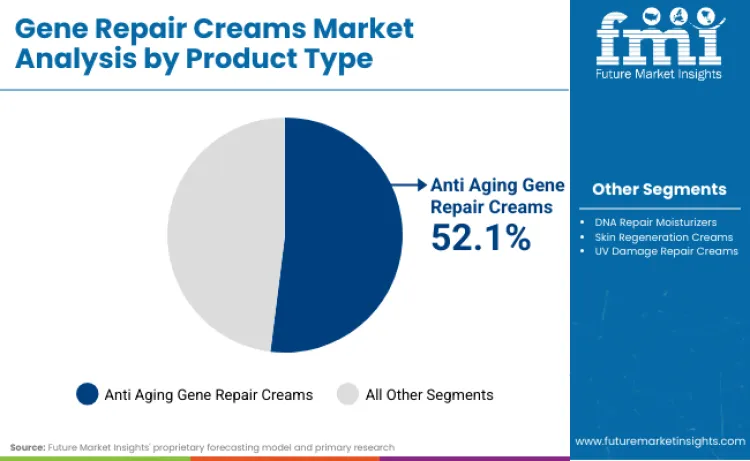
Anti aging gene repair creams command a dominant 52.1% because they are scientifically validated to address the root cause of photoaging which is DNA damage rather than masking visible symptoms. These creams move beyond traditional antioxidant approaches by using enzymes such as T4 endonuclease V and Photolyase that actively reverse UV induced molecular lesions within skin cells. This positions them as therapeutic skincare tools rather than cosmetic moisturizers. Dr. Ronald Moy, a leading dermatologist, explained the clinical necessity of this shift: “Antioxidants are about a 50 year old theory that we've since made improvements on instead of potentially mopping up DNA damage, we now know that we can attack damage head on.” This evidence driven confidence among practitioners protects the segment from displacement by conventional anti aging creams, as dermatologists increasingly prefer formulations that demonstrate measurable DNA repair rather than surface level protection.
Why does the Peptide Based Formulation Segment Dominate Market?
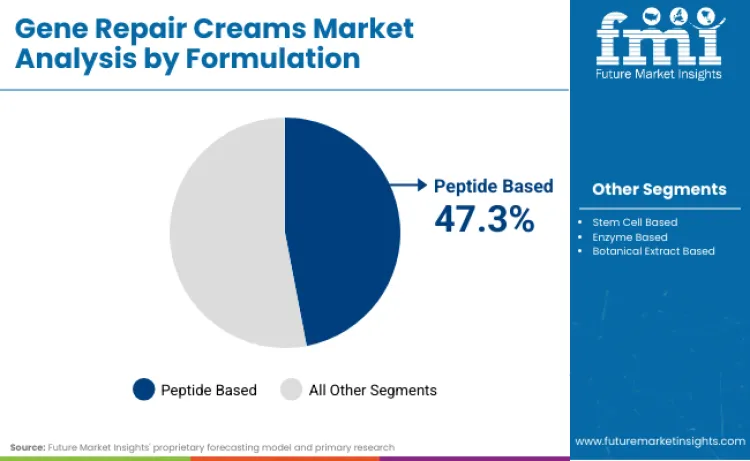
Peptide based formulations lead the gene repair creams market at 47.3%. Factors supporting the dominance include proven penetration capability, compatibility with DNA repair enzymes, and clinician preference for delivery systems that demonstrate measurable cellular interaction. Dermatologists increasingly rely on peptide carriers because they enhance the transport of active repair ingredients into deeper skin layers where molecular damage occurs. A key validation comes from clinical dermatology practice, where Dr. Vivian Bucay noted: “We know that topical enzymes can work. A good example of that would be sunscreen with DNA repair. A study in the Journal of Drugs in Dermatology concluded that this formulation penetrates the skin and the nucleus of the cell.” Rising evidence for nucleus level delivery and practitioner trust further amplify demand for peptide based systems in this segment. Such dynamics position peptide formulations as the cornerstone of sustained market expansion in advanced gene repair skincare.
Why Is Enzyme-Based DNA Repair Reshaping Skincare?
Enzyme-based DNA repair is fundamentally reshaping skincare by replacing passive protection strategies with active molecular correction of UV-induced damage. Clinical evaluation published in the Journal of Drugs in Dermatology demonstrated that “Compared to baseline, patients who used the repair enzyme had significantly fewer AKs than those using the control lotion after 8-weeks treatment. Specifically, there was a 46.6% percent decrease in AKs the DNA repair enzyme lotion group compared to a 32.7% decrease in the placebo group.” This evidence proves that topical enzymes do more than prevent damage, they reverse it at the cellular level. The technology allows dermatological formulations to directly interact with damaged DNA, effectively functioning as a form of precision molecular therapy by correcting lesions before they evolve into more serious skin conditions.
How Is Molecular "Precision Repair" Changing Clinical Practice?
Clinical dermatology is pivoting from general antioxidant protection toward targeted molecular intervention that enhances intrinsic repair pathways. Literature reviews published through ResearchGate and MDPI confirm that “Topical DNA repair enzymes do enhance removal of DNA damage and reduce the appearance of new actinic keratoses as well as increase regression of existing lesions.” This shift allows clinicians to recommend formulations that demonstrate measurable biological impact rather than cosmetic improvement alone. It reduces reliance on symptomatic treatments and moves skincare into the domain of preventive dermatological care, where correction of molecular damage becomes part of routine skin management for high-risk patients.
What Role Does Scientific Validation Play in Market Innovation?
Scientific validation is stabilizing confidence in enzyme-based formulations by anchoring innovation in fundamental biological research. The Nobel Prize in Chemistry recognized the importance of DNA repair systems by noting that “People born with defects in this repair system will develop skin cancer if they are exposed to sunlight.” This foundational understanding reinforces the necessity of supporting DNA repair externally when natural mechanisms are overwhelmed. As a result, market innovation is being guided by validated biological principles rather than cosmetic trends, encouraging the development of products that address the root cause of photoaging and UV-induced skin damage.
What is Gene Repair Creams Market Regional Outlook?
Sales in high UV exposure and dermatology aware markets are significantly outpacing the global average, driven by rising incidence of photodamage, skin cancer awareness, and clinical acceptance of DNA repair technologies. While the global market expands at 14.2%, countries with strong dermatological research ecosystems and regulatory support for advanced cosmeceuticals are adopting gene repair creams as preventive skin health tools rather than cosmetic solutions. China leads this growth with a 19.1% CAGR, followed by India at 17.8% and Germany at 16.3%, creating a new axis of demand centered on clinical skincare adoption. In contrast, markets like the United States (13.5%) and the United Kingdom (12.1%) are growing through consumer awareness and dermatology channel expansion rather than policy driven acceleration. FMI analysis indicates that future growth will be anchored in regions where sun exposure risk, aging demographics, and dermatology infrastructure intersect.
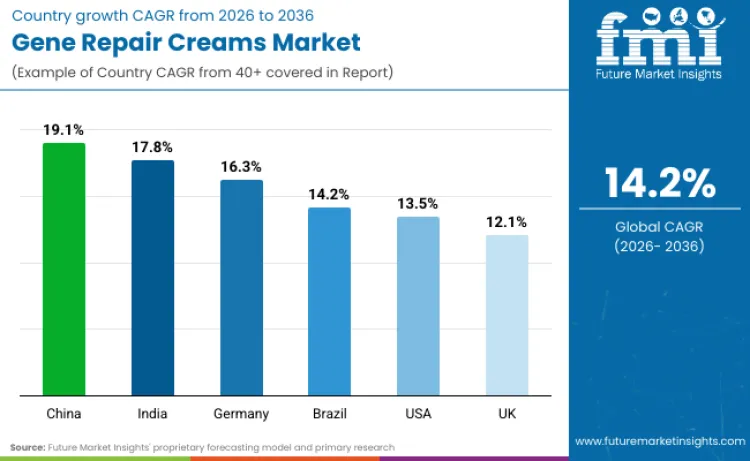
| Country | CAGR (2026 to 2036) |
|---|---|
| China | 19.1% |
| India | 17.8% |
| Germany | 16.3% |
| Brazil | 14.2% |
| United States | 13.5% |
| United Kingdom | 12.1% |
Source: FMI historical analysis and forecast data.
Why is China Building a Post Procedure Skincare Ecosystem?
China is expanding at a 19.1% CAGR, fueled by the explosive growth of light medical aesthetics and a consumer shift toward scientifically backed skincare. Industry analysis notes that China's light medical aesthetics and aftercare skincare segment is expanding rapidly as minimally invasive cosmetic procedures become mainstream among urban consumers. Deloitte projects that by 2030, China’s light medical beauty market could reach 415.7 billion RMB, creating strong downstream demand for clinically validated post procedure skincare. This shift is positioning gene repair and DNA repair creams as essential parts of dermatology aftercare protocols rather than optional cosmetic products. FMI analysis indicates that clinics, aesthetic studios, and dermatology centers are creating a structured ecosystem where scientifically supported topical repair solutions are integrated into routine aftercare. This infrastructure ensures repeated product usage, strengthens clinician recommendations, and creates sustained demand for gene repair creams across professional and consumer skincare channels nationwide.
Why is India Formalizing Medical Oversight in Aesthetic Treatments?
India is growing at a rapid 17.8% CAGR, driven by the CDSCO’s initiative to refine risk classification for medical and aesthetic technologies used in dermatology and oncology. On January 6th, 2025, the Central Drugs Standard Control Organization released draft guidance updating the risk categorization of numerous devices, including those used in dermatological procedures. The updated framework introduces clearer classifications and tighter oversight, bringing aesthetic technologies into a more medically supervised environment. This regulatory approach is formalizing how aesthetic treatments are evaluated, creating a setting where aftercare products must align with medically approved protocols. FMI analysis suggests that this risk standardization increases demand for clinically supported gene repair creams that comply with evolving treatment safety expectations. As dermatology procedures grow across urban India, regulated aftercare becomes critical, encouraging practitioners to recommend scientifically validated topical repair solutions that align with structured safety guidelines and patient monitoring practices across healthcare facilities.
Why is Germany Advancing Clinical Validation of DNA Repair?
Germany’s market is rising at a 16.3% CAGR due to its leadership in integrating DNA repair research into clinical dermatology practice. Scientific organizations such as the German Society for Research on DNA Repair actively promote the translation of genomic research into preventive skin health strategies. Medical literature highlights that enzymes such as photolyase and T4 endonuclease V, when incorporated into topical formulations, show promise in enhancing DNA repair and improving outcomes related to photoaging and skin cancer prevention. FMI analysis indicates that Germany’s strong research culture, academic collaboration, and clinical rigor are driving acceptance of gene repair creams as medically credible tools. Dermatologists increasingly view these formulations as part of long term photoprotection and skin maintenance strategies. This clinical validation reinforces consumer confidence and positions gene repair creams as scientifically grounded solutions rather than cosmetic enhancements within Germany’s advanced dermatology ecosystem.
Why is Brazil Encouraging Biological Innovation in Skincare Regulation?
Brazil is expanding at a 14.2% CAGR as ANVISA modernizes its regulatory framework to encourage innovation in biological and dermal action products. The 2024 to 2025 Regulatory Agenda focuses on harmonizing assessment procedures and accelerating approvals for innovative health and aesthetic products. Regulatory authorities are actively promoting discussions on how to create structured pathways that allow biologically active formulations to enter the market with clear compliance standards. FMI analysis suggests that this modernization creates an enabling environment for gene repair creams to be evaluated and approved through faster, transparent processes. As dermatology clinics and aesthetic centers grow in major Brazilian cities, practitioners seek advanced aftercare products supported by biological science. Regulatory clarity strengthens confidence in these formulations and encourages wider adoption of gene repair creams within professional skincare protocols across Brazil.
Why is the United States Encouraging Genomics Driven Skincare Innovation?
The United States is growing steadily as regulatory clarity improves around genomic and laboratory based innovations in dermatology. On September 19, 2025, the FDA restored earlier regulatory positioning regarding laboratory developed tests, allowing continued enforcement discretion and reducing compliance burdens for research driven innovation. This action stabilizes the investment environment for genomics and biotechnology applications that can translate into topical skincare solutions. FMI analysis indicates that this stability encourages research institutions and biotech firms to explore DNA repair technologies suitable for consumer dermatology products. As awareness of gene based skin health increases, dermatologists and skincare specialists are more open to recommending formulations grounded in molecular repair science. This environment supports gradual integration of gene repair creams into both clinical dermatology and premium consumer skincare markets across the United States.
Why is the United Kingdom Integrating Genomic Medicine into Dermatology?
The United Kingdom is advancing through the integration of genomic medicine into routine dermatology practice. Since 2020, genomic testing for skin diseases has been incorporated into mainstream clinical workflows, allowing dermatologists to interpret genetic data alongside traditional diagnostic methods. Educational initiatives from the Genomics Education Programme continue to equip clinicians with knowledge on applying genomic insights to skin health management. FMI analysis indicates that this integration fosters a healthcare environment where gene repair concepts are more easily understood and trusted by practitioners. As dermatologists become familiar with genomic mechanisms behind skin damage and repair, they are more inclined to recommend DNA repair based topical products. This growing clinical awareness is strengthening acceptance of gene repair creams within professional skincare recommendations across the UK.
How is the Competition in the Gene Repair Creams Market?
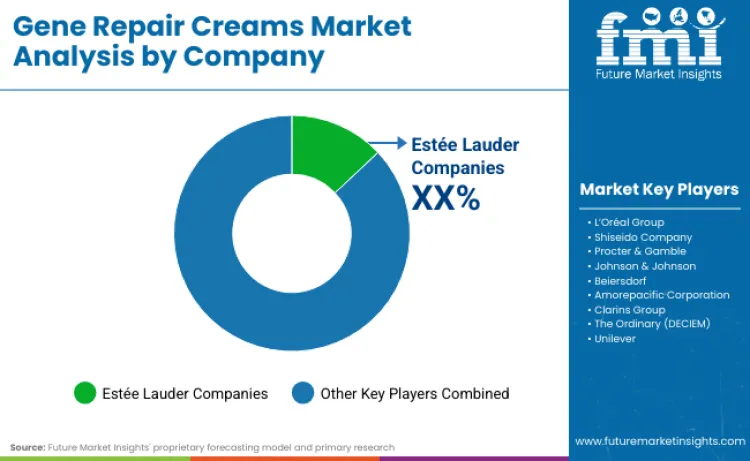
Established leaders in dermatological science protect their market share through decades of clinical validation, proprietary enzyme delivery systems, and strong relationships with dermatologists who act as primary gatekeepers for advanced skincare recommendations. These companies leverage proven DNA repair technologies based on enzymes such as photolyase and T4 endonuclease V to maintain trust among clinicians who prioritize evidence backed formulations for photodamage and skin cancer prevention.
Startups and research institutions are challenging this dominance by developing topical CRISPR based therapies and mRNA platforms that move beyond surface repair to permanent correction. "Dr. Sarah Hedtrich", senior author of a 2026 breakthrough study, validated the clinical utility of these new entrants: "With this work, we show that it is possible to correct disease-causing mutations in human skin using a topical treatment that is safe, scalable and easy-to-use." Strategic collaborations between universities, biotech firms, and dermatology research centers are further defining the competitive landscape by merging gene editing science with consumer dermatology. Even specialized formulation labs are aligning with genomic researchers to translate molecular breakthroughs into clinically usable topical applications that can integrate into standard dermatology aftercare routines.
Recent Developments:
- In December 2025, Pharma and biotech M&A activity accelerated in 2025 as companies shifted from cautious 2024 strategies to aggressive deal-making, targeting innovation, pipeline expansion, and competitive positioning amid patent expirations, rising competition, and AI-driven drug discovery advances across oncology, neuroscience, and cell therapy.
- In September 2025, Galderma launched four core Alastin® products in China, debuting its premium peri-procedural skincare range with a refreshed identity, reinforcing science-led positioning, regenerative care across treatment stages, and expansion into one of the fastest-growing aesthetic skincare markets.
Key Players in Gene Repair Creams Market
- Estée Lauder Companies
- L’Oréal Group
- Shiseido Company
- Procter & Gamble
- Johnson & Johnson
- Beiersdorf
- Amorepacific Corporation
- Clarins Group
- The Ordinary (DECIEM)
- Unilever
Market Definition
The Gene Repair Creams Market refers to advanced dermatological formulations designed to correct, reverse, or mitigate DNA level skin damage caused by ultraviolet radiation, oxidative stress, pollution, and aging. These products utilize scientifically validated mechanisms such as DNA repair enzymes, peptide based signaling systems, liposomal carriers, and emerging gene editing delivery technologies to restore cellular integrity rather than only improving surface appearance. Unlike conventional moisturizers or antioxidant creams, gene repair creams act on molecular pathways responsible for photoaging, mutation formation, and inflammatory skin responses. The market is closely aligned with dermatology aftercare, skin cancer prevention strategies, and medically recommended skincare routines. It bridges cosmetic dermatology and therapeutic skincare by offering clinically supported solutions that supplement intrinsic cellular repair systems and promote long term skin health resilience through targeted bioactive intervention.
Market Inclusion
The market includes topical formulations containing DNA repair enzymes such as photolyase and T4 endonuclease V, peptide based repair systems, stem cell derived actives, and liposomal or nanoparticle delivery platforms designed to enhance cellular repair. Products recommended by dermatologists for photodamage, actinic keratosis prevention, post procedure recovery, and anti aging cellular repair fall within scope. Gene repair moisturizers, UV damage repair creams, enzyme infused sunscreens, regenerative cosmeceuticals, and CRISPR inspired topical research applications are included. Distribution across pharmacies, dermatology clinics, medical aesthetic centers, and specialized skincare retail channels is covered. Products positioned as clinically validated solutions for DNA level repair, mutation reduction, or cellular regeneration are considered part of the market when supported by scientific mechanisms and dermatological use cases rather than purely cosmetic claims.
Market Exclusion
The market excludes conventional anti aging creams, antioxidant serums, herbal formulations, basic sunscreens without DNA repair technology, and cosmetic moisturizers that only address hydration or surface texture. Products relying solely on botanical extracts, vitamins, or fragrance based positioning without molecular repair mechanisms are not included. Injectable therapies, oral supplements, laser treatments, and in clinic dermatological procedures are outside scope unless directly linked to topical gene repair formulations. Decorative cosmetics, makeup products, and general skincare items without enzyme, peptide, or gene targeting functionality are excluded. Products marketed under clean beauty, natural beauty, or organic skincare categories without clinical evidence of DNA repair capability are also excluded, as the market strictly focuses on scientifically supported cellular repair technologies with dermatological relevance.
Scope of Report
| Items | Values |
|---|---|
| Quantitative Units | USD billion |
| Product Type | Anti-Aging Gene Repair Creams; DNA Repair Moisturizers; Skin Regeneration Creams; UV Damage Repair Creams; Others |
| Formulation | Peptide-Based Formulations; Stem Cell-Based Formulations; Enzyme-Based Formulations; Botanical Extract-Based Formulations; Others |
| Skin Type | Sensitive Skin; Normal Skin; Dry Skin; Oily Skin; Combination Skin |
| Distribution Channel | Pharmacies & Drug Stores; Online Retail; Specialty Stores; Dermatology Clinics; Supermarkets & Hypermarkets |
| End User | Women; Men; Unisex |
| Technology & Repair Mechanism Focus | DNA Repair Enzyme Systems (Photolyase, T4 Endonuclease V); Peptide Signaling Platforms; Liposomal & Nanoparticle Delivery Systems; Epigenetic & Cellular Regeneration Actives; Post-Procedure Molecular Repair Solutions |
| Regions Covered | North America, Europe, Asia Pacific, Latin America, Middle East & Africa |
| Countries Covered | China, India, Germany, Brazil, United States, United Kingdom, Japan, South Korea, France, and 40+ countries |
| Key Companies Profiled | Estée Lauder Companies; L’Oréal Group; Shiseido Company; Procter & Gamble; Johnson & Johnson; Beiersdorf; Amorepacific Corporation; Clarins Group; The Ordinary (DECIEM); Unilever |
| Additional Attributes | Dollar sales by product type, formulation, skin type, distribution channel, and end user; performance benchmarking across DNA repair efficacy, photodamage reversal, cellular regeneration speed, and long-term skin resilience; adoption trends within dermatology aftercare and preventive skin health protocols; impact on clinical recommendation rates, repeat usage, and post-procedure recovery outcomes; regulatory influence on enzyme-based skincare validation and cosmeceutical approvals; procurement dynamics across pharmacies, dermatology clinics, and premium skincare retail networks |
Gene Repair Creams Market by Segments
By Product Type:
- Anti-Aging Gene Repair Creams
- DNA Repair Moisturizers
- Skin Regeneration Creams
- UV Damage Repair Creams
- Others
By Formulation:
- Peptide-Based Formulations
- Stem Cell-Based Formulations
- Enzyme-Based Formulations
- Botanical Extract-Based Formulations
- Others
By Skin Type:
- Sensitive Skin
- Normal Skin
- Dry Skin
- Oily Skin
- Combination Skin
By Distribution Channel:
- Pharmacies and Drug Stores
- Online Retail
- Specialty Stores
- Dermatology Clinics
- Supermarkets and Hypermarkets
By End User:
- Women
- Men
- Unisex
By Region:
- North America
- Europe
- East Asia
- South Asia
- Latin America
- Middle East & Africa
Bibliography
- Journal of Drugs in Dermatology. (2024). Clinical evaluation of topical DNA repair enzymes (T4 endonuclease V, photolyase) in actinic keratoses and photodamage management.
- Journal of Investigative Dermatology. (2025). Mechanisms of UV‑induced DNA damage and topical enzymatic repair in human epidermis.
- American Academy of Dermatology. (2024). Photodamage, actinic keratosis prevention, and evidence‑based topical repair approaches.
Frequently Asked Questions
What is the current global market size for Gene Repair Creams?
The global Gene Repair Creams market is valued at USD 1.9 billion in 2026.
What is the projected CAGR for the Gene Repair Creams market?
The market is projected to grow at a 14.2% CAGR from 2026 to 2036.
Which segment currently dominates the industry?
Anti-aging gene repair creams lead with a 52.1% share while peptide-based formulations dominate with about 47.3%.
What are the primary drivers for adoption in high-growth regions?
Adoption is driven by rising photodamage incidence, clinical validation of DNA repair enzymes, and regulatory support for advanced cosmeceuticals in China, India, and Germany.
Who are the leading players in the Gene Repair Creams space?
Leading companies include Estée Lauder Companies, L’Oréal Group, Shiseido Company, Procter & Gamble, Johnson & Johnson, Beiersdorf, Amorepacific Corporation, Clarins Group, The Ordinary (DECIEM), and Unilever.
Preview the report firsthand - request a free sample
Get SampleGet the brochure for pricing and purchase details.
Get PDFTable of Content
- Executive Summary
- Global Market Outlook
- Demand-side Trends
- Supply-side Trends
- Technology Roadmap Analysis
- Analysis and Recommendations
- Market Overview
- Market Coverage / Taxonomy
- Market Definition / Scope / Limitations
- Research Methodology
- Chapter Orientation
- Analytical Lens and Working Hypotheses
- Market Structure, Signals, and Trend Drivers
- Benchmarking and Cross-market Comparability
- Market Sizing, Forecasting, and Opportunity Mapping
- Research Design and Evidence Framework
- Desk Research Programme (Secondary Evidence)
- Company Annual and Sustainability Reports
- Peer-reviewed Journals and Academic Literature
- Corporate Websites, Product Literature, and Technical Notes
- Earnings Decks and Investor Briefings
- Statutory Filings and Regulatory Disclosures
- Technical White Papers and Standards Notes
- Trade Journals, Industry Magazines, and Analyst Briefs
- Conference Proceedings, Webinars, and Seminar Materials
- Government Statistics Portals and Public Data Releases
- Press Releases and Reputable Media Coverage
- Specialist Newsletters and Curated Briefings
- Sector Databases and Reference Repositories
- FMI Internal Knowledge Base and Historical Datasets
- Subscription Datasets and Paid Sources
- Social Channels, Communities, and Digital Listening Inputs
- Additional Desk Sources
- Expert Input and Fieldwork (Primary Evidence)
- Primary Modes
- Qualitative Interviews and Expert Elicitation
- Quantitative Surveys and Structured Data Capture
- Blended Approach
- Why Primary Evidence is Used
- Field Techniques
- Interviews
- Surveys
- Focus Groups
- Observational and In-context Research
- Social and Community Interactions
- Stakeholder Universe Engaged
- C-suite Leaders
- Board Members
- Presidents and Vice Presidents
- R&D and Innovation Heads
- Technical Specialists
- Domain Subject-matter Experts
- Scientists
- Physicians and Other Healthcare Professionals
- Governance, Ethics, and Data Stewardship
- Research Ethics
- Data Integrity and Handling
- Primary Modes
- Tooling, Models, and Reference Databases
- Desk Research Programme (Secondary Evidence)
- Data Engineering and Model Build
- Data Acquisition and Ingestion
- Cleaning, Normalisation, and Verification
- Synthesis, Triangulation, and Analysis
- Quality Assurance and Audit Trail
- Market Background
- Market Dynamics
- Drivers
- Restraints
- Opportunity
- Trends
- Scenario Forecast
- Demand in Optimistic Scenario
- Demand in Likely Scenario
- Demand in Conservative Scenario
- Opportunity Map Analysis
- Product Life Cycle Analysis
- Supply Chain Analysis
- Investment Feasibility Matrix
- Value Chain Analysis
- PESTLE and Porter's Analysis
- Regulatory Landscape
- Regional Parent Market Outlook
- Production and Consumption Statistics
- Import and Export Statistics
- Market Dynamics
- Global Gene Repair Creams Market Analysis 2021 to 2025 and Forecast, 2026 to 2036
- Historical Market Size Value (USD Billion) Analysis, 2021 to 2025
- Current and Future Market Size Value (USD Billion) Projections, 2026 to 2036
- Y-o-Y Growth Trend Analysis
- Absolute $ Opportunity Analysis
- Global Gene Repair Creams Market Pricing Analysis 2021 to 2025 and Forecast 2026 to 2036
- Y-o-Y Growth Trend Analysis 2021 to 2025
- Absolute $ Opportunity Analysis 2026 to 2036
- Global Gene Repair Creams Market Analysis 2021 to 2025 and Forecast 2026 to 2036, By Product Type
- Introduction / Key Findings
- Historical Market Size Value (USD Billion) Analysis By Product Type, 2021 to 2025
- Current and Future Market Size Value (USD Billion) Analysis and Forecast By Product Type, 2026 to 2036
- Anti-Aging Gene Repair Creams
- DNA Repair Moisturizers
- Skin Regeneration Creams
- UV Damage Repair Creams
- Others
- Y-o-Y Growth Trend Analysis By Product Type, 2021 to 2025
- Absolute $ Opportunity Analysis By Product Type, 2026 to 2036
- Global Gene Repair Creams Market Analysis 2021 to 2025 and Forecast 2026 to 2036, By Formulation
- Introduction / Key Findings
- Historical Market Size Value (USD Billion) Analysis By Formulation, 2021 to 2025
- Current and Future Market Size Value (USD Billion) Analysis and Forecast By Formulation, 2026 to 2036
- Peptide-Based Formulations
- Stem Cell-Based Formulations
- Enzyme-Based Formulations
- Botanical Extract-Based Formulations
- Others
- Y-o-Y Growth Trend Analysis By Formulation, 2021 to 2025
- Absolute $ Opportunity Analysis By Formulation, 2026 to 2036
- Global Gene Repair Creams Market Analysis 2021 to 2025 and Forecast 2026 to 2036, By Skin Type
- Introduction / Key Findings
- Historical Market Size Value (USD Billion) Analysis By Skin Type, 2021 to 2025
- Current and Future Market Size Value (USD Billion) Analysis and Forecast By Skin Type, 2026 to 2036
- Sensitive Skin
- Normal Skin
- Dry Skin
- Oily Skin
- Combination Skin
- Y-o-Y Growth Trend Analysis By Skin Type, 2021 to 2025
- Absolute $ Opportunity Analysis By Skin Type, 2026 to 2036
- Global Gene Repair Creams Market Analysis 2021 to 2025 and Forecast 2026 to 2036, By Distribution Channel
- Introduction / Key Findings
- Historical Market Size Value (USD Billion) Analysis By Distribution Channel, 2021 to 2025
- Current and Future Market Size Value (USD Billion) Analysis and Forecast By Distribution Channel, 2026 to 2036
- Pharmacies & Drug Stores
- Online Retail
- Specialty Stores
- Dermatology Clinics
- Supermarkets & Hypermarkets
- Y-o-Y Growth Trend Analysis By Distribution Channel, 2021 to 2025
- Absolute $ Opportunity Analysis By Distribution Channel, 2026 to 2036
- Global Gene Repair Creams Market Analysis 2021 to 2025 and Forecast 2026 to 2036, By End User
- Introduction / Key Findings
- Historical Market Size Value (USD Billion) Analysis By End User, 2021 to 2025
- Current and Future Market Size Value (USD Billion) Analysis and Forecast By End User, 2026 to 2036
- Women
- Men
- Unisex
- Y-o-Y Growth Trend Analysis By End User, 2021 to 2025
- Absolute $ Opportunity Analysis By End User, 2026 to 2036
- Global Gene Repair Creams Market Analysis 2021 to 2025 and Forecast 2026 to 2036, By Region
- Introduction
- Historical Market Size Value (USD Billion) Analysis By Region, 2021 to 2025
- Current Market Size Value (USD Billion) Analysis and Forecast By Region, 2026 to 2036
- North America
- Latin America
- Western Europe
- Eastern Europe
- East Asia
- South Asia and Pacific
- Middle East & Africa
- Market Attractiveness Analysis By Region
- North America Gene Repair Creams Market Analysis 2021 to 2025 and Forecast 2026 to 2036, By Country
- Historical Market Size Value (USD Billion) Trend Analysis By Market Taxonomy, 2021 to 2025
- Market Size Value (USD Billion) Forecast By Market Taxonomy, 2026 to 2036
- By Country
- United States
- By Product Type
- By Formulation
- By Skin Type
- By Distribution Channel
- By End User
- By Country
- Market Attractiveness Analysis
- By Country
- By Product Type
- By Formulation
- By Skin Type
- By Distribution Channel
- By End User
- Key Takeaways
- Latin America Gene Repair Creams Market Analysis 2021 to 2025 and Forecast 2026 to 2036, By Country
- Historical Market Size Value (USD Billion) Trend Analysis By Market Taxonomy, 2021 to 2025
- Market Size Value (USD Billion) Forecast By Market Taxonomy, 2026 to 2036
- By Country
- Brazil
- By Product Type
- By Formulation
- By Skin Type
- By Distribution Channel
- By End User
- By Country
- Market Attractiveness Analysis
- By Country
- By Product Type
- By Formulation
- By Skin Type
- By Distribution Channel
- By End User
- Key Takeaways
- Western Europe Gene Repair Creams Market Analysis 2021 to 2025 and Forecast 2026 to 2036, By Country
- Historical Market Size Value (USD Billion) Trend Analysis By Market Taxonomy, 2021 to 2025
- Market Size Value (USD Billion) Forecast By Market Taxonomy, 2026 to 2036
- By Country
- Germany
- United Kingdom
- By Product Type
- By Formulation
- By Skin Type
- By Distribution Channel
- By End User
- By Country
- Market Attractiveness Analysis
- By Country
- By Product Type
- By Formulation
- By Skin Type
- By Distribution Channel
- By End User
- Key Takeaways
- East Asia Gene Repair Creams Market Analysis 2021 to 2025 and Forecast 2026 to 2036, By Country
- Historical Market Size Value (USD Billion) Trend Analysis By Market Taxonomy, 2021 to 2025
- Market Size Value (USD Billion) Forecast By Market Taxonomy, 2026 to 2036
- By Country
- China
- By Product Type
- By Formulation
- By Skin Type
- By Distribution Channel
- By End User
- By Country
- Market Attractiveness Analysis
- By Country
- By Product Type
- By Formulation
- By Skin Type
- By Distribution Channel
- By End User
- Key Takeaways
- South Asia and Pacific Gene Repair Creams Market Analysis 2021 to 2025 and Forecast 2026 to 2036, By Country
- Historical Market Size Value (USD Billion) Trend Analysis By Market Taxonomy, 2021 to 2025
- Market Size Value (USD Billion) Forecast By Market Taxonomy, 2026 to 2036
- By Country
- India
- By Product Type
- By Formulation
- By Skin Type
- By Distribution Channel
- By End User
- By Country
- Market Attractiveness Analysis
- By Country
- By Product Type
- By Formulation
- By Skin Type
- By Distribution Channel
- By End User
- Key Takeaways
- Market Structure Analysis
- Competition Dashboard
- Competition Benchmarking
- Market Share Analysis of Top Players
- By Regional
- By Product Type
- By Formulation
- By Skin Type
- By Distribution Channel
- By End User
- Competition Analysis
- Competition Deep Dive
- Assumptions & Acronyms Used


