

- Industry Size (2025)
- USD 6.1 Bn
- Forecast (2035)
- USD 8.4 Bn
- CAGR (2025 to 2035)
- 3.4%
Demand for Fortified Milk & Dairy in Japan Forecast and Outlook 2025 to 2035
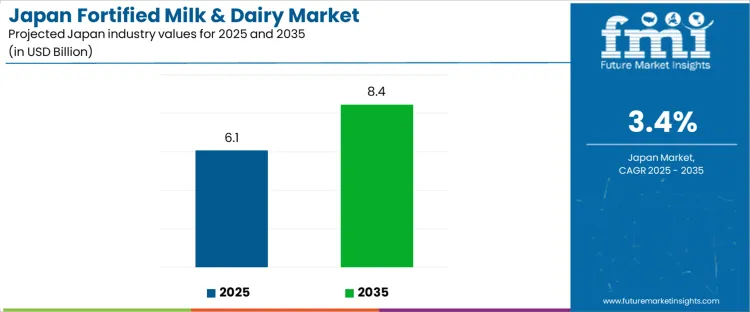
Demand for fortified milk and dairy in Japan is expected to grow from USD 6.1 billion in 2025 to USD 8.4 billion by 2035, reflecting a compound annual growth rate (CAGR) of 3.4%. Demand growth is driven by the rising popularity of functional foods, with fortified milk and dairy products offering added health benefits, including higher calcium, vitamin D, and other essential nutrients. Japan’s aging population and rising health-consciousness among consumers are driving the growth of fortified dairy products, as they support bone health, immune function, and overall well-being.
Growth is further supported by innovations in dairy processing, including new fortification techniques and the development of plant-based dairy alternatives that appeal to a broader range of consumers. As Japan continues to focus on health and wellness trends, the demand for fortified milk and dairy products is expected to rise steadily, with the market seeing increased adoption of products such as fortified milk, yogurt, and functional dairy beverages.
Quick Stats of the Demand for Fortified Milk & Dairy in Japan
- Demand for Fortified Milk & Dairy in Japan Value (2025): USD 6.1 billion
- Demand for Fortified Milk & Dairy in Japan Forecast Value (2035): USD 8.4 billion
- Demand for Fortified Milk & Dairy in Japan Forecast CAGR (2025-2035): 3.4%
- Demand for Fortified Milk & Dairy in Japan Leading Micronutrient: Minerals (65.0%)
- Demand for Fortified Milk & Dairy in Japan Key Growth Regions: Kyushu & Okinawa, Kanto, Kansai, Chubu, Tohoku, Rest of Japan
- Demand for Fortified Milk & Dairy in Japan Key Players: Arla Foods Ltd, FrieslandCampina, Fonterra Co-operative Group, Guangming Dairy Co. Ltd., The Kraft Heinz Company
What is the Growth Forecast for the Fortified Milk & Dairy Market through 2035?
The market growth curve for fortified milk and dairy in Japan shows consistent, gradual increases throughout the forecast period. Starting at USD 6.1 billion in 2025, the market grows steadily, reaching USD 6.3 billion in 2026 and USD 6.5 billion in 2027. These early years reflect moderate growth as consumers continue to adopt fortified dairy products as part of a health-conscious diet.
From 2027 to 2030, the industry continues its upward trajectory, with values reaching USD 6.7 billion in 2028, USD 6.9 billion in 2029, and USD 7.2 billion in 2030. This steady increase is driven by greater awareness of the health benefits of fortified dairy and continued innovation in product offerings. By 2035, the market is expected to reach USD 8.4 billion, reflecting consistent growth. The market growth curve shows a stable yet incremental rise, indicating sustained demand for fortified milk and dairy products as consumers prioritize functional nutrition and dairy-based health solutions.
Key Takeaways of Fortified Milk & Dairy Industry in Japan
| Metric | Value |
|---|---|
| Industry Sales Value (2025) | USD 6.1 billion |
| Industry Forecast Value (2035) | USD 8.4 billion |
| Industry Forecast CAGR (2025-2035) | 3.4% |
What Is Driving the Demand for Fortified Milk & Dairy in Japan?
Demand for fortified milk and dairy products in Japan is shaped by rising consumer interest in health, nutrition, and functional foods. As public awareness increases about nutrition, immunity, bone health, and digestive wellbeing, dairy producers have responded by offering milk, yogurt, and dairy-based drinks that are enriched with vitamins, minerals, probiotics, or enhanced protein content. The shift toward functional and value-added dairy reflects a broader trend in which Japanese consumers seek more than basic nutrition from their dairy intake. Traditional dairy consumption patterns have been supplemented with interest in products that support long term health, especially among older adults and health conscious segments. This evolving demand has encouraged manufacturers and retailers to expand fortified dairy offerings across retail and convenience channels.
Future demand for fortified milk and dairy in Japan is expected to grow as demographic trends and lifestyle changes continue to reinforce the appeal of nutritionally enhanced dairy products. Growth will likely be supported by increasing health awareness across all age groups, continued interest in gut health and immunity, and demand for dairy products that align with dietary needs, such as higher-protein or vitamin-fortified options. Expansion of ready-to-drink dairy beverages, probiotic yogurts, and fortified milk aimed at bone and immune health can be anticipated. The pace of growth will depend on how well producers maintain quality, ensure effective distribution, and meet evolving consumer preferences for nutritional value, convenience, and functional benefits.
What Are the Key Segments in Fortified Milk & Dairy Market in Japan?
Fortified milk and dairy market in Japan is segmented by product type and micronutrient. Milk is the leading product type, holding 23% of the market share. In terms of micronutrients, minerals dominate, accounting for 65% of the market. The growing demand for nutrient-enhanced dairy products, driven by health-conscious consumers seeking functional foods, is propelling the growth of the fortified milk and dairy market in Japan.
Which Product Type Drives Fortified Milk & Dairy Demand in Japan?
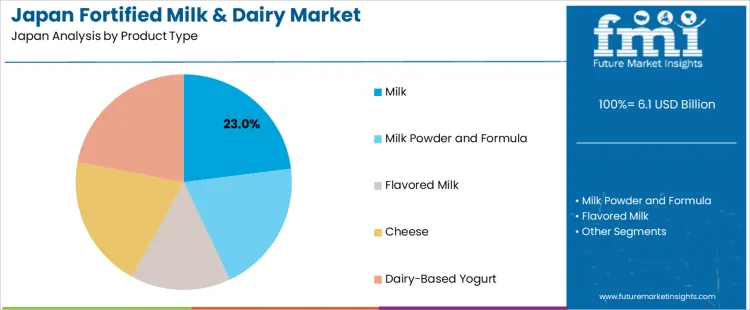
Milk is the most widely consumed product type in the fortified milk and dairy market in Japan, representing 23% of the market share. Fortified milk is a popular source of essential nutrients such as calcium, vitamin D, and other minerals, catering to consumers looking to improve bone health, immune function, and overall well-being. The demand for fortified milk is driven by its widespread use in daily diets, especially among families, children, and elderly individuals who are looking to improve their nutrient intake. While other dairy products like milk powder and formula, flavored milk, cheese, and dairy-based yogurt also contribute to the market, milk remains the dominant product due to its core role in the Japanese diet and its effectiveness in delivering essential micronutrients in a convenient, easy-to-consume form.
Which Micronutrient Drives Fortified Milk & Dairy Demand in Japan?
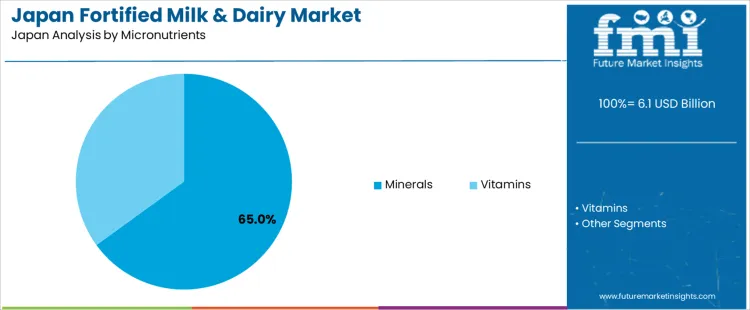
Minerals are the dominant micronutrient in the fortified milk and dairy market in Japan, holding 65% of the market share. Minerals, particularly calcium, are crucial for bone health, which is a significant concern in Japan’s aging population. Fortified dairy products are commonly enriched with calcium, magnesium, and other essential minerals to address common nutritional deficiencies and promote overall health. The demand for mineral-enriched dairy products is driven by the growing awareness of the importance of bone health and the rising prevalence of osteoporosis, especially among older adults. Vitamins are also added to fortified dairy products, but minerals, particularly calcium, remain the primary micronutrient driving market growth due to their direct impact on health and well-being.
What is the Key Dynamics for Fortified Milk & Dairy Demand in Japan?
Demand for fortified milk and dairy in Japan is being shaped by growing consumer focus on health, nutrition, and functional benefits. As the population ages and health awareness rises, more consumers are turning to dairy products enriched with vitamins, minerals, protein, or probiotics. Products such as fortified milk, yogurt, and functional dairy drinks are increasingly preferred over plain milk because they offer added nutritional value, convenience, and support for bone health, immunity, and general well being. This shift is influencing producers to expand fortified dairy lines and invest in value added dairy formulations.
What are the Key Drivers for Fortified Milk & Dairy Demand in Japan?
One main driver is rising health consciousness among consumers, especially older adults and urban populations seeking nutrient rich diets. Fortified dairy appeals as a source of calcium, protein, vitamin D and other micronutrients that support bone health and overall wellness. The trend toward functional foods and beverages is encouraging consumption of fortified milk, probiotic yogurt, and value added dairy drinks. Growth in retail distribution-supermarkets, convenience stores, and modern retail channels-plus increasing availability of functional dairy options are supporting market expansion. Demand for protein enhanced dairy and fortified products among fitness focused or health aware consumers is also strengthening the market.
What are the Restraints for Fortified Milk & Dairy Demand in Japan?
A constraint is the declining domestic fluid milk production resulting from decreasing milking cow population, which may limit supply of milk raw material and increase costs for fortified dairy products. Price sensitivity among some consumers may limit adoption of higher price fortified products compared to standard dairy. Competition from non dairy alternatives or alternative protein sources may pose challenges. Dietary preferences that avoid additives or fortified foods may curtail demand among some segments. Seasonal or economic fluctuations could impact consumer spending on premium fortified dairy products.
What are the Key Trends in Fortified Milk & Dairy Demand in Japan?
A prominent trend is rising popularity of probiotic fortified dairy and functional yogurt drinks aimed at gut health, immunity, and longevity. There is increasing consumer interest in high protein and lactose reduced dairy offerings catering to aging population and fitness oriented groups. Fortified milk and dairy products with value added nutrition and wellness positioning are being launched by leading producers. Another trend is growth in specialty dairy segments-including organic, lactose managed, fortified, and functional dairy-responding to shifts toward health and dietary awareness. Distribution expansion through supermarkets, convenience stores and modern retail is making fortified dairy more accessible across urban and rural markets.
What is the Regional Demand Outlook for Fortified Milk & Dairy in Japan?
Demand for fortified milk and dairy in Japan is projected to grow steadily, with Kyushu & Okinawa leading the way at a projected CAGR of 4.2%. Kanto follows with a growth rate of 3.9%, while Kansai is expected to grow at 3.4%. Chubu is projected to grow at a rate of 3.0%, while Tohoku and Rest of Japan show more moderate growth, with CAGRs of 2.6% and 2.5%, respectively. Increasing focus on health and wellness, coupled with the demand for nutrient-enriched food products, is driving the consumption of fortified milk and dairy products across Japan.
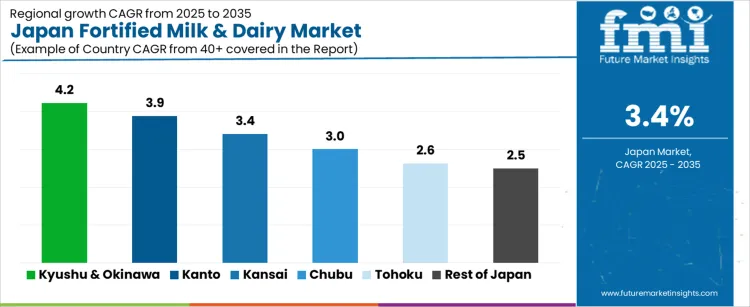
| Region | CAGR (2025-2035) |
|---|---|
| Kyushu & Okinawa | 4.2% |
| Kanto | 3.9% |
| Kansai | 3.4% |
| Chubu | 3.0% |
| Tohoku | 2.6% |
| Rest of Japan | 2.5% |
What is Driving the Growth of Fortified Milk & Dairy in Kyushu & Okinawa?
Kyushu & Okinawa is projected to experience the highest growth in the fortified milk and dairy market, with a projected CAGR of 4.2%. The region's increasing health consciousness, particularly among its aging population, is driving the demand for dairy products fortified with essential nutrients, such as calcium and vitamins. The growing preference for nutrient-enriched products to support bone health, immune function, and overall well-being is contributing to the rise in consumption of fortified milk and dairy products. Furthermore, the region's emphasis on natural and clean-label products is also supporting the adoption of fortified dairy options that align with the health-focused trends. The increasing availability of fortified dairy in local supermarkets and grocery stores is expected to further drive growth in this sector.
Why is the Fortified Milk & Dairy Market Expanding in Kanto?
In Kanto, the demand for fortified milk and dairy is projected to grow at a CAGR of 3.9%. Kanto, with Tokyo as its center, is Japan’s largest and most urbanized region. The region's high population density and increasing health awareness are key factors contributing to the growing demand for fortified milk and dairy products. As consumers in Kanto become more health-conscious, they are seeking products that offer additional nutritional benefits. Fortified milk and dairy, particularly those enriched with calcium, vitamin D, and probiotics, are increasingly popular among Kanto’s urban population. Additionally, the convenience of fortified dairy products, particularly in ready-to-consume formats, is fueling market growth. The region's extensive retail networks and high consumer purchasing power further support the expansion of the fortified milk and dairy market.
How is the Fortified Milk & Dairy Market Growing in Kansai?
In Kansai, the fortified milk and dairy market is projected to grow at a CAGR of 3.4%. Kansai, which includes major cities like Osaka and Kyoto, has a strong demand for health-focused and functional foods. The region’s growing interest in wellness products is driving the adoption of fortified dairy, especially among younger and health-conscious consumers. Kansai’s food industry is increasingly focusing on nutritional enhancement, offering fortified dairy options that cater to the needs of consumers looking to boost their nutrient intake. As Kansai continues to prioritize healthy living and nutritional balance, the demand for fortified milk and dairy products, particularly those that support immunity, digestion, and bone health, is expected to increase steadily.
What is Contributing to the Growth of Fortified Milk & Dairy in Chubu?
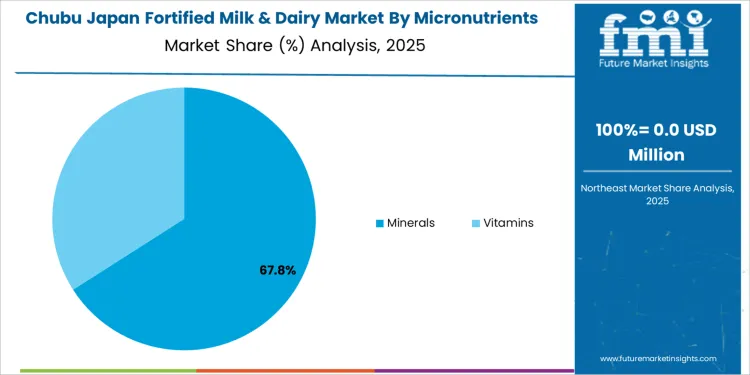
In Chubu, the fortified milk and dairy market is expected to grow at a CAGR of 3.0%. Chubu, which includes cities like Nagoya, has a well-developed food manufacturing sector that is increasingly focusing on developing nutrient-enriched dairy products. As consumers in Chubu become more health-conscious and seek out products that offer additional nutritional benefits, fortified milk and dairy products are gaining popularity. The region’s growing focus on nutrition and wellness, particularly among children and elderly consumers, is contributing to the demand for dairy products enriched with vitamins and minerals. As health trends continue to drive consumer choices in Chubu, the market for fortified milk and dairy is expected to expand steadily.
What is Influencing the Growth of Fortified Milk & Dairy in Tohoku?
In Tohoku, the fortified milk and dairy market is projected to grow at a CAGR of 2.6%. While growth is slower compared to more urbanized regions, the increasing interest in health and wellness is contributing to the demand for fortified dairy products. Tohoku's aging population is driving the adoption of dairy products fortified with calcium and other essential nutrients to support bone health and overall wellness. As consumer awareness about the benefits of fortified dairy grows, particularly in rural and less urbanized areas, the market for fortified milk and dairy in Tohoku is expected to see steady growth. The increasing availability of these products in local grocery stores is also supporting the market expansion in the region.
What is Contributing to the Growth of Fortified Milk & Dairy in Rest of Japan?
In Rest of Japan, the fortified milk and dairy market is expected to grow at a more moderate rate of 2.5%. Although demand is smaller compared to more urbanized regions, the increasing availability of fortified milk and dairy in rural and less densely populated areas is contributing to gradual market growth. Rest of Japan’s growing focus on health, particularly among the elderly population, is driving the adoption of fortified dairy products. With the rising demand for products that support bone health, immune function, and digestive health, the market for fortified milk and dairy is expected to continue growing steadily. As more local manufacturers and retailers introduce fortified dairy products to meet the growing consumer demand, the market is expected to see a steady rise across these areas.
What is the Competitive Landscape for Demand for Fortified Milk & Dairy in Japan?
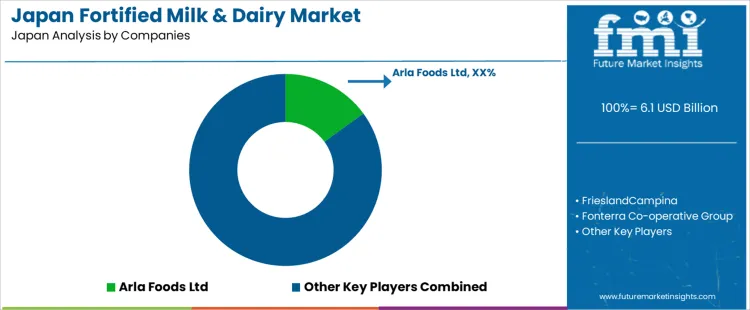
Demand for fortified milk and dairy products in Japan has been rising steadily as more consumers become health conscious and look for foods that offer added nutritional value. An aging population, growing interest in preventative health care, and rising awareness of bone health, immunity, and general wellness support this rising demand. The broader dairy market in Japan remains substantial, and within that, fortified dairy products-milk, milk based drinks, yogurts and other dairy items enriched with vitamins, minerals or probiotics-are gaining a growing share.
On the supply side, several major global dairy and food companies compete to serve this growing segment. According to your list, Arla Foods Ltd holds a leading share (about 15 %), followed by FrieslandCampina, Fonterra Co operative Group, Guangming Dairy Co. Ltd., and The Kraft Heinz Company. These firms are likely to supply fortified milk, enriched dairy drinks, or functional dairy products tailored for Japanese consumer preferences. Competition among them tends to center on product quality (taste, texture, nutritional profile), variety of fortification (vitamins, minerals, probiotics, etc.), packaging formats suited for convenience or on the go consumption, and distribution reach to retail outlets, supermarkets, convenience stores and modern trade. Companies with a strong track record in dairy quality, global supply chain reliability, and ability to adapt formulations to local tastes are best positioned to capture growth as demand rises for fortified dairy in Japan.
Key Players of the Fortified Milk & Dairy Industry in Japan
- Arla Foods Ltd
- FrieslandCampina
- Fonterra Co-operative Group
- Guangming Dairy Co. Ltd.
- The Kraft Heinz Company
Scope of the Report
| Items | Values |
|---|---|
| Quantitative Units (2025) | USD Billion |
| Product Type | Milk, Milk Powder and Formula, Flavored Milk, Cheese, Dairy-Based Yogurt |
| Micronutrients | Vitamins, Minerals |
| Sales Channel | Modern Trade, Convenience Stores, Departmental Stores, Drug Stores, Online Stores |
| Companies | Arla Foods Ltd, FrieslandCampina, Fonterra Co-operative Group, Guangming Dairy Co. Ltd., The Kraft Heinz Company |
| Regions Covered | Kyushu & Okinawa, Kanto, Kansai, Chubu, Tohoku, Rest of Japan |
| Additional Attributes | Dollar by sales by product type, micronutrients, sales channel, and region. Includes fortified milk and dairy product health benefits, nutritional profiles, market trends towards functional foods, product differentiation (flavors, formulations), packaging innovations, shelf life stability, demand for specific vitamins and minerals, cost-effectiveness in production, market share and competitive positioning of key companies, and adaptation to consumer preferences in fortified dairy products. |
Key Segments in the Demand for Fortified Milk & Dairy in Japan
Product Type
- Milk
- Milk Powder and Formula
- Flavored Milk
- Cheese
- Dairy-Based Yogurt
Micronutrients
- Vitamins
- Minerals
Sales Channel
- Modern Trade
- Convenience Stores
- Departmental Stores
- Drug Stores
- Online Stores
Region
- Kyushu & Okinawa
- Kanto
- Kansai
- Chubu
- Tohoku
- Rest of Japan
Frequently Asked Questions
How big is the demand for fortified milk & dairy in Japan in 2025?
The demand for fortified milk & dairy in Japan is estimated to be valued at USD 6.1 billion in 2025.
What will be the size of fortified milk & dairy in Japan in 2035?
The market size for the fortified milk & dairy in Japan is projected to reach USD 8.4 billion by 2035.
How much will be the demand for fortified milk & dairy in Japan growth between 2025 and 2035?
The demand for fortified milk & dairy in Japan is expected to grow at a 3.4% CAGR between 2025 and 2035.
What are the key product types in the fortified milk & dairy in Japan?
The key product types in fortified milk & dairy in Japan are milk, milk powder and formula, flavored milk, cheese and dairy-based yogurt.
Which micronutrients segment is expected to contribute significant share in the fortified milk & dairy in Japan in 2025?
In terms of micronutrients, minerals segment is expected to command 65.0% share in the fortified milk & dairy in Japan in 2025.
Preview the report firsthand - request a free sample
Get SampleGet the brochure for pricing and purchase details.
Get PDFTable of Content
- Executive Summary
- Japan Market Outlook
- Demand-side Trends
- Supply-side Trends
- Technology Roadmap Analysis
- Analysis and Recommendations
- Market Overview
- Market Coverage / Taxonomy
- Market Definition / Scope / Limitations
- Market Background
- Market Dynamics
- Drivers
- Restraints
- Opportunity
- Trends
- Scenario Forecast
- Demand in Optimistic Scenario
- Demand in Likely Scenario
- Demand in Conservative Scenario
- Opportunity Map Analysis
- Product Life Cycle Analysis
- Supply Chain Analysis
- Investment Feasibility Matrix
- Value Chain Analysis
- PESTLE and Porter’s Analysis
- Regulatory Landscape
- Regional Parent Market Outlook
- Production and Consumption Statistics
- Import and Export Statistics
- Market Dynamics
- Japan Market Analysis 2020 to 2024 and Forecast, 2025 to 2035
- Historical Market Size Value (USD Million) Analysis, 2020 to 2024
- Current and Future Market Size Value (USD Million) Projections, 2025 to 2035
- Y-o-Y Growth Trend Analysis
- Absolute $ Opportunity Analysis
- Japan Market Pricing Analysis 2020 to 2024 and Forecast 2025 to 2035
- Japan Market Analysis 2020 to 2024 and Forecast 2025 to 2035, By Product Type
- Introduction / Key Findings
- Historical Market Size Value (USD Million) Analysis By Product Type , 2020 to 2024
- Current and Future Market Size Value (USD Million) Analysis and Forecast By Product Type , 2025 to 2035
- Milk
- Milk Powder and Formula
- Flavored Milk
- Cheese
- Dairy-Based Yogurt
- Y-o-Y Growth Trend Analysis By Product Type , 2020 to 2024
- Absolute $ Opportunity Analysis By Product Type , 2025 to 2035
- Japan Market Analysis 2020 to 2024 and Forecast 2025 to 2035, By Micronutrients
- Introduction / Key Findings
- Historical Market Size Value (USD Million) Analysis By Micronutrients, 2020 to 2024
- Current and Future Market Size Value (USD Million) Analysis and Forecast By Micronutrients, 2025 to 2035
- Minerals
- Vitamins
- Y-o-Y Growth Trend Analysis By Micronutrients, 2020 to 2024
- Absolute $ Opportunity Analysis By Micronutrients, 2025 to 2035
- Japan Market Analysis 2020 to 2024 and Forecast 2025 to 2035, By Sales Channel
- Introduction / Key Findings
- Historical Market Size Value (USD Million) Analysis By Sales Channel, 2020 to 2024
- Current and Future Market Size Value (USD Million) Analysis and Forecast By Sales Channel, 2025 to 2035
- Modern Trade
- Convenience Stores
- Departmental Stores
- Drug Stores
- Online Stores
- Y-o-Y Growth Trend Analysis By Sales Channel, 2020 to 2024
- Absolute $ Opportunity Analysis By Sales Channel, 2025 to 2035
- Market Structure Analysis
- Competition Dashboard
- Competition Benchmarking
- Market Share Analysis of Top Players
- By Regional
- By Product Type
- By Micronutrients
- By Sales Channel
- Competition Analysis
- Competition Deep Dive
- Arla Foods Ltd
- Overview
- Product Portfolio
- Profitability by Market Segments (Product/Age /Sales Channel/Region)
- Sales Footprint
- Strategy Overview
- Marketing Strategy
- Product Strategy
- Channel Strategy
- FrieslandCampina
- Fonterra Co-operative Group
- Guangming Dairy Co. Ltd.
- The Kraft Heinz Company
- Arla Foods Ltd
- Competition Deep Dive
- Assumptions & Acronyms Used
- Research Methodology


