

- Market Size (2026)
- USD 82.6 Bn
- Forecast (2036)
- USD 628.1 Bn
- CAGR (2026 to 2036)
- 22.5%
How big is the MENA digital transformation market in 2026?
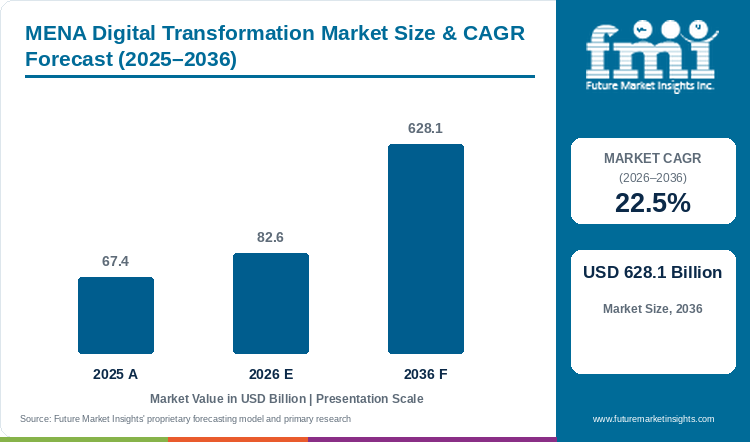
The MENA digital transformation market was estimated at USD 67.4 billion in 2025 and is expected to reach USD 82.6 billion in 2026. It is forecast to grow at a CAGR of 22.5% from 2026 to 2036 and reach USD 628.1 billion by 2036.
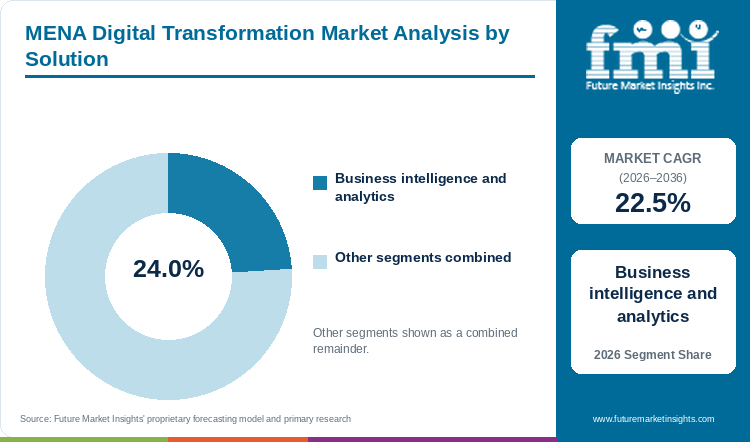
The MENA digital transformation market was valued at USD 67.4 billion in 2025 and is estimated to reach USD 82.6 billion in 2026. The market is projected to reach USD 628.1 billion by 2036, expanding at a compound annual growth rate (CAGR) of 22.5% between 2026 and 2036. Cloud accounted for the largest share of the market by deployment, contributing 53.0% of total revenue in 2026, while business intelligence and analytics led solution spending with a 24.0% share and technology implementation led the services mix with 31.0%. The demand for digital services is supported by a large connected user base, with GSMA estimating 308 million mobile internet users in MENA in 2024, and mobile technologies contributing USD 350.0 billion, or 5.7% of regional GDP. The growth in digital transformation spending is also reflected in infrastructure announcements, as Google Cloud opened its Dammam region in Saudi Arabia in September 2023, while AWS stated on 15 October 2026 that its first Saudi Arabia region was on track for a December 2026 launch. Companies are also investing to strengthen their position in the market. For instance, AWS and HUMAIN announced a strategic AI partnership in Saudi Arabia in May 2025, involving more than USD 5.0 billion of planned investment.
Key Market Trends & Insights
- Cloud leads the projected deployment mix, while workload location and integration remain central to the choice between cloud and on premises.
- Technology implementation and business intelligence and analytics represent important positions within their separate service and solution classifications.
- GSMA estimated 308 million mobile internet users in MENA in 2024, providing a substantial access base for digital services. [1]
Country Highlights
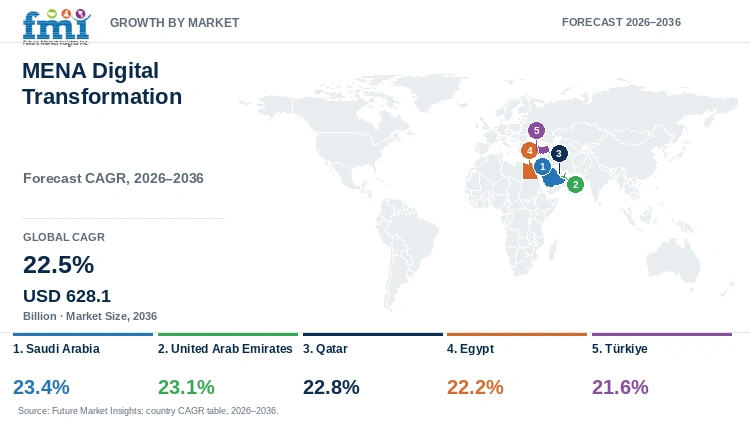
- Saudi Arabia has the highest forecast growth rate among the five profiled countries, followed by the United Arab Emirates and Qatar.
- Egypt and Türkiye complete the profiled country coverage, with government service integration providing distinct local operating contexts. [7][8]
Market Size & Forecast
Table 1: MENA Digital Transformation Market Size (2025) and Forecast (2026 to 2036), USD billion
| Market size and forecast | Value |
|---|---|
| 2025 Value | USD 67.4 billion |
| Estimated market size in 2026 | USD 82.6 billion |
| Projected market size by 2036 | USD 628.1 billion |
| CAGR (2026-2036) | 22.5% |
How do organisations turn digital plans into operating systems?
The outlook implies USD 545.5 billion of additional annual market value between 2026 and 2036. The opportunity covers solutions and services used in enterprise and government transformation; connectivity or hardware sold without the associated transformation platform is outside the stated scope. A platform purchase can initiate a much wider programme because the application must exchange data with existing systems and follow the organisation’s approval rules. The practical unit of delivery is often a working process, such as a service request that can be received, checked, approved and recorded through connected systems. This creates demand for both the software involved and the services needed to make that process dependable.
Infrastructure announcements are changing the sequence of those decisions. Google Cloud announced that its Dammam region was open in September 2023. AWS stated on 15 October 2026 that its first Saudi Arabia region was on track for a December 2026 launch. [3][4] The AWS-HUMAIN announcement described its proposed AI Zone investment separately from AWS’s planned region investment. [2] An operating region and a planned region offer different planning conditions. A buyer can assess dependencies before a new location becomes available, while retaining a transition schedule that reflects the actual availability of the required services. That work includes application discovery, licensing, data movement and the cost of running the workload after migration. It also gives implementation partners a practical role before the infrastructure purchase is finalised.
The global digital transformation market places similar enterprise decisions within a broader geographic setting, while public cloud application services concern a more specific software delivery model. Within MENA, the commercial relationship depends on what the buyer is trying to change. A shared reporting platform may require substantial data preparation, whereas a public service portal may depend on identity and payment connections. Suppliers gain a clearer basis for pricing when those dependencies are identified at the start. Buyers gain a more useful comparison of proposals when subscription costs, implementation work and continuing operational responsibilities are described separately.
Table 2: Supporting Industry Indicators and Their Commercial Relevance
| Indicator | Data point | Why it matters | Source |
|---|---|---|---|
| Mobile internet access | 308 million users in MENA in 2024 | Access base for mobile service delivery | [1] |
| Mobile economic contribution | USD 350.0 billion, or 5.7% of regional GDP, in 2024 | Broader connectivity context; separate from transformation revenue | [1] |
| Saudi AI partnership | More than USD 5.0 billion of planned AWS-HUMAIN investment, announced May 2025 | Potential demand for AI deployment, data and skills services | [2] |
| Saudi AWS region | December 2026 launch remained planned in October 2026 | Migration preparation precedes service availability | [3] |
| Abu Dhabi government systems | Strategy includes sovereign cloud and a unified ERP platform | Connects infrastructure purchasing with administrative process change | [5] |
Demand Intensity Analysis
Demand intensity reflects how deeply a digital system becomes embedded in daily work. A reporting tool used occasionally creates a different service commitment from an application handling transactions throughout the working day. As more functions depend on the same records, the buyer needs clearer permissions, reliable data exchange and an agreed response when a process stops. Spending can therefore extend from a first platform deployment into integration, additional workflows and digital operations. This relationship explains why a sizeable implementation services position can coexist with strong cloud adoption: the infrastructure location does not complete the operational change.
Software, implementation and hosting can enter the same programme through separate contracts. Their interaction affects the work needed to establish and maintain the resulting service. A cloud analytics installation, for example, may involve software, migration work, data connections and user support. The cloud analytics market and cross-cloud analytics market examine related analytical requirements, including the movement of information across platforms. In this regional assessment, such requirements affect the delivery burden and the choice of partner. They also influence whether a buyer can expand an initial deployment without rebuilding the data arrangements each time another function joins.
Table 3: Demand Metrics and Measurement Bases
| Demand intensity metric | Value | Basis |
|---|---|---|
| Cloud deployment | 53.0% in 2026 | Deployment mix in 2026. |
| Business intelligence and analytics | 24.0% in 2026 | Solution spending in 2026. |
| Technology implementation | 31.0% in 2026 | Services mix in 2026. |
| Regional expansion | 22.5% CAGR, 2026 to 2036 | Growth of the stated solutions and services market from 2026 to 2036. |
| Additional annual value | USD 545.5 billion, 2026 to 2036 | Difference between annual market values in 2026 and 2036. |
Analyst Perspective
Digital transformation suppliers in MENA can build a base for subsequent projects by connecting a buyer’s chosen platform to existing records and applications through a defined workflow. Integration design and clear responsibility for live services make that first deployment usable and give later purchases an operating foundation without requiring every dependent system to be replaced at once.
- Sudip Saha, Principal Analyst at Future Market Insights
How is the MENA digital transformation market segmented?
The market is classified by solution, service, deployment, enterprise size, industry and country. Solutions comprise Business intelligence and analytics, AI and IoT platforms, Cloud enablement, Enterprise mobility and collaboration, and Other solutions. Services comprise Consulting, Technology implementation, Technology integration and Digital operations. Deployment covers Cloud and On premises; enterprise size covers Small and medium-sized enterprises and Large enterprises. Industry coverage comprises Government, Financial services, Healthcare, IT and telecom, and Retail and other industries. The five profiled countries are Saudi Arabia, United Arab Emirates, Qatar, Egypt and Türkiye. These axes show different aspects of the same purchasing environment, from the application being bought to the organisation using it and the work required to keep it operating.
How do business intelligence and analytics lead spending by solution?
Business intelligence and analytics are projected to lead solution spending with a 24.0% share in 2026.
A useful analytical system connects a reported result to the records and decisions behind it. Departments may use different names for a customer, transaction or operating event. Bringing those records into one view requires agreed definitions and a process for correcting inconsistencies. The value of a dashboard therefore depends partly on work that happens before information reaches the screen. Buyers can assess that work through the handling of a real decision: how a manager investigates an unexpected result, finds the underlying transaction and assigns the follow-up action.
The other solution categories broaden the possible applications. AI and IoT platforms can introduce new sources and uses of data, while Cloud enablement and Enterprise mobility and collaboration support its movement and availability. Other solutions complete the classification. The commercial connection is the need to make information available to the appropriate people and systems. IBM’s watsonx portfolio illustrates the separate roles of AI development, data infrastructure and governance within an enterprise offer. [9]
- Consistent definitions and traceable source records make analytical outputs easier to use in routine management decisions.
- Data preparation and access design influence the amount of delivery work required around the analytical software.
How do workload requirements shape cloud deployment?
Cloud deployment is expected to represent 53.0% of the deployment mix in 2026.
The location of an application affects its connections to other services, its operating cost and the responsibilities of the support team. Local infrastructure can make a new deployment practical, but the suitability of individual workloads still matters. AWS’s Saudi migration guidance starts with workload assessment and projected running costs. [3] An application with tightly connected dependencies may need a different transition plan from a new service that can be built independently. The decision also includes how data will be copied, protected and reconciled during the move.
On premises remains the other deployment category. Where an organisation retains existing installations, the commercial requirement can involve connections between those systems and new cloud applications. Providers that explain the whole operating arrangement can price migration and continuing support more clearly. The buyer can then compare the cost of maintaining that arrangement with the business value of the process it supports.
- Application dependencies determine the sequence of migration and the integration work required before a workload can operate reliably.
- Retained installations create a continuing need for clear ownership of connections, access policies and operational support.
How does technology implementation lead demand by service?
Technology implementation is expected to lead the services mix with a 31.0% share in 2026.
Implementation turns the purchased platform into a working service. An approval process needs named decision roles, permission settings and a route for requests that require further information. A transaction must also reach the next system with the correct status. These details determine whether a project supports normal operations when staff begin using it. The service contract becomes more precise when it identifies the workflows being delivered and the conditions that demonstrate successful operation. That gives both the buyer and the delivery team a practical basis for accepting completed work.
Consulting, Technology integration and Digital operations describe the surrounding service stages in the taxonomy. Consulting can establish the process and investment priorities; integration connects the applications; operations maintains the live service. The boundaries between those stages affect pricing. A buyer needs to know whether a later change is covered by routine support or requires further implementation work, particularly when several suppliers contribute to the same workflow.
- Defined workflows give implementation teams a concrete delivery scope and buyers an operational basis for assessing completion.
- Clear terms for later configuration changes reduce uncertainty between project delivery and continuing digital operations.
How do enterprise size and delivery capacity affect purchasing?
Small and medium-sized enterprises and Large enterprises are the two enterprise-size categories in the report.
Enterprise size changes the resources available to manage a programme. A smaller organisation may need a supplier to combine configuration, training and support because its own staff also run daily operations. A large enterprise can have specialist teams but face a broader set of applications, business units and approval requirements. In either case, the delivery design needs to match the organisation’s ability to maintain what it buys. A staged programme can establish a useful process before adding further functions. Its commercial value depends on each stage working on its own while preserving a common data structure for subsequent expansion. This creates room for both packaged delivery and more extensive systems work without assuming the same contract suits every customer.
- Smaller organisations benefit from a defined operating service whose support responsibilities are clear at the point of purchase.
- Larger estates place more emphasis on common architecture and coordination across applications, teams and suppliers.
How does the industry using a platform change the delivery requirement?
Government, Financial services, Healthcare, IT and telecom, and Retail and other industries form the industry classification.
The workflow being changed determines what a digital programme must deliver. Government service integration involves identity, administrative records and the completion of citizen or business requests. Financial and healthcare processes can place sensitive records at the centre of the application, making permissions and traceability part of its operating design. IT and telecom programmes must connect services and support teams across an existing technical estate. Retail workflows link customer activity with fulfilment and internal records. These are different delivery problems even when buyers select similar cloud or analytics products. A supplier’s relevant experience is therefore most useful when it can show how a proposed design handles the buyer’s actual process and its exceptions, rather than presenting a broad catalogue of features.
- Industry relevance depends on the provider’s ability to connect the proposed technology to a complete operating workflow.
- Access, record quality and exception handling belong in the delivery scope because they affect whether the service can be used.
What are the drivers, restraints and opportunities in the MENA digital transformation market?
Wider mobile connectivity and public digital programmes create demand for connected services, while fragmented records and application dependencies can extend delivery schedules and raise costs. Suppliers have opportunities in reusable integration and workflow training, with continuing security and support responsibilities shaping the transition into live operation.
How does wider connectivity support service demand?
GSMA reported that mobile technologies contributed USD 350.0 billion, or 5.7% of regional GDP, in 2024. [1] Its regional assessment links advanced networks with consumer and business applications while identifying an ongoing usage gap. A digital service can therefore reach a substantial connected population, but its design still affects whether people complete the intended task. A mobile interface needs to fit the supporting administrative process and provide a route when information is incomplete. For enterprise buyers, this places demand on the systems behind the interface as well as on application development. A service that accepts requests electronically but requires staff to re-enter the same information leaves much of the operating work unchanged. Connecting the front end to the relevant records creates a broader project for software and service providers.
Why do data preparation and application dependencies restrain delivery?
The existing estate determines how quickly a new application can become operational. Records may sit in separate systems with different identifiers, while one application may depend on another for a transaction status or access decision. A project that overlooks these relationships can need further work after configuration appears complete. This creates a cost and scheduling constraint for the buyer. A clear delivery sequence begins with the information that the workflow needs and establishes how it will remain consistent across the connected systems. The opportunity for an integrator lies in resolving those dependencies in a reusable way. If each connection has an owner and a defined change process, later additions can use the same operating foundation instead of creating another set of disconnected records.
How do cybersecurity and governance affect the operating commitment?
Security requirements continue after deployment because applications, permissions and data connections change. Palo Alto Networks describes Prisma Cloud as covering code, infrastructure and runtime security, including cloud security posture management. [11] Such capabilities address a different purchasing need from the application’s business functionality. The buyer still needs an operating arrangement for reviewing findings and correcting the affected systems. That can involve application developers, infrastructure teams and the service partner responsible for support. Commercially, this creates demand for tools and for the work that turns their output into changes. Contracts become more usable when the response process and the responsibilities at each connection are defined, especially where a single business service relies on applications operated by different teams.
Where do public programmes create opportunities for suppliers?
Public digital programmes translate broad policy goals into specific system requirements. Abu Dhabi’s government strategy includes a unified ERP platform, while Egypt’s Digital Egypt programme describes linked government systems, digital identification and electronic payments. [5][7] These conditions support opportunities in process configuration, data exchange and service operation. A supplier can address one part of the programme while fitting the common architecture needed by the whole service. Skills development also matters because the organisation must be able to operate and adapt the system after delivery. The commercial opportunity includes training tied to the actual workflow, a controlled transition into live use and continuing assistance where responsibilities extend beyond the initial project. These services have a clearer value when they are attached to a defined administrative or enterprise result.
How do country outlooks compare across the profiled markets?
The five country forecasts share a common 2026 to 2036 period. Their operating contexts differ in the public programmes and infrastructure choices shaping delivery. Saudi Arabia combines an open Google Cloud region with planned AWS infrastructure and an announced AI partnership. In the United Arab Emirates, Abu Dhabi’s government programme creates an identifiable application and cloud agenda. Qatar’s Digital Agenda emphasises government efficiency and service evaluation. Egypt combines digital workflows with talent development, while Türkiye’s e-Government Gateway connects services from different institutions. [2][3][4][5][6][7][8]
Table 4: Country Growth Outlook and Local Operating Conditions
| Country | CAGR, 2026 to 2036 and operating context |
|---|---|
| Saudi Arabia | 23.4% Dammam Google Cloud region open; AWS region planned [3][4] Workload assessment and migration preparation |
| United Arab Emirates | 23.1% Abu Dhabi strategy includes unified ERP and sovereign cloud [5] Common platforms and cross-function delivery |
| Qatar | 22.8% Digital Agenda service monitoring and evaluation [6] Continuity and measurable service operation |
| Egypt | 22.2% Digital Egypt links workflows, skills and public systems [7] Staged deployment and operating capability |
| Türkiye | 21.6% Gateway integrates services through shared authentication [8] Connections and support across institutions |
How does Saudi Arabia's growth outlook relate to AI delivery work?
The AWS-HUMAIN partnership announced in May 2025 connects planned AI infrastructure with services and talent development in Saudi Arabia. [2] Against this operating backdrop, the country has the highest rate among the five profiled markets, with a forecast 23.4% CAGR from 2026 to 2036. Turning AI investment into an application used at work requires relevant data, suitable access and a process for acting on the output.
Google Cloud’s open Dammam region provides an established local infrastructure option, while AWS’s Saudi region remained planned as of October 2026. [3][4] This gives Saudi buyers a specific sequencing issue. Workload assessments and integration preparation can proceed before a planned location is available, while production commitments need to reflect the services actually ready for use. Delivery providers can contribute through application mapping and transition planning. Their value also extends into the operational handover, where responsibility for data connections and application support needs to be settled before staff rely on the resulting service.
How can organisations in the United Arab Emirates extend digital systems across functions?
Shared government systems are a concrete part of the United Arab Emirates’ delivery environment. Abu Dhabi’s Digital Strategy 2025-2027 includes sovereign cloud adoption, process automation and a unified ERP platform for government operations. [5] The national market is forecast to grow at a 23.1% CAGR from 2026 to 2036. Within the Abu Dhabi programme, connecting departmental workflows around common records becomes a central delivery task.
A shared platform requires agreement about who owns a record and which function can change it. When a process crosses departments, permissions and approval steps must accommodate those roles without creating separate versions of the same transaction. The purchasing implication is that configuration and organisational coordination form part of the application programme. A delivery team can define an initial administrative process and then extend that design to further functions. Each extension needs to preserve the common information structure while reflecting the responsibilities of the joining department. An extension can then reuse the common records while adding the permissions and approval stages required by the joining department.
What makes service continuity important to digital programmes in Qatar?
An electronic public service needs to remain usable while its supporting systems develop. Qatar’s market is projected to expand at a 22.8% CAGR from 2026 to 2036. In its May 2024 discussion of the Digital Agenda 2030, the Shura Council recorded the ministry’s focus on government efficiency, user experience and periodic evaluation of digital services. [6]
That service orientation makes the transition from an established process commercially important. Requests already under way need a route to completion after a new platform begins operating. Staff also need access to the appropriate status and supporting records when a user seeks help. The delivery requirement therefore includes migration of active work, exception handling and support arrangements across the connected agencies or systems. Providers can build their proposition around that full service journey. A system that produces consistent records and an observable completion status gives the operating organisation a practical foundation for evaluating the service and deciding which changes to prioritise next.
How can buyers in Egypt manage the full cost of a digital programme?
Digital skills sit alongside system delivery in MCIT’s Digital Egypt framework, which combines digital transformation, digital upskilling and digital innovation. [7] Egypt’s market is forecast to grow at a 22.2% CAGR from 2026 to 2036. The national transformation programme describes redesigned administrative procedures and linked government systems, supported by digital identification and payments. [7] These connected requirements make the operating cost wider than the software purchase alone.
A staged programme can align that commitment with the work being delivered. The initial stage needs to provide a usable process, while staff gain the skills to operate it and later stages retain compatible records. This creates a local opportunity for suppliers that combine implementation with practical knowledge transfer. Training has greater operating value when it follows the tasks users will perform, including how to correct a record and resolve an incomplete request. Buyers can compare proposals on the full service being established: the platform, its connections, staff preparation and support. Clear stage boundaries also make further work easier to price as more administrative or enterprise processes are added.
What sustains the value of digital systems after implementation in Türkiye?
Türkiye’s e-Government Gateway brings services from different institutions to a single point of access and uses shared authentication for integrated services. It also supports information and document exchange among public bodies. [8] With the market forecast at a 21.6% CAGR from 2026 to 2036, continuing support for connected applications forms part of the commercial outlook. The gateway provides a concrete setting in which those connections matter after launch.
A change to one connected service can affect how a user completes a wider task. Support teams need to distinguish an authentication problem from a problem in the institution providing the service and route it to the appropriate owner. The commercial requirement includes maintaining those connections as applications and workflows change. Providers offering digital operations can define the monitoring, incident investigation and configuration work covered by their service. For buyers, this makes continuing support a part of the investment decision from the outset. A clear operating arrangement helps preserve the value of the original implementation as the connected service environment develops.
Who are the notable companies in the MENA digital transformation market?
Companies named in the market include IBM, Siemens, Deloitte, Protiviti, Palo Alto Networks, DXC Technologies, Digital Qatalyst and Torry Harris. Their positioning spans several parts of a transformation programme. IBM’s watsonx portfolio separates AI development, data and governance functions, while Siemens Industrial Operations X connects software and analytics capabilities with industrial automation. [9][10] These are different application environments. A buyer evaluating them needs to begin with the process and technical estate involved, then identify the platform and delivery skills required for that setting.
Service providers address the work surrounding applications and data. Deloitte’s Middle East engineering offer includes software platform engineering, ERP integration and API development. Protiviti describes digital strategy, business agility and digital product optimisation. DXC offers application development, modernisation, quality assurance and managed applications. Torry Harris’s Middle East API management offer includes WSO2 integration services. [12][13][14][15] These offers create different routes into an account, from defining the operating change to connecting and maintaining the resulting systems. Palo Alto Networks addresses the security layer across the application lifecycle. [11] Competitive differentiation rests on how well each role fits the buyer’s programme and how clearly responsibilities pass between the participating suppliers.
Competitive Benchmarking: MENA Digital Transformation Market
Table 5: Company Capabilities Benchmark
| Company | Relevant offer | Commercial capability |
|---|---|---|
| IBM | watsonx AI, data and governance components [9] | Provides distinct components for enterprise AI development, data infrastructure and governance. |
| Siemens | Industrial Operations X within Xcelerator [10] | Brings software and analytics capabilities into industrial automation. |
| Deloitte | Middle East platform engineering, ERP and APIs [15] | Engineers platforms and connections around enterprise processes. |
| Protiviti | Digital strategy and product optimisation [14] | Combines digital strategy with product optimisation and operating change. |
| Palo Alto Networks | Prisma Cloud lifecycle security [11] | Provides protection capabilities across code, infrastructure and runtime. |
| DXC Technology | Application modernisation and management [12] | Develops, modernises and manages applications across their lifecycle. |
| Torry Harris | Middle East API and WSO2 integration [13] | Builds and supports API connections across cloud and on-premises systems. |
Key Developments
- In May 2025, AWS and HUMAIN announced their proposed Saudi AI partnership involving more than USD 5.0 billion of planned investment. [2] The announcement connects infrastructure with services and talent development, supporting opportunities for data preparation and AI deployment work as the programme develops.
- On 15 October 2026, AWS said its Saudi region was on track for a December 2026 launch. [3] Its migration guidance encouraged assessment of workload suitability and projected running cost before the region opens, giving buyers a preparatory stage before committing production services to the new location.
- Abu Dhabi announced its Digital Strategy 2025-2027 on 21 January 2025, including a unified government ERP platform and sovereign cloud objectives. [5] This creates a defined administrative systems agenda for providers able to deliver common records, configured workflows and operating support within that programme.
- The Shura Council discussed Qatar’s Digital Agenda 2030 on 6 May 2024, including government efficiency, service access and periodic evaluation. [6] For delivery providers, the commercial implication is a service design that can be monitored through the user’s full transaction and maintained as supporting systems change.
- GSMA’s 2025 regional report described mobile internet usage and the contribution of the mobile ecosystem to MENA’s economy. [1] Its discussion of the usage gap also gives service designers a reason to account for access and usability when connecting digital interfaces with enterprise and government workflows.
Key Players in the MENA Digital Transformation Market
- IBM
- Siemens
- Deloitte
- Protiviti
- Palo Alto Networks
- DXC Technologies
- Digital Qatalyst
- Torry Harris
MENA Digital Transformation Market - Report Scope
Table 6: Report Scope
| Coverage field | Report scope |
|---|---|
| Market | Enterprise and government digital transformation solutions and services |
| Forecast | 2026 to 2036 |
| Prior-year estimate | 2025 |
| Unit | USD billion |
| Solutions | Analytics, AI, IoT, cloud enablement, collaboration and security; taxonomy: Business intelligence and analytics; AI and IoT platforms; Cloud enablement; Enterprise mobility and collaboration; Other solutions |
| Services | Consulting, implementation, integration and operations; taxonomy: Consulting; Technology implementation; Technology integration; Digital operations |
| Deployment | Cloud and on premises |
| Enterprise size | Small and medium-sized enterprises; Large enterprises |
| Industry | Government; Financial services; Healthcare; IT and telecom; Retail and other industries |
| Countries | Saudi Arabia; United Arab Emirates (UAE); Qatar; Egypt; Türkiye among the profiled markets. |
| Company coverage | IBM; Siemens; Deloitte; Protiviti; Palo Alto Networks; DXC Technologies; Digital Qatalyst; Torry Harris |
| Stated boundary | Connectivity or hardware sold without the associated transformation platform is outside the stated scope |
Research Methodology
Table 7: Research Methods and Approaches
| Method | Approach |
|---|---|
| Market basis | Published MENA assessment for market endpoints, segment shares and country growth rates |
| Prior-year presentation | Estimated prior-year market value for 2025 |
| Industry context | GSMA mobile connectivity and economic contribution observations [1] |
| Infrastructure review | Official AWS and Google Cloud announcements, with planned and open status retained [2][3][4] |
| Country context | Official government programme and service descriptions [5][6][7][8] |
| Company comparison | Official product and service descriptions across documented suppliers [9]-[15] |
| Commercial analysis | Assessment of delivery scope, integration dependencies and operating responsibilities |
Market values, focal shares and country growth rates follow the published MENA assessment. The 2025 value is presented as a prior-year estimate. Connectivity observations and announced investment commitments provide industry context alongside the commercial analysis. [1][2] The assessment uses the stated classifications for solutions, services and deployment, with national programmes and official company offers informing the discussion of delivery conditions.
MENA Digital Transformation Market by Segments
By Solution
- Business intelligence and analytics
- AI and IoT platforms
- Cloud enablement
- Enterprise mobility and collaboration
- Other solutions
By Service
- Consulting
- Technology implementation
- Technology integration
- Digital operations
By Deployment
- Cloud
- On premises
By Enterprise Size
- Small and medium-sized enterprises
- Large enterprises
By Industry
- Government
- Financial services
- Healthcare
- IT and telecom
- Retail and other industries
MENA Digital Transformation Market by Country
- Saudi Arabia
- United Arab Emirates
- Qatar
- Egypt
- Türkiye
Research Sources and Bibliography
- [1] GSMA Intelligence. The Mobile Economy Middle East and North Africa 2025.
- [2] Amazon. AWS and HUMAIN Announce Strategic AI Partnership in Saudi Arabia. 13 May 2025.
- [3] AWS. How to Plan Your Migration to the AWS Region in Saudi Arabia. 15 October 2026.
- [4] Google Cloud. Expanding Cloud Infrastructure Around the World.
- [5] Abu Dhabi Media Office. Abu Dhabi Government launches Digital Strategy 2025-2027. 21 January 2025.
- [6] Shura Council of Qatar. Shura Council’s Weekly Session Discusses Digital Agenda 2030. 6 May 2024.
- [7] Ministry of Communications and Information Technology, Egypt. Digital Egypt.
- [8] Republic of Türkiye e-Government Gateway. Frequently Asked Questions: e-Government Gateway.
- [9] IBM Cloud Docs. Watsonx architecture decision.
- [10] Siemens. Industrial Operations X: Overview.
- [11] Palo Alto Networks. Prisma Cloud: Comprehensive Cloud Security.
- [12] DXC Technology. Application Services.
- [13] Torry Harris. API Management in the Middle East.
- [14] Protiviti. Digital Transformation Consulting Services.
- [15] Deloitte Middle East. Engineering.
This Report Answers
- What are the estimated market size and forecast value for MENA digital transformation?
- How do cloud, analytics and technology implementation shape different spending classifications?
- Which operating conditions distinguish Saudi Arabia, the United Arab Emirates, Qatar, Egypt and Türkiye?
- How do vendor capabilities fit platform, integration, cybersecurity and continuing service requirements?
- Which purchasing decisions influence implementation scope and the cost of operating a digital service?
Frequently Asked Questions
How large is the MENA digital transformation market in 2026?
The market is estimated at USD 82.6 billion in 2026, following an estimated USD 67.4 billion in 2025. The stated scope covers enterprise and government digital transformation solutions and services, including the software and delivery work involved in establishing digital operations.
What value is forecast for 2036?
The market is projected to reach USD 628.1 billion by 2036 at a 22.5% CAGR from 2026 to 2036. The forecast spans the report’s solution, service, deployment, enterprise-size and industry classifications within its MENA coverage.
Which deployment model leads?
Cloud is expected to represent 53.0% of the deployment mix in 2026. On premises is the other deployment category. The choice depends on the workload, its connections, operating requirements and the responsibilities involved in maintaining the resulting service.
Which service segment has a notable share?
Technology implementation is projected to account for 31.0% of the services mix in 2026. It includes the work that turns a purchased platform into a usable process, alongside the report’s Consulting, Technology integration and Digital operations service categories.
Which profiled country has the highest growth rate?
Saudi Arabia is forecast at 23.4% CAGR from 2026 to 2036, the highest among the five profiled countries. United Arab Emirates, Qatar, Egypt and Türkiye complete the country profiles, each with different public service and infrastructure conditions affecting delivery.
Which companies are included in the report?
The company roster includes IBM, Siemens, Deloitte, Protiviti, Palo Alto Networks, DXC Technologies, Digital Qatalyst and Torry Harris. The discussion examines documented offers across enterprise AI and data, industrial systems, engineering, consulting, cybersecurity, application modernisation and integration services.
Preview the report firsthand - request a free sample
Get SampleGet the brochure for pricing and purchase details.
Get PDFTable of Content
- Key Takeaways
- Market Size and CAGR
- Top Growth Driver
- Fastest Growing Segment
- Leading Region
- Key Companies
- Emerging Opportunities
- Executive Summary
- Global Market Outlook
- Demand-side Trends
- Supply-side Trends
- Technology Roadmap Analysis
- Analysis and Recommendations
- Analyst Perspective (What is happening? Why now? What should investors know?)
- Key Questions Answered
- How large is the market?
- What is the CAGR?
- What are key trends?
- Which region dominates?
- Who are the leaders?
- Market Overview
- Market Coverage / Taxonomy
- Market Definition / Scope / Limitations
- Research Methodology
- Chapter Orientation
- Analytical Lens and Working Hypotheses
- Market Structure, Signals, and Trend Drivers
- Benchmarking and Cross-market Comparability
- Market Sizing, Forecasting, and Opportunity Mapping
- Research Design and Evidence Framework
- Desk Research Programme (Secondary Evidence)
- Expert Input and Fieldwork (Primary Evidence)
- Tooling, Models, and Reference Databases
- Data Engineering and Model Build
- Quality Assurance and Audit Trail
- Market Background
- Market Dynamics (Drivers, Restraints, Opportunity, Trends)
- Scenario Forecast (Optimistic, Likely, Conservative)
- Impact Analysis
- AI Impact
- Sustainability Impact
- Regulatory Impact
- Technology Impact
- Consumer / Buyer Analysis
- Purchase Drivers
- Adoption Barriers
- Buyer Journey
- Opportunity Map Analysis
- Product Life Cycle Analysis
- Supply Chain Analysis
- Investment Feasibility Matrix
- Value Chain Analysis
- PESTLE and Porter's Analysis
- Regulatory Landscape
- Regional Parent Market Outlook
- Production and Consumption Statistics
- Import and Export Statistics
- Global Market Analysis and Forecast, 2021 to 2036
- Historical Market Size Value (USD Billion) Analysis, 2021 to 2025
- Current and Future Market Size Value (USD Billion) Projections, 2026 to 2036
- Y-o-Y Growth Trend Analysis
- Absolute $ Opportunity Analysis
- Global Market Pricing Analysis, 2021 to 2036
- Global Market Analysis and Forecast, By Solution, 2021 to 2036
- Introduction / Key Findings
- Historical Market Size Value (USD Billion) Analysis By Solution, 2021 to 2025
- Current and Future Market Size Value (USD Billion) Analysis and Forecast By Solution, 2026 to 2036
- Business intelligence and analytics
- AI and IoT platforms
- Cloud enablement
- Enterprise mobility and collaboration
- Other solutions
- Y-o-Y Growth Trend Analysis By Solution, 2021 to 2025
- Absolute $ Opportunity Analysis By Solution, 2026 to 2036
- Global Market Analysis and Forecast, By Service, 2021 to 2036
- Introduction / Key Findings
- Historical Market Size Value (USD Billion) Analysis By Service, 2021 to 2025
- Current and Future Market Size Value (USD Billion) Analysis and Forecast By Service, 2026 to 2036
- Consulting
- Technology implementation
- Technology integration
- Digital operations
- Y-o-Y Growth Trend Analysis By Service, 2021 to 2025
- Absolute $ Opportunity Analysis By Service, 2026 to 2036
- Global Market Analysis and Forecast, By Deployment, 2021 to 2036
- Introduction / Key Findings
- Historical Market Size Value (USD Billion) Analysis By Deployment, 2021 to 2025
- Current and Future Market Size Value (USD Billion) Analysis and Forecast By Deployment, 2026 to 2036
- Cloud
- On premises
- Y-o-Y Growth Trend Analysis By Deployment, 2021 to 2025
- Absolute $ Opportunity Analysis By Deployment, 2026 to 2036
- Global Market Analysis and Forecast, By Enterprise Size, 2021 to 2036
- Introduction / Key Findings
- Historical Market Size Value (USD Billion) Analysis By Enterprise Size, 2021 to 2025
- Current and Future Market Size Value (USD Billion) Analysis and Forecast By Enterprise Size, 2026 to 2036
- Small and medium-sized enterprises
- Large enterprises
- Y-o-Y Growth Trend Analysis By Enterprise Size, 2021 to 2025
- Absolute $ Opportunity Analysis By Enterprise Size, 2026 to 2036
- Global Market Analysis and Forecast, By Industry, 2021 to 2036
- Introduction / Key Findings
- Historical Market Size Value (USD Billion) Analysis By Industry, 2021 to 2025
- Current and Future Market Size Value (USD Billion) Analysis and Forecast By Industry, 2026 to 2036
- Government
- Financial services
- Healthcare
- IT and telecom
- Retail and other industries
- Y-o-Y Growth Trend Analysis By Industry, 2021 to 2025
- Absolute $ Opportunity Analysis By Industry, 2026 to 2036
- Global Market Analysis and Forecast, By Country, 2021 to 2036
- Introduction / Key Findings
- Historical Market Size Value (USD Billion) Analysis By Country, 2021 to 2025
- Current and Future Market Size Value (USD Billion) Analysis and Forecast By Country, 2026 to 2036
- Saudi Arabia
- United Arab Emirates
- Qatar
- Egypt
- Türkiye
- Y-o-Y Growth Trend Analysis By Country, 2021 to 2025
- Absolute $ Opportunity Analysis By Country, 2026 to 2036
- Key Countries Market Analysis
- Saudi Arabia
- Pricing Analysis
- Market Share Analysis, 2025
- By Solution
- By Service
- By Deployment
- By Enterprise Size
- By Industry
- By Country
- United Arab Emirates
- Pricing Analysis
- Market Share Analysis, 2025
- By Solution
- By Service
- By Deployment
- By Enterprise Size
- By Industry
- By Country
- Qatar
- Pricing Analysis
- Market Share Analysis, 2025
- By Solution
- By Service
- By Deployment
- By Enterprise Size
- By Industry
- By Country
- Egypt
- Pricing Analysis
- Market Share Analysis, 2025
- By Solution
- By Service
- By Deployment
- By Enterprise Size
- By Industry
- By Country
- Türkiye
- Pricing Analysis
- Market Share Analysis, 2025
- By Solution
- By Service
- By Deployment
- By Enterprise Size
- By Industry
- By Country
- Saudi Arabia
- Market Structure Analysis
- Competition Dashboard
- Competition Benchmarking
- Market Share Analysis of Top Players
- By Regional
- By Solution
- By Service
- By Deployment
- By Enterprise Size
- By Industry
- By Country
- Emerging Startups
- Innovation Benchmarking
- Competition Analysis
- Competition Deep Dive
- IBM
- Overview
- Product Portfolio
- Profitability by Market Segments
- Sales Footprint
- Strategy Overview
- Marketing Strategy
- Product Strategy
- Channel Strategy
- Siemens
- Deloitte
- Protiviti
- Palo Alto Networks
- DXC Technology
- Torry Harris
- DXC Technologies
- Digital Qatalyst
- IBM
- Case Studies
- Success Stories
- Recent Developments
- Competition Deep Dive
- Assumptions & Acronyms Used


