

- Industry Size (2026)
- USD 420.0 Mn
- Forecast (2036)
- USD 1120.0 Mn
- CAGR (2026 to 2036)
- 10.5%
Moringa Leaf Powder Market Size, Market Forecast and Outlook By FMI
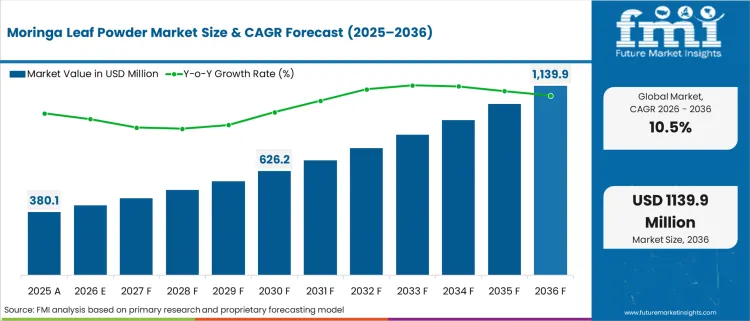
In 2025, the global Moringa Leaf Powder market crossed a valuation of USD 390.0 million and is projected to reach USD 420.0 million in 2026 and USD 1,120.0 million by 2036, reflecting a CAGR of 10.5%, as clinical validation protocols elevate plant-derived proteins into mainstream nutraceutical specifications. Procurement concentrates on verified macronutrient profiles over generic botanicals.
Absolute dollar growth of USD 700.0 million over the forecast period signals a critical pivot from artisanal cultivation toward standardized medical-grade supply chains. Regulatory adoption curves and formulation standardization reset minimum supplier capabilities. A 2025 physical composition study quantified protein content at 22.78 grams per 100 grams alongside 10.02 grams of fiber, prompting formulators to substitute synthetic binders with organic leaf alternatives [1]. Buyers actively seek audited producers capable of delivering zero-residue harvests.
Summary of Moringa Leaf Powder
- Moringa Leaf Powder Market Definition
- Processing operations transform raw agricultural biomass into standardized nutritional ingredients for global wellness integration.
- Demand Drivers in the Market
- Clinical validation of immune-boosting phytochemical markers.
- Sourcing shifts toward transparent, zero-pesticide botanical cultivation.
- Widespread adoption within premium sports nutrition matrices.
- Key Segments Analyzed in the FMI Report
- Product Form: Raw powder (54%) versus capsules, blended powders, and ready-to-use beverage mixes.
- Application: Dietary supplements (41% of total volume) versus functional foods, cosmetics, pharmaceuticals, and animal nutrition.
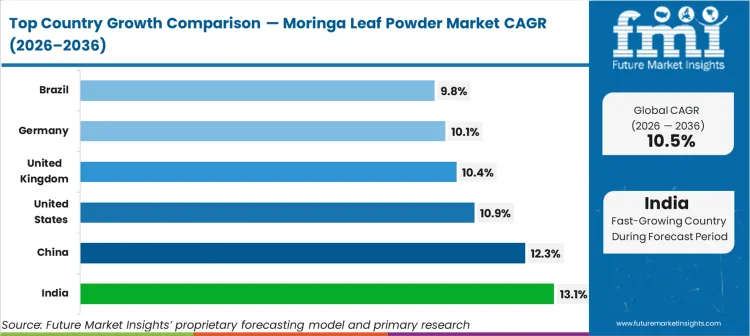
- Geography: High-growth Asia-Pacific (India 13.1%, China 12.3%) versus mature North America and Europe (United States 10.9%, Germany 10.1%, United Kingdom 10.4%).
- Analyst Opinion at FMI
- Nandini Roy Choudhury, Principal Consultant for Food & Beverage at Future Market Insights, opines, “In our latest Moringa Leaf Powder Market analysis, my team and I have identified immune-positioned daily nutrition as the next commercialization frontier. Beyond superfood branding, large-scale manufacturers are evaluating moringa for routine fortification in staples, premixes, and institutional nutrition programs. However, batch-to-batch phytochemical variability and microbial load control remain operational challenges. Suppliers that implement standardized harvesting cycles, rapid drying protocols, and validated export compliance frameworks will transition moringa from specialty wellness shelves into mainstream fortified food systems.”
- Strategic Implications/Executive Takeaways
- Implement zero-tolerance pathogen screening prior to export.
- Acquire regional processing infrastructure to ensure output consistency.
- Pivot toward value-added encapsulation formats rather than bulk trade.
- Methodology
- Validated through first-hand corporate production and capacity data.
- Zero reliance on speculative third-party market research reports.
- Based on verifiable industrial benchmarks and verified sources.
As noted by Lisa Curtis, Founder and CEO of Kuli Kuli Foods, "We've always believed moringa deserved the same spotlight as matcha or turmeric." "As more consumers look for natural, sustained energy and nutrient-dense superfoods, we're thrilled to make moringa even easier to add to a daily routine, all while continuing to support smallholder farmers who grow this incredible plant." [2]
Country dispersion reveals concentrated adoption near established processing hubs and stringent food safety jurisdictions. India, China, and United States command dominant volume shares, whereas United Kingdom and Germany register rapid uptake. Expansion strictly tracks functional food ingredients application trends and clinical backing. Procurement clusters around pre-qualified vendors possessing advanced sterilization infrastructure.
Moringa Leaf Powder Market Key Takeaways
| Metric | Details |
|---|---|
| Industry Size (2026) | USD 420.0 Million |
| Industry Value (2036) | USD 1,120.0 Million |
| CAGR (2026-2036) | 10.5% |
Moringa Leaf Powder Definition
Moringa leaf powder involves the harvesting, milling, and distribution of dried leaves from Moringa oleifera trees. Industrial buyers primarily use the processed biomass as a functional ingredient in nutritional formulations and cosmetic products, capitalizing on its health benefits and versatile applications.
Moringa Leaf Powder Inclusions
The scope includes raw milled leaf biomass, encapsulated derivatives, and blended functional beverage mixes. The analysis tracks revenue generated from pharmaceutical, animal nutrition, and direct dietary supplement applications, covering the primary commercial uses of moringa leaf powder in various industries.
Moringa Leaf Powder Exclusions
The evaluation excludes root extracts, isolated seed oils sold as standalone commodities, and unharvested agricultural biomass. Non-commercial artisanal cultivation yields, which do not contribute to large-scale commercial trade, are also outside the scope of the market valuation.
Moringa Leaf Powder Market Research Methodology
- Primary Research: Direct interviews conducted with cultivation facility managers, encapsulation plant directors, and international botanical distributors.
- Desk Research: Regulatory recall databases, official clinical trial registries, and government agricultural yield reports supported baseline estimates.
- Market-Sizing and Forecasting: Bottom-up formulation mapping reconciled against top-down global trade import volumes.
- Data Validation and Update Cycle: Multi-point variance checks executed against published corporate earnings and verified customs shipping manifests.
Segmental Analysis
Moringa Leaf Powder Market Analysis by Product Form
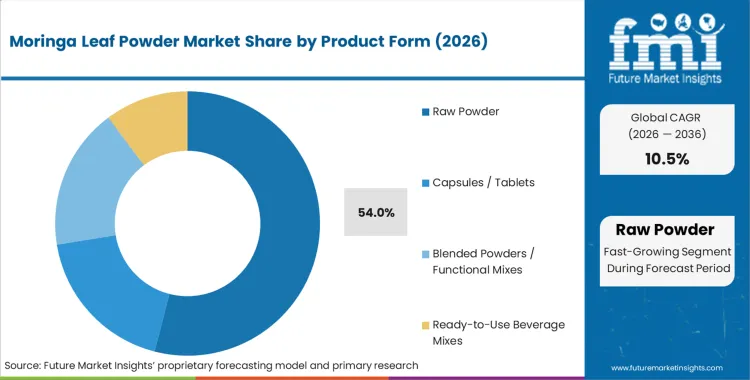
Industrial buyers continue to favor minimally processed moringa formats to preserve natural nutrient density, chlorophyll content, and antioxidant potency. Food, nutraceutical, and functional beverage manufacturers prefer raw powder for its formulation flexibility, clean-label positioning, and ease of blending into capsules, smoothies, and fortified staples. Bulk procurement also supports cost efficiency and scalable contract manufacturing. As demand for plant-based nutrition accelerates, raw powder commands 54% of global demand in 2026.
- Procurement shift: Formulation teams utilize moringa extract bases across diverse supplement categories to streamline inventory management. A 2025 livestock review highlighted 20 to 30% supplementation viability in commercial feed applications, broadening end-use potential [3]. Buyers scale bulk orders to secure competitive pricing against volatile international freight rates.
- Medical integration: Medical nutrition divisions incorporate standard doses to support immune function claims. A 2025 meta-analysis demonstrated significant CD4+ T cell improvement with a standard mean difference of 1.4 using controlled powder dosing [4]. Practitioners substitute synthetic vitamins with plant-derived complexes to satisfy clean-label patient preferences.
- Manufacturing constraint: Encapsulation facilities require specific particle sizes to prevent machinery blockages during high-speed manufacturing. In January 2026, Kuli Kuli Foods launched pure capsules delivering over 1,000 milligrams per serving, demonstrating refined flowability [5]. Tooling upgrades enable vendors to bypass historic viscosity challenges.
Moringa Leaf Powder Market Analysis by Application
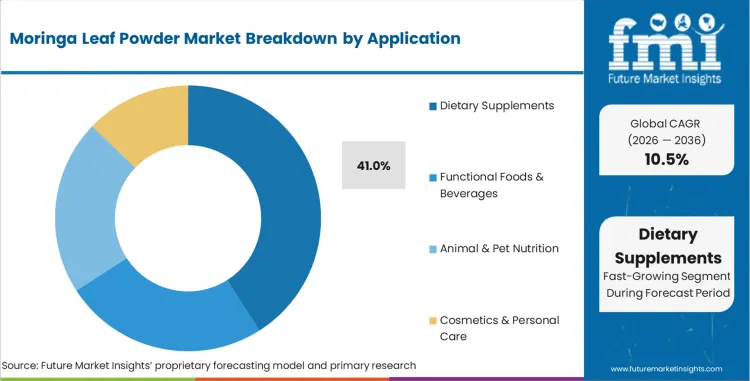
Dietary Supplements represent 41% of sector volume in 2026. Manufacturers are increasingly incorporating moringa leaf powder into capsules, tablets, and functional blends as consumers shift toward plant-based nutrition and transparent ingredient sourcing. Its natural vitamin, mineral, and antioxidant profile supports positioning in immunity, energy, and overall wellness formulations, strengthening sustained demand from nutraceutical and private-label brands.
- Clinical pathway: Clinical practitioners increasingly recommend terrestrial botanicals to address chronic metabolic conditions. A 2025 clinical trial in Mexico investigating metabolic syndrome utilized dehydrated leaf dosing to establish localized therapeutic efficacy [6]. Prescribers demand audited clinical data before authorizing adjunctive therapies.
- Immune specification: Immune-focused formulations demand verified bioactive concentrations to substantiate packaging claims. A 2025 systematic review demonstrated significant increases in white blood cell counts using controlled powder dosing [7]. Formulation chemists require standardized phytochemical yields to prevent regulatory penalties.
- Topical transition: Beauty brands integrate nutrient-dense terrestrial extracts to capture high-margin cosmetic segments. Skincare formulators bypass saturated ingestible markets to secure premium shelf placement.
Moringa Leaf Powder Market Drivers, Restraints, and Opportunities
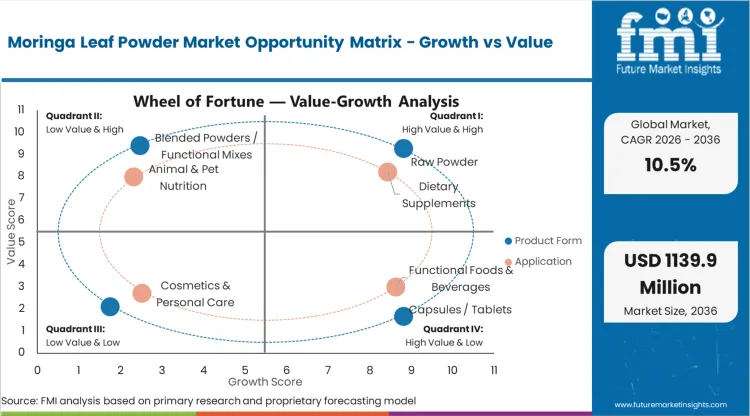
Robust clinical validation of functional biomarkers accelerates mainstream adoption within medical nutrition and premium wellness sectors. Formulators transition away from isolated synthetic vitamins toward complex phytochemical matrices that offer synergistic physiological benefits. Procurement teams actively seek verified supply chains capable of delivering consistent batch profiles to support audited health claims. During 2025, data revealed a daily 1 tablespoon serving offers vitamin A equivalents matching a quarter baby carrot and calcium mirroring half a cup of milk, establishing a baseline for dietary substitution [9]. Such quantifiable outcomes compel medical practitioners to recommend plant-based adjunctive therapies, expanding addressable patient populations and accelerating commercial deployment.
Contamination risks and stringent food safety enforcement severely disrupt global supply continuity. Importers face immediate product seizures and brand damage when microbiological limits exceed regulatory thresholds, effectively halting cross-border distribution. FMI analysts opine that rigorous testing protocols inflate operational overhead for emerging brands attempting international expansion. In January 2026, federal safety agencies recalled multiple batches, including Why Not Natural capsules, due to widespread Salmonella contamination [10]. Sourcing teams must prioritize audited closed-loop agricultural partners over spot-market commodity purchases to mitigate existential reputational threats, thereby narrowing viable vendor pools and driving up verified material acquisition costs.
- Strategic consolidation: Established pharmaceutical entities acquire regional organic brands to instantly capture health-conscious demographic segments.
- Specialized maternal nutrition: Postnatal recovery regimes represent an untapped demographic eager for iron-rich natural supplementation. Market data from late 2025 indicates rising product launches featuring fermented multivitamins combined with green superfoods specifically formulated for lactating mothers [12].
- Pathogen elimination: Corporate agricultural investors pursue direct wholesale distribution to bypass fragmented retail networks and secure nationwide footprint. An October 2025 FDA recall of a specific organic lot code sold via Food To Live highlights severe supply chain disruption caused by pathogen detection, pushing buyers toward closed-loop suppliers [13].
Regional Analysis
.webp "Top Country Growth Comparison Moringa Leaf Powder Market Cagr (2026 2036)")
Based on the regional analysis, Moringa Leaf Powder market is segmented into North America, Latin America, Europe, East Asia, South Asia, Oceania and Middle East & Africa across 40+ countries. The full report also offers market attractiveness analysis based on regional trends.
| Country | CAGR (2026 to 2036) |
|---|---|
| India | 13.1% |
| China | 12.3% |
| United States | 10.9% |
| United Kingdom | 10.4% |
| Germany | 10.1% |
| Brazil | 9.8% |
Source: Future Market Insights (FMI) analysis, based on proprietary forecasting model and primary research
North America Moringa Leaf Powder Analysis
North America registers aggressive adoption felled by clean-label consumer preferences and stringent regulatory oversight shaping vendor qualification. Health-conscious demographics demand transparent sourcing, forcing brands to overhaul supply networks to prevent widespread pathogen contamination. Federal monitoring ensures only highly compliant producers retain retail access. Buyers now enforce zero-tolerance microbiological specifications during contract negotiations, isolating unverified offshore suppliers and driving investment toward audited domestic processing infrastructure.
- United States: Demand for raw inputs in United States is set to grow at 10.9% CAGR through 2036, supported by clinical validation before procurement cycles translate into higher deployment volumes. A 2025 acceptability trial in California confirmed positive consumer reception for medium and high dosing formats [14]. Verified palatability accelerates mass-market integration and expands brand distribution footprint.
FMI's report includes detailed commercial evaluations for Canada and Mexico alongside domestic evaluations. Canadian herbal supplements buyers increasingly specify organic certifications to align with national dietary guidelines, reflecting similar regulatory maturity. Operators must navigate strict cross-border safety protocols to maintain steady distribution velocity.
Europe Moringa Leaf Powder Analysis
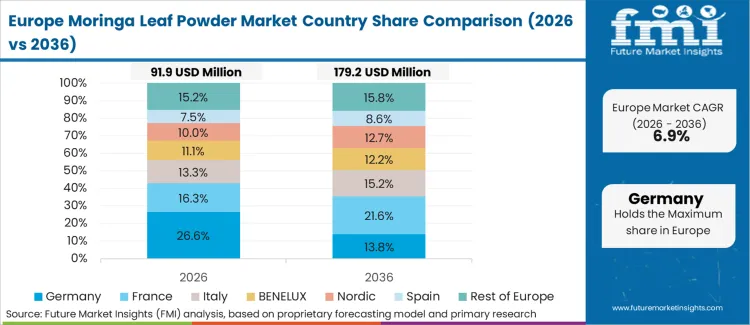
European formulation trends prioritize functional integration into everyday food formats over standalone pill consumption. Regulatory bodies maintain rigorous novel food standards, elevating entry barriers for unverified exporters attempting continental penetration. Premium positioning relies on organic cultivation methodologies and zero-residue testing certifications that shield brands from unpredictable import seizures. Vertical integration shields brands from erratic external ingredient quality, pushing regional formulators toward fully traceable agricultural contracts.
- United Kingdom: Sales volume in United Kingdom is projected to rise at 10.4% CAGR from 2026 to 2036 as supply chain transparency improves, creating a clearer pathway from spending intent to purchase orders. Kuli Kuli Foods expanded its board in 2025 to include Wendy Davidson, mirroring industry-wide pushes for structured corporate governance [15]. Unified portfolios outcompete fragmented independent sellers.
- Germany: In Germany, the nutraceutical sector is strengthening as corporate restructuring initiatives streamline supplier networks and phase out non-compliant participants, increasing reliance on certified inputs and upgraded processing technologies. In 2025, Kuli Kuli launched a dedicated ingredient company backed by strategic investment to secure global B2B supply lines [16]. Enhanced processing standards also reduce exposure to international shipment seizures, supporting growth at a 10.1% CAGR from 2026 to 2036.
FMI's report includes extensive coverage spanning France, Italy, and Spain. French Europe superfood powder formulators actively target clinical nutrition pathways. Buyers across these nations demand full pesticide-residue transparency to satisfy stringent European Union import criteria.
Latin America Moringa Leaf Powder Analysis
Latin America emerges as an essential cultivation zone offering favorable climatic conditions and lower land acquisition overhead. Regional agricultural ministries incentivize high-yield botanical farming to substitute volatile cash crops and generate steady export revenue. Domestic consumption expands alongside export-driven cultivation strategies as processing infrastructure matures. Validated domestic research stimulates local healthcare sector uptake while fulfilling immense North American biomass demands.
- Brazil: Brazil is expected to record 9.8% CAGR in biomass demand over 2026 to 2036 as agricultural yields optimize, tightening link between operational constraints and adoption-led investment. Reviews published during 2025 demonstrate annual tree production hitting 43 to 115 tons per hectare under optimal spacing, validating scalable commercial cultivation models [17]. Scalable harvests attract global corporate farming investments and secure long-term buyer contracts.
FMI's report includes operational insights covering Argentina, Colombia, and Chile. Colombian organic tea processors frequently blend native botanicals with green superfoods to enhance export portfolios. Favorable trade agreements assist regional growers in accessing North American wholesale networks.
East Asia Moringa Leaf Powder Analysis
East Asia showcases rapid transition from traditional herbal medicine frameworks toward modernized, clinically-backed nutraceutical manufacturing. Heavy investments in extraction technology allow regional producers to capture maximum phytochemical value from raw agricultural inputs. Government health initiatives actively promote preventative nutrition to manage ageing population burdens and reduce downstream medical expenditures. Aggressive scaling reduces global per-kilogram pricing structures and dominates bulk international commodity channels.
- China: In China, wholesale demand is strengthening as processors invest heavily in automation, translating operational upgrades into structured capital allocation and improved cost efficiency. In 2025, Superfoods Inc rolled out its Live It Up green powder line nationwide, integrating botanical blends into mainstream retail channels [18]. Expanded automated facilities are reinforcing regional pricing leverage and supply consistency, supporting growth at a 12.3% CAGR through 2036.
FMI's report includes granular data covering Japan and South Korea. Japanese detox products formulators prioritize ultra-fine granulometry for premium cosmetic integrations. Advanced milling technologies ensure superior solubility metrics required by high-end retail brands.
South Asia Moringa Leaf Powder Analysis
South Asia maintains supreme dominance in global cultivation volume, driven by native species origins and vast agricultural workforces. Climate suitability guarantees multiple harvest cycles annually, securing uninterrupted supply for international off-takers. Local consumption remains deeply embedded in cultural dietary practices. Massive domestic output shields local buyers from international price shocks.
- India: Powder uptake in India is anticipated to climb at 13.1% CAGR over forecast period as domestic processing infrastructure matures, helping suppliers align positioning with local buying triggers. A 2025 production baseline indicates India cultivates 1.2 million tons of related fruit annually across 380 square kilometers [19]. Exporting finished goods replaces raw biomass trade.
FMI's report includes detailed supply chain mapping for Bangladesh, Sri Lanka, and Nepal. Sri Lankan botanical bioactive exporters focus on certified organic cultivation to differentiate from bulk mainland producers. Traceability programs secure premium European buyer contracts.
Competitive Aligners for Market Players
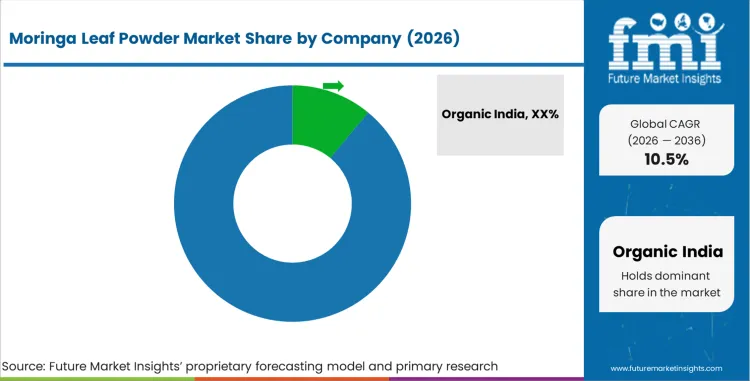
Market participants confront escalating pressures to verify microbiological safety while simultaneously scaling output. Pathogen contamination represents an existential threat, capable of destroying brand equity overnight. Operators must invest heavily in advanced sterilization technologies, such as steam treatment or irradiation, to secure wholesale contracts.
Vertical integration emerges as primary defense mechanism against raw material volatility. Companies dependent on fragmented smallholder networks face severe consistency issues regarding moisture content and phytochemical yields. Direct farm-to-capsule operations allow precision control over final product efficacy.
Portfolio diversification remains essential for enduring margin compression. Relying solely on bulk powder sales exposes manufacturers to aggressive price undercutting from emerging agricultural regions. Transitioning into antioxidants applications and high-margin cosmetics bypasses saturated dietary supplement channels.
Recent Developments
The report includes full coverage of key trends from competitive benchmarking. Some of the recent developments covered in the reports:
- In January 2026, All Moringa introduced an innovative synergy oil product merging leaf powder and seed extracts for premium topical cosmetic applications. [8]
- In July 2025, SASMAR Pharma acquired Goodwin Nutrition Srl, absorbing established brands to accelerate European market penetration. [11]
Key Players in Moringa Leaf Powder
-
Organic India
- Grenera Nutrients
- Kuli Kuli, Inc.
- Farmdirect Foods
- Himalaya Wellness
- Moringa Connect
- Medikonda Nutrients
- Superfoods Inc.
- Ancient GreenFields
- Food To Live
Scope of the Report
| Metric | Value |
|---|---|
| Quantitative Units | USD 420.0 million (2026) to USD 1,120.0 million (2036), at a CAGR of 10.5% |
| Market Definition | Global trade involves harvesting, milling, and distributing dried leaves from native oleifera trees. |
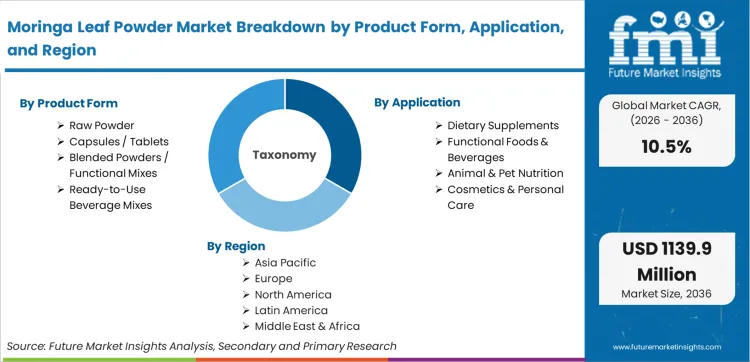
| Product Form Segmentation | Raw Powder, Capsules / Tablets, Blended Powders / Functional Mixes, Ready-to-Use Beverage Mixes |
| Application Segmentation | Dietary Supplements, Functional Foods & Beverages, Animal & Pet Nutrition, Cosmetics & Personal Care, Pharmaceuticals / Clinical Nutrition |
| Distribution Channel Segmentation | Specialty Stores & Pharmacies, Online Retail, Grocery / Supermarket Stores, Institutional / B2B Sales |
| End-User Group Segmentation | Adults, Elderly, Youth & Athletes, Children |
| Regions Covered | North America, Latin America, Europe, East Asia, South Asia, Oceania, Middle East and Africa |
| Countries Covered | India, China, United States, United Kingdom, Germany, Brazil and 40 plus countries |
| Key Companies Profiled | Organic India, Grenera Nutrients, Kuli Kuli, Inc., Farmdirect Foods, Himalaya Wellness, Moringa Connect, Medikonda Nutrients, Superfoods Inc., Ancient GreenFields, Food To Live |
| Forecast Period | 2026 to 2036 |
| Approach | Hybrid top-down and bottom-up market modeling, validated through primary interviews with moringa producers and nutraceutical companies, supported by trade data benchmarking and production capacity analysis for the global distribution of moringa products |
Moringa Leaf Powder Market Analysis by Segments
Product Form
- Raw Powder
- Capsules / Tablets
- Blended Powders / Functional Mixes
- Ready-to-Use Beverage Mixes
Application
- Dietary Supplements
- Functional Foods & Beverages
- Animal & Pet Nutrition
- Cosmetics & Personal Care
- Pharmaceuticals / Clinical Nutrition
Distribution Channel
- Specialty Stores & Pharmacies
- Online Retail
- Grocery / Supermarket Stores
- Institutional / B2B Sales
End-User Group
- Adults
- Elderly
- Youth & Athletes
- Children
Region
- Asia Pacific
- India
- China
- Japan
- South Korea
- Indonesia
- Australia & New Zealand
- ASEAN
- Rest of Asia Pacific
- Europe
- Germany
- Italy
- France
- United Kingdom
- Spain
- Benelux
- Nordics
- Central & Eastern Europe
- Rest of Europe
- North America
- United States
- Canada
- Mexico
- Latin America
- Brazil
- Argentina
- Chile
- Rest of Latin America
- Middle East & Africa
- Kingdom of Saudi Arabia
- United Arab Emirates
- South Africa
- Turkey
- Rest of Middle East & Africa
Bibliography
- [1] PMC. (2025). Physical and chemical composition of Moringa oleifera leaf powder.
- [2] Yahoo Finance. (2026). Lisa Curtis on Kuli Kuli debut and wellness trends.
- [3] PMC. (2025). Proximate analysis MOLP vs soybean/maize for livestock.
- [4] Frontiers in Nutrition. (2025). CD4+ T cell count improvement with MO supplementation.
- [5] PR Newswire. (2026). Kuli Kuli debuts pure organic capsules.
- [6] ClinicalTrials.gov. (2025). Clinical trial on moringa leaf powder for metabolic syndrome.
- [7] Frontiers in Nutrition. (2025). Moringa in immune biomarkers systematic review.
- [8] USA Today. (2026). All Moringa introduces leaf and seed synergy oil.
- [9] NutritionFacts.org. (2025). Nutritional comparison per serving.
- [10] FDA. (2026). Outbreak investigation Salmonella Why Not Natural.
- [11] SASMAR Pharma. (2025). Strategic acquisition of Goodwin Nutrition Srl.
- [12] FDA. (2025). Moringa leaf powder in postnatal supplements.
- [13] FDA. (2025). Outbreak investigation Salmonella Food To Live recall.
- [14] PMC. (2025). Acceptability study doses of moringa leaf powder California.
- [15] Kuli Kuli Foods. (2025). Board expansion Wendy Davidson.
- [16] New Hope. (2025). Kuli Kuli ingredient company launch.
- [17] PMC. (2025). Annual biomass yield of M. oleifera.
- [18] WA DOH. (2026). Superfoods Inc Live It Up national rollout tracking.
- [19] Wikipedia. (2025). India production reference 1.2 million tonnes.
This bibliography is provided for reader reference and is not exhaustive. The full report contains the complete reference list and detailed citations.
This Report Addresses
- Market intelligence to enable structured strategic decision making across mature and emerging botanical economies
- Market size estimation and 10 year revenue forecasts from 2026 to 2036, supported by validated capacity and trade benchmarks
- Growth opportunity mapping across powder, liquid, and solid forms with emphasis on microbiological compliance transitions
- Segment and regional revenue forecasts covering dietary supplements, animal nutrition, cosmetics, and functional beverages
- Competition strategy assessment including integration models, cost survivability positioning, and compliance capability benchmarking
- Product reformulation and emission compliance tracking including zero-residue and organic aligned grades
- Regulatory impact analysis covering pathogen testing mandates, novel food thresholds, and export driven specification upgrades
- Market report delivery in PDF, Excel, PPT, and interactive dashboard formats for executive and operational use
Frequently Asked Questions
How large is the demand for Moringa Leaf Powder in the global market in 2026?
Global demand is estimated to reach USD 420.0 million in 2026.
What will be the market size of Moringa Leaf Powder in the global market by 2036?
Revenue is projected to reach USD 1,120.0 million by 2036.
What is the expected demand growth for Moringa Leaf Powder in the global market between 2026 and 2036?
Global revenue is expected to grow at a CAGR of 10.5% between 2026 and 2036.
Which Product Form is poised to lead global sales by 2026?
Raw Powder is expected to capture 54% share in 2026 due to extensive formulation flexibility across functional beverage categories.
How significant is the role of Dietary Supplements in driving Moringa Leaf Powder adoption in 2026?
Dietary Supplements represent a critical segment, projected to hold a substantial 41% share in 2026 as consumer interest in plant-based immunity rises.
What is driving demand in India?
Massive domestic cultivation baselines exceeding one million tons annually provide cost-effective biomass for value-added encapsulation.
What compliance standards or regulations are referenced for United States?
Federal FDA microbiological safety thresholds and zero-tolerance Salmonella regulations are referenced as key compliance benchmarks.
What is the United States growth outlook in this report?
United States demand is projected to grow at a CAGR of 10.9% during 2026 to 2036.
Why is Europe described as a priority region in this report?
Growth is constrained by elevated compliance costs and strict novel food regulations, forcing brands into strategic corporate acquisitions.
What type of demand dominates in Europe?
Demand for premium-grade, highly audited organic ingredients dominates regional consumption.
What is China growth outlook in this report?
China is projected to expand at a CAGR of 12.3% during 2026 to 2036.
Does the report cover United Kingdom in its regional analysis?
Yes, Germany is included within Europe under the regional coverage framework.
What is the main Germany related demand theme in its region coverage?
Heightened contamination awareness drives investment into localized sterilization processing to reduce pathogen risks.
Which product formats or configurations are strategically important for North America supply chains?
Highly sterilized, micro-tested raw powders are prioritized due to intense federal oversight regarding foodborne illnesses.
What is Moringa Leaf Powder and what is it mainly used for?
It is a functional botanical ingredient primarily used in dietary supplements, functional foods, cosmetics, and animal nutrition.
What does Moringa Leaf Powder mean in this report?
Scope refers to global production, trade, and industrial consumption of milled leaves from native oleifera trees.
What is included in the scope of this Moringa Leaf Powder report?
Scope covers raw powder, capsules, and beverage mixes utilized across health, cosmetic, and animal nutrition applications.
What is excluded from the scope of this report?
Root extracts, isolated seed oils sold independently, and unharvested agricultural biomass are excluded from valuation.
What does market forecast mean on this page?
Market forecast represents a model-based projection built on defined agricultural and commercial assumptions for strategic planning purposes.
How does FMI build and validate the Moringa Leaf Powder forecast?
Forecast is developed using hybrid top-down and bottom-up modeling validated through trade data, capacity checks, and industry review.
What does zero reliance on speculative third party market research mean here?
Primary interviews and verifiable public datasets are used instead of unverified syndicated market estimates.
Preview the report firsthand - request a free sample
Get SampleGet the brochure for pricing and purchase details.
Get PDFTable of Content
- Executive Summary
- Global Market Outlook
- Demand-side Trends
- Supply-side Trends
- Technology Roadmap Analysis
- Analysis and Recommendations
- Market Overview
- Market Coverage / Taxonomy
- Market Definition / Scope / Limitations
- Research Methodology
- Chapter Orientation
- Analytical Lens and Working Hypotheses
- Market Structure, Signals, and Trend Drivers
- Benchmarking and Cross-market Comparability
- Market Sizing, Forecasting, and Opportunity Mapping
- Research Design and Evidence Framework
- Desk Research Programme (Secondary Evidence)
- Company Annual and Sustainability Reports
- Peer-reviewed Journals and Academic Literature
- Corporate Websites, Product Literature, and Technical Notes
- Earnings Decks and Investor Briefings
- Statutory Filings and Regulatory Disclosures
- Technical White Papers and Standards Notes
- Trade Journals, Industry Magazines, and Analyst Briefs
- Conference Proceedings, Webinars, and Seminar Materials
- Government Statistics Portals and Public Data Releases
- Press Releases and Reputable Media Coverage
- Specialist Newsletters and Curated Briefings
- Sector Databases and Reference Repositories
- FMI Internal Proprietary Databases and Historical Market Datasets
- Subscription Datasets and Paid Sources
- Social Channels, Communities, and Digital Listening Inputs
- Additional Desk Sources
- Expert Input and Fieldwork (Primary Evidence)
- Primary Modes
- Qualitative Interviews and Expert Elicitation
- Quantitative Surveys and Structured Data Capture
- Blended Approach
- Why Primary Evidence is Used
- Field Techniques
- Interviews
- Surveys
- Focus Groups
- Observational and In-context Research
- Social and Community Interactions
- Stakeholder Universe Engaged
- C-suite Leaders
- Board Members
- Presidents and Vice Presidents
- R&D and Innovation Heads
- Technical Specialists
- Domain Subject-matter Experts
- Scientists
- Physicians and Other Healthcare Professionals
- Governance, Ethics, and Data Stewardship
- Research Ethics
- Data Integrity and Handling
- Primary Modes
- Tooling, Models, and Reference Databases
- Desk Research Programme (Secondary Evidence)
- Data Engineering and Model Build
- Data Acquisition and Ingestion
- Cleaning, Normalisation, and Verification
- Synthesis, Triangulation, and Analysis
- Quality Assurance and Audit Trail
- Market Background
- Market Dynamics
- Drivers
- Restraints
- Opportunity
- Trends
- Scenario Forecast
- Demand in Optimistic Scenario
- Demand in Likely Scenario
- Demand in Conservative Scenario
- Opportunity Map Analysis
- Product Life Cycle Analysis
- Supply Chain Analysis
- Investment Feasibility Matrix
- Value Chain Analysis
- PESTLE and Porter’s Analysis
- Regulatory Landscape
- Regional Parent Market Outlook
- Production and Consumption Statistics
- Import and Export Statistics
- Market Dynamics
- Global Market Analysis 2021 to 2025 and Forecast, 2026 to 2036
- Historical Market Size Value (USD Million) Analysis, 2021 to 2025
- Current and Future Market Size Value (USD Million) Projections, 2026 to 2036
- Y-o-Y Growth Trend Analysis
- Absolute $ Opportunity Analysis
- Global Market Pricing Analysis 2021 to 2025 and Forecast 2026 to 2036
- Global Market Analysis 2021 to 2025 and Forecast 2026 to 2036, By Product Form
- Introduction / Key Findings
- Historical Market Size Value (USD Million) Analysis By Product Form , 2021 to 2025
- Current and Future Market Size Value (USD Million) Analysis and Forecast By Product Form , 2026 to 2036
- Raw Powder
- Capsules / Tablets
- Blended Powders / Functional Mixes
- Ready-to-Use Beverage Mixes
- Raw Powder
- Y-o-Y Growth Trend Analysis By Product Form , 2021 to 2025
- Absolute $ Opportunity Analysis By Product Form , 2026 to 2036
- Global Market Analysis 2021 to 2025 and Forecast 2026 to 2036, By Application
- Introduction / Key Findings
- Historical Market Size Value (USD Million) Analysis By Application, 2021 to 2025
- Current and Future Market Size Value (USD Million) Analysis and Forecast By Application, 2026 to 2036
- Dietary Supplements
- Functional Foods & Beverages
- Animal & Pet Nutrition
- Cosmetics & Personal Care
- Dietary Supplements
- Y-o-Y Growth Trend Analysis By Application, 2021 to 2025
- Absolute $ Opportunity Analysis By Application, 2026 to 2036
- Global Market Analysis 2021 to 2025 and Forecast 2026 to 2036, By Region
- Introduction
- Historical Market Size Value (USD Million) Analysis By Region, 2021 to 2025
- Current Market Size Value (USD Million) Analysis and Forecast By Region, 2026 to 2036
- North America
- Latin America
- Western Europe
- Eastern Europe
- East Asia
- South Asia and Pacific
- Middle East & Africa
- Market Attractiveness Analysis By Region
- North America Market Analysis 2021 to 2025 and Forecast 2026 to 2036, By Country
- Historical Market Size Value (USD Million) Trend Analysis By Market Taxonomy, 2021 to 2025
- Market Size Value (USD Million) Forecast By Market Taxonomy, 2026 to 2036
- By Country
- USA
- Canada
- Mexico
- By Product Form
- By Application
- By Country
- Market Attractiveness Analysis
- By Country
- By Product Form
- By Application
- Key Takeaways
- Latin America Market Analysis 2021 to 2025 and Forecast 2026 to 2036, By Country
- Historical Market Size Value (USD Million) Trend Analysis By Market Taxonomy, 2021 to 2025
- Market Size Value (USD Million) Forecast By Market Taxonomy, 2026 to 2036
- By Country
- Brazil
- Chile
- Rest of Latin America
- By Product Form
- By Application
- By Country
- Market Attractiveness Analysis
- By Country
- By Product Form
- By Application
- Key Takeaways
- Western Europe Market Analysis 2021 to 2025 and Forecast 2026 to 2036, By Country
- Historical Market Size Value (USD Million) Trend Analysis By Market Taxonomy, 2021 to 2025
- Market Size Value (USD Million) Forecast By Market Taxonomy, 2026 to 2036
- By Country
- Germany
- UK
- Italy
- Spain
- France
- Nordic
- BENELUX
- Rest of Western Europe
- By Product Form
- By Application
- By Country
- Market Attractiveness Analysis
- By Country
- By Product Form
- By Application
- Key Takeaways
- Eastern Europe Market Analysis 2021 to 2025 and Forecast 2026 to 2036, By Country
- Historical Market Size Value (USD Million) Trend Analysis By Market Taxonomy, 2021 to 2025
- Market Size Value (USD Million) Forecast By Market Taxonomy, 2026 to 2036
- By Country
- Russia
- Poland
- Hungary
- Balkan & Baltic
- Rest of Eastern Europe
- By Product Form
- By Application
- By Country
- Market Attractiveness Analysis
- By Country
- By Product Form
- By Application
- Key Takeaways
- East Asia Market Analysis 2021 to 2025 and Forecast 2026 to 2036, By Country
- Historical Market Size Value (USD Million) Trend Analysis By Market Taxonomy, 2021 to 2025
- Market Size Value (USD Million) Forecast By Market Taxonomy, 2026 to 2036
- By Country
- China
- Japan
- South Korea
- By Product Form
- By Application
- By Country
- Market Attractiveness Analysis
- By Country
- By Product Form
- By Application
- Key Takeaways
- South Asia and Pacific Market Analysis 2021 to 2025 and Forecast 2026 to 2036, By Country
- Historical Market Size Value (USD Million) Trend Analysis By Market Taxonomy, 2021 to 2025
- Market Size Value (USD Million) Forecast By Market Taxonomy, 2026 to 2036
- By Country
- India
- ASEAN
- Australia & New Zealand
- Rest of South Asia and Pacific
- By Product Form
- By Application
- By Country
- Market Attractiveness Analysis
- By Country
- By Product Form
- By Application
- Key Takeaways
- Middle East & Africa Market Analysis 2021 to 2025 and Forecast 2026 to 2036, By Country
- Historical Market Size Value (USD Million) Trend Analysis By Market Taxonomy, 2021 to 2025
- Market Size Value (USD Million) Forecast By Market Taxonomy, 2026 to 2036
- By Country
- Kingdom of Saudi Arabia
- Other GCC Countries
- Turkiye
- South Africa
- Other African Union
- Rest of Middle East & Africa
- By Product Form
- By Application
- By Country
- Market Attractiveness Analysis
- By Country
- By Product Form
- By Application
- Key Takeaways
- Key Countries Market Analysis
- USA
- Pricing Analysis
- Market Share Analysis, 2025
- By Product Form
- By Application
- Canada
- Pricing Analysis
- Market Share Analysis, 2025
- By Product Form
- By Application
- Mexico
- Pricing Analysis
- Market Share Analysis, 2025
- By Product Form
- By Application
- Brazil
- Pricing Analysis
- Market Share Analysis, 2025
- By Product Form
- By Application
- Chile
- Pricing Analysis
- Market Share Analysis, 2025
- By Product Form
- By Application
- Germany
- Pricing Analysis
- Market Share Analysis, 2025
- By Product Form
- By Application
- UK
- Pricing Analysis
- Market Share Analysis, 2025
- By Product Form
- By Application
- Italy
- Pricing Analysis
- Market Share Analysis, 2025
- By Product Form
- By Application
- Spain
- Pricing Analysis
- Market Share Analysis, 2025
- By Product Form
- By Application
- France
- Pricing Analysis
- Market Share Analysis, 2025
- By Product Form
- By Application
- India
- Pricing Analysis
- Market Share Analysis, 2025
- By Product Form
- By Application
- ASEAN
- Pricing Analysis
- Market Share Analysis, 2025
- By Product Form
- By Application
- Australia & New Zealand
- Pricing Analysis
- Market Share Analysis, 2025
- By Product Form
- By Application
- China
- Pricing Analysis
- Market Share Analysis, 2025
- By Product Form
- By Application
- Japan
- Pricing Analysis
- Market Share Analysis, 2025
- By Product Form
- By Application
- South Korea
- Pricing Analysis
- Market Share Analysis, 2025
- By Product Form
- By Application
- Russia
- Pricing Analysis
- Market Share Analysis, 2025
- By Product Form
- By Application
- Poland
- Pricing Analysis
- Market Share Analysis, 2025
- By Product Form
- By Application
- Hungary
- Pricing Analysis
- Market Share Analysis, 2025
- By Product Form
- By Application
- Kingdom of Saudi Arabia
- Pricing Analysis
- Market Share Analysis, 2025
- By Product Form
- By Application
- Turkiye
- Pricing Analysis
- Market Share Analysis, 2025
- By Product Form
- By Application
- South Africa
- Pricing Analysis
- Market Share Analysis, 2025
- By Product Form
- By Application
- USA
- Market Structure Analysis
- Competition Dashboard
- Competition Benchmarking
- Market Share Analysis of Top Players
- By Regional
- By Product Form
- By Application
- Competition Analysis
- Competition Deep Dive
- Organic India
- Overview
- Product Portfolio
- Profitability by Market Segments (Product/Age /Sales Channel/Region)
- Sales Footprint
- Strategy Overview
- Marketing Strategy
- Product Strategy
- Channel Strategy
- Grenera Nutrients
- Kuli Kuli, Inc.
- Farmdirect Foods
- Himalaya Wellness
- Moringa Connect
- Medikonda Nutrients
- Superfoods Inc.
- Organic India
- Competition Deep Dive
- Assumptions & Acronyms Used


