

- Industry Size (2026)
- USD 1.9 Bn
- Forecast (2036)
- USD 3.2 Bn
- CAGR (2026 to 2036)
- 5.5%
Multi Tool Combo Kits Market Forecast and Outlook 2026 to 2036
The multi tool combo kits market is likely to be valued at USD 1.9 billion in 2026 and extends it to USD 3.2 billion by 2036 at a 5.50% CAGR. This category sells workflows rather than single tools. Buyers compare kit composition, battery platform coverage, and case format before brand loyalty comes into play. Merchandising teams design bundles around common job sequences, not around tool families. Once a contractor commits to a battery ecosystem, repeat purchases follow that platform. Warranty handling, charger compatibility, and accessory availability influence shelf decisions. Seasonal promotions matter less than continuity of core sets for fleet buyers and maintenance departments.
Manufacturing and channel execution shape performance more than headline specifications. Kit assembly lines coordinate tool sourcing, battery allocation, chargers, and packaging to protect fill rates. Forecast errors show up as mismatched stock between fast moving tools and slower accessories. Distribution centers manage pick logic and repacking for regional assortments. Retailers prefer stable configurations to reduce planogram resets. After sales support affects brand trust because a single failed component disables the whole set. Product managers adjust bundles by usage data rather than by marketing cycles. Profit formation follows inventory balance, packaging efficiency, and platform retention rather than aggressive price cuts.
Quick Stats for Multi Tool Combo Kits Market
- Multi Tool Combo Kits Market Value (2026): USD 1.9 billion
- Multi Tool Combo Kits Market Forecast Value (2036): USD 3.2 billion
- Multi Tool Combo Kits Market Forecast CAGR 2026 to 2036: 5.5%
- Leading Tool Type in Multi Tool Combo Kits Market: Multi-tool kits with pliers-based tools
- Leading Distribution Channel in Multi Tool Combo Kits Market: Offline retail stores
- Key Growth Regions in Multi Tool Combo Kits Market: Asia Pacific, Europe, North America
- Top Players in Multi Tool Combo Kits Market: Leatherman, Victorinox, Gerber Gear, SOG Specialty Knives & Tools
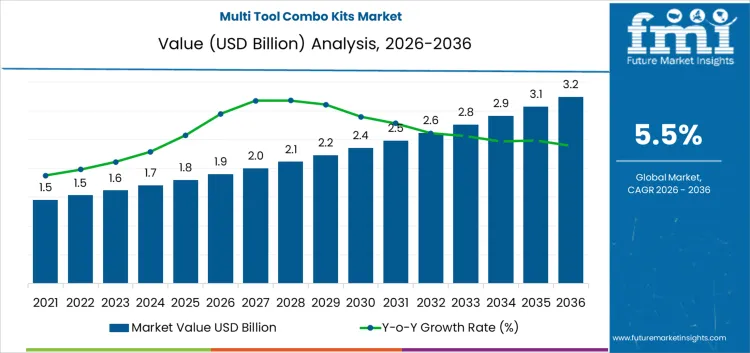
What Is the Growth Forecast for the Multi Tool Combo Kits Market through 2036?
Demand for multi-tool combo kits is shaped less by individual tool replacement needs and more by how brands and retailers package, promote, and sell complete solutions. Around the mid-decade point, sales are strongest in contractor-focused outlets, home improvement chains, and professional distributors because combo kits make buying easier, customers get a ready-to-use set without comparing dozens of separate SKUs. Most kits stay unchanged for long selling seasons, so demand tracks promotional cycles, store assortment planning, and platform-based marketing rather than tool breakdown rates. Growth is supported by more first-time buyers choosing bundled starter kits and existing users expanding within the same battery ecosystem.
In the later phase, the category becomes increasingly driven by operational efficiency. As the segment scales, manufacturers focus on common components, streamlined packaging, and smooth assembly to control costs. Retailers prioritize kits that sell quickly, protect margins, and simplify inventory, fewer SKUs, faster turnover, and consistent availability matter more than adding extra tools that don’t move. Expansion reflects broader shelf presence, wider channel reach, and a growing variety of bundle formats rather than any sudden technology shift. Suppliers that keep kits practical, platform-compatible, and reliably stocked tend to win long-term placement across major retail and distribution networks.
Multi-Tool Combo Kits Market Key Takeaways
| Metric | Value |
|---|---|
| Market Value (2026) | USD 1.9 billion |
| Forecast Value (2036) | USD 3.2 billion |
| Forecast CAGR 2026 to 2036 | 5.5% |
How Is the Multi Tool Combo Kits Market Shaping Tool Purchasing and Jobsite Standardization?
Multi tool combo kits bundle several powered or hand tools with shared batteries, chargers, and cases for coordinated use. Earlier buyers assembled tool sets one item at a time, which produced mixed platforms, duplicate chargers, and uneven performance across crews. Kits change that pattern by locking users into a single power and accessory ecosystem. Contractors and maintenance teams evaluate them by torque range, duty cycle coverage, battery interchangeability, and service network reach. Adoption is strongest where crews move between tasks and where downtime from missing tools carries schedule risk. Product managers design kits around common workflows such as installation, repair, and light fabrication. Packaging and logistics also matter because storage footprint and transport weight affect daily handling and site organization practices.
Procurement decisions usually involve operations managers and fleet coordinators rather than individual users. Earlier purchasing allowed wide variation between crews, which complicated spares stocking and training. Current programs aim to standardize platforms across regions and job types. Manufacturers compete on battery life management, tool durability, and warranty response rather than headline feature lists. Buyers compare total cost through replacement rates, lost time, and charger and battery inventory, not sticker price. Distributors add value through kitting, local stock, and rapid swap programs. Over time, demand follows labor constraints and pressure to shorten task changeover time. Suppliers that keep form factors stable and maintain backward compatibility hold positions in long running fleet contracts across construction, utilities, and facility maintenance operations.
What Factors Are Shaping the Demand for Multi-Tool Combo Kits Market in 2026?
Specification in Multi-Tool Combo Kits Market is influenced by use case definition, retail assortment strategy, and warranty support models rather than by short term promotional activity. Once a kit configuration is positioned for a target user group, component mix and packaging format remain fixed across extended selling cycles. This ties demand to product line refresh schedules, channel merchandising plans, and brand portfolio management. Segment structure reflects differences in functional concentration, component redundancy, and perceived utility across tasks. Buyers evaluate kits on durability, coverage of common tasks, and service support because replacement and return costs affect brand economics. Volume development therefore follows channel expansion and range planning decisions rather than short term fluctuations in consumer spending.
How Does Tool Type Selection Influence Product Positioning and Cost Structure in the Multi-Tool Combo Kits Market?

Multi-tool kits with pliers based tools represent about 40% of demand in the Multi-Tool Combo Kits Market because they center on a core gripping and cutting function that supports a wide range of tasks. These kits are positioned as general purpose solutions and benefit from stable demand across user segments. Kits focused on screwdriver sets address assembly and maintenance work, though they face higher component count and packaging complexity. Knife set based kits are oriented toward cutting and utility tasks, which increases sensitivity to blade quality, safety standards, and regional regulations. Specialized combo kits target defined use cases and trades, which increases specification depth and limits volume. Each configuration establishes different material cost, warranty exposure, and inventory risk profiles.
From a manufacturing and portfolio management perspective, tool type choice fixes the economic logic of the product line. Pliers centered kits rely on fewer high value components and support consistent margin structures. Screwdriver and knife oriented kits increase part variety, which raises sourcing and quality control effort. Specialized kits require tighter alignment between marketing claims and actual field performance, increasing validation and return risk. Once a configuration is launched and supported through distribution, changes are avoided because packaging, certification, and channel listings must be revised. Demand by tool type therefore follows product line strategy and assortment planning rather than short term shifts in end user preference.
Why Does Distribution Channel Define Volume Concentration and Commercial Discipline in the Multi-Tool Combo Kits Market?

Offline retail stores account for about 45% of demand in the Multi-Tool Combo Kits Market because many buyers prefer to assess size, weight, and build quality before purchase. This channel favors standardized, high turnover kits with predictable pricing and packaging formats. E-commerce and online marketplaces support broader assortment and faster product rotation, though they increase return rates and logistics handling costs. Specialty tool dealers focus on higher specification or trade oriented kits, resulting in lower volumes but higher average unit value. Direct to consumer brand sales emphasize controlled presentation, bundled offerings, and margin retention, often with narrower but more curated ranges.
Distribution channel also shapes procurement, forecasting, and inventory strategy. Large retail chains require long planning horizons, fixed planograms, and stable supply commitments. Online channels allow faster listing changes but demand strong fulfillment and customer service capability. Specialty dealers align purchases with trade cycles and professional demand. Direct channels integrate sales with marketing campaigns and brand development plans. The resulting demand structure concentrates volume in physical retail while growth in assortment and customization is supported through digital channels. Segment shares therefore move with retail footprint changes, channel strategy shifts, and brand portfolio management rather than with short term promotional intensity.
How Is the Multi-Tool Combo Kits Market Being Defined by Workflow Efficiency and Purchase Bundling Logic?
The Multi-Tool Combo Kits Market is shaped by how professionals and serious users equip themselves for a wide range of tasks with predictable tool compatibility. Combo kits reduce purchasing friction by bundling commonly used tools, batteries, and chargers into a single decision. Buyers focus on coverage of core applications, platform consistency, and total kit value rather than on individual tool features. Selection decisions often involve contractors, maintenance teams, and procurement managers who want to standardize equipment across crews. This positions combo kits as workflow enablers and inventory simplifiers rather than as simple promotional bundles.
How Is Platform Consolidation Changing Expectations in The Multi-Tool Combo Kits Market?
Users increasingly commit to a single battery and tool platform to simplify charging, spares, and training. This is changing expectations in the Multi-Tool Combo Kits Market toward kits that form a clear entry point into a broader ecosystem. Buyers prefer combinations that include the most frequently used tools and leave room for future expansion using the same batteries and chargers. This shifts attention to platform continuity, backward compatibility, and availability of add-on tools. As a result, suppliers are evaluated on the depth and stability of their platform range rather than only on the attractiveness of one specific kit.
Where Is Repeat Purchase and Volume Growth Being Built in The Multi-Tool Combo Kits Market?
Repeat purchase and volume growth are being built through fleet equipping, crew expansion, and periodic tool refresh cycles in construction, maintenance, and installation businesses. Once a platform is chosen, additional kits are often purchased to outfit new workers or new sites. The Multi-Tool Combo Kits Market also benefits from users who upgrade from smaller starter sets to larger kits as their tool needs expand. There is opportunity for suppliers that offer clear step-up kit structures and consistent availability. Being selected as a standard kit for an organization creates recurring demand tied to workforce size and activity levels.
Why Do Budget Sensitivity and Overlap with Existing Tools Limit Faster Kit Adoption in The Multi-Tool Combo Kits Market?
Some buyers already own several compatible tools and see limited value in purchasing a full combo kit that duplicates equipment. In these cases, individual tool purchases appear more economical. The Multi-Tool Combo Kits Market also faces budget scrutiny from small contractors and individual users who prefer to spread spending over time rather than commit to a large upfront purchase. Storage space and transport weight can also discourage buying larger kits. These factors slow adoption in segments where users build tool collections gradually and keep combo kits more attractive to new platform adopters or fleet-level buyers.
What is the Demand for Multi Tool Combo Kits by Country?
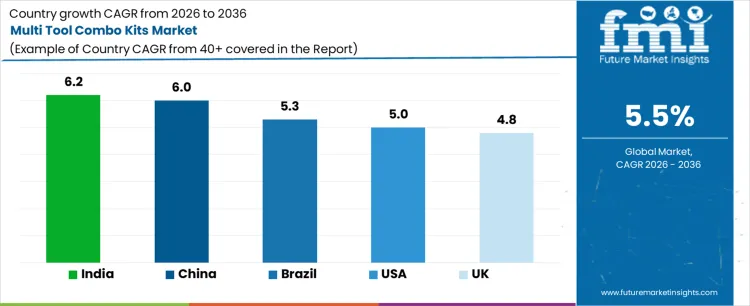
| Country | CAGR |
|---|---|
| USA | 5.0% |
| UK | 4.8% |
| China | 6.0% |
| India | 6.2% |
| Brazil | 5.3% |
Demand for multi tool combo kits is rising as professional contractors and DIY users prefer bundled power and hand tool sets that improve jobsite efficiency and reduce procurement cost. India leads with a 6.2% CAGR, supported by growth in small construction projects, home renovation activity, and expansion of organized retail for tools and hardware. China follows at 6.0%, driven by manufacturing activity, infrastructure projects, and strong domestic tool brands. Brazil records 5.3%, reflecting growth in residential construction and maintenance work. The USA grows at 5.0%, shaped by steady home improvement spending and replacement purchases. The UK, at 4.8%, reflects a mature DIY and professional tools market with stable demand.
How Do Contractor Purchasing Cycles and Fleet Standardization Shape Demand in the United States?
Fleet purchasing programs keep the multi tool combo kits market in the United States on a 5.0% CAGR path. Demand comes from contractors, maintenance teams, utility crews, and rental operators. Buyers focus on battery platform compatibility, tool durability, and warranty coverage. Procurement usually follows annual equipment replacement plans rather than one time purchases. Standardization across fleets simplifies training and spare management. Service records influence repeat brand selection. Kit composition affects job site efficiency and storage planning. Distribution partners manage regional availability and service coordination. Replacement demand follows usage intensity and failure rates. Promotional bundles influence upgrade timing. Financing plans support bulk purchases for large teams. Inventory planning follows project pipelines. Commercial position depends on inclusion in fleet programs and service reach rather than competition for isolated retail transactions.
Why Do Framework Agreements and Public Procurement Influence Adoption in the United Kingdom?
Centralized purchasing places the multi tool combo kits market in the United Kingdom on a 4.8% CAGR trajectory. Local authorities, infrastructure contractors, and facilities management firms represent key buyers. Tool selection follows safety standards, noise limits, and approved supplier lists. Orders move through framework agreements serving multiple departments and sites. Battery standardization across tool fleets receives priority. Workshop managers track repair rates and downtime. Training programs influence acceptance of new platforms. Replacement schedules align with budget cycles and contract renewals. Kit configuration affects storage and transport planning. Distributors coordinate service and calibration support. Documentation supports compliance audits. Inventory levels follow project workload forecasts. Commercial access depends on framework participation and service reliability rather than competition for small scale retail purchases by individual tradespeople.
What Role Do Manufacturing Scale and Trade Channel Expansion Play in China?
Industrial production growth places the multi tool combo kits market in China on a 6.0% growth path. Factory maintenance teams, construction firms, and installation contractors account for most demand. Domestic manufacturing supports broad product availability and price control. Corporate buyers define standard tool platforms for internal use. Procurement flows through group purchasing organizations and regional distributors. Battery ecosystems influence long term platform commitment. Service networks manage warranty and parts supply. Replacement cycles follow utilization intensity and equipment rotation policies. Kit content adapts to typical job tasks across sectors. E commerce channels expand access for smaller buyers. Inventory planning follows seasonal construction schedules. Payment terms align with procurement contracts. Commercial success depends on placement within large buyer programs and strong channel coverage rather than fragmented single store sales.
How Do Infrastructure Projects and Contractor Fragmentation Shape Demand in India?
Construction activity growth fixes the multi tool combo kits market in India at a 6.2% CAGR. Small contractors, installation crews, and maintenance service firms represent the main users. Procurement decisions focus on price performance balance, service access, and battery interchangeability. Many purchases occur through distributors serving regional trade networks. Tool kits support multi skill work on constrained sites. Training levels influence acceptance of advanced features. Replacement demand follows heavy usage and limited repair cycles. Import and domestic brands compete under warranty expectations. Inventory planning follows project award timing. Financing options influence buying capacity for smaller firms. Demonstration programs support product understanding. Distribution coverage shapes regional preference. Commercial results depend on distributor relationships and service support rather than reliance on premium branding or single channel retail strategies.
How Do Professional Trades and Retail Channel Structure Shape Spending in Brazil?
Workforce modernization keeps the multi tool combo kits market in Brazil near a 5.3% CAGR. Construction trades, maintenance providers, and utility contractors form the main customer base. Tool choice reflects durability, warranty terms, and service network coverage. Procurement often occurs through trade distributors and specialized retailers. Battery platform continuity influences repeat purchases. Training availability affects adoption of higher powered tools. Replacement cycles follow wear patterns and repair cost considerations. Kit configuration supports transport and storage constraints. Import procedures influence pricing and availability. Promotional campaigns affect seasonal demand peaks. Inventory planning follows construction activity levels. Distributor service capacity shapes brand reputation. Commercial position depends on channel reach and aftersales support rather than competition for occasional single tool purchases by individual users.
How Do Brand Owners Compete for Shelf Space and User Loyalty in the Multi Tool Combo Kits Market?
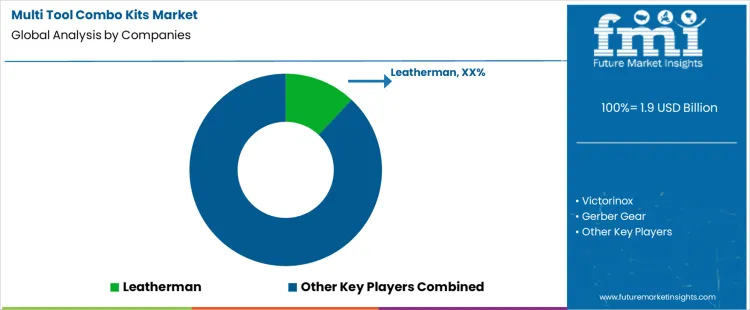
Multi tool combo kit purchasing reflects use context, carry habits, and replacement cycles rather than abstract feature lists. Buyers compare blade quality, plier strength, locking reliability, corrosion resistance, and sheath design before choosing brands. Leatherman, Victorinox, Gerber Gear, SOG compete through different product philosophies and channel strategies. Leatherman built its position on plier based platforms and repair programs that support long service life. Victorinox relies on precision finishing, compact layouts, and long standing associations with everyday carry tools. Gerber Gear targets outdoor, military, and worksite users with rugged constructions and broad retail reach. SOG focuses on compound leverage mechanisms and niche tool configurations. Once users standardize on a form factor, repeat purchases follow for gifts, spares, and task specific kits across many years.
Competition centers on durability reputation, warranty handling, and distribution coverage rather than short term price promotions. Retailers evaluate packaging efficiency, SKU turnover, and accessory compatibility when allocating shelf space. Professional users examine tool steel hardness, pivot wear, and field serviceability during selection. Leatherman benefits from domestic manufacturing perception and long warranty policies. Victorinox holds share where compactness and finish quality guide choices. Gerber Gear gains volume through outdoor and tactical channels with wide model ranges. SOG secures buyers who value mechanical advantage and specialized designs. Product refresh cycles shape visibility without forcing users to abandon familiar platforms. Market outcomes vary by region, user group, and retail channel mix, with brand trust carrying more weight than incremental specification differences.
Key Players of Multi Tool Combo Kits Market
- Leatherman
- Victorinox
- Gerber Gear
- SOG Specialty Knives & Tools
Scope of the Report
| Items | Values |
|---|---|
| Quantitative Units (2026) | USD Billion |
| Tool Type | Multi-tool kits with pliers-based tools; Multi-tool kits with screwdriver sets; Multi-tool kits with knife sets; Specialized combo kits |
| Distribution Channel | Offline retail stores; E-commerce and online marketplaces; Specialty tool dealers; Direct-to-consumer brand sales |
| Region | Asia Pacific; Europe; North America; Latin America; Middle East & Africa |
| Countries Covered | United States, Canada, Mexico, Germany, United Kingdom, France, Italy, Spain, Nordic, BENELUX, China, Japan, South Korea, India, Australia & New Zealand, ASEAN, Brazil, Chile, Saudi Arabia, Turkey, South Africa, Rest of regions |
| Key Companies Profiled | Leatherman; Victorinox; Gerber Gear; SOG Specialty Knives & Tools |
| Additional Attributes | Dollar by sales by tool type and channel; regional growth outlook; inventory and SKU mix analysis; platform ecosystem adoption; contractor and fleet purchasing patterns; retail versus online channel dynamics; replacement and upgrade cycle trends; assortment and bundling strategy analysis |
Multi Tool Combo Kits Market Segmentation
Tool Type:
- Multi-tool kits with pliers-based tools
- Multi-tool kits with screwdriver sets
- Multi-tool kits with knife sets
- Specialized combo kits
Distribution Channel:
- Offline retail stores
- E-commerce and online marketplaces
- Specialty tool dealers
- Direct-to-consumer brand sales
Region
- Asia Pacific
- China
- Japan
- South Korea
- India
- Australia & New Zealand
- ASEAN
- Rest of Asia Pacific
- Europe
- Germany
- United Kingdom
- France
- Italy
- Spain
- Nordic
- BENELUX
- Rest of Europe
- North America
- United States
- Canada
- Mexico
- Latin America
- Brazil
- Chile
- Rest of Latin America
- Middle East & Africa
- Kingdom of Saudi Arabia
- Other GCC Countries
- Turkey
- South Africa
- Other African Union
- Rest of Middle East & Africa
Bibliography
- Organisation for Economic Co-operation and Development. (2025, June 3). Peru. In OECD economic outlook, volume 2025 issue 1. OECD Publishing.
- U.S. Census Bureau. (2025, March 18). Advance monthly sales for retail and food services, February 2025. U.S. Department of Commerce.
- U.S. International Trade Commission. (2025, February 7). Harmonized tariff schedule of the United States (2025), revision 1. U.S. International Trade Commission.
Frequently Asked Questions
How big is the multi tool combo kits market in 2026?
The global multi tool combo kits market is estimated to be valued at USD 1.9 billion in 2026.
What will be the size of multi tool combo kits market in 2036?
The market size for the multi tool combo kits market is projected to reach USD 3.2 billion by 2036.
How much will be the multi tool combo kits market growth between 2026 and 2036?
The multi tool combo kits market is expected to grow at a 5.5% CAGR between 2026 and 2036.
What are the key product types in the multi tool combo kits market?
The key product types in multi tool combo kits market are multi‑tool kits with pliers‑based tools , multi‑tool kits with screwdriver sets, multi‑tool kits with knife sets and specialized combo kits.
Which distribution channel segment to contribute significant share in the multi tool combo kits market in 2026?
In terms of distribution channel, offline retail stores segment to command 45.0% share in the multi tool combo kits market in 2026.
Preview the report firsthand - request a free sample
Get SampleGet the brochure for pricing and purchase details.
Get PDFTable of Content
- Executive Summary
- Global Market Outlook
- Demand-side Trends
- Supply-side Trends
- Technology Roadmap Analysis
- Analysis and Recommendations
- Market Overview
- Market Coverage / Taxonomy
- Market Definition / Scope / Limitations
- Market Background
- Market Dynamics
- Drivers
- Restraints
- Opportunity
- Trends
- Scenario Forecast
- Demand in Optimistic Scenario
- Demand in Likely Scenario
- Demand in Conservative Scenario
- Opportunity Map Analysis
- Product Life Cycle Analysis
- Supply Chain Analysis
- Investment Feasibility Matrix
- Value Chain Analysis
- PESTLE and Porter’s Analysis
- Regulatory Landscape
- Regional Parent Market Outlook
- Production and Consumption Statistics
- Import and Export Statistics
- Market Dynamics
- Global Market Analysis 2021 to 2025 and Forecast, 2026 to 2036
- Historical Market Size Value (USD Million) Analysis, 2021 to 2025
- Current and Future Market Size Value (USD Million) Projections, 2026 to 2036
- Y-o-Y Growth Trend Analysis
- Absolute $ Opportunity Analysis
- Global Market Pricing Analysis 2021 to 2025 and Forecast 2026 to 2036
- Global Market Analysis 2021 to 2025 and Forecast 2026 to 2036, By Tool Type
- Introduction / Key Findings
- Historical Market Size Value (USD Million) Analysis By Tool Type , 2021 to 2025
- Current and Future Market Size Value (USD Million) Analysis and Forecast By Tool Type , 2026 to 2036
- Multi‑tool kits with pliers‑based tools
- Multi‑tool kits with screwdriver sets
- Multi‑tool kits with knife Sets
- Specialized combo kits
- Multi‑tool kits with pliers‑based tools
- Y-o-Y Growth Trend Analysis By Tool Type , 2021 to 2025
- Absolute $ Opportunity Analysis By Tool Type , 2026 to 2036
- Global Market Analysis 2021 to 2025 and Forecast 2026 to 2036, By Distribution Channel
- Introduction / Key Findings
- Historical Market Size Value (USD Million) Analysis By Distribution Channel, 2021 to 2025
- Current and Future Market Size Value (USD Million) Analysis and Forecast By Distribution Channel, 2026 to 2036
- Offline retail stores
- E‑commerce and online marketplaces
- Specialty tool dealers
- Direct‑to‑consumer brand sales
- Offline retail stores
- Y-o-Y Growth Trend Analysis By Distribution Channel, 2021 to 2025
- Absolute $ Opportunity Analysis By Distribution Channel, 2026 to 2036
- Global Market Analysis 2021 to 2025 and Forecast 2026 to 2036, By Region
- Introduction
- Historical Market Size Value (USD Million) Analysis By Region, 2021 to 2025
- Current Market Size Value (USD Million) Analysis and Forecast By Region, 2026 to 2036
- North America
- Latin America
- Western Europe
- Eastern Europe
- East Asia
- South Asia and Pacific
- Middle East & Africa
- Market Attractiveness Analysis By Region
- North America Market Analysis 2021 to 2025 and Forecast 2026 to 2036, By Country
- Historical Market Size Value (USD Million) Trend Analysis By Market Taxonomy, 2021 to 2025
- Market Size Value (USD Million) Forecast By Market Taxonomy, 2026 to 2036
- By Country
- USA
- Canada
- Mexico
- By Tool Type
- By Distribution Channel
- By Country
- Market Attractiveness Analysis
- By Country
- By Tool Type
- By Distribution Channel
- Key Takeaways
- Latin America Market Analysis 2021 to 2025 and Forecast 2026 to 2036, By Country
- Historical Market Size Value (USD Million) Trend Analysis By Market Taxonomy, 2021 to 2025
- Market Size Value (USD Million) Forecast By Market Taxonomy, 2026 to 2036
- By Country
- Brazil
- Chile
- Rest of Latin America
- By Tool Type
- By Distribution Channel
- By Country
- Market Attractiveness Analysis
- By Country
- By Tool Type
- By Distribution Channel
- Key Takeaways
- Western Europe Market Analysis 2021 to 2025 and Forecast 2026 to 2036, By Country
- Historical Market Size Value (USD Million) Trend Analysis By Market Taxonomy, 2021 to 2025
- Market Size Value (USD Million) Forecast By Market Taxonomy, 2026 to 2036
- By Country
- Germany
- UK
- Italy
- Spain
- France
- Nordic
- BENELUX
- Rest of Western Europe
- By Tool Type
- By Distribution Channel
- By Country
- Market Attractiveness Analysis
- By Country
- By Tool Type
- By Distribution Channel
- Key Takeaways
- Eastern Europe Market Analysis 2021 to 2025 and Forecast 2026 to 2036, By Country
- Historical Market Size Value (USD Million) Trend Analysis By Market Taxonomy, 2021 to 2025
- Market Size Value (USD Million) Forecast By Market Taxonomy, 2026 to 2036
- By Country
- Russia
- Poland
- Hungary
- Balkan & Baltic
- Rest of Eastern Europe
- By Tool Type
- By Distribution Channel
- By Country
- Market Attractiveness Analysis
- By Country
- By Tool Type
- By Distribution Channel
- Key Takeaways
- East Asia Market Analysis 2021 to 2025 and Forecast 2026 to 2036, By Country
- Historical Market Size Value (USD Million) Trend Analysis By Market Taxonomy, 2021 to 2025
- Market Size Value (USD Million) Forecast By Market Taxonomy, 2026 to 2036
- By Country
- China
- Japan
- South Korea
- By Tool Type
- By Distribution Channel
- By Country
- Market Attractiveness Analysis
- By Country
- By Tool Type
- By Distribution Channel
- Key Takeaways
- South Asia and Pacific Market Analysis 2021 to 2025 and Forecast 2026 to 2036, By Country
- Historical Market Size Value (USD Million) Trend Analysis By Market Taxonomy, 2021 to 2025
- Market Size Value (USD Million) Forecast By Market Taxonomy, 2026 to 2036
- By Country
- India
- ASEAN
- Australia & New Zealand
- Rest of South Asia and Pacific
- By Tool Type
- By Distribution Channel
- By Country
- Market Attractiveness Analysis
- By Country
- By Tool Type
- By Distribution Channel
- Key Takeaways
- Middle East & Africa Market Analysis 2021 to 2025 and Forecast 2026 to 2036, By Country
- Historical Market Size Value (USD Million) Trend Analysis By Market Taxonomy, 2021 to 2025
- Market Size Value (USD Million) Forecast By Market Taxonomy, 2026 to 2036
- By Country
- Kingdom of Saudi Arabia
- Other GCC Countries
- Turkiye
- South Africa
- Other African Union
- Rest of Middle East & Africa
- By Tool Type
- By Distribution Channel
- By Country
- Market Attractiveness Analysis
- By Country
- By Tool Type
- By Distribution Channel
- Key Takeaways
- Key Countries Market Analysis
- USA
- Pricing Analysis
- Market Share Analysis, 2025
- By Tool Type
- By Distribution Channel
- Canada
- Pricing Analysis
- Market Share Analysis, 2025
- By Tool Type
- By Distribution Channel
- Mexico
- Pricing Analysis
- Market Share Analysis, 2025
- By Tool Type
- By Distribution Channel
- Brazil
- Pricing Analysis
- Market Share Analysis, 2025
- By Tool Type
- By Distribution Channel
- Chile
- Pricing Analysis
- Market Share Analysis, 2025
- By Tool Type
- By Distribution Channel
- Germany
- Pricing Analysis
- Market Share Analysis, 2025
- By Tool Type
- By Distribution Channel
- UK
- Pricing Analysis
- Market Share Analysis, 2025
- By Tool Type
- By Distribution Channel
- Italy
- Pricing Analysis
- Market Share Analysis, 2025
- By Tool Type
- By Distribution Channel
- Spain
- Pricing Analysis
- Market Share Analysis, 2025
- By Tool Type
- By Distribution Channel
- France
- Pricing Analysis
- Market Share Analysis, 2025
- By Tool Type
- By Distribution Channel
- India
- Pricing Analysis
- Market Share Analysis, 2025
- By Tool Type
- By Distribution Channel
- ASEAN
- Pricing Analysis
- Market Share Analysis, 2025
- By Tool Type
- By Distribution Channel
- Australia & New Zealand
- Pricing Analysis
- Market Share Analysis, 2025
- By Tool Type
- By Distribution Channel
- China
- Pricing Analysis
- Market Share Analysis, 2025
- By Tool Type
- By Distribution Channel
- Japan
- Pricing Analysis
- Market Share Analysis, 2025
- By Tool Type
- By Distribution Channel
- South Korea
- Pricing Analysis
- Market Share Analysis, 2025
- By Tool Type
- By Distribution Channel
- Russia
- Pricing Analysis
- Market Share Analysis, 2025
- By Tool Type
- By Distribution Channel
- Poland
- Pricing Analysis
- Market Share Analysis, 2025
- By Tool Type
- By Distribution Channel
- Hungary
- Pricing Analysis
- Market Share Analysis, 2025
- By Tool Type
- By Distribution Channel
- Kingdom of Saudi Arabia
- Pricing Analysis
- Market Share Analysis, 2025
- By Tool Type
- By Distribution Channel
- Turkiye
- Pricing Analysis
- Market Share Analysis, 2025
- By Tool Type
- By Distribution Channel
- South Africa
- Pricing Analysis
- Market Share Analysis, 2025
- By Tool Type
- By Distribution Channel
- USA
- Market Structure Analysis
- Competition Dashboard
- Competition Benchmarking
- Market Share Analysis of Top Players
- By Regional
- By Tool Type
- By Distribution Channel
- Competition Analysis
- Competition Deep Dive
- Leatherman
- Overview
- Product Portfolio
- Profitability by Market Segments (Product/Age /Sales Channel/Region)
- Sales Footprint
- Strategy Overview
- Marketing Strategy
- Product Strategy
- Channel Strategy
- Victorinox
- Gerber Gear
- SOG Specialty Knives & Tools
- Leatherman
- Competition Deep Dive
- Assumptions & Acronyms Used
- Research Methodology


