

- Industry Size (2026)
- USD 1060 Mn
- Forecast (2036)
- USD 3140 Mn
- CAGR (2026 to 2036)
- 11.5%
Multi-Pack Packaging for Toddler Toys Market Forecast and Outlook 2026 to 2036?
The global multi-pack packaging for toddler toys market is estimated to be valued at USD 1,060 million in 2026 and is projected to reach USD 3,140 million by 2036, expanding at an 11.5% CAGR. FMI analysis indicates that growth is primarily a function of retail channel concentration and the scaling of value-pack merchandising models rather than premium packaging innovation. As the toddler toy category becomes more price competitive and more dependent on large-format retail distribution, the economic logic of bundling is strengthening and multi-pack packaging becomes a recurring, high-throughput packaging requirement.
A key contributor to growth is the operational behavior of high-volume retail channels. Warehouse clubs and hypermarkets increasingly prefer multi-pack formats because they reduce stocking labor and increase average transaction value. For toddler toys, bundling also helps reduce unit theft risk and improves shelf impact through larger, more visible packs. Packaging formats are being optimized for shelf footprint, pallet stability, and transit integrity because the cost of returns and damage is high relative to the margin of mass-market toddler toy assortments.
Another growth driver is export consolidation and regional redistribution. A large portion of toddler toys is manufactured in Asia and shipped across long logistics chains. Multi-pack and master carton configurations are engineered to reduce the frequency of repacking at destination markets. This pushes demand toward packaging architectures that can survive extended transit and multiple handling steps without compromising box integrity or print readability. FMI observes that packaging procurement is increasingly influenced by end-to-end damage economics rather than single-leg shipping assumptions.
Sustainability alignment is a third structural factor shaping the market outlook. Retailers and consumer brands are reducing plastic use in outer packaging where substitution is operationally feasible. Paper-based solutions are therefore growing, but only where they can maintain the mechanical performance required for high stacking loads and long-distance shipping. The result is a market where growth is not simply driven by material substitution, but by the ability of paper-based and hybrid paper formats to meet the physical and commercial requirements of large retail distribution systems.
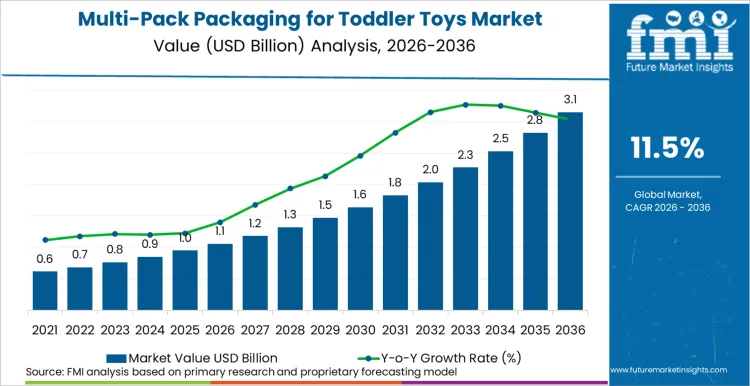
Summary of Wooden Toddler Toy Packaging Market
- The wooden toddler toy packaging market comprises paper-based packaging formats and protective systems used to merchandise and ship wooden toddler toys across eco-toy retailers, online retail platforms, OEM export channels, and specialty boutiques.
- The defined scope is structured under FMI taxonomy with segmentation across end use, packaging format, material, and region, focusing exclusively on packaging solutions for wooden toddler toys and excluding toy manufacturing revenues, non-wood toy packaging, and downstream retail services.
- The wooden toddler toy packaging market is projected to grow at a CAGR of 12.0% from 2026 to 2036, expanding from USD 640 million in 2026 to USD 1,980 million by 2036, based on FMI proprietary forecasting integrating channel mix evolution, sustainability-led material substitution, and packaging format penetration across retail and export flows.
- The sector is transitioning toward plastic-minimized, fiber-based packaging systems where recycled paperboard, molded pulp protection, and kraft-forward carton architectures are increasingly preferred to support credible sustainability positioning while maintaining protection performance for heavier wooden SKUs.
- Competition is concentrated among integrated paper packaging and corrugated suppliers such as Mondi, Smurfit Kappa, WestRock, Pratt Industries, Nine Dragons, Lee & Man, Amcor, TCPL Packaging, and Klabin, with competitive advantage driven by recycled fiber sourcing capability, molded pulp execution depth, and scalable retail-ready packaging engineering.
- India is projected to record the fastest growth at a 15.2% CAGR through 2036, while Europe retains the largest value share, supported by high eco-toy retailer penetration, sustainability-led procurement standards, and strong adoption of recycled paperboard and kraft-based packaging formats.
Multi-Pack Packaging for Toddler Toys Market Key Takeaways?
| Metric | Value |
|---|---|
| Expected Value 2026E | USD 1,060 million |
| Forecast Value 2036F | USD 3,140 million |
| CAGR 2026 to 2036 | 11.5% |
Source: Future Market Insights analysis based on proprietary forecasting model and primary research
Why is the Multi-Pack Packaging for Toddler Toys Market Growing?
The primary growth driver is the continued rise of multi-unit merchandising in mass retail. Warehouse clubs, large-format retailers, and selected hypermarkets rely on value packs to drive basket size and limit shelf complexity. For toddler toys, bundles also reduce friction for gift purchases and simplify choice for parents. This creates a structural preference for multipacks and, by extension, packaging that can present multiple items cohesively while maintaining clear visibility of what is inside. FMI observes that packaging decisions for this category are increasingly led by retail execution teams rather than by product branding teams, shifting priorities toward shelf efficiency and damage control.
A second driver is logistics simplification. Bundling reduces the number of individual items that require scanning, stocking, and replenishment. It also reduces the number of unique handling units moving through distribution centers. This matters for toddler toys where seasonal surges can overwhelm retail supply chains. Multi-pack formats improve throughput by standardizing case pack dimensions and improving pallet stability. FMI finds that packaging designs are increasingly being evaluated by how well they reduce distribution bottlenecks during peak retail periods, rather than by how they enhance product storytelling.
Sustainability pressure reinforces the shift but does not replace operational drivers. Parents are sensitive to packaging waste, and retailers increasingly maintain scorecards for packaging recyclability and plastic reduction. This creates a demand-side push toward paper-dominant multi-pack structures. However, the market grows only where paper-based designs can withstand compression loads and retain shape through long shipping routes. In effect, sustainability is acting as a constraint that reshapes material choice, while retail efficiency remains the engine that drives volume.
What is the Segment Profile of the Multi-Pack Packaging for Toddler Toys Market?
The segment structure reflects where demand concentration and execution feasibility are highest. FMI retains only the dominant segment in each category and expands it into operationally grounded analysis.
Why do warehouse clubs dominate end-use demand?
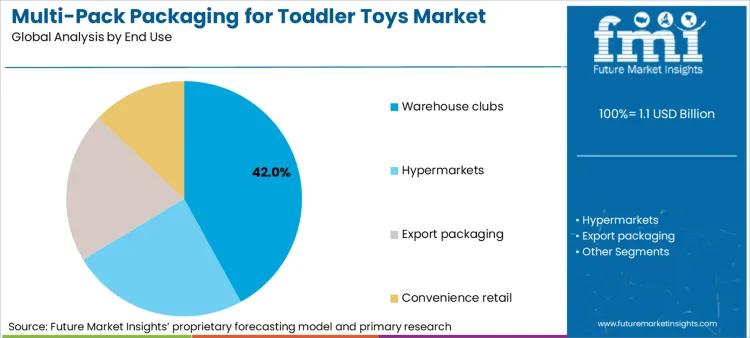
Warehouse clubs account for 42% of end-use demand because their commercial model is built around bulk purchasing and limited-SKU merchandising. Toddler toys in warehouse clubs are typically sold as value bundles, seasonal packs, or assortment sets where the bundle itself is the selling unit. This makes multi-pack packaging a structural requirement rather than a discretionary choice. Packaging must deliver high stacking strength for palletized presentation, predictable shelf footprint to fit standardized merchandising bays, and enough graphic real estate to communicate bundle value quickly in a high-traffic environment.
A second reason for dominance is the strict packaging governance imposed by these retailers. Warehouse clubs frequently enforce detailed requirements on dimensions, pallet patterns, and transit durability because they operate at high volume and cannot tolerate frequent damage or unstable stacking. FMI observes that suppliers design multipacks backward from retailer handling systems, optimizing for compression strength, corner protection, and minimal repacking at store level. This channel power hardens demand for robust, repeatable packaging formats and sustains warehouse clubs as the largest end-use segment through the forecast period.
Why do shrink-bundled cartons dominate packaging format selection?
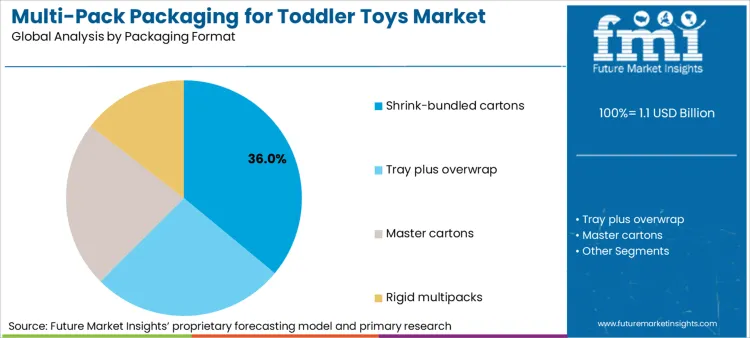
Shrink-bundled cartons represent 36% of packaging format demand because they provide a practical compromise between unitization strength, line speed, and merchandising clarity. The structure allows multiple toy units or inner packs to be secured together into a stable retail bundle without requiring heavy secondary packaging. This keeps unit costs low while maintaining bundle coherence through distribution. FMI analysis indicates that the format is favored where retailers require stable bundling for pallet-ready handling but brands still want some visibility or perceived openness compared to fully enclosed multipacks.
A second factor supporting dominance is operational scalability. Shrink-bundled cartons can be produced at high throughput and are compatible with standardized packing line architectures. This matters for toddler toys where seasonality drives surges and production lines must scale quickly. FMI finds that the format also reduces the risk of bundle separation during shipping, which is a key driver of returns and retail non-compliance. Even as plastic reduction efforts continue, the shrink-bundled carton remains dominant because it enables stability with minimal material complexity, and because the plastic content can be optimized rather than eliminated in many programs.
Why does corrugated board dominate material selection?
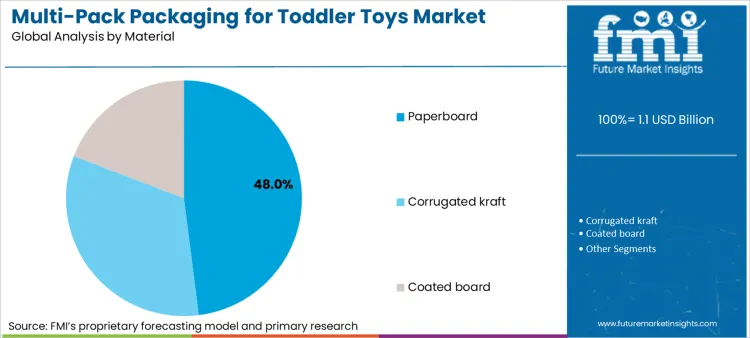
Corrugated board accounts for 48% of material demand because it provides the best balance between compression strength, cost efficiency, and recyclability for multi-pack logistics. Toddler toy multipacks often face stacking loads in warehouses and during store presentation. Corrugated board supports these loads with predictable performance at scale, while also providing sufficient surface for basic branding and regulatory labeling. FMI observes that corrugated is favored when damage economics are a priority, because it reduces the frequency of crushed packs and protects product boxes within.
A second reason for corrugated dominance is compatibility with export and long-haul distribution. Corrugated board performs well in master carton systems and can be specified with different flute profiles to match transit risk. This design flexibility supports diverse toy assortments without expensive tooling changes. FMI finds that corrugated board also aligns with retailer sustainability optics because it is widely recycled and easy to communicate as paper-based packaging. As a result, corrugated holds a leadership position not only because it is strong and inexpensive, but because it simultaneously satisfies performance and sustainability narratives in high-volume retail settings.
Why does North America dominate regional demand?
North America accounts for 34% of regional demand because the region’s retail structure is highly concentrated in bulk purchasing channels and large-format stores that actively promote multi-pack value strategies. Warehouse clubs are deeply embedded, and many mass retailers use multi-pack bundles to simplify shelf management and drive higher average transaction value. This raises the baseline demand for multi-pack packaging and pushes packaging formats toward standardized geometries that fit the region’s distribution and merchandising norms.
A second driver is the region’s heightened sensitivity to packaging waste in children’s categories. Brands selling toddler toys face reputational pressure to reduce excessive packaging. Retailers also maintain sustainability expectations that influence packaging selection. FMI observes that North American demand therefore favors paper-based solutions that can be positioned as recyclable while still meeting the handling demands of high-volume retail. This combination of channel concentration and sustainability optics sustains North America as the largest regional market.
What Drivers, Restraints, Opportunities, and Trends Prevail in the Multi-Pack Packaging for Toddler Toys Market?
Drivers: The dominant driver is channel-led bundling economics. Retailers, particularly warehouse clubs and hypermarkets, use multipacks to reduce SKU complexity and improve shelf efficiency, which makes multi-pack packaging a recurring requirement. A second driver is damage and return cost reduction. Multipacks designed for high stacking strength and stable unitization reduce crushed packaging and broken outer packs, which is critical for toddler toys where packaging condition influences perceived safety and gift suitability. Sustainability pressure also drives demand for paper-based materials, but primarily as a constraint shaping design rather than the core volume engine.
Restraints: The largest restraint is extreme cost sensitivity. Toddler toys sold as multipacks are value-led, and packaging cost must remain low relative to product cost. Retailers often resist packaging upgrades that raise price even if sustainability improves. Another restraint is moisture and scuff risk during long supply chains. Paper-based formats can be vulnerable in humid transit or during repeated handling, which can force brands to retain protective elements or select heavier grades, increasing cost. In addition, shelf and pallet specifications imposed by major retailers can restrict packaging innovation by enforcing standardized dimensions.
Opportunities: The strongest opportunity lies in lightweighting and structure optimization that reduces material use while retaining compression performance. Packaging redesign that improves stacking stability can reduce damages and yield savings that offset the cost of higher-grade board. Another opportunity is shelf-ready design integration. Multipacks that reduce in-store labor and improve display readiness can gain retailer preference, creating a commercial advantage for converters. There is also opportunity in improved print and graphics strategies that convey safety and value without increasing structural complexity, particularly in gift-driven seasonal periods.
Trends: A key trend is the shift toward paper-dominant structures with minimized plastic elements, rather than fully eliminating plastic in all cases. Another trend is standardized pack architectures across multiple toy lines, enabling scale efficiencies for both converters and brands. FMI also sees an increased use of master-carton rationalization, where export packaging and retail multipack are aligned to reduce repacking steps at destination. Over time, the market will reward converters who can deliver repeatable performance, retailer compliance, and sustainability optics within tight cost bands.
How is the Multi-Pack Packaging for Toddler Toys Market Analyzed in Key Countries?
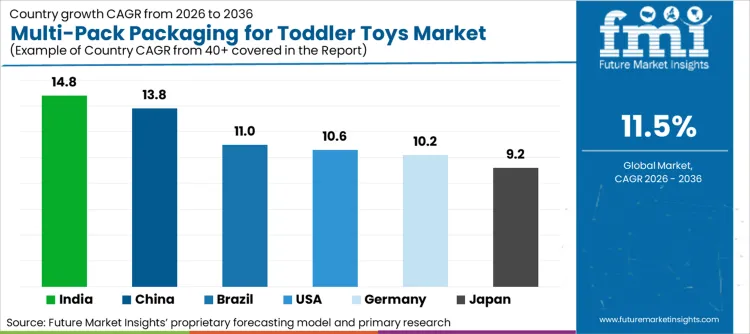
| Country | CAGR (2026-2036) |
|---|---|
| USA | 10.6% |
| Germany | 10.2% |
| China | 13.8% |
| Japan | 9.2% |
| India | 14.8% |
| Brazil | 11.0% |
Source: Future Market Insights analysis, supported by a proprietary forecasting model and primary research
How is USA shaping demand through warehouse club dominance and compliance discipline?
USA is projected to grow at a 10.6% CAGR, driven by the outsized influence of warehouse clubs and large-format retailers on toddler toy merchandising. Multi-pack formats are structurally favored because they improve value perception and reduce shelf complexity, and retailers impose strict requirements around pallet stability, case durability, and store handling. FMI analysis indicates that U.S. demand is therefore anchored in packaging architectures that prioritize compression strength, standardized footprints, and stable bundle integrity, particularly for seasonal assortments where replenishment velocity is high.
A second U.S. growth driver is the rising emphasis on packaging waste reduction in children’s categories. Parents and retailers increasingly view excessive plastic packaging as a negative signal, pushing brands toward paper-dominant solutions. However, adoption is constrained by damage economics. FMI observes that U.S. brands and retailers accept plastic reduction when packaging still performs under long distribution cycles and high handling intensity. This favors corrugated-led designs and shrink-bundled carton formats where plastic is reduced or optimized rather than removed.
Why is Germany advancing through hypermarket structuring and packaging waste governance?
Germany is expected to expand at a 10.2% CAGR, supported by strong hypermarket and discount retail structures that favor standardized multi-packs for price discipline and shelf efficiency. German retailers typically enforce clean merchandising and compact packaging footprints, which pushes multi-pack design toward controlled geometry, strong edge protection, and predictable stacking behavior. FMI finds that packaging designs in Germany often prioritize tidy retail presentation and recyclability alignment over visibility-heavy formats.
A second growth driver is the regulatory and societal pressure to reduce packaging waste and improve recycling alignment. Brands serving Germany are encouraged to adopt paperboard and corrugated solutions that fit established recycling expectations. However, cost pressure remains intense. FMI analysis indicates that the market grows fastest when packaging redesign improves both sustainability optics and operational outcomes, such as reducing damages and minimizing retail handling labor, enabling adoption without raising unit costs materially.
How is China leveraging export consolidation and manufacturing scale?
China is projected to grow at a 13.8% CAGR, primarily driven by export packaging demand tied to its manufacturing role in global toddler toy supply chains. Large volumes of toys are consolidated into master cartons and multi-pack configurations designed for long-haul shipping, regional distribution, and compliance labeling. FMI observes that demand is particularly strong for packaging that provides high compression resistance and stable transit performance, because shipping damage can destroy margin on high-volume export programs.
A second driver is scale economics. High production runs enable packaging standardization and cost optimization. Export-oriented toy manufacturers prefer packaging formats that can be produced at high throughput with minimal variation, which sustains demand for corrugated-based solutions and standardized master carton architectures. FMI expects China’s growth to remain robust because export consolidation needs will persist and because packaging is increasingly being engineered to reduce repacking at destination markets.
Why does Japan remain a design disciplined but slower growth market?
Japan is forecast to grow at a 9.2% CAGR, reflecting the influence of convenience retail formats and compact merchandising expectations. While multi-pack volumes are smaller than in warehouse club markets, packaging still plays an important role in ensuring clean presentation and consistent product integrity. FMI finds that Japanese demand prioritizes neatness, controlled dimensions, and strong packaging finish quality, which shapes format selection even in value-driven segments.
A second factor is the discipline of packaging execution. Japan tends to adopt packaging changes cautiously, focusing on reliability and consumer perception. Paper-based formats and coated board solutions are favored where they preserve visual quality and shelf presentation, but cost constraints limit excessive upgrades. FMI expects steady growth as bundled formats increase modestly, but Japan’s market remains less volume-driven than export and warehouse club markets.
Why is India emerging as a fast growth manufacturing and domestic retail market?
India is projected to expand at a 14.8% CAGR, driven by rising domestic toy manufacturing and a growing share of organized retail distribution. As manufacturers scale production for both local sales and exports, multi-pack packaging becomes more relevant for efficiency, particularly for bundling related items and supporting bulk retail distribution. FMI analysis indicates that growth is strongest where packaging improves logistics handling and reduces damage rates without increasing packaging cost materially.
A second driver is export alignment. Indian suppliers increasingly serve global buyers that expect standardized packaging and clearer sustainability cues. Corrugated and paper-based formats are preferred because they are cost-effective and widely acceptable in export markets. FMI observes that India’s growth is supported by the ability to scale packaging supply locally, but quality consistency and moisture resilience remain constraints that packaging suppliers must manage through grade selection and process control.
How is Brazil developing through regional paper strength and retail evolution?
Brazil is expected to grow at an 11.0% CAGR, shaped by gradual expansion in organized retail and the strengthening of domestic paper and corrugated capabilities. As retailers push for better shelf readiness and reduced handling costs, multi-pack packaging becomes more attractive for value bundles. FMI analysis indicates that Brazil’s market growth is concentrated in paper-based formats that can be produced competitively and that deliver sufficient protection in regional distribution systems.
A second driver is the role of local corrugated producers and forestry-linked packaging supply chains that support competitive pricing. However, demand remains sensitive to packaging cost and logistics variability. FMI observes that growth accelerates where multi-pack packaging reduces damages and returns, enabling brands to justify packaging spend through operational savings. Over time, Brazil’s market will grow through disciplined adoption of standardized corrugated multi-pack architectures rather than premium packaging shifts.
How Competitive is the Multi-Pack Packaging for Toddler Toys Market?
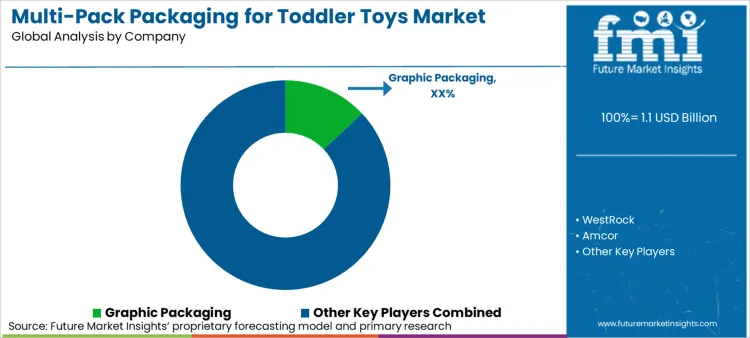
The competitive landscape of multi-pack packaging for toddler toys is defined by scale efficiency, retail compliance capability, and the ability to deliver repeatable packaging performance under tight cost constraints. Competition is not centered on high design novelty. Instead, it is driven by how effectively packaging suppliers can meet retailer specification regimes while delivering compression strength, stable unitization, and consistent print outcomes at high throughput. Because toddler toy multipacks are commonly sold through value-driven channels, converters that can reliably deliver cost discipline and operational performance tend to win long-term supply positions.
A primary competitive differentiator is the ability to engineer packaging for retailer handling systems. Warehouse clubs and hypermarkets enforce standardized pallet patterns, minimum compression requirements, and strict rules for shelf footprint. Suppliers that have proven capability to design, test, and consistently manufacture packaging that passes these requirements are structurally advantaged. FMI observes that many packaging awards are decided on reliability metrics, such as damage reduction and replenishment labor savings, rather than on aesthetics. This favors large integrated paperboard and corrugated producers with strong packaging testing infrastructure and consistent board supply.
A second axis of competition is material strategy under sustainability constraints. Retailers and brands are under pressure to reduce plastic usage, especially for products targeted at young children. Packaging suppliers compete on how well they can reduce plastic content without increasing failure rates. This includes shifting toward paper-dominant structures, optimizing overwrap use, and improving structural design to maintain bundle stability. FMI analysis indicates that suppliers that can show quantified plastic reduction while keeping total packaging cost stable gain an advantage in procurement decisions, particularly in North America and Europe where retailer sustainability scorecards are most influential.
A third differentiator is footprint and supply reliability. Toy manufacturing and distribution are global, with large volumes shipped across regions. Suppliers with multi-region manufacturing networks or strong export-ready supply chains can support brands with consistent packaging specifications across markets. This is important because brands aim to standardize pack formats to reduce complexity and avoid repacking at destination. FMI finds that converters with strong regional coverage and consistent quality systems can win preferred supplier positions because they reduce operational friction for toy brands serving multiple retail channels.
A fourth competitive factor is print and merchandising execution within cost bands. Toddler toy multipacks must communicate value and safety perception quickly, often in crowded retail environments. Packaging that retains print clarity, maintains good edge definition, and resists scuffing during handling can influence retailer acceptance even for value packs. However, the market does not reward expensive finishes. The winners are suppliers that can deliver sufficient print quality for mass retail merchandising while keeping structural performance strong and cost low. This tends to favor paperboard and corrugated leaders with advanced converting capability and stable board properties.
A fifth driver of competitive intensity is seasonality management. Toddler toy demand spikes in holiday periods and promotional cycles. Packaging suppliers that can ramp volumes, maintain lead times, and avoid quality drift during surges are more likely to retain supply contracts. FMI analysis indicates that operational resilience and capacity flexibility are often more important than marginal price differences, particularly for brands that cannot afford stockouts during seasonal peaks. This favors large converters with capacity redundancy, robust procurement of paper inputs, and strong production planning.
Key players influence the market through board supply integration, converting capability, and retail program relationships. Companies such as Graphic Packaging and WestRock are positioned through scale and North American retail channel penetration. Amcor participates through broader packaging solutions relationships and multi-region service capability. Nine Dragons and SCG Packaging shape supply in Asia through board capacity and export packaging support. Rengo influences the Japan market through domestic packaging standards and strong manufacturing governance. ITC Packaging and Klabin influence South Asia and Latin America through regional board availability and pricing competitiveness. Over the forecast period, competitive advantage will increasingly accrue to suppliers that can combine retailer compliance engineering, paper-dominant sustainability execution, and high-throughput cost discipline.
Key Players Profiled
- Graphic Packaging
- WestRock
- Amcor
- Nine Dragons
- SCG Packaging
- Rengo
- ITC Packaging
- Klabin
Market Definition
The multi-pack packaging for toddler toys market comprises revenues generated from secondary and tertiary packaging solutions used to bundle multiple toddler toy units into a single retail or logistics selling unit. This includes packaging formats used for bulk retail, hypermarket distribution, and export consolidation, where packaging is designed to improve handling efficiency, protect products during transit, and support retail merchandising requirements.
The scope includes paper-based and hybrid packaging structures such as shrink-bundled cartons, tray and overwrap formats, master cartons, and rigid multi-pack formats used specifically for toddler toys. It excludes primary toy packaging at the individual unit level where it is not part of a multipack, and excludes reusable plastic crates used only in closed-loop distribution systems.
Scope of Report
| Items | Values |
|---|---|
| Quantitative Units (2026) | USD 1,060 million |
| End Use | Warehouse clubs, Hypermarkets, Export packaging, Convenience retail |
| Packaging Format | Shrink-bundled cartons, Tray plus overwrap, Master cartons, Rigid multipacks |
| Material | Corrugated board, Paperboard, Corrugated kraft, Coated board |
| Regions Covered | North America, Europe, East Asia, Japan, South Asia, Rest of World |
| Key Companies | Graphic Packaging, WestRock, Amcor, Nine Dragons, SCG Packaging, Rengo, ITC Packaging, Klabin |
Source: Future Market Insights analysis based on proprietary forecasting model and primary research
Multi-Pack Packaging for Toddler Toys Market Key Segments
End Use:
- Warehouse clubs
- Hypermarkets
- Export packaging
- Convenience retail
Packaging Format:
- Shrink-bundled cartons
- Tray plus overwrap
- Master cartons
- Rigid multipacks
Material:
- Corrugated board
- Paperboard
- Corrugated kraft
- Coated board
Region:
- North America
- Europe
- East Asia
- Japan
- South Asia
- Rest of the World
Bibliography
- American Forest & Paper Association. (2024). Corrugated packaging performance and recyclability in U.S. retail supply chains. AF&PA.
- ASTM International. (2024). ASTM D642-24: Standard test method for determining compressive resistance of shipping containers. ASTM International.
- International Safe Transit Association. (2025). ISTA 3 series: General simulation performance tests for packaged products. ISTA.
- Organisation for Economic Co-operation and Development. (2025). Retail logistics, packaging efficiency, and damage reduction in global consumer goods trade. OECD Publishing.
- Paper and Packaging Board. (2024). Paper-based packaging in mass retail: Performance, perception, and sustainability. P+PB.
- Toy Association. (2025). U.S. toy retail trends and packaging implications for early childhood products. The Toy Association.
- United Nations Conference on Trade and Development. (2024). Global manufacturing, export consolidation, and packaging requirements. UNCTAD.
- World Packaging Organisation. (2025). Packaging for children’s products: Safety, sustainability, and retail compliance. WPO.
Frequently Asked Questions
How big is the multi-pack packaging for toddler toys market in 2026?
The global multi-pack packaging for toddler toys market is estimated to be valued at USD 1.1 billion in 2026.
What will be the size of multi-pack packaging for toddler toys market in 2036?
The market size for the multi-pack packaging for toddler toys market is projected to reach USD 3.1 billion by 2036.
How much will be the multi-pack packaging for toddler toys market growth between 2026 and 2036?
The multi-pack packaging for toddler toys market is expected to grow at a 11.5% CAGR between 2026 and 2036.
What are the key product types in the multi-pack packaging for toddler toys market?
The key product types in multi-pack packaging for toddler toys market are warehouse clubs, hypermarkets, export packaging and convenience retail.
Which packaging format segment to contribute significant share in the multi-pack packaging for toddler toys market in 2026?
In terms of packaging format, shrink-bundled cartons segment to command 36.0% share in the multi-pack packaging for toddler toys market in 2026.
Preview the report firsthand - request a free sample
Get SampleGet the brochure for pricing and purchase details.
Get PDFTable of Content
- Executive Summary
- Global Market Outlook
- Demand-side Trends
- Supply-side Trends
- Technology Roadmap Analysis
- Analysis and Recommendations
- Market Overview
- Market Coverage / Taxonomy
- Market Definition / Scope / Limitations
- Research Methodology
- Chapter Orientation
- Analytical Lens and Working Hypotheses
- Market Structure, Signals, and Trend Drivers
- Benchmarking and Cross-market Comparability
- Market Sizing, Forecasting, and Opportunity Mapping
- Research Design and Evidence Framework
- Desk Research Programme (Secondary Evidence)
- Company Annual and Sustainability Reports
- Peer-reviewed Journals and Academic Literature
- Corporate Websites, Product Literature, and Technical Notes
- Earnings Decks and Investor Briefings
- Statutory Filings and Regulatory Disclosures
- Technical White Papers and Standards Notes
- Trade Journals, Industry Magazines, and Analyst Briefs
- Conference Proceedings, Webinars, and Seminar Materials
- Government Statistics Portals and Public Data Releases
- Press Releases and Reputable Media Coverage
- Specialist Newsletters and Curated Briefings
- Expert Input and Fieldwork (Primary Evidence)
- Primary Modes
- Qualitative Interviews and Expert Elicitation
- Quantitative Surveys and Structured Data Capture
- Blended Approach
- Why Primary Evidence is Used
- Field Techniques
- Interviews
- Surveys
- Focus Groups
- Observational and In-context Research
- Social and Community Interactions
- Stakeholder Universe Engaged
- C-suite Leaders
- Board Members
- Presidents and Vice Presidents
- R&D and Innovation Heads
- Technical Specialists
- Domain Subject-matter Experts
- Scientists
- Physicians and Other Healthcare Professionals
- Governance, Ethics, and Data Stewardship
- Research Ethics
- Data Integrity and Handling
- Primary Modes
- Tooling, Models, and Reference Databases
- Data Engineering and Model Build
- Data Acquisition and Ingestion
- Cleaning, Normalisation, and Verification
- Synthesis, Triangulation, and Analysis
- Quality Assurance and Audit Trail
- Desk Research Programme (Secondary Evidence)
- Market Background
- Market Dynamics
- Drivers
- Restraints
- Opportunity
- Trends
- Scenario Forecast
- Demand in Optimistic Scenario
- Demand in Likely Scenario
- Demand in Conservative Scenario
- Opportunity Map Analysis
- Product Life Cycle Analysis
- Supply Chain Analysis
- Investment Feasibility Matrix
- Value Chain Analysis
- PESTLE and Porter’s Analysis
- Regulatory Landscape
- Regional Parent Market Outlook
- Production and Consumption Statistics
- Import and Export Statistics
- Market Dynamics
- Global Market Analysis 2021 to 2025 and Forecast, 2026 to 2036
- Historical Market Size Value (USD Million) Analysis, 2021 to 2025
- Current and Future Market Size Value (USD Million) Projections, 2026 to 2036
- Y-o-Y Growth Trend Analysis
- Absolute $ Opportunity Analysis
- Global Market Pricing Analysis 2021 to 2025 and Forecast 2026 to 2036
- Global Market Analysis 2021 to 2025 and Forecast 2026 to 2036, By End Use
- Introduction / Key Findings
- Historical Market Size Value (USD Million) Analysis By End Use , 2021 to 2025
- Current and Future Market Size Value (USD Million) Analysis and Forecast By End Use , 2026 to 2036
- Warehouse clubs
- Hypermarkets
- Export packaging
- Convenience retail
- Y-o-Y Growth Trend Analysis By End Use , 2021 to 2025
- Absolute $ Opportunity Analysis By End Use , 2026 to 2036
- Global Market Analysis 2021 to 2025 and Forecast 2026 to 2036, By Packaging Format
- Introduction / Key Findings
- Historical Market Size Value (USD Million) Analysis By Packaging Format, 2021 to 2025
- Current and Future Market Size Value (USD Million) Analysis and Forecast By Packaging Format, 2026 to 2036
- Shrink-bundled cartons
- Tray plus overwrap
- Master cartons
- Rigid multipacks
- Y-o-Y Growth Trend Analysis By Packaging Format, 2021 to 2025
- Absolute $ Opportunity Analysis By Packaging Format, 2026 to 2036
- Global Market Analysis 2021 to 2025 and Forecast 2026 to 2036, By Material
- Introduction / Key Findings
- Historical Market Size Value (USD Million) Analysis By Material, 2021 to 2025
- Current and Future Market Size Value (USD Million) Analysis and Forecast By Material, 2026 to 2036
- Paperboard
- Corrugated kraft
- Coated board
- Y-o-Y Growth Trend Analysis By Material, 2021 to 2025
- Absolute $ Opportunity Analysis By Material, 2026 to 2036
- Global Market Analysis 2021 to 2025 and Forecast 2026 to 2036, By Region
- Introduction
- Historical Market Size Value (USD Million) Analysis By Region, 2021 to 2025
- Current Market Size Value (USD Million) Analysis and Forecast By Region, 2026 to 2036
- North America
- Latin America
- Western Europe
- Eastern Europe
- East Asia
- South Asia and Pacific
- Middle East & Africa
- Market Attractiveness Analysis By Region
- North America Market Analysis 2021 to 2025 and Forecast 2026 to 2036, By Country
- Historical Market Size Value (USD Million) Trend Analysis By Market Taxonomy, 2021 to 2025
- Market Size Value (USD Million) Forecast By Market Taxonomy, 2026 to 2036
- By Country
- USA
- Canada
- Mexico
- By End Use
- By Packaging Format
- By Material
- By Country
- Market Attractiveness Analysis
- By Country
- By End Use
- By Packaging Format
- By Material
- Key Takeaways
- Latin America Market Analysis 2021 to 2025 and Forecast 2026 to 2036, By Country
- Historical Market Size Value (USD Million) Trend Analysis By Market Taxonomy, 2021 to 2025
- Market Size Value (USD Million) Forecast By Market Taxonomy, 2026 to 2036
- By Country
- Brazil
- Chile
- Rest of Latin America
- By End Use
- By Packaging Format
- By Material
- By Country
- Market Attractiveness Analysis
- By Country
- By End Use
- By Packaging Format
- By Material
- Key Takeaways
- Western Europe Market Analysis 2021 to 2025 and Forecast 2026 to 2036, By Country
- Historical Market Size Value (USD Million) Trend Analysis By Market Taxonomy, 2021 to 2025
- Market Size Value (USD Million) Forecast By Market Taxonomy, 2026 to 2036
- By Country
- Germany
- UK
- Italy
- Spain
- France
- Nordic
- BENELUX
- Rest of Western Europe
- By End Use
- By Packaging Format
- By Material
- By Country
- Market Attractiveness Analysis
- By Country
- By End Use
- By Packaging Format
- By Material
- Key Takeaways
- Eastern Europe Market Analysis 2021 to 2025 and Forecast 2026 to 2036, By Country
- Historical Market Size Value (USD Million) Trend Analysis By Market Taxonomy, 2021 to 2025
- Market Size Value (USD Million) Forecast By Market Taxonomy, 2026 to 2036
- By Country
- Russia
- Poland
- Hungary
- Balkan & Baltic
- Rest of Eastern Europe
- By End Use
- By Packaging Format
- By Material
- By Country
- Market Attractiveness Analysis
- By Country
- By End Use
- By Packaging Format
- By Material
- Key Takeaways
- East Asia Market Analysis 2021 to 2025 and Forecast 2026 to 2036, By Country
- Historical Market Size Value (USD Million) Trend Analysis By Market Taxonomy, 2021 to 2025
- Market Size Value (USD Million) Forecast By Market Taxonomy, 2026 to 2036
- By Country
- China
- Japan
- South Korea
- By End Use
- By Packaging Format
- By Material
- By Country
- Market Attractiveness Analysis
- By Country
- By End Use
- By Packaging Format
- By Material
- Key Takeaways
- South Asia and Pacific Market Analysis 2021 to 2025 and Forecast 2026 to 2036, By Country
- Historical Market Size Value (USD Million) Trend Analysis By Market Taxonomy, 2021 to 2025
- Market Size Value (USD Million) Forecast By Market Taxonomy, 2026 to 2036
- By Country
- India
- ASEAN
- Australia & New Zealand
- Rest of South Asia and Pacific
- By End Use
- By Packaging Format
- By Material
- By Country
- Market Attractiveness Analysis
- By Country
- By End Use
- By Packaging Format
- By Material
- Key Takeaways
- Middle East & Africa Market Analysis 2021 to 2025 and Forecast 2026 to 2036, By Country
- Historical Market Size Value (USD Million) Trend Analysis By Market Taxonomy, 2021 to 2025
- Market Size Value (USD Million) Forecast By Market Taxonomy, 2026 to 2036
- By Country
- Kingdom of Saudi Arabia
- Other GCC Countries
- Turkiye
- South Africa
- Other African Union
- Rest of Middle East & Africa
- By End Use
- By Packaging Format
- By Material
- By Country
- Market Attractiveness Analysis
- By Country
- By End Use
- By Packaging Format
- By Material
- Key Takeaways
- Key Countries Market Analysis
- USA
- Pricing Analysis
- Market Share Analysis, 2025
- By End Use
- By Packaging Format
- By Material
- Canada
- Pricing Analysis
- Market Share Analysis, 2025
- By End Use
- By Packaging Format
- By Material
- Mexico
- Pricing Analysis
- Market Share Analysis, 2025
- By End Use
- By Packaging Format
- By Material
- Brazil
- Pricing Analysis
- Market Share Analysis, 2025
- By End Use
- By Packaging Format
- By Material
- Chile
- Pricing Analysis
- Market Share Analysis, 2025
- By End Use
- By Packaging Format
- By Material
- Germany
- Pricing Analysis
- Market Share Analysis, 2025
- By End Use
- By Packaging Format
- By Material
- UK
- Pricing Analysis
- Market Share Analysis, 2025
- By End Use
- By Packaging Format
- By Material
- Italy
- Pricing Analysis
- Market Share Analysis, 2025
- By End Use
- By Packaging Format
- By Material
- Spain
- Pricing Analysis
- Market Share Analysis, 2025
- By End Use
- By Packaging Format
- By Material
- France
- Pricing Analysis
- Market Share Analysis, 2025
- By End Use
- By Packaging Format
- By Material
- India
- Pricing Analysis
- Market Share Analysis, 2025
- By End Use
- By Packaging Format
- By Material
- ASEAN
- Pricing Analysis
- Market Share Analysis, 2025
- By End Use
- By Packaging Format
- By Material
- Australia & New Zealand
- Pricing Analysis
- Market Share Analysis, 2025
- By End Use
- By Packaging Format
- By Material
- China
- Pricing Analysis
- Market Share Analysis, 2025
- By End Use
- By Packaging Format
- By Material
- Japan
- Pricing Analysis
- Market Share Analysis, 2025
- By End Use
- By Packaging Format
- By Material
- South Korea
- Pricing Analysis
- Market Share Analysis, 2025
- By End Use
- By Packaging Format
- By Material
- Russia
- Pricing Analysis
- Market Share Analysis, 2025
- By End Use
- By Packaging Format
- By Material
- Poland
- Pricing Analysis
- Market Share Analysis, 2025
- By End Use
- By Packaging Format
- By Material
- Hungary
- Pricing Analysis
- Market Share Analysis, 2025
- By End Use
- By Packaging Format
- By Material
- Kingdom of Saudi Arabia
- Pricing Analysis
- Market Share Analysis, 2025
- By End Use
- By Packaging Format
- By Material
- Turkiye
- Pricing Analysis
- Market Share Analysis, 2025
- By End Use
- By Packaging Format
- By Material
- South Africa
- Pricing Analysis
- Market Share Analysis, 2025
- By End Use
- By Packaging Format
- By Material
- USA
- Market Structure Analysis
- Competition Dashboard
- Competition Benchmarking
- Market Share Analysis of Top Players
- By Regional
- By End Use
- By Packaging Format
- By Material
- Competition Analysis
- Competition Deep Dive
- Graphic Packaging
- Overview
- Product Portfolio
- Profitability by Market Segments (Product/Age /Sales Channel/Region)
- Sales Footprint
- Strategy Overview
- Marketing Strategy
- Product Strategy
- Channel Strategy
- WestRock
- Amcor
- Nine Dragons
- SCG Packaging
- Rengo
- ITC Packaging
- Graphic Packaging
- Competition Deep Dive
- Assumptions & Acronyms Used


