

- Industry Size (2026)
- USD 640 Mn
- Forecast (2036)
- USD 1980 Mn
- CAGR (2026 to 2036)
- 12.0%
Wooden Toddler Toy Packaging Market Size, Market Forecast and Outlook By FMI
The global wooden toddler toy packaging market is estimated to be valued at USD 640 million in 2026 and is projected to reach USD 1,980 million by 2036, expanding at a 12.0% CAGR. FMI analysis indicates that growth is structurally tied to the premiumization of early-childhood gifting, the expansion of eco-toy specialty retail, and the increasing normalization of plastic-free packaging architectures that protect heavier wooden SKUs without compromising sustainability positioning.
Quick Stats for Wooden Toddler Toy Packaging Market
- Market Snapshot
- The Wooden Toddler Toy Packaging Market is estimated at USD 640 million in 2026.
- The Wooden Toddler Toy Packaging Market is projected to reach USD 1,980 million by 2036 at a CAGR of 12.0%.
- The market growth is driven by premiumization of wooden toys and increasing adoption of plastic-free packaging formats.
- Demand and Growth Drivers
- Expansion of eco-toy retail channels is increasing demand for sustainability-focused packaging solutions.
- Growth in e-commerce is raising demand for durable, damage-resistant packaging for heavier wooden toys.
- Retailer requirements for recycled content and plastic-free packaging are standardizing material selection.
- Product and Segment View
- Recycled paperboard leads with a 46% share due to scalability and sustainability compliance.
- Kraft cartons account for 38% share driven by structural strength and eco-friendly positioning.
- Eco-toy retailers dominate with a 44% share due to strict sustainability and packaging consistency requirements.
- Geography and Competitive Outlook
- India leads with a CAGR of 15.2%, followed by China at 14.6% and the USA at 11.8%.
- Germany and Brazil are expected to grow at CAGRs of 11.4% and 11.2%, respectively.
- Key players include Mondi, Smurfit Kappa, WestRock, Pratt Industries, and Klabin focusing on recycled fiber sourcing and molded pulp integration.
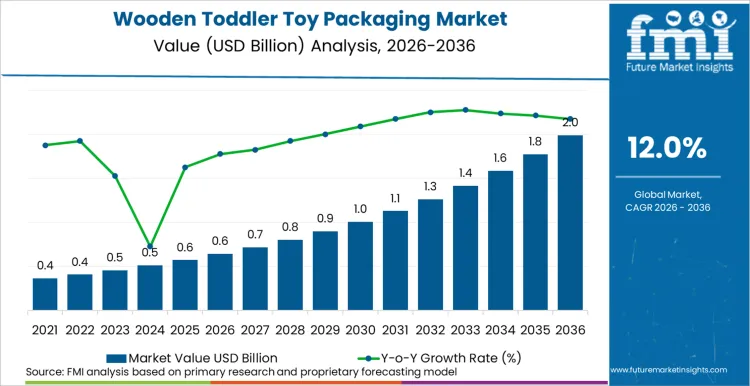
Packaging demand is being shaped by a channel execution dynamic. Wooden toddler toys increasingly sell through eco-toy retailers and curated assortments where packaging must reinforce brand trust and sustainability claims while maintaining retail-ready presentation. In parallel, online retail is expanding the addressable volume for wooden toys, which increases the penalty for transit damage and shifts packaging selection toward formats that balance sustainability with crush resistance and containment integrity.
FMI observes that growth is not simply more toys. It is a packaging format upgrade cycle. As brands compete on sustainability credibility, packaging choices are converging toward high-recycled-content paperboard, molded pulp protection, and kraft-forward structures. This shifts value toward converters that can supply consistent board quality, molded pulp reliability, and repeatable printing and converting outcomes at scale.
Summary of Wooden Toddler Toy Packaging Market
- The wooden toddler toy packaging market comprises paper-based packaging formats and protective structures used to merchandise and ship wooden toddler toys across eco-toy retail, online retail, OEM export programs, and specialty boutiques.
- The defined scope is structured under FMI taxonomy with segmentation across end use, packaging format, material, and region, focusing on packaging for wooden toddler toys and excluding the wooden toys themselves, non-toddler toy packaging, and downstream retail services.
- The wooden toddler toy packaging market is projected to grow at a CAGR of 12.0% from 2026 to 2036, expanding from USD 640 million in 2026 to USD 1,980 million by 2036, based on FMI proprietary forecasting integrating channel mix shifts, packaging format penetration, and sustainability-led material substitution dynamics.
- The sector is transitioning toward plastic-minimized, verified-fiber packaging systems where recycled paperboard and molded pulp adoption increases as brands and retailers require defensible sustainability claims and consistent protection performance for heavier wooden SKUs.
- Competition is concentrated among large paper-based packaging suppliers and regional kraft and corrugated leaders such as Mondi, Smurfit Kappa, WestRock, Pratt Industries, Nine Dragons, Lee & Man, Amcor, TCPL Packaging, and Klabin, with competitive advantage increasingly defined by recycled-fiber sourcing capability, molded pulp execution depth, and retail-ready packaging engineering.
- India is projected to record the fastest growth at 15.2% CAGR through 2036, while Europe retains the largest value share supported by high eco-toy retailer density, sustainability-led procurement expectations, and strong adoption of recycled paperboard-based formats.
Wooden Toddler Toy Packaging Market Key Takeaways?
| Metric | Value |
|---|---|
| Expected Value 2026E | USD 640 million |
| Forecast Value 2036F | USD 1,980 million |
| CAGR 2026 to 2036 | 12.0% |
Source: Future Market Insights analysis based on proprietary forecasting model and primary research
Why is the Wooden Toddler Toy Packaging Market Growing?
The primary growth driver is the eco-premium positioning of wooden toddler toys, which increases packaging value intensity. Packaging functions as the sustainability proof layer, recycled fiber usage, plastic-free cues, and minimalist finishing, making packaging a purchase reinforcement tool rather than only protective containment.
A second driver is channel-driven durability requirements, especially for online retail and OEM export flows. Wooden toys are heavier and more damage-sensitive in transit than lightweight plastic toys, raising demand for packaging formats that deliver structural protection without undermining sustainability messaging. This accelerates adoption of kraft-forward cartons, corrugated shipper packs, and molded pulp protective components.
Retailer governance, particularly among eco-toy retailers that standardize packaging expectations around recycled content, plastic reduction, and brand-consistent minimalism, reinforces growth. As these retail programs scale, packaging formats become more standardized and repeatable, allowing converters to commercialize high-volume recyclable packaging architectures across multiple brands.
What is the Segment Profile of the Wooden Toddler Toy Packaging Market?
The segment structure reflects where packaging decisions deliver the strongest sustainability signaling and the lowest operational risk. FMI retains only the dominant segment in each category and expands the analysis to execution realism consistent with the reference preview format.
Why do Eco-toy retailers anchor end-use demand?
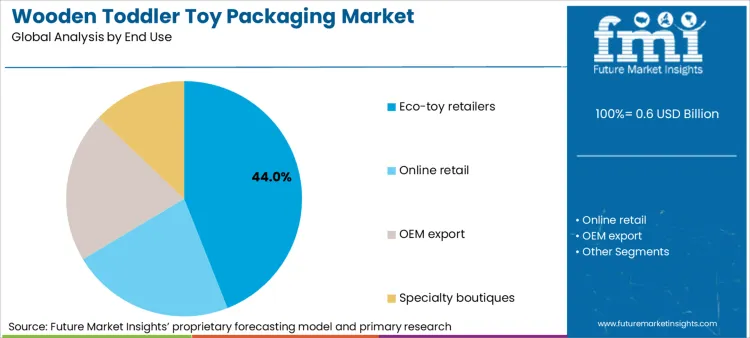
Eco-toy retailers (44%) lead because they concentrate the highest sustainability governance and the strongest consumer expectation that packaging must match product ethos. In these channels, packaging is evaluated as part of brand credibility: recycled content, plastic-free protection, and minimalist printing directly influence perceived authenticity and willingness to pay.
A second driver of dominance is assortment curation. Eco-toy retailers typically carry fewer SKUs per brand but demand high consistency of presentation. This rewards packaging programs built around standardized kraft carton platforms and repeatable material specifications that reduce variability across seasonal refresh cycles and gifting periods.
Why do Kraft cartons dominate packaging format selection?
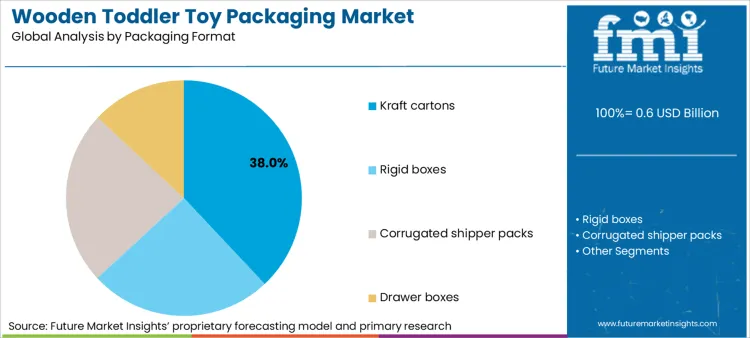
Kraft cartons (38%) lead because they balance three requirements that are structurally important for wooden toys: sustainability signaling, stiffness and containment integrity, and cost-disciplined scalability across brands. Kraft cartons also support minimalist branding aesthetics that align with eco-premium narratives, while maintaining shelf-ready form factor and predictable converting behavior.
Kraft cartons are also favored for their compatibility with paper-based protective inserts and molded pulp components. This makes them the core “outer architecture” into which protective systems can be integrated without introducing multi-material complexity that would weaken sustainability claims.
How does Recycled paperboard sustain material leadership?
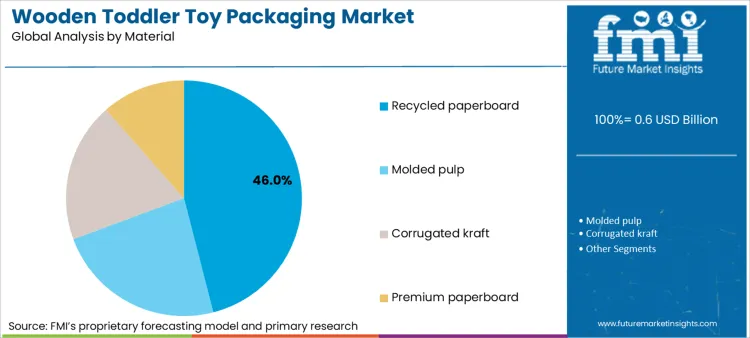
Recycled paperboard (46%) dominates because it is the most scalable material pathway for brands that must signal sustainability while meeting retailer requirements for recyclability and low-plastic design. Recycled board provides an auditable basis for environmental claims and supports high-volume conversion economics without requiring premium substrates.
Dominance is reinforced by procurement discipline. Brands and retailers increasingly want predictable recycled content performance and consistent board quality across production lots. As a result, suppliers with stable recycled fiber sourcing and quality control gain share as packaging programs move from boutique craft to standardized execution.
Why does Europe retain regional leadership?
Europe (36%) leads because it combines high eco-conscious purchasing behavior with dense specialty retail networks and strong sustainability-led packaging expectations. Wooden toys are deeply positioned as eco-alternatives in many European markets, and packaging choices—recycled paperboard, kraft-forward formats, and molded pulp protection are treated as part of the product’s legitimacy.
Europe’s leadership is also supported by the conversion capacity and supply base of paper packaging leaders, enabling rapid scaling of standardized kraft and recycled board formats across brands.
What Drivers, Restraints, Opportunities, and Trends Prevail in the Wooden Toddler Toy Packaging Market?
The strongest driver is the convergence of sustainability signaling and retail governance in wooden toy categories. Packaging is increasingly required to be plastic-minimized, recycled-content-forward, and visually consistent with eco-brand narratives especially in curated retail environments.
A major restraint is cost and performance tension. Plastic-free protection for heavier wooden SKUs can increase material usage and pack weight if not engineered efficiently. Molded pulp and high-recycled-content boards also introduce quality variability risks if supply chains are not tightly controlled, which can create dents, dusting, or crush issues that undermine shelf presentation.
The highest-value opportunity lies in engineered paper-based protection systems: molded pulp + kraft carton architectures that provide damage control in e-commerce and export flows while maintaining a single sustainability story. As online retail expands, the value of plastic-free damage reduction becomes monetizable.
The dominant trend is the shift from craft packaging to repeatable packaging platforms, standard carton footprints, validated pulp inserts, and stable recycled paperboard specifications, allowing brands to scale across channels without redesign churn or inconsistent sustainability claims.
How is the Wooden Toddler Toy Packaging Market Analyzed in Key Countries?
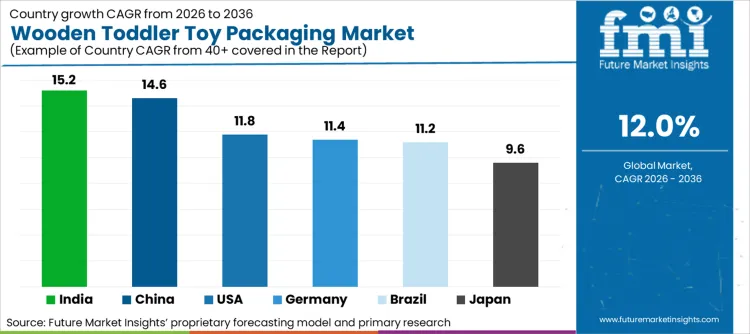
| Country | CAGR 2026 to 2036 |
|---|---|
| Germany | 11.4% |
| USA | 11.8% |
| China | 14.6% |
| Japan | 9.6% |
| India | 15.2% |
| Brazil | 11.2% |
Source: FMI analysis based on proprietary forecasting model and primary research
Why is Germany a lead market for wooden toy packaging governance?
Germany is projected to grow at an 11.4% CAGR, supported by high eco-toy retailer penetration and disciplined sustainability expectations in children’s categories. Packaging decisions favor recycled paperboard and kraft cartons that support credible environmental messaging while maintaining strong shelf presentation.
A second driver is execution quality. German retail ecosystems reward consistent packaging appearance and structural integrity, which increases the value of converters that can deliver stable recycled board quality and low-variance converting outcomes across repeat orders.
How is USA scaling through online retail and gifting-led demand?
USA is forecast to expand at an 11.8% CAGR, driven by strong online retail momentum and the growth of eco-premium gifting. The key packaging requirement is durability through fulfillment while preserving eco-brand aesthetics, which supports demand for rigid boxes and molded pulp protection.
A second factor is brand differentiation. USA wooden toy brands compete on trust cues, making packaging, recycled content claims, plastic-free protection, and premium unboxing—a functional part of conversion and repeat purchase logic.
How is China leveraging OEM export growth and ship-ready packaging intensity?
China is expected to grow at a 14.6% CAGR, driven by OEM export flows where packaging is evaluated primarily on ship-readiness, stacking strength, and cost efficiency. This supports corrugated shipper packs and corrugated kraft material pathways that scale in high-volume manufacturing ecosystems.
A second driver is the export compliance mindset. OEM programs increasingly require standardized packaging specifications across customers, favoring repeatable corrugated architectures and consistent kraft quality to reduce damage rates and claims.
Why does Japan follow a boutique-led, premium packaging trajectory?
Japan is projected to grow at a 9.6% CAGR, shaped by specialty boutiques and premium presentation standards. Packaging demand concentrates in high-finish formats such as drawer boxes, where tactile quality and presentation discipline matter in curated retail environments.
A second driver is conservative adoption pacing. Premium paperboard has a small share but remains strategically important for boutique channels where unboxing experience and brand refinement outweigh cost considerations.
Why is India the fastest-growing market?
India leads at a 15.2% CAGR, driven by rapid expansion of eco-positioned parenting categories, growing organized retail reach, and increasing adoption of sustainable packaging formats. As brands scale, packaging shifts from inconsistent craft execution toward standardized recycled paperboard and kraft carton platforms.
A second driver is export-linked improvement. Indian suppliers serving international brands are increasingly adopting sustainability-led packaging specifications, accelerating the upgrade cycle toward plastic-minimized protective systems.
How is Brazil building demand through fiber-based packaging capacity and mainstream adoption?
Brazil is forecast to expand at an 11.2% CAGR, supported by growing retail availability of wooden toys and strong regional fiber packaging capacity. Packaging demand is anchored in durable paper-based solutions that can handle logistics variability.
A second driver is the gradual expansion of eco-premium product lines in mainstream retail. As these lines scale, packaging standardization increases, benefiting large regional packaging suppliers.
How Competitive is the Wooden Toddler Toy Packaging Market?
Sustainability execution credibility and packaging engineering rather than commodity carton supply define the competitive landscape. Suppliers compete on their ability to deliver plastic-minimized packaging systems that protect heavier wooden SKUs, maintain consistent shelf appearance, and support recycled-content claims without quality volatility.
The first axis of competition is recycled fiber governance, stable sourcing, consistent board performance, and the ability to supply high-recycled-content paperboard at scale. The second axis is protective system capability, particularly molded pulp execution and integration into carton architectures that reduce damage rates in e-commerce and export flows. The third axis is retail program fit, where suppliers that can standardize packaging platforms across SKUs and brands reduce redesign churn and win longer-term supply positions.
Key Players Profiled
- Mondi
- Smurfit Kappa
- WestRock
- Pratt Industries
- Nine Dragons
- Lee & Man
- Amcor
- TCPL Packaging
- Klabin
Market Definition
The wooden toddler toy packaging market comprises revenues generated from packaging formats used to merchandise, protect, and ship wooden toddler toys across domestic retail and international export channels. The market includes primary and secondary packaging solutions such as kraft cartons, rigid boxes, corrugated shipper packs, drawer boxes, and paper-based protective components including molded pulp, inserts, and cushioning where these form an integral part of the packaging system.
The scope includes packaging supplied to eco-focused toy brands and retailers, e-commerce and direct-to-consumer programs, OEM export packaging for global distribution, and specialty or boutique toy outlets. Packaging formats designed to support sustainability positioning, product protection, regulatory compliance, and retail presentation for toddler-age wooden toys are fully within scope.
The scope excludes revenues from toy manufacturing, packaging for non-toddler toys, packaging used for toys made from non-wood materials, and tertiary logistics services provided by retailers or distributors. Plastic-dominant packaging formats, reusable retail display infrastructure, and downstream merchandising or fulfillment services fall outside the defined market boundary.
Scope of Report
| Items | Values |
|---|---|
| Quantitative Units | USD 640 million |
| End Use | Eco-toy retailers, Online retail, OEM export, Specialty boutiques |
| Packaging Format | Kraft cartons, Rigid boxes, Corrugated shipper packs, Drawer boxes |
| Material | Recycled paperboard, Molded pulp, Corrugated kraft, Premium paperboard |
| Countries Covered | Germany, USA, China, Japan, India, Brazil |
| Regions Covered | Europe, North America, East Asia, Japan, South Asia, RoW |
| Key Companies | Mondi, Smurfit Kappa, WestRock, Pratt Industries, Nine Dragons, Lee & Man, Amcor, TCPL Packaging, Klabin |
Source: Future Market Insights analysis based on proprietary forecasting model and primary research
Wooden Toddler Toy Packaging Market Key Segments?
End Use
- Eco-toy retailers
- Online retail
- OEM export
- Specialty boutiques
Packaging Format
- Kraft cartons
- Rigid boxes
- Corrugated shipper packs
- Drawer boxes
Material
- Recycled paperboard
- Molded pulp
- Corrugated kraft
- Premium paperboard
Region
- Europe
- North America
- East Asia
- Japan
- South Asia
- RoW
Bibliography
- OECD. (2024). Policy approaches and market implications for circular economy packaging and recycled fiber governance. OECD Publishing.
- UNECE. (2024). Trade and sustainability considerations for paper-based packaging supply chains and material traceability. United Nations Economic Commission for Europe.
- ISO. (2025). Environmental management systems requirements and guidance for packaging supply chains. International Organization for Standardization.
- Ellen MacArthur Foundation. (2024). Design considerations for packaging circularity and fiber-based packaging systems. EMF.
- World Economic Forum. (2024). Supply chain transparency and sustainability claims governance in consumer products. WEF.
- FAO. (2024). Forestry and fiber supply chain sustainability metrics relevant to packaging materials. Food and Agriculture Organization.
Frequently Asked Questions
How big is the wooden toddler toy packaging market in 2026?
The global wooden toddler toy packaging market is estimated to be valued at USD 0.6 billion in 2026.
What will be the size of wooden toddler toy packaging market in 2036?
The market size for the wooden toddler toy packaging market is projected to reach USD 2.0 billion by 2036.
How much will be the wooden toddler toy packaging market growth between 2026 and 2036?
The wooden toddler toy packaging market is expected to grow at a 12.0% CAGR between 2026 and 2036.
What are the key product types in the wooden toddler toy packaging market?
The key product types in wooden toddler toy packaging market are eco-toy retailers , online retail, oem export and specialty boutiques.
Which packaging format segment to contribute significant share in the wooden toddler toy packaging market in 2026?
In terms of packaging format, kraft cartons segment to command 38.0% share in the wooden toddler toy packaging market in 2026.
Preview the report firsthand - request a free sample
Get SampleGet the brochure for pricing and purchase details.
Get PDFTable of Content
- Executive Summary
- Global Market Outlook
- Demand-side Trends
- Supply-side Trends
- Technology Roadmap Analysis
- Analysis and Recommendations
- Market Overview
- Market Coverage / Taxonomy
- Market Definition / Scope / Limitations
- Research Methodology
- Chapter Orientation
- Analytical Lens and Working Hypotheses
- Market Structure, Signals, and Trend Drivers
- Benchmarking and Cross-market Comparability
- Market Sizing, Forecasting, and Opportunity Mapping
- Research Design and Evidence Framework
- Desk Research Programme (Secondary Evidence)
- Company Annual and Sustainability Reports
- Peer-reviewed Journals and Academic Literature
- Corporate Websites, Product Literature, and Technical Notes
- Earnings Decks and Investor Briefings
- Statutory Filings and Regulatory Disclosures
- Technical White Papers and Standards Notes
- Trade Journals, Industry Magazines, and Analyst Briefs
- Conference Proceedings, Webinars, and Seminar Materials
- Government Statistics Portals and Public Data Releases
- Press Releases and Reputable Media Coverage
- Specialist Newsletters and Curated Briefings
- Sector Databases and Reference Repositories
- FMI Internal Proprietary Databases and Historical Market Datasets
- Subscription Datasets and Paid Sources
- Social Channels, Communities, and Digital Listening Inputs
- Additional Desk Sources
- Expert Input and Fieldwork (Primary Evidence)
- Primary Modes
- Qualitative Interviews and Expert Elicitation
- Quantitative Surveys and Structured Data Capture
- Blended Approach
- Why Primary Evidence is Used
- Field Techniques
- Interviews
- Surveys
- Focus Groups
- Observational and In-context Research
- Social and Community Interactions
- Stakeholder Universe Engaged
- C-suite Leaders
- Board Members
- Presidents and Vice Presidents
- R&D and Innovation Heads
- Technical Specialists
- Domain Subject-matter Experts
- Scientists
- Physicians and Other Healthcare Professionals
- Governance, Ethics, and Data Stewardship
- Research Ethics
- Data Integrity and Handling
- Primary Modes
- Tooling, Models, and Reference Databases
- Desk Research Programme (Secondary Evidence)
- Data Engineering and Model Build
- Data Acquisition and Ingestion
- Cleaning, Normalisation, and Verification
- Synthesis, Triangulation, and Analysis
- Quality Assurance and Audit Trail
- Market Background
- Market Dynamics
- Drivers
- Restraints
- Opportunity
- Trends
- Scenario Forecast
- Demand in Optimistic Scenario
- Demand in Likely Scenario
- Demand in Conservative Scenario
- Opportunity Map Analysis
- Product Life Cycle Analysis
- Supply Chain Analysis
- Investment Feasibility Matrix
- Value Chain Analysis
- PESTLE and Porter’s Analysis
- Regulatory Landscape
- Regional Parent Market Outlook
- Production and Consumption Statistics
- Import and Export Statistics
- Market Dynamics
- Global Market Analysis 2021 to 2025 and Forecast, 2026 to 2036
- Historical Market Size Value (USD Million) Analysis, 2021 to 2025
- Current and Future Market Size Value (USD Million) Projections, 2026 to 2036
- Y-o-Y Growth Trend Analysis
- Absolute $ Opportunity Analysis
- Global Market Pricing Analysis 2021 to 2025 and Forecast 2026 to 2036
- Global Market Analysis 2021 to 2025 and Forecast 2026 to 2036, By End Use
- Introduction / Key Findings
- Historical Market Size Value (USD Million) Analysis By End Use , 2021 to 2025
- Current and Future Market Size Value (USD Million) Analysis and Forecast By End Use , 2026 to 2036
- Eco-toy retailers
- Online retail
- OEM export
- Specialty boutiques
- Eco-toy retailers
- Y-o-Y Growth Trend Analysis By End Use , 2021 to 2025
- Absolute $ Opportunity Analysis By End Use , 2026 to 2036
- Global Market Analysis 2021 to 2025 and Forecast 2026 to 2036, By Packaging Format
- Introduction / Key Findings
- Historical Market Size Value (USD Million) Analysis By Packaging Format, 2021 to 2025
- Current and Future Market Size Value (USD Million) Analysis and Forecast By Packaging Format, 2026 to 2036
- Kraft cartons
- Rigid boxes
- Corrugated shipper packs
- Drawer boxes
- Kraft cartons
- Y-o-Y Growth Trend Analysis By Packaging Format, 2021 to 2025
- Absolute $ Opportunity Analysis By Packaging Format, 2026 to 2036
- Global Market Analysis 2021 to 2025 and Forecast 2026 to 2036, By Material
- Introduction / Key Findings
- Historical Market Size Value (USD Million) Analysis By Material, 2021 to 2025
- Current and Future Market Size Value (USD Million) Analysis and Forecast By Material, 2026 to 2036
- Recycled paperboard
- Molded pulp
- Corrugated kraft
- Premium paperboard
- Recycled paperboard
- Y-o-Y Growth Trend Analysis By Material, 2021 to 2025
- Absolute $ Opportunity Analysis By Material, 2026 to 2036
- Global Market Analysis 2021 to 2025 and Forecast 2026 to 2036, By Region
- Introduction
- Historical Market Size Value (USD Million) Analysis By Region, 2021 to 2025
- Current Market Size Value (USD Million) Analysis and Forecast By Region, 2026 to 2036
- North America
- Latin America
- Western Europe
- Eastern Europe
- East Asia
- South Asia and Pacific
- Middle East & Africa
- Market Attractiveness Analysis By Region
- North America Market Analysis 2021 to 2025 and Forecast 2026 to 2036, By Country
- Historical Market Size Value (USD Million) Trend Analysis By Market Taxonomy, 2021 to 2025
- Market Size Value (USD Million) Forecast By Market Taxonomy, 2026 to 2036
- By Country
- USA
- Canada
- Mexico
- By End Use
- By Packaging Format
- By Material
- By Country
- Market Attractiveness Analysis
- By Country
- By End Use
- By Packaging Format
- By Material
- Key Takeaways
- Latin America Market Analysis 2021 to 2025 and Forecast 2026 to 2036, By Country
- Historical Market Size Value (USD Million) Trend Analysis By Market Taxonomy, 2021 to 2025
- Market Size Value (USD Million) Forecast By Market Taxonomy, 2026 to 2036
- By Country
- Brazil
- Chile
- Rest of Latin America
- By End Use
- By Packaging Format
- By Material
- By Country
- Market Attractiveness Analysis
- By Country
- By End Use
- By Packaging Format
- By Material
- Key Takeaways
- Western Europe Market Analysis 2021 to 2025 and Forecast 2026 to 2036, By Country
- Historical Market Size Value (USD Million) Trend Analysis By Market Taxonomy, 2021 to 2025
- Market Size Value (USD Million) Forecast By Market Taxonomy, 2026 to 2036
- By Country
- Germany
- UK
- Italy
- Spain
- France
- Nordic
- BENELUX
- Rest of Western Europe
- By End Use
- By Packaging Format
- By Material
- By Country
- Market Attractiveness Analysis
- By Country
- By End Use
- By Packaging Format
- By Material
- Key Takeaways
- Eastern Europe Market Analysis 2021 to 2025 and Forecast 2026 to 2036, By Country
- Historical Market Size Value (USD Million) Trend Analysis By Market Taxonomy, 2021 to 2025
- Market Size Value (USD Million) Forecast By Market Taxonomy, 2026 to 2036
- By Country
- Russia
- Poland
- Hungary
- Balkan & Baltic
- Rest of Eastern Europe
- By End Use
- By Packaging Format
- By Material
- By Country
- Market Attractiveness Analysis
- By Country
- By End Use
- By Packaging Format
- By Material
- Key Takeaways
- East Asia Market Analysis 2021 to 2025 and Forecast 2026 to 2036, By Country
- Historical Market Size Value (USD Million) Trend Analysis By Market Taxonomy, 2021 to 2025
- Market Size Value (USD Million) Forecast By Market Taxonomy, 2026 to 2036
- By Country
- China
- Japan
- South Korea
- By End Use
- By Packaging Format
- By Material
- By Country
- Market Attractiveness Analysis
- By Country
- By End Use
- By Packaging Format
- By Material
- Key Takeaways
- South Asia and Pacific Market Analysis 2021 to 2025 and Forecast 2026 to 2036, By Country
- Historical Market Size Value (USD Million) Trend Analysis By Market Taxonomy, 2021 to 2025
- Market Size Value (USD Million) Forecast By Market Taxonomy, 2026 to 2036
- By Country
- India
- ASEAN
- Australia & New Zealand
- Rest of South Asia and Pacific
- By End Use
- By Packaging Format
- By Material
- By Country
- Market Attractiveness Analysis
- By Country
- By End Use
- By Packaging Format
- By Material
- Key Takeaways
- Middle East & Africa Market Analysis 2021 to 2025 and Forecast 2026 to 2036, By Country
- Historical Market Size Value (USD Million) Trend Analysis By Market Taxonomy, 2021 to 2025
- Market Size Value (USD Million) Forecast By Market Taxonomy, 2026 to 2036
- By Country
- Kingdom of Saudi Arabia
- Other GCC Countries
- Turkiye
- South Africa
- Other African Union
- Rest of Middle East & Africa
- By End Use
- By Packaging Format
- By Material
- By Country
- Market Attractiveness Analysis
- By Country
- By End Use
- By Packaging Format
- By Material
- Key Takeaways
- Key Countries Market Analysis
- USA
- Pricing Analysis
- Market Share Analysis, 2025
- By End Use
- By Packaging Format
- By Material
- Canada
- Pricing Analysis
- Market Share Analysis, 2025
- By End Use
- By Packaging Format
- By Material
- Mexico
- Pricing Analysis
- Market Share Analysis, 2025
- By End Use
- By Packaging Format
- By Material
- Brazil
- Pricing Analysis
- Market Share Analysis, 2025
- By End Use
- By Packaging Format
- By Material
- Chile
- Pricing Analysis
- Market Share Analysis, 2025
- By End Use
- By Packaging Format
- By Material
- Germany
- Pricing Analysis
- Market Share Analysis, 2025
- By End Use
- By Packaging Format
- By Material
- UK
- Pricing Analysis
- Market Share Analysis, 2025
- By End Use
- By Packaging Format
- By Material
- Italy
- Pricing Analysis
- Market Share Analysis, 2025
- By End Use
- By Packaging Format
- By Material
- Spain
- Pricing Analysis
- Market Share Analysis, 2025
- By End Use
- By Packaging Format
- By Material
- France
- Pricing Analysis
- Market Share Analysis, 2025
- By End Use
- By Packaging Format
- By Material
- India
- Pricing Analysis
- Market Share Analysis, 2025
- By End Use
- By Packaging Format
- By Material
- ASEAN
- Pricing Analysis
- Market Share Analysis, 2025
- By End Use
- By Packaging Format
- By Material
- Australia & New Zealand
- Pricing Analysis
- Market Share Analysis, 2025
- By End Use
- By Packaging Format
- By Material
- China
- Pricing Analysis
- Market Share Analysis, 2025
- By End Use
- By Packaging Format
- By Material
- Japan
- Pricing Analysis
- Market Share Analysis, 2025
- By End Use
- By Packaging Format
- By Material
- South Korea
- Pricing Analysis
- Market Share Analysis, 2025
- By End Use
- By Packaging Format
- By Material
- Russia
- Pricing Analysis
- Market Share Analysis, 2025
- By End Use
- By Packaging Format
- By Material
- Poland
- Pricing Analysis
- Market Share Analysis, 2025
- By End Use
- By Packaging Format
- By Material
- Hungary
- Pricing Analysis
- Market Share Analysis, 2025
- By End Use
- By Packaging Format
- By Material
- Kingdom of Saudi Arabia
- Pricing Analysis
- Market Share Analysis, 2025
- By End Use
- By Packaging Format
- By Material
- Turkiye
- Pricing Analysis
- Market Share Analysis, 2025
- By End Use
- By Packaging Format
- By Material
- South Africa
- Pricing Analysis
- Market Share Analysis, 2025
- By End Use
- By Packaging Format
- By Material
- USA
- Market Structure Analysis
- Competition Dashboard
- Competition Benchmarking
- Market Share Analysis of Top Players
- By Regional
- By End Use
- By Packaging Format
- By Material
- Competition Analysis
- Competition Deep Dive
- Mondi
- Overview
- Product Portfolio
- Profitability by Market Segments (Product/Age /Sales Channel/Region)
- Sales Footprint
- Strategy Overview
- Marketing Strategy
- Product Strategy
- Channel Strategy
- Smurfit Kappa
- WestRock
- Pratt Industries
- Nine Dragons
- Lee & Man
- Amcor
- TCPL Packaging
- Mondi
- Competition Deep Dive
- Assumptions & Acronyms Used


