

- Industry Size (2026)
- USD 520 Mn
- Forecast (2036)
- USD 1740 Mn
- CAGR (2026 to 2036)
- 12.8%
Instructional Packaging for Toddler Toys Market Forecast and Outlook 2026 to 2036?
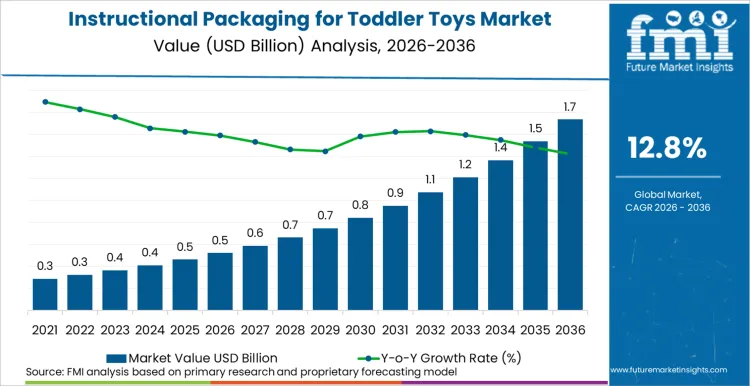
The global instructional packaging for toddler toys market is estimated to be valued at USD 520 million in 2026 and is projected to reach USD 1,740 million by 2036, expanding at a 12.8% CAGR. FMI analysis indicates that this growth reflects the increasing formalization of educational claims, safety guidance, and instructional transparency in toddler toy categories, particularly as toys are marketed not only as play objects but as early learning tools.
One of the strongest contributors to growth is the rising expectation among parents for clear, credible, and actionable guidance on how toys should be used to support developmental milestones. Instructional packaging provides a trusted medium for conveying age grading, learning outcomes, and safety boundaries at the point of purchase. This is especially important for toddler toys, where misuse risks are higher and where parents seek reassurance before purchase. FMI observes that brands are increasingly allocating more packaging real estate to structured instructions, diagrams, and usage guidance rather than relying solely on external manuals or online content.
Another factor shaping the market outlook is the growth of online retail. When toys are sold through digital platforms, packaging becomes the first physical interface encountered by the buyer. Instructional content on packaging therefore plays a critical role in reinforcing purchase confidence and reducing post-purchase confusion. This has increased demand for packaging formats that integrate scannable elements, structured text hierarchy, and clear visual cues that work across languages and regions.
Regulatory dynamics further reinforce growth. Many markets require explicit labeling related to age suitability, safety warnings, and instructional clarity for children’s products. As regulations tighten and enforcement becomes more consistent, instructional packaging is becoming more standardized and content-heavy. FMI expects sustained growth as instructional packaging evolves into a regulated communication layer that brands must manage proactively rather than reactively.
Summary of Instructional Packaging for Toddler Toys Market
The instructional packaging for toddler toys market comprises primary and secondary packaging formats designed to communicate usage instructions, safety guidance, age grading, and educational value for toddler toys across educational retail, online platforms, OEM export programs, and specialty toy stores.
The defined scope is structured under FMI taxonomy with segmentation across end use, packaging format, material, and region, focusing exclusively on packaging where instructional content is a core functional requirement and excluding standalone instruction manuals and purely decorative toy packaging.
The instructional packaging for toddler toys market is projected to grow at a CAGR of 12.8% from 2026 to 2036, expanding from USD 520 million in 2026 to USD 1,740 million by 2036, based on FMI proprietary forecasting integrating educational toy penetration, regulatory labeling requirements, channel mix evolution, and adoption of hybrid print-digital instruction systems.
The sector is transitioning from compliance-driven labeling toward structured instructional communication platforms, where packaging acts as a trust-building interface that supports safe usage, developmental guidance, and caregiver confidence at the point of purchase.
Competition is concentrated among packaging suppliers with strong content governance, print clarity, and regulatory fluency capabilities such as Amcor, Avery Dennison, WestRock, Greatview, Zijiang, DNP, TCPL Packaging, and Klabin, with competitive advantage driven by the ability to manage multilingual instructional content and integrate physical packaging with digital guidance tools.
India is projected to record the fastest growth through 2036, while Europe retains the largest value share, supported by stringent child product safety regulations, high educational toy adoption, and strong demand for detailed, compliant instructional packaging across retail channels.
Instructional Packaging for Toddler Toys Market Key Takeaways?
| Metric | Value |
|---|---|
| Expected Value 2026E | USD 520 million |
| Forecast Value 2036F | USD 1,740 million |
| CAGR 2026 to 2036 | 12.8% |
Source: Future Market Insights analysis based on proprietary forecasting model and primary research
Why is the Instructional Packaging for Toddler Toys Market Growing?
The primary growth driver is the increasing educational positioning of toddler toys. Brands are marketing toys as tools for early cognitive, sensory, and motor development, which creates a requirement for instructional clarity. Packaging must explain not only how a toy is used, but what developmental outcomes it supports and how caregivers should guide play. FMI observes that instructional packaging is increasingly designed in collaboration with child development frameworks, making it a functional component of product positioning.
A second driver is caregiver trust and liability management. Toddler toys operate in a high-risk perception category because of choking hazards, misuse potential, and age sensitivity. Clear instructional packaging reduces misuse risk and supports brands in demonstrating due diligence. This is particularly important in markets with strong consumer protection regimes, where packaging content can be scrutinized in the event of complaints or recalls. As a result, instructional packaging is being treated as a risk mitigation investment rather than a discretionary cost.
Digital integration also contributes to growth. QR-enabled boxes and hybrid instruction systems allow brands to link physical packaging with extended digital content such as videos, tutorials, and language-specific guides. This enables brands to keep packaging visually clean while still providing depth of instruction. FMI finds that instructional packaging is increasingly designed as an entry point to a broader instructional ecosystem rather than a standalone information surface.
What is the Segment Profile of the Instructional Packaging for Toddler Toys Market?
Why do educational retailers dominate end-use demand?
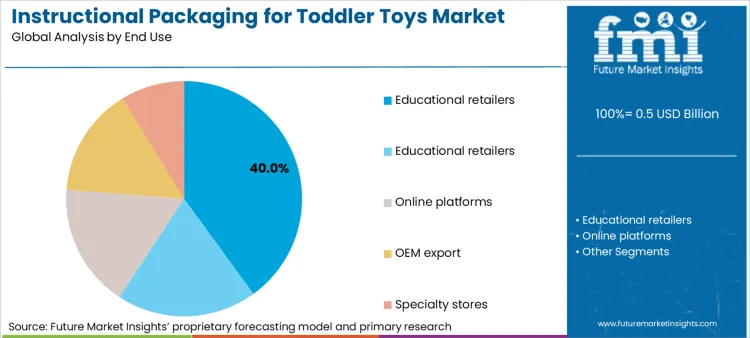
Educational retailers account for 40% of end-use demand because they curate toy assortments specifically around learning outcomes and developmental value. These retailers expect packaging to clearly articulate educational purpose, age progression, and usage guidance, as their staff and customers rely on packaging to support informed purchasing decisions. Instructional clarity is therefore not optional but a core requirement for shelf acceptance in these channels.
A second factor reinforcing dominance is credibility signaling. Educational retailers often position themselves as trusted advisors for parents and educators. FMI observes that they favor brands whose instructional packaging demonstrates pedagogical intent and structured guidance rather than generic play descriptions. This elevates demand for well-designed instructional packaging with diagrams, step-by-step usage explanations, and clearly framed learning objectives.
Why do printed cartons dominate packaging format selection?
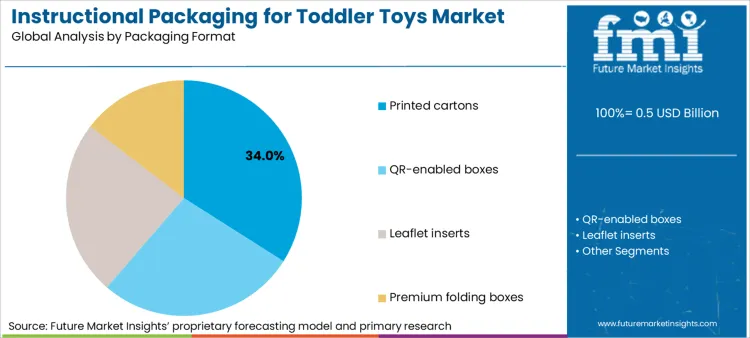
Printed cartons represent 34% of packaging format demand because they offer the most reliable medium for structured instructional communication. Cartons provide ample surface area for text, illustrations, icons, and regulatory information, allowing brands to present layered instructional content in a controlled hierarchy.
Another reason for dominance is accessibility. Printed instructions are immediately available without requiring digital access, which is important in caregiver settings where quick reference is needed. FMI finds that printed cartons remain preferred in regulated markets because they provide a permanent, auditable record of instructional content that is not dependent on external platforms or connectivity.
Why does paperboard dominate material selection?
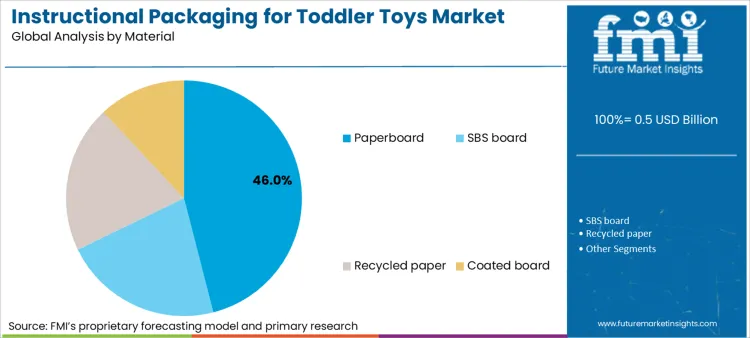
Paperboard accounts for 46% of material demand because it balances print quality, sustainability perception, and cost efficiency. Instructional packaging relies heavily on legibility, color fidelity, and surface smoothness, all of which are well supported by paperboard substrates.
A second driver is regulatory and consumer preference for paper-based packaging in children’s products. FMI observes that paperboard aligns well with recycling expectations and parental perception of safety and cleanliness, reinforcing its dominance in instructional applications where packaging is closely scrutinized.
Why does Europe dominate regional demand?
Europe accounts for 36% of regional demand due to strong regulatory frameworks governing children’s products and a high prevalence of educational toy retail. European markets require clear instructional labeling, multilingual content, and age-appropriate guidance, all of which drive demand for instructional packaging solutions.
A second factor is consumer expectation. European caregivers often expect detailed guidance on how toys should be used to support development. FMI finds that this cultural emphasis on structured learning reinforces demand for robust instructional packaging across both domestic and imported toy brands.
What Drivers, Restraints, Opportunities, and Trends Prevail in the Instructional Packaging for Toddler Toys Market?
Drivers include the educational positioning of toddler toys, regulatory enforcement of labeling standards, and the need to build caregiver trust at point of purchase. Instructional packaging also helps brands differentiate in crowded categories by communicating learning value clearly.
Restraints are primarily related to cost and complexity. Adding instructional content increases design, translation, and compliance costs, particularly for brands operating across multiple markets. Space constraints on packaging can also limit instructional depth unless digital integration is used effectively.
Opportunities exist in hybrid instructional models that combine printed guidance with QR-linked digital content, enabling scalable multilingual instruction without overcrowding packaging. Trends indicate increasing use of standardized iconography, progressive learning cues, and age-banded instruction frameworks to simplify communication.
How is the Instructional Packaging for Toddler Toys Market Analyzed in Key Countries?
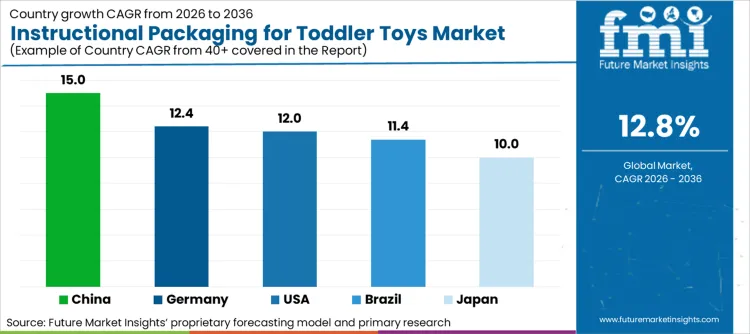
| Country | CAGR (2026-2036) |
|---|---|
| Germany | 12.4% |
| USA | 12.0% |
| China | 15.0% |
| Japan | 10.0% |
| Brazil | 11.4% |
Source: FMI analysis based on primary research and proprietary forecasting model
Why is Germany setting the instructional packaging benchmark?
Germany is projected to grow at a 12.4% CAGR, driven by stringent consumer protection norms and a strong educational toy retail ecosystem. Instructional packaging in Germany must deliver clear, accurate, and structured guidance, as both regulators and consumers expect high transparency in children’s products. FMI analysis indicates that brands operating in Germany invest heavily in instructional clarity to meet compliance and maintain retailer trust.
A second driver is cultural emphasis on structured learning. German caregivers and educators value toys that clearly articulate learning outcomes and safe usage. This reinforces demand for detailed printed instructions and well-designed packaging layouts that communicate purpose and progression.
How is USA scaling through digital and online channels?
USA is forecasted to expand at a 12.0% CAGR, supported by the rapid growth of online toy sales and digitally integrated packaging. Instructional packaging plays a key role in bridging the gap between online product descriptions and real-world usage.
FMI observes that U.S. brands increasingly use QR-enabled packaging to provide extended instructional content, reducing reliance on printed manuals while maintaining clarity. This hybrid approach supports scalability and multilingual reach, particularly for national brands.
Why is China the fastest-growing manufacturing-driven market?
China is expected to grow at a 15.0% CAGR, driven by its role as a major OEM exporter of toddler toys. Export markets impose instructional and labeling requirements that must be met at the packaging level, increasing demand for compliant instructional packaging solutions. A second driver is domestic upgrading. As China’s domestic toy market shifts toward higher educational value, instructional packaging is becoming more prominent in local retail as well.
Why does Japan emphasize premium instructional execution?
Japan is projected to grow at a 10.0% CAGR, shaped by specialty retail formats and high expectations for packaging quality. Instructional packaging must be visually clean, precise, and culturally appropriate. FMI finds that Japanese brands favor premium folding boxes with well-integrated instructional elements that maintain aesthetic refinement while conveying guidance.
Why is India emerging as a high-growth instructional packaging market?
India leads growth at a 16.0% CAGR, driven by rising domestic toy manufacturing and increasing alignment with global educational standards. Instructional packaging is becoming more important as brands seek to build trust in a fragmented retail environment. Export-oriented manufacturers also drive demand, as international buyers require structured instructional content to meet regulatory and retailer expectations.
How is Brazil developing through regional compliance alignment?
Brazil is expected to grow at an 11.4% CAGR, supported by gradual tightening of labeling standards and growing awareness of educational toy positioning. Instructional packaging adoption is increasing as brands seek to differentiate through clarity and safety communication.
How Competitive is the Instructional Packaging for Toddler Toys Market?
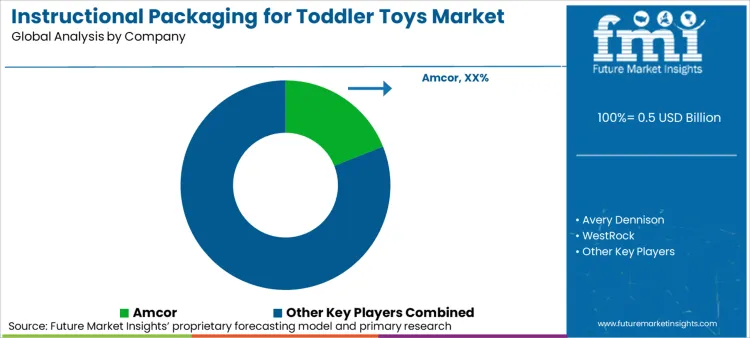
The competitive landscape of the instructional packaging for toddler toys market is shaped by content governance capability rather than by structural packaging innovation alone. Suppliers compete on their ability to deliver accurate, compliant, and visually clear instructional communication at scale, across multiple languages and regulatory regimes. This elevates the role of design, prepress, and content management capabilities alongside traditional converting expertise.
A key competitive differentiator is regulatory fluency. Packaging suppliers that understand child safety labeling requirements, age grading norms, and instructional disclosure expectations across regions are better positioned to support global toy brands. FMI observes that many packaging contracts are awarded not solely on price, but on the supplier’s ability to manage compliance complexity and reduce the risk of packaging rework or regulatory rejection.
Another axis of competition is integration of physical and digital instruction. Suppliers that can seamlessly integrate QR codes, variable data printing, and consistent instructional iconography across print and digital formats gain an advantage. This is particularly relevant for online-first brands and export-oriented manufacturers that require scalable multilingual instruction without frequent packaging redesigns.
Print quality and legibility are also critical. Instructional packaging must maintain clarity even on small cartons and across high-speed production runs. Suppliers with strong paperboard sourcing, print consistency, and color management capabilities are better positioned to meet these requirements. FMI finds that instructional packaging failures are often related to poor legibility or overcrowded layouts rather than structural defects, making design execution a central competitive factor.
Scale and footprint matter as well. Global toy brands prefer packaging suppliers that can deliver consistent instructional packaging across regions, reducing variation in content and appearance. This favors large integrated packaging groups with multi-region manufacturing and standardized quality systems.
Key Players Profiled
- Amcor
- Avery Dennison
- WestRock
- Greatview
- Zijiang
- DNP
- TCPL Packaging
- Klabin
Market Definition
The instructional packaging for toddler toys market comprises revenues generated from secondary and primary packaging solutions designed to convey usage instructions, educational guidance, safety information, and age-appropriate play recommendations for toddler toys. This includes printed cartons, QR-enabled boxes, leaflet inserts, and premium folding boxes where instructional content is a primary functional requirement.
The scope includes paper-based packaging formats used across educational retail, online platforms, export packaging, and specialty stores. It excludes standalone instruction manuals sold separately from packaging and purely decorative packaging without instructional content.
Scope of Report?
| Items | Values |
|---|---|
| Quantitative Units | USD 520 million |
| End Use | Educational retailers, Online platforms, OEM export, Specialty stores |
| Packaging Format | Printed cartons, QR-enabled boxes, Leaflet inserts, Premium folding boxes |
| Material | Paperboard, SBS board, Recycled paper, Coated board |
| Regions Covered | Europe, North America, East Asia, Japan, South Asia, Rest of World |
| Key Companies | Amcor, Avery Dennison, WestRock, Greatview, Zijiang, DNP, TCPL Packaging, Klabin |
Instructional Packaging for Toddler Toys Market Key Segments?
End Use:
- Educational retailers
- Online platforms
- OEM export
- Specialty stores
Packaging Format:
- Printed cartons
- QR-enabled boxes
- Leaflet inserts
- Premium folding boxes
Material:
- Paperboard
- SBS board
- Recycled paper
- Coated board
Region:
- Europe
- North America
- East Asia
- Japan
- South Asia
- Rest of the World
Bibliography
- International Organization for Standardization. (2025). ISO 8124-6: Safety of toys - Graphical symbols for age warning labelling and instructions. ISO.
- Organisation for Economic Co-operation and Development. (2024). Consumer product safety policy and information disclosure for children’s goods. OECD Publishing.
- USA Consumer Product Safety Commission. (2025). Best practices for instructional labeling and warnings on children’s products. CPSC.
- Japan Ministry of Economy, Trade and Industry. (2024). Packaging communication standards for consumer products intended for children. METI.
- Bureau of Indian Standards. (2025). IS 9873 series: Requirements for labeling, instructions, and warnings for toys. BIS.
Frequently Asked Questions
How big is the instructional packaging for toddler toys market in 2026?
The global instructional packaging for toddler toys market is estimated to be valued at USD 0.5 billion in 2026.
What will be the size of instructional packaging for toddler toys market in 2036?
The market size for the instructional packaging for toddler toys market is projected to reach USD 1.7 billion by 2036.
How much will be the instructional packaging for toddler toys market growth between 2026 and 2036?
The instructional packaging for toddler toys market is expected to grow at a 12.8% CAGR between 2026 and 2036.
What are the key product types in the instructional packaging for toddler toys market?
The key product types in instructional packaging for toddler toys market are educational retailers , educational retailers, online platforms, oem export and specialty stores.
Which packaging format segment to contribute significant share in the instructional packaging for toddler toys market in 2026?
In terms of packaging format, printed cartons segment to command 34.0% share in the instructional packaging for toddler toys market in 2026.
Preview the report firsthand - request a free sample
Get SampleGet the brochure for pricing and purchase details.
Get PDFTable of Content
- Executive Summary
- Global Market Outlook
- Demand-side Trends
- Supply-side Trends
- Technology Roadmap Analysis
- Analysis and Recommendations
- Market Overview
- Market Coverage / Taxonomy
- Market Definition / Scope / Limitations
- Research Methodology
- Chapter Orientation
- Analytical Lens and Working Hypotheses
- Market Structure, Signals, and Trend Drivers
- Benchmarking and Cross-market Comparability
- Market Sizing, Forecasting, and Opportunity Mapping
- Research Design and Evidence Framework
- Desk Research Programme (Secondary Evidence)
- Company Annual and Sustainability Reports
- Peer-reviewed Journals and Academic Literature
- Corporate Websites, Product Literature, and Technical Notes
- Earnings Decks and Investor Briefings
- Statutory Filings and Regulatory Disclosures
- Technical White Papers and Standards Notes
- Trade Journals, Industry Magazines, and Analyst Briefs
- Conference Proceedings, Webinars, and Seminar Materials
- Government Statistics Portals and Public Data Releases
- Press Releases and Reputable Media Coverage
- Specialist Newsletters and Curated Briefings
- Expert Input and Fieldwork (Primary Evidence)
- Primary Modes
- Qualitative Interviews and Expert Elicitation
- Quantitative Surveys and Structured Data Capture
- Blended Approach
- Why Primary Evidence is Used
- Field Techniques
- Interviews
- Surveys
- Focus Groups
- Observational and In-context Research
- Social and Community Interactions
- Stakeholder Universe Engaged
- C-suite Leaders
- Board Members
- Presidents and Vice Presidents
- R&D and Innovation Heads
- Technical Specialists
- Domain Subject-matter Experts
- Scientists
- Physicians and Other Healthcare Professionals
- Governance, Ethics, and Data Stewardship
- Research Ethics
- Data Integrity and Handling
- Primary Modes
- Tooling, Models, and Reference Databases
- Data Engineering and Model Build
- Data Acquisition and Ingestion
- Cleaning, Normalisation, and Verification
- Synthesis, Triangulation, and Analysis
- Quality Assurance and Audit Trail
- Desk Research Programme (Secondary Evidence)
- Market Background
- Market Dynamics
- Drivers
- Restraints
- Opportunity
- Trends
- Scenario Forecast
- Demand in Optimistic Scenario
- Demand in Likely Scenario
- Demand in Conservative Scenario
- Opportunity Map Analysis
- Product Life Cycle Analysis
- Supply Chain Analysis
- Investment Feasibility Matrix
- Value Chain Analysis
- PESTLE and Porter’s Analysis
- Regulatory Landscape
- Regional Parent Market Outlook
- Production and Consumption Statistics
- Import and Export Statistics
- Market Dynamics
- Global Market Analysis 2021 to 2025 and Forecast, 2026 to 2036
- Historical Market Size Value (USD Million) Analysis, 2021 to 2025
- Current and Future Market Size Value (USD Million) Projections, 2026 to 2036
- Y-o-Y Growth Trend Analysis
- Absolute $ Opportunity Analysis
- Global Market Pricing Analysis 2021 to 2025 and Forecast 2026 to 2036
- Global Market Analysis 2021 to 2025 and Forecast 2026 to 2036, By End Use
- Introduction / Key Findings
- Historical Market Size Value (USD Million) Analysis By End Use , 2021 to 2025
- Current and Future Market Size Value (USD Million) Analysis and Forecast By End Use , 2026 to 2036
- Educational retailers
- Educational retailers
- Online platforms
- OEM export
- Specialty stores
- Educational retailers
- Y-o-Y Growth Trend Analysis By End Use , 2021 to 2025
- Absolute $ Opportunity Analysis By End Use , 2026 to 2036
- Global Market Analysis 2021 to 2025 and Forecast 2026 to 2036, By Packaging Format
- Introduction / Key Findings
- Historical Market Size Value (USD Million) Analysis By Packaging Format, 2021 to 2025
- Current and Future Market Size Value (USD Million) Analysis and Forecast By Packaging Format, 2026 to 2036
- Printed cartons
- QR-enabled boxes
- Leaflet inserts
- Premium folding boxes
- Printed cartons
- Y-o-Y Growth Trend Analysis By Packaging Format, 2021 to 2025
- Absolute $ Opportunity Analysis By Packaging Format, 2026 to 2036
- Global Market Analysis 2021 to 2025 and Forecast 2026 to 2036, By Material
- Introduction / Key Findings
- Historical Market Size Value (USD Million) Analysis By Material, 2021 to 2025
- Current and Future Market Size Value (USD Million) Analysis and Forecast By Material, 2026 to 2036
- Paperboard
- SBS board
- Recycled paper
- Coated board
- Paperboard
- Y-o-Y Growth Trend Analysis By Material, 2021 to 2025
- Absolute $ Opportunity Analysis By Material, 2026 to 2036
- Global Market Analysis 2021 to 2025 and Forecast 2026 to 2036, By Region
- Introduction
- Historical Market Size Value (USD Million) Analysis By Region, 2021 to 2025
- Current Market Size Value (USD Million) Analysis and Forecast By Region, 2026 to 2036
- North America
- Latin America
- Western Europe
- Eastern Europe
- East Asia
- South Asia and Pacific
- Middle East & Africa
- Market Attractiveness Analysis By Region
- North America Market Analysis 2021 to 2025 and Forecast 2026 to 2036, By Country
- Historical Market Size Value (USD Million) Trend Analysis By Market Taxonomy, 2021 to 2025
- Market Size Value (USD Million) Forecast By Market Taxonomy, 2026 to 2036
- By Country
- USA
- Canada
- Mexico
- By End Use
- By Packaging Format
- By Material
- By Country
- Market Attractiveness Analysis
- By Country
- By End Use
- By Packaging Format
- By Material
- Key Takeaways
- Latin America Market Analysis 2021 to 2025 and Forecast 2026 to 2036, By Country
- Historical Market Size Value (USD Million) Trend Analysis By Market Taxonomy, 2021 to 2025
- Market Size Value (USD Million) Forecast By Market Taxonomy, 2026 to 2036
- By Country
- Brazil
- Chile
- Rest of Latin America
- By End Use
- By Packaging Format
- By Material
- By Country
- Market Attractiveness Analysis
- By Country
- By End Use
- By Packaging Format
- By Material
- Key Takeaways
- Western Europe Market Analysis 2021 to 2025 and Forecast 2026 to 2036, By Country
- Historical Market Size Value (USD Million) Trend Analysis By Market Taxonomy, 2021 to 2025
- Market Size Value (USD Million) Forecast By Market Taxonomy, 2026 to 2036
- By Country
- Germany
- UK
- Italy
- Spain
- France
- Nordic
- BENELUX
- Rest of Western Europe
- By End Use
- By Packaging Format
- By Material
- By Country
- Market Attractiveness Analysis
- By Country
- By End Use
- By Packaging Format
- By Material
- Key Takeaways
- Eastern Europe Market Analysis 2021 to 2025 and Forecast 2026 to 2036, By Country
- Historical Market Size Value (USD Million) Trend Analysis By Market Taxonomy, 2021 to 2025
- Market Size Value (USD Million) Forecast By Market Taxonomy, 2026 to 2036
- By Country
- Russia
- Poland
- Hungary
- Balkan & Baltic
- Rest of Eastern Europe
- By End Use
- By Packaging Format
- By Material
- By Country
- Market Attractiveness Analysis
- By Country
- By End Use
- By Packaging Format
- By Material
- Key Takeaways
- East Asia Market Analysis 2021 to 2025 and Forecast 2026 to 2036, By Country
- Historical Market Size Value (USD Million) Trend Analysis By Market Taxonomy, 2021 to 2025
- Market Size Value (USD Million) Forecast By Market Taxonomy, 2026 to 2036
- By Country
- China
- Japan
- South Korea
- By End Use
- By Packaging Format
- By Material
- By Country
- Market Attractiveness Analysis
- By Country
- By End Use
- By Packaging Format
- By Material
- Key Takeaways
- South Asia and Pacific Market Analysis 2021 to 2025 and Forecast 2026 to 2036, By Country
- Historical Market Size Value (USD Million) Trend Analysis By Market Taxonomy, 2021 to 2025
- Market Size Value (USD Million) Forecast By Market Taxonomy, 2026 to 2036
- By Country
- India
- ASEAN
- Australia & New Zealand
- Rest of South Asia and Pacific
- By End Use
- By Packaging Format
- By Material
- By Country
- Market Attractiveness Analysis
- By Country
- By End Use
- By Packaging Format
- By Material
- Key Takeaways
- Middle East & Africa Market Analysis 2021 to 2025 and Forecast 2026 to 2036, By Country
- Historical Market Size Value (USD Million) Trend Analysis By Market Taxonomy, 2021 to 2025
- Market Size Value (USD Million) Forecast By Market Taxonomy, 2026 to 2036
- By Country
- Kingdom of Saudi Arabia
- Other GCC Countries
- Turkiye
- South Africa
- Other African Union
- Rest of Middle East & Africa
- By End Use
- By Packaging Format
- By Material
- By Country
- Market Attractiveness Analysis
- By Country
- By End Use
- By Packaging Format
- By Material
- Key Takeaways
- Key Countries Market Analysis
- USA
- Pricing Analysis
- Market Share Analysis, 2025
- By End Use
- By Packaging Format
- By Material
- Canada
- Pricing Analysis
- Market Share Analysis, 2025
- By End Use
- By Packaging Format
- By Material
- Mexico
- Pricing Analysis
- Market Share Analysis, 2025
- By End Use
- By Packaging Format
- By Material
- Brazil
- Pricing Analysis
- Market Share Analysis, 2025
- By End Use
- By Packaging Format
- By Material
- Chile
- Pricing Analysis
- Market Share Analysis, 2025
- By End Use
- By Packaging Format
- By Material
- Germany
- Pricing Analysis
- Market Share Analysis, 2025
- By End Use
- By Packaging Format
- By Material
- UK
- Pricing Analysis
- Market Share Analysis, 2025
- By End Use
- By Packaging Format
- By Material
- Italy
- Pricing Analysis
- Market Share Analysis, 2025
- By End Use
- By Packaging Format
- By Material
- Spain
- Pricing Analysis
- Market Share Analysis, 2025
- By End Use
- By Packaging Format
- By Material
- France
- Pricing Analysis
- Market Share Analysis, 2025
- By End Use
- By Packaging Format
- By Material
- India
- Pricing Analysis
- Market Share Analysis, 2025
- By End Use
- By Packaging Format
- By Material
- ASEAN
- Pricing Analysis
- Market Share Analysis, 2025
- By End Use
- By Packaging Format
- By Material
- Australia & New Zealand
- Pricing Analysis
- Market Share Analysis, 2025
- By End Use
- By Packaging Format
- By Material
- China
- Pricing Analysis
- Market Share Analysis, 2025
- By End Use
- By Packaging Format
- By Material
- Japan
- Pricing Analysis
- Market Share Analysis, 2025
- By End Use
- By Packaging Format
- By Material
- South Korea
- Pricing Analysis
- Market Share Analysis, 2025
- By End Use
- By Packaging Format
- By Material
- Russia
- Pricing Analysis
- Market Share Analysis, 2025
- By End Use
- By Packaging Format
- By Material
- Poland
- Pricing Analysis
- Market Share Analysis, 2025
- By End Use
- By Packaging Format
- By Material
- Hungary
- Pricing Analysis
- Market Share Analysis, 2025
- By End Use
- By Packaging Format
- By Material
- Kingdom of Saudi Arabia
- Pricing Analysis
- Market Share Analysis, 2025
- By End Use
- By Packaging Format
- By Material
- Turkiye
- Pricing Analysis
- Market Share Analysis, 2025
- By End Use
- By Packaging Format
- By Material
- South Africa
- Pricing Analysis
- Market Share Analysis, 2025
- By End Use
- By Packaging Format
- By Material
- USA
- Market Structure Analysis
- Competition Dashboard
- Competition Benchmarking
- Market Share Analysis of Top Players
- By Regional
- By End Use
- By Packaging Format
- By Material
- Competition Analysis
- Competition Deep Dive
- Amcor
- Overview
- Product Portfolio
- Profitability by Market Segments (Product/Age /Sales Channel/Region)
- Sales Footprint
- Strategy Overview
- Marketing Strategy
- Product Strategy
- Channel Strategy
- Avery Dennison
- WestRock
- Greatview
- Zijiang
- DNP
- TCPL Packaging
- Amcor
- Competition Deep Dive
- Assumptions & Acronyms Used


