

- Industry Size (2026)
- USD 1240 Mn
- Forecast (2036)
- USD 3680 Mn
- CAGR (2026 to 2036)
- 11.5%
Licensed Character Packaging for Toddler Toys Market Forecast and Outlook 2026 to 2036
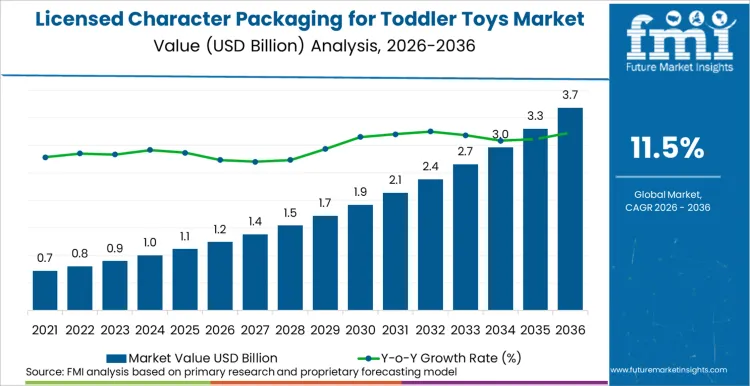
The global licensed character packaging for toddler toys market is estimated to be valued at USD 1,240 million in 2026 and is projected to reach USD 3,680 million by 2036, expanding at an 11.5% CAGR. FMI analysis indicates that this growth is structurally tied to the continued monetization of licensed IP in early-age product categories and the packaging intensity of character-driven portfolios, where packaging acts as both a protective format and a conversion asset that influences shelf pick-up and gifting preference.
Market expansion is being shaped by a portfolio execution dynamic: character lines are refreshed frequently, but the packaging “platform” is increasingly standardized. The value in licensed packaging is not simply the launch of a single pack, it is the ability to scale a consistent dieline-and-artwork system across multiple SKUs, regions, and retail programs without redesign churn. This makes packaging suppliers more valuable when they can enforce repeatable print reproduction, stable material performance, and predictable pack geometry across high-volume runs.
Compliance and governance pressures reinforce this shift. In the EU, stronger toy safety requirements entering into force on 1 January 2026 increase the premium placed on disciplined labeling, documentation, and controlled packaging execution for toys marketed to young children. In the USA, small-parts restrictions and choking hazard labeling requirements reinforce the need for consistent age grading and warning communication across packaging and advertising touchpoints.
FMI also observes an omnichannel constraint convergence. Licensed toddler toys increasingly need packaging that performs simultaneously in big-box retail (high shelf-impact, planogram fit) and e-commerce fulfilment (damage resistance, ship readiness). This dual requirement is narrowing demand toward formats and materials that can deliver both high visual merchandising value and operational robustness, increasing concentration in a limited set of scalable packaging architectures.
Summary of Licensed Character Packaging for Toddler Toys Market
- The licensed character packaging for toddler toys market comprises printed packaging formats used to merchandise and protect toddler toy products sold under licensed entertainment or character IP across mass retail, specialty toy stores, e-commerce fulfillment, and convenience retail channels.
- The defined scope is structured under FMI taxonomy with segmentation across end use, packaging format, material, and region, focusing exclusively on licensed-character toy packaging and excluding non-licensed toy packaging, non-toy licensed merchandise packaging, and downstream retail service revenues.
- The licensed character packaging for toddler toys market is projected to grow at a CAGR of 11.5% from 2026 to 2036, expanding from USD 1,240 million in 2026 to USD 3,680 million by 2036, based on FMI proprietary forecasting integrating channel mix shifts, format standardization dynamics, and licensed SKU portfolio expansion assumptions.
- The sector is transitioning toward standardized, repeatable packaging platforms where licensor approval discipline, print fidelity, and consistent pack geometry reduce redesign friction across multi-SKU character programs and enable faster rollout across retailers and regions.
- Competition is concentrated among large packaging suppliers and regionally scaled paperboard players such as Berry Global, Graphic Packaging, Smurfit Kappa, DS Smith, Nine Dragons, Greatview, Toppan, Rengo, ITC Packaging, and Amcor, with competitive advantage increasingly determined by licensing-grade print execution, format engineering, and retailer-ready operational performance.
- India is projected to record the fastest growth at 14.8% CAGR through 2036, while the USA retains the largest value share supported by big-box retail scale, high licensed-IP penetration, and mature compliance-led packaging execution requirements.
Licensed Character Packaging for Toddler Toys Market Key Takeaways
| Metric | Value |
|---|---|
| Expected Value 2026E | USD 1,240 million |
| Forecast Value 2036F | USD 3,680 million |
| CAGR 2026 to 2036 | 11.5% |
Source: Future Market Insights analysis based on proprietary forecasting model and primary research
Why is the Licensed Character Packaging for Toddler Toys Market Growing?
The primary growth driver is the packaging intensity of licensed toddler toy portfolios. Licensed SKUs rely on packaging as a merchandising interface-character artwork must be highly legible, color-consistent, and scalable across variants, which increases packaging value per unit relative to unlicensed lines and creates recurring packaging demand as character programs refresh.
A second driver is channel structure, particularly the dominance of mass retail and the rise of fulfillment-led distribution. Big-box programs require standardized footprints and high shelf visibility, while e-commerce channels reward packaging formats that protect product and graphics integrity through shipping. This is pushing conversion toward packaging designs that minimize execution variance and perform across both shelf and fulfillment constraints.
Growth is reinforced by compliance discipline and warning communication requirements for children’s products. In the U.S., small-parts restrictions and choking hazard labeling rules elevate the importance of consistent, auditable packaging communication and reduce tolerance for packaging execution errors across high-volume toddler categories.
What is the Segment Profile of Licensed Character Packaging for Toddler Toys Market?
The segment structure reflects where licensed packaging delivers the highest conversion leverage and the lowest execution risk at scale. FMI retains only the dominant segment in each category and expands the analysis to execution realism consistent with the reference preview format.
Why does Big-box retail anchor end-use demand?
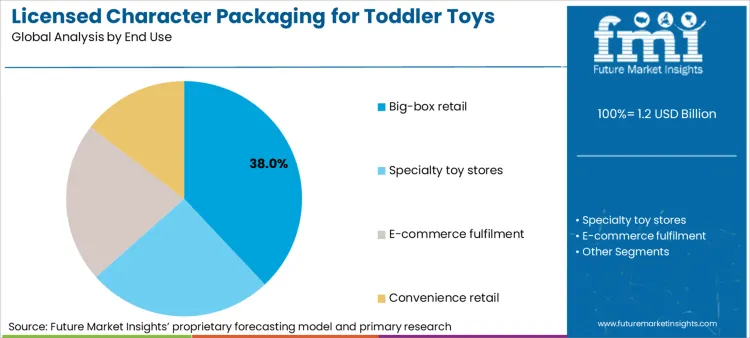
Big-box retail (38%) leads because it concentrates the highest volume throughput and the tightest shelf-performance requirements. Licensed toddler toy purchases are often influenced by immediate visual recognition, and big-box environments reward packaging that delivers rapid shelf conversion through high-impact artwork an presence.
A second driver is operational standardization. Big-box programs favor repeatable pack sizes, stable stacking and facing behavior, and predictable replenishment patterns. This increases the value of packaging suppliers that can deliver consistent die-cut quality, print reproduction, and structural durability across long production runs without creating rework or retailer compliance issues.
Why do Window boxes dominate packaging format selection?
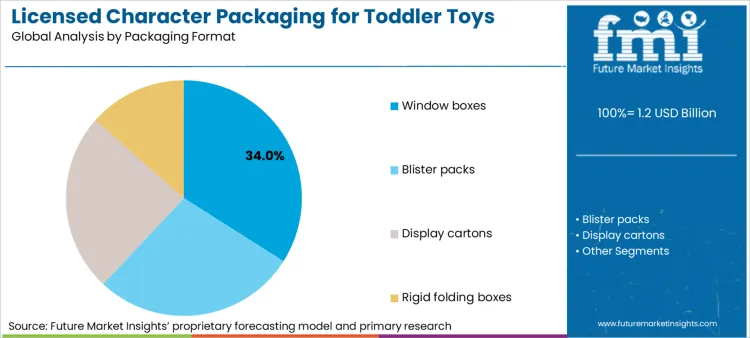
Window boxes (34%) lead because they combine two high-conversion signals: licensed character artwork plus direct product visibility. For toddler categories, caregivers often want to see the product while also being influenced by character trust and familiarity, making window boxes a scalable retail architecture for licensed lines.
Window boxes also provide a governance advantage. They create predictable zones for legal copy, age grading, warnings, and authentication features, which reduces execution variance across multi-SKU character programs and supports consistent licensor approval outcomes.
How is SBS paperboard sustaining material leadership?
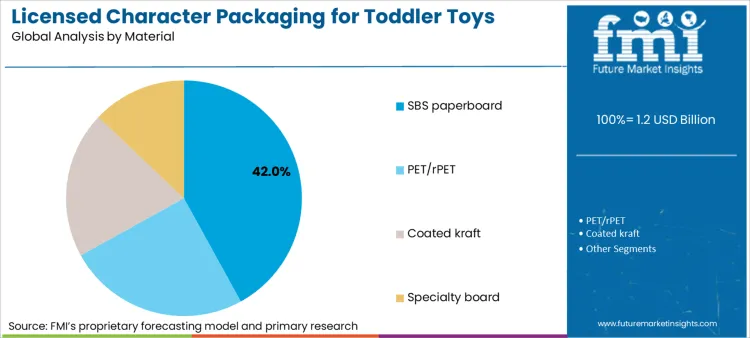
SBS paperboard (42%) dominates because licensed packaging is highly print-sensitive. Character artwork requires color fidelity, clean line reproduction, and durable surface performance to prevent scuffing and degradation through handling. SBS delivers a reliable print substrate and stable converting behavior that supports standardized packaging programs across mass retail.
SBS leadership is further reinforced by structural performance needs. Licensed toddler packaging must protect product integrity while maintaining premium shelf appearance. Paperboard-based structures offer predictable stiffness and geometry control, supporting both merchandising and operational durability requirements.
Why does North America retain regional leadership?
North America at 34% leads because it combines high licensed-IP penetration with big-box retail dominance and large-scale packaging conversion infrastructure. The region’s retail model amplifies the payoff from packaging that converts quickly at shelf and maintains consistent presentation across wide store networks.
North America also benefits from mature compliance communication expectations. In the U.S., choking hazard labeling requirements and children’s product safety expectations reinforce disciplined packaging execution, which increases demand for suppliers capable of standardized, compliant packaging programs.
What Drivers, Restraints, Opportunities, and Trends Prevail in the Licensed Character Packaging for Toddler Toys Market?
The strongest driver is the continued expansion of licensed IP monetization in toddler categories and the role of packaging as a conversion layer in retail. Licensed packaging creates measurable commercial value when it improves shelf recognition, supports gifting behavior, and enables rapid refresh of character lines without structural redesign.
A major restraint is licensing execution friction. Artwork approvals, strict brand guidelines, and frequent refresh cycles can create bottlenecks and redesign churn, increasing cost and elongating packaging timelines, especially when packaging structures are not standardized across SKUs and regions.
The highest-value opportunity lies in packaging platform standardization: reusable dielines, modular artwork zones, and region-ready compliance layouts that allow licensors and brands to scale a character program across multiple retailers and geographies with reduced approval loops. This opportunity strengthens as e-commerce fulfillment grows and packaging must perform in both merchandising and logistics environments.
The dominant trend is increasing governance and defensibility of packaging decisions. Compliance requirements for children’s products and retailer operational discipline are pushing packaging programs toward tighter standardization, better warning and age-grading consistency, and packaging architectures that balance shelf impact with fulfillment durability. EU toy safety updates entering into force in 2026 reinforce the direction toward stronger enforcement and compliance discipline.
How is the Licensed Character Packaging for Toddler Toys Market Analyzed in Key Countries?
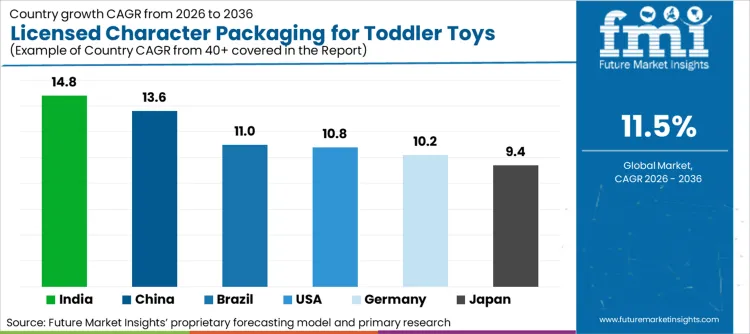
| Country | CAGR 2026 to 2036 |
|---|---|
| USA | 10.8% |
| Germany | 10.2% |
| China | 13.6% |
| Japan | 9.4% |
| India | 14.8% |
| Brazil | 11.0% |
Source: FMI analysis based on proprietary forecasting model and primary research
How is USA scaling through mass retail and compliance-grade packaging execution?
USA is projected to grow at a 10.8% CAGR, supported by big-box retail dominance and the high packaging intensity of licensed toddler toy programs. Market growth is anchored in standardized pack architectures that can be deployed across large retailer footprints while maintaining print consistency and shelf-readiness.
A second driver is compliance communication discipline. U.S. choking hazard labeling and small-parts restrictions elevate the importance of consistent warnings and age grading for toddler-targeted products, increasing the value of suppliers that can execute packaging programs with low variance and strong documentation logic.
Why is Germany advancing through EU compliance discipline and retail packaging governance?
Germany is forecast to expand at a 10.2% CAGR, shaped by EU compliance expectations and retailer sensitivity to packaging documentation and material outcomes. Licensed toy packaging programs in Germany favor controlled execution and repeatable packaging systems that can withstand scrutiny and reduce redesign churn.
A second growth engine is the structural push toward disciplined packaging decisions as EU toy safety requirements strengthen in 2026. This raises the premium on standardized layouts, defensible labeling systems, and reliable pack performance in organized retail supply chains.
How is China leveraging scale manufacturing and fast character refresh cycles?
China is expected to grow at a 13.6% CAGR, driven by the economics of high-volume production and rapid character portfolio turnover. Packaging demand rises as licensors and brands push frequent refreshes, seasonal programs, and high-velocity SKUs that require consistent print reproduction at scale.
FMI observes that adoption favors packaging formats that scale efficiently in high-throughput conversion environments, enabling fast turnarounds while preserving core licensed artwork integrity and standardized pack geometry.
Why does Japan follow a quality-led trajectory with channel-specific packaging needs?
Japan is projected to grow at a 9.4% CAGR, reflecting a more measured adoption pattern shaped by stringent quality expectations and channel specificity. Packaging decisions emphasize presentation discipline and legibility, supporting formats that deliver premium shelf appearance in compact retail environments.
A second driver is the operational value of consistency. Japanese programs often prioritize stable packaging execution and high print fidelity, which rewards suppliers that can maintain low defect rates and consistent finishing across licensed runs.
Why is India emerging as the fastest-growing market?
India leads at a 14.8% CAGR, driven by expanding organized retail, rising licensed character penetration, and improving packaging quality infrastructure. As branded toddler categories scale, packaging increasingly becomes a brand-control layer that helps licensors maintain consistency and reduce counterfeiting and execution variance.
A second driver is channel modernization. As big-box and large-format retail expands, standard pack footprints and high-impact display formats become more important, increasing demand for scalable paperboard-based solutions that can deliver consistent artwork reproduction and strong shelf performance.
How is Brazil building demand through mainstream retail expansion and licensed SKU growth?
Brazil is forecast to expand at an 11.0% CAGR, supported by increasing licensed product penetration and expansion of organized retail distribution for toys. Growth concentrates in cost-effective, durable packaging solutions that can withstand variable logistics conditions while preserving artwork integrity.
FMI observes that packaging suppliers win share when they can provide stable structural performance and reliable print consistency, enabling licensed programs to scale without excessive rework or retailer quality failures.
How Competitive is the Licensed Character Packaging for Toddler Toys Market?
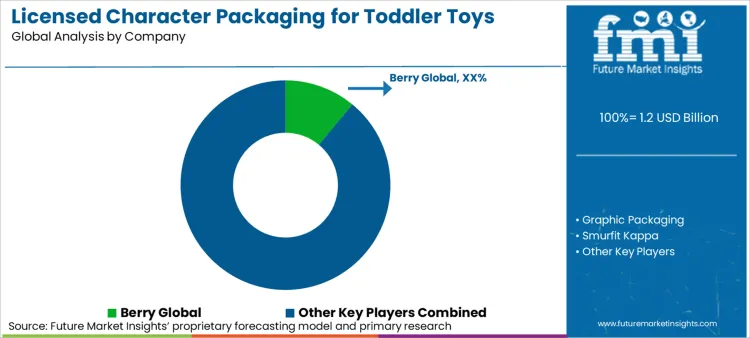
The competitive landscape is defined by execution capability rather than commodity capacity. Competition is not solely about producing cartons; it is about delivering licensing-grade print fidelity, repeatable dieline systems, and channel-ready packaging performance that can scale across character portfolios without approval churn.
The first axis of competition is licensing compliance and print governance. Suppliers differentiate on their ability to reproduce character artwork consistently across runs, manage color control, and execute finishes without defect escalation. This reduces the risk of licensor rejection and protects brand equity at shelf.
The second axis is packaging architecture standardization. Character programs require speed and repeatability. Suppliers that provide platform-style packaging-standard footprints, modular artwork zones, predictable windowing and sealing behavior-enable faster SKU expansion and reduce the cost of frequent character refresh cycles.
The third axis is omnichannel durability. As e-commerce fulfillment grows, suppliers that can engineer retail-ready packs to also withstand shipping stress gain a structural advantage. This includes material choices and structural reinforcement that protect both product and the visual integrity of licensed artwork.
Key Players Profiled
- Berry Global
- Graphic Packaging
- Smurfit Kappa
- DS Smith
- Nine Dragons
- Greatview
- Toppan
- Rengo
- ITC Packaging
- Amcor
Market Definition
The licensed character packaging for toddler toys market comprises revenues generated from packaging formats used for toddler toy products sold under licensed entertainment or character IP. The market includes paperboard packaging and plastic packaging formats that provide merchandising impact, product visibility, protection, and standardized compliance communication across retail and e-commerce channels.
The scope includes packaging used in big-box retail, specialty toy stores, e-commerce fulfillment, and convenience retail programs. It excludes non-licensed toy packaging, non-toy licensed merchandise packaging, and downstream retail service revenues.
Scope of Report
| Items | Values |
|---|---|
| Quantitative Units | USD 1,240 million |
| End Use | Big-box retail, Specialty toy stores, E-commerce fulfillment, Convenience retail |
| Packaging Format | Window boxes, Blister packs, Display cartons, Rigid folding boxes |
| Material | SBS paperboard, PET / rPET, Coated kraft, Specialty board |
| Countries Covered | USA, Germany, China, Japan, India, Brazil |
| Regions Covered | North America, Europe, East Asia, Japan, South Asia, RoW |
| Key Companies | Berry Global, Graphic Packaging, Smurfit Kappa, DS Smith, Nine Dragons, Greatview, Toppan, Rengo, ITC Packaging, Amcor |
Source: Future Market Insights analysis based on proprietary forecasting model and primary research
Licensed Character Packaging for Toddler Toys Market Key Segments
End Use:
- Big-box retail
- Specialty toy stores
- E-commerce fulfilment
- Convenience retail
Packaging Format:
- Window boxes
- Blister packs
- Display cartons
- Rigid folding boxes
Material:
- SBS paperboard
- PET/rPET
- Coated kraft
- Specialty board
Region:
- North America
- Europe
- East Asia
- Japan
- South Asia
- RoW
Bibliography
- Directorate-General for Internal Market, Industry, Entrepreneurship and SMEs. (2025). Stronger toy safety rules enter into force (Toy Safety Regulation effective 1 January 2026). European Commission.
- UL. (2026). Toys: Europe publishes new Toy Safety Regulation (Regulation (EU) 2025/2509). UL Solutions.
- USA Consumer Product Safety Commission. (2024). Small Parts Ban and Choking Hazard Labeling (16 C.F.R. §§ 1500.19-1500.20). CPSC.
- Office of the Federal Register. (2024). Safety Standard Mandating ASTM F963 for Toys (effective April 20, 2024). Federal Register.
- USA Government Publishing Office. (2025). 16 C.F.R. Part 1501-Method for identifying toys and other articles intended for use by children under 3 years of age which present choking, aspiration, or ingestion hazards because of small parts. eCFR.
- European Commission. (2025). Packaging waste-policy overview and PPWR implementation context. Directorate-General for Environment.
Frequently Asked Questions
How big is the licensed character packaging for toddler toys market in 2026?
The global licensed character packaging for toddler toys market is estimated to be valued at USD 1.2 billion in 2026.
What will be the size of licensed character packaging for toddler toys market in 2036?
The market size for the licensed character packaging for toddler toys market is projected to reach USD 3.7 billion by 2036.
How much will be the licensed character packaging for toddler toys market growth between 2026 and 2036?
The licensed character packaging for toddler toys market is expected to grow at a 11.5% CAGR between 2026 and 2036.
What are the key product types in the licensed character packaging for toddler toys market?
The key product types in licensed character packaging for toddler toys market are big-box retail , specialty toy stores, e-commerce fulfilment and convenience retail.
Which packaging format segment to contribute significant share in the licensed character packaging for toddler toys market in 2026?
In terms of packaging format, window boxes segment to command 34.0% share in the licensed character packaging for toddler toys market in 2026.
Preview the report firsthand - request a free sample
Get SampleGet the brochure for pricing and purchase details.
Get PDFTable of Content
- Executive Summary
- Global Market Outlook
- Demand-side Trends
- Supply-side Trends
- Technology Roadmap Analysis
- Analysis and Recommendations
- Market Overview
- Market Coverage / Taxonomy
- Market Definition / Scope / Limitations
- Research Methodology
- Chapter Orientation
- Analytical Lens and Working Hypotheses
- Market Structure, Signals, and Trend Drivers
- Benchmarking and Cross-market Comparability
- Market Sizing, Forecasting, and Opportunity Mapping
- Research Design and Evidence Framework
- Desk Research Programme (Secondary Evidence)
- Company Annual and Sustainability Reports
- Peer-reviewed Journals and Academic Literature
- Corporate Websites, Product Literature, and Technical Notes
- Earnings Decks and Investor Briefings
- Statutory Filings and Regulatory Disclosures
- Technical White Papers and Standards Notes
- Trade Journals, Industry Magazines, and Analyst Briefs
- Conference Proceedings, Webinars, and Seminar Materials
- Government Statistics Portals and Public Data Releases
- Press Releases and Reputable Media Coverage
- Specialist Newsletters and Curated Briefings
- Sector Databases and Reference Repositories
- FMI Internal Proprietary Databases and Historical Market Datasets
- Subscription Datasets and Paid Sources
- Social Channels, Communities, and Digital Listening Inputs
- Additional Desk Sources
- Expert Input and Fieldwork (Primary Evidence)
- Primary Modes
- Qualitative Interviews and Expert Elicitation
- Quantitative Surveys and Structured Data Capture
- Blended Approach
- Why Primary Evidence is Used
- Field Techniques
- Interviews
- Surveys
- Focus Groups
- Observational and In-context Research
- Social and Community Interactions
- Stakeholder Universe Engaged
- C-suite Leaders
- Board Members
- Presidents and Vice Presidents
- R&D and Innovation Heads
- Technical Specialists
- Domain Subject-matter Experts
- Scientists
- Physicians and Other Healthcare Professionals
- Governance, Ethics, and Data Stewardship
- Research Ethics
- Data Integrity and Handling
- Primary Modes
- Tooling, Models, and Reference Databases
- Desk Research Programme (Secondary Evidence)
- Data Engineering and Model Build
- Data Acquisition and Ingestion
- Cleaning, Normalisation, and Verification
- Synthesis, Triangulation, and Analysis
- Quality Assurance and Audit Trail
- Market Background
- Market Dynamics
- Drivers
- Restraints
- Opportunity
- Trends
- Scenario Forecast
- Demand in Optimistic Scenario
- Demand in Likely Scenario
- Demand in Conservative Scenario
- Opportunity Map Analysis
- Product Life Cycle Analysis
- Supply Chain Analysis
- Investment Feasibility Matrix
- Value Chain Analysis
- PESTLE and Porter’s Analysis
- Regulatory Landscape
- Regional Parent Market Outlook
- Production and Consumption Statistics
- Import and Export Statistics
- Market Dynamics
- Global Market Analysis 2021 to 2025 and Forecast, 2026 to 2036
- Historical Market Size Value (USD Million) Analysis, 2021 to 2025
- Current and Future Market Size Value (USD Million) Projections, 2026 to 2036
- Y-o-Y Growth Trend Analysis
- Absolute $ Opportunity Analysis
- Global Market Pricing Analysis 2021 to 2025 and Forecast 2026 to 2036
- Global Market Analysis 2021 to 2025 and Forecast 2026 to 2036, By End Use
- Introduction / Key Findings
- Historical Market Size Value (USD Million) Analysis By End Use , 2021 to 2025
- Current and Future Market Size Value (USD Million) Analysis and Forecast By End Use , 2026 to 2036
- Big-box retail
- Specialty toy stores
- E-commerce fulfilment
- Convenience retail
- Big-box retail
- Y-o-Y Growth Trend Analysis By End Use , 2021 to 2025
- Absolute $ Opportunity Analysis By End Use , 2026 to 2036
- Global Market Analysis 2021 to 2025 and Forecast 2026 to 2036, By Packaging Format
- Introduction / Key Findings
- Historical Market Size Value (USD Million) Analysis By Packaging Format, 2021 to 2025
- Current and Future Market Size Value (USD Million) Analysis and Forecast By Packaging Format, 2026 to 2036
- Window boxes
- Blister packs
- Display cartons
- Rigid folding boxes
- Window boxes
- Y-o-Y Growth Trend Analysis By Packaging Format, 2021 to 2025
- Absolute $ Opportunity Analysis By Packaging Format, 2026 to 2036
- Global Market Analysis 2021 to 2025 and Forecast 2026 to 2036, By Material
- Introduction / Key Findings
- Historical Market Size Value (USD Million) Analysis By Material, 2021 to 2025
- Current and Future Market Size Value (USD Million) Analysis and Forecast By Material, 2026 to 2036
- SBS paperboard
- PET/rPET
- Coated kraft
- Specialty board
- SBS paperboard
- Y-o-Y Growth Trend Analysis By Material, 2021 to 2025
- Absolute $ Opportunity Analysis By Material, 2026 to 2036
- Global Market Analysis 2021 to 2025 and Forecast 2026 to 2036, By Region
- Introduction
- Historical Market Size Value (USD Million) Analysis By Region, 2021 to 2025
- Current Market Size Value (USD Million) Analysis and Forecast By Region, 2026 to 2036
- North America
- Latin America
- Western Europe
- Eastern Europe
- East Asia
- South Asia and Pacific
- Middle East & Africa
- Market Attractiveness Analysis By Region
- North America Market Analysis 2021 to 2025 and Forecast 2026 to 2036, By Country
- Historical Market Size Value (USD Million) Trend Analysis By Market Taxonomy, 2021 to 2025
- Market Size Value (USD Million) Forecast By Market Taxonomy, 2026 to 2036
- By Country
- USA
- Canada
- Mexico
- By End Use
- By Packaging Format
- By Material
- By Country
- Market Attractiveness Analysis
- By Country
- By End Use
- By Packaging Format
- By Material
- Key Takeaways
- Latin America Market Analysis 2021 to 2025 and Forecast 2026 to 2036, By Country
- Historical Market Size Value (USD Million) Trend Analysis By Market Taxonomy, 2021 to 2025
- Market Size Value (USD Million) Forecast By Market Taxonomy, 2026 to 2036
- By Country
- Brazil
- Chile
- Rest of Latin America
- By End Use
- By Packaging Format
- By Material
- By Country
- Market Attractiveness Analysis
- By Country
- By End Use
- By Packaging Format
- By Material
- Key Takeaways
- Western Europe Market Analysis 2021 to 2025 and Forecast 2026 to 2036, By Country
- Historical Market Size Value (USD Million) Trend Analysis By Market Taxonomy, 2021 to 2025
- Market Size Value (USD Million) Forecast By Market Taxonomy, 2026 to 2036
- By Country
- Germany
- UK
- Italy
- Spain
- France
- Nordic
- BENELUX
- Rest of Western Europe
- By End Use
- By Packaging Format
- By Material
- By Country
- Market Attractiveness Analysis
- By Country
- By End Use
- By Packaging Format
- By Material
- Key Takeaways
- Eastern Europe Market Analysis 2021 to 2025 and Forecast 2026 to 2036, By Country
- Historical Market Size Value (USD Million) Trend Analysis By Market Taxonomy, 2021 to 2025
- Market Size Value (USD Million) Forecast By Market Taxonomy, 2026 to 2036
- By Country
- Russia
- Poland
- Hungary
- Balkan & Baltic
- Rest of Eastern Europe
- By End Use
- By Packaging Format
- By Material
- By Country
- Market Attractiveness Analysis
- By Country
- By End Use
- By Packaging Format
- By Material
- Key Takeaways
- East Asia Market Analysis 2021 to 2025 and Forecast 2026 to 2036, By Country
- Historical Market Size Value (USD Million) Trend Analysis By Market Taxonomy, 2021 to 2025
- Market Size Value (USD Million) Forecast By Market Taxonomy, 2026 to 2036
- By Country
- China
- Japan
- South Korea
- By End Use
- By Packaging Format
- By Material
- By Country
- Market Attractiveness Analysis
- By Country
- By End Use
- By Packaging Format
- By Material
- Key Takeaways
- South Asia and Pacific Market Analysis 2021 to 2025 and Forecast 2026 to 2036, By Country
- Historical Market Size Value (USD Million) Trend Analysis By Market Taxonomy, 2021 to 2025
- Market Size Value (USD Million) Forecast By Market Taxonomy, 2026 to 2036
- By Country
- India
- ASEAN
- Australia & New Zealand
- Rest of South Asia and Pacific
- By End Use
- By Packaging Format
- By Material
- By Country
- Market Attractiveness Analysis
- By Country
- By End Use
- By Packaging Format
- By Material
- Key Takeaways
- Middle East & Africa Market Analysis 2021 to 2025 and Forecast 2026 to 2036, By Country
- Historical Market Size Value (USD Million) Trend Analysis By Market Taxonomy, 2021 to 2025
- Market Size Value (USD Million) Forecast By Market Taxonomy, 2026 to 2036
- By Country
- Kingdom of Saudi Arabia
- Other GCC Countries
- Turkiye
- South Africa
- Other African Union
- Rest of Middle East & Africa
- By End Use
- By Packaging Format
- By Material
- By Country
- Market Attractiveness Analysis
- By Country
- By End Use
- By Packaging Format
- By Material
- Key Takeaways
- Key Countries Market Analysis
- USA
- Pricing Analysis
- Market Share Analysis, 2025
- By End Use
- By Packaging Format
- By Material
- Canada
- Pricing Analysis
- Market Share Analysis, 2025
- By End Use
- By Packaging Format
- By Material
- Mexico
- Pricing Analysis
- Market Share Analysis, 2025
- By End Use
- By Packaging Format
- By Material
- Brazil
- Pricing Analysis
- Market Share Analysis, 2025
- By End Use
- By Packaging Format
- By Material
- Chile
- Pricing Analysis
- Market Share Analysis, 2025
- By End Use
- By Packaging Format
- By Material
- Germany
- Pricing Analysis
- Market Share Analysis, 2025
- By End Use
- By Packaging Format
- By Material
- UK
- Pricing Analysis
- Market Share Analysis, 2025
- By End Use
- By Packaging Format
- By Material
- Italy
- Pricing Analysis
- Market Share Analysis, 2025
- By End Use
- By Packaging Format
- By Material
- Spain
- Pricing Analysis
- Market Share Analysis, 2025
- By End Use
- By Packaging Format
- By Material
- France
- Pricing Analysis
- Market Share Analysis, 2025
- By End Use
- By Packaging Format
- By Material
- India
- Pricing Analysis
- Market Share Analysis, 2025
- By End Use
- By Packaging Format
- By Material
- ASEAN
- Pricing Analysis
- Market Share Analysis, 2025
- By End Use
- By Packaging Format
- By Material
- Australia & New Zealand
- Pricing Analysis
- Market Share Analysis, 2025
- By End Use
- By Packaging Format
- By Material
- China
- Pricing Analysis
- Market Share Analysis, 2025
- By End Use
- By Packaging Format
- By Material
- Japan
- Pricing Analysis
- Market Share Analysis, 2025
- By End Use
- By Packaging Format
- By Material
- South Korea
- Pricing Analysis
- Market Share Analysis, 2025
- By End Use
- By Packaging Format
- By Material
- Russia
- Pricing Analysis
- Market Share Analysis, 2025
- By End Use
- By Packaging Format
- By Material
- Poland
- Pricing Analysis
- Market Share Analysis, 2025
- By End Use
- By Packaging Format
- By Material
- Hungary
- Pricing Analysis
- Market Share Analysis, 2025
- By End Use
- By Packaging Format
- By Material
- Kingdom of Saudi Arabia
- Pricing Analysis
- Market Share Analysis, 2025
- By End Use
- By Packaging Format
- By Material
- Turkiye
- Pricing Analysis
- Market Share Analysis, 2025
- By End Use
- By Packaging Format
- By Material
- South Africa
- Pricing Analysis
- Market Share Analysis, 2025
- By End Use
- By Packaging Format
- By Material
- USA
- Market Structure Analysis
- Competition Dashboard
- Competition Benchmarking
- Market Share Analysis of Top Players
- By Regional
- By End Use
- By Packaging Format
- By Material
- Competition Analysis
- Competition Deep Dive
- Berry Global
- Overview
- Product Portfolio
- Profitability by Market Segments (Product/Age /Sales Channel/Region)
- Sales Footprint
- Strategy Overview
- Marketing Strategy
- Product Strategy
- Channel Strategy
- Graphic Packaging
- Smurfit Kappa
- DS Smith
- Nine Dragons
- Greatview
- Toppan
- Rengo
- ITC Packaging
- Berry Global
- Competition Deep Dive
- Assumptions & Acronyms Used


