

- Industry Size (2026)
- USD 1.69 Bn
- Forecast (2036)
- USD 2.91 Bn
- CAGR (2026 to 2036)
- 5.6%
Mushroom Fermenter Market Size, Market Forecast and Outlook By FMI
In 2025, the mushroom fermenter market was valued at USD 1.60 billion. Based on Future Market Insights' analysis, demand for mushroom fermenter is estimated to grow to USD 1.69 billion in 2026 and USD 2.91 billion by 2036. FMI projects a CAGR of 5.6% during the forecast period.
The absolute dollar expansion of approximately USD 1.22 billion reflects accelerating pharmaceutical mycelium biomass production requirements, growing functional mushroom extract manufacturing capacity, and expanding bioprocessing research infrastructure investment across Asian and European biotechnology clusters. Mechanical agitation fermenter dominance at 63.2% reflects the superior oxygen mass transfer rates, scalability, and process control capabilities that stirred tank bioreactor designs deliver across high-density mushroom mycelium cultivation applications in pharmaceutical active compound extraction workflows. Cosmetics and personal care sector adoption of mushroom-derived bioactives including beta-glucans, ergothioneine, and kojic acid creates incremental fermentation capacity demand beyond traditional food and pharmaceutical application segments.
Summary of Mushroom Fermenter Market
- Mushroom Fermenter Market Definition
- The Mushroom Fermenter Market encompasses specialized bioreactor and fermentation vessel systems designed and optimized for submerged liquid-state cultivation of edible and medicinal mushroom mycelium, including Ganoderma lucidum, Lentinula edodes, Grifola frondosa, Cordyceps sinensis, and Pleurotus species, for pharmaceutical bioactive compound extraction, functional food ingredient production, cosmetic bioactive manufacturing, and chemical synthesis applications.
- Demand Drivers in the Market
- Pharmaceutical industry demand for standardized mycelium-derived bioactive compounds including polysaccharides, triterpenoids, and beta-glucan complexes with defined molecular weight specifications requires controlled submerged fermentation rather than traditional solid-state cultivation methods
- Functional mushroom ingredient demand growth from dietary supplement, sports nutrition, and cosmetics manufacturers creates commercial-scale submerged fermentation procurement requirements for standardized extract supply beyond what traditional mushroom cultivation operations can deliver
- Research institution and contract development manufacturing organization investment in mycology bioprocessing platforms creates laboratory and pilot-scale fermenter demand supporting scale-up pathway development for novel mushroom-derived pharmaceutical and nutritional compounds
- Key Segments Analyzed in the FMI Report
- Mechanical Agitation: 63.2% share in 2026 as the leading Type segment, reflecting structural demand advantages and established procurement preference across key end-use applications.
- Pharmaceutical: 24.6% share in 2026 as the dominant Application segment, supported by established channel relationships and high-volume purchasing activity from primary end-use operators.
- India: 7.0% CAGR through 2036, the fastest-growing geographic market driven by regulatory advancement, capacity investment, and accelerating consumer or industrial demand adoption.
- Analyst Opinion at FMI
- Nandini Roy Choudhury, Principal Consultant for Food & Beverage analysts assess the mushroom fermenter sector as positioned at a structural inflection where supply chain maturation, regulatory clarity, and consumer awareness convergence creates conditions for sustained above-market-average growth. As per FMI's analysis, market participants aligning product development, compliance infrastructure, and distribution investment with regional growth trajectories will capture disproportionate value share across the forecast period. FMI is of the opinion that differentiation through application-specific formulation expertise and validated quality credentials will determine competitive positioning in premium end-use segments.
- Strategic Implications / Executive Takeaways
- Fermenter manufacturers should develop mushroom-specific bioreactor configurations with optimized impeller geometry and aeration systems validated for high-viscosity mycelium broth handling to differentiate from general-purpose pharmaceutical fermenters
- Sales teams should target functional mushroom extract contract manufacturers seeking to transition from solid-state fermentation to submerged fermentation to achieve standardized bioactive content certification and premium ingredient pricing
- After-sales service teams should build regional application support capability in India and China to assist mushroom fermentation operators with process optimization, contamination control, and productivity scale-up technical challenges
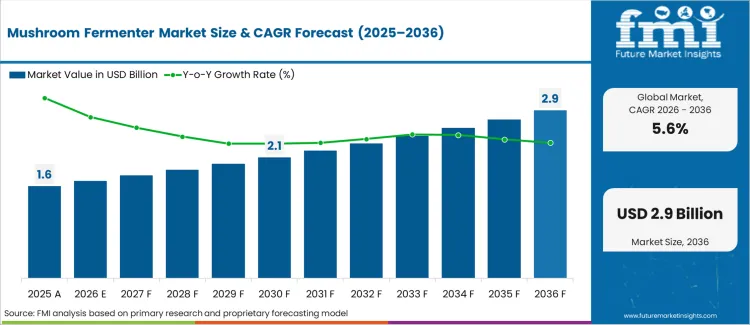
Mushroom Fermenter Market Key Takeaways
| Metric | Details |
|---|---|
| Industry Size (2026) | USD 1.69 Billion |
| Industry Value (2036) | USD 2.91 Billion |
| CAGR (2026-2036) | 5.6% |
| Source | Future Market Insights, 2026 |
Source: FMI analysis based on primary research and proprietary forecasting model
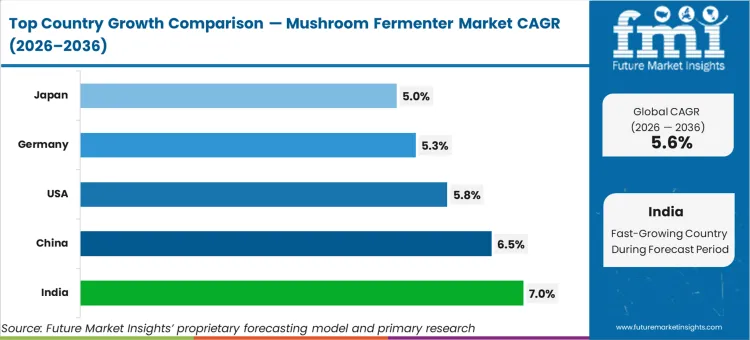
India leads growth at 7.0% CAGR as expanding pharmaceutical biotechnology manufacturing investment, growing functional mushroom supplement export operations, and government bioprocessing infrastructure development programs accelerate fermenter procurement. China advances at 6.5% driven by the world's largest commercial mushroom cultivation industry scaling from traditional solid-state fermentation toward controlled submerged fermentation for standardized extract production. The United States registers 5.8% growth anchored by pharmaceutical bioprocess scale-up investment and growing functional mushroom ingredient procurement by supplement and cosmetics manufacturers. Germany sustains 5.3% growth reflecting precision pharmaceutical fermentation equipment manufacturing and European pharmaceutical-grade mycelium extract production expansion. Japan registers 5.0% CAGR anchored by established medicinal mushroom research institutions and precision fermentation technology deployment in nutraceutical manufacturing.
Mushroom Fermenter Market Definition
The Mushroom Fermenter Market encompasses specialized bioreactor and fermentation vessel systems designed and optimized for submerged liquid-state cultivation of edible and medicinal mushroom mycelium, including Ganoderma lucidum, Lentinula edodes, Grifola frondosa, Cordyceps sinensis, and Pleurotus species, for pharmaceutical bioactive compound extraction, functional food ingredient production, cosmetic bioactive manufacturing, and chemical synthesis applications.
Mushroom Fermenter Market Inclusions
Market scope includes mechanical agitation stirred tank bioreactors, airlift fermenters, bubble column reactors, and hybrid agitation systems in laboratory, pilot, and industrial production scale configurations. Both stainless steel jacketed vessels for aseptic production and single-use bioreactor systems for research-scale mushroom fermentation are within scope. Integrated monitoring and control automation systems supplied as part of fermenter units are incorporated.
Mushroom Fermenter Market Exclusions
Solid-state fermentation trays, mushroom fruiting body substrate bags, and conventional growing house infrastructure for commercial mushroom production harvested as whole food products are excluded. General-purpose pharmaceutical bioreactors not specifically characterized or marketed for mushroom mycelium cultivation fall outside the defined market boundaries. Post-fermentation downstream processing equipment for extract purification is valued separately.
Mushroom Fermenter Market Research Methodology
- Primary Research: Primary analysts conducted structured interviews with procurement directors, product development leads, regulatory affairs specialists, and distribution channel managers across key geographies to validate market sizing assumptions and identify emerging demand drivers.
- Desk Research: Publicly available regulatory filings, government statistical publications, trade association reports, company annual reports, investor presentations, and peer-reviewed scientific literature formed the secondary data foundation for market characterization and growth driver analysis.
- Market-Sizing and Forecasting: Forecasting applies a bottom-up methodology building from installed bioreactor capacity metrics at pharmaceutical, food ingredient, and cosmetics mushroom fermentation operations, applying equipment replacement cycles, new facility installation rates, and upgrade investment assumptions to project fermenter unit and value demand trajectories.
- Data Validation and Update Cycle: Forecast model outputs are cross-validated against company earnings disclosures, trade flow data, and regional regulatory adoption timelines. Models are reviewed and updated on a defined cycle to incorporate material market developments.
Key Mushroom Fermenter Industry Trends
Growing Demand for Mushrooms Drives the Mushroom Fermenter Market
The mushroom fermenter market has been gaining considerable traction due to the increase awareness for health benefits associated with consumption of fermented mushroom and growing consumer preference for mushroom as primary nutritional source.
Due to fermentation process of the mushroom, many of the nutritional and health benefits of the mushroom increases, decrease in carbohydrates and fats. Thus, fermented mushroom has gained significant popularity in the health conscious population which indirectly supports for the growth of the mushroom fermenter market during the forecast period.
Rising Demand for Mycelium-Based Products Fuels Expansion of Mushroom Fermenters
Mycelium-based products-such as biodegradable packaging and textiles-are creating new avenues of application for mushroom fermenters beyond the traditional avenues of the food industry. Mycelium is recognized as a root which found its acceptance as a sustainable-also the new and innovative designation in value for various applications.
Thus, this tendency creates an award for mushroom fermenters to produce a large amount of mycelium for industrial applications. Increasing demand eco-friendly alternatives and innovative materials for further processing are likely to generate more demand for mushroom fermenter during the forecast period, as indicated by the mushroom fermenter industry analysis.
The Increasing Demand for Fermented Mushrooms in Beverages, Snacks, and Supplements is Driving Market Growth
The mushroom fermenter market is witnessing a gradual rise in the demand for fermented mushrooms in beverages, snacks, and supplements. Health considerations influences this trend, as mushroom are nutrient rich through fermentation process. Mushroom based functional beverages such as teas and coffees are gaining major popularity in health conscious populace are further contributes to generate demand for mushroom fermenting equipment.
Thus, aforementioned factors such as increasing use of fermented mushroom in beverage snacks and supplements and rapidly increasing demand for fermented mushroom based supplements and functional beverages are collectively contributes for the growth of the market.
Comparison of Historical vs Forecast Sales Outlook for Mushroom Fermenters (2021 to 2036)
Global sales increased at a CAGR of 4.6% from 2026 to 2036. For the next ten years (2026 to 2036), projections are that expenditure on such products will rise at 5.6% CAGR.
The mushroom fermenter market is calculated to register significant growth during the period from 2026 to 2036 The development was primarily due to increased consumer awareness of the health benefits of mushrooms and their growing culinary applications.
Further influence comes from awareness of sustainable food production and from the health and nutritional benefits of mushrooms which consequently increases demand. Major firms like Bioengineering AG and Sartorius AG are developing newer technologies in fermentations to attain greater efficiencies in the production and quality of the product. Mycelium-based products for food and pharmaceutical applications are further proof of this trend.
The market is expected to have a major boom from 2026 to 2036 as a result of advancements in precision fermentation technology to improve optimization processes for production. The trend towards plant-based diets as well as the quest for sources of sustainable food will then increase demand for mushroom fermenters.
By this time emerging markets in Asia, particularly India, and China, are poised to make a huge impact on growth as a result of increasing consumer awareness about the nutritional and medicinal benefits of mushrooms. Overall, the future looks bright for the mushroom fermenter market going by the changing consumer behaviors and embracing new technology advancements.
Concentration of Key Players in the Mushroom Fermenter Market
Tier 1 Companies have set themselves at the top of the industry. They are both well-established around the world and hold significant market shares. They also lead in innovation, research, and development sometimes creating the trends. Examples are Bioengineering AG and Sartorius AG, which provide advanced fermentation technologies to produce efficiently and with quality. Their worldwide presence and extensive product offer qualify them as number one in mushroom fermenter markets.
Tier 2 Companies are regional players with enough market coverage and have industries of niche products. They have usually moved beyond the basic needs of a specific geographic area and managed to be competitive elsewhere. Good examples are Eppendorf AG and DCI-Biolafitte.
Although they work to create tailor-made solutions for many applications, from food to pharmaceutical, their localized approach gives them an advantage in serving those specific markets. In fact, this strategy is aligned with the mushroom fermenter industry outlook, which predicts that such companies will continue to succeed with a focus on niche markets and creative solutions.
Tier-3 Companies consist of smaller players who primarily operate in the local or even regional markets. They do not have a fancy R and D portfolio but offer local solutions with their special products. Taking examples such as GS Bio and Quanhe Fungi, this tier represents the very essential services in their target markets.
Country-wise Insights in the Mushroom Fermenter Market
The following table shows the estimated growth rates of the top three territories. India, China and USA are set to exhibit high consumption, recording CAGRs of 7.0%, 6.5% and 5.8%, respectively, through 2036.
.webp "Top Country Growth Comparison Mushroom Fermenter Market Cagr (2026 2036)")
| Countries | CAGR |
|---|---|
| USA | 5.8% |
| China | 6.5% |
| Germany | 5.3% |
| India | 7.0% |
| Japan | 5.0% |
Source: FMI analysis based on primary research and proprietary forecasting model
Technological Advancements Drive Significant Growth in the USA Mushroom Fermenter Market
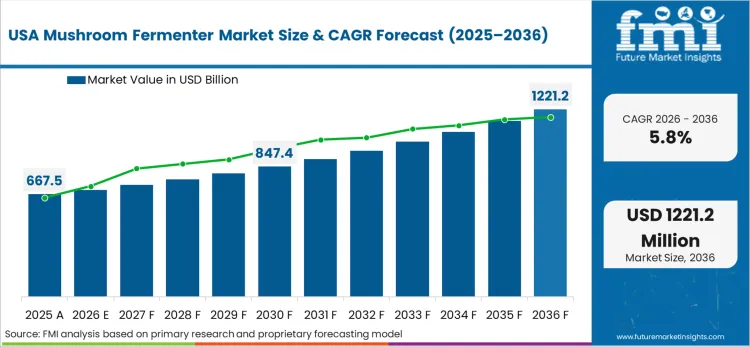
The USA mushroom fermenter market is significantly driven by technological advancements and its adoption in the food processing sector. Automation and advanced bioreactors kind of technological innovations enhance the production efficiency and quality of the fermented mushroom. These advancements enable fermented mushroom producers to achieve higher and consistent yields.
Furthermore, mushroom fermenter companies are manufacturing industry specific mushroom fermenters for sectors such as cosmetic and personal care, pharmaceutical and specific to food and beverages. This diversification in product offerings not only meets different needs in the market, but also concurs with findings from mushroom fermenter industry analysis and continued potential for growth in the USA market.
Technological Advancements and Consumer Trends Propel Growth in the Mushroom Fermenter Market in China and India
The mushroom fermenter market is gradually growing in China and India as a result of innovative applications of fermented mushroom and evolving consumer behaviour. China is the number one edible fungi producing country, accounting for about 74.11% of total world production.
The total annual production has almost doubled from 22 million tons in 2010 to 42 million tons in 2022. Thus, the growth of the mushroom fermenter market in China is driven by technological advancements and increasing production capacity of mushroom, which aligns with the mushroom fermenter industry outlook.
Health Awareness and Sustainability Drive Growth in the Mushroom Fermenter Market in Europe
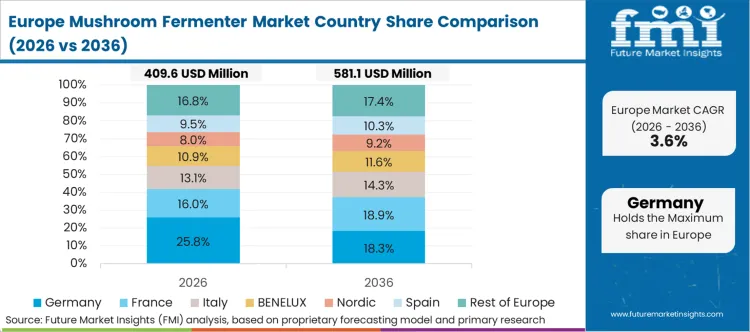
Increased health consciousness among consumers in Europe is causing demand and growth in the mushroom fermenter market. On the other hand, mushrooms boast of high nutritional benefits; hence people are looking more into wellness. A lot of consumers are considering putting mushrooms in different recipes as part of culinary applications.
One reason put forward by the increase in demand for plant protein is because people want to eat healthier. Finally, people also prefer local sources and organic production. Therefore, it adds to the market for mushroom fermenters; hence mushroom producers are now looking for better ways to meet rising consumer demands.
Category-wise Insights in the Mushroom Fermenter Market
How Mechanical Agitation Supplements the Growth of the Fermented Mushroom Market
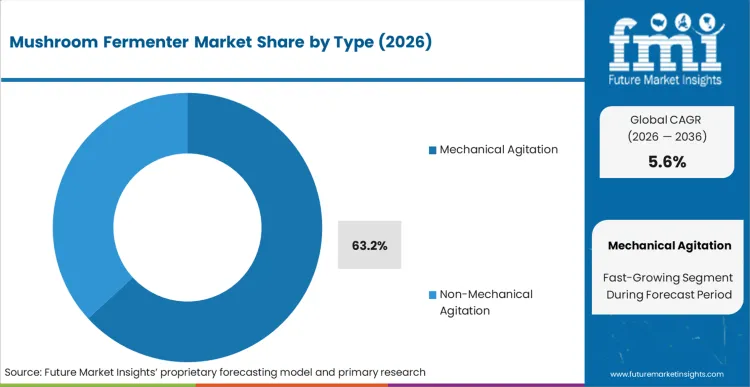
| Segment | Value Share (2026) |
|---|---|
| Mechanical Agitation (By Type) | 63.2% |
Mechanical agitation has a critical role in the production of fermented mushrooms and influences mushroom fermenter market growth. Increasing mixing efficiency allows for optimized mass transfer rates in fermentation tanks. This optimized mixing distributes nutrients and oxygen for mycelium development.
As a result, it yields consistently high product quality. Such large multinationals firms as Eppendorf AG and Sartorius AG are all implementing mechanical agitation into fermenter designs for better growth and fermentation conditions having less shear stress on mycelium. With these arguments, increasing consumption of mechanical agitation mushroom fermenters will favor the growth of the market in the forecast period.
Fermented Mushrooms: Essential Components in the Development of Life-Saving Pharmaceutical Products
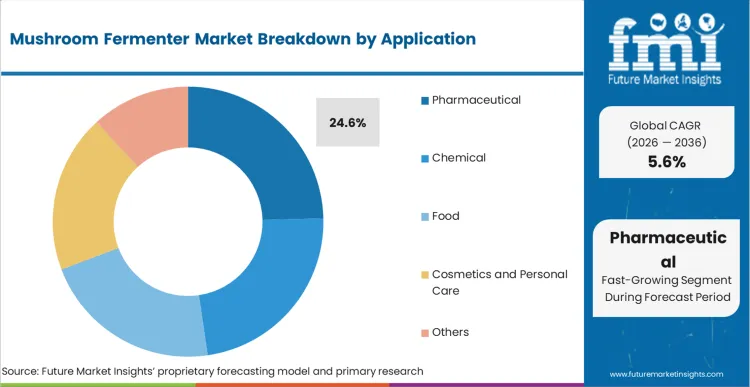
| Segment | Value Share (2026) |
|---|---|
| Pharmaceutical (By Application) | 24.6% |
Fermented mushrooms are one of the vital ingredients for developing life-saving medicines. They are well-known for several healthy benefits, including immune boosters and nutritional value. Rising awareness of the health benefits of mushrooms is pushing the demand for mushroom fermentation systems with scalable capacity.
Advanced technologies in fermentation methods improve production efficiency and product quality. The applicability of various mushrooms continues to grow across sectors, particularly in the pharmaceutical industry. There is a current interest in harnessing mushrooms for the production of antitumor agents and cardiovascular medicines.
Competitive Landscape of the Mushroom Fermenter Market
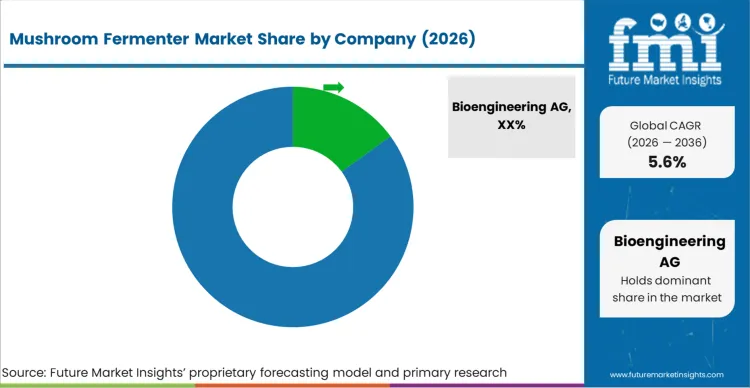
The key players in the mushroom fermenter market compete using different strategies regarding market development. Bioengineering AG, Eppendorf AG, and Sartorius AG have shifted their attention to heavy use of research and development for innovation in product offerings. They put emphasis on fermentation improvement using advanced bioreactor designs that maximize efficiency and yield. At the same time, they adjust their technologies to the rising market demand for high-quality mushroom products for a variety of applications, from food to pharmaceuticals and cosmetics. This competitive landscape is indicative of the trends reflected in the mushroom fermenter industry outlook.
Apart from that, many manufacturing firms have strategic acquisition and alliances in strengthening their market position. For example, DCI-Biolafitte has established improved capabilities for having acquired smaller companies with specialized know-how technologies, thus giving it an enhanced range of offerings. Infors AG, on the other hand, is teaming up with some research institutes to develop cutting-edge fermentation technologies that focus on specific market needs. A more recent application of such innovations is the new bioreactor systems with built-in automation for dynamic real-time condition monitoring optimization.
Top Mushroom Fermenter Brands by Market Share
- Bioengineering AG
- Eppendorf AG
- DCI-Biolafitte
- Sartorius AG
- Infors AG
- Yongxiang Machinery
- Hangzhou Huihe Equipment Co., Ltd.
- Applikon Biotechnology
- GS Bio
- Quanhe Fungi
- Others
Scope of the Report
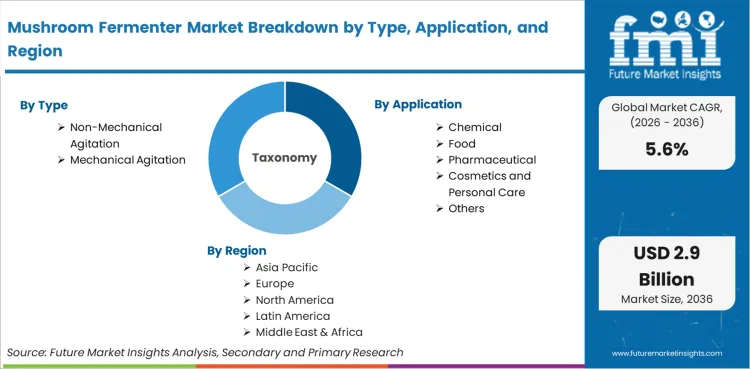
| Metric | Value |
|---|---|
| Quantitative Units | USD 1.69 Billion to USD 2.91 Billion, at a CAGR of 5.6% |
| Market Definition | The Mushroom Fermenter Market encompasses specialized bioreactor and fermentation vessel systems designed and optimized for submerged liquid-state cultivation of edible and medicinal mushroom mycelium, including Ganoderm... |
| Type Segmentation | Mechanical Agitation, Non-Mechanical Agitation |
| Application Segmentation | Pharmaceutical, Food, Chemical, Cosmetics and Personal Care, Others |
| Regions Covered | North America, Latin America, Europe, East Asia, South Asia, Oceania, Middle East & Africa |
| Countries Covered | India, China, USA, Germany, Japan, and 40 plus countries |
| Key Companies Profiled | Bioengineering AG, Eppendorf AG, DCI-Biolafitte, Sartorius AG, Infors AG, Yongxiang Machinery, Hangzhou Huihe Equipment Co. Ltd., Applikon Biotechnology |
| Forecast Period | 2026 to 2036 |
| Approach | Forecasting applies a bottom-up methodology building from installed bioreactor capacity metrics at pharmaceutical, food ingredient, and cosmetics mushroom fermentation operations, applying equipment replacement cycles, new facility installation rates, and upgrade investment assumptions to project fermenter unit and value demand trajectories. |
Top Segments Studied in the Mushroom Fermenter Market Research Report
By Type:
As per type, the industry has been categorized into Non-Mechanical Agitation and Mechanical Agitation.
By Application:
As per Application, the industry has been categorized into Chemical, Food, Pharmaceutical, Cosmetics and Personal Care, and Others.
By Region:
Industry analysis has been carried out in key countries of North America, Latin America, Europe, East Asia, South Asia, Oceania, and the Middle East & Africa.
Bibliography
- 1. Food and Agriculture Organization of the United Nations. (2024). Edible and medicinal mushrooms: production and market statistics. FAO.
- 2. European Medicines Agency. (2024). Guideline on process validation for finished products: fermentation-derived biologicals. EMA.
- 3. United States Food and Drug Administration. (2024). Guidance for industry: process validation for pharmaceutical manufacturing. FDA.
- 4. Ministry of Science and Technology India. (2024). Biotechnology sector investment and bioreactor infrastructure development. DST India.
- 5. International Society for Pharmaceutical Engineering. (2024). Single-use bioreactor technology and fermentation equipment standards. ISPE.
- This bibliography is provided for reader reference. The full FMI report contains the complete reference list with primary research documentation.
This bibliography is provided for reader reference and is not exhaustive. The full report contains the complete reference list and detailed citations.
Frequently Asked Questions
How large is the demand for Mushroom Fermenter Market in the global market in 2026?
Demand for mushroom fermenter market in the global market is estimated to be valued at USD 1.69 Billion in 2026.
What will be the market size of Mushroom Fermenter Market in the global market by 2036?
Market size for mushroom fermenter market is projected to reach USD 2.91 Billion by 2036.
What is the expected demand growth for Mushroom Fermenter Market between 2026 and 2036?
Demand for mushroom fermenter market is expected to grow at a CAGR of 5.6% between 2026 and 2036.
What is Mushroom Fermenter Market and what is it mainly used for?
The Mushroom Fermenter Market encompasses specialized bioreactor and fermentation vessel systems designed and optimized for submerged liquid-state cultivation of edible and medicinal mushroom mycelium, including Ganoderma lucidum, Lentinula edodes, Grifola frondosa, Cordyceps sinensis, and Pleurotus species, for pharmaceutical bioactive compound extraction, functional food ingredient production, cosmetic bioactive manufacturing, and chemical synthesis applications.
What is included in the scope of this Mushroom Fermenter Market report?
Market scope includes mechanical agitation stirred tank bioreactors, airlift fermenters, bubble column reactors, and hybrid agitation systems in laboratory, pilot, and industrial production scale configurations. Both stainless steel jacketed vessels for aseptic production and single-use bioreactor systems for research-scale mushroom fermentation are within scope. Integrated monitoring and control automation systems supplied as part of fermenter units are incorporated.
What is excluded from the scope of this report?
Solid-state fermentation trays, mushroom fruiting body substrate bags, and conventional growing house infrastructure for commercial mushroom production harvested as whole food products are excluded. General-purpose pharmaceutical bioreactors not specifically characterized or marketed for mushroom mycelium cultivation fall outside the defined market boundaries. Post-fermentation downstream processing equipment for extract purification is valued separately.
How does FMI build and validate the Mushroom Fermenter Market forecast?
Forecasting applies a bottom-up methodology building from installed bioreactor capacity metrics at pharmaceutical, food ingredient, and cosmetics mushroom fermentation operations, applying equipment replacement cycles, new facility installation rates, and upgrade investment assumptions to project fermenter unit and value demand trajectories.
Which Type leads the Mushroom Fermenter Market in 2026?
Mechanical agitation fermenters command 63.2% share in 2026, as stirred tank bioreactor configurations deliver superior oxygen mass transfer, temperature control precision, and scalability for high-density mushroom mycelium cultivation in pharmaceutical-grade extract production workflows.
Which Application dominates Mushroom Fermenter Market demand?
Pharmaceutical applications hold 24.6% share in 2026, driven by standardized mycelium bioactive compound extraction requirements for polysaccharide, triterpenoid, and beta-glucan pharmaceutical ingredient production that mandates controlled submerged fermentation processes.
What is driving demand in China?
China's 6.5% CAGR reflects the world's largest commercial mushroom industry transitioning from traditional solid-state growing methods to controlled submerged fermentation systems to achieve standardized bioactive content specifications demanded by export pharmaceutical and supplement markets.
Preview the report firsthand - request a free sample
Get SampleGet the brochure for pricing and purchase details.
Get PDFTable of Content
- Executive Summary
- Global Market Outlook
- Demand-side Trends
- Supply-side Trends
- Technology Roadmap Analysis
- Analysis and Recommendations
- Market Overview
- Market Coverage / Taxonomy
- Market Definition / Scope / Limitations
- Research Methodology
- Chapter Orientation
- Analytical Lens and Working Hypotheses
- Market Structure, Signals, and Trend Drivers
- Desk Research Programme (Secondary Evidence)
- Company Annual and Sustainability Reports
- Peer-reviewed Journals and Academic Literature
- Corporate Websites, Product Literature, and Technical Notes
- Earnings Decks and Investor Briefings
- Statutory Filings and Regulatory Disclosures
- Technical White Papers and Standards Notes
- Trade Journals, Industry Magazines, and Analyst Briefs
- Conference Proceedings, Webinars, and Seminar Materials
- Government Statistics Portals and Public Data Releases
- Press Releases and Reputable Media Coverage
- Specialist Newsletters and Curated Briefings
- Sector Databases and Reference Repositories
- FMI Internal Proprietary Databases and Historical Market Datasets
- Subscription Datasets and Paid Sources
- Social Channels, Communities, and Digital Listening Inputs
- Additional Desk Sources
- Expert Input and Fieldwork (Primary Evidence)
- Primary Modes
- Qualitative Interviews and Expert Elicitation
- Quantitative Surveys and Structured Data Capture
- Blended Approach
- Why Primary Evidence is Used
- Field Techniques
- Interviews
- Surveys
- Focus Groups
- Observational and In-context Research
- Social and Community Interactions
- Stakeholder Universe Engaged
- C-suite Leaders
- Board Members
- Presidents and Vice Presidents
- R&D and Innovation Heads
- Technical Specialists
- Domain Subject-matter Experts
- Scientists
- Physicians and Other Healthcare Professionals
- Governance, Ethics, and Data Stewardship
- Research Ethics
- Data Integrity and Handling
- Primary Modes
- Tooling, Models, and Reference Databases
- Data Engineering and Model Build
- Data Acquisition and Ingestion
- Cleaning, Normalisation, and Verification
- Synthesis, Triangulation, and Analysis
- Quality Assurance and Audit Trail
- Market Background
- Market Dynamics
- Drivers
- Restraints
- Opportunity
- Trends
- Scenario Forecast
- Demand in Optimistic Scenario
- Demand in Likely Scenario
- Demand in Conservative Scenario
- Opportunity Map Analysis
- Product Life Cycle Analysis
- Supply Chain Analysis
- Investment Feasibility Matrix
- Value Chain Analysis
- PESTLE and Porter’s Analysis
- Regulatory Landscape
- Regional Parent Market Outlook
- Production and Consumption Statistics
- Import and Export Statistics
- Market Dynamics
- Global Market Analysis 2021 to 2025 and Forecast, 2026 to 2036
- Historical Market Size Value (USD Million) Analysis, 2021 to 2025
- Current and Future Market Size Value (USD Million) Projections, 2026 to 2036
- Y-o-Y Growth Trend Analysis
- Absolute $ Opportunity Analysis
- Global Market Pricing Analysis 2021 to 2025 and Forecast 2026 to 2036
- Global Market Analysis 2021 to 2025 and Forecast 2026 to 2036, By Type
- Introduction / Key Findings
- Historical Market Size Value (USD Million) Analysis By Type , 2021 to 2025
- Current and Future Market Size Value (USD Million) Analysis and Forecast By Type , 2026 to 2036
- Mechanical Agitation
- Non-Mechanical Agitation
- Mechanical Agitation
- Y-o-Y Growth Trend Analysis By Type , 2021 to 2025
- Absolute $ Opportunity Analysis By Type , 2026 to 2036
- Global Market Analysis 2021 to 2025 and Forecast 2026 to 2036, By Application
- Introduction / Key Findings
- Historical Market Size Value (USD Million) Analysis By Application, 2021 to 2025
- Current and Future Market Size Value (USD Million) Analysis and Forecast By Application, 2026 to 2036
- Pharmaceutical
- Chemical
- Food
- Cosmetics and Personal Care
- Others
- Pharmaceutical
- Y-o-Y Growth Trend Analysis By Application, 2021 to 2025
- Absolute $ Opportunity Analysis By Application, 2026 to 2036
- Global Market Analysis 2021 to 2025 and Forecast 2026 to 2036, By Region
- Introduction
- Historical Market Size Value (USD Million) Analysis By Region, 2021 to 2025
- Current Market Size Value (USD Million) Analysis and Forecast By Region, 2026 to 2036
- North America
- Latin America
- Western Europe
- Eastern Europe
- East Asia
- South Asia and Pacific
- Middle East & Africa
- Market Attractiveness Analysis By Region
- North America Market Analysis 2021 to 2025 and Forecast 2026 to 2036, By Country
- Historical Market Size Value (USD Million) Trend Analysis By Market Taxonomy, 2021 to 2025
- Market Size Value (USD Million) Forecast By Market Taxonomy, 2026 to 2036
- By Country
- USA
- Canada
- Mexico
- By Type
- By Application
- By Country
- Market Attractiveness Analysis
- By Country
- By Type
- By Application
- Key Takeaways
- Latin America Market Analysis 2021 to 2025 and Forecast 2026 to 2036, By Country
- Historical Market Size Value (USD Million) Trend Analysis By Market Taxonomy, 2021 to 2025
- Market Size Value (USD Million) Forecast By Market Taxonomy, 2026 to 2036
- By Country
- Brazil
- Chile
- Rest of Latin America
- By Type
- By Application
- By Country
- Market Attractiveness Analysis
- By Country
- By Type
- By Application
- Key Takeaways
- Western Europe Market Analysis 2021 to 2025 and Forecast 2026 to 2036, By Country
- Historical Market Size Value (USD Million) Trend Analysis By Market Taxonomy, 2021 to 2025
- Market Size Value (USD Million) Forecast By Market Taxonomy, 2026 to 2036
- By Country
- Germany
- UK
- Italy
- Spain
- France
- Nordic
- BENELUX
- Rest of Western Europe
- By Type
- By Application
- By Country
- Market Attractiveness Analysis
- By Country
- By Type
- By Application
- Key Takeaways
- Eastern Europe Market Analysis 2021 to 2025 and Forecast 2026 to 2036, By Country
- Historical Market Size Value (USD Million) Trend Analysis By Market Taxonomy, 2021 to 2025
- Market Size Value (USD Million) Forecast By Market Taxonomy, 2026 to 2036
- By Country
- Russia
- Poland
- Hungary
- Balkan & Baltic
- Rest of Eastern Europe
- By Type
- By Application
- By Country
- Market Attractiveness Analysis
- By Country
- By Type
- By Application
- Key Takeaways
- East Asia Market Analysis 2021 to 2025 and Forecast 2026 to 2036, By Country
- Historical Market Size Value (USD Million) Trend Analysis By Market Taxonomy, 2021 to 2025
- Market Size Value (USD Million) Forecast By Market Taxonomy, 2026 to 2036
- By Country
- China
- Japan
- South Korea
- By Type
- By Application
- By Country
- Market Attractiveness Analysis
- By Country
- By Type
- By Application
- Key Takeaways
- South Asia and Pacific Market Analysis 2021 to 2025 and Forecast 2026 to 2036, By Country
- Historical Market Size Value (USD Million) Trend Analysis By Market Taxonomy, 2021 to 2025
- Market Size Value (USD Million) Forecast By Market Taxonomy, 2026 to 2036
- By Country
- India
- ASEAN
- Australia & New Zealand
- Rest of South Asia and Pacific
- By Type
- By Application
- By Country
- Market Attractiveness Analysis
- By Country
- By Type
- By Application
- Key Takeaways
- Middle East & Africa Market Analysis 2021 to 2025 and Forecast 2026 to 2036, By Country
- Historical Market Size Value (USD Million) Trend Analysis By Market Taxonomy, 2021 to 2025
- Market Size Value (USD Million) Forecast By Market Taxonomy, 2026 to 2036
- By Country
- Kingdom of Saudi Arabia
- Other GCC Countries
- Turkiye
- South Africa
- Other African Union
- Rest of Middle East & Africa
- By Type
- By Application
- By Country
- Market Attractiveness Analysis
- By Country
- By Type
- By Application
- Key Takeaways
- Key Countries Market Analysis
- USA
- Pricing Analysis
- Market Share Analysis, 2025
- By Type
- By Application
- Canada
- Pricing Analysis
- Market Share Analysis, 2025
- By Type
- By Application
- Mexico
- Pricing Analysis
- Market Share Analysis, 2025
- By Type
- By Application
- Brazil
- Pricing Analysis
- Market Share Analysis, 2025
- By Type
- By Application
- Chile
- Pricing Analysis
- Market Share Analysis, 2025
- By Type
- By Application
- Germany
- Pricing Analysis
- Market Share Analysis, 2025
- By Type
- By Application
- UK
- Pricing Analysis
- Market Share Analysis, 2025
- By Type
- By Application
- Italy
- Pricing Analysis
- Market Share Analysis, 2025
- By Type
- By Application
- Spain
- Pricing Analysis
- Market Share Analysis, 2025
- By Type
- By Application
- France
- Pricing Analysis
- Market Share Analysis, 2025
- By Type
- By Application
- India
- Pricing Analysis
- Market Share Analysis, 2025
- By Type
- By Application
- ASEAN
- Pricing Analysis
- Market Share Analysis, 2025
- By Type
- By Application
- Australia & New Zealand
- Pricing Analysis
- Market Share Analysis, 2025
- By Type
- By Application
- China
- Pricing Analysis
- Market Share Analysis, 2025
- By Type
- By Application
- Japan
- Pricing Analysis
- Market Share Analysis, 2025
- By Type
- By Application
- South Korea
- Pricing Analysis
- Market Share Analysis, 2025
- By Type
- By Application
- Russia
- Pricing Analysis
- Market Share Analysis, 2025
- By Type
- By Application
- Poland
- Pricing Analysis
- Market Share Analysis, 2025
- By Type
- By Application
- Hungary
- Pricing Analysis
- Market Share Analysis, 2025
- By Type
- By Application
- Kingdom of Saudi Arabia
- Pricing Analysis
- Market Share Analysis, 2025
- By Type
- By Application
- Turkiye
- Pricing Analysis
- Market Share Analysis, 2025
- By Type
- By Application
- South Africa
- Pricing Analysis
- Market Share Analysis, 2025
- By Type
- By Application
- USA
- Market Structure Analysis
- Competition Dashboard
- Competition Benchmarking
- Market Share Analysis of Top Players
- By Regional
- By Type
- By Application
- Competition Analysis
- Competition Deep Dive
- Bioengineering AG
- Overview
- Product Portfolio
- Profitability by Market Segments (Product/Age /Sales Channel/Region)
- Sales Footprint
- Strategy Overview
- Marketing Strategy
- Product Strategy
- Channel Strategy
- Eppendorf AG
- DCI-Biolafitte
- Sartorius AG
- Infors AG
- Yongxiang Machinery
- Hangzhou Huihe Equipment Co., Ltd.
- Applikon Biotechnology
- GS Bio
- Quanhe Fungi
- Others
- Bioengineering AG
- Competition Deep Dive
- Assumptions & Acronyms Used


