

- Market Size (2026)
- USD 11.0 Bn
- Forecast (2036)
- USD 16.0 Bn
- CAGR (2026 to 2036)
- 3.8%
Canned Mushroom Market Size, Market Forecast and Outlook By FMI
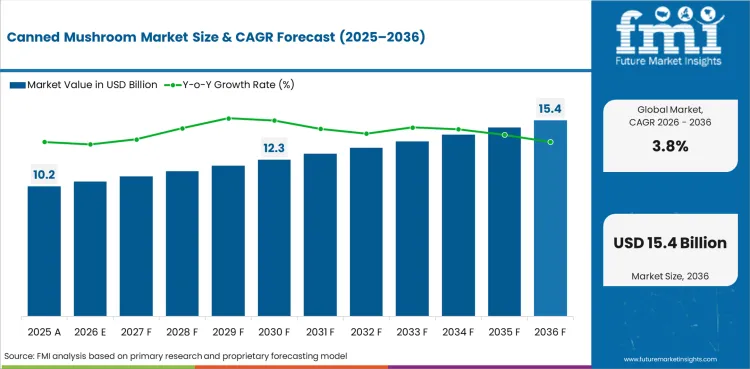
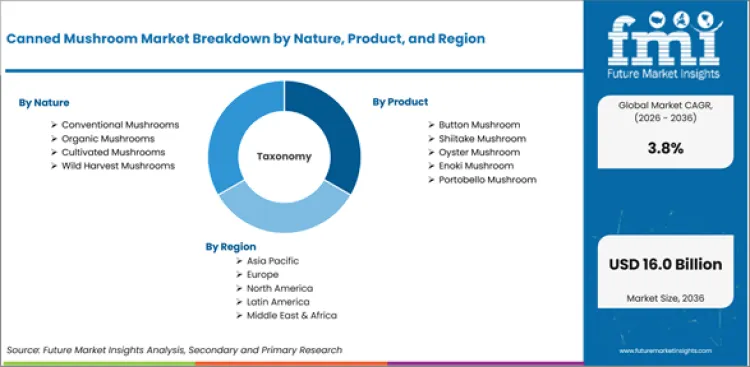
The canned mushroom market was valued at USD 10.6 billion in 2025. The market is set to reach USD 11.0 billion by 2026-end and grow at a CAGR of 3.8% between 2026-2036 to reach USD 16.0 billion by 2036. Conventional Mushrooms will dominate with a 49.0% share, while Button Mushroom will lead with a 52.0% share.
Key Takeaways, Market Size, and Forecast
- 2026 Market Size: USD 11 billion
- 2036 Market Size: USD 16 billion
- Compound Annual Growth Rate (CAGR): 3.8% from 2026 to 2036
- Absolute $ Opportunity: USD 5 billion between 2026 and 2036
- Leading Nature Segment: Conventional Mushrooms
- Conventional Mushrooms Share in 2026: 49%
- Fastest-growing Country: Brazil
- Brazil CAGR: 5.3% through 2036
| Parameter | Details |
|---|---|
| Market Size in 2026 (Value) | USD 11 billion |
| Market Forecast in 2036 (Value) | USD 16 billion |
| CAGR (2026 to 2036) | 3.8% |
| Years Considered | 2021 to 2036 |
| Base Year | 2025 |
| Forecast Period | 2026 to 2036 |
| Units Considered | Value (USD Bn) |
| Leading Sub-Region | Brazil |
Summary of the Canned Mushroom Market
- Demand and Growth Drivers
- Demand for canned mushrooms is expanding as food processing convenience, extended shelf life, and growing culinary application of mushrooms in plant-based and traditional dishes sustain procurement across retail, foodservice, and food manufacturing channels.
- Conventional mushrooms account for 49.0% of the nature segment in 2026, reflecting the dominance of standard cultivation button, cremini, and portobello mushrooms in canned food production for mass-market retail distribution.
- Foodservice procurement for pizza toppings, pasta sauces, soups, and prepared meal ingredients represents a significant demand channel alongside retail household consumption.
- Product and Segment View
- Conventional mushrooms hold 49.0% of the nature segment in 2026, with standard cultivation varieties serving mass-market retail and foodservice applications.
- Sliced and whole forms dominate, reflecting the primary culinary use occasions of pizza toppings, salad ingredients, and cooking preparation.
- Supermarkets and hypermarkets lead distribution, with canned mushrooms positioned in the shelf-stable vegetables section alongside other canned produce.
- Geography and Competitive Outlook
- Brazil leads at 5.3% CAGR, supported by growing urban food consumption, expanding modern retail distribution, and increasing adoption of convenience food products including canned vegetables in Brazilian household cooking.
- The USA at 4.1% reflects established canned vegetable consumption habits, foodservice pizza and pasta sauce manufacturing, and growing interest in mushroom-based functional food ingredients.
- Bonduelle Group holds a leading competitive position with comprehensive canned vegetable portfolios including mushroom products distributed through global retail and foodservice channels.
- Analyst Opinion
- Nandini Roy Choudhury, Principal Consultant at FMI says, 'Canned mushroom producers that can deliver consistent quality, expand organic and specialty mushroom varieties, and develop functional mushroom-enriched product lines are positioned to capture both traditional cooking demand and emerging health-food applications through 2036.'
- The canned mushroom market is benefiting from the broader mushroom category trend, where consumer interest in umami flavoring, plant-based protein, and functional mushroom health benefits is expanding culinary adoption.
- Adoption of organic and specialty mushroom varieties (shiitake, oyster, chanterelle) in canned format is increasing as consumers seek premium ingredients with extended shelf life for home cooking convenience.
- Demand is further supported by the growth of plant-based cooking where mushrooms serve as a meat texture substitute and umami flavor source in vegetarian and vegan meal preparation.
Canned Mushroom Market Definition
The canned mushroom market encompasses preserved mushroom products in metal cans, glass jars, and retort packaging for retail, foodservice, and food manufacturing applications. Products include whole, sliced, diced, and marinated mushroom preparations from conventional and organic cultivation of button, cremini, portobello, shiitake, oyster, and specialty mushroom varieties.
Canned Mushroom Market Inclusions
Market scope covers all commercially traded canned mushroom products categorized by nature, product, form, end use application, distribution channel, packaging, processing method. Revenue is tracked from 2026 to 2036.
Canned Mushroom Market Exclusions
The scope does not include fresh mushrooms sold without preservation, dried mushroom products, mushroom powder supplements, or frozen mushroom products.
Canned Mushroom Market Research Methodology
- Primary Research: FMI analysts conducted interviews with mushroom processors, canned food manufacturers, retail buyers, and foodservice ingredient distributors.
- Desk Research: Combined data from canned food industry associations, mushroom cultivation statistics, and retail scanner databases.
- Market Sizing and Forecasting: Bottom-up aggregation from canned mushroom production volumes, retail sales data, and foodservice procurement with regional consumption trend projections.
- Data Validation: Cross-checked quarterly against mushroom cultivation statistics, canned food production data, and import-export records.
Why is the Canned Mushroom Market Growing?
- Convenience food demand and extended shelf life advantages sustain canned mushroom procurement as consumers and foodservice operators value the ready-to-use format that eliminates washing, slicing, and spoilage concerns associated with fresh mushrooms.
- Brazil leads at 5.3% CAGR, supported by urbanization-driven convenience food adoption, expanding modern retail infrastructure, and growing household cooking use of canned vegetables.
The canned mushroom market is growing at 3.8% CAGR from 2026 to 2036, reflecting sustained demand from retail convenience, foodservice ingredient procurement, and food manufacturing. The market is projected to create an absolute opportunity of USD 5.0 billion between 2026 and 2036.
Conventional mushrooms dominate at 49.0%, with organic mushrooms gaining share as health-conscious consumers seek pesticide-free and certification-compliant products. Button mushrooms remain the highest-volume variety, while specialty mushrooms including shiitake, oyster, and chanterelle are growing in premium canned product lines.
Foodservice consumption accounts for a significant share through pizza restaurant toppings, Italian cuisine preparation, soup and sauce manufacturing, and prepared meal ingredient supply. Retail consumption centers on household cooking convenience, where canned mushrooms provide ready-to-use ingredients for pasta, stir-fry, omelet, and casserole preparation.
Market Segmentation Analysis
- Conventional mushrooms hold 49.0% of the nature segment, with button, cremini, and portobello varieties serving mass-market applications.
- Sliced and whole forms dominate, reflecting pizza topping, salad, and cooking preparation use occasions.
- Foodservice and food manufacturing represent significant demand alongside retail household consumption.
The canned mushroom market segments by nature, product, form, end use application, distribution channel, packaging, processing method. Conventional cultivation leads nature type. Button mushrooms dominate product type. Sliced format leads form. Supermarkets and foodservice are the primary distribution channels.
Insights into the Conventional Mushrooms Segment
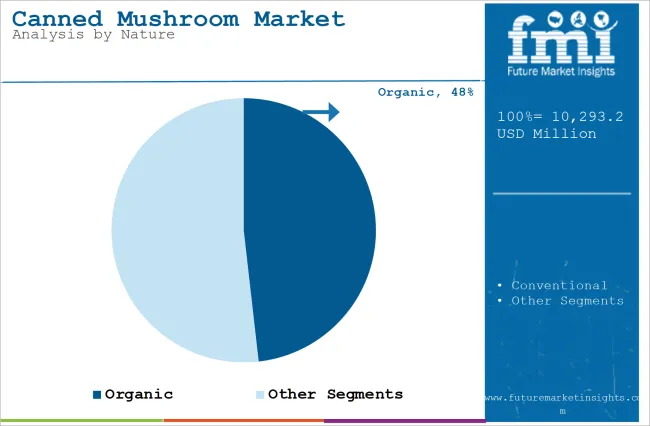
Conventional mushrooms hold 49.0% of the nature segment in 2026. Standard cultivation using composted substrates produces the majority of button, cremini, and portobello mushrooms processed for canning. Conventional production offers lower cost per unit, serving the price-sensitive mass-market retail and foodservice segments.
Organic mushrooms are the fastest-growing nature category as consumer demand for pesticide-free and certification-compliant products increases. Organic canned mushrooms command retail price premiums of 25 to 40 percent over conventional products, creating margin improvement opportunities for producers with certified organic cultivation capacity.
Insights into the Foodservice End Use Segment
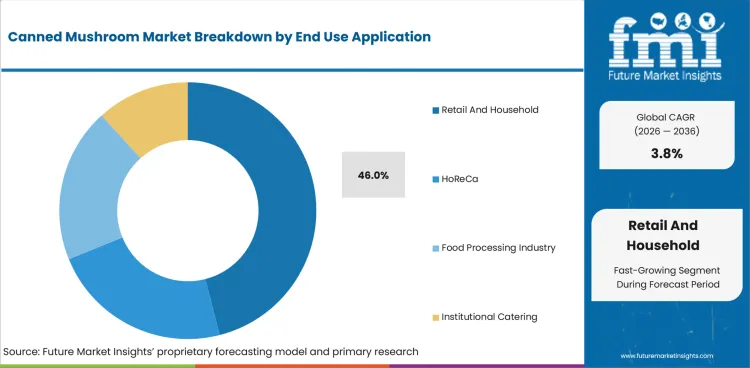
Foodservice represents a significant end use for canned mushrooms. Pizza restaurant chains consume large volumes of sliced mushrooms as standard toppings. Italian and Asian restaurant cooking uses canned mushrooms as convenient ingredients. Soup, sauce, and prepared meal manufacturing procures canned mushrooms as shelf-stable ingredient inputs.
Retail household consumption centers on cooking convenience. Canned mushrooms eliminate preparation time and extend shelf life compared to fresh alternatives. Growing interest in mushroom-based cooking and plant-based meal preparation is expanding household culinary use occasions.
Canned Mushroom Market Drivers, Restraints, and Opportunities
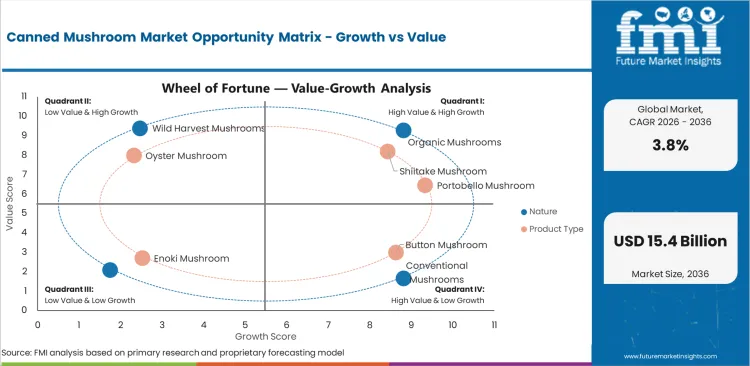
- Convenience and shelf stability sustain demand as canned mushrooms eliminate preparation time and spoilage risk compared to fresh alternatives.
- Competition from fresh mushrooms and frozen alternatives constrains canned mushroom growth in premium consumer segments where freshness perception influences purchase decisions.
- Organic and specialty mushroom varieties in canned format create growth opportunities in premium retail and health-food channels.
The canned mushroom market is shaped by convenience food demand, foodservice procurement, and mushroom category popularity growth. Growth is constrained by fresh and frozen alternatives, while opportunities exist in organic varieties, functional mushroom products, and emerging market retail expansion.
Convenience Food Demand
Demand is shaped by the convenience value of canned mushrooms that eliminate washing, slicing, and spoilage management. Ready-to-use format saves preparation time for household cooking and provides consistent quality for foodservice operations that require standardized ingredient supply.
Fresh and Frozen Competition
Growth is constrained by consumer preference for fresh mushrooms in premium cooking applications, where perceived freshness quality creates a product hierarchy favoring fresh over canned. Frozen mushroom products compete on convenience while offering texture characteristics closer to fresh products than canned alternatives.
Organic and Specialty Varieties
Adoption of organic and specialty mushroom varieties (shiitake, oyster, chanterelle) in canned format is increasing as consumers seek premium shelf-stable ingredients. These products command significant retail price premiums and serve health-conscious and gourmet cooking consumer segments.
Analysis of Canned Mushroom Market By Key Countries
.webp "Top Country Growth Comparison Canned Mushroom Market Cagr (2026 2036)")
| Country | CAGR |
|---|---|
| Brazil | 5.3% |
| USA | 4.1% |
| India | 3.5% |
| Japan | 3.1% |
| China | 2.4% |
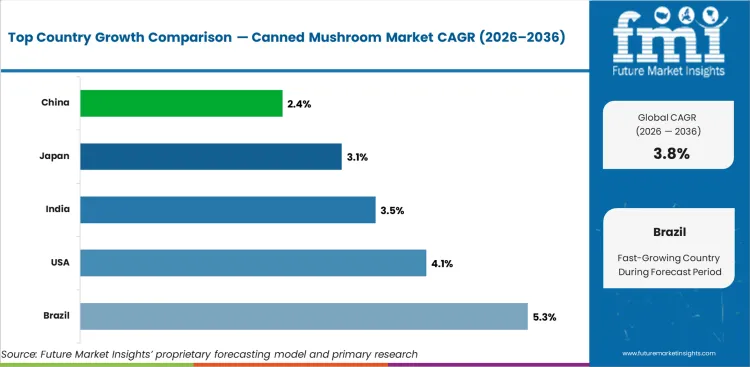
- Brazil leads at 5.3% CAGR, driven by urbanization, modern retail expansion, and growing convenience food adoption in household cooking.
- The USA at 4.1% reflects established canned vegetable habits, foodservice pizza and sauce manufacturing, and mushroom health trend interest.
- India at 3.5% shows growth from urbanization, organized retail expansion, and increasing mushroom awareness in Indian culinary applications.
The global canned mushroom market is projected to grow at 3.8% CAGR from 2026 to 2036. The study covers more than 30 countries, and the main markets are listed below.
Demand Outlook for Canned Mushroom Market in Brazil
Brazil leads at 5.3% CAGR through 2036. Growing urban food consumption, expanding modern retail infrastructure, and increasing adoption of convenience food products sustain demand. Brazilian consumers are adopting canned vegetables including mushrooms as modern retail shelf availability improves.
- Urbanization drives convenience food adoption as Brazilian consumers seek time-saving cooking ingredients.
- Modern retail expansion creates distribution infrastructure for canned mushroom products in Brazilian cities.
- Growing household cooking interest in Italian and Asian cuisines supports mushroom ingredient adoption.
Future Outlook for Canned Mushroom Market in the United States
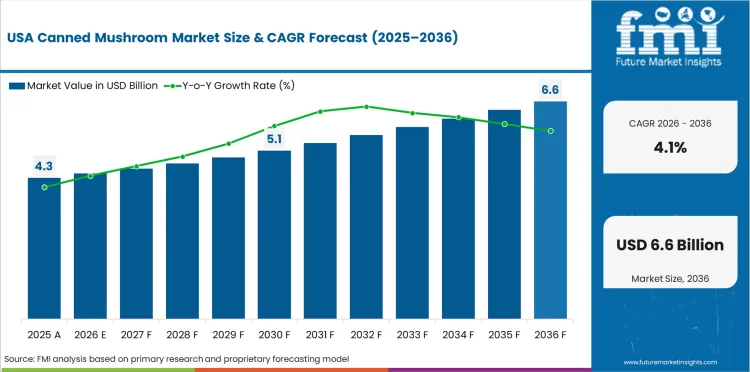
The US market grows at 4.1% CAGR through 2036. Established canned vegetable consumption, foodservice pizza and pasta sauce demand, and mushroom functional food trends sustain procurement.
- Established canned vegetable consumption habits sustain retail demand for mushrooms as a pantry staple.
- Foodservice pizza restaurant and sauce manufacturing create sustained B2B procurement for sliced mushrooms.
- Functional mushroom trend interest supports development of canned mushroom products with health-food positioning.
Opportunity Analysis for Canned Mushroom Market in India
India grows at 3.5% CAGR through 2036. Urbanization, expanding organized retail, and growing mushroom awareness in Indian cooking sustain demand. Indian urban consumers are adopting mushrooms as part of diversified vegetarian and non-vegetarian cooking.
- Urbanization and organized retail expansion create distribution infrastructure for canned mushroom products.
- Growing mushroom culinary awareness among Indian consumers supports adoption in vegetarian cooking applications.
- Food processing industry growth creates B2B demand for canned mushroom ingredients in prepared food manufacturing.
In-depth Analysis of Canned Mushroom Market in Japan
Japan grows at 3.1% CAGR through 2036. Established mushroom cuisine culture, quality-focused consumer preferences, and convenience food demand sustain procurement. Japanese canned mushroom consumption includes specialty varieties for traditional and contemporary cooking.
- Established mushroom cuisine culture sustains demand for canned mushroom products across traditional and modern cooking.
- Quality-focused consumer preferences favor premium canned mushroom products with consistent texture and flavor.
- Convenience food culture supports canned mushroom adoption as a ready-to-use ingredient in Japanese meal preparation.
Sales Analysis for Canned Mushroom Market in China
China grows at 2.4% CAGR through 2036. Large domestic mushroom cultivation capacity, established canned food consumption, and foodservice ingredient demand sustain the market. China is the largest mushroom producer globally, providing cost-competitive raw material supply for canning operations.
- Largest global mushroom production capacity provides cost-competitive raw material for domestic canning operations.
- Established canned food consumption in Chinese urban and rural households sustains retail demand.
- Foodservice and food manufacturing ingredient procurement supports commercial canned mushroom demand.
Competitive Landscape and Strategic Positioning
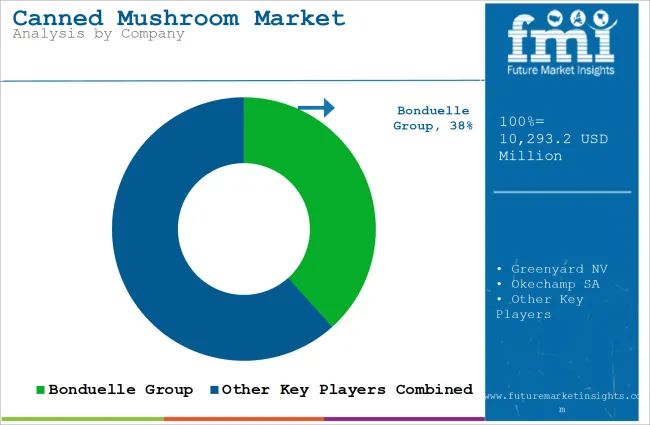
- Bonduelle Group leads with comprehensive canned vegetable portfolios including mushroom products distributed through global retail and foodservice channels.
- Greenyard NV and Giorgio Fresh Co. maintain strong positions in European and North American mushroom processing and canned product distribution.
- Monterey Mushrooms Inc. and Okechamp SA compete on cultivation-integrated canned mushroom production for retail and foodservice markets.
The competitive landscape spans multinational canned food companies and integrated mushroom cultivation-processing operations. Bonduelle leads with global canned vegetable distribution. Greenyard serves European retail. Giorgio Fresh and Monterey Mushrooms operate integrated cultivation and processing in North America.
Okechamp SA is a major Polish mushroom processor serving European markets. Prochamp B.V. provides processed mushroom products. The Mushroom Company and Costa Group serve Asia-Pacific markets. Competition centers on cultivation scale, processing quality, pricing, and distribution network access.
Entry barriers include mushroom cultivation infrastructure, canning facility investment, food safety certification, retail distribution access, and the price competitiveness required to compete with major integrated mushroom processors.
Key Companies in the Canned Mushroom Market
Key global companies leading the canned mushroom market include:
- Bonduelle Group (France), Greenyard NV (Belgium), and Giorgio Fresh Co. (USA) lead with large-scale canned mushroom production, global distribution, and established retail customer relationships.
- Monterey Mushrooms Inc. (USA) and Okechamp SA (Poland) hold strong positions with vertically integrated mushroom cultivation and processing operations.
- Prochamp B.V. (Netherlands), The Mushroom Company (Australia), and Costa Group Holdings (Australia) are gaining traction in European and Asia-Pacific canned mushroom supply.
Competitive Benchmarking: Canned Mushroom Market
| Company | Cultivation Scale | Processing | Distribution | Geographic Reach |
|---|---|---|---|---|
| Bonduelle Group | High | High | Global | Global |
| Greenyard NV | Medium | High | Europe | Europe |
| Giorgio Fresh Co. | High | High | North America | North America |
| Monterey Mushrooms | High | Medium | North America | North America |
| Okechamp SA | High | High | Europe | Europe |
| Prochamp B.V. | Medium | Medium | Europe | Europe |
| The Mushroom Company | Medium | Medium | Asia Pacific | Asia Pacific |
| Costa Group | Medium | Medium | Asia Pacific | Asia Pacific |
Source: Future Market Insights competitive analysis, 2026.
Key Developments in Canned Mushroom Market
- In 2025, Bonduelle Group expanded its organic canned mushroom range with shiitake and oyster mushroom varieties for European health-food retail markets.
- In 2025, Monterey Mushrooms Inc. introduced a line of seasoned and marinated canned mushrooms targeting US foodservice convenience and retail meal preparation.
Key Players in the Canned Mushroom Market
Major Global Players
- Bonduelle Group
- Greenyard NV
- Giorgio Fresh Co.
- Monterey Mushrooms Inc.
- Okechamp SA
Emerging Players/Startups
- Smallhold
- M2 Ingredients
- Mush Foods
Report Scope and Coverage
| Parameter | Details |
|---|---|
| Market size by 2036 | USD 16 billion |
| Growth rate | 3.8% CAGR (2026 to 2036) |
| Forecast period | 2026 to 2036 |
| Base year value (2025) | USD 10.6 billion |
| Key Segment Covered | Nature, Product, Form, End Use Application, Distribution Channel, Packaging, Processing Method |
| Regions covered | North America, Latin America, Western Europe, Eastern Europe, East Asia, South Asia and Pacific, Middle East and Africa |
| Countries covered | USA, Brazil, India, Japan, China, 30 plus countries |
| Key companies profiled | Bonduelle Group, Greenyard NV, Giorgio Fresh Co., Monterey Mushrooms Inc., Okechamp SA, Prochamp B.V., The Mushroom Company, Costa Group |
| Approach | Hybrid bottom-up and top-down methodology starting with verified transaction data, projecting adoption velocity across segments and regions. |
Market Segmentation Analysis
Canned Mushroom Market Segmented by Nature:
- Conventional Mushrooms
- Commercial Farm Production
- Mass Market Supply
- Private Label Production
- Standard Processed Mushrooms
- Retail Canned Products
- Foodservice Supply
- Commercial Farm Production
- Organic Mushrooms
- Certified Organic Mushrooms
- Premium Retail Products
- Health Focused Consumption
- Clean Label Mushrooms
- Natural Preservation
- Specialty Retail Distribution
- Certified Organic Mushrooms
- Cultivated Mushrooms
- Controlled Environment Farming
- High Yield Production
- Year Round Availability
- Industrial Mushroom Farming
- Contract Farming Supply
- Large Scale Processing
- Controlled Environment Farming
- Wild Harvest Mushrooms
- Forest Harvest Mushrooms
- Premium Gourmet Products
- Seasonal Mushroom Supply
- Exotic Wild Mushrooms
- Specialty Culinary Applications
- Luxury Foodservice Usage
- Forest Harvest Mushrooms
Canned Mushroom Market Segmented by Product:
- Button Mushroom
- White Button Mushroom
- Retail Consumption
- Foodservice Applications
- Brown Button Mushroom
- Premium Cooking Applications
- Processed Food Integration
- White Button Mushroom
- Shiitake Mushroom
- Dried Shiitake Processing
- Asian Cuisine Applications
- Soup Base Products
- Fresh Shiitake Canning
- Premium Gourmet Products
- Ready Meal Integration
- Dried Shiitake Processing
- Oyster Mushroom
- Gray Oyster Mushroom
- Foodservice Cooking
- Frozen Meal Usage
- King Oyster Mushroom
- Premium Culinary Applications
- High Protein Meals
- Gray Oyster Mushroom
- Enoki Mushroom
- Traditional Enoki
- Asian Ready Meals
- Soup Applications
- Premium Enoki Products
- Gourmet Retail Products
- Specialty Cuisine
- Traditional Enoki
- Portobello Mushroom
- Whole Portobello
- Grilling Applications
- Restaurant Usage
- Sliced Portobello
- Pizza Toppings
- Processed Food Manufacturing
- Whole Portobello
Canned Mushroom Market Segmented by Form:
- Whole Mushrooms
- Small Whole Mushrooms
- Retail Canning
- Ready Cooking Usage
- Large Whole Mushrooms
- Premium Foodservice
- Stuffed Mushroom Applications
- Small Whole Mushrooms
- Slices
- Thin Slices
- Pizza Applications
- Pasta Meal Integration
- Thick Slices
- Restaurant Cooking
- Frozen Meal Production
- Thin Slices
- Stems And Pieces
- Mixed Mushroom Cuts
- Soup Manufacturing
- Bulk Food Processing
- Industrial Mushroom Pieces
- Sauce Applications
- Institutional Catering
- Mixed Mushroom Cuts
- Diced Mushrooms
- Fine Diced Mushrooms
- Ready Meal Integration
- Stuffing Applications
- Chunk Diced Mushrooms
- Frozen Food Production
- Prepared Food Manufacturing
- Fine Diced Mushrooms
- Puree Mushrooms
- Concentrated Mushroom Puree
- Soup Base Manufacturing
- Sauce Production
- Seasoned Mushroom Puree
- Ready To Cook Meals
- Flavor Enhancement Applications
- Concentrated Mushroom Puree
Canned Mushroom Market Segmented by End Use Application:
- Retail And Household
- Home Cooking
- Daily Meal Preparation
- Convenience Cooking
- Ready Pantry Products
- Long Shelf Life Usage
- Bulk Household Purchases
- Home Cooking
- HoReCa
- Restaurants
- Pizza And Pasta Applications
- Gourmet Cuisine
- Hotels And Catering
- Buffet Meal Preparation
- Large Volume Usage
- Restaurants
- Food Processing Industry
- Frozen Food Manufacturing
- Ready Meal Production
- Packaged Food Applications
- Soup And Sauce Manufacturing
- Flavor Base Applications
- Industrial Ingredient Supply
- Frozen Food Manufacturing
- Institutional Catering
- Educational Institutions
- Bulk Meal Preparation
- Cost Efficient Catering
- Healthcare Catering
- Nutritional Meal Programs
- Large Scale Foodservice
- Educational Institutions
Canned Mushroom Market Segmented by Distribution Channel:
- Supermarkets And Hypermarkets
- Modern Trade Retail
- Mass Consumer Sales
- Private Label Distribution
- Premium Grocery Chains
- Organic Product Shelves
- Imported Mushroom Products
- Modern Trade Retail
- Online Sales Channel
- E Commerce Grocery
- Direct Consumer Delivery
- Subscription Grocery Sales
- Brand Owned Platforms
- Bulk Product Orders
- Premium Product Sales
- E Commerce Grocery
- Specialty Stores
- Organic Food Stores
- Health Focused Products
- Premium Mushroom Varieties
- Gourmet Food Stores
- Imported Mushroom Products
- Luxury Culinary Ingredients
- Organic Food Stores
- Convenience Stores
- Urban Convenience Retail
- Quick Purchase Products
- Single Unit Sales
- Travel Retail Stores
- Ready To Cook Products
- Compact Packaging Formats
- Urban Convenience Retail
Canned Mushroom Market Segmented by Packaging:
- Canned Metal Packaging
- Standard Tin Cans
- Mass Retail Distribution
- Long Shelf Life Storage
- Easy Open Cans
- Convenience Usage
- Foodservice Supply
- Standard Tin Cans
- Glass Jars
- Premium Glass Packaging
- Organic Mushroom Products
- Gourmet Retail Sales
- Reusable Glass Containers
- Premium Shelf Presentation
- Specialty Store Distribution
- Premium Glass Packaging
- Retort Pouches
- Flexible Pouch Packaging
- Lightweight Transportation
- Travel Friendly Products
- Stand Up Pouches
- Convenience Retail
- Ready To Cook Usage
- Flexible Pouch Packaging
- Vacuum Sealed Packs
- Modified Atmosphere Packs
- Freshness Preservation
- Premium Mushroom Products
- Bulk Vacuum Packaging
- Foodservice Supply
- Industrial Storage
- Modified Atmosphere Packs
Canned Mushroom Market Segmented by Processing Method:
- Sterilized Canning
- High Temperature Sterilization
- Extended Shelf Life
- Mass Market Products
- Commercial Sterilization
- Industrial Food Safety
- Export Grade Products
- High Temperature Sterilization
- Blanched And Packed
- Hot Water Blanching
- Texture Preservation
- Retail Consumption
- Steam Blanching
- Nutrient Retention
- Premium Mushroom Products
- Hot Water Blanching
- Marinated Processing
- Herb Marinated Mushrooms
- Gourmet Retail Products
- Restaurant Applications
- Spiced Mushroom Processing
- Ready To Eat Products
- Specialty Cuisine
- Herb Marinated Mushrooms
- Fresh Pack Preservation
- Low Processing Preservation
- Natural Flavor Retention
- Premium Retail Products
- Refrigerated Fresh Pack
- Short Shelf Life Products
- Specialty Foodservice
- Low Processing Preservation
Canned Mushroom Market by Region:
- North America
- USA
- Canada
- Mexico
- Latin America
- Brazil
- Chile
- Rest of Latin America
- Western Europe
- Germany
- UK
- Italy
- Spain
- France
- Nordic
- BENELUX
- Rest of Western Europe
- Eastern Europe
- Russia
- Poland
- Hungary
- Balkan & Baltic
- Rest of Eastern Europe
- East Asia
- China
- Japan
- South Korea
- South Asia and Pacific
- India
- ASEAN
- Australia & New Zealand
- Rest of South Asia and Pacific
- Middle East & Africa
- Kingdom of Saudi Arabia
- Other GCC Countries
- Türkiye
- South Africa
- Other African Union
- Rest of Middle East & Africa
Research Sources and Bibliography
- 1. Food and Agriculture Organization. (2025). FAO Global Mushroom Production and Trade Statistics. FAO.
- 2. European Commission. (2025). EU Food Safety Regulation: Canned Vegetable Processing Standards. EC.
- 3. USA Food and Drug Administration. (2025). FDA Canned Food Processing and Labeling Requirements. FDA.
- 4. International Society for Mushroom Science. (2025). ISMS Global Mushroom Industry Report. ISMS.
- 5. Bonduelle Group. (2025). Annual Report: Canned Vegetables Division Performance. Bonduelle.
This bibliography is provided for reader reference.
This Report Answers
- Estimating the size of the market and how much revenue it is projected to generate from 2026 to 2036.
- Segmentation by nature, product, form, end use application, distribution channel, packaging, processing method.
- Insights about more than 30 markets in the region.
- Analysis of mushroom types including button, cremini, portobello, shiitake, and oyster varieties.
- Assessment of the competitive landscape.
- Finding investment opportunities in retail, foodservice, food manufacturing, and organic specialty products.
- Keeping track of the supply chain.
- Delivery of data in PDF and Excel formats.
Frequently Asked Questions
How big is the canned mushroom market in 2026?
The global canned mushroom market is estimated to be valued at USD 11.0 billion in 2026.
What will be the size of the canned mushroom market in 2036?
The market size for the canned mushroom market is projected to reach USD 16.0 billion by 2036.
How much will the canned mushroom market growth be between 2026 and 2036?
The canned mushroom market is expected to grow at a 3.8% CAGR between 2026 and 2036.
What are the key natures in the canned mushroom market?
The key natures in the canned mushroom market are Conventional Mushrooms, Organic Mushrooms, Cultivated Mushrooms and Wild Harvest Mushrooms.
Which product segment is expected to contribute a significant share in the canned mushroom market in 2026?
In terms of product, the button mushroom segment is expected to command 52.0% share in the canned mushroom market in 2026.
Preview the report firsthand - request a free sample
Get SampleGet the brochure for pricing and purchase details.
Get PDFTable of Content
- Key Takeaways
- Market Size and CAGR
- Top Growth Driver
- Fastest Growing Segment
- Leading Region
- Key Companies
- Emerging Opportunities
- Executive Summary
- Global Market Outlook
- Demand-side Trends
- Supply-side Trends
- Technology Roadmap Analysis
- Analysis and Recommendations
- Analyst Perspective (What is happening? Why now? What should investors know?)
- Key Questions Answered
- How large is the market?
- What is the CAGR?
- What are key trends?
- Which region dominates?
- Who are the leaders?
- Market Overview
- Market Coverage / Taxonomy
- Market Definition / Scope / Limitations
- Research Methodology
- Chapter Orientation
- Analytical Lens and Working Hypotheses
- Market Structure, Signals, and Trend Drivers
- Benchmarking and Cross-market Comparability
- Market Sizing, Forecasting, and Opportunity Mapping
- Research Design and Evidence Framework
- Desk Research Programme (Secondary Evidence)
- Expert Input and Fieldwork (Primary Evidence)
- Tooling, Models, and Reference Databases
- Data Engineering and Model Build
- Quality Assurance and Audit Trail
- Market Background
- Market Dynamics (Drivers, Restraints, Opportunity, Trends)
- Scenario Forecast (Optimistic, Likely, Conservative)
- Impact Analysis
- AI Impact
- Sustainability Impact
- Regulatory Impact
- Technology Impact
- Consumer / Buyer Analysis
- Purchase Drivers
- Adoption Barriers
- Buyer Journey
- Opportunity Map Analysis
- Product Life Cycle Analysis
- Supply Chain Analysis
- Investment Feasibility Matrix
- Value Chain Analysis
- PESTLE and Porter's Analysis
- Regulatory Landscape
- Regional Parent Market Outlook
- Production and Consumption Statistics
- Import and Export Statistics
- Global Market Analysis and Forecast, 2021 to 2036
- Historical Market Size Value (USD Million) Analysis, 2021 to 2025
- Current and Future Market Size Value (USD Million) Projections, 2026 to 2036
- Y-o-Y Growth Trend Analysis
- Absolute $ Opportunity Analysis
- Global Market Pricing Analysis, 2021 to 2036
- Global Market Analysis and Forecast, By Nature, 2021 to 2036
- Introduction / Key Findings
- Historical Market Size Value (USD Million) Analysis By Nature, 2021 to 2025
- Current and Future Market Size Value (USD Million) Analysis and Forecast By Nature, 2026 to 2036
- Conventional Mushrooms
- Commercial Farm Production
- Standard Processed Mushrooms
- Organic Mushrooms
- Certified Organic Mushrooms
- Clean Label Mushrooms
- Cultivated Mushrooms
- Controlled Environment Farming
- Industrial Mushroom Farming
- Wild Harvest Mushrooms
- Forest Harvest Mushrooms
- Exotic Wild Mushrooms
- Conventional Mushrooms
- Y-o-Y Growth Trend Analysis By Nature, 2021 to 2025
- Absolute $ Opportunity Analysis By Nature, 2026 to 2036
- Global Market Analysis and Forecast, By Product, 2021 to 2036
- Introduction / Key Findings
- Historical Market Size Value (USD Million) Analysis By Product, 2021 to 2025
- Current and Future Market Size Value (USD Million) Analysis and Forecast By Product, 2026 to 2036
- Button Mushroom
- White Button Mushroom
- Brown Button Mushroom
- Shiitake Mushroom
- Dried Shiitake Processing
- Fresh Shiitake Canning
- Oyster Mushroom
- Gray Oyster Mushroom
- King Oyster Mushroom
- Enoki Mushroom
- Traditional Enoki
- Premium Enoki Products
- Portobello Mushroom
- Whole Portobello
- Sliced Portobello
- Button Mushroom
- Y-o-Y Growth Trend Analysis By Product, 2021 to 2025
- Absolute $ Opportunity Analysis By Product, 2026 to 2036
- Global Market Analysis and Forecast, By Form, 2021 to 2036
- Introduction / Key Findings
- Historical Market Size Value (USD Million) Analysis By Form, 2021 to 2025
- Current and Future Market Size Value (USD Million) Analysis and Forecast By Form, 2026 to 2036
- Whole Mushrooms
- Small Whole Mushrooms
- Large Whole Mushrooms
- Slices
- Thin Slices
- Thick Slices
- Stems And Pieces
- Mixed Mushroom Cuts
- Industrial Mushroom Pieces
- Diced Mushrooms
- Fine Diced Mushrooms
- Chunk Diced Mushrooms
- Puree Mushrooms
- Concentrated Mushroom Puree
- Seasoned Mushroom Puree
- Whole Mushrooms
- Y-o-Y Growth Trend Analysis By Form, 2021 to 2025
- Absolute $ Opportunity Analysis By Form, 2026 to 2036
- Global Market Analysis and Forecast, By End Use Application, 2021 to 2036
- Introduction / Key Findings
- Historical Market Size Value (USD Million) Analysis By End Use Application, 2021 to 2025
- Current and Future Market Size Value (USD Million) Analysis and Forecast By End Use Application, 2026 to 2036
- Retail And Household
- Home Cooking
- Ready Pantry Products
- HoReCa
- Restaurants
- Hotels And Catering
- Food Processing Industry
- Frozen Food Manufacturing
- Soup And Sauce Manufacturing
- Institutional Catering
- Educational Institutions
- Healthcare Catering
- Retail And Household
- Y-o-Y Growth Trend Analysis By End Use Application, 2021 to 2025
- Absolute $ Opportunity Analysis By End Use Application, 2026 to 2036
- Global Market Analysis and Forecast, By Distribution Channel, 2021 to 2036
- Introduction / Key Findings
- Historical Market Size Value (USD Million) Analysis By Distribution Channel, 2021 to 2025
- Current and Future Market Size Value (USD Million) Analysis and Forecast By Distribution Channel, 2026 to 2036
- Supermarkets And Hypermarkets
- Modern Trade Retail
- Premium Grocery Chains
- Online Sales Channel
- E Commerce Grocery
- Brand Owned Platforms
- Specialty Stores
- Organic Food Stores
- Gourmet Food Stores
- Convenience Stores
- Urban Convenience Retail
- Travel Retail Stores
- Supermarkets And Hypermarkets
- Y-o-Y Growth Trend Analysis By Distribution Channel, 2021 to 2025
- Absolute $ Opportunity Analysis By Distribution Channel, 2026 to 2036
- Global Market Analysis and Forecast, By Packaging
- Introduction / Key Findings
- Historical Market Size Value (USD Million) Analysis By Packaging, 2021 to 2025
- Current and Future Market Size Value (USD Million) Analysis and Forecast By Packaging, 2026 to 2036
- Canned Metal Packaging
- Standard Tin Cans
- Easy Open Cans
- Glass Jars
- Premium Glass Packaging
- Reusable Glass Containers
- Retort Pouches
- Flexible Pouch Packaging
- Stand Up Pouches
- Vacuum Sealed Packs
- Modified Atmosphere Packs
- Bulk Vacuum Packaging
- Canned Metal Packaging
- Y-o-Y Growth Trend Analysis By Packaging, 2021 to 2025
- Absolute $ Opportunity Analysis By Packaging, 2026 to 2036
- Global Market Analysis and Forecast, By Processing Method
- Introduction / Key Findings
- Historical Market Size Value (USD Million) Analysis By Processing Method, 2021 to 2025
- Current and Future Market Size Value (USD Million) Analysis and Forecast By Processing Method, 2026 to 2036
- Sterilized Canning
- High Temperature Sterilization
- Commercial Sterilization
- Blanched And Packed
- Hot Water Blanching
- Steam Blanching
- Marinated Processing
- Herb Marinated Mushrooms
- Spiced Mushroom Processing
- Fresh Pack Preservation
- Low Processing Preservation
- Refrigerated Fresh Pack
- Sterilized Canning
- Y-o-Y Growth Trend Analysis By Processing Method, 2021 to 2025
- Absolute $ Opportunity Analysis By Processing Method, 2026 to 2036
- Global Market Analysis and Forecast, By Region, 2021 to 2036
- Introduction
- Historical Market Size Value (USD Million) Analysis By Region, 2021 to 2025
- Current Market Size Value (USD Million) Analysis and Forecast By Region, 2026 to 2036
- North America
- Latin America
- Western Europe
- Eastern Europe
- East Asia
- South Asia and Pacific
- Middle East & Africa
- Market Attractiveness Analysis By Region
- North America Market Analysis and Forecast, By Country, 2021 to 2036
- Historical Market Size Value (USD Million) Trend Analysis By Market Taxonomy, 2021 to 2025
- Market Size Value (USD Million) Forecast By Market Taxonomy, 2026 to 2036
- By Country
- USA
- Canada
- Mexico
- By Nature
- By Product
- By Form
- By End Use Application
- By Distribution Channel
- By Packaging
- By Processing Method
- By Country
- Market Attractiveness Analysis
- By Country
- By Nature
- By Product
- By Form
- By End Use Application
- By Distribution Channel
- By Packaging
- By Processing Method
- Key Takeaways
- Latin America Market Analysis and Forecast, By Country
- Historical Market Size Value (USD Million) Trend Analysis By Market Taxonomy, 2021 to 2025
- Market Size Value (USD Million) Forecast By Market Taxonomy, 2026 to 2036
- By Country
- Brazil
- Chile
- Rest of Latin America
- By Nature
- By Product
- By Form
- By End Use Application
- By Distribution Channel
- By Packaging
- By Processing Method
- By Country
- Market Attractiveness Analysis
- By Country
- By Nature
- By Product
- By Form
- By End Use Application
- By Distribution Channel
- By Packaging
- By Processing Method
- Key Takeaways
- Western Europe Market Analysis and Forecast, By Country
- Historical Market Size Value (USD Million) Trend Analysis By Market Taxonomy, 2021 to 2025
- Market Size Value (USD Million) Forecast By Market Taxonomy, 2026 to 2036
- By Country
- Germany
- UK
- Italy
- Spain
- France
- Nordic
- BENELUX
- Rest of Western Europe
- By Nature
- By Product
- By Form
- By End Use Application
- By Distribution Channel
- By Packaging
- By Processing Method
- By Country
- Market Attractiveness Analysis
- By Country
- By Nature
- By Product
- By Form
- By End Use Application
- By Distribution Channel
- By Packaging
- By Processing Method
- Key Takeaways
- Eastern Europe Market Analysis and Forecast, By Country
- Historical Market Size Value (USD Million) Trend Analysis By Market Taxonomy, 2021 to 2025
- Market Size Value (USD Million) Forecast By Market Taxonomy, 2026 to 2036
- By Country
- Russia
- Poland
- Hungary
- Balkan & Baltic
- Rest of Eastern Europe
- By Nature
- By Product
- By Form
- By End Use Application
- By Distribution Channel
- By Packaging
- By Processing Method
- By Country
- Market Attractiveness Analysis
- By Country
- By Nature
- By Product
- By Form
- By End Use Application
- By Distribution Channel
- By Packaging
- By Processing Method
- Key Takeaways
- East Asia Market Analysis and Forecast, By Country
- Historical Market Size Value (USD Million) Trend Analysis By Market Taxonomy, 2021 to 2025
- Market Size Value (USD Million) Forecast By Market Taxonomy, 2026 to 2036
- By Country
- China
- Japan
- South Korea
- By Nature
- By Product
- By Form
- By End Use Application
- By Distribution Channel
- By Packaging
- By Processing Method
- By Country
- Market Attractiveness Analysis
- By Country
- By Nature
- By Product
- By Form
- By End Use Application
- By Distribution Channel
- By Packaging
- By Processing Method
- Key Takeaways
- South Asia and Pacific Market Analysis and Forecast, By Country
- Historical Market Size Value (USD Million) Trend Analysis By Market Taxonomy, 2021 to 2025
- Market Size Value (USD Million) Forecast By Market Taxonomy, 2026 to 2036
- By Country
- India
- ASEAN
- Australia & New Zealand
- Rest of South Asia and Pacific
- By Nature
- By Product
- By Form
- By End Use Application
- By Distribution Channel
- By Packaging
- By Processing Method
- By Country
- Market Attractiveness Analysis
- By Country
- By Nature
- By Product
- By Form
- By End Use Application
- By Distribution Channel
- By Packaging
- By Processing Method
- Key Takeaways
- Middle East & Africa Market Analysis and Forecast, By Country
- Historical Market Size Value (USD Million) Trend Analysis By Market Taxonomy, 2021 to 2025
- Market Size Value (USD Million) Forecast By Market Taxonomy, 2026 to 2036
- By Country
- Kingdom of Saudi Arabia
- Other GCC Countries
- Türkiye
- South Africa
- Other African Union
- Rest of Middle East & Africa
- By Nature
- By Product
- By Form
- By End Use Application
- By Distribution Channel
- By Packaging
- By Processing Method
- By Country
- Market Attractiveness Analysis
- By Country
- By Nature
- By Product
- By Form
- By End Use Application
- By Distribution Channel
- By Packaging
- By Processing Method
- Key Takeaways
- Key Countries Market Analysis
- USA
- Pricing Analysis
- Market Share Analysis, 2025
- By Nature
- By Product
- By Form
- By End Use Application
- By Distribution Channel
- By Packaging
- By Processing Method
- Canada
- Pricing Analysis
- Market Share Analysis, 2025
- By Nature
- By Product
- By Form
- By End Use Application
- By Distribution Channel
- By Packaging
- By Processing Method
- Mexico
- Pricing Analysis
- Market Share Analysis, 2025
- By Nature
- By Product
- By Form
- By End Use Application
- By Distribution Channel
- By Packaging
- By Processing Method
- Brazil
- Pricing Analysis
- Market Share Analysis, 2025
- By Nature
- By Product
- By Form
- By End Use Application
- By Distribution Channel
- By Packaging
- By Processing Method
- Chile
- Pricing Analysis
- Market Share Analysis, 2025
- By Nature
- By Product
- By Form
- By End Use Application
- By Distribution Channel
- By Packaging
- By Processing Method
- Germany
- Pricing Analysis
- Market Share Analysis, 2025
- By Nature
- By Product
- By Form
- By End Use Application
- By Distribution Channel
- By Packaging
- By Processing Method
- UK
- Pricing Analysis
- Market Share Analysis, 2025
- By Nature
- By Product
- By Form
- By End Use Application
- By Distribution Channel
- By Packaging
- By Processing Method
- Italy
- Pricing Analysis
- Market Share Analysis, 2025
- By Nature
- By Product
- By Form
- By End Use Application
- By Distribution Channel
- By Packaging
- By Processing Method
- Spain
- Pricing Analysis
- Market Share Analysis, 2025
- By Nature
- By Product
- By Form
- By End Use Application
- By Distribution Channel
- By Packaging
- By Processing Method
- France
- Pricing Analysis
- Market Share Analysis, 2025
- By Nature
- By Product
- By Form
- By End Use Application
- By Distribution Channel
- By Packaging
- By Processing Method
- India
- Pricing Analysis
- Market Share Analysis, 2025
- By Nature
- By Product
- By Form
- By End Use Application
- By Distribution Channel
- By Packaging
- By Processing Method
- ASEAN
- Pricing Analysis
- Market Share Analysis, 2025
- By Nature
- By Product
- By Form
- By End Use Application
- By Distribution Channel
- By Packaging
- By Processing Method
- Australia & New Zealand
- Pricing Analysis
- Market Share Analysis, 2025
- By Nature
- By Product
- By Form
- By End Use Application
- By Distribution Channel
- By Packaging
- By Processing Method
- China
- Pricing Analysis
- Market Share Analysis, 2025
- By Nature
- By Product
- By Form
- By End Use Application
- By Distribution Channel
- By Packaging
- By Processing Method
- Japan
- Pricing Analysis
- Market Share Analysis, 2025
- By Nature
- By Product
- By Form
- By End Use Application
- By Distribution Channel
- By Packaging
- By Processing Method
- South Korea
- Pricing Analysis
- Market Share Analysis, 2025
- By Nature
- By Product
- By Form
- By End Use Application
- By Distribution Channel
- By Packaging
- By Processing Method
- Russia
- Pricing Analysis
- Market Share Analysis, 2025
- By Nature
- By Product
- By Form
- By End Use Application
- By Distribution Channel
- By Packaging
- By Processing Method
- Poland
- Pricing Analysis
- Market Share Analysis, 2025
- By Nature
- By Product
- By Form
- By End Use Application
- By Distribution Channel
- By Packaging
- By Processing Method
- Hungary
- Pricing Analysis
- Market Share Analysis, 2025
- By Nature
- By Product
- By Form
- By End Use Application
- By Distribution Channel
- By Packaging
- By Processing Method
- Kingdom of Saudi Arabia
- Pricing Analysis
- Market Share Analysis, 2025
- By Nature
- By Product
- By Form
- By End Use Application
- By Distribution Channel
- By Packaging
- By Processing Method
- Türkiye
- Pricing Analysis
- Market Share Analysis, 2025
- By Nature
- By Product
- By Form
- By End Use Application
- By Distribution Channel
- By Packaging
- By Processing Method
- South Africa
- Pricing Analysis
- Market Share Analysis, 2025
- By Nature
- By Product
- By Form
- By End Use Application
- By Distribution Channel
- By Packaging
- By Processing Method
- USA
- Market Structure Analysis
- Competition Dashboard
- Competition Benchmarking
- Market Share Analysis of Top Players
- By Regional
- By Nature
- By Product
- By Form
- By End Use Application
- By Distribution Channel
- By Packaging
- By Processing Method
- Emerging Startups
- Innovation Benchmarking
- Competition Analysis
- Competition Deep Dive
- Bonduelle Group
- Overview
- Product Portfolio
- Profitability by Market Segments (Product/Region/Sales Channel)
- Sales Footprint
- Strategy Overview
- Marketing Strategy
- Product Strategy
- Channel Strategy
- Greenyard NV
- Okechamp SA
- Giorgio Fresh Co.
- Monterey Mushrooms Inc.
- Prochamp B.V.
- The Mushroom Company
- Costa Group Holdings
- Lutèce B.V.
- Green Giant (B&G Foods)
- Others
- Bonduelle Group
- Case Studies
- Success Stories
- Recent Developments
- Competition Deep Dive
- Assumptions & Acronyms Used


